Archive for April 15, 2015

EXCLUSIVE: Iranian Parliament Releases “Factsheet” for Revision of Lausanne Statement

April 15, 2015

EXCLUSIVE: Iranian Parliament Releases “Factsheet” for Revision of Lausanne Statement, FARS News Agency (Iranian), April 15, 2015

(Note: all bold print and italics are in the original. Iran now insists on a five year term for an agreement and the immediate lifting of all sanctions, among other things. — DM)
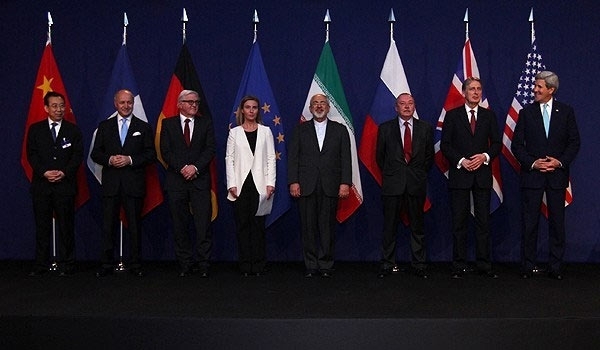
13940114000003_PhotoI
TEHRAN (FNA)- The Iranian parliament’s Nuclear Committee on Wednesday released a factsheet to declare the revisions needed to be made in the Lausanne statement that was issued by Tehran and the world powers as a framework understanding at the end of their nuclear talks in Switzerland earlier this month.

The factsheet which was presented by Head of the Nuclear Committee Ebrahim Karkhaneyee on Wednesday stresses the necessity for respecting the redlines and guidelines specified by Supreme Leader of the Islamic Revolution Ayatollah Seyed Ali Khamenei, making Iran’s decisions and undertakings reversible to enable the country to resume its nuclear operations in case of the other side’s non-commitment to its undertakings, and immediate termination of all sanctions in a single step and on the first day of the implementation of the final agreement.

The factsheet also necessitates commitment of both sides to their undertakings based on the Geneva agreement, a fair and reasonable balance between the gives and takes, taking good care not to impair the country’s security and military boundaries and national interests, providing 190,000 SWUs (Separative Work Units) of nuclear fuel enrichment capability needed by Iran to produce fuel for the Bushehr nuclear power plant immediately after the end of contract with Russia, safeguarding the nuclear achievements, actual operation of all nuclear facilities of Iran not in words, but in action, continued Research and Development (R&D) works and scientific and technological progress in Iran and immediate application of R&D findings in the country’s industrial-scale uranium enrichment cycle.

The factsheet urges operation of 10,000 centrifuge machines at Natanz and Fordo, a maximum 5-year-long duration for the deal and for Iran’s nuclear limitations, replacement of the current centrifuges with the latest generation of home-made centrifuge machines at the end of the five-year period.

Enrichment Program:

The period for the Join Comprehensive Plan of Action (JCPOA) should be limited to five years, in which about 10,000 active centrifuges operating at Natanz and Fordo now will continue nuclear fuel production by enriching uranium  below the 5% grade.

The UF6 enriched reserves which are under the supervision of the International Atomic Energy Agency (IAEA) should be kept at Fordo nuclear plant and will be turned into nuclear fuel complex based on the existing capabilities.

During the five-year period, the Islamic Republic of Iran will continue to keep the excess centrifuges installed at Natanz and Fordo or will gradually dismantle them, and at the end of the 5-year period, it will replace all the existing centrifuges, including the active or inactive ones, with the new generation of (IR-N) centrifuge machines with the help of the new spaces and infrastructures which will have been already prepared and will use them without any limitation.

Justification:

Based on the Geneva agreement, the period for the final step should merely include a single period which has been considered as to be five years in the present factsheet. But in the Lausanne statement, different periods of 10, 20, 25 years and higher have been considered.

Given the Geneva agreement, the amount of enrichment should be specified based on the country’s practical needs and the number of 10,000 centrifuges has also been specified on this basis.

The 5-year period in this factsheet has been has been specified with respect to the date when Iran’s nuclear fuel contract with Russia for the Bushehr nuclear power plant will end; hence, the rules and limitations for the components of the enrichment cycle should be set in such a way that the Islamic Republic of Iran will be able to supply the fuel needed for the power plant after the end of the contract with Russia.

Operation of 10,000 centrifuges and developing and having a 10-ton enriched uranium stockpile will enable the Islamic Republic of Iran to supply the fuel needed for the Bushehr power plant in the year when the fuel supply contract with Russia (28-30 tons) ends.

Fordo installations:

Fordo nuclear facility will remain an enrichment and nuclear Research and Development (R&D) center. 4 enrichment cascades with 656 centrifuges will continue operation and production of fuel for purity levels lower than 5% by maintaining the current chain arrangements.

If the country would need 20%-degree (enriched) uranium, the nuclear fuel production line for purity levels lower than 5% will be altered to enrich uranium to the 20%-grade after connecting the centrifuge cascades to each other again.

Justification:

Based on the above, Fordo will remain an actual and active center, and the Islamic Republic of Iran will maintain its capability to reverse its decision and restore the 20%-grade enrichment.

Research and Development (R&D):

In a bid to use R&D findings in the country’s industrial-scale enrichment chain, R&D should be planned in a way that the necessary possibilities and infrastructures will be provided for replacing the first generation of centrifuges with the latest generation of centrifuge machines (IR-N) when the Joint Comprehensive Plan of Action comes to an end after 5 years.

The R&D program should undergo no limitation before it comes into use for industrial-scale operation.

Justification:

Accordingly, the advanced centrifuges will enter the chain of nuclear fuel production without any restriction at the end of the 5-year deal.

Arak Heavy Water Reactor:

Given the Group 5+1 countries’ mere concern about the plutonium existing in the spent nuclear fuel (SNF) of the Arak 40-MW heavy water reactor, the fuel used by the reactor will be sent abroad.

The G5+1 states will be committed to cooperate and take the necessary measures for relevant international licensing and permissions.

Justification:

Given the SNF export abroad, the insistence of the G5+1, specially the US, on redesigning the said reactor is merely a pretext and doesn’t have any scientific rationale.

What is more important than the heavy water nature of Arak reactor is the core of the reactor which is due to be taken out and then be redesigned and renovated. Such a move is irreversible in nature, and thus means crossing the specified redlines.

Supervision and Inspection:

Supervision and inspections of the Islamic Republic of Iran’s nuclear program should be carried out within the framework of the the Non-Proliferation Treaty (NPT) safeguards agreements.

Justification:

Once done, the principle stated by the Supreme Leader of the Islamic Revolution – that security and military sanctities and boundaries shouldn’t be violated and that the inspections should be carried out at conventional levels similar to all other countries – will be respected and materialized. Given the Islamic Republic of Iran’s opposition to the world arrogance, endorsing and implementing the Additional Protocol will provide the world arrogance (a term normally used for the US and its western allies) with legal grounds to stage their preplanned plots against the Islamic Republic of Iran.

Sanctions:

Concurrently with the start of the JCPOA, all the US and EU sanctions will be terminated and Iran will start fulfilling its undertakings based on the verification of the IAEA.

The UN Security Council sanctions resolution against Iran will be annulled and all nuclear-related sanctions will be terminated and the Islamic Republic of Iran’s case will be normalized.

The G5+1 countries, the EU and the UNSC will avoid imposition of new nuclear-related sanctions against Iran.

Justification:

By terminating all sanctions in a single step right at the start of the implementation of the final comprehensive agreement, the Supreme Leader’s statement that termination of sanctions is part of the agreement and not its result will be materialized.

Based on the Geneva agreement, after the implementation of the JCPOA, all UNSC, US and EU sanctions should be terminated and no new (UNSC) resolution would be needed in this regard; Hence, terminating the UNSC sanctions will close the case and no new resolution which would pave the ground for new plots will be issued.

International cooperation:

The Islamic Republic of Iran’s nuclear cooperation with the world states, including the G5+1 members, in areas of building nuclear power plants, research reactors, nuclear fuel production, nuclear safety medicine and nuclear agriculture, etc. will be possible and will improve. Based on the JCPOA, Iran will be provided with access to the global market, trade and finance and technical know-how and energy.

Reversibility:

In case of the two sides’ non-commitment to their undertakings, there will be a possibility for reversing all measures.

Justification:

Based on the aforementioned proposal, the Islamic Republic of Iran will be provided with reversible measures at the lowest level of damage and, therefore, the G5+1’s commitment to its undertakings will be in fair balance (with those of Iran).

Duration of the JCPOA:

After the end of the five-year period and the JCPOA exercise, all restrictions will be lifted and based on the Geneva agreement, the case with the Islamic Republic of Iran’s nuclear program will be similar to that of the other NPT member states.

The Iranian Parliament factsheet for a revision to the Lausanne agreement came after the US released a factsheet different from the joint statement issued by Iran’s Foreign Minister Mohammad Javad Zarif and Federica Mogherini, the High Representative of the European Union for Foreign Affairs and head of the G5+1 in nuclear talks with Iran, at the end of the latest round of Iran-world powers nuclear talks in Switzerland on April 2, known as the Lausanne statement.

The US factsheet that was released only a few hours after the Lausanne framework understanding caused fury in Iran, encouraging many to raise deep doubt about the results of the talks and US accountability and trustworthiness.

In only a few weeks, a bipartisan bill was also presented to the Congress for vote that would give the US legislature oversight of a final deal, a move seen by many across the globe, including both Iran and the US, as furthering impediments to the endorsement of a final deal between Iran and the sextet.

Senate Foreign Relations Committee Chairman Senator Bob Corker, who wrote the bill, said the White House had agreed to go along with the bill only after it was clear there was strong Democratic support. The legislation was passed unanimously by the committee and is expected to pass the full Senate and then the House of Representatives.

“That change occurred only when they saw how many senators were going to vote for this,” Corker said.

Bipartisan support for the bill had grown in recent weeks to near the 67 votes needed to override any presidential veto. But senators from Obama’s Democratic Party did succeed in adding amendments to water down the bill, making it more palatable to the White House.

Congress defeats WH on Iran. Bob Corker- New bi-partisan hero on hill

April 15, 2015

Congress defeats WH on Iran. Bob Corker- New bi-partisan hero on hill – YouTube.

David Ignatius:  “WH leaves Kerry looking like ‘beached whale”

Congress will now have a say in the U.S.-Iran nuclear deal after a unanimous vote Tuesday in the Senate Foreign Relations Committee. The Morning Joe panel discusses the vote.

Israel approves of the bill as passed.


Obama’s One-Man Nuclear Deal – WSJ

April 15, 2015

Obama’s One-Man Nuclear Deal – WSJ.

Congress will get a vote but the President still has a free hand.

President Obama says he wants Congress to play a role in approving a nuclear deal with Iran, but his every action suggests the opposite. After months of resistance, the White House said Tuesday the President would finally sign a bill requiring a Senate vote on any deal—and why not since it still gives him nearly a free hand.

Modern Presidents have typically sought a Congressional majority vote, and usually a two-thirds majority, to ratify a major nuclear agreement. Mr. Obama has maneuvered to make Congress irrelevant, though bipartisan majorities passed the economic sanctions that even he now concedes drove Iran to the negotiating table.

The Republican Congress has been trying to reclaim a modest role in foreign affairs over Mr. Obama’s furious resistance. And on Tuesday afternoon the Senate Foreign Relations Committee unanimously passed a measure that authorizes Congress to vote on an Iran deal within 30 days of Mr. Obama submitting it for review.

Opinion Journal Video

Baker & Hostetler Partner David Rivkin on the Senate Foreign Relation Committee’s attempt to reassert influence over President Obama’s nuclear deal with Iran. Photo credit: Associate Press.

As late as Tuesday morning, Secretary of State John Kerry was still railing in private against the bill. But the White House finally conceded when passage with a veto-proof majority seemed inevitable. The bill will now pass easily on the floor, and if Mr. Obama’s follows his form, he will soon talk about the bill as if it was his idea.

Mr. Obama can still do whatever he wants on Iran as long as he maintains Democratic support. A majority could offer a resolution of disapproval, but that could be filibustered by Democrats and vetoed by the President. As few as 41 Senate Democrats could thus vote to prevent it from ever getting to President Obama’s desk—and 34 could sustain a veto. Mr. Obama could then declare that Congress had its say and “approved” the Iran deal even if a majority in the House and Senate voted to oppose it.

Foreign Relations Chairman Bob Corker deserves credit for trying, but in the end he had to agree to Democratic changes watering down the measure if he wanted 67 votes to override an Obama veto. Twice the Tennessee Republican delayed a vote in deference to Democrats, though his bill merely requires a vote after the negotiations are over.

His latest concessions shorten the review period to 30 days, which Mr. Obama wanted, perhaps to mollify the mullahs in Tehran who want sanctions lifted immediately. After 52 days Mr. Obama could unilaterally ease sanctions without Congressional approval. Mr. Obama has said that under the “framework” accord sanctions relief is intended to be gradual. But don’t be surprised if his final concession to Ayatollah Khamenei is to lift sanctions after 52 days.

Mr. Corker also removed a requirement that the Administration certify to Congress that Iran is no longer supporting terrorism. This sends an especially bad signal to Iran that Congress agrees with Mr. Obama that the nuclear deal is divorced from its behavior as a rogue state. One of Mr. Obama’s least plausible justifications for the nuclear deal is that it would help to make Iran a “normal” nation. But if Tehran is still sponsoring terrorism around the world, how can it be trusted as a nuclear partner?

***

Our own view of all this is closer to that of Wisconsin Senator Ron Johnson, who spoke for (but didn’t offer) an amendment in committee Tuesday to require that Mr. Obama submit the Iran nuclear deal as a treaty. Under the Constitution, ratification would require an affirmative vote by two-thirds of the Senate.

Committing the U.S. to a deal of this magnitude—concerning proliferation of the world’s most destructive weapons—should require treaty ratification. Previous Presidents from JFK to Nixon to Reagan and George H.W. Bush submitted nuclear pacts as treaties. Even Mr. Obama submitted the U.S.-Russian New Start accord as a treaty.

The Founders required two-thirds approval on treaties because they wanted major national commitments overseas to have a national political consensus. Mr. Obama should want the same kind of consensus on Iran.

But instead he is giving more authority over American commitments to the United Nations than to the U.S. Congress. By making the accord an executive agreement as opposed to a treaty, and perhaps relying on a filibuster or veto to overcome Congressional opposition, he’s turning the deal into a one-man presidential compact with Iran. This will make it vulnerable to being rejected by the next President, as some of the GOP candidates are already promising.

The case for the Corker bill is that at least it guarantees some debate and a vote in Congress on an Iran deal. Mr. Obama can probably do what he wants anyway, but the Iranians are on notice that the United States isn’t run by a single Supreme Leader.

A Reckless Act in the Senate on Iran

April 15, 2015

A Reckless Act in the Senate on Iran, New York Times, The Editorial Board, April 14, 2015

(Consider the source. — DM)

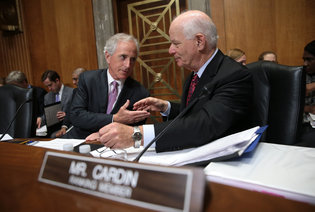
15wed1Web-master315Senators Bob Corker, left, and Ben Cardin, the leaders of the Senate Foreign Relations Committee. Credit Win McNamee/Getty Images

Congress has formally muscled its way into President Obama’s negotiations with Iran, creating new and potentially dangerous uncertainties for an agreement that offers the best chance of restraining that country’s nuclear program.

With a unanimous vote on Tuesday, the Senate Foreign Relations Committee approved a bill that would require Congress to review, and then vote on, the final text of a nuclear deal. It would also prohibit Mr. Obama from waiving economic sanctions on Iran — the crucial element of any agreement under which Iran rolls back its nuclear program — for at least 30 days, and up to 52 days, after signing an agreement so Congress has time to weigh in.

The full Senate and the House will have to approve the bill. But the committee’s action gives momentum to those who have bitterly criticized Mr. Obama for negotiating with Iran, though they offer no credible alternative to the preliminary deal on the table. Republicans who control Congress have largely been the driving force behind the legislation, but this bill was passed overwhelmingly by the Senate committee thanks to Democratic support.

Mr. Obama initially threatened to veto the legislation, but he backed off rather than face a bipartisan override of his veto. The administration did get some compromises. The review period was shortened, and language making the lifting of sanctions dependent on Iran ending support for terrorism was softened.

Mr. Obama’s acquiescence might be a tactical move. He could veto the congressional vote on the final agreement, which is supposed to be concluded by the June 30 deadline, rather than expending political capital in vetoing this measure if it were to pass both chambers of Congress. But the Senate committee’s action puts him in an weakened position as the only leader involved in the negotiations who may not be permitted to fully honor commitments that were made.

The nuclear deal is the product of a multinational negotiation with Iran conducted by the United States, France, Britain, China, Germany and Russia. In no other country has a legislative body demanded the right to block the agreement. Even if Congress barred Mr. Obama from waiving American sanctions, the European Union and the United Nations Security Council could lift the sanctions they imposed, thus undercutting the American decision.

Report: Hamas Using Heavy Machinery to Re-Dig Terror Tunnels

April 15, 2015

Report: Hamas Using Heavy Machinery to Re-Dig Terror Tunnels, Israel National News, Tova Dvorin, April 15, 2015

(From whom are they getting the heavy machinery, how is it being transported and from where to where? — DM)

Less than one year after Operation Protective Edge in Gaza fizzled out, Hamas is already building new terror tunnels under Israel.

But while the evidence that terror activity has resumed has been lingering for months, sources now say that the terror group has taken the digging to the next level.

Hamas has switched from manual slave labor to machinery to dig terror tunnels under Israel, Palestinian Arab sources revealed to Walla! News Wednesday.

The group is using a Bagger 288, a German-produced mining machine known as a bucket-wheel excavator.

A damning letter emerged from Gaza in August 2014 from a Palestinian Arab who was forced to dig terror tunnels after he accepted a cryptic joboffer from Hamas; the group plucked him from his home in a truck and forced him down into a tunnel. At least 160 Palestinian Arab children have also died digging terror tunnels, the same report revealed.

Unlike workers working by hand, however, the Bagger can dig far faster and burrow into smaller spaces, the sources revealed.

In addition, bulldozers can clearly be seen from the Israeli side of the border doing at least part of the digging and cleanup; Hamas is using a mixture of cement (when available) and wooden boards for the construction.

Senior security sources confirmed the report, adding that Hamas’s true aim is to dig the tunnels at high speed and that they are focusing on producing short-range rockets and mortars – which are more difficult for the Iron Dome Missile Defense System to shoot down.

Exclusive: Moscow has no S-300 air defense missiles available for Iran. Replacements under discussion

April 15, 2015

Exclusive: Moscow has no S-300 air defense missiles available for Iran. Replacements under discussion, DEBKAfile, April 15, 2015

Although Tehran celebrated President Vladimir Putin’s decision to release the S-300 missiles withheld from Iran for five years by an arms embargo, DEBKAfile reports exclusively that Iran can’t hope to take delivery of the advanced air defense systems in the foreseeable future. The Russian military industry is already way behind meeting demands for more S-300 missiles and their radar systems for the Russian army, which has none to spare for Iran. Its own needs have soared since Russia fell out with US and Europe over the Ukraine conflict.

The Russian army lately moved S-300 batteries, which are capable of downing fighter jets and missiles, to the country’s southern border with Ukraine, as air cover for the pro-Russian separatists against Ukrainian air bombardment, which has since petered out.

Additional batteries are deployed at Russian sea and air bases on the Black Sea and Crimean Peninsula.

A further batch of S-300 missiles, as well as the S-400 from the same family, has been positioned in the Russian strategic enclave of Kaliningrad on the Baltic Sea, Moscow’s forward military position against Europe.

In response to US plans to install a missile shield network in East and West European countries belonging to  NATO, the Russians advanced into Kaliningrad a number of short-range ballistic K720 Iskander (NATO-named SS-26 Stone9) missiles capable of carrying nuclear warheads.

The S-300 missile batteries are in place to defend them.

DEBKAfile’s military sources also disclose that, after five years of training one Iranian team after another in the operation of the S-300 systems, the Russians have given up on their acquiring the necessary skills.

Tehran and Moscow have still to decide, after eight years of debating, which particular missile system best suits Iran’s needs out of the S-300 family of weapons, each of whose basic six categories is designed for a particular task. Those categories employ seven types of missile, which too break down into 16-sub-types, including the S-400.

In an attempt to reach a decision, our intelligence sources in Moscow report that Iran’s National Security chief Ali Shankhani, who is currently visiting Moscow, has settled on an Iranian military delegation making an early trip to Russia, viewing the various S-300 models and returning home with recommendations. Tehran will then make its choice.

This process too could stretch out over many months. Moscow may not see eye to eye with Tehran on the type of missile to be supplied, a difficulty that would entail a fresh round of negotiations.

Given all these circumstances, it is hard to see Iran taking delivery of the first S-300 missiles any time this year, as it had hoped.
A

ll the same, although the entire transaction is in the air, the US and Israel made big play of protesting the Kremlin’s decision to end its embargo on the S-300s for Iran. When Secretary of State John Kerry talked about it to Foreign Minister Sergei Lavrov Monday, and Prime Minister Binyamin Netanyahu  phoned President Putin Tuesday, both were perfectly aware that the batteries wold not be making their way to Tehran any time in the near future.

Obama Hid North Korea Rocket Component Transfer to Iran

April 15, 2015

Obama Hid North Korea Rocket Component Transfer to Iran, Israel National News, Ari Yashar, April 15, 2015

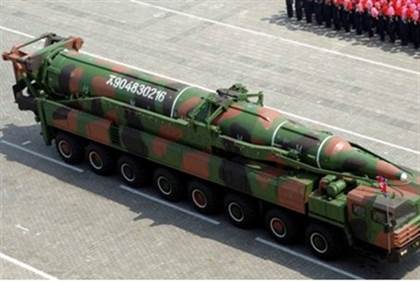
NK missileA North Korean rocket in a military parade (file)Reuters

The information is particularly damaging given that Admiral Bill Gortney, Commander of North American Aerospace Defense Command (NORAD) and US Northern Command (USNORTHCOM), admitted this month that the Pentagon fears that North Korea and possibly Iran can target the US with a nuclear EMP strike.

********************

US intelligence officials revealed that during the ongoing Iran nuclear negotiations, North Korea has provided several shipments of advanced missile components to the Islamic regime in violation of UN sanctions – and the US hid the violations from the UN.

The officials, who spoke to the Washington Free Beacon on Wednesday on condition of anonymity, said more than two shipments of missile parts since last September have been monitored by the US going from North Korea to Iran.

One official detailed that the components included large diameter engines, which could be used to build a long-range missile system, potentially capable of bearing a nuclear warhead.

The information is particularly damaging given that Admiral Bill Gortney, Commander of North American Aerospace Defense Command (NORAD) and US Northern Command (USNORTHCOM), admitted this month that the Pentagon fears that North Korea and possibly Iran can target the US with a nuclear EMP strike.

Critics have pointed out that the nuclear framework deal reached with Iran earlier this month completely avoids this question of Iran’s intercontinental ballistic missile (ICBM) program, which would allow it to conduct nuclear strikes.

US President Barack Obama was given details of the shipments in his daily intelligence briefings, but the officials say the information was hiddenfrom the UN by the White House so that it would not take action on the sanctions violations.

Back in 2010, the UN Security Council put sanctions on Iran’s illegal uranium enrichment program. Those sanctions prohibit Iran from buying ballistic missile parts, and any “technology related to ballistic missiles capable of delivering nuclear weapons.”

The US officials said the recent transfers fall within the scope of the sanctions.

In confirmation, a spokesperson for Spain’s mission to the UN, now in charge of the UN’s sanctions committee, said the committee has not been told about the incidents by the US since Spain took over in January.

White House and State Department spokespersons contacted by the paper refused to comment on the report.

Hiding transfers from the UN – “typical” Obama

A wave of experts came out with criticism against Obama’s administration for hiding the missile part transfer from the UN.

Former UN Ambassador John Bolton said the shipments violate UN sanctions on Iran, as well as those imposed on North Korea back in 2009.

“If the violation was suppressed within the U.S. government, it would be only too typical of decades of practice,” Bolton said. “Sadly, it would also foreshadow how hard it would be to get honest reports made public once Iran starts violating any deal.”

Former CIA analyst Fred Fleitz shared his assessment, saying “while it may seem outrageous that the Obama administration would look the other way on missile shipments from North Korea to Iran during the Iran nuclear talks, it doesn’t surprise me at all.”

“Iran’s ballistic missile program has been deliberately left out of the talks even though these missiles are being developed as nuclear weapon delivery systems,” noted Fleitz. “Since the administration has overlooked this long list of belligerent and illegal Iranian behavior during the Iran talks, it’s no surprise it ignored missile shipments to Iran from North Korea.”

The mounting criticism was added to by Thomas Moore, a former Senate Foreign Relations Committee arms control specialist, who told Washington Free Beacon that the transfer “certainly points out the glaring omission present in the Iran deal: the total lack of anything on its missile threat.”

“If true, allowing proliferation with no response other than to lead from behind or reward it, let alone bury information about it, is to defeat the object and purpose of the global nonproliferation regime – the only regime Obama may end up changing in favor of those in Tehran, Havana and Pyongyang,” Moore said.

And Henry Sokolski, head of the Nonproliferation Policy Education Center, said the missile transfer “more than suggests why the administration had to back away from securing any ballistic missile limits in its negotiations” with Iran.

Exposing the Iran-North Korea missile partnership

The Washington Free Beacon went into detail about the relationship between North Korea and Iran in building the latter’s advanced missile program, which is poised to construct ICBMs capable of delivering a strike with a nuclear warhead at astounding distances.

A classified State Department cable from October 2009 that was exposed by Wikileaks details that Iran is the leading missile customer of North Korean.

It stated how since the 1980s North Korea has been handing Scud missiles and technology for developing Nodong missiles with a 620-mile range to Iran.

“Pyongyang’s assistance to Iran’s [space launch vehicle] program suggests that North Korea and Iran may also be cooperating on the development of long-range ballistic missiles,” read the cable.

Another cable from September 2009 posited that the steering engines in Iran’s Safir rocket likely come from North Korea, and are based on Soviet-era SS-N-6 submarine launched ballistic missiles.

Importantly, that transfer of technology let Iran develop a self-igniting missile propellant that “could significantly enhance Tehran’s ability to develop a new generation of more-advanced ballistic missiles.”

“All of these technologies, demonstrated in the Safir [space launch vehicle] are critical to the development of long-range ballistic missiles and highlight the possibility of Iran using the Safir as a platform to further its ballistic missile development,” read the cable.

The assessments of the classified cables were confirmed by Joseph DeTrani, former director of the US intelligence agency National Counterproliferation Center, who said North Korea has kept “close and long term” relations with Iran in transferring missiles and related technology.

“U.N. Security Council resolutions prohibit this type of activity, and continued missile-related transfers from North Korea to Iran would be in violation of these Security Council resolutions,” added DeTrani, a former CIA officer and special envoy to North Korea nuclear talks.

Obama caves on Corker-Menendez

April 15, 2015

Obama caves on Corker-Menendez, Power Line, Scott Johnson, April 14, 2015

(It’s not a great bill but may be enough to scuttle the “deal.” Might Obama have decided that his and Iran’s talking points about the “deal” are too far apart, that there will be no agreement and that he would prefer to put the blame on the Congress rather than on his negotiating team or Iran? — DM)


[T]he Obama administration flipped this afternoon, just before the markup started, and withdrew its veto threat. Josh Earnest disclosed the move to reporters at today’s White House briefing. In retrospect this was probably just simple math. After the Corker-Cardin compromise, a Senate Democratic staffer told the New York Times that a veto-proof majority was now assured. McCarthy had already told reporters that he had the votes he needed in the House to sustain a veto. Someone in the White House seems to have counted to 67 and 290, and made the call.

*****************

We’ve been following the political action following the arrangement in process with Iran mostly via the email reports of Omri Ceren. Today he mailed two reports on the Corker-Menendez bill, which passed unanimously out of the Senate Foreign Relations Committee this afternoon. In the second of the two messages below, Omri reports that the White House has backed off its veto threat in light of its impending loss on this matter. Some readers may want to skip to the second of these two messages.

These messages are not brief, but I think they summarize the information necessary to understand developments in this most consequential matter. Here is Omri’s first message, sent this morning.

Happy Markup Day.

The Senate Foreign Relations Committee takes up Corker-Menendez at 2:15pm today, and it looks like the session will go quickly. The NYT, Reuters, CNN, etc. are reporting that Corker and Cardin came to an agreement on language earlier today, and the NYT quoted a senior Democratic aide saying that the changes mean the bill will “now have overwhelming, veto-proof support.”Reuters has more details on what the final provisions – which call for Congressional approval of any Iran deal – will probably look like.

I’ll send around whatever gets finalized this afternoon, but it looks like this is locked and everyone has their lines. Opponents from the left will say the vote damaged hopes for a deal. Supporters will respond that any deal that can’t stand up to Congressional scrutiny isn’t worth having. Opponents from the right will say the bill actually undermines Congressional prerogatives because it requires a supermajority to block a deal. Supporters will respond that any bipartisan compromise legislation capable of mustering a veto-proof majority is going to be imperfect.

All of which will get lost in what’s sure to be the broader takeaway: Congress looked at what came out of Lausanne and they didn’t like it. Then they got briefed by the administration – and they liked it even less. This is their way of sending a message to the President about the need to make any deal stronger, and this is their way of mobilizing pressure to make sure their message gets through.

The question is what exactly they didn’t like. On that point, I wanted to make sure you had the report on the Lausanne announcement published this weekend by David Albright’s Institute for Science and International Security (ISIS), which has been making the rounds on the Hill. ISIS is widely considered one of the most credible shops on Iran proliferation, if not flat out the most credible. But because their paper is so brutal – it’s tersely titled “P5+1/Iran Framework: Needs Strengthening” – Albright and his team had to open by reminding people of that: “no outside group has worked as much as ours on generating recommended provisions for this deal, identifying missing pieces, and assessing the strengths and weaknesses of proposed provisions… consistently we have been met with gratitude and positive feedback from negotiators in several countries about our contributions.”

Then there’s a brief bright spot for the administration – ISIS assesses that Iran’s concessions on the Arak heavy water reactor are adequate – before things get very bad on every other issue. The whole paper is 13 pages, it gets wonkish at times, and there’s no way a summary could be adequate. There are sections like the one on breakout times, where the authors are in disbelief that the administration refuses to include Iran’s 20% enriched uranium in breakout calculations, which just have to be slogged through.

But one useful way to wrap your mind around the paper – and this gets back to the conversation on the Hill – is that it’s a catalog of how the concessions made to Iran at Lausanne detonated the possibility of a good deal. In order to get even the contested announcement that came out, the Americans had to cave diplomatically on a variety of issues. The ISIS paper, in part, now describes the consequences of those concessions. It’s not written that way – it’s just a policy paper that goes issue by issue – but it can be usefully read like that to see how the political and policy debates are interacting. Remember how the news unfolded during Lausanne:

Wednesday 25th — the Wall Street Journal revealed that Iran will be allowed to put off making a full disclosure of its nuclear activities until after sanctions relief — now the ISIS assessment on disclosure: “Negotiators must not agree to lift UNSC sanctions before the IAEA has reached its broader conclusion about the peaceful nature of Iran’s program, including determining the extent of past progress on Iran’s military nuclear program and dismantling any remaining efforts… Unless this facet of Iran’s nuclear program is dealt with, no agreement should be made. It is a deal component that negotiators would ignore at the peril of regional security and peace.”

Thursday 26h — the Associated Press revealed that Iran will be allowed to continue spinning centrifuges in its underground military bunker at Fordow — now the ISIS assessment on Fordow: “A surprise in the Framework is the proposed continuation of the Fordow enrichment plant… If bans on producing near 20 percent LEU also sunset at year 15 (see above), this heavily fortified plant would be capable of producing enough weapon-grade uranium for a nuclear weapon within a few weeks, or enough WGU for two weapons in less than a month.”

Monday 29th — the New York Times revealed that Iran will not be forced to ship its enriched uranium beyond its borders — now the ISIS assessment on stockpiles: “How will this material be disposed of so that the limit is not exceeded?… accumulations of more than 500 kilograms of 3.5 percent LEU above the 300 kilogram limit would lower breakout times significantly below 12 months… If Iran accumulates stocks of 3.5 percent LEU hexafluoride above 1,000 kilograms and can access quickly only 50 kilograms of near 20 percent LEU hexafluoride, it could reduce breakout times to less than six months.”

Again, these are just part of the paper. But they’re enough to understand why Congress is demanding oversight: combined, the concessions made in just the last few weeks to the Iranians give Tehran a breakout time significantly shorter than 12 months, an enrichment facility where breakout can happen that’s impervious to most air attacks, and a verification regime so weak it threatens to undermine “regional security and peace.”

Here is Omri’s second message, commenting on the passage of the Corker-Menendez bill out of the Senate Foreign Relations Committee on a unanimous vote:

That was quick. Apparently everything had indeed been worked out this morning. One token failed amendment, one vote on everything else in a single manager’s package, and then a quick vote. 19-0.

The big news from this afternoon isn’t actually the vote. It was already clear by late this morning that the legislation would get out of committee with strong bipartisan support, although I don’t think anyone was willing to predict unanimous support. As I wrote in the morning’s email with the Albright report, today’s compromise between Corker and Cardin guaranteed that the markup would be a snoozefest (let me know if you didn’t get that email, by the way, because the report at the bottom is now one of the most important policy document circulating around).

Instead the breaking news is that the Obama administration flipped this afternoon, just before the markup started, and withdrew its veto threat. Josh Earnest disclosed the move to reporters at today’s White House briefing. In retrospect this was probably just simple math. After the Corker-Cardin compromise, a Senate Democratic staffer told the New York Times that a veto-proof majority was now assured. McCarthy had already told reporters that he had the votes he needed in the House to sustain a veto. Someone in the White House seems to have counted to 67 and 290, and made the call.

The White House spin is that the Corker-Cardin compromise substantively altered the legislation, so that now just ‘a vote to vote later’ on sanctions. The spin is going to be tough to sustain, and it’s not yet clear what part of the legislation the White House is even claiming was substantively altered. One change reduced the time Congress gets to review a deal from 60 days to 52 days. Another change removed language linking sanctions to Iranian terrorism (Barrasso offered an amendment to put the restriction back in, which failed 13-6 and had Corker quipping that if Iranian terrorism kills Americans they’re going to get missiles not sanctions). Neither of those seem particularly dramatic.

The substantive problem for the White House spin is that this bill locks in what Corker-Menendez was always supposed to lock in: it gives Congress the ability to intervene after an Iran deal is signed by the parties but before it is implemented by Washington. The legislation prohibits the President from implementing the provisions of a deal immediately, and instead provides lawmakers with 30 days to review its details. If Congress acts to block the deal, the President will presumably veto that action, at which point lawmakers will have the remainder of the 52 days to try to override the veto.

Corker more or less rolled his eyes at the spin during today’s markup: “I think the reason the administration in the last 2 hours has chosen the path that they’re now taking, is the number of Senators that they realized were going to support this legislation.” He had already brushed aside the idea that there were any substantive changes: “This legislation is exactly the congressional review we’ve been working on since day 1.”

The political problem for the White House spin is that it looks like they lost big. They fought against oversight for months, up to and including accusing supporters of being warmongers (also something that came up during today’s session). The National Iranian American Council – one of the groups that has been at the front of the White House campaign to block Congressional action – issued a press release blasting the vote and declaring “the compromise amendment that was struck by Senators Corker and Cardin does not change the fundamental problems with this bill.” Beyond the substance, it’s just very difficult in DC to spin a loss like this. Votes spin themselves. The White House talk about substantive changes is probably aimed as much at preventing that narrative from taking hold, as it is anything else.

Let me add this: the bill is far from perfect. At best it just locks in how a post-deal vote would go down. Congress always would have needed 67 votes to do anything (imagine the first day after a deal; Congress passes new sanctions; Obama vetoes; Congress needs 2/3 to override). At worst it may help the President by letting him get a headline like “Congress approves Iran deal” if only 34 Senators approve.

But politically, it’s important to show that Congress disapproves of the President’s diplomacy to such an extent that the Senate Foreign Relations Committee just advanced legislation 19-0 prohibiting him from touching Congressional sanctions until they review a deal. It builds pressure on the administration to explain what they’re doing. It will serve as a formal way for the Senate to have a debate on the floor. It forces the issue.