Archive for April 14, 2015

Nuclear Iran’s “Spillover Effects”

April 14, 2015

Nuclear Iran’s “Spillover Effects” Gatestone InstituteVijeta Uniyal, April 13, 2015

As President Obama tries to sell the world his mysterious nuclear “framework agreement,” India’s defense establishment is just not buying it. The U.S. and Western commentators might be expecting “peace dividends” from Iran, but India cannot afford to harbor such illusions.

The Iranians have already announced that they plan to sell “enriched uranium” in the international marketplace, and will be “hopefully making some money” from it. To whom will they sell?

A nuclear Iran would be able to hold the world hostage by blocking one-third of the world’s oil supply at the Strait of Hormuz. Iranian proxies have also been trying to seize control of the Bab-el-Mandeb Strait, the maritime choke point of the Suez Canal.

The only question is whether the West would rather have an adversary such as Iran before it has nuclear weapons or after.

When the West and Iran agreed — or not, depending on whether one believes the U.S. version or Iran’s — on the parameters of a supposed nuclear “framework,” India’s foreign office hailed the agreement as a “significant step.”

India’s foreign office might have joined the international chorus welcoming the deal, but as U.S. President Barack Obama aggressively tries to sell the world his mysterious nuclear “framework,” India’s defense establishment is just not buying it.

India’s defense establishment seems to be having acute qualms about this “framework.”

One day after the P5+1’s mysterious “agreement” with Iran, India began gearing up for a more effective nuclear defense, and unveiled plans to equip the country’s capital, New Delhi, with a comprehensive missile defense shield to avert a nuclear attack.

Once in place, the shield could intercept missiles fired from a range of 5,000 km, roughly double the aerial distance between New Delhi and Tehran.

The first step would be to install the long-range “Swordfish” radars, developed with the help of Israel. They can track missiles from a range of 800 km.

India’s missile interceptor capability is expected to be functional by 2016. India also plans to set up a missile shield for its commercial capital, Mumbai.
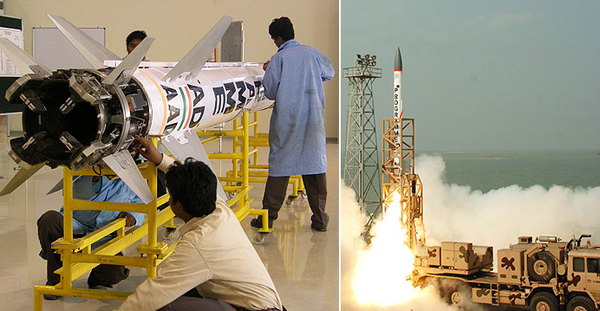
1020At left, Indian defense contractors work on an Advanced Air Defence (AAD) interceptor missile. At right, an Indian AAD missile is test-launched.

On April 4, India’s Defence Research and Development Organisation (DRDO) also reiterated the country’s ability to hit targets well beyond its adjoining region.

India has always been seriously concerned about prospect of nuclear proliferation in the Middle East. If Arab and Muslim countries decide to counter the Iranian nuclear threat with nuclear arsenal of their own, India’s hostile neighbor, Pakistan, is likely to want to play a crucial role.

India is not only vulnerable to nuclear threats from Pakistan. Both the Islamic State (ISIS) and Al-Qaeda have also openly declared hostility toward it. India has long been concerned about nuclear capabilities or materiel falling into the hands of Islamists in Pakistan. By now, it is no secret that if Iran acquires nuclear weapons capability, nuclear proliferation in the Middle East will increase exponentially. The Iranians have already announced that they plan to sell “enriched uranium” in the international marketplace and will be “hopefully making some money” from it. To whom will they sell?

President Obama and Western commentators might be expecting “peace dividends” from this “historic reconciliation” and be awaiting all sorts of positive “spillover effects” as a result of lifting sanctions — from changing Iran’s attitude towards Israel to democratizing the Iranian regime — but India cannot afford to harbor such illusions. Islamist terror has claimed more than 30,000 Indian lives in just the last two decades.

Indians are now bracing for the real spillover effects of a nuclear Iran.

Thanks to Washington’s indifference, Iran now controls four Arab capitals — Damascus, Baghdad, Beirut, and now Sana’a, while the U.S. has retreated from three: in Libya, Yemen and Iraq. If Iran can hold the Obama administration hostage without any leverage, a nuclear Iran would be able to hold the whole world hostage by blocking one-third of the world’s oil supply at the Strait of Hormuz — with impunity. Iranian proxies have also been trying to seize control of the Bab-el-Mandeb Strait, the maritime choke point of the Suez Canal.

European leaders who failed to show any resoluteness in face of Russian aggression against Ukraine, and even failed to vote against a “framework” that threatens global security, can hardly be expected to stand up to Tehran. The only question is whether the West would rather have an adversary such as Iran before it has nuclear weapons or after.

Once major European powers such as Russia, France and Germany start investing in Iranian infrastructure and entangling themselves with Iran economically, one can forget about rolling back sanctions.

Western leaders can spin the “framework” agreement all they want to cover up their abysmal diplomatic failure, but as Tehran’s centrifuges keep spinning as a result of the deal, the region turns more and more volatile.

Regardless of the diplomatic chorus and the media circus, the defense planers in New Delhi are just not buying this agreement. Other countries that care about the free world would be wise not to buy it, too.

King Abdullah II: We’re War With “Outlaws Of Islam” – Special Report

April 14, 2015

King Abdullah II: We’re War With “Outlaws Of Islam” – Special Report via You Tube, April 13, 2015

(He seems quite diplomatic, but what does he actually think? — DM)


US Ignores Linking the ‘Deal’ with Russian Sale of S-300s to Iran

April 14, 2015

Kerry clinched the deal, expresses “concern” over sale of S-300 missiles but says it won’t affect a final agreement.

By: Tzvi Ben-Gedalyahu

Published: April 14th, 2015

via The Jewish Press » » US Ignores Linking the ‘Deal’ with Russian Sale of S-300s to Iran.


John Kerry and Moshe Ya'alon.

John Kerry and Moshe Ya’alon.
Photo Credit: US Embassy


Defense Minister Moshe Ya’alon Tuesday charged that Russia’s lifting a five-year ban on the sale of critical S-300 anti-missile systems is a “direct result of the framework agreement reached in Lausanne, but the United States is ignoring any connection.

Ya’alon’s “analysis” was overly obvious. Anyone who can add 1 and 1 and come up with 2 already has connected the dots between the temporary agreement with Iran on its nuclear program and Russia’s announcement Monday to allow the sale of one of the most advance anti-missile systems in the world.

Iran’s deployment of the S-300 systems would make an aerial attack on the Islamic Republic’s nuclear sites very improbable.

Voice of America quoted Jane’s Terrorism and Security Monitor editor Jeremy Binnie as saying:

The Iranians desperately want a new long-range [surface-to-air missile] system to form the centerpiece of an integrated air defense network that will deter anyone who might want to enter its airspace. I think it would be fair to say it [the S-300] would complicate a strike against Iran’s nuclear infrastructure.

Ya’alon raised the obvious point that if Russia lifted the ban on the sale of the S-300 two weeks after the temporary deal was reached between P5+1 and Iran, what will happen when the United States lifts sanctions?

He said:

[Iran] continues to arm itself, and arm others, which we have been warning about even before the details [of the deal] were concluded. It was clear, even then, that sanctions will be lifted, and that of course this will influence and strengthen the Iranian economy.

The outgoing defense minister also pointed out that the deal did not even mention Hezbollah, Iran’s military proxy in Lebanon and which military sources lately have warned is over-loaded with heavy-duty missiles for an attack on Israel.

The reaction of U.S. Secretary of State John Kerry to the Russian sale to Iran is most curious.

His spokeswoman Marie Harf said, “We think given Iran’s destabilizing actions in the region, in places like Yemen or Syria or Lebanon, that this isn’t the time to be selling these kinds of systems to them.”

She offered an amazing analysis that disconnects Ya’alon’s dots:

We think given Iran’s destabilizing actions in the region, in places like Yemen or Syria or Lebanon, that this isn’t the time to be selling these kinds of systems to them, [but] we don’t think this will have an impact on unity in terms of inside the negotiating room.

Harf’s incredible denial continues the Obama administration’s policy that makes a deal with Iran an end it itself and not a means to stop Tehran for acquiring a nuclear bomb.

Adding 1 and 1 and getting 2 is simple, but adding another 1 and getting 3 may be too complicated for the White House, which only said it is “concerned” over the sale of the S-300 anti-missile systems.

The first “1” is that Iran can retain its nuclear infrastructure and continue to enrich low-grade uranium while simply promising it will open its sites for inspections. There are no provisions in the deal against Iran’s operating a secret nuclear site outside the country, such as in North Korea. Even if Iran balks at open inspections, it would take months before the West can get its act together and agree to clamp sanctions on Iran, especially since Russia is one of the P5+1 countries.

The second “1” is Hezbollah’s huge army and missile stockpile, along with Iran’s filling up the money pipeline to Hamas in Gaza, where the terrorist organization is busy re-building terror tunnels.

The third “1” is the S-300 systems.

Once Israel cannot penetrate Iran’s air defense systems, Tehran has nothing to fear when it comes to making a nuclear weapon.

In other words, 1+1+1=3, but the State Dept. mathematicians think otherwise.

Russian Missile Sales to Iran Cross White House ‘Red Line’

April 14, 2015

Russian Missile Sales to Iran Cross White House ‘Red Line’
BY: Adam Kredo April 14, 2015 5:00 am Via The Washington Free Beacon


(Still more on those pesky ‘red lines’. – LS)

Russia’s announcement on Monday that it will proceed with the sale of advanced missile systems to Iran crosses a so-called “red line” established by the Obama administration in 2010, according to comments by senior administration officials.

Following years of dissent from the United States, Russia announced on Monday that it would proceed with the sale of the advanced S-300 air defense missile system to Iran, which has been vying to purchase the hardware for years.

The announcement sparked criticism from the Obama administration, which has been pressuring Iran since at least 2010 to withhold the sale.

Russia’s previous ban on selling Tehran the powerful defense system was hailed as a coup by the Obama administration and promoted by it as an example of President Obama’s ability to rein in Russian intransigence on the military front.

However, Monday’s announcement by Russia threatens to complicate an already fractured relationship with Moscow and throw into further jeopardy the ongoing negotiations with Tehran over its nuclear program.

Experts have warned that the reversal threatens to split the international coalition currently working to halt Iran’s nuclear program—a narrative that the White House is working to downplay

The Russian executive order effectively “lifts the ban on transit of the S-300 air defense missile systems via Russian Federation territory (including by air), export from the Russian Federation to the Islamic Republic of Iran, and transfer of the S-300 to the Islamic Republic of Iran outside the Russian Federation’s territory, using ships or aircraft flying the Russian Federation flag,” according to an announcement by Moscow.

Russia’s decision to arm Tehran with the S-300 system erodes a long-promoted narrative by the Obama administration about its success in preventing Russian proliferation.

One senior Obama administration official speaking in 2010 described the S-300 sale as a “red line” for the United States that “couldn’t be crossed,” according to Foreign Policy.

“They’ve made that very clear to us for the last two years that this is not a symmetrical transaction for them and they don’t share the same threat assessment as us vis-a-vis Iran,” the official was quoted as telling Foreign Policy in a 2010 article focused on “how the Obama team convinced Russia not to sell arms to Iran.”

The White House claimed that Moscow’s decision to ban arms sales to Tehran would usher in a new era of cooperation between the United States and Russia.

“The decision was a bold one that acknowledges how important it is to us and how important [Former Russian President] Medvedev takes this reset with President Obama,” the administration official said.

Obama administration officials also told Foreign Policy that it had “made clear to Medvedev and other Russian officials that the sale of the S-300 to Iran was a red line that couldn’t be crossed.”

Monday’s announcement by Russia flies in the face of this purported diplomatic success and left the Obama administration scrambling to respond. Officials in both the White House and State Department declined to discuss with the Washington Free Beacon its previous declaration about Russia’s deal with Iran violating a so-called red line.

“We’ve seen those reports, as they relate to the possible sale of the S-300 anti-ballistic missile system to Iran,” White House Press Secretary Josh Earnest told reporters on Monday.

The United States, he added, “has previously made known our objections to that sale” and did so again on Monday in private phone calls with the Kremlin.

The sale of the S-300 system to Iran could violate international economic sanctions still in place, Earnest said.

State Department spokeswoman Marie Harf said that while the sale of the S-300 to Iran would not violate United Nations Security Council sanctions on Tehran, it remains a concern to the United States.

“We don’t believe it’s constructive at this time for Russia to move forward with it,” Harf told reporters.

“We think given Iran’s destabilizing actions in the region, in places like Yemen or Syria or Lebanon, that this isn’t the time to be selling these kinds of system to them,” Harf explained. “So in general, that’s what our concerns are based on.”

Elliott Abrams, a former White House National Security Council (NSC) member, wrote that the breakdown in the Obama administration’s campaign to block the sale is yet another sign of Washington’s waning influence.

“American ‘red lines’ aren’t what they used to be, Medvedev is gone, and the ‘reset’ with Russia is an embarrassment,” Abrams wrote at the Council on Foreign Relations (CFR). “So is the way the Obama administration claimed credit for changing Russia’s policy toward Iran.”


