Archive for April 7, 2015

Yemen war: Saudis prevented Russian evacuations by air, bombed Moscow’s spy center in Aden

April 7, 2015

Yemen war: Saudis prevented Russian evacuations by air, bombed Moscow’s spy center in Aden, DEBKAfile, April 7, 2015

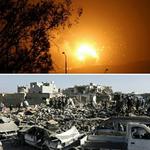
Russias_Yemen_consulate_damaged_in_Saudi-led_airstrikes_1.4.15Russia’s bombed out consulate in Aden

Saudi Arabia has gone head to head with Russia as Iran’s ally in Yemen.

Moscow claims to have evacuated hundreds of Russian nationals from Yemen by an air lift running out of Sanaa airport, but DEBKAfile’s exclusive intelligence and military sources reveal that not a single Russian plane has taken off from any Yemeni airport since March 27, when Saudi Arabia launched its military offensive against the pro-Iranian Houthi rebels.

The Saudiis warned Russia that they would not be responsible for the safety of any flights landing at a Yemeni airport or the passengers assembled there for evacuation, while their air force conducted strikes against the rebels. Having achieved control of Yemen’s skies in the early stages of their intervention, the Saudis declared its air space a no-fly zone.

This warning gained substance when, on April 1, Saudi F-15 warplanes bombed the Russian consulate in the second largest Yemeni city, Aden. A Russian witness said that not a single window was left in the building and all Russian citizens would have to leave the town.

According to DEBKAfile’s sources, the building was in fact completely demolished in order to dismantle Russia’s regional intelligence-gathering center which operated out of the consulate building and fed Iranian intelligence with data on military movements in the neighborhood.

It functioned according to the same system as Russian spy stations in Syria, which routinely keep their Iranian colleagues au fait with military activities, including Israeli army movements.

The intelligence gathered by the Aden facility was no doubt passed on by Iranian agents to the Houthi commanders, certainly after Al Qods Brigades chief Gen. Qassem Soleimani arrived in Sanaa to direct the rebel offensive after the Saudi offensive was launched.

In normal times, the Russian spy facility would have been responsible for surveillance over navigation through the Bab el-Mandeb Strait and the warships sailing between Red Sea, the Gulf of Aden and the Indian Ocean.

The next chapter of the Russian evacuation story unfolded on Thursday, April 2, the day after the consulate was razed: The Russians tried activating their connections in Cairo to obtain Saudi permission to land a plane in Sanaa, where hundreds of Russians had crowded to await passage to safety.

The Saudis relayed their refusal to Moscow through Cairo.

Then, on Friday, April 3, a flight landed at Moscow’s Chkalovsky Airport carrying Russian evacuees from Yemen, followed by a second flight which landed at an unnamed Russian military airport.

DEBKAfile’s sources report that neither of those planes were actually permitted to take off from Sanaa, but flew in from Cairo. After the Saudi ban on flights through Yemeni airports, Moscow had no choice but to rescue its nationals from the embattled country by sea aboard ships that carried them to Egypt.


‘Messing’ with Israel

April 7, 2015

‘Messing’ with Israel, Israel Hayom, Elliott Abrams, April 7, 2015

(“If you like your country you can keep it.” Even if Obama’s phrasings were not ambiguous, and they are, he could not be trusted. Moreover, since Obama’s talking points about the “once in a lifetime deal” and those of his Iranian counterparts are very different, there is no way of knowing now whether there will be a deal, whether the U.S. Congress will block it, or what it will be. — DM)

In his lengthy interview with Thomas Friedman of The New York Times, President Obama makes many statements about Israel’s security and how the proposed deal with Iran enhances it. These words from the interview are key:

“I have to respect the fears that the Israeli people have,” he added, “and I understand that Prime Minister Netanyahu is expressing the deep-rooted concerns that a lot of the Israeli population feel about this, but what I can say to them is: Number one, this is our best bet by far to make sure Iran doesn’t get a nuclear weapon, and number two, what we will be doing even as we enter into this deal is sending a very clear message to the Iranians and to the entire region that if anybody messes with Israel, America will be there.”

What does “messes with Israel” mean? No one has the slightest idea. The president unfortunately uses this kind of diction too often, dumbing down his rhetoric for some reason and leaving listeners confused. Today, Iran is sending arms and money to Hamas in Gaza, and has done so for years. Is that “messing with Israel?” Iran has tried to blow up several Israeli embassies, repeating the successful attack it made on Israel’s embassy in Buenos Aires in 1992. Fortunately Israel has foiled the more recent plots, but is attempting to bomb Israeli embassies “messing with Israel?” Iranian Revolutionary Guards, along with Hezbollah troops, are in southern Syria now near the Golan. Is that “messing with Israel?” And what does the president mean by “America will be there?” With arms? With bandages? With the diplomatic protection his administration is now considering removing at the United Nations?

Later in the interview, the president says this:

“Now, what you might hear from Prime Minister [Benjamin] Netanyahu, which I respect, is the notion, ‘Look, Israel is more vulnerable. We don’t have the luxury of testing these propositions the way you do,’ and I completely understand that. And further, I completely understand Israel’s belief that given the tragic history of the Jewish people, they can’t be dependent solely on us for their own security. But what I would say to them is that not only am I absolutely committed to making sure that they maintain their qualitative military edge, and that they can deter any potential future attacks, but what I’m willing to do is to make the kinds of commitments that would give everybody in the neighborhood, including Iran, a clarity that if Israel were to be attacked by any state, that we would stand by them. And that, I think, should be … sufficient to take advantage of this once-in-a-lifetime opportunity to see whether or not we can at least take the nuclear issue off the table.”

This is not much help. For one thing, the president says “attacked by any state,” presumably leaving out Hamas and Hezbollah, and for that matter the Islamic State group and al-Qaida. One has to assume he means “attacked by Iran,” but what does “we would stand by them” mean? It doesn’t add much to “America will be there.” There will be no conventional war between Israel and any Arab state in the foreseeable future, so Hezbollah is the most likely problem and is presumably excluded from the president’s formulation. What Israel worries about today is a nuclear attack by Iran or a terrorist group like Hezbollah to which Iran has given the bomb. No doubt that qualifies as “messing with Israel,” but were that to occur what exactly would “America will be there” and “stand by them” mean? Take in refugees from the destroyed State of Israel after the nuclear attack on it? The president’s language about “commitment” suggests that he may envision a formal defense commitment by the United States to Israel. Israel has not wanted such a treaty because it has always said it wants to defend itself, not have Americans dying to defend it. That position has served the U.S.-Israel relationship well for 67 years. Should it really be changed now, and would that really help Israel? What would the value of such a commitment be? To ask the question another way, are not Poles and Estonians wondering right now about the value of their membership in NATO, if Mr. Putin “messes” with them?

There were other problems in the interview, such as this language:

“There has to be the ability for me to disagree with a policy on settlements, for example, without being viewed as … opposing Israel. There has to be a way for Prime Minister Netanyahu to disagree with me on policy without being viewed as anti-Democrat, and I think the right way to do it is to recognize that as many commonalities as we have, there are going to be strategic differences. And I think that it is important for each side to respect the debate that takes place in the other country and not try to work just with one side. … But this has been as hard as anything I do because of the deep affinities that I feel for the Israeli people and for the Jewish people. It’s been a hard period.”

“You take it personally?” Friedman asked.

“It has been personally difficult for me to hear … expressions that somehow … this administration has not done everything it could to look out for Israel’s interest — and the suggestion that when we have very serious policy differences, that that’s not in the context of a deep and abiding friendship and concern and understanding of the threats that the Jewish people have faced historically and continue to face.”

“Respect the debate?” “Personally difficult?” This is the White House whose high officials called the prime minister of Israel a “chickens—” and a “coward,” in interviews meant to be published — not off the record. And the officials who said those things remain in place; no effort was ever made to identify and discipline them.

But the deeper problem is that the reassurances the president is offering to Israel … are simply not reassuring. Iran is already, right now, while under sanctions that are badly hurting its economy, spending vast amounts of money and effort to “mess with Israel.” This administration’s reaction has been to seek a nuclear deal that will give Iran more economic resources to dedicate to its hatred and violence against Israel, but will in no way whatsoever limit Iran’s conventional weapons and its support for terrorism.

Several times in this interview the president went out of his way to suggest that he fully understands Israel’s security problems, but the full text suggests that he does not — because he believes that his statements that “if anybody messes with Israel, America will be there” and would “stand by them” actually solve any of those problems. Time alone undermines the value of those statements, because he will not be president in 22 months. The words he used are sufficiently vague to undermine their value as well. It is hard to believe that many Israelis will be reassured by the interview, especially if they read the Iranian press and see what, in their own interviews, Iranian officials are claiming they got out of the new nuclear agreement.
Obama Nukes Own Iran Deal in NPR Interview

April 7, 2015

Obama Nukes Own Iran Deal in NPR Interview

by Joel B. Pollak7 Apr 2015

via Obama Nukes Own Iran Deal in NPR Interview – Breitbart.

President Barack Obama has granted an interview to National Public Radio in an attempt to sell the Iran “framework” to a skeptical public. In the process, he compares the agreement to a real-estate deal–a poor analogy for a man who called his own last property purchase deal “boneheaded” after involving indicted (now convicted) bag Chicago man Tony Rezko. Obama also provided at least five big reasons that Congress–whose opposition is growing–should reject the Iran deal.

1. Iran could have a nuclear weapon after 12 years. Obama volunteers to NPR’s Steve Inskeep “that in year 13, 14, 15, they [Iran] have advanced centrifuges that enrich uranium fairly rapidly, and at that point the breakout times would have shrunk almost down to zero.” Obama argues that would be better than the current breakout time of 2-3 months and that the world would at least know more about the Iranian nuclear program when it did detonate a nuclear weapon.

2. Obama admits the Iranian regime is not going to change. At the outset, Obama says that “this is a good deal if you think Iran’s open to change.” Later, however, in dismissing Israeli Prime Minister Benjamin Netanyau’s demand that a final deal include Iranian recognition of Israel’s right to exist, Obama says that would preclude a deal “unless the nature of the Iranian regime completely transforms.” By his own standard–Iranian openness to change–the deal is dead on arrival.

3. Obama admits Iran will not stop supporting terrorism. Obama admits that sanctions relief will allow Iran to keep funding terror throughout the region and the world. However, he says, Iran does that anyway, even under significant financial pressure. Amazingly, Obama actually offers the example of North Korea as a country that causes mischief despite being isolated. North Korea is the best example of why a nuclear deal like the Iran framework has no chance of success.

4. Russia could stop the UN Security Council from inspecting Iran. The fact that Russia holds a veto on the UN Security Council means that it can effectively protect Iran from international inspections. Obama says he is “trying to design” a system in which nuclear inspectors from the International Atomic Energy Agency (IAEA) do not have to report to the Security Council. The problem? Russia is one of the P5+1 powers. (Obama admits the problem is not yet “resolved.”)

5. There is no way to resolve differences over sanctions. Iran only came to the negotiating table, Obama admits, because of international sanctions (which he opposed, but for which he now takes credit). Yet Iran claims the deal will include an immediate end to sanctions, while Obama says that sanctions will only be lifted later. And Obama acknowledges that he needs Russia’s support to “snap-back” sanctions if Iran violates the deal–a problem for reasons described above.

French fact sheet differs from US on Iran’s centrifuge use, R&D

April 7, 2015

French fact sheet differs from US on Iran’s centrifuge use, R&D

Raising new questions, internal Paris document seen by Times of Israel also shows discrepancies over sanctions relief, inspectors’ access

By Times of Israel staff April 7, 2015, 3:28 pm

via French fact sheet differs from US on Iran’s centrifuge use, R&D | The Times of Israel.


Fact is nobody knows what the real facts are, but still a deal of the century.

it is a freak show


French government fact sheet on the Iran framework deal, which has not been made public by Paris but which has been seen by The Times of Israel, provides for Iran to gradually introduce the use of advanced centrifuges to enrich uranium after 12 years, in contrast to the US official parameters, which make no such specific provision.

The use of the more advanced IR-2 and IR-4 centrifuges, as permitted according to the French fact sheet, would enable Iran to more rapidly accumulate the highly enriched uranium needed to build nuclear weapons, accelerating its breakout time to the bomb.

The French fact sheet also specifies that Iran will be allowed to continue R&D work on the advanced IR-4, IR-5, IR-6 and IR-8 centrifuges, the last of which can enrich uranium at 20-times the speed of Iran’s current IR-1 centrifuges, whereas the American parameters are less specific.

Differences between the texts issued by Paris and Washington also extend to the question of inspection and supervision of Iran’s activities, with the French document indicating that the IAEA, the International Atomic Energy Agency, will be able to visit any suspect site in Iran — so-called “anywhere, anytime” access — whereas the US document is less far-reaching.

The two documents also differ in their terminology as regards the scale and timing of sanctions relief as the deal takes effect.

From left, Head of Mission of the People's Republic of China to the European Union Hailong Wu, French Foreign Minister Laurent Fabius, German Foreign Minister Frank Walter Steinmeier, European Union High Representative Federica Mogherini, Iranian Foreign Minister Javad Zarifat, Russian Deputy Political Director Alexey Karpov, British Foreign Secretary Philip Hammond and US Secretary of State John Kerry arrive in Lausanne, Switzerland, Thursday, April 2, 2015, after the United States, Iran and five other world powers on Thursday announced an understanding outlining limits on Iran's nuclear program. (AP Photo/Brendan Smialowski, Pool)

Ever since the framework agreement was announced last week, the various parties have set out sometimes sharply differing accounts of what has been agreed, provoking escalating controversy and criticism over a deal that President Barack Obama has hailed as historic and Israel’s Prime Minister Benjamin Netanyahu has warned is “very bad” and paves Iran’s path to the bomb.

The Iranian Foreign Ministry on Friday issued its own fact sheet, which differs starkly with the official American parameters and with the French fact sheet seen by The Times of Israel.

Six key discrepancies between the US and Iranian documents, some of them at the very heart of the framework agreement announced in Lausanne, Switzerland, last Thursday, were highlighted by an Israeli expert on Saturday.

Iranian Foreign Minister Mohammad Javad Zarif claimed earlier on Saturday that, under the deal, Iran has the right to continue working on more of the advanced IR-8 centrifuges. “Some said Iran can have no R&D, but we now have the right to develop IR-8, which has 20x the output of IR-1,” he said.

The Israeli government on Monday issued a series of demands intended to transform the non-signed framework agreement into a more reasonable deal by the scheduled June 30 deadline, and asked 10 key questions about the terms, several of which related to the emerging discrepancies between the various players’ accounts of what was decided in Lausanne.

Hours later, in two interviews with Israeli television stations, Ben Rhodes, a senior adviser to Obama, quashed the notion that the final deal would be markedly more stringent on Iran than the terms of the framework agreement, declaring that the deal as it now stands meets the US’s “core objectives.

“We believe that this is the best deal that can emerge from these negotiations,” Rhodes said.

Lead Iran Negotiator: We Haven’t Agreed On How Much Pre-Inspection Notice Iran Gets

April 7, 2015

Lead Iran Negotiator: We Haven’t Agreed On How Much Pre-Inspection Notice Iran Gets

by Ian Hanchett7 Apr 2015

via Lead Iran Negotiator: We Haven’t Agreed On How Much Pre-Inspection Notice Iran Gets – Breitbart.


Obama call it the deal of the century

One year break out time for inspections ?


Under Secretary of State for Political Affairs Amb. Wendy Sherman, the lead US negotiator in the P5+1 talks with Iran, said that the amount of notice Iran gets before its nuclear sites are inspected hasn’t been determined yet on Tuesday’s “Morning Joe” on MSNBC.

“Well, I’m not going to go into the specific details of each and every element of this negotiation because…we do not yet have an agreement, or an understanding as the lawyers call it. What we have is a framework. We are now negotiating those details, those details are absolutely crucial for all of the reasons that you all are discussing, and we have until June 30th to reach that. What we wanted to do, and the instructions we had from the president is get a framework, where we know, at least the top line–and actually, we got several more lines, of each of the major elements so that I, in fact, can tell Congress, I, in fact, can tell the American people that we can move ahead” Sherman stated when asked how much notice Iran would have to be given before any inspections.

When asked what her understanding of the framework regarding inspections, she responded “I think what the framework means is we will have the access we need to ensure that we have the time to make the decisions that we need. It’s why the one-year breakout time that we’ve talked about so much, the amount of time that it would take them to get enough fissile material for a nuclear weapon is so critical. Because in a year you have more than enough time to make other decisions about sanctions, or about other kinds of actions, to make sure that America’s national security, and the world’s national security is indeed secure.”

Follow Ian Hanchett on Twitter @IanHanchett

Obama admits: Deal will give Iran ‘near zero’ breakout time in 13 years

April 7, 2015

Obama admits: Deal will give Iran ‘near zero’ breakout time in 13 years

President concedes Iran framework nuclear agreement’s shortcomings amid growing chorus of objections

By Josh Lederman April 7, 2015, 1:46 pm

via Obama admits: Deal will give Iran ‘near zero’ breakout time in 13 years | The Times of Israel.


WASHINGTON (AP) — Defending an emerging nuclear deal, President Barack Obama said Iran would be kept a year away from obtaining a nuclear weapon for more than a decade, but conceded Tuesday that the buffer period could shrink to almost nothing after 13 or more years.

Obama, whose top priority at the moment is to sell the framework deal to critics, was pushing back on the charge that the deal fails to eliminate the risk because it allows Iran to keep enriching uranium. He told NPR News that Iran will be capped for a decade at 300 kilograms — not enough to convert to a stockpile of weapons-grade material.

“What is a more relevant fear would be that in Year 13, 14, 15, they have advanced centrifuges that enrich uranium fairly rapidly, and at that point, the breakout times would have shrunk almost down to zero,” Obama said.

Breakout time refers to how long it would take to build a bomb if Iran decided to pursue one full-bore — in other words, how long the rest of the world would have to stop it. The framework deal expands Iran’s breakout time — currently two to three months — to at least a year. But that constraint would stay in place only for 10 years, at which point some restrictions would start phasing out.

Although Obama acknowledged that Iran’s breakout time could shrink, he said at least the world would have better insight into Iran’s capabilities because of extensive inspections in the earlier years.

“The option of a future president to take action if in fact they try to obtain a nuclear weapon is undiminished,” Obama said.

The stark admission came as the president seeks to quiet a growing chorus questioning whether the deal he and world leaders have negotiated merely delays the certainty of a nuclear-armed Iran. Obama has insisted confidently that Iran will not get a nuclear weapon on his watch, which ends in roughly 20 months, but has made no similar assurances about his successors.

Tehran has always maintained it doesn’t want a nuclear bomb, but the international community has been skeptical, and America’s close ally Israel considers a nuclear Iran an existential threat. U.S. lawmakers and foreign policy hawks have questioned how Obama can strike a diplomatic deal with a country that continues to threaten Israel and tops the US list of state sponsors of terror.

Copyright 2015 The Associated Press


