Archive for April 5, 2015

Can and should Israel destroy Iran’s nuclear facilities?

April 5, 2015

Can and should Israel destroy Iran’s nuclear facilities? Dan Miller’s Blog, April 5, 2015

(The views expressed in this article are mine and do not necessarily reflect those of Warsclerotic or any of its other editors. — DM)

It has been suggested that Israel should seriously consider destroying Iranian nuclear facilities, but Israeli officials obviously haven’t said, and won’t say, if, how or when she might.

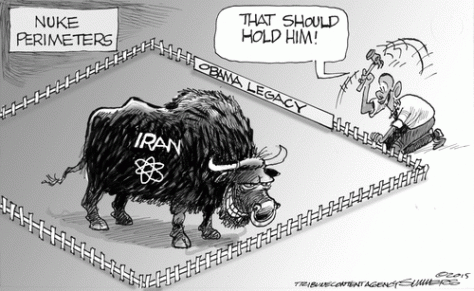
Iran fenced in

Speaking to Arutz Sheva Friday, Professor Efraim Inbar, who heads the Begin-Sadat Center for Strategic Studies, said the deal had realized Israel’s worst fears by leaving Iran’s nuclear program essentially intact.

The Islamic Republic’s nuclear program has been granted “legitimacy” by the agreement, which still allowed it to continue enriching uranium and to maintain a reactor capable of producing enriched plutonium, he said. “And that’s what worries Israel, that they (Iran) will be able within a short time frame to reach a nuclear bomb.”

“I hold the view that the only way to stop Iran in its journey to a nuclear bomb is through military means,” Inbar maintained, suggesting that “Israel needs to seriously consider striking a number of important nuclear facilities” to head off the threat.

On March 28, former U.S. Ambassador Bolton said that it should be done.

The P5+1 nuclear “deal,” proudly announced by President Obama on April 2nd, is a sham. There is no “deal,” and public announcements by Iran and Obama cast it in very different lights. According to Iran, all sanctions will be lifted immediately when an agreement is reached on or before June 30th. According to Obama, sanctions relief will be gradual and based on Iran’s compliance with invasive inspections and other conditions. Even National Public Radio (NPR) has pointed out differences. NPR observed that, according to Iran,

all sanctions relief – U.N., EU and U.S. – would be immediate. It was unequivocal. It stated that Iran under the deal was free to pursue industrial scale enrichment to fuel its own reactors – unequivocal. It stated that Iran was unhindered in its ability to conduct centrifuge R&D.

Iran has also emphasized that its intention to destroy Israel is non-negotiable, and the Obama Administration has rejected any efforts to make Iran recognize Israel’s right to exist, on the ground that

“This is an agreement that is only about the nuclear issue,” State Department spokeswoman Marie Harf told reporters on Friday night, according to Fox News. “This is an agreement that doesn’t deal with any other issues, nor should it.” [Emphasis added.]

Israeli Prime Minister Netanyahu has said that Israel’s right to exist is non-negotiable.

Iran is very unlikely to retreat from its perception of the “deal,” Obama is very likely to retreat in Iran’s favor, and Israel is very unlikely to retreat from its perceptions about Iran, the “deal” or Israel’s right to exist.

What should Israel do?

In Martin Archer’s novel Islamic War, which I reviewed here, Israel dispatched elderly, large and substantially refurbished remove controlled aircraft, full of high explosives, from Somalia to half dozen nuclear facilities operated by hostile nations. They flew circuitous routes at varying altitudes to avoid detection until it was too late to stop them. Over a period of weeks, they crashed into and destroyed their targets, amid speculation about who had done it and why. Israel was not suspected. Would that have been possible then? Now? I don’t know.

It has been reported that Saudi Arabia has given Israel clearance to use her airspace for an attack on Iran’s nuclear facilities.

Fox News reports that US Defense sources claim the Saudis are conducting tests on their air defense systems after giving Israel permission to to enter a narrow corridor to shorten the distance to attack Iran.

The testing would make sure that Saudi jets don’t get scrambled when Israel entered Saudi airspace. Once the IAF planes complete their mission and exit Saudi airspace, Saudi defenses would go back online again. [Emphasis added.]

Might Saudi Arabia, Egypt and perhaps other Gulf States go beyond not interfering with an Israeli attack to provide air support and other help? They seem to be as displeased with the “deal” as Israel is.

Assuming that Israel is not overly concerned about being identified as the attacker and is willing to act alone, she might:

Detonate one or more high-altitude atomic bombs to emit sufficient electromagnetic pulses (EMP) to fry all above-ground Iranian electronics. That would substantially disable Iranian above-ground command and control facilities as well as other communications, hence diminishing (but not eliminating) the possibility of counter-strikes by Iran and/or its proxies. Perhaps she has other, non-nuclear, means of generating EMPs; she hasn’t said.

Immediately thereafter, drop whatever suitable bombs she may have on all Iranian military and nuclear facilities. Does Israel have bunker-buster bombs? Probably not of U.S. manufacture, but that does not mean that she has not developed her own. It would be surprising if she had not.

Obama and other “leaders of the free world” would complain and the U.N. would emit fits of angry censures. However, that happens with great frequency in any event, and would be an insufficient reason for Israel to commit national suicide through inaction against Iran.

I am no “military expert” and would appreciate any comments on the suggestions I have made as well as any other suggestions anyone might care to offer.

Egypt sends large naval-marine force to Bab el-Mandeb

April 5, 2015

Egypt sends large naval-marine force to Bab el-Mandeb , DEBKAfile, April 5, 2015

(Please see also, Khamenei sends Iranian navy to Bab el-Mandeb Straits. Iran arms store for Hamas bombed in Libya. — DM)

DEBKAfile’s military sources report that Egypt Sunday transferred war ships and marine forces as reinforcements for securing the Bab el-Mandeb Strait against Iranian-backed Houthi control. Egypt now deploys six warships and at least 1,000 marines at the vital shipping gateway.

Egypt will defend its Gulf allies “if we have to,” said President Abdel-Fatteh Al-Sisi Saturday night after a meeting of the Supreme Council of the Armed Forces. He stresse that Bab Al-Mandab Strait was a national security issue for Egypt and Arab countries. Arab national security would only be protected by Arab countries, said the president.

Egypt has closely monitored the civil war in Yemen, especially since the Saudi-led Operation Decisive Storm began to end the Iranian-backed Houthi rebellion. The disruption of shipping in the Bab el-Mandeb Strait would directly affect traffic, including energy shipments, to and from the Gulf and Far East through Egypt’s Suez Canal.

Nuclear déjà vu

April 5, 2015

Israel Hayom | Nuclear déjà vu.

Just three days have passed since six world powers and Iran reached a framework nuclear agreement, yet the first creaks are already being heard and many more are expected. A nuclear deal with Iran turned into an obsession for U.S. President Barack Obama, but it appears that opponents of the deal also know how to be obsessive.

There were some in Israel who welcomed the news of the nuclear agreement. Yet these were the same exact people who saw the 1993 Oslo Accords as an end to the Israeli-Palestinian conflict, the 2005 disengagement from the Gaza Strip as a brilliant move and the 2008 election of Obama as a huge step forward for peace and humanity. They were wrong at those times and they are wrong now.

It was not surprising when white smoke rose on Thursday from the Beau Rivage Palace Hotel in Lausanne, Switzerland. Did anyone really think there would not be serious differences between the delegations? Would anyone have gambled that the talks would not be extended past the original deadline (like in the talks leading up to the November 2013 interim agreement)? Did anyone truly believe U.S. Secretary of State John Kerry would return to Washington empty-handed?

And what was to come next was also not surprising. Iranian Foreign Minister Mohammad Javad Zarif was quick to tell his people that the restrictions on Iran would be far less significant than what was told to the world by Obama, who lied to Congress. For those who were not already aware, the Iranians also know how to speak in two languages.

France’s behavior — it had a very skeptical attitude yet ultimately fell in line with the rest of the world powers — should also have been expected.

On one hand, a cornerstone of French foreign policy is the principle of nonproliferation of nuclear weapons, meaning France should have opposed the deal. On the other hand, France needs America as a partner in managing numerous conflicts around the world, including the Ukrainian front against the Russians and the war against jihadist terrorism.

But another wrinkle for France is that its Arab partners — Egypt and Saudi Arabia — fear a nuclear Iran no less than Israel does.

French Foreign Minister Laurent Fabius, the toughest foreign minister among those representing the world powers, indicated on Friday that France had wanted a better deal.

Some were enthusiastic about the soothing words uttered by Obama in the Rose Garden at the White House. It would be advisable for those who felt this way to listen to then-President Bill Clinton said in 1994 after a framework nuclear agreement was reached with North Korea. “This is a good deal for the United States,” Clinton said. “North Korea will freeze and then dismantle its nuclear program. South Korea and our other allies will be better protected. The entire world will be safer as we slow the spread of nuclear weapons. … The United States and international inspectors will carefully monitor North Korea to make sure it keeps its commitments. Only as it does so will North Korea fully join the community of nations.”

I tip my hat to Iran for its ability to bring the U.S. down again after the failed experiment with North Korea. Only Iran could have pulled this off.

By the way, the signing of the agreement with North Korea in 1994 sparked an outcry in the U.S., particularly from Republicans, who felt Clinton gave too much in the deal.

It just so happens that the Republicans were right then. And they are right now.

Iran sends Hamas massive aid to rebuild tunnels – report

April 5, 2015

Iran sends Hamas massive aid to rebuild tunnels – report, DEBKAfile, April 5, 2015

Iran has transferred tens of millions of dollars to Hamas’s military wing in Gaza to help it rebuild the tunnels destroyed in last summer’s conflict with Israel, the Sunday Telegraph reports. In an intense effort to restore the Palestinian extremists’ military capabilities, Iran is also funding new missile supplies to replenish the stocks used up in bombing Israeli towns and villages. Hamas capabilities were seriously degraded by Israel’s Operation Protective Edge last summer which ended in a ceasefire.

Cartoon of the day

April 5, 2015

Via Freedom is just another word, April 5, 2015

Iran fenced in

Netanyahu: “The SURVIVAL of Israel is non-negotiable…”

April 5, 2015

Netanyahu: “The SURVIVAL of Israel is non-negotiable…” – YouTube.

Statement by Prime Minister Benjamin Netanyahu regarding the proposed framework for a deal with Iran.

“Israel will not accept an agreement that allows a country that vows to annihilate us to develop nuclear weapons… Period.”

