Archive for March 2015

U.S. Generals: Israeli Military Restraint Bolstered Hamas

March 9, 2015

U.S. Generals: Israeli Military Restraint Bolstered Hamas

Report rejects American adoption of Israeli level of restraint

BY:
March 9, 2015 5:00 am

via U.S. Generals: Israeli Military Restraint Bolstered Hamas | Washington Free Beacon.


Israel’s military restraint during the conflict in Gaza last summer “unintentionally empowered Hamas” by allowing the terror group to distort international law and secure a public relations victory by exploiting the media, according a task force of retired U.S. generals.

The task force also warned that Hamas’ disinformation strategy could be replicated against the U.S. military and advised the U.S. government to institute a plan to combat similar media campaigns in the future.

“Hamas supported false claims against the [Israel Defense Forces] by distorting stories and images to serve the organization’s narrative, and by manipulating stories in the international media,” said the Gaza Conflict Task Force in a report commissioned by the Jewish Institute for National Security Affairs and released on Monday.

The report, titled “The 2014 Gaza War: Observations and Implications for U.S. Military Operations,” concluded that Hamas was not aiming for a military victory but instead put Gaza’s civilians at risk in order to increase casualties and damage the global standing of the Israel Defense Forces.

The main goal, according to the report, was to build international pressure on Israel.

“Hamas proved very effective at exploiting images of civilian deaths, particularly children, to gain international sympathy to their cause and a high degree of international opposition to the Israeli cause,” said the report. “Further, Hamas was effective at not allowing access to their more brutal and illegal actions, beyond what they published themselves as part of their internal intimidation efforts.”

According to the task force, the techniques used by Hamas “represent an evolution in unconventional warfare, and will probably be imitated and improved upon by America’s enemies.”

The report recommended that the United States should institute a “whole-of government approach” to countering such efforts.

“The U.S. government and military must come to grips with the increased importance and use of the information domain in war,” said the task force. “They must develop effective countermeasures to this enemy advantage, as it threatens to exploit a strategic vulnerability for the United States and its allies.”

One issue that Hamas exploited in Gaza, according to the report, was the lack of clarity between international laws of war and military policy.

The task force argued that the IDF exceeded the Laws of Armed Conflict by using restraint during times when it was legally unnecessary. This created a precedent that could open Israeli civilians up to increased risk, according to the report.

“Unless there is a clear demarcation between law and policy-based restraints on the use of combat power, raising standards in one instance—even if done as a matter of national policy and not as the result of legal obligation—risks creating a precedent to which military forces will likely be expected to adhere in the future,” said the report.

“We do not believe the Israeli level of restraint should be considered the standard for U.S. armed forces in future conflicts,” the report concluded

The task force, which traveled to Israel while conducting the assessment, included General Charles Wald, Lieutenant General William B. Caldwell IV, Lieutenant General Richard Natonski, Major General Rick Devereaux, and Major General Mike Jones.

Iranian Al Qods chief on landmark visit to Amman as guest of Jordan’s national intelligence director

March 9, 2015

Iranian Al Qods chief on landmark visit to Amman as guest of Jordan’s national intelligence director, DEBKAfile, March 9, 2015

Qassem_Suleimani_Jordan_5.3.15Al Qods chief Gen. Soleimani welcomed in Amman

[T]he Jordanian king lately shows a different face in private conversations to his public aspect as steadfast friend of the Obama administration. In private, Abdullah is highly critical of current US policies in the region.

*************************

DEBKAfile’s military and intelligence sources reveal exclusively that Gen. Qassem Soleiman, commander of the Revolutionary Guards elite Al Qods Brigades, paid a groundbreaking visit last Thursday, March 5, to the Hashemite Kingdom of Jordan as guest of Gen. Faisal Al-Shoulbaki, director of General Intelligence and a close adviser to King Abdullah II.

The visit, encouraged by Obama administration policy, showed one of America’s oldest Sunni Arab allies, recognizing the direction of the trending regional reality to jump the lines over to Tehran. Iran’s grab for Middle East influence is now reaching from four capitals, Baghdad, Damascus, Sanaa, Beirut to a fifth, Amman.

Our sources report that Royal Jordanian Air Force fighter jets escorted the Iranian general’s armored motorcade as it drove from Baghdad to Amman through the main highway connecting the two Arab capitals.

It is not known whether the king gave Soleimani an audience, but the possibility is not ruled out.

His talks with Jordan’s intelligence and military heads ranged widely over the battles in Iraq and Syria against the Islamic State in Iraq and the Levant-ISIS. This suggests that Jordan has shown willingness to take the first step towards coordinating its policies and military operations with Tehran – not just with Washington as hitherto.

Some 12,000 American soldiers are posted to Jordan, most of them members of elite US combat units. Their primary task is to safeguard the throne against threats from Syria and Al Qaeda and its affiliates.

Interestingly, Soleimani’s landmark trip to Amman was carefully timed to take place just a day before Gen. Martin Dempsey, Chairman of the Joint US Chiefs of Staff, arrived in Baghdad, so that by the time he landed, the Iranian general, who commands his coutry’s expanding military input in the war on ISIS, had returned to the  Iraqi capital from his visit to Amman.

Our sources also report that the Jordanian king lately shows a different face in private conversations to his public aspect as steadfast friend of the Obama administration. In private, Abdullah is highly critical of current US policies in the region. In meetings with US lawmakers on visits to Amman, Abdullah has voiced bitter disappointment in President Barack Obama’s tepid response to the  burning alive by ISIS of the Jordanian pilot Lt. Moath al-Kasasbeh.

He was on a visit to the White House when the horrific video was released on Feb. 3.

The Jordanian king has been heard to remark that Obama’s military partnership with Iran, which has the effect of providing the Assad regime with an extra shield, cannot survive long, because the Sunni Arab world finds it intolerable and won’t accept it.

The Danger of Negotiating with Iran

March 9, 2015

The Danger of Negotiating with Iran, Washington Free Beacon, March 9, 2015

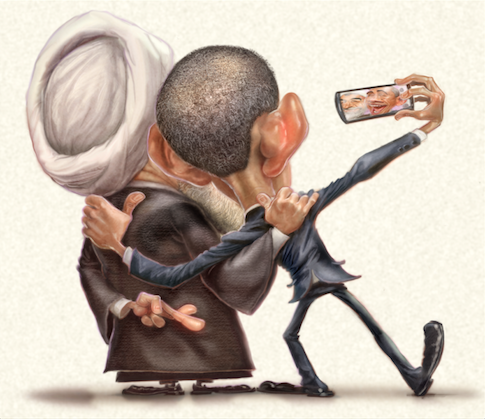
Obama-Rouhani-Selfie

Incentivizing defiance also undercuts diplomacy. In the year before Obama blessed talks with Iran, the Iranian economy had shrunk 5.4 percent. After talks, its economy grows. In order to bring Iran to the table, Obama has released more than $11 billion to Iran. To put that in perspective, that is equivalent to the last two years’ budget of the IRGC, a group responsible for the deaths of hundreds of Americans. What Obama has done is the equivalent of giving a toddler dessert first, and then asking him to come back to eat his broccoli.

How can these past successes be replicated? Sunset clauses, multinational contracts, and sanctions relief won’t do it. Only one thing will: Forcing the regime to choose between its nuclear ambitions and its survival.

*********************

As a candidate for president, Barack Obama made diplomacy with rogue regimes a signature issue. “The notion that somehow not talking to countries is punishment to them…is ridiculous,” he declared in 2007. In both his inaugural addressand his first television interview as president, he reached out to the Islamic Republic of Iran. “If countries like Iran are willing to unclench their fist, they will find an extended hand from us,” he told Al-Arabiya. In the six years since, whether firebrand Mahmoud Ahmadinejad or reformer-by-comparison Hassan Rouhani held the Iranian presidency, Obama has been so committed to a deal on Iran’s illicit nuclear program that he hasn’t let anything stand in his way—Congress, allies, or evenfacts.

Unfortunately, when it comes to the history of high-profile diplomacy with rogue regimes, Obama’s behavior is more the rule than the exception. If every senator looks in a mirror and sees a future president, then every president looks in a mirror and sees a brilliant statesman, a man who will be Nixon in China or Reagan in Reykjavik. In reality, what most should see is a reflection of Frank B. Kellogg, Aristide Briand, or Neville Chamberlain. With very little understanding of history, Obama, alas, sees only himself.

Albert Einstein is often credited (wrongly) with the adage that insanity is doing the same thing repeatedly while expecting different results. By that definition, Foggy Bottom is Bedlam. The U.S. military, in contrast, constantly forces soldiers to confront their mistakes—that is, after all, why sergeants-major chew out soldiers. Soldiers spend more time in the classroom dissecting exercises than they do in the field. Even when deployed, they never neglect after-action reports to determine what they might have done better.

In the last half century, however, the State Department has never conducted a “lessons learned” exercise to identify what went wrong with high stakes diplomacy. Nor does the State Department have any clear metrics to measure success and failure. State Department spokesmen often make declarations of progress that declassified records of talks—with Iran, North Korea, the Palestinians, Saddam Hussein’s Iraq, Muammar Gaddafi’s Libya, Pakistan or, increasingly, Turkey and Russia—belie.

Too many American diplomats dismiss the need to consider mistakes. Instead, many are committed to the belief that talking is a cost-free, risk-free strategy. Testifying before the Senate in support of Obama’s outreach to Iran, Nicholas Burns, the second undersecretary of state for foreign affairs under George W. Bush, promised, “We will be no worse off if we try diplomacy and fail.” Richard Armitage, another veterans of Bush’s State Department, has promoted a similar argument: “We ought to have enough confidence in our ability as diplomats to go eye to eye with people—even though we disagree in the strongest possible way—and come away without losing anything.”

But Armitage was wrong to project American values onto others. Americans may not see willingness to talk as weakness, but other cultures do. On the same day in 2008 that William J. Burns, Bush’s third undersecretary of state for foreign affairs, met an Iranian delegation in Geneva—the first public high-level meeting between American and Iranian diplomats in decades—Mohammad-JafarAssadi, the ground force commander of the Islamic Revolutionary Guard Corps (IRGC) declared that, “America has no other choice but to leave the Middle East region beaten and humiliated.”

But Armitage was wrong to project American values onto others. Americans may not see willingness to talk as weakness, but other cultures do. On the same day in 2008 that William J. Burns, Bush’s third undersecretary of state for foreign affairs, met an Iranian delegation in Geneva—the first public high-level meeting between American and Iranian diplomats in decades—Mohammad-JafarAssadi, the ground force commander of the Islamic Revolutionary Guard Corps (IRGC) declared that, “America has no other choice but to leave the Middle East region beaten and humiliated.”

American diplomats genuinely want peace, but cultural equivalence can kill. So too can ignorance of an adversary’s true goals. This is why Obama’s headlong rush into a deal with Iran will be disastrous.

Obama has had no shortage of cheerleaders. Secretary of State Hillary Clinton endorsed his embrace of diplomacy with rogue regimes.  “You don’t make peace with your friends,” she said, adding, “You have to be willing to engage with your enemies.” That may be true, but how you engage with rogues is important. And this is where Obama—and so many would-be statesmen before him—have gone wrong.

It is possible both to take diplomacy seriously and to remember that rogue regimes are a particular problem. There is, of course, no standard definition of “rogue,” but there is no universal definition of “terrorism” either. That doesn’t mean it doesn’t exist. In effect, rogueness is the diplomatic equivalent of pornography; attempting to define it calls to mind Justice Potter Stewart’s quip about pornography: “I can’t define it, but I know it when I see it.”

For the purposes of American policy, it wasn’t the “neocons” of the Bush administration who coined the concept, but rather the progressives within the Clinton administration. In 1993, Les Aspin, then the secretary of defense, warned that “the new nuclear danger we face is perhaps a handful of nuclear devices in the hands of rogue states or even terrorist groups.” The following year, Bill Clinton himself described Iran and Libya as “rogue states” in a speech before European officials. Secretary of State Warren Christopher, hardly a hawk, repeatedly referred to Iran as a rogue regime, and, in 1997, Madeleine Albright argued that “dealing with the rogue states is one of the great challenges of our time…because they are there with the sole purpose of destroying the system.”

Indeed, Iran checks every box for a rogue regime: It has sacked embassies at home and blown them up abroad. When, between 2000 and 2005, the European Union more than doubled its trade with Iran in the name of supporting “Dialogue of Civilizations,” Mohammad Khatami’s reformist administration poured the bulk of its hard currency windfall into nuclear and ballistic missile programs, constructing, for example, the undeclared and covert enrichment facility at Natanz.  Iranian leaders have also been unapologetic about ratcheting up terrorism and support for insurgencies in proportion to their sense of the West’s diplomatic desperation. In their wildest dreams, the Iranians never imagined seeing Western acquiescence to their domination not only of Syria and Lebanon, but also of Iraq, Yemen, and perhaps the Gaza Strip. The Iranians have only grown more truculent under Obama, sending naval warships through the Suez Canaland undertaking their first naval deployment to the Pacific Ocean since the 10th century.

Of course, the Iranian people themselves bear the brunt of the Islamic regime’s tyranny. Every time Iranian leaders speak of reform to the Western audience, public executions and crackdowns on religious minorities increase: Iranians understand the message: talk of reform is for external consumption only.

That hasn’t stopped every U.S. administration from seeking to bring Iran in from the cold. Obama may have reached his hand out to Iran, but he wasn’t the first: both Bushes, Clinton, Reagan, and Jimmy Carter each tried something similar. Revolutionary leaders only had American hostages to seize because Carter was determined to keep hopes for rapprochement alive, and to keep the embassy in Tehran open whatever the risks—Khomeini’s rhetoric notwithstanding. Then, as now, the president had the media in his corner. The day before Khomeini’s revolutionary thugs seized the U.S. embassy, Steven Erlanger, the New York Times’ future chief diplomatic correspondent, published an analysis arguing that “the religious phase [of Iran’s Revolution] is drawing to a close even as it is becoming formalized.” In other words, Carter was right. The naysayers who listened to what the Iranian leaders actually promised were not sophisticated enough to understand the nuanced position of the new regime.

But Carter did not stand alone in his hope of restoring the partnership between Tehran and Washington, nor are Democrats the only party who have expected dialogue to reform rogues. The Reagan-era “Arms for Hostages” scheme began as an effort to engage Iran and cultivate a new generation who might succeed Khomeini. And it was George H.W. Bush, not Obama, who used his inauguration topromise the Iranian leadership that, “Goodwill begets goodwill. Good faith can be a spiral that endlessly moves on.” President Ali Akbar Hashemi Rafsanjani publicly suggested that he was willing to play ball, and Bush was hooked. Only when Bush had the secretary general of the United Nations send an intermediary to Tehran did he learn that Rafsanjani’s interest in peace was a ruse. Rafsanjani, whom aides to Carter, Reagan, and George H.W. Bush all called a pragmatist at various times, subsequently suggested that Iran could annihilate Israel with a single nuclear bomb while Iran’s size would enable it to withstand any retaliation.

Bill Clinton turned the other cheek to Iran’s culpability in the 1996 Khobar Towers attack in order to give diplomacy a chance. After Khatami’s term ended, his own advisors began to brag about how they had played the United States. On June 14, 2008, Abdollah Ramezanzadeh, Khatami’s press secretary, hinted about the real motivation behind Iran’s reformist rhetoric. “We should prove to the entire world that we want power plants for electricity,” he said. “Afterwards, we can proceed with other activities.” Ramezanzadeh had this to say about the purpose of dialogue: “We had an overt policy, which was one of negotiation and confidence building, and a covert policy, which was continuation of the activities.”

When Obama declared on April 5, 2009, that “All countries can access peaceful nuclear energy,” the hardline daily Resalat responded with a front-page headline, “The United States capitulates to the nuclear goals of Iran.”

If Obama were serious about ending Iran’s nuclear threat, he would consider the lessons from past diplomacy with Iran. First, taking force off the table undercuts rather than eases diplomacy. Consider the hostage crisis. According to interviews with veterans of Carter’s Iran crisis team, Gary Sick, the 39th president’s point man on Iran, leaked word that the White House had agreed to table any military response. Hostage takers have since acknowledged that, once they learned that they could expect no military consequences, they transformed their 48-hour embassy sit-in into a 444-day crisis.

Desperation for a deal also backfires. After Iran seized the hostages, Secretary of State Cyrus Vance sought to talk to any Iranian who would listen. He sought a meeting with his Iranian counterpart, Abulhassan Bani Sadr. Bani Sadr made demands, but lost his post just two and a half weeks after the meeting was held. So Vance then sought to work with Bani Sadr’s successor, Sadegh Ghotbzadeh, a former trainer for Palestinian terrorists, who proved his revolutionary credentials by augmenting earlier demands. Steering into the Iranian political maelstrom has never worked.

Western diplomats, like community organizers, pride themselves on sensitivity. Multiculturalism is their religion and moral equivalence is their mantra. They seldom understand how adversaries feign grievance to put Americans on the defensive. Take, for example, Ambassador Thomas Pickering, a vocal proponent of engagement with Iran, who warned that Iranians “bristle at the use of the phrase ‘carrots and sticks,’” because it both depicted them as donkeys and implied noncompliance would lead to a beating. What Pickering and crew never realized, however, is that Iranians often use the phrase “carrots and sticks” themselves.

Likewise, Iranians often demand apologies for grievances real and imagined. When Albright apologized for the American role in the 1953 coup against Iranian Prime Minister Mohammad Mosaddeq, Tehran demanded compensation. Alas, Albright was apologizing to America’s co-conspirators: Due to right-wing Iranian fears of communism during the Cold War, the clergy had sided with the United States and the Shah over the left-leaning populist.

Incentivizing defiance also undercuts diplomacy. In the year before Obama blessed talks with Iran, the Iranian economy had shrunk 5.4 percent. After talks, its economy grows. In order to bring Iran to the table, Obama has released more than $11 billion to Iran. To put that in perspective, that is equivalent to the last two years’ budget of the IRGC, a group responsible for the deaths of hundreds of Americans. What Obama has done is the equivalent of giving a toddler dessert first, and then asking him to come back to eat his broccoli.

Obama recently dismissed a speech by Prime Minister Benjamin Netanyahu of Israel for being devoid of any “viable alternatives.” But Netanyahu was right: leverage matters. Reagan talked to the Soviet Union, but only after a massive military build-up that allowed him to negotiate from a position of strength. He never abandoned moral clarity. Only twice in history has the Islamic Republic reversed course after swearing to a course of no compromises. The first time was about what it would take to release the American hostages, and the second about what it would take to end the Iran-Iraq War. After the hostages were released on the first day of the Reagan presidency, Carter’s associates credited the persistence of diplomacy. This is nonsense: As Peter Rodman has pointed out, Iraq’s invasion of Iran had rendered Tehran’s isolation untenable. Khomeini needed to release the hostages or his country would have crumbled. Likewise, Khomeini considered ending the Iran-Iraq War in 1982, but the IRGC pushed him to continue it until “the liberation of Jerusalem.” After six years of stalemate and another half million deaths, Khomeini reconsidered. In his radio address, he likened accepting the ceasefire to drinking from a chalice of poison, but suggested that he had no choice if Iran was to survive.

How can these past successes be replicated? Sunset clauses, multinational contracts, and sanctions relief won’t do it. Only one thing will: Forcing the regime to choose between its nuclear ambitions and its survival.

Republicans to Iran: agreement will not oblige us

March 9, 2015

Republicans to Iran: agreement will not oblige us

47 Republican Senators sent a letter to Iran’s leaders, warning that they will not be obliged to honor any nuclear agreement between Iran and world powers, as soon as Obama’s term is over.

Mar 09, 2015, 01:17PM | Tom Dolev

via Israel News – Republicans to Iran: agreement will not oblige us – JerusalemOnline.

Ayatollah Ali Khamenei

Ayatollah Ali Khamenei Photo Credit: AP / Channel 2 News

While negotiations between Iran and the world powers to reach a nuclear agreement continue, tonight (Mon) a group of 47 Republican Senators sent an open letter to Iran’s leaders, warning that any agreement that might be reached with the Obama administration will not oblige his White House successors with the end of his term in 2016.

The initiator of the letter was newly-elected Senate member Tom Cotton, who managed to get senior officials from the Republican party to sign, including some who may run for President next year: Marco Rubio, Ted Cruz and Rand Paul. The aim of the letter is not only to deter Iran from signing an agreement, but also to pressure the White House, who is working on the issue under the supervision of Congress.

The letter, addressed to Iran’s Supreme Leader, Ayatollah Ali Khamenei, states: “It has come to our attention while observing your nuclear negotiations with our government that you may not fully understand our constitutional system… Anything not approved by Congress is a mere executive agreement.”

Will Congress obstruct the deal? Archives

Will Congress obstruct the deal? Archives Photo Credit: Reuters / Channel 2 News

“The next president could revoke such an executive agreement with the stroke of a pen and future Congresses could modify the terms of the agreement any time,” they added. Through the letter, Republicans are trying to bypass the Obama Administration, whose representatives are continuing efforts to reach a deal with Iranian representatives in Geneva. However, international arms control sources say that it will be very tough for Congress to change or annul any such deal.

The negotiations with Iran have become a major part of the Republicans’ campaign regarding the 2016 elections. Former Governor of Florida Jeb Bush, for example, came out strongly against the talks in a speech held in Chicago last month, while Former Governor of Texas, Rick Perry, published a video in which he criticizes the negotiations and calls on Congress to oversee the agreements.

The letter is the last in a series of actions taken by Republicans, in an attempt to ensure Congress’s part in any future agreement, if and when it is reached. President Obama has previously addressed the issue, threatening that if the Republican-controlled Congress will vote against the deal, he will use his veto power.


From

Republican Senators: Congress Can Reject Iran Deal

The open letter, led by Sen. Tom Cotton (R., Ark.), explains how the U.S. Constitution works, according to the Weekly Standard, which excerpted the letter:

“It has come to our attention while observing your nuclear negotiations with our government that you may not fully understand out constitutional system. Thus, we are writing to bring to your attention two features of Constitution–the power to make binding international agreements and the different character of federal offices–which you should seriously consider as negotiations progress,” the senators write.

“First, under our Constitution, while the president negotiates international agreements, Congress plays the significant role of ratifying them. In the case of a treaty, the Senate must ratify it by a two-thirds vote. A so-called congressional-executive agreement requires a majority vote in both the House and the Senate (which, because of procedural rules, effectively means a three-fifths vote in the Senate). Anything not approved by Congress is a mere executive agreement,” the letter continues.

“Second, the offices of our Constitution have difference characteristics. For example, the president may serve only two 4-year terms, whereas senators may serve an unlimited number of 6-year terms. As applied today, for instance, President Obama will leave office in January 2017, while most of us will remain in office well beyond then–perhaps decades.”

“What these two constitutional provisions mean is that we will consider any agreement regarding your nuclear-weapons program that is not approved by the Congress as nothing more than an executive agreement between President Obama and Ayatollah Khamenei. The next president could revoke such an executive agreement with the stroke of a pen and future Congresses could modify the terms of the agreement at any time.”

Israel, Jews, and the Obama Administration

March 9, 2015

Israel, Jews, and the Obama Administration

by Victor Davis Hanson

March 8th, 2015 – 9:07 pm

via Israel, Jews, and the Obama Administration | Works and Days.

obama_netanyahu_3-8-15-1

Can you feel the warmth? President Obama meets with Prime Minister Benjamin Netanyahu at the White House, Oct 1st, 2014. (Rex Features via AP Images)


Even some Democrats in Congress have come to the conclusion that after the brouhaha over Israeli Prime Minister Netanyahu’s speech before Congress, President Obama wants to radically downgrade the long American special relationship with democratic Jewish Israel — and perhaps has a dislike of the idea of Israel. Add up the administration’s initial disparagement on the matter of Israeli settlements, untoward administration remarks during the Gaza War, its assumptions that a future autonomous West Bank had a right to insist on becoming Judenfrei, its downplaying the Iranian nuclear threat, John Kerry’s various editorializing about Israeli supposed overreactions, the constant hectoring of Israel, and rumors of a slowdown in military aid to Israel during the Gaza war, and so on and so on.

These acts seem to fit into a prior landscape of the administration’s anti-Jewish and anti-Israeli supposed slips, gaffes, and smears.

I thought it a bit strange that in 2008 the Obama campaign lobbied the Los Angeles Times not to release a tape of Obama’s remarks at a 2003 dinner honoring Palestinian activist Rashid Khalidi when then-state senator Obama supposedly thanked the latter for reminding him of his own “biases” and “blind spots” on the Middle East. Why not just release the innocuous tape I thought. But then again things happen at dinners.

I thought it a bit strange when would-be national security advisor to the 2008 Obama campaign, Zbigniew Brzezinski, hinted that he might think it a good idea to shoot down Israeli jets should they go over U.S.-controlled Iraqi airspace on their way to hit Iran’s nuclear facilities. But then again everyone says strange things now and then.

I thought it a bit strange that Samantha Power would become such a prominent Obama advisor after she hypothesized about sending U.S. forces into the Israeli-Palestinian dispute to keep both sides honest. But then again it is easy to take things out of context. And who, after all, would even envision U.S. and Israeli soldiers shooting at each other?

I thought it a bit strange that Barack Obama’s minister, whose “audacity of hope” sloganeering became the title of Obama’s second book, whined shortly after his former protégé assumed the presidency, “Them Jews ain’t going to let him talk to me.” But then again one should not fall into the guilt-by-association trap of “birds of a feather flock together.”

I thought it was strange when Obama’s first call as president went to Palestinian Authority leader Mahmoud Abbas. But then again I shrugged that his first interview went to the newspaper Al-Arabiya, and he declared a “special relationship” with the virulently anti-Israeli Prime Minister and now President of Turkey Recep Erdogan.

I thought it strange that Obama in 2009 called in Jewish leaders only to lecture on the need to put “daylight” between Israel and the United States. But then I assumed that these leaders did not seem too disturbed about such comments.

I thought it strange when Barack Obama stormed out of a White House meeting with Prime Minister Netanyahu and left him to stew alone for over an hour. But then again I noted that he was hungry and wanted to step out for a while to dine alone with his family.

I thought it strange that Secretary of State Hillary Clinton would leak the fact that for 43 minutes — not 42 or 44 — she berated Prime Minister Netanyahu about settlements on the West Bank. But then who really counts minutes on the phone?

I thought it a bit strange that Al Sharpton became Obama’s chief contact with the African-American community and a habitual visitor to the Oval Office, given that he has a long history of anti-Semitism slurs, highlighted by eerie quotes like “If the Jews want to get it on, tell them to pin their yarmulkes back and come over to my house!”  But then again, I wrote that off as just another Jesse Jackson-like Hymietown off-the-cuff quote.

I thought it strange that Obama trashed the Israeli prime minister in an open-mic putdown. But then I note that so did French President Nicolas Sarkozy, and thus so what?

I thought it strange when Obama’s ambassador to Belguim seemed to justify Islamic anti-Semitism as if it were the fault of Jews in Israel: “A distinction should be made between traditional anti-Semitism, which should be condemned, and Muslim hatred for Jews, which stems from the ongoing conflict between Israel and the Palestinians…an Israeli-Palestinian peace treaty will significantly diminish Muslim anti-Semitism.” But then I note that ambassadors are often not an impressive bunch.

I thought it strange that aides to the president in unattributed remarks would smear the combat veteran Netanyahu as both a “coward” and “a chickensh-t.” But then again, who knows what is actually said off the record?

I thought it strange that after radical Islamic terrorists deliberately targeted a Jewish Kosher market in Paris to kill Jews the president would characterize the attacks cavalierly and inaccurately as terrorists who “randomly shoot a bunch of folks in a deli in Paris.” I thought all that strange — and yet perhaps the pattern now not so strange.

After six years, all this — and far more examples — makes perfect sense. There is only one pattern to supposed gaffes and slips: they always go against the state of Israel and give the benefit of the doubt to its numerous enemies. The administration’s words about Israel naturally explain its deeds, and then again its deeds its words: Barack Obama is not and has never been fond of Israel, both the reasoning for its existence and the vigilance necessary for its continuance.

It’s time Americans accept this radical detour from 70 years of American foreign policy. It is what it is — and it is far from over yet.

Sisi’s religious revolution gets underway

March 8, 2015

Sisi’s religious revolution gets underway, American ThinkerMichele Antaki, March 8, 2015

In light of the apocalyptic convulsions shaking our world, never had the reform of the Islamic religious discourse been of more consequence and urgency than now. Sisi warned this would take time. One can see why, but he is to be applauded for keeping the pressure on in order to remove resistance to his initiative. The reform, which had known several false starts in the past, is now firmly underway.

*******************

Last week, the news spread across the web that Egypt’s President Al-Sisi had “cancelled Islamic education” in all of Egypt. Was it in fulfillment of his New Year call for a religious revolution?  Was that dramatic announcement for real or a just a wild rumor?

Bonjour Egypte, a French-language online publication, announced on February 20th that Al-Sisi’s Ministry of Education had “published a manual of values and ethics, for all levels of education, after canceling the program of Islamic education.” It added: “The decision is explained by the lack of moral values in the Egyptian street. Sissi, a champion of secularism and an enemy of the Muslim Brotherhood, has canceled the teaching of Islam in the schools of Egypt.”

The same word-for-word announcement had already been made by a different publication on 26 June 2014, only to be denied as a fake in an online forum one day later.

On February 22, in the Saudi holy city of Mecca where a counter-terrorism conference was held in the aftermath of the slaughter of 21 Copts by the Islamic State, Grand Imam Ahmed Tayyeb called for a radical reform of religious education to prevent the misinterpretation of the Quran by extremists. “The only hope for Muslim nations to restore their unity is to deal with this Takfiri trend [accusing other Muslims of being unbelievers] in our schools and universities.” He offered no indication whether this reform had been effected in Egypt and to what extent.

When Sisi called for a religious revolution on January 1st, 2015 before an assembly of ulema and clerics at prestigious Al-Azhar University, the world caught its breath. Could it be that the leader of a great Muslim nation, seat of the foremost Sunni Islamic learning center, was truly intent on carrying out such a historic and unprecedented reform?

Sisi knew that in requesting the revisiting of the “corpus of texts and ideas” that had been “sacralized over the years” and were “antagonizing the entire world,” he was taking enormous risks and not endearing himself to the radical fringes of his people. And indeed, voices calling out for his death were quickly heard on programs broadcast by Turkey-based Muslim Brotherhood channels: “Anyone who kills Egyptian President Abdel Al-Fattah Al-Sisi and the journalists who support him would be doing a good deed,” said Salama Abdel Al-Qawi on Rabea TV.  On Misr Alaan TV, Wagdi Ghoneim clamored that “whoever can bring us the head of one of these dogs and Hell-dwellers” would be “rewarded by Allah.”

In calling for a ‘religious revolution,’ Sisi also knew that he was up against tremendous odds, owing to Al-Azhar’s educational curricula that had been promoting a radical Salafist and Wahhabist brand of Islam for quite some time.

On Jan 4, the popular satellite TV host Ibrahim Issa showed, with book in hand, that what Al-Azhar taught in its curricula was exactly what Daesh [ISIS] practiced. To wit, that “all adult, free and able men” were to “kill infidels,” and do so “without so much as a prior notice or even an invitation to embrace Islam.” Issa, in his characteristically refreshing and funny style, chided his audience for being so deeply in denial. “So you find Daesh horrible, don’t you? Oh dear, oh dear! But why, when Daesh does exactly what Al-Azhar teaches?” He added that there was “no hope that Al-Azhar would ever lead the “religious revolution’” requested by Sisi, unless Al-Azhar was first willing to “reform itself.”  For how could an entity that was “part of the problem be also part of the solution?”

As Sisi had done, Issa made the distinction between religion/doctrine/belief (deen/ akida) on the one hand, and the thinking/ideology (fikr) on the other. He further explained that what was meant by the latter was the body of interpretative and non-core texts — such as Bukhari’s Hadith, for example, which narrated violent episodes taken from the lives of the Prophet’s companions. Those were amenable to re-interpretation in terms of contextual relevance.

In an earlier, Dec.14 program, Al-Azhar refused to consider the Islamic State as an apostate. On Dec.11, Al-Azhar had called the Islamic State criminal while insisting that “No believer can be declared an apostate, regardless of his sins.”  Nonsense, opined Issa. Apostasy had been declared many times against believers. The real reason for the reluctance was simply that ISIS’s practices were based on Al-Azhar’s teachings,[i] which had been allowed to stand for decades with the regrettable connivance and complicity of the State. Consequently, if ISIS was now declared an apostate, so should Al-Azhar.

Issa’s views echoed those of Sheikh Mohammed Abdallah Nasr, a former Al-Azhar student and a leading figure of the “Azhariyyun” Civil State Front, which is opposed to political Islam. “Although many consider Al-Azhar a representative of moderate Islam, its curricula incite hatred, discrimination and intolerance, and are a doctrinal reference for the Islamic State,” he said to MCN direct.

It is to be remembered that soon after his New Year’s bombshell, Sisi had created another commotion on Jan.7, by becoming the first Egyptian leader ever to visit the Coptic Orthodox Cathedral during mass, to wish his Christian compatriots a Merry Christmas. His overtures towards the Copts were a bold gesture that went against conventional wisdom. As stated by Ibrahim Issa, religious radicalism and supremacism were “deeply embedded in the minds of some Egyptians contaminated by pollutants inherent in the Brotherhood’s ideology.” The contamination “endured despite Egypt’s massive rejection of the MB rule in 2013,” he believed. Those people would not take kindly to Sisi’s move.

And sure enough, a leading Takfiri Salafist by the name of Yahia Rifai Suroor launched into inflammatory rhetoric that spread across Facebook and was also reported by Copts Today. Suroor posted that unless Christians clearly renounced “the war waged by the Church on Islam,” shedding their blood would be “a religious duty.” As for Muslims who were “Sisi’s supporters,” they were automatically “renegades” and their blood was also fair game.

A few days later at Davos, however, Sisi appeared to have taken a step back in his carefully worded address where he described Islamic terrorism as the action of a “minority” that “distorted religion,” instead of his previous strong language on the need for a “religious revolution.”

But his speech was delivered in the aftermath of the Paris terror attacks and subsequent violent protests that had swept the Muslim world; the timing was probably not right for him to come down too hard on Islam.

On Jan. 31, he was back on track when a wave of deadly attacks rocked the Egyptian Sinai Peninsula. Responsibility was claimed by a group of extremists previously called “Beit al-Maqdis,” who had pledged allegiance to the Islamic State and morphed into the “Province of Sinai.” The new terror acts presented Sisi with an opportunity to forecefullyrenew his commitment to fighting terrorism and to also tackle its root cause, religious extremism. He reiterated his undertaking on Feb.1st before a huge gathering of leaders of the Armed Forces, Islamic and Coptic clerics, and government members.  He said he was aware of how sensitive the subject of religion was, yet he had to confront it head on because he would be “accountable before God” for his stewardship of the country. In a dramatic tone, he added that he was ready to “lay down his life” for the completion of his mission — perhaps a veiled allusion to the fate of late assasinated President Sadat. He reminded the assembly that Egyptians had mandated him to lead their fight against the enemy [the Muslim Brotherhood, which he never named other than by “them”], adding that “they” had declared armed jihad on Egypt on their official website as of that very day. Therefore, it was war and Egyptians needed to brace themselves for it. This said, he emphasized he would not lead them against their will because he had to respect their freedom of choice.

This freedom, he said, extended to the religious sphere, for freedom was God-given gift to the human species. There were three aspects to religious freedom, which he enumerated. “First, the freedom to embrace a religion or none at all. Second, the freedom to choose which religion. Third, the freedom to do the right thing based on the teachings of that religion or to stray away from the path of righteousness.” Fourteen minutes into his address, Sisi called moderate Sheikh  Ali al-Jifri in the assembly, and pleaded with him half-jokingly: “Sheikh Ali al-Jifri, the world is so tired of us…Can we please, please have some tolerance and moderation?” Turning next to Grand Imam Ahmed al-Tayyeb, he assured him that he would not interfere with the technical aspect of the reform process entrusted to him, adding that the the religious problem as a whole was indeed a shared concern for all Egyptians. Both statements drew a round of applause.

On 3 Feb, Egypt’s Imams came out in a massive show of support for the President, chanting pro-Sisi and anti-Muslim Brothers slogans.

The Feb.15 massacre of 21 Egyptian Copts that took place in Libya at the hands of ISIS was a further test of Sisi’s resolve. At Christmas mass on Jan.7, he had told the Coptic Christian congregation that all of them were “Egyptians, without distinction.” And he proved true to his word by immediately launching punitive strikes against ISIS’s positions in the wake of the mass slaughter, in coordination with the Libyan government.

Sisi returned to the Coptic cathedral to present his condolences in person to the congregation and decreed 7 days of national mourning for the victims. This went far beyond what governments of Christian-majority Western countries ever did to honor their own nationals targeted by terrorist attacks. He also acknowledged to all 21 Copts the status of “martyrs,” an unprecedented move in a country that previously denied its victimized Copts such recognition — deemed incompatible with the uncertainty on whether they would end up in hell or paradise, owing to their condition of  “kufar.”  He finally granted a generous financial compensation to the victims’ families — bereaved and deprived of their breadwinner — both as one-time cash payments and yearly income.

In doing so, Sisi did not fear arousing again the ire of the “Ikhwan” [Muslim Brotherhood].  And sure enough, ex-Muslim Brother Wagdy Ghoneim started his ranting against Copts from his exile in Turkey. He justified their killing by arguing that they behaved as though they owned the country. On his public Facebook page, he also lashed out at those who had expressed condemnation for the beheadings, including the Church.

In a statement uploaded to his personal YouTube channel on February 19, he accused the Coptic Pope of having “staged a coup” for the removal of former MB President Morsi in 2013, saying that “treachery run in the blood of Copts.”

Ibrahim Issa held another episode of his 25/30 TV program on that same day, where he blamed the religious education infused with a Wahhabi and Salafist ideology — taught in schools and at Al-Azhar University — for the radicalization that boomeranged now against Egypt. He said that Egypt was only reaping what it had sewn for  30/40 years by allowing its students to be poisoned by notions of religious supremacy and hatred of non-Muslims.  It was sheer hypocrisy to feign being scandalized by the slaughter of these 21 Christians, knowing that ISIS’s legal and religious justifications for their killings found their origins in the teachings of Al-Azhar.

On a more positive note, the Copts’ massacre was perhaps the catalyst that allowed Grand Imam Ahmed Tayyeb to be persuaded to modify his stance on religious education. Previously, his position had been that the teachings dispensed at Al-Azhar reflected the true and immutable word of God — as he stated in his closing remarks at the Al-Azhar meeting of Jan.1st, 2015.

Ibrahim Issa had analyzed them as meaning that Sisi’s initiative of a “religious revolution” was doomed to be indefinitely shelved. In Issa’s opinion, those remarks by the Grand Imam effectively closed the door on exegesis or ijtihad [also called intellectual jihad].

Yet, in a dramatic turnabout after the Copts’ massacre, it was the same Grand Imam who called for a radical reform of religious education while speaking at a Mecca conference on “Islam and counter-terrorism.”

Just as one was wondering where Egypt stood exactly with this on-again, off-again reform of the religious discourse and education, the “cancelation of religious education” reported by Bonjour Egypte appeared to have been misstated. On Feb. 23, Dar al-Akhbar reported not a cancelation, but a revision, was stillo worked on. The media representative of the Education Ministry, Omar Turk, said that efforts, focused on “generating a spirit of tolerance,” were part of “a 3-year strategy for intellectual security established in response to Sisi’s repeated calls for a religious revolution.”

Some people on social media expressed doubts the revision would ever take place. But as the project seemed pushed back to a distant future — if not downright taken off the table — an article suddenly appeared last Monday in the Egyptian publication Youm7 showing the first amendments made to Al-Azhar’s educational manuals. It was immediately shared and profusely commented upon on Facebook’s public pages. Jihad was not abrogated — because it could “merge with the protection of the homeland” — but postponed to the last 3 years of high school (ages 15-18 years); the crime of “terrorism” replaced that of “spreading [moral] corruption on earth,” perhaps to prevent the latter expression from covering atheism or “polytheism” [Christianity].  And the distribution of war booty among the victors was suppressed as being incompatible with modern warfare.

Last but not least, a former license to cannibalise enemies was also removed as being incompatible with modern mentalities. Comments under the Facebook post revealed readers’ genuine outrage and disbelief at discovering what had been taught for all these years under their nose — with the exception of a minority who attempted to find excuses.

A special Nov. 26, 2014 Youm7 investigative report predating the start of the reform analyzed the main contents of Al-Azhar’s educational books in some detail.  It revealed that late Grand Imam Mohammed Tantawi was very much aware of how “catastrophic” the Al-Azhar curricula were, and that is why he had removed certain texts deemed ill-adapted to our day and age. But his successor, current Grand Imam Ahmed al-Tayyeb, yielding to pressure by some groups, had reinstated them.

The report added that Al-Azhar had always professed to promote an “Islam for all times and places,” truly “in the service of mankind,” as was “the purpose of all revealed religions.”

Al-Azhar, touted as a “bastion of moderation in the Muslim world,” had clearly not walked the talk, said the report. In deciding to sponsor archaic texts, revolting for modern minds, it had instead produced a generation of  “extremists” who also suffered from “psychological and behavioral troubles, and a sense of alienation from others,” as confirmed by the interviewed psychologists and sociologists.

These texts “could have been studied as part of a ‘history of religion’ curriculum without any problem, but not as a source of 21st century doctrine,” the report went on to say, least of all in an embattled country “fighting for its prosperity, and against terrorism and extremism.”  It was important, concluded the report, to make proposals “in a dispassionate spirit,” for “the substitution of all articles inciting violence and hatred against non-Muslims and against women, for others reflecting true Islam.”

Recent examples of horrific acts probably inspired by Al-Azhar’s anachronistic teachings come to mind. Such as the video of an FSA fighter, showing him eating the heart of an Assad loyalist back in 2013. Or this week’s repulsive story of a mother fed the flesh of her kidnapped son when she came to enquire about him with ISIS members.

In light of the apocalyptic convulsions shaking our world, never had the reform of the Islamic religious discourse been of more consequence and urgency than now. Sisi warned this would take time. One can see why, but he is to be applauded for keeping the pressure on in order to remove resistance to his initiative. The reform, which had known several false starts in the past, is now firmly underway.

Michele Antaki was raised in Egypt and France. LLM of Law – France. PG Diploma of Conference Interpretation – UK. She was a UN interpreter in NY for 27 years in 4 languages – Arabic, English, French, Spanish.


[i] “All infidels inside the country and everywhere else are killed without exception or excuse, to get them to convert. If they refuse, both to convert and to pay the jizya (protection money conferring the status of dhimmi – protected, second-class citizen), death is their fate, “including by immolation.” Infidels slated to be killed have “their weapons, clothes and horses confiscated, their lands burned. If the Imam entered a town by force, he could decide to distribute the booty among the looters [his men]. He could also decide to kill or enslave prisoners.  Those allowed to pay the jizya, have first to be subdued and humiliated.”


Dr. Zuhdi Jasser: How to Win the New Cold War Against Muslim Theocracy

March 8, 2015

Dr. Zuhdi Jasser: How to Win the New Cold War Against Muslim Theocracy via You Tube, March 8, 2015

(Please see also Dr. Jasser gives reaction to Israeli Prime Minister Netanyahu’s speech. — DM)


What Iran Won’t Say About the Bomb

March 8, 2015

What Iran Won’t Say About the Bomb, New York Times

(Please refer to the link for an excellent diagram I was unable to reproduce here. It shows the few IAEA successes and the many Iranian refusals to permit access. — DM)

Last month, the inspectors reported that “Iran has not provided any explanations” for two of the three design questions now on the table. The other nine remain in limbo.

********************

OVER the course of a dozen years, ever since atomic sleuths from the United Nations began scrutinizing Iran’s nuclear program, hundreds of inspections have uncovered a hidden world of labs and sprawling factories, some ringed by barbed wire and antiaircraft guns, others camouflaged or buried deep underground. Yet despite that progress, Iran has so far managed to evade a central question — whether it knows how to build an atom bomb.

With negotiators from six world powers facing a deadline later this month to cut a basic agreement with Iran on the fate of its nuclear program, much of the public discussion has focused on curtailing Iran’s uranium plants and plutonium complex, its pathways to atomic fuel. In short, the buzz centers on brawn, not brains. But quietly, the United States and its allies are also discussing whether a final deal should compel Tehran to reveal the depth of its atomic knowledge.

That inner debate, as one European official in the midst of the negotiations put it, turns on “whether to force Iran to explain its past” — especially before 2003, when American intelligence officials believe Iran operated a full-scale equivalent of the Manhattan Project — “or whether to focus on the future.”

American officials are vague when pressed on how fully Iran will have to answer questions it has avoided for years from United Nations inspectors with the International Atomic Energy Agency, based in Vienna. To date, Iran has dodged all but one of the agency’s dozen sharp questions on bomb design.

“Iran’s most serious verification shortcoming,” Olli Heinonen, the former chief inspector, now at Harvard, said recently, “remains its unwillingness to address concerns about the past and possibly ongoing military dimensions of its nuclear program.”

Investigators at the I.A.E.A., drawing on intelligence from member states as well as their own investigations, have assembled a secret trove of reports, correspondence, viewgraphs, videos and blueprints that purport to show Iran’s skill in warhead design.

Iran ridicules the material as fake, maintaining that the trove is full of forged documents created by the Central Intelligence Agency or Israel’s Mossad. (The atomic agency’s chief, Yukiya Amano, dismissed that allegation in an interview last summer, saying the inspectors had confirmed the documents by consulting other sources.)

The problem is that the documents, if real, would undercut Iran’s argument that its nuclear ambitions are entirely peaceful, centering on the production of radioisotopes for medicine and electrical power for economic growth.

Expertise in warhead design, as opposed to atomic fuel production, is far more ephemeral and hard to track. It can also be less ambiguous. Some nuclear parts have application only to making weapons, such as neutron spark plugs at the core of some atom bombs. In contrast, uranium can fuel both nuclear arms and reactors that make electricity — it can light cities or annihilate them.

In early 2003, when the inspectors began their investigation, the focus was mainly on whether Iran was building factories that could make fuel for nuclear arms. That agenda made sense because acquiring fuel is the hardest part of the bomb equation. It’s the chokepoint. Moreover, it was relatively easy for the inspectors to monitor the giant factories that Iran was building, such as the plutonium reactor at Arak and the uranium plant at Natanz, its halls roughly half the size of the Pentagon.

Today, the six powers negotiating with Iran — Britain, China, France, Germany, Russia and the United States — still focus overwhelmingly on fuel production. They want Tehran to downsize or disconnect the centrifuges that spin at supersonic speeds to purify uranium. They want the reactor at Arak, still under construction, reconfigured to produce less plutonium, the other bomb fuel. The negotiators want the cutbacks to be large enough and long enough in duration — a decade or more — to ensure that Iran for the near future cannot mount a headlong rush for a bomb, known in the field as breakout.

Even Prime Minister Benjamin Netanyahu of Israel, in his dramatic speech to a joint session of Congress on Tuesday, elevated brawn over brains, saying “nuclear know-how without nuclear infrastructure doesn’t get you very much.” He added, “A pilot without a plane can’t fly.”

True enough. But there are other ways to get fuel, including buying it from the likes of North Korea or on the black market. So the design riddle still lurks in the background, both for breakout and what experts call sneak out.

Iran already knows how to make a rudimentary bomb. So do terrorists and college students. The real question is whether Iran can miniaturize a weapon to fit atop a missile, can make bombs more destructive than the one that turned Hiroshima into a radioactive cinder, and can use precious fuel sparingly enough to build a nuclear arsenal.

The I.A.E.A. inspectors saw hope of getting answers in mid-2007 when they agreed on a “work plan” with Iran meant to shed light on what happened inside the secretive laboratories run by Mohsen Fakhrizadeh, said to be Iran’s atomic mastermind. More than two years later, in late 2009, the plan lay in ruins. Mohamed ElBaradei, then the agency’s director general, said the inquiry had “effectively reached a dead end” because of Iran’s intransigence.

In November 2011, the inspectors stepped up the pressure by publishing a detailed listing of a dozen major fields critical for warhead building, saying their cache indicated that Iran had deeply researched the topics. Iran repeated its disavowal. In August 2013, as tensions mounted, Iran’s new president, Hassan Rouhani, elected on a platform of getting international sanctions lifted, agreed to open negotiations about the overall fate of Iran’s atomic program.

While those talks have dragged on for 18 months, Iran has let inspectors deep inside its production facilities and observed every commitment on cutting back its production of nuclear fuel. But it has continued to stiff-arm the inspectors on the question of suspected “military dimensions,” despite agreeing to another work plan. The Obama administration has said little about that silence.

Last month, the inspectors reported that “Iran has not provided any explanations” for two of the three design questions now on the table. The other nine remain in limbo.

So will Iran have to come clean before the economic sanctions are lifted? American officials won’t say. “It’s the most sensitive topic for the Iranians,” said one former American negotiator. “Is it worth blowing up a potential agreement in the name of forcing a confession?”

One solution, analysts suggest, would be the gradual lifting of sanctions in step with the investigators certifying that Tehran was finally answering their longstanding queries. That is under discussion. But it remains unclear whether the atomic riddle will be resolved. If past is prologue, the West might once again find itself stonewalled.

Ron Dermer and Dore Gold on Fox

March 8, 2015

Ron Dermer and Dore Gold on Fox, via You Tube, March 8, 2015

(Giving Iran years to pursue its ambition of obliterating the U.S. and Israel, with few or no remaining sanctions as Iran continues its efforts to control the Middle East, and no significant progress in allowing the IAEA to pursue its investigations of Iran’s past and future progress in nuclear weaponry strikes me as worse than merely absurd.– DM)

Nuclear Truth; Clare Lopez, Hide the Nukes

March 8, 2015

Nuclear Truth; Clare Lopez, Hide the Nukes, via You Tube, March 7, 2015