The Kobani Precedent, [Bary] Rubin Center, Jonathan Spyer, March 25, 2015
(Whose side are “we” on in Iraq? Not the Kurds. Why not? Do “we” prefer an Iranian theocracy with nukes?– DM)
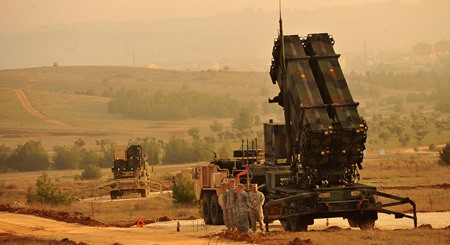
 U.S. Service members stand by a Patriot missile battery in Gaziantep, Turkey, Feb. 4, 2013, during a visit from U.S. Deputy Secretary of Defense Ashton B. Carter, not shown. U.S. and NATO Patriot missile batteries and personnel deployed to Turkey in support of NATO’s commitment to defending Turkey’s security during a period of regional instability. (DoD photo by Glenn Fawcett)
Unlike in Syria . . . in Iraq the US relates to the official government, mistakenly, as an ally. This is leading to a potentially disastrous situation whereby US air power is currently partnering with Iran-supported Shia militias against the Islamic State.
The most powerful of these militias have a presence in the government of Iraq. But they do not act under the orders of the elected Baghdad government, but rather in coordination with their sponsors in the Qods Force of the Iranian Revolutionary Guards Corps.
The Kurds, because of the existence among them of a secular, pro-western nationalist politics with real popular appeal, have unsurprisingly emerged as the only reliable partner. On both the Shia and the Sunni sides, the strongest and prevailing forces are anti-western.
This reality is denied both by advocates for rapprochement with Iran, and by wishful-thinking supporters of the Syrian rebellion. But it remains so.
*****************
Recently, I attempted to undertake a reporting trip into the Kurdish Kobani enclave in northern Syria. It would not have been my first visit, neither to Syria nor to Kobani. For the first time, however, I found myself unable to enter. Instead, I spent a frustrating but, as it turns out, instructive four days waiting in the border town of Suruc in south-east Turkey before running out of time and going home.
The episode was instructive because of what it indicated regarding the extent to which Kurdish control in the enclaves established in mid 2012 is now a fact acknowledged by all neighboring players, including the enemies of the Kurds. This in itself has larger lessons regarding US and western policy in Syria and Iraq.
But I am getting ahead of myself. First, let me complete the account of the episode on the border. My intention had been to enter Kobani ‘illegally’ with the help of the Kurdish YPG and local smugglers. This sounds more exciting than it is. I have entered Syria in a similar way half a dozen times over the last two years, to the extent that it has become a not very pleasant but mundane procedure. This time, however, something was different. I was placed in a local center with a number of other westerners waiting to make the trip. Then, it seemed, we were forgotten.
The westerners themselves were an interesting bunch, whose varied presence was an indication of the curious pattern by which the Syrian Kurdish cause has entered public awareness in the west.
There was a group of European radical leftists, mainly Italians, who had come after being inspired by stories of the ‘Rojava revolution.’ A little noted element of the control by the Syrian franchise of the PKK of de facto sovereign areas of Syria has been the interest that this has generated in the circles of the western radical left. These circles are ever on the lookout for something which allows their politics to encounter reality, in a way that does not bring immediate and obvious disaster. As of now, ‘Rojava,’ given the leftist credentials of the PKK, is playing this role. So the Europeans in question wanted to ‘contribute’ to what they called the ‘revolution.’
Unfortunately, their preferred mode of support was leading to a situation of complete mutual bewilderment between themselves and the local Kurds. Offered military training by their hosts, the radical leftists demurred. They would not hold a gun for Rojava before they had seen it and been persuaded that it did indeed represent the peoples’ revolution that they hoped for.
Instead, they had a plan for the rebuilding of Kobani along sustainable and environmentally friendly lines, using natural materials In addition, the health crisis and shortage of medicines in the devastated enclave led the radicals to believe that this might offer an appropriate context for popularizing various items of alternative and naturopathic medicine about which they themselves were enthusiastic. (I’m not making any of this up).
All this had elicited the predictable reaction from the Kurds, who were trying to manage a humanitarian disaster and a determined attempt by murderous jihadis to destroy them. ‘Perhaps you could do the military training first and then we could talk about the other stuff?’ suggested Fawzia, the nice and helpful representative of the PYD who was responsible for us. This led to further impassioned and theatrical responses from the Italians.
Apart from this crowd, there was a seasoned Chilean war reporter who looked on the leftists with impatience. He was looking to get down to the frontlines south of Kobani, where the YPG was trying to cut the road from Raqqa to Aleppo at an important point close to the Euphrates.
Also, there was a polite and friendly lone American, a Baptist Christian, who had come to volunteer his services to the YPG. That was us.
But as the days passed, it became clear that none of us appeared to be getting anywhere near Kobani any time soon.
The reasons given for the delay were plentiful, and unconvincing. ‘It is the weather,’ Fawzia would say vaguely, ‘too much mud.’ But the presence of mud on the border in February was hardly a new development, so this couldn’t be the reason.
Finally, frustrated at the lack of information, I called a PKK friend based in Europe and asked for his help in finding out why we weren’t moving. He got back to me a little later. ‘It seems the Turkish army is all over the border, more than usual. That’s the reason,’ he told me.
This was more plausible, if disappointing. After four days on the border, I was out of time and set off back for Gaziantep and then home. The Italians went to Diyarbakir to take part in a demonstration. The Chilean and the American volunteer stayed and waited.
When I got back to Jerusalem, all rapidly became clear. News reports were coming in about a large operation conducted by the Turkish army through Kobani and into Syria. The operation involved the evacuation of the Turkish garrison at the tomb of Suleiman Shah, south of the enclave. The American volunteer sent me a picture of the Turkish tanks on tank transporters driving though Suruc at the conclusion of the operation.
This operation was astonishing on a number of levels.
Despite stern Turkish denials, it could only have been carried out on the basis of full cooperation between the Turkish armed forces and the Kurdish fighters of the YPG in Kobani. Obviously, any unauthorized entry of Turkish troops into the Kurdish canton would have meant an armed battle.
During the fight for Kobani last year, the Turkish government was very clearly quite content for the enclave to fall. The Turkish army waited on the border, as the prospect of a generalized slaughter of the Kurds in Kobani came close to realization.
But of course, the slaughter didn’t happen. In the end, the partnering of US air power with the competent and determined forces of the YPG on the ground delivered the first real defeat to the forces of the Islamic State in Syria.
This effective partnering has continued, and has now become the main military element in northern Syria in the battle against IS.
The combination of the YPG and the USAF is now nudging up to a second strategic achievement against the jihadis – namely, the cutting of the road from Tel Hamis to the town of al-Houl on the Iraqi border. This road forms one of the main transport arteries linking the Islamic State’s conquests in Iraq to its heartland in the Syrian province of Raqqa. If the links are cut, the prospect opens for the splitting of the Islamic State into a series of dis-connected enclaves.
The YPG-US partnership is particularly noteworthy, given that the YPG is neither more nor less than the Syrian representative of the PKK. The latter, meanwhile, is a veteran presence on the US and EU lists of terror organizations. Despite a faltering peace process, the PKK remains in conflict with Turkey, a member of NATO.
But the reality of the Kurdish-US alliance in northern Syria has clearly now been accepted by the Turks as an unarguable fait accompli, to the extent that they are now evidently willing to work together with the armed Syrian Kurds, where their interests require it.
It is an astonishing turnabout in the fortunes of the Kurds of Syria, who before 2011 constituted one of the region’s most brutally oppressed, and most forgotten minority populations.
This raises the question as to why this reversal of fortune has taken place.
Why is the YPG the chosen partner of the Americans in northern Syria, just as the Kurdish Pesh Merga further east is one of the preferred partners on the ground in Iraq?
The answer to this is clear, but not encouraging. It is because in both countries, the only reliable, pro-western and militarily effective element on the ground is that of the Kurds.
Consider: in northern Syria, other than the forces of the Islamic State, there are three other elements of real military and political import. These are the forces of the Assad regime, the al-Qaeda affiliated Jabhat al-Nusra and the YPG.
In addition, there are a bewildering variety of disparate rebel battalions, with loyalties ranging from Salafi Islamism to Muslim Brotherhood style Islamism, to non-political opposition to the Assad regime. Some of these groups operate independently. Others are gathered in local alliances such as the Aleppo based Jabhat al-Shamiya (Levant Front), or the Syria-wide Islamic Front, which unites Salafi factions.
Despite the reported existence of a US staffed military operations room in Turkey, the latter two movements are either too weak, or too politically suspect (because of their Islamist nature), to form a potential partner for the US in northern Syria.
Nusra is for obvious reasons not a potential partner for the US in the fight against the Islamic State. And the US continues to hold to its stated goal that Bashar Assad should step down. So the prospect of an overt alliance between the regime and the US against the Islamic State is not on the cards (despite the de facto American alliance with Assad’s Iran-supported Shia Islamist allies in Iraq).
This leaves the Kurds, and only the Kurds, to work with. And the un-stated alliance is sufficiently tight for it to begin to have effects also on Turkish-Kurdish relations in Syria, as seen in the Suleiman Shah operation.
But what are the broader implications of this absence of any other coherent partner on the ground?
The stark clarity of the northern Syria situation is replicated in all essentials in Iraq, though a more determined attempt by the US to deny this reality is under way in that country.
In Iraq, there is a clear and stated enemy of the US (the Islamic State), a clear and stated Kurdish ally of the west (the Kurdish Regional Government and its Pesh Merga) and an Iran-supported government which controls the capital and part of the territory of the country.
Unlike in Syria, however, in Iraq the US relates to the official government, mistakenly, as an ally. This is leading to a potentially disastrous situation whereby US air power is currently partnering with Iran-supported Shia militias against the Islamic State.
The most powerful of these militias have a presence in the government of Iraq. But they do not act under the orders of the elected Baghdad government, but rather in coordination with their sponsors in the Qods Force of the Iranian Revolutionary Guards Corps.
It is possible that the current partnering with Shia Islamist forces in Iraq is the result of a general US attempt now under way to achieve a historic rapprochement with Iran, as suggested by Michael Doran in a recent essay. Or it may be that this reality has emerged as a result of poor analysis of the realities of the Levant and Iraq, resulting in a confused and flailing policy. But either way, the result is an astonishing mess.
In northern Syria, the obvious absence of any partners other than the Kurds has produced a momentary tactical clarity. But as the larger example of Iraq shows, this clarity is buried in a much larger strategic confusion.
This confusion, at root, derives from a failure to grasp what is taking place in Syria and in Iraq.
In both countries, the removal or weakening of powerful dictatorships has resulted in the emergence of conflict based on older, sub-state ethnic and sectarian identities. The strength and persistence of these identities is testimony to the profound failure of the states of Syria and Iraq to develop anything resembling a sustainable national identity. In both Syria and Iraq, the resultant conflict is essentially three-sided. Sunni Arabs, Shia/Alawi Arabs and Kurds are fighting over the ruins of the state.
Because of the lamentable nature of Arab politics at the present time, the form that both Arab sides are taking is that of political Islam. On the Shia side, the powerful Iranian structures dedicated to the creation and sponsorship of proxy movements are closely engaged with the clients in both countries (and in neighboring Lebanon.)
On the Sunni Arab side, a bewildering tangle of support from different regional and western states to various militias has emerged. But two main formations may be discerned. These are the Islamic State, which has no overt state sponsor, and Jabhat al-Nusra, which has close links to Qatar.
In southern Syria, a western attempt to maintain armed forces linked to conservative and western-aligned Arab states (Jordan, Saudi Arabia) has proved somewhat more successful because of the close physical proximity of Jordan and the differing tribal and clan structures in this area when compared with the north. Even here, however, Nusra is a powerful presence, and Islamic State itself recently appeared in the south Damascus area.
The Kurds, because of the existence among them of a secular, pro-western nationalist politics with real popular appeal, have unsurprisingly emerged as the only reliable partner. On both the Shia and the Sunni sides, the strongest and prevailing forces are anti-western.
This reality is denied both by advocates for rapprochement with Iran, and by wishful-thinking supporters of the Syrian rebellion. But it remains so. What are its implications for western policy?
Firstly, if the goal is to degrade the Islamic State, reduce it, split it, impoverish it, this can probably be achieved through the alliance of US air power and Kurdish ground forces. But if the desire, genuinely, is to destroy the Islamic State, this can only be achieved through the employment of western boots on the ground. This is the choice which is presented by reality.
Secondly, the desire to avoid this choice is leading to the disastrous partnering with Iraqi Shia forces loyal to Iran. The winner from all this will be, unsurprisingly, Iran. Neither Teheran nor its Shia militias are the moral superiors to Islamic State. The partnering with them is absurd both from a political and an ethical point of view.
Thirdly, the determination to maintain the territorial integrity of ‘Syria’ and ‘Iraq’ is one of the midwives of the current confusion. Were it to be acknowledged that Humpty cannot be put back together again, it would then be possible to accurately ascertain which local players the west can partner with, and which it can not.
As of now, the determination to consider these areas as coherent states is leading to absurdities including the failure by the US to directly arm the pro-US Pesh Merga because the pro-Iranians in Baghdad object to this, the failure to revive relations with and directly supply Iraqi Sunni tribal elements in IS controlled areas for the same reason, and the insistence on relating to all forces ostensibly acting on behalf of Baghdad as legitimate.
Ultimately, the mess in the former Syria and Iraq derives from a very western form of wishful thinking that is common to various sides of the debate in the west. This is the refusal to accept that political Islam, of both Shia and Sunni varieties, has an unparalleled power of political mobilization among Arab populations in the Middle East at the present time, and that political Islam is a genuinely anti-western force, with genuinely murderous intentions.
For as long as that stark reality is denied, western policy will resemble our Italian leftist friends on the border, baffled and bewildered as they go about proposing ideas and notions utterly alien to and irrelevant to the local situation.
The reality of this situation means that the available partners for the west are minority nationalist projects such as that of the Kurds (or the Jews,) and traditional, non-ideological conservative elites – such as the Egyptian military, the Hashemite monarchs, and in a more partial and problematic way, the Gulf monarchs. Attempts to move beyond this limited but considerable array of potential allies will result in the strengthening of destructive, anti-western Islamist forces in the region, of either Sunni or Shia coloration.
As for the Syrian Kurds, they deserve their partnership with US air power, and the greater security it is bringing them.
The American Baptist volunteer, to conclude the story, made it across the border and is now training with the YPG. He, at least, has a clear sense of who is who in the Middle East. Hopefully, this sense will eventually percolate up to the policymaking community too.
 Dimona nuclear reactor circa 1960sNational Security Archive/Flash 90





 anneinpt
 artaxes
 danmillerinpanama
 davidking1530
 Peter Hofman
 Joseph Wouk
 Peter
Peter Louisiana Steve
 WarSclerotic
Recent Comments