Archive for March 14, 2015

ISIS-Sinai Is packing large water tankers with explosives

March 14, 2015

ISIS-Sinai Is packing large water tankers with explosives, DEBKAfile, March 14, 2015

(Please see also, IDF braces for Islamic State attack on Israel-Egypt border. — DM>

Egyptian military sources report that the ISIS Sinai affiliate has been discovered rounding up a large fleet of water and fuel tankers and big lorries and packing them with explosives for large-scale terrorist attacks on Egyptian and Israeli targets. The group which calls it’s the Sinai Province of the Islamist Caliphate tried the method out on March 4, using an explosives-packed water tanker to storm an Egyptian military compound in the Kawthar district of the northern Sinai town of Sheikh Zuweid. On March 10, they seized another water tanker at al-Towil east of El Arish, and on March 11, in the same area, they captured two large trucks of the Egyptian electricity company and pushed the drivers out.
Thursday, March 13, Col. Arik Hen of the IDF’s 80th Division said the military was on the alert for a major coordinated ISIS attack on Eilat from Sinai and the sea.

War with Iran is probably our best option – The Washington Post

March 14, 2015

War with Iran is probably our best option – The Washington Post.


Iran’s Supreme Leader Ayatollah Ali Khamenei on March 8, 2015. (Ho/AFP/Getty Images)

March 13 at 8:27 PM

Joshua Muravchik is a fellow at the Foreign Policy Institute of Johns Hopkins University’s School of Advanced International Studies.

The logical flaw in the indictment of a looming “very bad” nuclear deal with Iran that Israeli Prime Minister Benjamin Netanyahu delivered before Congress this month was his claim that we could secure a “good deal” by calling Iran’s bluff and imposing tougher sanctions.

The Iranian regime that Netanyahu described so vividly — violent, rapacious, devious and redolent with hatred for Israel and the United States — is bound to continue its quest for nuclear weapons by refusing any “good deal” or by cheating.

This gives force to the Obama administration’s taunting rejoinder: What is Netanyahu’s alternative? War? But the administration’s position also contains a glaring contradiction. National security adviser Susan Rice declared at an American Israel Public Affairs Committee conference before Netanyahu’s speech that “a bad deal is worse than no deal.” So if Iran will accept only a “bad deal,” what is President Obama’s alternative? War?

Obama’s stance implies that we have no choice but to accept Iran’s best offer — whatever is, to use Rice’s term, “achievable” — because the alternative is unthinkable.

But should it be? What if force is the only way to block Iran from gaining nuclear weapons? That, in fact, is probably the reality. Ideology is the raison d’etre of Iran’s regime, legitimating its rule and inspiring its leaders and their supporters. In this sense, it is akin to communist, fascist and Nazi regimes that set out to transform the world. Iran aims to carry its Islamic revolution across the Middle East and beyond. A nuclear arsenal, even if it is only brandished, would vastly enhance Iran’s power to achieve that goal.

Such visionary regimes do not trade power for a mess of foreign goods. Materialism is not their priority: They often sacrifice prosperity to adhere to ideology. Of course, they need some wealth to underwrite their power, but only a limited amount. North Korea has remained dirt poor practicing its ideology of juche, or self-reliance, but it still found the resources to build nuclear weapons.

Sanctions may have induced Iran to enter negotiations, but they have not persuaded it to abandon its quest for nuclear weapons. Nor would the stiffer sanctions that Netanyahu advocates bring a different result. Sanctions could succeed if they caused the regime to fall; the end of communism in Ukraine and Kazakhstan, and of apartheid in South Africa, led to the abandonment of nuclear weapons in those states. But since 2009, there have been few signs of rebellion in Tehran.

Otherwise, only military actions — by Israel against Iraq and Syria, and through the specter of U.S. force against Libya — have halted nuclear programs. Sanctions have never stopped a nuclear drive anywhere.

Does this mean that our only option is war? Yes, although an air campaign targeting Iran’s nuclear infrastructure would entail less need for boots on the ground than the war Obama is waging against the Islamic State, which poses far smaller a threat than Iran does.

Wouldn’t an attack cause ordinary Iranians to rally behind the regime? Perhaps, but military losses have also served to undermine regimes, including the Greek and Argentine juntas, the Russian czar and the Russian communists.

Wouldn’t destroying much of Iran’s nuclear infrastructure merely delay its progress? Perhaps, but we can strike as often as necessary. Of course, Iran would try to conceal and defend the elements of its nuclear program, so we might have to find new ways to discover and attack them. Surely the United States could best Iran in such a technological race.

Much the same may be said in reply to objections that airstrikes might not reach all the important facilities and that Iran would then proceed unconstrained by inspections and agreements. The United States would have to make clear that it will hit wherever and whenever necessary to stop Iran’s program. Objections that Iran might conceal its program so brilliantly that it could progress undetected all the way to a bomb apply equally to any negotiated deal with Iran.

And finally, wouldn’t Iran retaliate by using its own forces or proxies to attack Americans — as it has done in Lebanon, Iraq and Saudi Arabia — with new ferocity? Probably. We could attempt to deter this by warning that we would respond by targeting other military and infrastructure facilities.

Nonetheless, we might absorb some strikes. Wrenchingly, that might be the price of averting the heavier losses that we and others would suffer in the larger Middle Eastern conflagration that is the likely outcome of Iran’s drive to the bomb. Were Iran, which is already embroiled in Iraq, Syria, Yemen, Lebanon and Gaza, further emboldened by becoming a “nuclear threshold state,” it would probably overreach, kindling bigger wars — with Israel, Arab states or both. The United States would probably be drawn in, just as we have been in many other wars from which we had hoped to remain aloof.

Yes, there are risks to military action. But Iran’s nuclear program and vaunting ambitions have made the world a more dangerous place. Its achievement of a bomb would magnify that danger manyfold. Alas, sanctions and deals will not prevent this.

Hamas’ revamped naval commandos could pose a problem for Israel

March 14, 2015

Hamas’ revamped naval commandos could pose a problem for Israel, Ynet News, Alex Fishman, March 14, 2015

Although all unit members were killed during last summer’s infiltration attempt at Zikkim, Hamas viewed this as a massive achievement and subsequently trained a new force whose role will be to carry out mass attacks on the Israeli home front.

Palestinian Islamist organization Hamas has completed the reconstruction of its naval commando force, consisting of dozens of trained divers, in order to hit strategic sites, Israeli and others’, in the Mediterranean Sea.

With the development of its underwater unit, Hamas aims to compensate for the failure of the offensive tunnels from the Gaza Strip, which it rules, which were supposed to reach into Israel. From just a handful, the force has grown into many dozens of fighters trained to strike the Israeli home front via abductions and killings.

Hamas’s operational approach sees the naval commandos as one long “tunnel”, extending from Gaza in Israel’s south to Rosh Hanikra in the north, through which it could hit any target along the entire Israeli coast. These could be strategic objectives such as power plants, coal terminals, gas rigs and so on. However, using Operation Protective Edge as a model, it seems that Hamas is training its commandos to create a continuous shockwave for Israeli society through the mass murder of civilians and soldiers.

Hamas diversHamas’ infiltration attempt at Zikim during Protective Edge (Photo: IDF)

The Israeli defense establishment sees the strengthening of Hamas’ underwater activity – through the establishment of a large and professional commando unit – as one of the main lessons Hamas took from last summer’s conflict.

The Hamas commandos’ successful penetration a kilometer deep within Israeli territory, near Kibbutz Zikkim, is one of the organization’s major achievements during the 50 days of fighting, as this was the only time when Hamas special unit members managed to infiltrate Israel. If not for Israeli intelligence, it is likely the commando unit would have been able to penetrate the community or a nearby IDF base and carry out the mass murder it wanted.

Earlier this week, Egyptian newspaper “Al-Akhbar” reported that the creation of the naval commando unit was intended to harm Egypt’s facilities in the Mediterranean. The Egyptians, who have signed a gas deal with Israel, are worried about damage to the Tethys Sea group’s installation, while accusing Hamas of conducting sea-based attacks on Egyptian naval forces.

In November 2014, an Egyptian patrol boat was attacked as it conducted an operation against smuggling from the Gaza Strip. The attack was carried out by three rubber boats in the Egyptian Delta, near the port of Damietta. The perpetrators seized control of the ship, killed 13 Egyptian soldiers and hoisted the Islamic State flag.

The Egyptians blamed Hamas for supporting and being party to attacks of this kind, and significantly changed the security measures on their ships. Even the commands to open fire have changed, and the Egyptians shoot to destroy Gazan fishing boats that approach them without prior coordination.

In light of the accusations, Hamas leader Mahmoud Zahar was quick to issue a denial in the Al-Quds newspaper, saying that Hamas was not planning to wave underwater warfare in the area.

It was until Operation Pillar of Defense in November 2012 that the Hamas naval force was viewed as amateurish. But since that operation, Hamas was been working on setting up a large professional unit – its people were sent abroad for training, most likely to Iran, and it procured military-grade diving equipment.

During last summer’s infiltration at Zikkim, Israel registered the use of military standard systems, which prevent bubbles from surfacing during a dive. Hamas also has a small underwater craft, known as a “scooter”, for individual divers, and has even published pictures of them for propaganda purposes. It appears that following the collapse of diving tourism in Sinai, the club owners were happy to sell some advanced diving equipment.

The training of the reinvigorated commando unit is largely reminiscent of the training for elite units in conventional armies, including the ability to withstand physical and mental pressure that is customary within professional naval commando units in the region.

The defense establishment and the IDF are preparing for an increased threat from this underwater force. It should be noted that during Protective Edge, this unit only sustained partial damage, and in any future conflict its infiltration efforts will be a force to be reckoned with for Israel.

Houthis say they have secured aid package from Iran

March 14, 2015

Houthis say they have secured aid package from Iran

Spokesperson says Tehran has pledged to expand Yemen’s ports, help build power plants and provide Yemen with oil.

14 Mar 2015 12:51 GMT

via Houthis say they have secured aid package from Iran – Al Jazeera English.


Look Brennan civilians, not terrorist !


The UN warned this week that the situation in Yemen can spiral into something similar to Syria, Libya or Iraq [Reuters]
Yemen’s de-facto rulers, the Shia Houthi rebels, say they have secured an economic aid package from Iran.

A delegation of Houthis just returned from Iran and a spokesperson said Iran had pledged to expand Yemen’s ports, help build power plants and provide Yemen with enough oil to last a year.

Yemen is caught in a standoff between deposed president Abd-Rabbu Mansour Hadi and the Houthi rebels, who seized control of the capital Sanaa and staged a coup in February by dissolving the country’s parliament and creating a “presidential council”.

A spokesman for the exiled government, Rajeh Badi, said the Houthis would be the only ones to benefit from a deal with Iran.

The Iranian interference is merely, inside or outside Yemen, about military support to some militias or military groups,” Badi said.

The United Nations warned this week that the situation in Yemen can spiral into something similar to Syria, Libya or Iraq if no solution is found through talks between the country’s rival parties.

The UN special envoy to Yemen, Jamal Benomar, told Al Jazeera on Thursday that there was a real danger of the country disintegrating and a civil war erupting.

Benomar has been meeting all parties in Yemen as well as regional powers in a bid to resolve the country’s crisis

“If there is no agreement, the prospects are very bleak. It’s a combination of scenarios like Syria, Libya and Iraq. It’s a horrible scenario and all sides are aware that every effort should be made for a peaceful way forward.”

The Houthi takeover has also stoked secessionist sentiments in the south, raising fears of a repeat of the 1994 civil war, when the formerly independent south attempted to break away from its union with the north, forged four years earlier.

John Brennan, CIA director: Social media ‘greatly amplifies’ terror threat

March 14, 2015

CIA director: Social media ‘greatly amplifies’ terror threat

via John Brennan, CIA director: Social media ‘greatly amplifies’ terror threat – Washington Times.


Photo by: Pablo Martinez Monsivais

CIA Director John Brennan said Friday that changing technology and social media websites have “greatly amplified” the security threats facing the free world.

Mr. Brennan told the Council on Foreign Relations in New York that the Islamic State group, for example, uses new technologies to “coordinate operations, attract new recruits, disseminate propaganda, and inspire sympathizers across the globe to act in their name,” Reuters reported.

The CIA director said that the Sunni radical terror group has grown to roughly 20,000 fighters from more than 90 countries.

“The overall threat of terrorism is greatly amplified by today’s interconnected world, where an incident in one corner of the globe can instantly spark a reaction thousands of miles away; and where a lone extremist can go online and learn how to carry out an attack without ever leaving home,” he said.

Mr. Brennan said the January attack on France’s Charlie Hebdo satirical newspaper was an example of how social media can aid and promote decentralized terror threats.

French brothers Said and Cherif Kouachi killed 12 people Jan. 7, including the paper’s editor, before dying in a shootout with police.

Copyright © 2015 The Washington Times, LLC. Click here for reprint permission.

Bibi’s a bad deal

March 14, 2015

Bibi’s a bad deal
Mar 14th 2015 | From the print edition Via The Economist


(In an effort to be more ‘fair and balanced, I’m going to play the devil’s advocate and post this opinion piece I just found. With the elections coming up, it will be interesting to see if and who gets a mandate to take a more aggressive stand against the threats facing Israel today. Like the old saying goes, “Let’s run it up the flagpole and see who salutes.” – LS)

The prime minister’s failures outweigh his achievements. Israelis should back Yitzhak Herzog

BINYAMIN NETANYAHU is articulate, dashing—and distrusted, by friends and foes alike. Nicolas Sarkozy, a former French president, was once heard telling Barack Obama: “I can’t stand him. He’s a liar.” Mr Obama did not demur.

This month the Israeli prime minister offered fresh glimpses of his deviousness. Following reports that he had offered the Palestinians more generous terms than his rhetoric admits, Mr Netanyahu (pictured, right) tried to regain right-wing support by repudiating his acceptance, in a speech in 2009, of (strictly limited) Palestinian statehood. This leaves a big question: is the real Bibi a man of negotiation, or of occupation? Recklessly, he gambled with bipartisan American support for Israel when he defied Mr Obama by brazenly appearing before a Republican-dominated Congress to denounce the administration’s nuclear negotiations with Iran: “This is a bad deal. It’s a very bad deal. We’re better off without it.”

On March 17th Israeli voters will have their say on Bibi (see article). In this newspaper’s view he has been a bad deal for Israel. It is better off without him. His challenger, Yitzhak “Bougie” Herzog (pictured, left), is not charismatic. But he is level-headed and has a credible security and economic team. He wants talks with the Palestinians and to heal ties with Mr Obama. He deserves a chance to prove himself.

Prime minister, you’re no David Ben-Gurion. In office for the past six years, having served a three-year stint in the 1990s, Mr Netanyahu is now Israel’s longest-serving leader since David Ben-Gurion. That is a remarkable feat for a man whose father once doubted his suitability for the job. Mr Netanyahu’s longevity is due to many factors, not least luck, cunning, a silver tongue and the loyalty of the Likud party. But his achievements are outweighed by his many flaws.

On the positive side, he has liberalised the Israeli economy and promoted a thriving high-tech sector. He navigated skilfully through the financial crisis and the long slump in Europe, Israel’s largest trading partner. He kept Iran’s nuclear programme at the forefront of world attention. He also kept Israel safe after the Arab-spring revolts of 2011, which toppled leaders and cracked fossilised states across the region. The jihadists and Shia militias that filled the void might have turned their guns on Israel, and may yet do so. For the time being they are killing each other. In the turmoil Israel has forged closer ties with Egypt and, more secretly, with Arab monarchies.

Against this, Bibi’s preservation of the military occupation in the West Bank and the stranglehold over Gaza Strip must count heavily against him. He has refused to make any genuine concessions to the Palestinians, on the ground that “there is no partner for peace”—even though Mahmoud Abbas, the Palestinian president, has abjured violence and maintained security co-operation with Israel in the West Bank (Gaza is controlled by the Islamist Hamas movement). Mr Abbas himself has plenty of shortcomings, but he has also been deliberately weakened by Mr Netanyahu. Israel has cut off Palestinian tax revenues in retaliation for Mr Abbas’s decision to join the International Criminal Court. The pragmatism that Mr Netanyahu sometimes expresses is belied by his actions: he has expanded settlements, thus breaking up Palestinian areas and making a mockery of the very notion of Palestinian statehood.

To Israelis traumatised by missiles and rockets, Mr Netanyahu sounds plausible when he claims that giving the Palestinians control over their own land will bring more violence. The turmoil of the Arab world deepens these fears. Had Israel handed the Golan Heights back to Syria, it might now find itself facing fighters from Hizbullah, al-Qaeda or Islamic State on the Sea of Galilee.

However, without a Palestinian state, Israel will either endanger its Jewish majority or lose its moral standing by subjugating and disenfranchising the Palestinian population. Israel will lose support abroad even when it legitimately defends itself. In the final days of the campaign, Mr Netanyahu may well play up the dangers from Iran, jihadists and Hamas. But the truth is that immobilism, too, is endangering Israel.

Iran’s advances create alarm in Saudi Arabia and the Gulf

March 14, 2015

Iran’s advances create alarm in Saudi Arabia and the Gulf, the Guardian,  March 13, 2015

Arabs believe Baghdad, Damascus, Beirut and Sana’a are in effect under Iranian control – and power may shift further if US sanctions are eased.

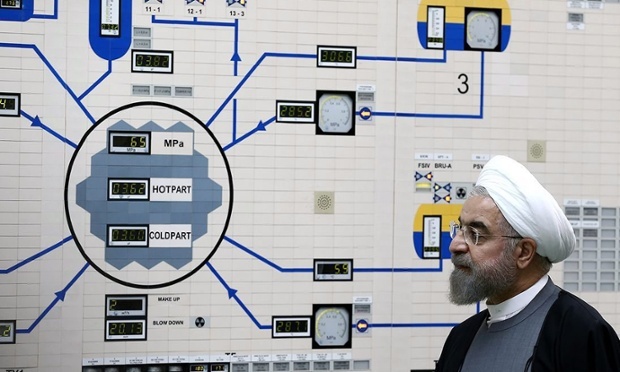
c0ac3569-93da-4ae8-8b51-29dc6991ee13-620x372 Hassan Rouhani, the Iranian president, visiting Bushehr nuclear power plant in southern Iran this year. Photograph: Presidential official handout/EPA

Iran’s great advantage, suggests Emile Hokayem, an analyst, is its commitment and competence, in Syria and beyond. “The expertise, experience and strategic patience it deployed in support of the Syrian regime to a great extent facilitated Assad’s recovery from serious setbacks in 2012. In contrast, the war in Syria has exposed not only the political and operational limitations of the Gulf states, but also the rivalries among them.”

*********************

The commanders of Iran’s Islamic Revolutionary Guard Corps (IRGC) have been working overtime recently, flaunting their achievements across the Middle East and flexing muscles as international negotiations over the country’s nuclear programme enter their critical and perhaps final phase.

On Wednesday it was the turn of Major-General Mohammad Ali Jafari, the IRGC’s most senior officer. “The Islamic revolution is advancing with good speed, its example being the ever-increasing export of the revolution,” he declared. “Not only Palestine and Lebanon acknowledge the influential role of the Islamic Republic but so do the people of Iraq and Syria. They appreciate the nation of Iran.”

Last month a similarly boastful message was delivered by General Qassem Suleimani, who leads the IRGC’s elite Quds force — and who is regularly photographed leading the fightback of Iraqi Shia miltias against the Sunni jihadis of the Islamic State (Isis) as well as against western and Arab-backed rebels fighting Bashar al-Assad in southern Syria. “Imperialists and Zionists have admitted defeat at the hands of the Islamic Republic and the resistance movement,” Suleimani said.

Iran’s advances are fuelling alarm in Saudi Arabia and the Gulf, where Tehran has been a strategic rival since the days of the Shah, and which now, it is said with dismay, in effect controls four Arab capitals – Baghdad, Damascus and Beirut and in the last month Sana’a in Yemen – which is uncomfortably close to home.

Iran’s regional position has certainly improved. Its high-profile role fighting Isis in Iraq, Assad’s retention of control in Syria with the help of its Lebanese ally Hezbollah, and the Houthi rebel takeover in Yemen have all been deeply discomfiting for the Saudis. Anti-government protests in Shia-majority Bahrain are also often blamed on Tehran — though that ignores the domestic roots of the unrest.

In Riyadh King Salman has dropped his preoccupation with the Muslim Brotherhood in favour of building a united Sunni Arab front to confront the Iranians, diplomats say, though translating that strategy into action is another matter. The message from Saudi Arabia and the United Arab Emirates is that whatever the outcome of the nuclear talks, Iran is bent on expanding its power and influence. “The Iranians have scored major victories but only where there are Shia minorities,” a senior Gulf official told the Guardian. “Our concern is that the nuclear issue will become a tool of their foreign policy.”

Arab alarm is shared by Israel. Binyamin Netanyahu used identical arguments in his recent speech to the US Congress, timed to influence next week’s nuclear endgame in Geneva. “The Saudis will be incredibly worried that we are getting close to a point where the Iranians will be players because of the nuclear issue and the way the Americans have effectively ended up on the same side as the Iranians in Iraq,” said one veteran Saudi-watcher. “But the noise they are making is in inverse proportion to their ability to do anything about it.”

Arab governments are not reassured by the promises of John Kerry, the US secretary of state, that Washington is not seeking a “grand bargain” with Tehran that will allow it to “destabilise” the Middle East, bolstered by the easing of economic sanctions. Saud Al Faisal, the Saudi foreign minister, warned of Tehran’s “hegemonic” ambitions as the IRGC supported the military operation to retake the Iraqi town of Tikrit from Isis. In Gulf capitals Hassan Rouhani, the emollient Iranian president, is seen as less important than the hardline supreme leader, Ayatollah Ali Khamenei.

It is hard to disentangle propaganda from reality. But independent analysts argue that Iran is inflating its gains for both foreign and domestic consumption. “If you listen to Suleimani there is a degree of exaggeration,” argues Ali Ansari of St Andrews University. “It’s rhetorical reassurance. He is saying to Iranians: ‘We are powerful and and everyone is worried about this’ – partly to make the point that they are not really under pressure. People outside can see what Iran’s strengths and weaknesses are. But there is this belief that you need to negotiate from a position of strength and that if you are weak you will be trampled on.”

Iran-watcher Hossein Rassam also detects a domestic calculation in the IRGC statements. “Critics of Rouhani’s policy of rapprochement with the international community inside Iran can turn to the supreme leader and say there wasn’t really much need for that softer tone because now we have more bargaining chips in our hands. Iran is the only power in the region which can actually fight Isis and the west needs us for that.”

Meir Litvak, an Israeli expert on Iran, sees both genuine belief and posturing in Tehran’s stance. “The Iranians believe they have been able to save the Assad regime from total collapse and there is at least stalemate in Syria,” he said. “That means they have been able to maintain the link with Hezbollah and maybe open a second front by proxy against Israel on the Golan Heights. The Houthi rebellion in Yemen was initially a genuinely domestic affair but the Iranian regime saw it as an opportunity. And it has become a bonus for it – even if they are not that active inYemen. But if the Saudis are scared that’s a plus for the Iranians.”

Arab diplomatic sources say they expect to see an IRGC and Hezbollah presence in Yemen, helped by a new agreement on regular flights between Tehran and Sana’a.

Iran’s role in Bahrain, where the Shia majority remains locked in confrontation with the Saudi-backed Sunni monarchy, is more about scoring propaganda points than material support – despite claims in Manama about Iran’s sinister role.

Still, in the heartlands of Iranian influence, Iraq and Syria, there have been significant costs as well as benefits, including the deaths of two senior IRGC commanders. Continuing sanctions and low oil prices – seen in Tehran as a deliberate strategy by the Saudis – have also made it harder to shell out billions of dollars to subsidise the Assad regime.

Iran’s great advantage, suggests Emile Hokayem, an analyst, is its commitment and competence, in Syria and beyond. “The expertise, experience and strategic patience it deployed in support of the Syrian regime to a great extent facilitated Assad’s recovery from serious setbacks in 2012. In contrast, the war in Syria has exposed not only the political and operational limitations of the Gulf states, but also the rivalries among them.”

Bad Lefty Idea Of The Week: Ally With Al-Qaeda

March 14, 2015

Foreign Policy Elite MEME OF THE WEEK: Accept ‘Moderate’ Al-Qaeda

How they learned to love Islamic terror.

By Patrick Poole

March 13, 2015 – 10:55 am

via Bad Lefty Idea Of The Week: Ally With Al-Qaeda | PJ Tatler.


As I’ve said here at PJ Media repeatedly, there are some ideas so profoundly stupid that they can only be taken seriously inside the political-media-academic bubble that stretches along the Washington, D.C.-New York-Boston corridor. These typically populate my annual year-end “National Security ‘Not Top 10′” review.

Such is the case with this week’s foreign policy “smart set” MEME OF THE WEEK: we need to accept “moderate” al-Qaeda in order to defeat “hardline” ISIS.

Understand, this is a continuation of a popular theme amongst the foreign policy “smart set.” See the “moderate Muslim Brotherhood,” which just a month ago declared all-out jihad on the Egyptian government. Or the New York Times, pitching “moderate” elements of the Iranian regime. Or current CIA director “Jihad” John Brennan calling for the U.S. to build up Hezbollah “moderates.” Or hapless academics proclaiming the “mellowing” of Hamas. Or the so-called “vetted moderate” Syrian rebel groups that, as I have reported here, regularly fight alongside ISIS and al-Qaeda and have even defected to those terror groups.

So why are the foreign policy elites now having to talk about engaging “moderate” al-Qaeda, of all things?

Because all of those previous “moderate” engagement efforts have ended in disaster. But rather than abandon the whole “moderate” theme, the foreign policy community seems intent to double-down on failure by continuing to move the “moderate” line.

First out of the gate this week was an article in Foreign Affairs by Harvard’s Barak Mendelsohn, “Accepting Al-Qaeda: The Enemy of the United States’ Enemy,” that argues:

Since 9/11, Washington has considered al-Qaeda the greatest threat to the United States, one that must be eliminated regardless of cost or time. After Washington killed Osama bin Laden in 2011, it made Ayman al-Zawahiri, al Qaeda’s new leader, its next number one target. But the instability in the Middle East following the Arab revolutions and the meteoric rise of the Islamic State of Iraq and al-Sham (ISIS) require that Washington rethink its policy toward al-Qaeda, particularly its targeting of Zawahiri. Destabilizing al-Qaeda at this time may in fact work against U.S. efforts to defeat ISIS.

Here’s how Foreign Affairs, published by the Council on Foreign Relations, billed this conventional wisdom:

There are several problems with Mendelsohn’s thesis. One problem that he barely acknowledges is that al-Qaeda is still a declared enemy and an active threat to the United States. They have said repeatedly that they intend to kill U.S. citizens and have continued to plot to do so. The enemy of my enemy can still also be my enemy.

A second pragmatic problem with trying to use Jabhat al-Nusra, al-Qaeda’s official affiliate in Syria, as a tool against ISIS is that the relationship between the two groups is constantly evolving. Not long ago, ISIS and Nusra were comrades-in-arms. Despite their present falling-out, within recent months they still occasionally worked together: in August they joined forces to attack Lebanese border checkpoints; in September they were engaged in joint operations around Qalamoun. And Nusra appears more interested in wiping out the U.S.-backed “vetted moderate” groups and fighting the Assad regime than going head-to-head with ISIS.

Thus, it is considerably more likely that ISIS and al-Qaeda will engage in some form of reconciliation than al-Qaeda falling into the U.S. foreign policy orbit and serving as an anti-ISIS proxy in Syria.

So what drives the folly of the foreign policy “smart set”? Mostly it is the hubris that only they comprehend the vast and constantly changing complexity of international affairs, but also it is their added belief that their pals in the administration can harness this “smart set” omniscience to manipulate global events to a predicted end.

That rarely, if ever, happens. Just witness the Obama administration’s foreign policy disaster in Syria.

Mendelsohn has not been alone this week in calling for greater “acceptance” of al-Qaeda. Yesterday, the Wall Street Journal published Yaroslav Trofimov’s “Al-Qaeda a lesser evil? Syria war pulls U.S., Israel apart,” where he makes the following case:

MOUNT BENTAL, Golan Heights — This mountaintop on the edge of the Israeli-controlled Golan Heights offers a unique vantage point into how the complexities of the Syrian war raging in the plains below are increasingly straining Israel’s ties with the U.S.

To the south of this overlook, from which United Nations and Israeli officers observe the fighting, are the positions of the Nusra Front, the Syrian branch of al-Qaeda that the U.S. has targeted with airstrikes.

Nusra Front, however, hasn’t bothered Israel since seizing the border area last summer — and some of its severely wounded fighters are regularly taken across the frontier fence to receive treatment in Israeli hospitals.

To the north of Mount Bental are the positions of the Syrian government forces and the pro-Iranian Shiite militias such as Hezbollah, along with Iranian advisers. Iran and these militias are indirectly allied with Washington in the fight against Islamic State in Iraq. But here in the Golan, they have been the target of a recent Israeli airstrike. Israel in recent months also shot down a Syrian warplane and attacked weapons convoys heading through Syria to Hezbollah.

It would be a stretch to say that the U.S. and Israel are backing different sides in this war. But there is clearly a growing divergence in U.S. and Israeli approaches over who represents the biggest danger — and who should be seen, if not as an ally, at least as a lesser evil in the regional crisis sparked by the dual implosion of Syria and Iraq.

Trofimov’s argument boils down to: “Accept al-Qaeda! See, the Israelis are doing it!!!”

Needless to say, Trofimov’s article quickly received praise from the foreign policy “smart set,” including the Washington Post’s Jackson Diehl and The Century Foundation’s Michael Hanna:

A couple thoughts on this. First, some have treated the report of Israelis helping injured Nusra fighters in the Golan as some breaking game-changing news, but in fact Vice News reported on this back in December.

Secondly, I reported from the Golan here at PJ Media back in September 2013, and I even stood on Mount Bental and looked over the ruins of Quneitra while fighting raged across the border. And yet, that perspective didn’t help me magically see al-Qaeda as some lesser evil that we needed to engage or accept.

Thirdly, and I know this will strike some as heresy, the Israelis are not infallible and have seen this approach literally blow up on them. Take, for instance, the January 2009 Wall Street Journal article, “How Israel helped spawn Hamas“:

Surveying the wreckage of a neighbor’s bungalow hit by a Palestinian rocket, retired Israeli official Avner Cohen traces the missile’s trajectory back to an “enormous, stupid mistake” made 30 years ago.

“Hamas, to my great regret, is Israel’s creation,” says Mr. Cohen, a Tunisian-born Jew who worked in Gaza for more than two decades. Responsible for religious affairs in the region until 1994, Mr. Cohen watched the Islamist movement take shape, muscle aside secular Palestinian rivals and then morph into what is today Hamas, a militant group that is sworn to Israel’s destruction.

Instead of trying to curb Gaza’s Islamists from the outset, says Mr. Cohen, Israel for years tolerated and, in some cases, encouraged them as a counterweight to the secular nationalists of the Palestine Liberation Organization and its dominant faction, Yasser Arafat’s Fatah. Israel cooperated with a crippled, half-blind cleric named Sheikh Ahmed Yassin, even as he was laying the foundations for what would become Hamas. Sheikh Yassin continues to inspire militants today; during the recent war in Gaza, Hamas fighters confronted Israeli troops with “Yassins,” primitive rocket-propelled grenades named in honor of the cleric. […]

When Israel first encountered Islamists in Gaza in the 1970s and ’80s, they seemed focused on studying the Quran, not on confrontation with Israel. The Israeli government officially recognized a precursor to Hamas called Mujama Al-Islamiya, registering the group as a charity. It allowed Mujama members to set up an Islamic university and build mosques, clubs and schools. Crucially, Israel often stood aside when the Islamists and their secular left-wing Palestinian rivals battled, sometimes violently, for influence in both Gaza and the West Bank.

“When I look back at the chain of events I think we made a mistake,” says David Hacham, who worked in Gaza in the late 1980s and early ’90s as an Arab-affairs expert in the Israeli military. “But at the time nobody thought about the possible results.”

“Nobody thought about the possible results.” Yeah, there’s a lot of that going around.

I should note that this is not the first time that the foreign policy “smart set” has taken a run at the “engaging moderate al-Qaeda” meme. In January 2014, Foreign Affairs published an article titled “The Good and Bad of Ahrar al-Sham” which contended that the U.S. needed to “befriend” the Syrian jihadist group Ahrar al-Sham as some kind of counter to more extreme jihadist groups, like ISIS and Jabhat al-Nusra. The precedent they cited was the U.S. failure to designate the Taliban (!!!) after 9/11.

Mind you, at the time they wrote this one of Ahrar al-Sham’s top leaders was a lieutenant for al-Qaeda head Ayman al-Zawahiri who openly declared himself a member of al-Qaeda. After most of their leadership was wiped out in a bombing in September, they gravitated closer to the jihadist groups they were supposed to counter and their positions have been bombed by the U.S. – much to the consternation of other “vetted moderate” rebel groups.

The article was originally subtitled “An al-Qaeda affiliate worth befriending”: