Archive for March 11, 2015

Analysis: Iran is no partner in the fight against the Islamic State

March 11, 2015

Analysis: Iran is no partner in the fight against the Islamic State, Long War Journal and , March 11, 2015

B_vsofcXEAAtDRvQassem Soleimani (center) with his bodyguards near the frontlines of Tikrit.

Iran benefits from the threat of an Islamic State, and if the US continues its courtship of Tehran, it may find the Islamic State replaced by an Islamic Republic.

****************

Testifying on Capitol Hill on March 3, Joint Chiefs Chairman General Martin Dempsey characterized the joint attempts of the Iraqi military, Iraqi Shia militias, and Iran’s Islamic Revolutionary Guards Corps (IRGC) at taking back control of Tikrit, Saddam Hussein’s hometown, from the Islamic State, as “a positive thing.” “Frankly,” General Dempsey said, “it will only be a problem if it results in sectarianism.”

General Dempsey’s caveat is an interesting one, since there is every reason to believe that Shia control of Tikrit will result in further sectarianism. While the US administration says in its most recent National Security Strategy that it desires to “degrade and ultimately defeat ISIL [Islamic State]” in an attempt to “support Iraq … free itself from sectarian conflict and the scourge of extremists,” Tehran is actively perpetuating the sectarian crisis in Iraq.

The threat of the Islamic State, coupled with American “strategic patience,” not only makes the Iraqi Shia more dependent on Tehran and legitimizes Iran’s military presence in Iraq, it also provides the regime in Tehran with another bargaining chip in nuclear negotiations with the P5+1 Group.

In the past, the Iraqi Shia have demonstrated little interest in reducing themselves to puppets of Tehran. During the war with Iraq from 1980-1988, Iraqi nationalism trumped sectarian identity: the Shia constituted the rank and file of the Iraqi military, and Shia leaders in Iraq kept their distance from the regime in Tehran. After the collapse of Saddam Hussein’s regime in 2003, Iraq became a sanctuary to Iranian clerics critical of the regime in Tehran, including Hossein Khomeini, grandson of the founder of the Islamic Republic.

But Iraq did not remain a refuge for long. The civil war in Iraq, followed by the rise of Islamic State, forced moderate Iraqi Shia, who otherwise would have pursued a line independent of Iran, to become dependencies of Tehran. After being rebuffed by the US following the Islamic State’s takeover of Mosul in 2014, General Qassem Atta, head of the Iraqi National Intelligence Service, asked Tehran for help and received assistance within 48 hours. Iraqi Prime Minister Haider al Abadi continues to press Washington for more support in his fight against the Islamic State and uses US hesitancy to justify reliance on Iran, which according to Vice President Iyad Allawi,only increases Iran’s influence in Iraq and could lead to dismantlement of the Iraqi state.

The Obama administration may desire to help secure the survival of the Iraqi state, but the small contingent of US advisers in Iraq is relying on a heavily Iranian-influenced Iraqi sectarian intelligence and security apparatus. The Iraqi security forces are predominantly Shia, and in addition, Shia militias and “advisers” from the IRGC Quds Force are now fighting as legitimate Iraqi forces. 

This creates an environment in which targeting operations developed by Iranian forces and the militias have primacy over those developed by the US, leading to the possibility that  Washington could be portrayed by Islamic State as complicit in the indiscriminate targeting of Sunnis. Such operations will be perceived the same way by the very Sunnis we need to fight Islamic State, thus undermining the US strategy to “support Iraq … free itself from sectarian conflict and the scourge of extremists.”

Any US reliance on Iranian support in the fight against the Islamic State is also likely to strengthen Tehran’s bargaining position in the nuclear negotiations.

Although both US and Iranian negotiators maintain that nothing but the nuclear issue is being discussed, this of course is fiction. On Sept. 22, Fars News, quoting an anonymous American source, reported that Secretary of State John Kerry and Mohammad Javad Zarif, Iran’s foreign minister, discussed the nuclear issue as well as the fight against the Islamic State. And Admiral Ali Shamkhani, Iran’s Supreme National Security Council Secretary, has also connected both issues. Clearly, Tehran’s cooperation with Washington in the fight against the Islamic State comes at a price, which Washington must pay at the negotiating table in Geneva.

Iran has Washington where it wants it. Iran wants a favorable deal, and the Obama administration is signaling that such a deal is forthcoming. US “strategic patience” is allowing Iran to increase its influence and presence in Iraq and Syria. Assad is waiting out the Americans and the international community, and Shia militias are now viewed as legitimate forces in Iraq, Syria, and Yemen. But most importantly, US “strategic patience” signals to Iran an unwillingness to jeopardize the talks by linking them to Iran’s role in Iraq, Syria, and Yemen. 

Iran benefits from the threat of an Islamic State, and if the US continues its courtship of Tehran, it may find the Islamic State replaced by an Islamic Republic.

Sen. Cotton: Why we wrote the letter to Iran

March 11, 2015

Sen. Cotton: Why we wrote the letter to Iran
Tom Cotton 8:32 p.m. EDT March 10, 2015 Via USA Today


(Every once and while we have to remind Obama we live in a constitutional republic. – LS)

Iranian leaders need to know that the Senate must approve any deal President Obama negotiates.

The critical role of Congress in the adoption of international agreements was clearly laid out by our Founding Fathers in our Constitution. And it’s a principle upon which Democrats and Republicans have largely agreed.

In fact, then-Sen. Joe Biden once reflected on this very topic, writing that “the president and the Senate are partners in the process by which the United States enters into, and adheres to, international obligations.”

OUR VIEW: Heedless letter subverts nuclear talks

It’s not often I agree with former senator and now Vice President Biden, but his words here are clear. The Senate must approve any deal President Obama negotiates with Iran by a two-thirds majority vote.

Anything less will not be considered a binding agreement when President Obama’s term expires in two years. This is true of any agreement, but in particular with the nuclear deal President Obama intends to strike with Iran.

Unfortunately, despite our best efforts, the Obama administration has so far completely bypassed Congress in its negotiations with Iran.

The administration cares little about what will win congressional approval — only complete nuclear disarmament — and more about just reaching some sort of deal.

Regrettably, it appears the deal President Obama is negotiating with Iran will not be a good one. In fact, if reports are correct, it will be a bad one that will ultimately allow Iran to continue its nuclear program and ultimately develop a nuclear weapon.

That is why this week, I, along with 46 of my fellow senators, wrote Iranian leaders to inform them of the role Congress plays in approving their agreement. Our goal is simple: to stop Iran from obtaining a nuclear weapon.

I do not take my obligations as a senator lightly. Nor do those who are signatories to the letter. If the president won’t share our role in the process with his negotiating partner, we won’t hesitate to do it ourselves.

Our constituents elected us to the Senate, in part, to protect them from bad agreements like this and to help ensure their safety and security. And that is what we intend to do.

Sen. Tom Cotton, R-Ark., is a member of the Senate Armed Services Committee and the lead signatory to the open letter to Iran’s leaders.

Rouhani adviser denies he called for Iran’s return to empire

March 11, 2015

Rouhani adviser denies he called for Iran’s return to empire, Al-MonitorArash Karami, March 10, 2015

(An modest attempt at a partial walk-back. Please see also, Advisor To Iranian President Rohani: Iran Is An Empire, Iraq Is Our Capital . . . — DM)

Iran's former Intelligence Minister Younesi, chief nuclear negotiator Larijani and former chief nuclear negotiator Rohani attend conference in TehranIran’s former Intelligence Minister Ali Younesi (L), chief nuclear negotiator Ali Larijani and former chief nuclear negotiator and current President Hassan Rouhani (R) attend a conference on Iran’s nuclear policies and prospects in Tehran April 25, 2006. (photo by REUTERS/Raheb Homavandi)

Ali Younesi, President Hassan Rouhani’s adviser on Ethnic and Religious Minorities affairs, has issued a clarification about his comments suggesting a union between regional countries. His words had sparked criticism from the Arab-language media, which construed them as reviving Iran’s ancient empire. A former Iranian vice president who was at the conference also spoke out against Younesi’s comments.

Younesi accused Iran’s enemies of creating propaganda by misconstruing his comments at a March 8 conference on Iranian history and culture, saying that he was simply talking about a “historical and cultural unity” between certain countries in the region, including Iran, Tajikistan, Afghanistan and Iraq. He said that his proposal was for a “union” and “does not mean an empire should be reborn,” but rather that the neighbors should cooperate to confront mutual threats. He added that Iran’s official position is that “it respects the national boundaries and territorial integrity of other countries.”

Younesi was specifically criticized for saying, “Currently, Iraq is not only part of our civilizational influence, but it is our identity, culture, center and capital, and this issue is for today and the past. Because Iran and Iraq’s geography and culture are inseparable, either we fight one another or we become one.” He went on, “My meaning is not that we should remove our borders, but that all the countries of the Iranian plateau should become close because our interests and safety are intertwined.”

Younesi’s call for a “natural union” between these countries was not welcomed by Iran’s regional rivals, especially given the sensitivities of Arab countries in the Persian Gulf to Iran’s assistance to Iraqi forces currently battling the Islamic State in former Iraqi President Saddam Hussein’s hometown of Tikrit.

Saudi Arabian-funded Al-Arabiya incorrectly reported that Younesi had said, “Iran today has become an empire like it used to be through history, and its capital is now Baghdad. That is the center of our civilization and our culture and our identity today, as it has been in the past.” CNN Arabic wrote in their headline that Younesi said, “Iran is an empire and its capital is Iraq. We protect the region from Wahhabis, neo-Ottomans and atheists.” Though the first sentence in the CNN Arabic is incorrectly translated, Younessi did say in the March 8 conference that Iran was helping to protect the region from Wahhabi, takfiri, Zionist and Western domination. The Al-Arabiya article was tweeted over 3,000 times and shared on Facebook by over 4,000 people.

Former Iranian Vice President Mohammad Ali Abtahi also criticized Younesi, posting on Facebook immediately after attending the conference, “Now that the Arab countries in the region have reached a relative unity with Israel on fears about Iran, these comments will be construed as the same threatening talk of Ahmadinejad.” He added, “Irrespective of their governments, people have a sensitivity to their land, and this talk provokes people’s sensitivities.”

As Rouhani’s Ethnic and Religious Minorities adviser, Younesi has become known for reaching out to Iran’s Jewish population by laying wreaths at the graves of Jewish Iranians killed in the Iran-Iraq war, taking criticism from conservatives for suggesting Iran revert to its pre-revolution flag bearing the lion and sun and criticizing those who commit human rights violations in Iran. Though he was once minister of intelligence under President Mohammad Khatami, today his position carries no executive weight. But given the tensions between Iran and Arab countries in the Persian Gulf, it’s understandable that these comments would spark a backlash.

Policy Ban Reversed – Iranian Students Study Nuke Science In U.S. – Fox & Friends

March 11, 2015

Policy Ban Reversed – Iranian Students Study Nuke Science In U.S. – Fox & Friends via You Tube, March 11, 2015


Presidential Commitments Then and Now

March 11, 2015

Presidential Commitments Then and Now, Commentary Magazine, March 11, 2015

(Please see also State Dept Describes Iran Deal as ‘Nonbinding’ — DM)

The White House “outrage” at the “open letter” to Iran signed by 47 senators, led by Sen. Tom Cotton, was reinforced by Vice President Biden’s formal statement, which intoned that “America’s influence depends on its ability to honor its commitments,” including those made by a president without a vote of Congress. Perhaps we should welcome Biden’s belated insight. As Jonathan Tobin notes, President Obama on taking office in 2009 refused to be bound by the 2004 Gaza disengagement deal in the letters exchanged between President George W. Bush and Israeli Prime Minister Ariel Sharon. His secretary of state, Hillary Clinton, announced that such commitments were “unenforceable”–that they were non-binding on the new administration. In 2009, Obama disregarded previous commitments not only to Israel but also to Poland, the Czech Republic, and Georgia; he “fundamentally transformed” America’s previous commitments, as he likes to describe the essential element of his entire presidency.

The Gaza disengagement deal was (1) approved by Congress; (2) included in the Gaza disengagement plan presented to the Israeli Knesset, and (3) relied on by Israel in withdrawing from Gaza later in 2005. The history of the deal (which the current secretary of state endorsed at the time as a U.S. “commitment”) is set forth here, and the reason Obama sought to undo it is discussed here. In 2009, the Obama administration refused at least 22 times to answer whether it considered itself bound by the deal; in 2011 it openly reneged on key aspects of it.

President Obama is currently negotiating an arms control agreement in secret, refusing to disclose the details of the offers his administration has made to Iran, a terrorist state according to his own State Department, and a self-described enemy of the United States since 1979. He has opposed not only a congressional debate before he concludes the deal but also a congressional vote afterwards. If he closes a deal with Iran on that basis, it will not be binding on any future president–at least not if that president chooses to follow the precedent Obama himself set in 2009.

If the administration is now seeking to restore the credibility of presidential commitments, the president might consider taking two steps: (1) acknowledge that the U.S. is bound by the disengagement deal negotiated by President Bush with Israel, endorsed by a vote of Congress; and (2) promise to put his prospective deal with Iran to a similar congressional vote once the deal is done. If not, perhaps a reporter at his next press conference will ask how he reconciles his position that (a) he could ignore President Bush’s congressionally approved deal with his view that (b) future presidents must honor the non-congressionally approved one he is negotiating now.

State Dept Describes Iran Deal as ‘Nonbinding’

March 11, 2015

State Dept Describes Iran Deal as ‘Nonbinding’, You Tube, March 11, 2015

(Huh? Does this suggest that the State Department agrees with the “traitorous” letter from Republican members of the Congress? Would a deal also be “nonbinding” on Iran?– DM)


Iran Declares Pre-emptive Victory in Nuke Talks

March 11, 2015

Iran Declares Pre-emptive Victory in Nuke Talks, Washington Free Beacon, March 11, 2015

(Unfortunately, he appears to be correct. Iran seems to have improved her arsenal substantially since November of 2013 and the sanctions relief, used to get Iran to “negotiate,” doubtless helped it to do so. Please see also Iran is an empire, Iraq is our capital.

What will Obama do if Iran declines even his “extremely reasonable” deal because Iran doesn’t want one? Blame it on the recent letter sent by Republican members of the Congress? — DM)

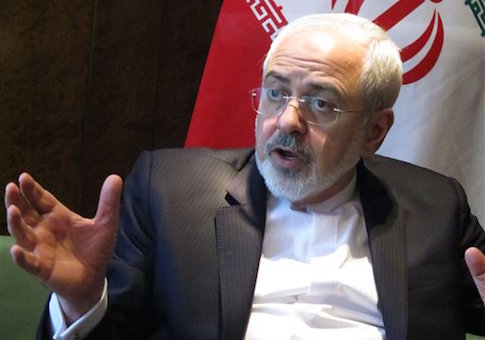
Iran minister says sanctions must be lifted before nuclear agreementIranian Foreign Minister Mohammad Javad Zarif / AP

Iran’s foreign minister and chief negotiator in nuclear talks with the West declared victory for his country, stating that no matter how the negotiations end, Tehran has come out “the winner,” according to remarks made on Tuesday and presented in the country’s state-run press.

Javad Zarif, the Islamic Republic’s foreign minister, stated in remarks before the country’s powerful Assembly of Experts, which recently installed a hardline new cleric as its leader, that the nuclear negotiations have established Tehran as a global power broker.

“We are the winner whether the [nuclear] negotiations yield results or not,” Zarif was quoted as saying before the assembly by the Tasnim News Agency. “The capital we have obtained over the years is dignity and self-esteem, a capital that could not be retaken.”

Zarif’s comments were accompanied by a host of bold military displays by Tehran in recent weeks, including the announcement of one new weapon that Iranian military leaders have described as a “very special” missile.

As the United States and Iran rush to hash out a final nuclear agreement ahead of a self-imposed July deadline, Zarif also lashed out at congressional Republicans who have expressed skepticism over the Obama administration’s diplomacy and have fought to exert control over the implementation of any deal.

Zarif dismissed as a “propaganda ploy” a recent letter signed by 47 Senate Republicans that warned Tehran against placing too much stock in a weak deal agreed to by the Obama administration.

Meanwhile, Iran’s military continues to unveil a range of new strategic missiles and advanced weapons meant to project strength throughout the region.

Iran disclosed during military drills late in February that it is developing a missile capable of being fired from a submerged submarine. Top Iranian military leaders have described the missile as a “very special weapon,” according to IHS Jane’s, a defense industry news source.

“I believe that this weapon is a strategic weapon,”Admiral Ali Fadavi, the naval commander of the Iranian Revolutionary Guard Corps (IRGC), said on state television, according to Jane’s. “It has special characteristics.”

Fadavi declined to provide additional details about the missile. “I would like to keep this information for the future. It is a very special weapon and the Americans cannot even surmise how strong and effective this weapon is.”

On Tuesday morning, the commander of Iran’s navy previewed the unveiling of “advanced surface and subsurface vessels” that will soon be incorporated into the country’s fleet, according to the state-run Fars News Agency.

Iran has put great stock in its navy, investing significant resources to bolster the force and make it a principal player in key global shipping lanes, including around the Strait of Hormuz, the Gulf of Oman, and the Caspian Sea.

Sea-based weapons were a major focus of recent high-level meetings between Iranian and Russian officials, who agreed to a new arms pact.

Earlier this week, Iran initiated into its fleet a new destroyer ship that is “armed with advanced anti-surface and anti-subsurface weapons and air defense systems,” according to military leaders quoted by Fars.

The ship was immediately deployed to the Caspian Sea, an area Iran views as critical to its interests.

Admiral Kordad Hakimi, a top Iranian navy official, told the country’s press that Iran is prepared to use force in the region.

“We have no security problem in the Caspian Sea today, [but] … the Navy is fully prepared to confront any threat,” he was quoted as saying.

Iranian officials have also bragged about being in full control of five out of nine major international waterways.

Islamic State’s Actions Against Jordan And Egypt Reveal Its Overall Plan

March 11, 2015

Islamic State’s Actions Against Jordan And Egypt Reveal Its Overall Plan

By Missing Peace

via Islamic State’s Actions Against Jordan And Egypt Reveal Its Overall Plan | Missing Peace | missingpeace.eu | EN.

Ansar Bayt al-Maqdis squad in Sinai desert

Ansar Bayt al-Maqdis squad in Sinai desert


Egypt responded swiftly to Islamic State’s beheading of 21 Egyptian Christian Coptic men in Libya on Sunday. President Abdel Fatah al-Sisi ordered his airforce to bomb the Islamic State stronghold Derna in eastern Libya. The airstrikes were directed at Islamic State camps, training sites, and weapon depots where as many as 50 Islamic State terrorists were killed. Libya’s air force also participated.

Egyptian state television aired footage of fighter planes leaving the hangar with “Long live Egypt” emblazoned on their tails. This was followed by night-vision aerial footage showing explosions. The Egyptian government requested targeting support from the U.S. to no avail.

The Egyptian Coptic Christian victims were among thousands of unemployed Egyptians who had been forced to seek employment in Libya. Unemployment in Egypt had risen from 8.9 percent to 13 percent since the ouster of President Mubarak in 2011.

Islamic State released a video that showed the gruesome killings. The Coptic Christians were marched to a beach, forced to kneel, and then beheaded.

One of the terrorists stood with a knife in his hand and said: “Safety for you crusaders is something you can only wish for; we will conquer Rome, by the will of Allah.”

Israeli and international media reported after the strike that Egypt has now joined the fight against Islamic State and that Egypt has become a target for Islamic State.

In fact, as Western Journalism reported on February 5th, Egypt has been waging war on the Islamic State since December 2014, when Al Qaeda affiliate Ansar Bayt al-Maqdis in Sinai pledged allegiance to Islamic State and changed its name to Wilayat Sinai (Sinai Province). Shortly afterward, violence in Sinai escalated significantly; and scores of Egyptian security personnel were killed in well-organized terrorist attacks. In one of these attacks, an army helicopter was downed by a surface-to-air missile that had been smuggled into Sinai from Libya.

The new Islamic State Branch also uses beheadings to intimidate Egyptian security personnel. Last year, the group beheaded four citizens who were accused of spying for the Mossad.

Islamic State has obviously decided to attack Egypt in an attempt to further destabilize the country. By baiting Egypt at its weakest point – the porous border with Libya – Islamic State compels President al-Sisi to move forces, diluting the effectiveness of the whole.

This aggravates the situation because Egypt is already challenged by keeping Sinai in check and safeguarding the crucial Nile Delta.

The security situation in Sinai has deteriorated significantly since the army removed the Muslim Brotherhood from power. Tourists traveling from Taba in Sinai to Eilat in Israel told Western Journalism that free traffic has become impossible in the Sinai Peninsula. The army only allows tourists to visit the coastal plain and Jebel Musa, the mountain Christians believe is the spot where the Ten Commandments were given to the people of Israel. Cars are only allowed to travel in convoys accompanied by army vehicles.

Israeli tourism to Sinai has nearly come to a complete standstill, Israeli security officers told Western Journalism. Israeli tourists now stay in Taba just over the border with Israel.

Islamic State is not strong enough yet to take over Egypt, but that’s not the goal of its latest actions. The group is clearly trying to destabilize Jordan and Egypt. The latest IS campaign started with the provocation of Jordan. King Abdullah decided to start Jordan’s own air campaign against Islamic State after Jordanian pilot Moaz al-Kasasbeh was burned alive. Egypt has now been similarly drawn in.

The Jihadist group is trying to destabilize both countries and to inspire the Muslim Brotherhood to rise up against the regimes in both Jordan and Egypt. Both countries face huge economic problems and struggle to contain the rise of Islamism.

Experts fear the air campaign against Islamic State will be answered by a sharp increase in terrorist attacks in both Jordan and Egypt. When Egypt and Jordan descend into chaos, it will be easier for Islamic State to expand its power base and to enlarge its territory. This clearly echoes the situation that developed in Syria and Iraq.

The group has a clear vision of what the end game will be. What is happening in Egypt and Jordan has everything to do with the ultimate goal of destroying the State of Israel. The group has already set up camp in Sinai close to Israel’s southern border. Islamic State’s presence along the long western border with Jordan would be a huge challenge for the IDF and would inspire Palestinian terrorist groups.

Expanding Islamic State presence in Libya serves another goal of the organization: The group wants to expand its influence in North Africa and to use Libya as a gateway to Europe. Islamic State operatives have already taken control of two important Libyan cities and a large part of the Mediterranean coast. They are moving toward oil facilities and are slowly infiltrating the capital, Tripoli.

The British newspaper The Telegraph reported that Islamic State plans to send its forces to North Africa, where they will try to sail across the Mediterranean posing as refugees. To oversee Islamic State operations in Libya and North Africa, the IS leadership has appointed an emir for Tripoli, the Tunisian Abu Talha, and one for west Libya, the Yemeni Abu al-Barra el-Azdi.

The recent terror attacks in France and Denmark are also connected to Islamic State’s plan for Europe. Both attacks revealed the goals of the organization in Europe. The first goal is to undermine European society to the point that they will lose the resolve to fight to uphold Western values and will accept Islamic domination. The second goal is to chase the Jews out of Europe.

It would be a mistake not to take the stated threats and goals of Islamic State seriously. Although the group does not have the means to conquer Israel and southern Europe at this moment, the organization has proven that it acts with a strategic purpose and can advance its goals.

The recent actions against Egypt and Jordan should serve as another warning to the West: Airstrikes alone are not sufficient to defeat Islamic State. It is highly doubtful, however, that this warning will be heeded. In an interview with MSNBC, State Department, Spokeswoman Marie Harf said “ The U.S. cannot win the war with Islamic State by killing them. We cannot kill our way out of this war”, she said. Harf also claimed that Muslims are attracted to Jihad because of poverty and a lack of jobs.

This article first appeared on Western Journalism in the United States

Intelligence: Broken Arrow

March 11, 2015

Intelligence: Broken Arrow

By G. Murphy Donovan

March 11, 2015

via Articles: Intelligence: Broken Arrow.

Policy is a worldview. Intelligence is the real world, a wilderness of untidy facts that may or may not influence policy. When Intelligence fails to provide a true and defensible estimate, a clear picture of threat, policy becomes a rat’s nest of personal and political agendas where asserted conclusions and political correctness become the loudest voices in the room.  The policymaker thinks he knows the answer. The intelligence officer has the much tougher tasks of confirming or changing minds.

American national security analysis has been poisoned by such toxins. An Intelligence report these days might be any estimate that supports the politics of the moment. Truth today is an afterthought at best and an orphan at worst.

Alas, corrupt Intelligence is the midwife of strategic fiasco. Four contemporary failures provide illustrations: revolutionary theocracy, the Islam bomb, imperial Islamism, and the new Cold War.

Back to Theocracy

The Persian revolution of 1979 was arguably the most significant strategic surprise of the last half of the 20th Century. Yes, more significant than the fall of Soviet Communism. (The precipitous fall of the Soviet Bloc, to be sure, was another bellwether event unanticipated by Intelligence analysis.) The successful religious coup in Iran, heretofore an American client regime, now provides a model for all Muslim states where the default setting among tribal autocracies is now theocracy not democracy. In the wake of the Communist collapse, Francis Fukuyama argued that the democratic ideal was triumphant, an end of history as we knew it, the evolutionary consequence of progressive dialects. Fukuyama was wrong, tragically wrong. History is a two-way street that runs forward as well as backwards.

The fall of the Soviet monolith was not the end of anything. It was the beginning of profound regression, an era of religious irredentism. Worrisome as the Cold War was, the relationship with Moscow was fairly well managed. Who can argue today that East Europe or the Muslim world is more stable or peaceful than it was three decades ago?

The Persian revolution of 1979 not only reversed the vector of Muslim politics, but the triumph of Shia imperialism blew new life into the Shia/Sunni sectarian fire, a conflict that had been smoldering for more than a thousand years. The theocratic victory in Tehran also raised the ante for Israel too, now confronted by state sponsored Shia and Sunni antagonists, Hezb’allah, Fatah, and Hamas.

Shia Hezb’allah calls itself the party of God! Those in the Intelligence Community who continue to insist that religion is not part of the mix have yet to explain why God is part of the conversation only on the Islamic side of the equation.

Global Islamic terror is now metastasizing at an alarming rate. More ominous is the ascent of the Shia clergy, apocalyptic ayatollahs, bringing a lowering of the nuclear threshold in the Middle East. Sunni ISIS by comparison is just another tactical terror symptom on the Sunni side — and yet another strategic warning failure too.

Tehran is in the cat bird’s seat, on the cusp of becoming a nuclear superpower. Nuclear Iran changes every strategic dynamic: with Israel, with Arabia, and also with NATO. A Shia bomb is the shortcut to checkmate the more numerous Sunni. Iran will not be “talked out” of the most potent tool in imperial Shia kit — and the related quest for parity with Arabian apostates.

The Islam Bomb

The Islam bomb has been with us for years, in Sunni Pakistan, although you might never know that if you followed the small wars follies in South Asia. The enemy, as represented by American analysis, is atomized, a cast of bit players on the subcontinent. First, America was fighting a proxy war with the Soviets. When the Russians departed, the enemy became the murderous Taliban followed by al Qaeda. Both now make common cause with almost every stripe of mujahedeen today. In the 25 years since the Soviet withdrawal, Afghanistan has been reduced now to a rubble of narco-terror and tribalism. If we can believe bulletins from the Pentagon or the Oval Office, America is headed for the Afghan exit in the next two years — maybe. Throughout, the real threat in South Asia remains unheralded — and unmolested.

Nuclear Pakistan is one car bomb, or one AK-47 clip, away from another Taliban theocracy. This is not the kind of alarm that has been raised by the Intelligence Community. Hindu India probably understands the threat, Shia Persia surely understands the Sunni threat, and just as surely, Israel understands that a Sunni bomb is the raison d’etre for a more proximate Shia bomb. Who would argue that the Sunni Saudis need nuclear “power”? Nonetheless, Riyadh is now in the game too.  The most unstable corner of the globe is now host to a nuclear power pull.

The American national security establishment seems to be clueless on all of this. Indeed, when a unique democracy like Israel tries to illuminate a portion of the nuclear threat before the American Congress, the Israeli prime minister is stiff-armed by the Oval Office. If Washington failed with Pakistan and North Korea, why would anyone, let alone the Israelis, believe that Wendy Sherman is a match for the nuclear pipedreams of apocalyptic Shia priests.

Alas, the motive force behind a Shia bomb is not Israeli capabilities or intentions. Israel is a stable democracy where any territorial ambitions are limited to the traditional Jewish homeland. Israel is no threat to Persia or Arabia.  Pakistan, in contrast, is like much of the Sunni world today, another internecine tribal or sectarian wildfire waiting for a match.

The advent of the Islam bomb in Asia was not just a strategic surprise, but the step-child of strategic apathy. The folly of taking sides with the Sunni has now come home to roost. Iran is about to go for the atomic brass ring too, with the Saudis in trail, and there’s not much that America can/will do except mutter about secret diplomacy and toothless sanctions. Of course, there’s always the option of blaming Jews when appeasement fails.

Imperial Islam

The Ummah problem, the Muslim world, has now replaced the Soviet empire, as Churchill would have put it, as the “riddle wrapped in a mystery inside an enigma.” There are four dimensions to the Islamic conundrum: the Shia/Sunni rift, intramural secular/religious conflicts, kinetic antipathy towards Israel and the West writ large, and the failure of analysis, especially strategic Intelligence, to unwrap the Muslim onion in any useful way. Imperial Islam, dare we say Islamofascism, now threatens secular autocracy and democracy on all points of the compass.

Islam in London

Islamic imperialism is a decentralized global movement. Nonetheless, the various theaters are united by tactics, strategy, ideology, and objectives. The tactics are jihad, small wars, and terror. The strategy is the imposition of Shariah Law. The ideology is the Koran and the Hadith. And the objective is a Shia or Sunni Islamic Caliphate — for infidels, a distinction without difference.

Muslim religious proselytizers and jihad generals in the field make no secret of any of this. The problem isn’t that some Muslims dissent from this agenda, the problem is that the West, especially national security analysts, cannot/will not believe or accept what Islamic imperialists say aloud, about themselves. The enemy is hiding in plain sight, yet the Intelligence Community doesn’t have the integrity or courage to make a clear call.

Noted British criminal psychiatrist Theodore Dalrymple captures the bizarre logic of appeasement:

“Racial, religious and cultural identity are morally important in politics, precisely what so many people would like to deny because it can so easily unleash the vilest political passions. Something that is true, say our people of goodwill to themselves, could have nasty consequences; therefore it is not true.”

Propaganda provides many of the strategic “tells” in any conflict. The Nemstov murder in the shadow of the Kremlin provides an example. The knee-jerk reaction of politicians and pundits in America was to implicate Russian culture, the Kremlin, or Vladimir Putin.

Contrast the Nemstov blame game with any or every recent Islamist atrocity and the nuclear race in the Ummah. With these, the knee-jerk reaction is to defend Islam, more concern for Islamism and the religious equivalence shibboleth than the nuclear threat or Jewish, Christian, and apostate heads that are now literally rolling on a global scale. In a recent US State Department brief, we are told by State Department spokesman Marie Harf that Islamic terrorism might be attributed to “unemployment” (sic).

Cold War Redux

The West can no longer take yes for an answer. The deliberate resuscitation of the Cold War amidst a host of tactical defeats in the Ummah is probably one of the worst foreign policy choices on record.

The old Soviet Union: took down the Berlin Wall, relinquished former satellites, dismantled the Warsaw Pact military alliance, and purged East Europe of nuclear weapons. In response, America and the EU dismantled Yugoslavia, taking the Muslim side we might add, and aggressively expanded NATO up to the traditional Russian border. The “End of (totalitarian) History” as we knew it wasn’t enough. Any vestigial associations with Moscow were relentlessly undermined. The American sponsored coup, orchestrated by Victoria Nuland at the US State Department, with likely help from the CIA, in Ukraine is the best and most recent example.

The “regime change” strategy in Europe has degenerated into some petulant version of nuclear chicken with the Russians. The American embassies in Moscow and Kiev regularly host anti-Putin dissidents in Ukraine and Russia

Regime change folly has lowered the nuclear threshold in South Asia, the Mideast, and now East Europe. Sevastopol and Kiev are side shows. The real target for Brussels and Washington is Moscow — and the Putin regime. The idea that the Kremlin or Russians can be undone or manipulated by: black operations, cyber war, sanctions, propaganda, or provocations is naïve and reckless. Putin is not a Pahlavi, Gadhafi, Assad, or Yanukovych.

Russians were very helpful in ridding Syria of chemical weapons and clearing the Ukraine of nuclear weapons.  Moscow and Putin have the potential also to be very useful against terror, nuclear proliferation, and resolving the Levant lunacy too.

The House minority leader recently lamented losing the “public relations” war with Russia. The American Secretary of State responded that Russian Television (RT) was responsible (sic). The more believable narrative spun by the Kremlin might be closer to the mark. Truth is a powerful ally, especially when it’s coupled with skillful propaganda.

The origin of the new Cold War may have domestic origins. Neither major American political party has a clue as what to do with the metastasizing Muslim problem. Indeed, both sides gag on words like Islam, Muslim, or Mohammed. As 2016 approaches, both parties desperately need to change the subject and find a foreign policy to run on. Regime change in Russia seems to be the consensus choice for American demagogues, Right and Left.

The idea that domestic “politics stops at the border” was always honored more in the breach than anywhere else. The politics of personal destruction is a time honored tradition in America, especially on the Left. That standard has now been folded into the foreign relations bag of tricks. Henry Kissinger claims that “demonization” is not policy. That may be true in any real politic sense, but the Putin bogyman is an ideal straw man for the next American presidential election. Proxy war abroad seems to be the safe sex of domestic politics.

What Now?

The American Intelligence Community is now the largest (17 agencies and uncountable contractors) and most expensive data collection and processing complex in history. Unfortunately, this gold-plated leviathan is undone by inferior analysis, indeed, estimates and reports that are more political than prudent. Withal, existential functions like strategic warning may be in freefall.

The obvious solution would be to take the strategic warning and national estimative functions out from under the IC, and the Executive Branch, and give those tasks to some apolitical body, assuming of course that an impartial forum might be sustained beyond the control of any branch of government. Realistically, it’s hard to believe that any American political party would sponsor an independent and uncontrollable voice of candor or objectivity.

Nonetheless, there are small things that might be done to make a huge difference. During the Cold War, USAF Intelligence ran a service of common concern for the IC called “Soviet Awareness.” The purpose of that program at Bolling AFB was to educate novice intelligence officers and FBI agents about the Soviet threat. The program included Russian history, the rise and spread of Communism, Marxist ideology, and Soviet military capabilities.

Ironically, the inter-agency program that answered the question “why we fight” was discontinued by James Clapper when he became the USAF Assistant Chief of Staff for Intelligence.


Clapper is now the Director of National Intelligence. The Soviet Awareness resources were reallocated to the information processing function. Today there is no awareness program of common concern on Russian, Islamist, or any other threats.

Clapper threw the threat baby out with the Soviet bathwater. Indeed, in most service schools, discussing Islamic ideology or religion is off limits. If any soldier or Intelligence officer were to ask: “Why do we fight?” the answer today would have to be, “Trust me.”

The real tragedy of Intelligence failure today is the burden born by American veterans, servicemen and women: the dead, crippled, and maimed.  “Why we fight?” is a leadership deficit, the forgotten readiness issue. Troops don’t have a clear picture of the enemy or the ideology in play in places like Iraq, Afghanistan, Arabia, the Philippines, and Africa. They will know even less about the rationale for serving in East Europe should another conflict be engineered with Russia.

Indeed, the Pentagon and the Oval Office throw lives at small wars that generals and politicians have no intention of declaring, justifying, or winning — by their own admission.  The Commander-in-Chief says the he seeks outcomes where there are no victors or vanquished. Indeed!

Traditionally, we like to think of collection and associated clandestine operations as the sharp end of the Intelligence spear. In fact, analysis is the cutting edge. Unfortunately, that edge is gone today. You could do worse than think of Intelligence analysis as the Broken Arrow in the national security quiver.

We may not know why we fight today, but there is little mystery anymore about why we fail.

The importance of information is seldom self-evident. Even if significance were obvious, information is still not knowledge. And clearly knowledge is not wisdom. Just as surely, only conscience allows an analyst to know the difference. All key judgments must be accompanied by courage and conviction too; courage to communicate to policy mandarins, or voters, with enough force to prompt action. Repetition is often the midwife of acceptance.

Good data and good analysis might be necessary, but never sufficient. Bridging the gap between analysis and acceptance is often a bridge too far for the timid. The national security continuum is a perilous enterprise. The messenger is always in danger of being shot. Alas, truth is an equal opportunity offender. It doesn’t care who gets hurt.

Nonetheless, changing minds is the object of any good Intelligence. Policy and action is only stimulated by an altered consciousness about the subject at hand. Prudent policy is a function of correct data, honest analysis, moral certainty, and rhetorical skill — written or spoken.

Alas, none of these self-evident, common sense observations, with the possible exception of abundant evidence, play much of a role in American threat analysis these days. A very expensive and growing intelligence Community (IC) is now the weak link in the national security chain. Any speculations about the catastrophic failures of American foreign policy in the past fifty years should begin with the “wilderness of mirrors,” James Angleton’s metaphor for Intelligence praxis.

G. Murphy Donovan was the last Director of Research and Russian (nee Soviet) Studies at USAF Intelligence, the directorate that staffed the associated Soviet Awareness Program.  He served under General James Clapper.

ISIS releases video purporting to show child soldier killing ‘Israeli spy’

March 11, 2015

ISIS releases video purporting to show child soldier killing ‘Israeli spy’
By Haaretz and Reuters Mar. 10, 2015 9:23 PM


(Bibi’s right…the enemy of your enemy is still your enemy. – LS)

Jihadist organization says suspected Muhammad Musallam, 19, from East Jerusalem, was spying for Mossad; he’d gone to Syria to fight for ISIS.

ISIS released a video on Tuesday that it claims shows the execution of East Jerusalem Palestinian Muhammad Musallam, 19, who was taken hostage as an alleged Israeli spy three months ago in Syria.

The video, published by the group’s Furqan media outlet, showed Musallam sitting in a room wearing an orange jumpsuit, talking about how he had been recruited and trained by the Israeli intelligence service. He said his father and elder brother had encouraged him. After that, it showed Musallam being escorted to a field and executed by a boy, described by an older, French-speaking fighter as one of the “cubs of the caliphate”.

The clip, which was approximately 13 minutes long, showed Musallam on his knees as he listened to the older fighter speaking the verdict in French. Then the boy, wearing a military uniform and armed with a pistol, stands face to face with Musallam and fires one bullet into his forehead. Musallam crumbles, then the child shoots him three more times and chants “Allahu Akbar!” (God is Greatest).

In the video, Musallam repeated what he said last month in an interview published by the group’s English language magazine Dabiq, in which he said he had joined ISIS to report to the Israelis on weapons caches, bases and Palestinian recruits. Israel and his family denied that he was an Israeli spy. “I tell my father and my son: Repent to God. I say to the spies who spy on Islamic State: You will not be successful, they will expose you,” Musallam said in the latest video, in Arabic.

Last month Musallam’s family confirmed to Haaretz that their son had traveled to Syria to fight for ISIS. The jihadist organization later published an article about Musallam in its magazine Dabiq titled “Interview with a spy working for the Israeli Mossad.”

Musallam had lived with his family in East Jerusalem. He completed 12 years of schooling and even worked as a national service volunteer with the Israeli firefighting services. His father, Said Musallam, told Haaretz that his son told him three months ago that he was traveling to a course in the city of Rishon Letzion, and asked him for money.

“He left that morning and the next day I tried to call him and the telephone was turned off,” said the father. “I thought that maybe he was busy. After a week we got an email that he wanted to be a martyr and he was giving up everything in his life and his family.”