Archive for March 10, 2015

Palestinian forces detain 500 Hamas West Bankers, to thwart coup and Abbas assassination plot

March 10, 2015

Palestinian forces detain 500 Hamas West Bankers, to thwart coup and Abbas assassination plot, DEBKAfile, March 10, 2015

security_forces_in_the_West_Bank_Hamas__10.3.15Palestinian security forces detain Hamas activists

[O]ur sources also reveal that the PA chairman has asked Netanyahu through back-channels for a secret rendezvous somewhere in Europe. He proposed avoiding prominent capitals like London, Paris or Berlin, but meeting at a smaller venue for the sake of confidentiality.

Abbas also insisted that this meeting must be concealed from Washington, especially from Secretary of State John Kerry.

The Israeli prime minister has turned him down – and not just because the Palestinian request finds him in the middle of a tough race for re-election.

*********************

Acting on direct orders from Palestinian Authority Chairman Mahmoud Abbas, Palestinian special forces raided the nine PA-ruled towns of the West Bank in the past 48 hours and detained 500 Hamas suspects, DEBKAfile’s military sources report. Abbas ordered the operation after discovering that Hamas had been hatching a plot for some weeks to stage an armed insurrection against the Palestinian Authority, starting in one of the Palestinian towns – possibly even the PA capital of Ramallah. They would assassinate him in the process of the coup.

Of late, Abbas has kept his distance from Ramallah and his seat of government and spends most of his time traveling in foreign countries, especially Arab capitals, where he feels safer under the protection of foreign security services than he does at home.

The wave of detentions from Sunday to Tuesday (March 9-10) is the most extensive the Palestinian Authority has ever conducted against Hamas’ West Bank cells. Not only prominent figures and known terror activists were taken into custody but also new figures.

Abbas ordered the operation amid a serious dilemma over his personal security.

Before him were reports presented by Palestinian Intelligence chief Maj. Gen. Majed Faraj revealing the preparations in train for his assassination, an event that would signal mass riots orchestrated by Hamas and Jihad Islami, leading up to the seizure of government from the Palestinian Authority – much as they did in the Gaza Strip.

At the same time, Abbas does not entirely trust Palestinian security services or their ability to safeguard him and his regime in Ramallah.

He therefore turned to Israel, touching off an IDF response that had nothing to do with Israel’s forthcoming general election on March 17 – as government opponents have claimed.

The 3,000 IDF soldiers plus 10,000 reservists called up this week were not posted on the West Bank to practice anti-riot tactics for putting down Palestinians disturbances against Jewish settlements – as reported. They were placed on the ready in case it was necessary to go into Palestinian towns and save them from being overrun by the radical Hamas and Jihad Islami.

The Israeli troops also rehearsed a possible scenario that might ensue from the murder of Mahmoud Abbas.

In view of the highly sensitive security situation on the West Bank, Prime Minister Binyamin Netanyahu accompanied by Defense Minister Moshe Ya’alon, paid a rare visit to the IDF’s Judea-Samaria command headquarters Tuesday, March 10, to inspect these preparations.

It was the Hamas conspiracy to seize power in Ramallah that prompted Ya’alon’s enigmatic remark that were it not for preemptive military operations, central Israel might now be under missile and mortar attack.

DEBKAfile’s military sources add that way the Palestinian issue has become a football for kicking around Israel’s election campaign, making it hard to penetrate the fog of anti-government propaganda and establish what is really going on.

For example, Netanyahu is being presented by his rivals as having agreed at a former stage in US-brokered peace negotiations with the Palestinians to withdraw to behind the 1967 lines. They have picked out one of the many papers drawn up by the Americans and discarded in the course of the negotiations – this one was written by a Shiite Iraqi academic in Oxford University and was never approved either by Israel or the Palestinians.

Turning to the real events afoot today, our sources also reveal that the PA chairman has asked Netanyahu through back-channels for a secret rendezvous somewhere in Europe. He proposed avoiding prominent capitals like London, Paris or Berlin, but meeting at a smaller venue for the sake of confidentiality.

Abbas also insisted that this meeting must be concealed from Washington, especially from Secretary of State John Kerry.

The Israeli prime minister has turned him down – and not just because the Palestinian request finds him in the middle of a tough race for re-election.

Supporters of Deal Are Strengthening Iran’s Negotiating Position

March 10, 2015

Supporters of Deal Are Strengthening Iran’s Negotiating Position, The Gatestone InstituteAlan M. Dershowitz, March 10, 2015

The reality is that we are in a far stronger negotiating position than advocates of the deal have asserted, but we are negotiating from weakness because we have persuaded the Iranians that we need the deal — any deal — more than they do.

*******************************

Despite repeating the mantra that “no deal is better than a bad deal” with Iran, the United States seems to be negotiating on the basis of a belief that the worst possible outcome of the current negotiations is no deal. Many supporters of the deal that is now apparently on the table are arguing that there is no realistic alternative to this deal. That sort of thinking out loud empowers the Iranian negotiators to demand more and compromise less, because they believe — and have been told by American supporters of the deal — that the United States has no alternative but to agree to a deal that is acceptable to the Iranians.

A perfect example of this mindset was Fareed Zakaria on his CNN show this past Sunday. He had a loaded panel of two experts and a journalist favoring the deal, and one journalist opposed. This followed Zakaria’s opening essay in favor of the deal. All those in favor made the same point: that this deal is better than no deal, and that any new proposal — for example, to condition the sunset provision on Iran stopping the export of terrorism and threatening to destroy Israel — is likely to be rejected by Iran, and is therefore, by definition, “irrational” or “unproductive,” because it would result in no deal.

The upshot of this position is that Iran essentially gets a veto over any proposal, but the United States does not get to make new proposals. If it were true that this deal is better than no deal, it would follow that any proposed change in this deal that Iran doesn’t like is a non-starter.

That’s why Netanyahu’s reasonable proposal that the sunset provision be conditioned on changes in Iranian actions and words has been pooh-poohed by the so-called “experts.” They haven’t tried to respond on the merits. Instead, they are satisfied to argue that Iran would never accept such conditions, and therefore the proposal should be rejected as a deal breaker.

This is the worst sort of negotiation strategy imaginable: telling the other side that any proposal that is not acceptable to them will be taken off the table, and that any leader who offers it will be attacked as a deal breaker. This approach — attacking Netanyahu without responding to his proposal on their merits — characterizes the approach of the administration and its supporters.

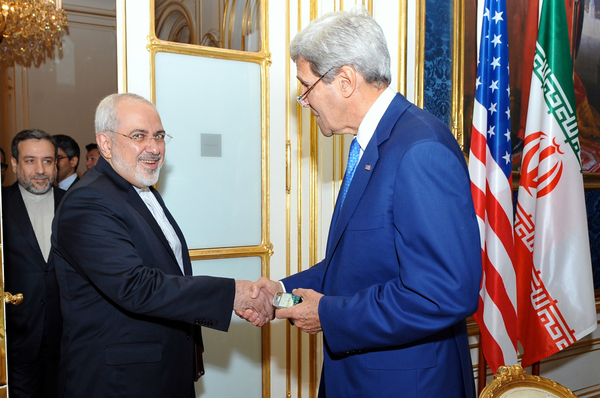
767U.S. Secretary of State John Kerry shakes hands with Iranian Foreign Minister Mohammad Javad Zarif during nuclear talks in Vienna, Austria, July 14, 2014. (Image source: U.S. State Department)

We will now never know whether Iran might have accepted a conditional sunset provision, because the advocates of the current deal, both inside and outside the administration, have told Iran that if they reject this proposal, it will be withdrawn, because it endangers the deal. What incentive would the Iranians then have to consider this proposal on its merits? None!

The current mindset of the deal’s advocates is that the United States needs the deal more than the Iranians do. That is why the U.S. is constantly leaking reports that the Mullahs may be reluctant to sign even this one-sided deal, which has shifted perceptibly in favor of the Iranian position over the past several months. But the truth is that Iran, which is suffering greatly from the combination of sanctions and dropping oil prices, needs this deal — a deal that would end sanctions and allow it unconditionally to develop nuclear weapons within ten years. That doesn’t necessarily mean they will accept it. They may push for even more compromises on the part of the United States. The reality is that we are in a far stronger negotiating position than advocates of the deal have asserted, but we are negotiating from weakness because we have persuaded the Iranians that we need the deal — any deal — more than they do.

Most Israelis seem to be against the current deal, especially the unconditional sunset provision. Author David Grossman, a left-wing dove who is almost always critical of Netanyahu, has accused the United States of “criminal naiveté.” He opposes Netanyahu’s reelection, but urges the world to listen to what Netanyahu told Congress.

“But what [Netanyahu] says about Iran and the destructive part it is playing in the Middle East cannot and should not be ignored,” Grossman said. “Netanyahu is right when he says that according to the emerging deal there is nothing to prevent the Iranians from developing a nuclear bomb once the deal expires in another 10 years, and on this matter there is no difference in Israel between Left and Right.”

There are considerable differences, however, between the Obama administrations’ negotiating position and the views of most Israelis, Saudis, Emiratis, Egyptians and Jordanians — as well as most members of our own Congress. We can get a better deal, but supporters of a deal must abandon their unhelpful public claims that the current deal is the best we can get.

Iran and the Perils of One-Man Rule

March 10, 2015

Iran and the Perils of One-Man Rule, Commentary Magazine, March 9, 2015

One-man rule may make sense in Tehran, but not here. This is not a question of partisanship but a defense of both the Constitution and the security of the nation. The Iranians should know that this deal is unpopular and will have no legitimacy without congressional ratification. Rather than sabotaging diplomacy, the letter is necessary pressure on the president to remember his oath to preserve the Constitution rather than to recklessly risk the country’s safety on Iranian détente.

********************

The letter sent by 47 Republican senators to Iran’s leadership is provoking predictable cries of outrage from liberals and Democrats. Obama administration supporters are decrying the missive as a blatant attempt to sabotage U.S. diplomatic efforts to end the standoff over Iran’s nuclear-weapons program. By warning Tehran that any deal approved by President Obama may be revoked by his successor after January 2017, the GOP caucus is opening itself up to charges of extending partisan warfare to foreign policy. But the letter, intended as much as a shot fired over the bow of the president as it was a lesson in the U.S. Constitution for the ayatollahs, made an important point. No matter what you think about the administration’s blatant push for détente with the Islamist regime, the president’s plans to craft an agreement that will not be submitted to Congress for approval means the senators are correct about its status in law. More importantly, they are highlighting an issue that transcends the nuclear question, even though that is a matter of life and death. A president that seeks to ignore the constitutional separation of powers cannot complain when his critics point out that his fiats cannot be expected to stand the test of time.

The impact of the letter on the Iranians is a matter of speculation. The Islamist regime needs no instructions from Republicans about how to protect their interests as they’ve been successfully stringing along Western governments for more than a decade in nuclear negotiations. In particular, they have scored a series of diplomatic triumphs at the expense of the United States as President Obama has abandoned his past insistence that Iran give up its nuclear program and instead offered concession after concession to the point where the deal that is being offered to the regime is one that will let them keep their infrastructure and will “sunset” restrictions on it. If they truly intend to take advantage of this craven retreat by the putative leader of the free world as opposed to more prevarication until the clock runs out on their march to a weapon, then nothing his Republican opponents say are likely to scare them out of it.

Moreover, the Iranians may believe that the same dynamic that has worked in their favor during the course of the negotiations may similarly ease their fears once such a bad deal is in place. Even a Republican president who has campaigned against appeasement of Iran and understands the dangers of an agreement that will make it possible for Iran to get a bomb either by cheating or, even worse, by abiding by its terms, will be hard-pressed to reverse it. America’s allies will fight tooth and nail against re-imposition of sanctions on an Iran that they want to do business with no matter what that terror-supporting regime is cooking up.

The campaign against reversal will also center on the straw-man arguments used by the president and his apologists to bolster their effort to appease Iran. We will be told that the only alternative to a deal that allows Iran to become a threshold nuclear power is war and not the return to tough sanctions and hard-headed diplomacy that President Obama jettisoned in his zeal for a deal.

But by planning to bypass Congress and treat his pact with Iran as merely an executive decision over which the legislative branch has no say, the president is steering into uncharted waters. Like his executive orders giving amnesty to millions of illegal immigrants that usurp the power of Congress to alter laws governing this issue, a nuclear deal that is not ratified by the Senate, as all treaties must be, can be treated as a presidential whim that is not binding on his successors. If it can be put into effect with only the stroke of a pen, it can just as easily be undone by a similar stroke from another president.

The difficulty of undertaking such a revision should not be underestimated. No president will lightly reverse a foreign-policy decision with such serious implications lightly. That is why an agreement that grants Western approval to Iran’s nuclear ambitions is so dangerous. That it is part of a comprehensive approach to Iran that, despite last week’s disclaimers issued by Secretary of State John Kerry, indicates that the U.S. is prepared to accept the regime’s efforts to achieve regional hegemony makes it even more perilous. Congress needs to act soon to both impose tougher sanctions on Iran and to ensure that any deal must be submitted to it for approval.

But Iran still had to be put on notice that a deal that is not approved by Congress can and should be reversed by the next president. One-man rule may make sense in Tehran, but not here. This is not a question of partisanship but a defense of both the Constitution and the security of the nation. The Iranians should know that this deal is unpopular and will have no legitimacy without congressional ratification. Rather than sabotaging diplomacy, the letter is necessary pressure on the president to remember his oath to preserve the Constitution rather than to recklessly risk the country’s safety on Iranian détente.

Advisor To Iranian President Rohani: Iran Is An Empire, Iraq Is Our Capital . . .

March 10, 2015

Advisor To Iranian President Rohani: Iran Is An Empire, Iraq Is Our Capital ; We Will Defend All The Peoples Of The Region; Iranian Islam Is Pure Islam – Devoid Of Arabism, Racism, Nationalism, MERI, March 9, 2015

On March 8, 2015, Ali Younesi, advisor to Iranian President Hassan Rohani and previously intelligence minister (2000-2005) in the government of president Khatami, spoke at the “Iran, Nationalism, History, and Culture” conference in Iran; his statements were published by the Iranian ISNA news agency the same day.

According to Younesi, Iran is once again an empire, as it was in the past, and its capital, Iraq, is “the center of Iranian heritage, culture, and identity.” Delineating the borders of the Persian Empire, or, in his words, “greater Iran,” he included countries from China, the Indian subcontinent, the north and south Caucasus, and the Persian Gulf. He added that since the very dawn of its history, Iran had been an empire and a melting pot of different cultures, languages, and peoples.

Younesi stressed that despite the current obstacles to the unification of the countries in the region under Iranian leadership, Iran cannot disregard its regional influence if it wishes to preserve its national interests. Iran, he said, has been operating in this region, particularly in Iraq, with the aim of ensuring the security of the peoples there, whose connection to Iran is obvious because of history and culture. Saudi Arabia has nothing to fear from Iran’s actions, he added, because the Saudis themselves are incapable of defending the peoples of the region. He also assured the peoples of the region that Iran is operating there against Islamic extremism as embodied by ISIS, as well as against the Saudi Wahhabis, Turkey, secularists, Western rule, and Zionism.

Further emphasizing that anything that enters Iran is improved by becoming Iranian, especially Islam itself, he added that Islam in its Iranian-Shi’ite form is the pure Islam, since it has shed all traces of Arabism, racism, and any other element that divides the various Islamic groups.

Following are excerpts from Younesi’s statements:

“Every Cultural Or Ethnic Group That Arrived From Other Places To The Iranian Plateau Has In Time Become Iranian”

“The central, western, and eastern parts of the Iranian Plateau have always protected and nurtured Iranian ethnic groups, and all the people living in this expanse are ethnic Iranians. Every cultural or ethnic group that arrived from other places to the Iranian Plateau has in time become Iranian, as have their language and culture – even a language originating from somewhere else takes on a distinct Iranian flavor once it reaches the Iranian Plateau.

“The Azeris are one of the oldest tribes of the Iranian empire, and some of them spoke a Turkic language. But when this language reached the Iranian Plateau, it became Iranian and totally different from Turkic languages in other countries. The Azeris in Iran have always defended [Iran’s] national literature, language, and culture.

“A large section of the Iranian Plateau stretches in the east to the peaks of the Pamir [mountains in Tajikistan, Kyrgyzstan, Afghanistan, and Pakistan] and to the great River Sindh; in the north to the River Amu [Darya]; in the west to the peaks of the Caucasus; and in the central part to the peaks of Alborz and Zagros, overlooking the Caspian Sea, the Persian Gulf, and Oman…

“Today Iran is restricted to [only] the central plateau. Several countries have emerged from the eastern and western plateaus. The name and culture of greater Iran have always had a good reputation in the region… We cannot preserve our interests, national security, and historic identity without attention to Iran’s regional influence and borders…”

“If We Disregard The Region That Lies Within Our Sphere Of Influence, We Will Be Unable To Protect Our Interests And Security… Since Its Inception, Iran Has [Always] Had A Global [Dimension]; It Was Born An Empire”

“In essence, the greater Iran and Iranian culture, civilization, religion, and spirit are present in this expanse, and constitute a natural union in this region. While differences prevent such a union, in truth the Iranian Plateau includes countries from the borders of China and the Indian subcontinent to the north and south Caucasus and the Persian Gulf – all of which are part of this union…

“There is no dismantling our borders. Our borders have been recognized throughout history, like our territory and our culture. This region is impacted greatly by cultural and historical partnerships. If we disregard the region that lies within our sphere of influence, we will be unable to protect our interests and security.

“Since its inception, Iran has [always] had a global [dimension]; it was born an empire. Iran’s leaders, officials, and administrators have always thought in the global [dimension]…

“Of course, I do not mean that we want to take over the world again, but we need to know what our status is and must arrive at historic self-awareness – that is, thinking globally but acting as Iranians. [Israeli Prime Minister Benjamin] Netanyahu acknowledged with certainty Iran’s might and influence; he said that Iran has taken over four countries in the region. But Iran was only trying to help these [countries].”

“Iraq Is Not Merely A Sphere Of Cultural Influence For Us; It Is Also… Our Capital”

“In the current situation, Iraq is not merely a sphere of cultural influence for us; it is also our identity, our culture, our center, and our capital. This issue [of Iraq as our capital] exists today as it did in the past, because just as there is no way to divide the territory of Iran and Iraq, there is no way to divide our culture either. We must either fight each other or unite. The purpose of such a union would not be the elimination of borders; rather, that all the countries in the Iranian expanse would become closer, since their interests and security are interconnected.”

“We Are Protecting The Interests Of [All] The People In The Region –Because They Are All Iran’s People”

“Now, when Iran is defending Iraq from the extremists, our historic rivals are displeased, and in order to annoy us they are helping their own enemiesthus destabilizing the region. Today, the [Saudi] Wahhabis are angry that Iran is supporting Iraq, but their fear is misplaced, since they themselves are incapable of fighting the fossilized Islamic thought in the region [i.e. ISIS]. We [on the other hand] are protecting the interests of [all] the people in the region, because they are all Iran’s people. We will support all the people living in Iranian Plateau, and we will defend them from fossilized Islamic thought, takfirism, and atheism, from the new Ottoman regime [Turkey], from the Wahhabi regime [Saudi Arabia], from the Western regime, and from Zionism.”

“When Islam Reached Iran, It Shed Arabism, Racism, And Nationalism”

“Everything that comes into Iran is improved. When Islam reached Iran, it shed Arabism, racism, and nationalism, and Iran eventually received pure Islam. Even during the time when the Iranians were Sunnis, their Islam was mystical, as opposed to Wahhabi; now, when [Iranian] Islam is Shi’ite, it belongs to Ahl Al-Beit – the Islam of unity and friendship.

“We must try to once again spread the banner of Islamic-Iranian unity and peace in the region. Iran must bear this responsibility, as it did in the past.”

On Iran Nuclear Talks, Does Obama Understand “Takiya”?

March 10, 2015

Foreign Minister Zarif’s ‘Takiya Theater’ and the Iranian Nuclear Talks

Iran is practicing “takiya” — the Islamic doctrine of lying for strategic advantage.

By Andrew G. Bostom

March 9, 2015 – 12:39 pm

via On Iran Nuclear Talks, Does Obama Understand “Takiya”? | PJ Media.


Narrated Abu Huraira: The Prophet [Muhammad] said, “Khosrau [Sassanid Zoroastrian ruler] will be ruined, and there will be no Khosrau after him, and Caesar [Byzantine Christian ruler] will surely be ruined and there will be no Caesar after him, and you will spend their treasures in Allah’s Cause.” He called, “War is deceit.”(Sahih Bukhari Volume 4, Book 52, Number 267); Narrated Abu Huraira: Allah’s Apostle called,“War is deceit.” (Sahih Bukhari Volume 4, Book 52, Number 268); Narrated Jabir bin ‘Abdullah: The Prophet said, “War is deceit.” (Sahih Bukhari Volume 4, Book 52, Number 269)

Islamic law [sharia] exists to serve the interests of the Muslim community and of Islam. [Therefore,] to save Muslim lives and for the sake of Islam’s survival it is obligatory to lie, it is obligatory to drink wine [if necessary]—Ayatollah Ruhollah Khomeini, from his speech addressing Revolutionary Guard commanders, and others, July 31, 1981.

——————-

One day after Prime Minister Netanyahu addressed a joint session of the U.S. Congress (3/3/15), NBC News’ Ann Curry interviewed Iran’s Foreign Minister Muhammad Javid Zarif, on Wednesday, March 4, 2015.

Engaging in an act of brazen takiya—sacralized Islamic religious dissimulation to “promote Islamic goals,” as promulgated by seminal Shiite legists for over a millennium, through the present era—Zarif opined:

The IAEA, the International Atomic Energy Agency, the nuclear watchdog of the United Nations, has come out and said, “There is nothing that is going on behind—public attention in Iran.” And we are confident that, with an agreement, where we will have even more monitoring and more scrutiny—it will be clear to the international community that our nuclear program is exclusively peaceful.

Ms. Curry, to her credit, followed up with this question about Iranian “stalling,” after Zarif alluded to the IAEA:

You’ve mentioned the IAEA. As you know—it says that Iran has been stalling on answering certain questions about past nuclear activities, specifically about whether or not Iran was involved in trying to develop a weapon. So why is Iran stalling on these questions?

The Iranian Foreign Minister replied,

No, we’re not stalling. The problem is that we have been negotiating within the group of whatever you wanna call it, E3 plus three or [P] five plus one, about how to proceed. And we have been waiting within this process for the questions that we need to answer.

Zarif’s response was unabashedly mendacious as can be gleaned from the IAEA’s own public reports, and statements.

For example, reviewing over a decade of International Atomic Energy Agency (IAEA) analyses (and some other corroborative investigative findings), an independent report of 102 pp. issued on November 20, 2014, concluded (despite repeated, disingenuous countervailing protests) that the Iranian regime continued to engage in “systematic,” “vigorous” combined military, and dual military-civilian efforts “such as enrichment, weaponization, warhead, and delivery system at some stage,” whose ultimate goal was procuring nuclear weapons capability. There were “no serious indications that Tehran has stopped or abandoned this project or intends to do so.” Iran, on the contrary, “has resorted to further secrecy and concealment to keep its program intact and unhindered.” Additional discoveries and data all underscored how “a military program and military related activities” remain “at the heart of the Iranian nuclear program.”

A subsequent updated report by the IAEA, exclusively, which was leaked to the New York Times and disclosed on February 20, 2015, stated that the agency “remains concerned about the possible existence in Iran of undisclosed nuclear related activities involving military-related organizations, including activities related to the development of a nuclear payload for a missile.” Adding Iran had not provided explanations for the IAEA’s queries about all Iranian nuclear-related work, the IAEA report claimed the agency was “not in a position to provide credible assurance about the absence of undeclared nuclear material and activities in Iran, and therefore to conclude that all nuclear material in Iran is in peaceful activities.”

Validating the IAEA’s gravest concerns, just 4 days later, Tuesday, February 24, 2015, the Iranian opposition group the National Council of Resistance of Iran (NCRI) claimed that a complex, dubbed Lavizan-3, on the outskirts of Tehran, was “buried deep underground in tunnels and underground facilities” with “radiation-proof doors” to prevent any leaks that could be detected by the IAEA inspectors. The NCRI claimed it smuggled out a photograph demonstrating a 1-foot thick lead-lined door which shields the complex from radiation, alleging further that the clandestine rooms and hallways are insulated for sound and radiation leaks so that they would remain undetected. The NCRI also maintained that the Iranian regime has secretly used the site to enrich uranium with advanced centrifuges since 2008, consistent with a long established deceptive pattern of hiding its actual nuclear activities.

Within 3-weeks of the interim “P5 (the U.S., Russia. China, France, and Britain) + 1 (Germany)” agreement announcement with Iran, on November 23, 2013,  per Islam’s prophet Muhammad’s tactical formulation when waging jihad, “War is deceit,” the Islamic doctrine of takiya, or kitman (“concealment”; “disguise”), and the modern analogue of Soviet Communist deceit and conspiracy, “moderate” Iranian Middle East analyst Mohammad Sadeq al-Hosseini, noted:

Incidentally, for your information, when you conduct political negotiations with Iran, you lose even when you think you have won. The [Iranians] have raised the level of uranium enrichment far beyond the level they really needed, so that when the level would be lowered, they would emerge victorious.

El-Hosseini’s candor helped elucidate a practical application of “takiya”/”kitman” as defined more broadly in the respected The Shorter Encyclopaedia of Islam (edited by H.A.R. Gibb and J.H. Kramers, Leiden/New Delhi, 1953/2008, pp. 795-796):

Muhammad himself avoided the Passion motive in religion—in dogmatics by docetism (Koran 4:157) [i.e., the heretical early Christian belief that Christ only seemed to have a human body and to suffer and die on the cross, repeated at Koran 4:157] in his own life by the Hidjira [Muhammad’s emigration from Mecca to Medina] and further by allowing in case of need the denial of the faith (Koran 16:106), friendship with unbelievers (Koran 3:128) and the eating of forbidden foods (Koran 6:119, 5:3). This point of view is general in Islam…Tabari [Al- Tabari (838-923), born in Tabaristan, died in Baghdad; historian, theologian, and jurisconsult; author of a monumental commentary on the Koran, and a universal history, Annals, and Kitab al-Jihad (Book of the Holy War)] says on Koran 16:106. “If anyone is compelled and professes unbelief with his tongue, while his heart contradicts him, to escape his enemies, no blame falls on him, because Allah takes his servants as their hearts believe.”…In Shi’i [Shiite] biographies concealment is a regular feature; we are told, and not at all in an apologetic way, that the hero broke the laws of religion like the prohibition of wine under compulsions…[T] following sayings of Ali [d. 661, cousin and son-in-law of Muhammad, and the fourth “Rightly Guided Caliph,” revered by Shia as the threefold imam, warrior, and saint of Islam] in juxtaposition:… “He among you who is most honored before Allah is the most fearful (of Allah),” that is “he who uses the takiya most,”; and it is also said, “The kitman [synonymous with takiya] is our jihad.”

Sami Mukaram [Makarim], a former Islamic studies professor at the American University of Beirut, wrote the contemporary treatise on takiya, At-Taqiyya fi ‘l-Islam (“Dissimulation in Islam”) published in 2004. Confirming the Shorter Encylcopaedia of Islam summary discussion (above) from 50 years before, Mukaram highlighted the ongoing mainstream nature, pervasiveness, and centrality of takiya, in particular, as an Islamic political tool:

Taqiyya [takiya] is of fundamental importance in Islam. Practically every Islamic sect agrees to it and practices it … We can go so far as to say that the practice of taqiyya is mainstream in Islam, and that those few sects not practicing it diverge from the mainstream … Taqiyya is very prevalent in Islamic politics, especially in the modern era (At-Taqiyya fi ‘l-Islam, (“Dissimulation in Islam”) London, Mu’assisat at-Turath ad- Druzi, 2004, p. 7, cited in, Raymond Ibrahim, “How Taqiyya Alters Islam’s Rules of War”, Middle East Quarterly Winter, 2010, pp. 3-13, extract translated by Ibrahim)

Orientalist par excellence Ignaz Goldziher* made the following observations about takiya in the Shiite traditions, specifically:

Ali [the 4th, “Rightly Guided” Caliph, revered by Shiites] is shown at the conversion of a Greek philosopher explaining the details of taqiyya. After he has presented him with the basic dogmas of Shia Islam, he issues an extensive admonition: “I instruct you in your faith to use taqiyya (he quotes sura 3:verse 28). I permit you to say that our enemies are better, if fear drives you to that. I permit you to publicly reject us .You may neglect obligatory prayers if their performance would bring you harm. Preferring our enemies to us if you are afraid cannot help them or hurt us. We suffer no disadvantage if you reject us out of fear. For you are only saying that, and temporarily, and are keeping faith inwardly, so that you may save your life and spare for the following months and years those of the faithful and brothers whom you know, until the affliction is gone and the wretched situation dissipates. This is preferable to exposing yourself to destruction and cutting off all possibility of working for the faith and the salvation of your brothers. Therefore, do not fail to make use of the taqiyya I commend to you, for you could shed your own blood and that of your brothers, expose your and their well-being to ruin and deliver yourself and them into the hands of the enemies of the religion. God has commanded you to bring luster to his faith and its faithful. If you act against my command, you will be damaging yourself and your brothers more than the nawasib [term used by the Shiites for persons whom they claim abhor the Ahlul Bayt, the family of Muhammad], and the infidels do.” We see from this admonition that taqiyya if first and foremost advanced in the interest of the security of allies, whose welfare could be put at risk by the bravery and martyr’s courage of an individual. Therefore, taqiyya appears mostly in connection with the hukuk al-ikhwan, the “interests of the brothers.” Imam Ali b. Muhammed [Alī ibn Muhammad ibn ‘Alī. , the tenth imam, fl. 9th century]was asked, “Who is the most complete person in good characteristics?” He answered, “He who most carefully uses taqiyya. gaining his brothers most good.” (Ignaz Goldziher, “Das Prinzip der takijja im Islam” Zeitschrift der Deutschen Morgenländischen Gesellschaft, 1906, S. 213–226; from pp. 219- 220, translation by Professor James L. Hodge; * Goldziher [1860–1921], the preeminent Hungarian scholar of Islam, has been widely acclaimed as one of the most profound and original European scholars from an era that produced seminal investigators. The English translations of his major works published between 1967 and 2006, include: Muslim Studies, A Short History of Classical Arabic Literature, The Zahiris, Introduction to Islamic Theology and Law, and Schools of Koranic Commentators.)

And Etan Kohlberg’s 1975 analysis of takiya emphasized the critical bearing this doctrine had on the Shiite way of life:

…[W]itness the numerous claims in Imami literature that many professed Sunnis had in fact been Shi’is practising taqiyya. The disappearance of the twelfth Imam (in 874) is explained as an act of taqiyya [takiya] designed to save him from harm until his return as Mahdi. There even exists a special legal term, dar al-taqiyya, denoting the areas where taqiyya is obligatory. The notion of taqiyya likewise had important implications for various facets of Shi’i hadith. In early Shi’i circles, for instance, great stress was laid on the principle that genuine Shi’i traditions should be concealed from strangers (kitman, taqiyya) and be propagated (idhdi’a) only among the faithful. The principle of taqiyya was not restricted to the hostile outside world, but was sometimes applied to relationships among the Shi’is themselves. (Etan Kohlberg, “Some Imāmī-shīʿī Views on Taqiyya,” Journal of the American Oriental Society, 1975, Vol. 95, No. 3, pp. 395-402; p. 397)

More than a century earlier, Orientalist, and French chargé d’affaires in Tehran (from 1855-1858), Joseph Arthur de Gobineau, made these observations about the doctrine and practice of kitman (takiya), based upon his first hand experiences:

[I]t is not a good idea to expose one’s faith to the insult of disbelievers…The possessor of truth must not expose his person, his worldy goods or esteem to the aberration, to the folly, the perversity of those whom it has pleased God to lead into and to keep in error. As long as he is sensible and walks the right path he is precious to God; his health and prosperity are of consequence to the world. Never could speaking lightly bring advantage; for God knows what he wants, and if it suits him that the infidel or the wayward believer discover the true path, he needs help from no one to bring about the miracle. Silence must therefore be considered useful, as well as knowing that speaking and exposing the believer and perhaps even the religion, is ill-advised and at times may even amount to impiety. However there are cases where silence is no longer sufficient, where it could pass for an admission. In that case there is no hesitation. One should not only renounce one’s real opinion but its imperative that one misleads one’s adversary by all manner of ruse. One makes all the professions of faith that may please him, performs all the most senseless of rites, distorts one’s own books, exhausts all the possibilities of deception. In this way one acquires the multiple satisfaction and merit of having safeguarded oneself and one’s loved ones, of not having exposed a venerable faith to horrid contact with the infidel, and finally of having imposed on the former [the infidel] the spiritual shame and wretchedness he deserves by tricking him and confirming him in his error… Kitman ennobles him who practises it. The believer raises himself to a perpetual state of superiority over the person he deceives, be it a minister or a powerful king, no matter; for he who uses kitman against him he is above all a poor wretch to whom one closes the true path and who suspects nothing; ragged and starving you stand, outwardly quaking in your boots before deceived might, yet thine eyes are filled with light; thou treadst in brightness before thy foes. You ridicule an unintelligent being; you disarm a dangerous beast. What multifarious delights! (Comte de Gobineau and Orientlaism—Selected eastern writings, translated by Daniel O’Donoghue, edited by Geoffrey Nash, 2009, New York, pp. 119-120.)

Finally, as per the consensus view of Sunni and Shiite Islam’s most authoritative Koranic commentators, classical and modern alike, Koran 3:28 is the keystone verse sanctioning Muslim deception towards non-Muslims, as elaborated further in the doctrine of takiya/ kitman. What follows are the glosses on Koran 3:28, in chronological order, across a millennium, by: al-Tabari (d. 923; see above); Ibn Kathir (d. 1373), one of the best-known historians and traditionalists of Syria during the reign of the Bahri Mamluks, who also compiled an important Koranic commentary; al-Suyuti (d. 1505) recognized as a brilliant jurist, historian, and biographer, among whose many scholarly contributions are about twenty works of Koranic studies, including seminal Koranic commentaries; Maulana Muhammad Shafi (d.1976), former grand mufti of India (prior to the August, 1947 partition), author of Maariful Qur’an, which remains the best-known Koranic commentary in Urdu, who wrote more than three hundred books, and in addition to these literary works, broadcasted tafsir of the Koran on Radio Pakistan for a number of years; and most aptly, Muhammad Husayn Tabatabai (d. 1981), the pre-eminent 20th century Shiite Koranic commentator, and renowned Muslim philosopher-educator:

(Tabari) If you [Muslims] are under their [non-Muslims’]authority, fearing for yourselves, behave loyally to them with your tongue while harboring inner animosity for them … [know that] God has forbidden believers from being friendly or on intimate terms with the infidels rather than other believers—except when infidels are above them [in authority]. Should that be the case, let them act friendly towards them while preserving their religion. (Abu Ja’far Muhammad at-Tabari, Jami’ al-Bayan ‘an ta’wil ayi’l-Qur’an al-Ma’ruf: Tafsir at-Tabari, Beirut: Dar Ihya’ at-Turath al-‘Arabi, 2001, vol. 3, p. 267, translated in Ibrahim, “How Taqiyya Alters Islam’s Rules of War”)

(Ibn Kathir) [B]elievers who in some areas or times fear for their safety from the disbelievers…such believers are allowed to show friendship to the disbelievers outwardly, but never inwardly. For instance, Al-Bukhari [d. 869, author of the most important of the six canonical hadith collections] recorded that Abu Darda said, “We smile in the face of some people although our hearts curse them.” Al- Bukhari said that Al-Hasan said, “The Tuqyah [takiya] is allowed until the Day of Resurrection.” (Tafsir Ibn Kathir, English translation produced by a group of scholars under the supervision of Shaykh Safiur-Rahman Al-Mubarakpuri, Vol. 2, 2000, Riyadh, p. 142)

(al-Suyuti) The believers should not take unbelievers as friends and protectors rather than the believers. Anyone who does that and befriends unbelievers has nothing whatsoever to do with the din [religion] of Allah—unless it is because you are afraid of them, unless it is dissimulation out of fear of them so that the befriending takes place with the tongue alone and not the heart. (Tafsir al- Jalalayn, 2008, translated by Aisha Bewley, London, pp. 122-124.

(Shafi) [F]riendship which binds a Muslim in very close ties with non-Muslims is not permissible under any condition…politeness and friendly treatment is… permissible when the purpose is to entertain a guest, convey Islamic teachings to non-Muslims or to stay safe against being hurt or harmed by them. (Ma’ariful Qur’an, 2009, Vol. 2, Karachi, p. 58)

(Tabatabai) The verse [3:28] clearly allows taqiyyah, as is shown by the traditions of the Imāms of Ahlu ’l-bayt [the family of Muhammad; Shias believe they consist of Muhammad, Fatima, and Muhammad’s “successors,” Ali, Hasan and Husayn]… The Qur’ān and the sunnah both agree that taqiyyah is permissible in places. Also, reason supports it. The main purpose of the religion and the Apostle is to keep the truth alive; and sometimes this purpose can be achieved by practicing taqiyyah, by keeping good relations with the enemies of the religion, while discarding taqiyyah would serve no purpose at all. It is a reality which no reasonable man can deny… The tafsīr as- Sāfī [Koranic commentary, in this case, written by 17th century Shi’ite scholar Mohsen Fayz Kashani (d. 1679)], quotes under the words: except (when) you guard yourselves against (them) . . ., from al-Ihtijāj, that the Commander of the faithful (a.s.) said, inter alia, in a tradition: ‘‘and He ordered you to practice taqiyyah in your religion; because Allāh says: Be careful, and be careful again, not to expose yourself to perdition, and not to neglect taqiyyah which I have ordered you (to practise); otherwise, you will cause shedding of your blood and the blood of your brethren (as well); will expose your bounties as well as theirs to ruin; and will cause their humiliation at the hands of the enemies of the religion of Allāh, while Allāh has ordered you to exalt them.’’ as-Sādiq (d. 765, sixth Shi’ite imam and jurist) said: ‘‘The Apostle of Allāh used to say: ‘He has no religion who does not have taqiyyah;’ then he used to say: ‘Allāh says: except (when) you guard yourselves against them for fear from them.’’ (al-‘Ayyāshī, fl. ? 2nd half of the 9th century, the Shi’ite commentator and traditionalist) al-Bāqir (d. 733, fifth Shi’ite imam and jurist) said: ‘‘taqiyyah is (allowed) in every matter about which a man falls in predicament; and Allāh has made it lawful to him.’’ (al-Kāfī; a Shiite hadith collection compiled by Muhammad Ya‘qūb Kulaynī [d. 941]) The author says: There are very many traditions from the Imāms of Ahlu ’l-bayt — probably reaching the limit of mutawātir [‘that which comes successively’; it can denote a Prophetic tradition, hadith, or, in general, any report), with multiple chains of transmission] containing the permission of taqiyyah; and you have already seen how the Qur’ānic verses [notably Koran 3:28] incontestably prove it. (Sayyid Muhammad Husayn at-Tabataba’i, Al-Mizan fe Tafsir al-Quran, translated by Sayyid Saeed Akhtar Rizvi, 1982, Vol. 3, Tehran, pp. 221-222, 234-235)

Igor Lukes has analyzed the marked concordance between Soviet Communist “linguistic maneuvers,” and takiya/ kitman, the Islamic doctrine of deception:

It is hard to ignore the existence of clear parallels between the defensive deceptions of Islamic kitman and the more global linguistic maneuvers of the Kremlin decision makers…[D]eception and conspiracy were to become a way of life of all communist movements. Indeed the long careers of Philby et al. [Harold Adrian Russell “Kim” Philby (d. 1988) was a high-ranking member of British intelligence, and Soviet double agent, who defected to the Soviet Union in 1963, having been an operative of the Soviet NKVD/KGB, as part the spy ring now known as the “Cambridge Five”] demonstrate that kitman is as Soviet as it is Middle Eastern. (from Joseph S. Douglass, Jr., Why the Soviets Violate Arms Control Treaties, 1988, Cambridge, MA.; Lukes’ essay, “Linguistic Deception and U.S.-Soviet Arms Control Treaties,” Appendix C, pp. 138-154; on p. 140)

Beyond the foreboding chronological symmetry—recognition of the Soviet Union on November 16, 1933, and almost precisely 80 years later, the announcement of the “P5 + 1” interim agreement, November 23, 2013—two essential likenesses are immediately apparent, and ominous:

  • Lying about the intrinsic nature of both the November, 1933 and November, 2013 agreements to deny or conceal their intractable strategic, and moral failures.

President Reagan’s landmark March, 1983 speech to the National Association of Evangelicals included this gimlet-eyed description of the “totalitarian darkness” at Communism’s ideological core:

… they [Communists] preach the supremacy of the state, declare its omnipotence over individual man, and predict its eventual domination of all peoples on the Earth.

What Ronald Reagan understood—and articulated—was elaborated more concretely by Robert Conquest, the nonpareil historian of Communist totalitarianism’s ideology, and resultant mass murderous depredations.

The Soviet Union, right up to the eve of its collapse, was committed to the concept of an unappeasable conflict with the Western world and to the doctrine that this could only be resolved by what Foreign Minister Andrey [Andrei] Gromyko described as officially as one could imagine, in his 1975 book The Foreign Policy of the Soviet Union, as world revolution: “The Communist Party of the Soviet Union subordinates all its theoretical and practical activity in the sphere of foreign relations to the task of strengthening the positions of socialism, and the interests of further developing and deepening the world revolutionary process.” One could hardly be franker.

There is a striking similarity between Soviet linguistic maneuvers of deceit, especially during arms control negotiations, and their ancient antecedent, takiya/ kitman, the Islamic doctrine of deception. Serious, honest U.S. negotiators, entrusted with the security of the American population, ignore these parallels at our collective peril.
Netanyahu: Palestinian State Would Be Influenced By Iran and ISIS

March 10, 2015

Netanyahu: Palestinian State Would Be Influenced By Iran and ISIS
by JORDAN SCHACHTEL 9 Mar 2015 Via Breitbart


(Let’s call if for what it is…land for war, not land for peace. – LS)

Israeli Prime Minister Benjamin Netanyahu said on Sunday that his country is not prepared to give up any more land for peace, as previous efforts have resulted in complete failure. Netanyahu also predicted that a Palestinian state, governed by an unsteady Palestinian leadership, would in all likelihood be controlled by state-sponsors of terror such as Iran, or terrorist groups like the Islamic State (ISIS).

Netanyahu said via his Likud Party on Sunday, “Any evacuated territory would fall into the hands of Islamic extremism and terror organizations supported by Iran. Therefore, there will be no concessions and no withdrawals. It is simply irrelevant.”

Publications such as Time magazine and The New York Times have attempted to frame the remarks as an “appeal to hard-liners” and a way to “shore up support” with his base. But in reality, Netanyahu is simply stating a likely outcome based on what has unfolded in recent history regarding Israel’s “land for peace” appeals.

Israel is in the midst of a hotly contested election season. Netanyahu hopes to build a conservative coalition strong enough to defeat his chief rivals in the left-wing Zionist Camp, co-leaders Isaac Herzog and Tzipi Livni.

On many occasions throughout its history, Israel has attempted a “land for peace” deal with the Palestinians.

With the signing of the 1993 Oslo Accords, Israel became the first country to offer Palestinians self-governing land. However, the Palestinian authorities continued to indoctrinate its youth and further radicalize its population, which would ultimately result in the Second Intifada.

In 2005, Israel forcibly removed all Jews from the Gaza Strip in hopes of peace with the Palestinians. The local Muslim population, instead, elected radical terror group Hamas to govern Gaza. Ever since, Hamas has sworn to the destruction of Israel as its chief goal.

Abdel Fattah el-Sisi Fox News. Egypt’s president discusses America’s role in fighting terror

March 10, 2015

Abdel Fattah el-Sisi Fox News. Egypt’s president discusses America’s role in fighting terror, March 9, 2015