Archive for February 26, 2015

Iran’s Navy Blasts Away at a Mock U.S. Carrier – NYTimes.com

February 26, 2015

Iran’s Navy Blasts Away at a Mock U.S. Carrier – NYTimes.com.

( Music by Max Steiner – The Caine Mutiny – Based on the novel by Herman Wouk, my dad.. – JW )

TEHRAN — Iran’s navy may pale in comparison to that of the United States, but on Wednesday it inflicted serious damage on an American aircraft carrier — a mock-up of one, to be exact.

The replica, which seemed to have been built on top of a barge, took some nasty hits, just as a real carrier would in a real war situation, Iranian commanders boasted.

“A unique power has been created, and we do not like to put it into practice,” Gen. Mohammad Ali Jafari, the highest commander of the Islamic Revolutionary Guards Corps, told the local news media. “But if, God forbid, such a day comes, Iran’s navy will have the complete control over the Sea of Oman, the Hormuz Strait and the Persian Gulf.”

The simulation, called Great Prophet 9, was the centerpiece of an exercise by the naval branch of the Revolutionary Guards, and it was carried out in the vicinity of the Strait of Hormuz, a strategic waterway through which more than 20 percent of the world’s oil passes.

State television showed images of missiles striking a “ship” resembling a Nimitz-class aircraft carrier, similar to the ones permanently patrolling the blue waters of the Persian Gulf. Enveloped in smoke, the ersatz warship was swarmed by dozens of Iranian speedboats, as a presenter described the types of missiles, torpedoes and rockets blowing holes in its sides.

Military officials could be heard shouting “praise the lord” each time the replica was hit.

“That is the Fateh-110 missile hitting its target,” the presenter said, as more smoke belched from the fake aircraft carrier. “God will guide those who fight in line with his wishes,” he added, quoting a line from the Quran.

Though Iran and the United States are engaged in nuclear talks, Iran has often threatened to close the Strait of Hormuz in retaliation for any attack on its nuclear sites.

Wednesday’s make-believe attack is part of Iran’s strategy to show military might, despite being engaged in direct talks with its archenemy, the United States.

The United States’ presence in the Persian Gulf has long vexed Iran’s leaders, who have said there is no reason for the American Navy to project power so far from its borders. In addition, Iranian officers say, its very presence presents a danger to the region.

“American aircraft carriers are very big ammunition depots housing a lot of missiles, rockets, torpedoes and everything else,” the Revolutionary Guards’ navy chief, Adm. Ali Fadavi, said on state television, adding that a direct hit by a missile could set off a large secondary explosion. Last month, Admiral Fadavi said his force was capable of sinking American aircraft carriers in the event of war.

The mock carrier bore a striking resemblance to a model that the United States military noticed when it was under construction in a shipyard in the port of Bandar Abbas last year. It quickly became known as the Target Barge. The United States did not seem overly concerned about the exercise or the implied threat to its carriers.

“We are aware of a recent exercise by Iranian naval forces involving a mock-up of a vessel similar to an aircraft carrier,” said Cmdr. Elissa Smith, a Defense Department spokeswoman. “We are confident in our naval forces’ ability to defend themselves against any maritime threat.”

Cmdr. Kevin Stephens, the spokesman for the Fifth Fleet, based in Bahrain, echoed that confidence, adding in remarks to The Associated Press, “It seems they’ve attempted to destroy the equivalent of a Hollywood movie set.”

Who are you going to trust on Iran?

February 26, 2015

Who are you going to trust on Iran? Washington Post, Jennifer Rubin, February 26, 2015

It is no wonder that the administration refuses to concede a deal must be approved by Congress. With each passing day, the administration’s credibility slips deeper into the abyss and the likelihood of bipartisan rejection of the Obama-Clinton-Kerry Iran diplomatic debacle increases.

*********************

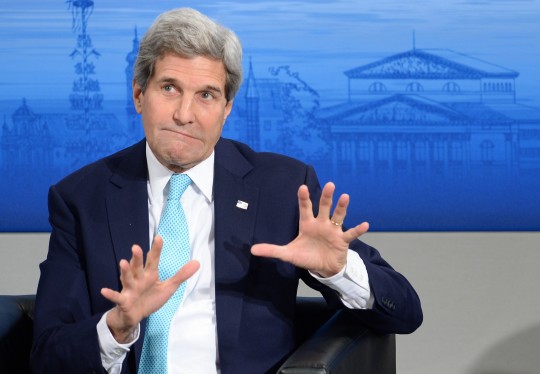
Secretary of State John Kerry ran into a bipartisan buzzsaw at the House Foreign Affairs Committee hearing on Wednesday:

California Republican Rep. Ed Royce, chairman of the House Foreign Affairs Committee, told Kerry at a hearing that members of the panel have serious concerns about the direction of the more than 1-year-old talks, which are at a critical juncture. Negotiators are rushing to try to meet a March 31 deadline for a framework agreement between Iran and the US and five other world powers.

“I’m hearing less about dismantlement and more about the performance of Iran’s nuclear program,” Royce told Kerry. “That’s particularly disturbing when you consider that international inspectors report that Iran has still not revealed its past bomb work.”

New York Rep. Elliot Engel, the ranking Democrat on the committee, expressed skepticism too. Engel noted news stories claiming that negotiators are willing to ease limits on Iran’s enrichment production during the later years of an accord in order to bridge the differences between the two sides over how long an agreement should last.

“We’re hearing troubling reports on the scale and duration of the program that Iran may be allowed as part of a deal,” Engel said.

Kerry, who voted for the Iraq war, at one point said Netanyahu couldn’t be trusted because he supported the war. Aside from the unmitigated chutzpah, it is not true. Israel, as has been widely reported, had significant qualms about the war and came under Scud missile fire. Netanyahu, of course, was not prime minister at the time; Ariel Sharon was. Elliott Abrams, who was deputy national security adviser under President George W. Bush and oversaw the Israel relationship, tells me, “Senator Kerry was famously for the invasion of Iraq before he was against it. Prime Minister Netanyahu, then a cabinet member, was — like Prime Minister Sharon — worried that the United States was going after the wrong target, Iraq, when they worried more about Iran. The assertion that Israel pressed for the invasion of Iraq is wrong, and is usually heard from the loonier anti-Semitic circles. Secretary Kerry owes a lot of apologies today.” Indeed, anti-Israel fanatics on the far right and left blame Israel for pushing the war, so maybe that is where Kerry got this from. But his accusation disproves his point: Netanyahu is actually far more credible on Iran since it is his country that is immediately threatened and it is he who accurately predicted Iran’s march to acquire a bomb.

The Post’s Fred Hiatt recently listed a number of false assurances and misguided predictions by the Obama administration. He concluded, “This litany of unfulfilled assurances is less a case of Nixonian deception than a product of wishful thinking and stubborn adherence to policies after they have failed. But inevitably it will affect how people hear Obama’s promises on Iran, as will his overall foreign policy record. . . . Islamist extremists are stronger than ever; democracy is in retreat around the globe; relations with Russia and North Korea have worsened; allies are questioning U.S. steadfastness.” Indeed there is a world leader who deserves deep skepticism on his judgment about Iran; it’s President Obama.

Frankly, the administration’s snit over the Netanyahu speech has rightly been seen as abject panic. The world leader most credible on Iran from the country that 70 percent of Americans support is coming to debunk the plan to let Iran keep its nuclear infrastructure — in direct contravention of the administration’s public statements and private assurances to our allies in the region. The administration’s lame effort to discredit the prime minister and start a partisan rumpus — led by two of the least credible foreign policy officials in recent memory (Susan Rice of “it was a video” fame on the Benghazi attack and John Kerry, whose previously threatened that the United States could not protect Israel unless it made a peace deal) — is nearly as pathetic as its negotiation posture with Iran. It is no wonder that the administration refuses to concede a deal must be approved by Congress. With each passing day, the administration’s credibility slips deeper into the abyss and the likelihood of bipartisan rejection of the Obama-Clinton-Kerry Iran diplomatic debacle increases.

The Odds Of A War Between Israel And Iran Just Went Way Up

February 26, 2015

The Odds Of A War Between Israel And Iran Just Went Way Up
The Economic Collapse By Michael Snyder, on February 25th, 2015


(I suspect Bibi will have something to say about this in his upcoming address to Congress. – LS)

Uh oh – Iran just got caught with both hands in the cookie jar.  It turns out that even while Iran has been negotiating a “historic peace deal” with the western world, it has been secretly operating a huge underground nuclear enrichment site that it didn’t tell anyone about.  But this is what the Iranians always do.  They lie, lie and then lie some more.  So how in the world can you make a deal with a government that absolutely refuses to tell the truth?  These revelations about a secret underground nuclear facility just outside Tehran come at a time when it looked like the Obama administration was about to cave in and give Iran just about everything that it wanted.  The “deal” that Obama was going to give them would have allowed the Iranians to keep all of the nuclear infrastructure that they have already constructed and would also give them permission to start building nuclear weapons in about a decade.  It would be a monstrously bad deal for the western world, and the Iranians should have jumped at it.  But now these new revelations could throw a wrench into those negotiations.  But much more importantly, knowledge of this secret nuclear facility has got to be extremely alarming to the Israelis.  Prime Minister Benjamin Netanyahu has always said that Israel will never, ever allow Iran to construct a nuclear weapon.  So what will happen if the Israelis determine that Iran is actually much closer to building a nuclear bomb that anyone originally suspected?  The truth is that the odds of a war between Israel and Iran just went way up thanks to these revelations, and that is not good news for any of us.

(more…)

Kerry: U.S. Aware of Illicit Iranian Nuke Facility

February 26, 2015

Kerry: U.S. Aware of Illicit Iranian Nuke Facility, Washington Free Beacon, February 25, 2015

(It’s comforting that Kerry is “aware” of anything the secret facility. But what’s being done to investigate it without, of course, offending Iran? — DM)

John-Kerry-photo-for-negotiations--540x374

Secretary of State John Kerry admitted before Congress on Wednesday that the United States is aware of a secret Iranian facility that an Iranian opposition group identified this week as part of an undisclosed parallel nuclear program.

The group, the National Council of the Resistance of Iran (NCRI), has a history of disclosing the existence of Iranian nuclear facilities that the United States has been later forced to confirm were indeed part of a clandestine nuclear program.

Kerry, under questioning before the House Foreign Affairs Committee, acknowledged that the United States has evidence of the facility, but declined to elaborate to lawmakers about its nature.

“Did the [Iranian] regime tell us about existence of this new nuclear facility,” Rep. Dana Rohrabacher (R., Calif.) asked Kerry at the hearing.

“What you’re saying is it’s a nuclear facility,” Kerry responded. “That is yet to be determined, but we know about the facility, yes.”

“So had they disclosed that facility to us?” Rohrabacher asked.

“It has not been revealed yet as a nuclear facility,” Kerry insisted. “It is a facility that we are aware of, which is on a list of facilities we have. I’m not going to go into greater detail, but these things are going to have to be resolved [in negotiations] as we go forward.”

Questions about the site come in the wake of a report released Tuesday by an Iranian dissident group claiming to provide evidence of “an active and secret parallel nuclear program” in the suburbs of Tehran.

The facility is said to be an “underground top-secret site currently used by the Iranian regime for research and development with advanced centrifuges for uranium enrichment,” according to a copy of the findings by NCRI, also known as the MEK.

Years-long concerns about several secret Iranian nuclear facilities have plagued advocates of an emerging Iran deal and provided ammunition to critics who maintain that the agreement would leave Iran with sufficient infrastructure to continue producing a nuclear weapon.

The existence of such sites has been known for some time to U.S. intelligence agencies and runs counter to the Obama administration’s narrative that Iran can be trusted to comply with a nuclear deal.

“There has never been a time in the past 15 years or so when Iran didn’t have a hidden facility in construction,” a senior Obama administration officialadmitted to the New York Times in 2013.

Concerns among lawmakers and others have been amplified in recent days following the revelation by the Associated Press that the United States is considering permitting Iran to keep its nuclear infrastructure in tact.

The deal is shaping up to be a two-phased agreement, meaning Tehran would be subject to restrictions on its work for around a decade before they are lifted, the AP reported.


