Deadly Fighting Between Hezbollah and Israel, Fox News with Oliver North via You Tube, January 29, 2015
(Obama: acting like a “petulant child.” — DM)
Deadly Fighting Between Hezbollah and Israel, Fox News with Oliver North via You Tube, January 29, 2015
(Obama: acting like a “petulant child.” — DM)
Iranian institutions to hold cartoon contest on The Holocaust
Via The Art Desk at the Tehran Times

(Let me guess…in response the Israelis will take to the streets in protest, riot, and behead several non-believers. – LS)
TEHRAN — Iran’s House of Cartoon and the Sarcheshmeh Cultural Complex plan to hold another international contest on the theme of Holocaust denial in the near future.
The 2nd International Holocaust Cartoons Contest has been organized in protest against French satirical weekly Charlie Hebdo’s recent publication of the cartoons insulting Prophet Muhammad (S), the secretary of the contest, Masud Shojaei-Tabatabaii, said in a press conference on Saturday.
Shojaei-Tabatabaii, who is also the director of Iran’s House of Cartoon, added that world cartoonists are asked to submit their works before the first day of April.
The first place winners will receive a cash prize of $12,000, the second place will have $8000 and the third $5000.
The top selected works will mainly go on show at the Palestine Museum of Contemporary Art in Tehran and several other locations across the city.
White House Struggles To Distinguish Between The Islamic State and Taliban Prisoner Swaps, Jonathan Turley’s Blog, Jonathan Turley, January 30, 2015
(President Humpty Dumpty:
‘When I use a word,’ Humpty Dumpty said, in rather a scornful tone, ‘it means just what I choose it to mean — neither more nor less.’
‘The question is,’ said Alice, ‘whether you can make words mean so many different things.’
‘The question is,’ said Humpty Dumpty, ‘which is to be master — that’s all.’
Hence, Islam is the religion of peace and terrorists aren’t terrorists. Will all of the king’s horses and all of the king’s men be able to put him back together again?– DM)


The White House again seems to be struggling with barriers of both language and logic as many raise comparisons between the controversial Bergdahl swap and the effort this week of Jordan to swap a terrorist for one of its downed pilots with Islamic State. During a week where one of the five Taliban leaders released by the Administration has been found trying to communicate with the Taliban, the Jordanian swap has reignited the criticism of the swap for Army Sgt. Bowe Bergdahl, which violated federal law and released Taliban leaders with long and bloody records. The White House seems to be trying to argue that the Taliban are not terrorists in direct contradiction to its prior position that they are indeed terrorists. It shows the fluidity of these terms and how the government uses or withdraws designations as terrorists to suit its purposes. The familiarities between Islamic State (IS) and the Taliban appear to be something in the eye of beholder or, to quote a certain former president, “It depends on what the meaning of the word ‘is’ is.”
As a refresher, the Taliban has long been viewed as terrorists, even when they were in power. They have destroyed religious sites, art, and in one of the most infamous acts in modern history, blew up the giant ancient Buddhas at Bamiyan.The United Nations and human rights groups have documented a long list of civilian massacres and bombings carried out by the Taliban. One report described “15 massacres” between 1996 and 2001. The UN estimates that the Taliban were responsible for 76% of civilian casualties in Afghanistan in 2009, 75% in 2010 and 80% in 2011. The Human Rights Watch estimates that “at least 669 Afghan civilians were killed in at least 350 armed attacks, most of which appear to have been intentionally launched at non-combatants.” This includes the widespread use of suicide belts. The Taliban has always had a close alliance with al Qaeda.
That record was put into sharp relief with the swap for Bergdahl with ties to terrorism including one who was the head of the Taliban army, one who had direct ties to al-Qaeda training operations, and another who was implicated by the United Nations for killing thousands of Shiite Muslims. While we have always said that we do not negotiate with terrorists, we not only negotiated for Bergdahl but gave them what they wanted.

The Jordanian swap raised the same obvious concerns. Many have objected, for good reason, to the idea of releasing Sajida al-Rishawi, who participated with her husband in a terrorist attack on a wedding party at the luxury Radisson hotel in the Jordanian capital of Amman on Nov. 9, 2005. al-Rishawi hoped to be welcomed to paradise by walking into a wedding of 300 people enjoying a family gathering with children and murdering them in cold blood. Her husband’s bomb went off but not her bomb. It goes without saying that she is a hero to the murderous Islamic State for her effort to kill men, women, and children at a wedding.
The swap appears in part the result of pressure from Japan to secure the release of one of its citizens. In my view, such a propose swap was disgraceful. al-Rishawi is as bad as it gets as a terrorist. To yield to terrorists who engage in weekly demonstrations of beheading unarmed captives is morally wrong and practically suicidal. Just as the West is funding this terrorist organization through millions of ransom payments, the exchange of a terrorist only fuels their effort to capture and torture more Western captives.
This brings us back to the White House. When asked about the proposed swap with Islamic State, the White House was aghast. White House spokesman Eric Schultz stated “Our policy is that we don’t pay ransom, that we don’t give concessions to terrorist organizations. This is a longstanding policy that predates this administration and it’s also one that we communicated to our friends and allies across the world.”
The media understandably sought guidance on why the swap with Bergdahl was the right thing to do (despite the flagrant violation of federal law) while the swap for the pilot was not. The White House acknowledged that the Taliban are still on a terrorist list but then tried to rehabilitate the organization into something else. The White House is now referring to the Taliban as an “armed insurgency.” It notes that the Taliban are not listed by the State Department as a terrorist organization. However, they are listed as one of the “specially designated global terrorist” groups by the Department of the Treasury. Indeed, they have been on that list since 2002. Worse yet, the statement from the White House came in the same week that the Taliban claimed responsibility for killing three U.S. contractors.
John Earnest tried to thread the needle by explaining “They do carry out tactics that are akin to terrorism, they do pursue terror attacks in an effort to try to advance their agenda.” He seems to struggle to explain what is terrorist attacks and what are attacks “akin to terrorism.” Most people view suicide belts and civilian massacres to be a bit more than “akin to terrorism.”
Earnest also note that, while the Taliban has links to al Qaeda, they “have principally been focused on Afghanistan.” However, “Al Qaeda is a terrorist organization that has aspirations that extend beyond just the border between Afghanistan and Pakistan.” That is diametrically opposed to the position of the Administration in claiming sweeping powers to strike targets around the world against any forces linked to al Qaeda and many who have few such links. Indeed, while referencing to the authorization to attack al Qaeda, the Administration attacked Islamic State, which was actively fighting with al Qaeda.
The spin of the White Hosue also ignores the role of the Taliban-aligned Haqqani network in holding Bergdahl, a well-known terrorist group.
There are obviously arguments to make for the Bergdahl swap (though I find little compelling in the arguments that justify the violation of federal law by the White House). However, the argument must acknowledge that we negotiated with a group of hostage taking terrorists and we need to address the implications of that fact. Alternatively, if the White House now believes that the Taliban is no longer a terrorist organization, it needs to take it off its listing of such groups (a listing that subjects people to criminal charges for material support or assistance with the group). It cannot have it both ways and call it a terrorist group unless such a label is inconvenient.
Swapping Prisoners with Terrorists, National Review Online, Andrew C. McCarthy, January 29, 2015
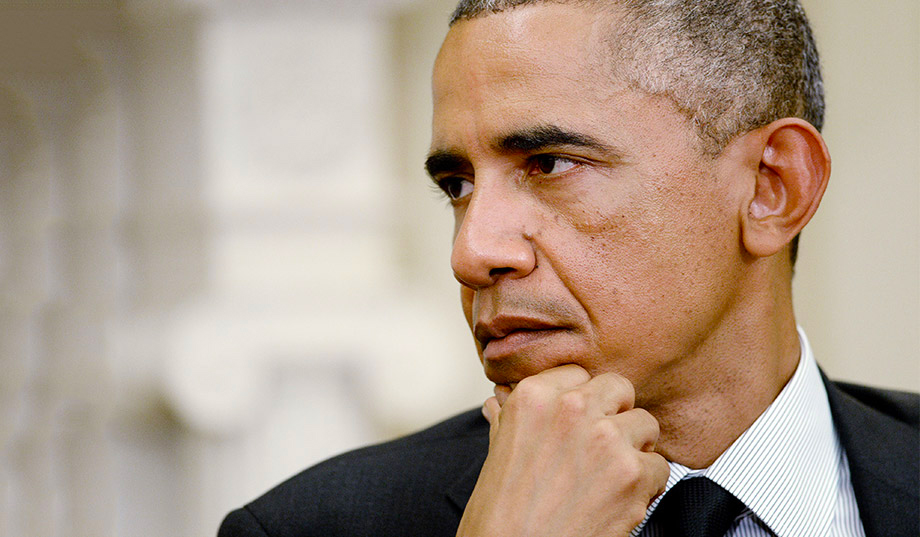
Obama’s disastrous policy dates back to his earliest days in office.
Suddenly, there is outrage in the land over President Obama’s policy of negotiating prisoner swaps with terrorist organizations, a national-security catastrophe that, as night follows day, is resulting in more abductions by terrorist organizations.
Well, yes, of course. But what took so long? Sorry if I sometimes sound like I work the “I Told You So” beat at the counter-jihad press. But as recounted in these pages, immediately upon assuming power in 2009, Obama started negotiating exchanges of terrorists — lopsided exchanges that sell out American national security for a net-zero return.
Critics now point to the indefensible swap Obama negotiated with our Taliban enemies in 2012 as if it were the start of the problem. In reality, the springing of five top Taliban commanders in exchange for the Haqqani terror network’s release of U.S. soldier Bowe Bergdahl was fully consistent with what was by then established Obama policy. There was nothing new in our president’s provision of material support to terrorists even as those terrorists continued to conduct offensive terrorist operations against our troops.
Clearly, the Bergdahl–Taliban swap was a disaster. As I’ve previously noted, it would be a profound dereliction of duty for a commander-in-chief to replenish enemy forces in this manner even if the captive we received in exchange had been an American war hero. To the contrary, Obama replenished our enemies in exchange for a likely deserter who may have voluntarily provided intelligence to the enemy and whose treachery cost the lives of American soldiers who tried to find and rescue him.
Even the conservative media are now suggesting it was the Bergdahl–Taliban swap that marked Obama’s reckless departure from longstanding American policy against negotiation with terrorists, and in particular against exchanging captured terrorists for hostages. This policy reversal has indeed incentivized jihadists to capture more Westerners, and prompted state sponsors of jihadists, such as Qatar, to propose more prisoner swaps. Moreover, the Obama strategy has deprived the U.S. of any moral authority or leadership influence to dissuade other countries, such as Jordan, from releasing anti-American jihadists in similar prisoner exchanges.
But the disaster did not begin with the Bergdahl–Taliban swap.
As I detailed in a column soon after Obama took office — specifically, on June 24, 2009 (“Negotiating with Terrorists: The Obama administration ignores a longstanding — and life-saving — policy”):
Even as the mullahs [i.e., the rulers of Iran’s Shiite regime] are terrorizing the Iranian people, the Obama administration is negotiating with an Iranian-backed terrorist organization and abandoning the American proscription against exchanging terrorist prisoners for hostages kidnapped by terrorists. Worse still, Obama has already released a terrorist responsible for the brutal murders of five American soldiers in exchange for the remains of two deceased British hostages.
To summarize: The Iranian government implanted a network of Shia jihadist cells in Iraq in order to spearhead the terror campaign against American troops. The point was to duplicate the Hezbollah model by which Iran controls other territory beyond its borders. In fact, the network of cells, known as Asaib al-Haq (League of the Righteous), was organized by Hezbollah veteran Ali Musa Daqduq.
The network was run day-to-day by two brothers, Qais and Layith Qazali. Both brothers and Daqduq were captured by U.S. forces in Basrah after they orchestrated the assassination-style murders of five American soldiers abducted in Karbala on January 20, 2007.
A few months later, in May 2007, the terror network kidnapped five British civilians. As American troops put their lives on the line to protect Iraq, the terrorist network told Iraq’s Iran-friendly prime minister, Nouri al-Maliki, that they would release the Brits in exchange for Daqduq and the Qazali brothers. The Bush administration refused the offer.
But soon after entering office in 2009, President Obama decided to change course and entertain the offer. The new administration rationalized that the trade could serve the purpose of Iraqi political reconciliation — which is to say: Obama, in the midst of pleading for negotiations with the “Death to America” regime in Tehran, prioritized the forging of political ties between Iraq and an Iran-backed terror network over justice for the murderers of American soldiers.
Conveniently, Iran’s influence over Maliki ensured that Iraq would play ball: Maliki’s government would serve as the cut-out, enabling Obama to pretend that (a) he was negotiating with Iraq, not terrorists; and (b) he was releasing terrorists for the sake of Iraqi peace, not as a ransom for hostages.
Layith Qazali was released in July. This failed to satisfy the terror network, which continued to demand the release of Daqduq and Qais Qazali. The terrorists did, however, turn over two of the British hostages — or rather, their remains.
I know you’ll be shock-shocked to hear this, but while Obama’s minions were practicing their so-very-smart diplomacy, the jihadists were killing most of their hostages. At least three of the Brits were murdered. Yet even that did not cause Obama to reconsider his position.
In late 2009, the administration released Qais Qazali in a trade for the last living British hostage, Peter Moore. As The Long War Journal’s Bill Roggio reported at the time, an enraged U.S. military official aware of the details of the swap presciently observed: “We let a very dangerous man go, a man whose hands are stained with U.S. and Iraqi blood. We are going to pay for this in the future.”
Meanwhile, as I related in July 2009, Obama released the “Irbil Five” — five commanders from the Iranian Revolutionary Guard’s Quds force. Like Daqduq, the Quds force was coordinating Iran’s terror cells in Iraq. At the time, General Ray Odierno, then the top U.S. military commander in Iraq, publicly stated that Iran was continuing to support, fund, and train the terrorists attacking American and allied forces.
As Michael Ledeen pointed out, the release of the five Iranian terrorist commanders – three years before Obama’s release of the five Taliban commanders – was the price the mullahs had demanded to free Roxana Saberi, a freelance journalist the mullahs had been holding. The Obama administration, naturally, claimed that it was not negotiating with terrorists but with sovereign governments (just as it claimed only to be negotiating with Qatar as it cut the Bergdahl deal with the Taliban and the Haqqanis). Besides, said the administration, the president’s hands were tied by the status-of-forces agreement, which purportedly required turning prisoners over to the Iraqi government (for certain return to Iran) — even prisoners responsible for killing hundreds of Americans, even prisoners sure to persevere in the ongoing, global, anti-American jihad.
And then there was Daqduq. His comparative notoriety, coupled with a smattering of negative publicity over the other terrorist negotiations and swaps, caused a delay in his release. But in July 2011, with the Beltway distracted by the debt-ceiling controversy, the Obama administration tried to pull off Daqduq’s stealth transfer to Iraq.
As I noted at the time, however, the Associated Press got wind of the terrorist’s imminent release, and its short report ignited fury on Capitol Hill. Several senators fired off a letter, outraged that the United States would surrender “the highest ranking Hezbollah operative currently in our custody” — a man who would surely return to the jihad “to harm and kill more American servicemen and women” when Iraq inevitably turned him over to Iran, as it had done with other released terrorists.
The administration retreated . . . but only for the moment. Realizing it would be explosive to spring Daqduq during his reelection campaign, Obama waited until the Christmas recess after the election. The president then had the terrorist quietly handed over to Iraq, which, after acquitting Daqduq at a farce of a “trial,” duly released him to Hezbollah in Lebanon.
There is a reason why the Arab press was reporting that the Obama State Department was entertaining discussions with Egyptian authorities about freeing the Blind Sheikh — Omar Abdel Rahman, the convicted terrorist serving a life sentence for running the jihadist cell that bombed the World Trade Center and plotted other attacks against New York City landmarks. There is a reason why, when he assumed power in 2011, Muslim Brotherhood–leader-turned-Egyptian-president Mohamed Morsi proclaimed that his top priorities included pressuring the United States to return the Blind Sheikh to Egypt.
Long before the Bergdahl–Taliban swap, it was well known that the Obama administration was open for business — if the business meant releasing terrorists.
Are Liberals Actually Admitting Islamic Terrorists Exist?!? PJ Media Trifecta via You Tube, January 29, 2015
(The phrase “literal Islam” is an excellent substitute for “radical Islam.” Literal readings of the Koran and other Islamic “holy” texts support and demand what so called “radical Islamic extremists” do. Perhaps Obama and others who claim that Islam is “the religion of peace” should be labeled “extremist” and/or “radical” because they — rather than the Islamic State, et al — pervert the basic teachings of Islam. They apparently want us to believe, all evidence to the contrary notwithstanding, that Islam is just another peaceful religion much like others and is therefore not a problem for secular societies. — DM)
By: J. E. Dyer
Published: January 30th, 2015
via The Jewish Press » » Bibi, Iran’s Nukes, and Military Force in a Changed Middle East.

{Originally posted on author’s website, Liberty Unyielding}
Over at The Atlantic, there’s a comprehensive worldview being built on the question of whether there’s a “military solution” to the Iran nuclear problem, and how Benjamin Netanyahu has Israel positioned vis-à-vis the problem in general.
Jeffrey Goldberg thinks Netanyahu has Israel positioned very poorly indeed.
James Fallows’ conclusion, agreeing with Goldberg on the worldview, is encapsulated in a quote from a war-game director and retired Air Force officer in 2004:
“After all this effort, I am left with two simple sentences for policymakers,” our main war-game designer, retired Air Force colonel Sam Gardiner, said at the end of our 2004 exercise. “You have no military solution for the issues of Iran. And you have to make diplomacy work.” That was true then, and truer now.
I don’t doubt at all the sincere belief Fallows has in this conclusion. But if you unpack the work that led to it 2004, you find that it was based on a fatally flawed premise. (More on that in a moment.)
Moreover, the situation of 2004 no longer obtains. That means that the calculations of two major players must now be different. One is Israel; the other is the United States. The calculations I refer to include not merely the consequences of each party’s actions, and whether the parties’ capabilities are sufficient for the necessary task. They also include what the threat has become, and the fact that it is graver now than in 2004.
Don’t make assumptions about what I mean by that. It may not be what you think.
Why the 2004 conclusion about “military force” is flawed
I’ll begin by explaining my point that the premise of the 2004 war game sponsored by The Atlantic was flawed. There are several criticisms that can be levied, but this is the one that matters most. (And I don’t mean to impugn the care and diligence that went into the war game. You’ll see, however, why I found it fatally flawed at the time – before I was an active blogger – and still do.)
To illustrate what I’m talking about, I’ll quote a key passage from the 2004 war-game summary. Several players were assembled to act out the roles of the Principals Committee of the National Security Council, and James Fallows narrates the events of the game:
The President wanted to understand the options he actually had for a military approach to Iran. The general and his staff had prepared plans for three escalating levels of involvement: a punitive raid against key Revolutionary Guard units, to retaliate for Iranian actions elsewhere, most likely in Iraq; a pre-emptive air strike on possible nuclear facilities; and a “regime change” operation, involving the forcible removal of the mullahs’ government in Tehran. Either of the first two could be done on its own, but the third would require the first two as preparatory steps. In the real world the second option—a pre-emptive air strike against Iranian nuclear sites—is the one most often discussed. Gardiner said that in his briefing as war-game leader he would present versions of all three plans based as closely as possible on current military thinking. He would then ask the principals to recommend not that an attack be launched but that the President authorize the preparatory steps to make all three possible.
The fatal flaw here is posing the problem set by the president as one of creating options for a “military approach” to Iran. That’s why the options end up being, respectively, useless, vague, and appalling.
Asking what a “military approach to Iran” would look like is asking the wrong question. The first question – the right question – is always what the objective is. If you read through the war-game summary, I believe you’ll agree with me that no strategic objective was ever set for the players. The three options outlined above imply three different objectives. If I were the president, and those three options were presented to me, I would ask what could have possessed my staff to forward options one and three.
Fallows relates that the Principals Committee players spent most of their time thinking of reasons why option three was bad. Of course they did. But why they were even discussing it is the real question.
They spent very little time on option two, according to Fallows, which is the only option that would have fit the objective as most Americans understood it: to prevent Iran from getting nuclear weapons by inflicting destruction on her nuclear program. This is his account of the time they gave to it:
The participants touched only briefly on the Osirak-style strike [i.e., option two] during the war game, but afterward most of them expressed doubt about its feasibility.
This is by no means the only reason to dispute the conclusion the war-gamers came to. But it’s the most important one. They were not asked to respond to a specific objective with options for accomplishing it. In particular, they weren’t told to focus on the objective that was relevant and widely understood to be the potential purpose of military operations – and they didn’t focus on it!
They were asked, in the absence of a specific objective, to discuss some random options for using military force. That tells us nothing about the efficacy of military force. It tells us that the planning process asked the wrong question.*
Fast-forward to 2015
In 2015, we are no longer in the situation of 2004. Three important conditions have changed since then. The importance of these conditions can’t be overstated, in fact, because they change both what’s possible, and what matters.
Jeffrey Goldberg wrote the following on Tuesday (emphases below are added by James Fallows):
Whatever the case, the only other way for Netanyahu to stop Iran would be to convince the president of the United States, the leader of the nation that is Israel’s closest ally and most crucial benefactor, to confront Iran decisively. An Israeli strike could theoretically set back Iran’s nuclear program, but only the U.S. has the military capabilities to set back the program in anything approaching a semi-permanent way.
Fallows disagrees with him, invoking the 2004 war game to assert that “military force,” per se, just can’t get the job done:
Israel doesn’t have the military capacity to “stop” Iran from getting a nuclear weapon, and neither does the United States, at least not in circumstances short of total war.
The key problem with working off of either of these premises, Goldberg’s or Fallows’, is that their framing is stuck in 2004. Here are the three conditions that have changed since then:
(1) The U.S. no longer has the conventional military capability to “set back Iran’s nuclear program in something approaching a semi-permanent way.” This is a relative condition, and it’s because of the loss of readiness in our armed forces, independent of any other reason.
(2) Iran’s nuclear program is considerably advanced from 2004, and setting it back has a different definition now. This doesn’t mean it’s infeasible, but it does mean that no one now has the capability to use a conventional strike campaign to set Iran’s program back to where it was ca. 2004 or earlier. A setback can only be to some much more advanced point in Iran’s progress.
(3) Iran’s geopolitical posture in the Middle East has changed materially since 2004. The regime’s intentions have never changed, but the facts on the ground about what territory Iran can use to menace her neighbors – as well as U.S. interests – have changed dramatically.
I’ll discuss each of these factors in turn.
Decline in U.S. military capabilities
Here is the thing to keep in mind about U.S. capabilities. In 2004, it was correct to say that the capabilities we had were sufficient to contemplate destroying every Iranian facility related to the nuclear weapons program, using conventional means. Not only did we have the weaponry; the weapon systems were in a readiness state high enough to be deployed and used.
There was a political question, certainly, about how hard we wanted to hit Iran. There were a number of factors to consider, and valid reasons why it was not done. But it was feasible to do it, with the arsenal we had readily available.
In 2015, we could no longer conduct that same attack: the attack that was necessary in 2004, against a smaller and less advanced nuclear program. We don’t have the same assets available now, because our strike-fighters, in the Air Force and Navy, are unable to maintain the same level of force-wide readiness they could in 2004. When they’re not deployed or within 3-5 months of deploying, our strike fleet aircrew and aircraft now fall to the lowest level of readiness, and can’t be “worked up” on a short timeline.
There are no extra ready squadrons to call on today, and fewer are routinely present in the CENTCOM area of responsibility than in 2004. The same is true of aircraft carriers and Tomahawk missile shooters. (Read more about how we got to this point here, here, here, here, and here.)
If the president wanted to assemble a force to attack Iran, the force would be smaller than what he would have had in 2004, and any “build-up” would involve pulling assets off the front line in other theaters: Europe, where NATO is trying to deter Russia with an enhanced military presence, or the Far East, where we are trying to deter North Korea and China.
Alternatively, the president could ask Congress for the funding to increase force readiness so that there would be more of the strike fleet available at a given time. Implementing that approach would take at least six months to see the first effects: e.g., one or two squadrons at improved readiness. The issue isn’t just things like pilot qualifications; it’s things like non-deployed aircraft being cannibalized for parts, and the whole fleet being backed up with deferred maintenance.
We continue to keep our global strategic bombers – B-2s and B-52s – at a generally higher level of readiness, and could use them to attack Iran with conventional ordnance. Their operations would be constrained, however, by the limitations of strike-fighter readiness and specialty aircraft (e.g., the Navy F/A-18 “Growlers” that provide electronic warfare support). The bombers need escorts, as they need in-flight refueling; having enough ready bombers isn’t the same thing as having enough ready capability.
Moreover, the U.S. could expect to have limited access to airfields in the Persian Gulf region. It became clear as early as 2010 that Gulf nations would seek to restrain U.S. operations against Iran from their bases, and today, we should expect the Gulf emirates to be very picky about what they allow. They won’t buy into tentative, non-decisive military operations that leave Iran able to retaliate against them. If they fear that we aren’t going to act decisively enough, it’s likely that all three of our major hosts – Bahrain, Qatar, and Kuwait – would deny us the use of their bases for an operation against Iran.
That limiting condition would take out the Air Force as a source of strike-fighters, and make it much harder to operate tankers, reconnaissance aircraft, and AWACS.
Add in factors like the uncertain future of the Tomahawk missile (the Obama administration proposed to end production in 2014), and what we have today is a much more limited set of options than we had in 2004. Although we still have a capability to attack Iran’s nuclear-related facilities, we can’t mount the kind of crippling attack we could have in 2004. What we could achieve now is limited to a smaller effect.
Put it this way: in 2004, the five-day attack described in option two of the Atlantic war game was less than what was needed to impose that “semi-permanent setback” referred to by Jeffrey Goldberg. But we could have mounted that option two attack with negligible inconvenience to ourselves. It was well within our capabilities. We also had the means, by deploying more force, to bring off the larger attack required to administer the “semi-permanent setback.”
In 2015, something like the five-day attack is the very most we could bring off. It was less than what was needed to achieve a semi-permanent setback to Iran’s program in 2004 – and today, it is far less.
Advances in Iran’s nuclear and missile programs
Iran has made significant advances in her nuclear and missile programs since 2004, demonstrating the ability to enrich uranium to near-weapons-grade purity; demonstrating the ability to enrich uranium on an industrial scale; acquiring enough enriched-uranium stock for 7-8 warheads; and demonstrating the ability to boost a payload into orbit, and therefore, inevitably, a ballistic missile to ICBM ranges. Iran had none of these capabilities in 2004, and in fact was not even close to having them.
(It is worth noting that the January 2015 appearance in Iran of a launch platform capable of supporting an ICBM has occurred right on schedule, in terms of when analysts in the last decade thought it would. As of 2015, we have seen most of the developments that were predicted in the Iranian nuclear program in the 2005 NIE – see here as well – and the missile-system developments predicted in that NIE and an East-West Institute analysis published in 2009.)

ICBM-capable launcher observed near Tehran in Jan 2015. (Israel Ch. 2)
The Iranians have also installed missile silos for their medium-range ballistic missiles (MRBMs) – hardening them against attack – and, according to British intelligence, successfully launched a solid-fuel mobile MRBM to a range of 2,000 km (1,200 statute miles) in 2011. The latter feats mean Iran has a no-notice, shoot-and-scoot MRBM capability that can reach well into Europe.
These various advances, and other related ones, have two significant implications. One is that the “bottleneck” of Iran’s nuclear weapons program – the part of it we would get the highest payoff from attacking – has shifted.
There are other, related implications, such as the right way to attack elements of the program. It wouldn’t be enough today to simply blast away at the Natanz uranium enrichment complex, for example; we would have to follow through afterward and actively prevent Iran from rebuilding a uranium enrichment capability, which the Iranians now have more than ample expertise to do. In 2004, it would have been a tremendous setback to them to lose Natanz. They still couldn’t absorb such a loss easily, but their recovery now would be a matter of time and money, not rebuilding from scratch.
At any rate, the bottleneck, or critical node, in their program shifted some time ago, from uranium enrichment, which Iran has mastered, to weaponization of a warhead: that is, fitting a functioning warhead to a delivery system (presumably a ballistic missile, at least to begin with. Cruise missiles would come later). Although we have a reasonable idea of which sites to hit to attack that “weaponization” bottleneck, it is the most shadowy aspect of the Iranian nuclear program. Our confidence in what to hit is slightly lower than it is for the uranium chain or the missile design and production chain.
The other key implication about Iran’s advances is, of course, that the threat has increased. It is greater today, and it’s more imminent. We can less afford to do nothing about it than we could in 2004.
And what that means is that even if we can only do less now than we would prefer, the urgency of doing it has increased.
Iran’s geopolitical posture and the resulting threat
That is one facet of the situation faced by Israel. It’s also a situation faced by the United States, now that Iran is ten years closer to having an ICBM capability, and at the very least could soon be able to hold every partner we have in the Middle East hostage with nuclear-armed MRBMs.
For Israel, however, it isn’t possible to separate the security implications of the nuclear-missile problem from the geopolitical problem. Both work together to change Israel’s security conditions – which is what Iran intends.
Jeffrey Goldberg wrote his piece Tuesday as if nothing has changed for Israel, other than that there are now face-to-face negotiations between the U.S. and Iran. But since January 2011, Israel’s security situation has changed significantly, and Iran is one of the biggest factors in that.

Graphic used by retired Gen. Jack Keane to brief Congress 27 Jan on 4-fold increase in radical Islamic threat since 2010. (Graphic: Institute for the Study of War; CSPAN video)
It’s particularly meaningful to frame the issue by starting from the fact that Israel’s capability against the Iranian nuclear program has always been more limited than America’s. (Stay with me; this does relate to the Iranian geopolitical posture.) It’s possible for America to recover the ability to pressure and intimidate Iran into a level of compliance, along the lines of the strategy outlined in my footnote below. It will never be possible for Israel to do that.
If Israel is going to act, it will have to be with an actual attack. And that means that what Iran has to do is make it as hard as possible for Israel to bring off such an attack. That is a driving facet of the geopolitical problem Iran sets for herself. Iran has larger designs on the region; her plans against Israel “nest” into them. But the focus on Israel is unmistakable, and one of the key reasons is that hemming Israel in with threats will dilute Israel’s capability to mount an attack against Iran’s high-value facilities.
As little as five years ago, Iran’s options for servicing this requirement were quite limited. Hamas and Hezbollah could launch rockets and dig tunnels from Gaza and southern Lebanon. Hezbollah had successfully used an Iranian-supplied anti-ship missile in 2006, but there was little likelihood of such an attack being brought off again.
Iran, however, had begun sending warships to the Horn of Africa for antipiracy operations as early as December 2008, and with the onset of the Arab Spring, her military profile across the region metastasized. The presence of Iranian warships has become routine in the Red Sea, and in 2011, Iran sent warships through the Suez Canal for the first time since the 1979 revolution. Iran has announced deploying submarines to the Red Sea as well. Every new weapon the Iranian navy tests or drills with in the Persian Gulf – including cruise missiles and high-speed torpedoes – it intends to use in its forward patrol areas, which now include the waters of the Red Sea, and potentially the Eastern Mediterranean.
Meanwhile, Iran now has Special Forces deployed in Iraq, as well as wherever the Assad regime is in (nominal) control of territory in Syria. There is intriguing evidence that the Iranians have taken over a nuclear-related facility in western Syria: in fact, that they arranged for Hezbollah to “liberate” it from Sunni jihadists because it’s a nuclear facility, and is being used for Iran’s purposes.

Iran’s aggressively expanding posture across the region. (Google map; author annotation.)

Google map; author annotation. Inset: Wikimedia Commons, author annotation)
It’s important to understand that Iran’s campaign serves multiple purposes, because its implications for Israel are therefore bigger. Israel isn’t just concerned now about Iran’s nuclear program. Netanyahu has to be concerned about what Iran, with or without nuclear arms, will do with her expanding territorial leverage in the region. Iran gaining a foothold in Yemen with the Houthi coup there is the latest disturbing development, one that could give the Iranians a base from which to deploy midget submarines into the Red Sea, for example, or base military aircraft, or position missile launchers to complicate Israel’s missile defense picture. Yemen could certainly become a waypoint for the flow of illicit arms from Iran to a variety of recipients. Where once Israeli intelligence could focus on ports in Sudan, it now may have the entire western coast of Yemen to contend with.
The brewing crisis in the Golan may by itself be enough to present Israel with a matrix of game-changing decision points in the next 12 months. There’s a limit to how much harassment Israel can afford to live with and retain viability as a free and secure nation, making a good life possible for her people. The confrontation with Iran is growing in more than one dimension, and Israel can’t treat the Iranian nuclear program as a theoretical, specialized threat, separate from the overall menace Iran presents to her.

right, IRGC General Mohammad Ali Allahdadi, one of two IRGC general officers and six Iranians conducting reconnaissance in the Golan Heights on 18 Jan 2015, when their convoy was struck by (presumably) the IDF. Allahdadi is seen here hanging with former President Khatami in 2009. (Image: Iranian TV via Twitter)
It’s not 2004 anymore
The profile of Iran’s activities makes it abundantly clear that none of what she does is “about” Israel making concessions on West Bank settlements, or otherwise falling in with proposals made by the Obama administration for a final status agreement. Iran is all over the region – Iraq, Syria, Lebanon, Yemen, Sudan – taking advantage of the opportunities created by the aftermath of the Arab Spring.
Jeffrey Goldberg suggests that Israel should strengthen Obama’s negotiating position by making more concessions to the Palestinian Arabs. But in 2015, nothing in the region’s main dynamic is even about that anymore. The main dynamic is the feeding frenzy for the territory of Syria and Iraq. The various actors are shaping up to be Iran, ISIS, the Kurds, and some combination of others who still retain a legacy set of “status quo” objectives (including, e.g., the U.S., Saudi Arabia, and perhaps Turkey).
Not one of those actors can be deterred or influenced by artificially forced developments in the now-defunct Oslo process. But at least two of the actors – Iran and ISIS – will exploit Israel however they have to, to gain advantage for themselves. That’s what Iran is doing with her foray into the Golan, which gives “top cover” to her nuclear program, but also has the real potential to become as much of an existential threat to Israel as an Iranian bomb.
Israel can’t afford to ignore the fact that the whole unfolding strategy interlocks. In essence, Iran has already begun a new phase in her long-running campaign against Israel, and the Obama administration is asking Israel to behave toward the negotiations with Iran as if that hasn’t happened: as if it’s still 2004, and everyone still has the same situation and the same options.
An emerging trigger point
Israel doesn’t. It’s not 2004 anymore. There was a time, as little as a year ago, when the triggers for Israel to have to attack boiled down mainly to these two: either Iran was about to cross the “red line” Bibi briefed to the UN in 2012, or the Iranians were about to deploy a modern anti-air missile system that would make it too difficult for Israel to pull the attack off, once it was in place.
But we’re past that point now. Developments in the nuclear program, or inside Iran, aren’t Israel’s only concern. The Israelis may well have to execute a preemptive strategy that baffles and blunts Iran’s whole package of activities in the Israeli security perimeter. Attacking the Iranian nuclear program – facilities in Iran – will probably form some element of that, but it won’t be enough.
And the trigger matrix has changed. The intolerable juncture for Israel is likely to be connected with Iran’s emerging campaign in the Golan. Neither the prompts for military action, nor its purpose and targets, will be bounded by the old outlines of the “Iranian nuclear” problem. The problem is bigger now: simultaneously more threatening and immediate, and more diffuse. A strike campaign against Iranian nuclear facilities, with F-15s, is no longer the main mental picture we should have.
Like the Oslo-legacy negotiations, the Obama administration’s negotiations with Iran have little relevance to the security conditions Israel faces today. One of the most important things the U.S. could do to reset the clock is now out of reach: that is, pacify and effectively settle the situation in Syria and Iraq, where Iran, like ISIS, is gaining strength and position from conflict. The Obama administration doesn’t seem aware that the situation has changed, and with it the motives and concerns of everyone in the region. Netanyahu has to deal, nevertheless, with a reality that’s changing under our feet with each passing day.

Center, with scarf: Iranian Qods Force commander Gen. Qassem Soleimani, with local Iraqi military leaders in Iraq in 2014. A U.S. defense official said in 2013 that Soleimani was “running the whole Syrian war by himself.” (Quoted by Dexter Filkins in “Shadow Commander,” The New Yorker, 30 Sep 2103. Image via Twitter)
* I’m fully aware, incidentally, that policy is sometimes made in just this way. But that doesn’t mean that we can accurately judge whether military force would be effective by approaching our evaluation through an inherently flawed policy-making process.
An objective and a strategy
For what it’s worth, this is what I would have asked the NSC and principals to look at back in 2004. The strategic objective would have been to rope Iran into a heavily and genuinely supervised mode with her nuclear program, understanding that political change in Iran might be encouraged that way (alongside other methods), through frustrating the regime and weakening its reputation, but would ultimately have to come in other ways from the Iranian people. Outreach to reformers in Iran would have been the highest American priority overall.
The objective of using military force would have been to set Iran’s nuclear program back significantly – by at least 24 months – and inflict some level of additional damage as a deterrent, against both immediate retaliation and future activities.
I would have wanted a process of escalating pressure on Iran with a concurrent military build-up in the Gulf region, designed to force Iran to open up all the facilities identified by the IAEA and Western intelligence as suspect. If Iran didn’t comply in good faith by a deadline, the strikes would start. The strike threat would have been implied, not spelled out. The deadline would have been a short one (30-45 days), only long enough to accommodate the build-up, but not so long that Iran could change all her program arrangements to evade attack.
The scope of military strikes for which the build-up was designed would have included the significant “bottleneck,” or critical node, of Iran’s program at the time – the uranium enrichment complex at Natanz – as well as the suspicious special-use facilities in the Parchin area southeast of Tehran.
There would have been some other targets in the nuclear and missile programs, but those two installations would have been the top priorities. Equally important targets would have been the IRGC assets most useful for projecting power outside Iran’s borders, including ballistic missiles, coastal cruise missiles, and submarines, as well as the IRGC’s paramilitary organization. Attacking the air defense network and national command and control nodes would have been necessary to hold air superiority for U.S. forces while they were operating in Iranian air space.
Ideally, the preparations for this, and the escalating pressure on Iran (very possibly including intense economic pressure), would have gotten Iran to make some meaningful concessions at the time. We need not oversell what we could have wrested from Iran without an attack, but odds were better than even that we could have gotten meaningful concessions: concessions that justified the effort, even if they weren’t everything we wanted. Rinsing and repeating would almost certainly have been necessary.
My own preference would be for an extended process in which we could force Iran’s program more into the open, and keep pushing Iran back, without having to strike. Instead of letting Iran play for time, we should be playing for time: time for Iranian reformers, who poked their heads up in 2009, and who are still there to be worked with.
About the Author: J.E. Dyer is a retired US Naval intelligence officer who served around the world, afloat and ashore, from 1983 to 2004.
Column One: Iran – Unafraid and undeterred – Opinion – Jerusalem Post.
Israel’s January 18 strike on Iranian and Hezbollah commanders in Syria showed Israel’s strategy wisdom and independent capacity.
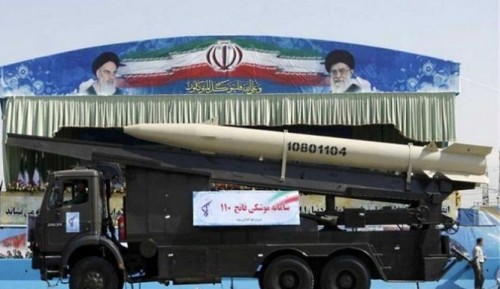
Israel’s reported strike January 18 on a joint Iranian-Hezbollah convoy driving on the Syrian Golan Heights was one of the most strategically significant events to have occurred in Israel’s neighborhood in recent months. Its significance lies both in what it accomplished operationally and what it exposed.
From what been published to date about the identities of those killed in the strike, it is clear that in one fell swoop the air force decapitated the Iranian and Hezbollah operational command in Syria.
The head of Hezbollah’s operations in Syria, the head of its liaison with Iran, and Jihad Mughniyeh, the son of Hezbollah’s longtime operational commander Imad Mughniyeh who was killed by Israel in Damascus in 2008, were killed. The younger Mughniyeh reportedly served as commander of Hezbollah forces along the Syrian-Israeli border.
According to a report by Brig.-Gen. (res.) Shimon Shapira, a Hezbollah expert from the Jerusalem Center for Public Affairs, the Iranian losses included three generals. Brig.- Gen. Mohammed Alladadi was the Iranian Revolutionary Guard Corps liaison officer to Hezbollah and to Syrian intelligence. He was also in charge of weapons shipments from Iran to Hezbollah. Gen. Ali Tabatabai was the IRGC commander in the Golan Heights and, according to Shapira, an additional general, known only as Assadi, “was, in all likelihood, the commander of Iranian expeditionary forces in Lebanon.”
The fact that the men were willing to risk exposure by traveling together along the border with Israel indicates how critical the front is for the regime in Tehran. It also indicates that in all likelihood, they were planning an imminent attack against Israel.
According to Ehud Yaari, Channel 2’s Arab Affairs commentator, Iran and Hezbollah seek to widen Hezbollah’s front against Israel from Lebanon to Syria. They wish to establish missile bases on the northern Hermon, and are expanding Hezbollah’s strategic depth from Lebanon’s Bekaa Valley to the outskirts of Damascus.
On Wednesday night, Yaari reported that the Syrian military has ceased to function south of Damascus. In areas not held by the al-Qaida-aligned Nusra Front and other regime opponents, the IRGC and Hezbollah have taken control, using the Syrian militia they have trained since the start of the Syrian civil war in 2011.
The effectiveness of Hezbollah’s control of its expanded front was on display on Wednesday morning. Almost at the same time that Hezbollah forces shot at least five advanced Kornet antitank missiles at an IDF convoy along Mount Dov, killing two soldiers and wounding seven, Hezbollah forces on the Golan shot off mortars at the Hermon area.
While these forces are effective, they are also vulnerable. Yaari noted that today, three-quarters of Hezbollah’s total forces are fighting in Syria. Their twofold task is to defend the Assad regime and to build the Iranian-controlled front against Israel along the Golan Heights. Most of the forces are in known, unfortified, above ground positions, vulnerable to Israeli air strikes.
THE IDENTITIES of the Iranian and Lebanese personnel killed in the Israeli strike indicate the high value Iran and Hezbollah place on developing a new front against Israel in Syria.
The fact that they are in control over large swathes of the border area and are willing to risk exposure in order to ready the front for operations exposes Iran’s strategic goal of encircling Israel on the ground and the risks it is willing to take to achieve that goal.
But Iran’s willingness to expose its forces and Hezbollah forces also indicates something else. It indicates that they believe that there is a force deterring Israel from attacking them.
And this brings us to another strategic revelation exposed by the January 18 operation.
Earlier this week, Iran’s Deputy Foreign Minister Hossein Amirabdolahian told Iran’s IRNA news agency that the regime had told its American interlocutors to tell Israel that it intended to strike Israel in retribution for the attack. The State Department did not deny that Iran had communicated the message, although it claims that it never relayed the message.
While the Obama administration did perhaps refuse to serve as Iran’s messenger, it has worked to deter Israel from striking Hezbollah and Iranian targets in Syria. Whereas Israel has a policy of never acknowledging responsibility for its military operations in Syria, in order to give President Bashar Assad an excuse to not retaliate, the US administration has repeatedly informed the media of Israeli attacks and so increased the risk that such Israeli operations will lead to counterattacks against Israel.
The US has also refused to acknowledge Iran’s control over the Syrian regime, and so denied the basic fact that through its proxies, Iran is developing a conventional threat against Israel. For instance, earlier this month, Der Spiegel reported that Iran has been building a secret nuclear facility in Syria. When questioned about the report, State Department spokeswoman Marie Harf sought to downplay its significance. When a reporter asked if the administration would raise the report in its nuclear negotiations with Iran, Harf replied, “No, the upcoming talks are about the Iranian nuclear program.”
Until this month, the White House continued to pay lip service to the strategic goal of removing Assad – and by inference Iran, which controls and protects him – from power in Syria. Lip service aside, it has been clear at least since September 2013, when President Barack Obama refused to enforce his own redline and take action against the Assad regime after it used chemical weapons against its opponents, that he had no intention of forcing Assad from power. But this month the administration crossed a new Rubicon when Secretary of State John Kerry failed to call for Assad to be removed to power in talks with the UN envoy in Syria Staffan de Mistura. Right before he met with his Iranian counterpart, Mohammad Javad Zarif, Kerry told Mistura, “It is time for President Assad, the Assad regime, to put their people first and to think about the consequences of their actions, which are attracting more and more terrorists to Syria, basically because of their efforts to remove Assad.”
IRAN’S PRESENCE on the Golan Heights is of course just one of the many strategic advances it has made in expanding its territorial reach. Over the past two weeks, Iranian-controlled Houthi militias have consolidated their control over Yemen, with their overthrow of the US-allied government of President Abed Rabbo Mansour Hadi.
Rather than defend the elected government that has fought side-by-side with US special forces in their Yemen-based operations against al-Qaida in the Arabian Peninsula, the administration is pretending that little has changed. It pretends it will still be able to gather the intelligence necessary to carry out drone strikes against al-Qaida terrorists even though its allies have now lost power.
The post-Houthi-conquest goal of the administration’s policy in Yemen is to seek a national dialogue that will include everyone from Iran’s proxy government to al-Qaida.
The idea is that everyone will work together to write a new constitution. It is impossible to understate the delusion at the heart of this plan.
With the conquest of Yemen, Iran now controls the Gulf of Aden. Together with the Straits of Hormuz, Iran now controls the region’s two maritime outlets to the open sea.
Far beyond the region, Iran expands its capacity to destabilize foreign countries and so advance its interests. Last week, Lee Smith raised the reasonable prospect that it was Iran that assassinated Argentinean prosecutor Alberto Nisman two weeks ago. Nisman was murdered the night before he was scheduled to make public the findings of his 10-year investigation into the 1994 bombing of the AMIA Jewish Center and the 1992 bombing of the Israeli Embassy in Buenos Aires. According to Smith, Nisman had proof that Iran had carried out the terrorist attacks to retaliate against Argentina for abrogating its nuclear cooperation with Tehran.
From the Golan Heights to Gaza, from Yemen and Iraq to Latin America to Nantanz and Arak, Iran is boldly advancing its nuclear and imperialist agenda. As Charles Krauthammer noted last Friday, the nations of the Middle East allied with the US are sounding the alarm.
Earlier this week, during Obama’s visit with the new Saudi King Salman, he got an earful from the monarch regarding the need to prevent Iran from acquiring nuclear weapons. But it seemed to have no impact on his nuclear diplomacy with Teheran. The administration believes that Iran and Saudi Arabia will be able to kiss and make up and bury a thousand- year rivalry between Sunni and Shi’ite Islam because they both oppose the Islamic State. This too is utter fantasy.
Israel’s January 18 strike on Iranian and Hezbollah commanders in Syria showed Israel’s strategy wisdom and independent capacity.
Israel can and will take measures to defend its critical security interests. It has the intelligence gathering capacity to identify and strike at targets in real time.
But it also showed the constraints Israel is forced to operate under in its increasingly complex and dangerous strategic environment.
Due to the US administration’s commitment to turning a blind eye to Iran’s advances and the destabilizing role it plays everywhere it gains power, Israel can do little more than carry out precision attacks against high value targets. The flipside of the administration’s refusal to see the dangers, and so enable Iran’s territorial expansion and its nuclear progress, is its determination to ensure that Israel does nothing to prevent those dangers from growing – whether along its borders or at Iran’s nuclear facilities.
PM: Easier to mend US ties than bad Iran nuclear deal | The Times of Israel.
Netanyahu says spat over Congress speech is ‘a procedural issue’ that can be resolved, after phoning Democratic leaders to explain position

Prime Minister Benjamin Netanyahu on Friday downplayed the diplomatic spat with the United States around his upcoming address to Congress, terming it a “procedural issue” that can be resolved — unlike a “bad” deal with Tehran, which cannot be so easily mended.
The remarks came shortly after The New York Times reported that Netanyahu had reached out by phone to leading Democrats in an effort to quell the tensions around his scheduled address on Iran, in which he is likely to campaign against the White House’s stance in the nuclear negotiations.
“We can resolve procedural issues with regard to my appearance in the US, but if Iran arms itself with nuclear weapons, it will be a lot harder to fix,” Netanyahu said.
In a visit to wounded Israeli soldiers hurt in a Hezbollah strike on Wednesday, the prime minister cautioned against a deal between Western powers and Iran on its nuclear deal, and said that Israel was under an “ongoing attack” by the Islamic Republic.
Iran is “opening new fronts against us, using terrorism in the Middle East and in the entire world,” he continued.
“We are under an ongoing attack organized by Iran,” added Netanyahu, in reference to the Hezbollah strike that killed two Israel Defense Forces soldiers. “Iran is trying to uproot us from here. They won’t be successful.”
He warned that “this same Iran” was now being indulged by world negotiators who, he said, are intending to leave it with the capabilities to build nuclear weapons.
Netanyahu accepted an invitation to speak to Congress from Republican House Speaker John Boehner (R-OH), an invitation that was not coordinated with the White House, and which White House officials called a troubling breach of diplomatic protocol.
Boehner himself framed the speech as a response to President Obama’s promise to veto legislation imposing stiffer sanctions on Iran that Republicans and some Democrats have drafted and which the White House vehemently opposes. Netanyahu initially insisted the invitation was bipartisan, as the formal invite from Boehner claimed, but Democratic leaders such as House Minority Leader Nancy Pelosi (D-CA) denied they had been consulted before the invitation was issued.
The New York Times reported on Friday that Netanyahu had reached out to Senator Harry Reid of Nevada, Pelosi, and Senator Charles Schumer of New York in an effort to explain his position.
Reid told The New York Times that he had told the Israeli prime minister the visit is “hurting you.” He said Netanyahu’s conduct had prompted several Democratic senators to withdraw their support for sanctions against Iran.
“I said: ‘You have to understand this. I’m not telling you what to do or what not to do, but you have to understand the background here from my perspective,’” he said. Reid said he wouldn’t tell Netanyahu to cancel the address, but told him that Boener’s invitation was “not the right thing to do.”
Similarly, Pelosi said she told Netanyahu the Congress address “could send the wrong message in terms of giving diplomacy a chance.”
On Wednesday, a senior Obama administration official charged that Israel’s ambassador to Washington, Ron Dermer, has been working to advance the political fortunes of Netanyahu at the expense of the US-Israel relationship, according to The New York Times. The accusation marked a striking escalation in the rhetorical spat between the White House and the Netanyahu government over the prime minister’s planned speech to Congress in early March.
The “unusually sharp criticism” by the senior official, who was not named in the report, reflected “the outrage the episode has incited within President Obama’s inner circle,” the Times suggested. “Such officially authorized criticisms of diplomats from major allies are unusual.”
The Conservative Response to the Islamic Threat.
by Jason Pappas © September 5, 2004
via Liberty And Culture: September 2004.
Do conservatives recognize the threat?
Rarely, in the course of history, has a nation gone to war while praising the enemy’s ideology. We can, however, see this absurd spectacle today. While terrorists attack our greatest cities in the name of Islam, we are told that these ideas have nothing to do with their actions. As Muslims cheer with joy throughout the Islamic world, we are told that we mustn’t rush to judgment and stereotype another culture. With each report of repression, misogyny, self-imposed poverty, anti-Semitic hatred, and suicidal glorification, we are told that they are human beings just like us – don’t judge! There is a pathological fear of saying anything negative about the motivating force driving our enemy: Islam.
At first this may seem like an exaggeration. But is it? We do condemn radical Islam but notice how we unduly minimize our criticism. We add the qualifier “radical” or “militant” to imply that it is something added to Islam. The problem must be this additional element – not Islam itself. Or we borrow a word from Christianity and call them fundamentalists as if there were differing versions of Islam. We presume fundamentalist Islam is spurned by the average Muslim, who, we imagine, sees this 7th century practice as a relic relevant to Mohammad’s time. How enlightened we imagine the modern Muslim!
Or we may complain that Islam needs some missing element that will transform it and bring it into the 21st century. We make a moral equivalence between Christianity’s failures centuries ago and Islamic backwardness today. If Christianity can move forward and adapt to the modern world, why can’t Islam? It must be this missing element, modernity, which Islam needs. It took Christians two thousands years to grow up, we are told; you can’t expect Islam to do that in 1400 years. At no point must we question the Islam religion itself.
The taboo against subjecting a religion to critical analysis is even greater when that religion is part of a foreign culture. Conservatives are quick to attack the relativism inherent in contemporary multi-cultural analysis – particularly on the left. There is indeed a wide-spread relativism and vitriolic anti-Americanism on the left but it is by no means universal. I will address this at another time. The contention of this article is that conservatives’ response to the Islamic threat is inadequate and they need to change if we are to fight this enemy effectively.
Almost immediately following the Islamic attacks of September 11, President Bush launches a propaganda campaign – of adulation of the Islamic religion. On September 17, Mr. Bush says, “The face of terror is not the true faith of Islam. That’s not what Islam is all about. Islam is peace.” 1 In the next few months, showing his understanding of Islam, he proclaims, “The terrorists are traitors to their own faith, trying, in effect, to hijack Islam itself.” Islam “teaches the value and the importance of charity, mercy, and peace.” “The face of terror is not the true faith of Islam. That’s not what Islam is all about. Islam is peace.” A year later, presumably after an extensive study of the Koran and Hadith, he pronounces that, “Islam is a faith that brings comfort to a billion people around the world. It’s a faith that has made brothers and sisters of every race. It’s a faith based upon love, not hate …“ “Islam, as practiced by the vast majority of people, is a peaceful religion, a religion that respects others …”
The public is understandably confused and looks for leadership as it reads the daily news. Continual reports from all over the world show nothing but Islamic atrocities with few denunciations from Islamic religious leaders. Yet, Mr. Bush is undeterred. “President Bush yesterday removed his shoes, entered a mosque and praised Islam for inspiring ‘countless individuals to lead lives of honesty, integrity, and morality.’”, writes Bill Sammon of the Washington Times. 2 Scott Lindlaw of the Associated Press explains that the purpose of Presidents visit is two fold: “defuse Americans’ anger against Islam” and decrease “hostility by Muslims around the world against America”. He reports that the Pew Global Attitudes Project shows “large percentages of Muslim respondents in several countries said they believe suicide bomb attacks are a justifiable defense of Islam.” 3 This is not a shrewd tactic as conservative apologists imply. This is a fundamental failure to understand the enemy we face.
A few conservatives have hinted that there may be something wrong with Islam. In a November 30, 2002 article of the Washington Post, called “Conservatives Dispute Bush Portrayal of Islam as Peaceful”4, some take issue with the President’s repeated claim that Islam is “a faith based upon peace and love and compassion” that has “morality and learning and tolerance.” Kenneth Adelman notes: “The more you examine the religion, the more militaristic it seems. After all, its founder, Mohammed, was a warrior …” Eliot Cohen says: “… the enemy has an ideology” but “nobody would like to think that a major world religion has a deeply aggressive and dangerous strain in it — a strain often excused or misrepresented in the name of good feelings.” Norman Podhoretz writes in Commentary magazine: “Certainly not all Muslims are terrorists. … But it would be dishonest to ignore the plain truth that Islam has become an especially fertile breeding-ground of terrorism in our time. This can only mean that there is something in the religion itself that legitimizes the likes of Osama bin Laden …”5
In contrast to the usual conservative hesitancy, Paul Johnson writes with clarity and decisiveness in the October 15, 2001 issue of National Review: 6 “Islam is an imperialist religion, more so than Christianity has ever been, and in contrast to Judaism.” He reviews the relevant passages from the Koran and adds, “These canonical commands cannot be explained away or softened by modern theological exegesis, because there is no such science in Islam. Unlike Christianity, which, since the Reformation and Counter Reformation, has continually updated itself and adapted to changed conditions … Islam remains a religion of the Dark Ages. The 7th-century Koran is still taught as the immutable word of God, any teaching of which is literally true. In other words, mainstream Islam is essentially akin to the most extreme form of Biblical fundamentalism.” To which one rises to one’s feet and shouts: Bravo! Unfortunately, Mr. Johnson is the rare exception in the immediate aftermath of the Islamic attack of 9/11.
These few critics are but faint whispers in the wind. Almost as soon as their warnings are made, the effect has dissipated. There is no sustained focus, no continued analysis built on a sound foundation of knowledge about Islam’s essential nature. Each insight about some failure of Islamic culture is noted and generally ignored as if it is an irrelevant side note immaterial to the problem we face. Each fact about Islamic history is dismissed as irrelevant to today’s Muslims. Why? The rationalizations are many. All Muslims are different – you can’t generalize, we are told. Each horrendous proscription of the Koran or atrocious example in the Hadith is discounted as if only the pleasant passages are valid. And, always, a comparison is made to Christianity and the Old Testament. We don’t follow those pronouncements do we? Thus, Islam must be the same. Proof!
The conservative embrace of Islam stems from the respect afforded to all believers in God. God seems to be the magic keyword to gain entry to respectable conservative venues. Christianity has become Judeo-Christianity. How about the Muslims? Not only are they God-fearing people, but they even respect Jesus if only as an earlier prophet. There is a positive prejudice – particularly towards monotheistic religions – that inclines many conservatives towards an expectation that Islam is, deep down, like the old time religions we know and love. Since 9/11, conservatives have gone out of their way to look for so-called moderate Muslims for ecumenical memorial services. (Note that secular philosophers and poets are virtually non-existent in these services.) For Republicans, Islam is in. The problem is finding moderate Muslims. Enter one Grover Norquist.
Mr. Norquist has been a Conservative organizer, fundraiser and fixture in Washington Republican politics for decades. His Islamic Institute was established with the help of Abdurahman Alamoudi – an active supporter of Hamas and Hezbollah. The institute’s founding director, Khaled Saffuri, supported Islamist operations worldwide. With Norquist’s help, Saffuri became George W. Bush’s “National Advisor on Arab and Muslims Affairs” during the 2000 presidential campaign. After 9/11, as the President implemented his Islamic sensitivity program he brought forth Muslims for photo ops – supplied in large part by Norquist’s contacts. The press was quick to dig up embarrassing archival video of the President’s Muslim friends cheering known terrorist groups. Frank J. Gaffney Jr., while ducking the usual charges of racism, tried to sever the connection between the Islamists and the White House. Eventually he had to expose the whole sordid affair in David Horowitz’ online conservative magazine. 7
Conservatives aren’t alone in their blindness to Islam. The Left is going through the same denial. This might tempt one to attribute the difficulties to politically correctness. Yes, this influence is felt across the political spectrum but the susceptibility to such self-induced blindness derives from different failings. The Right could condemn communism with full moral righteousness and without a hint of exculpatory relief. Communism wasn’t a noble ideology hijacked by an evil one, Stalin. Communism was evil and the Soviet Union was the “Evil Empire.” No apologies there. Political correctness be damned! Conservatives are unable, this time, to deal with the threat of Islam in the black and white terms that fueled their fight against communism. Let’s contrast the current threat with the 20th century crisis that helped define modern conservatism.
Conservatism’s unwavering opposition to communism.
Hitler’s conquest of continental Europe and the barbarity of the death camps was a profound shock to anyone who remembers that Germany was land of Goethe and Beethoven; the German language was the tongue of Kant and Schiller; and German universities were home to scientific giants like Einstein and Heisenberg. How could Germany sink so low? What makes this all the more shocking is that in Germany, Nazism was embraced by the intellectuals of the day. Hitler’s popularity soared in German Universities – among both students and faculties – before the electoral success. The rise of Nazism was no accident. To this day intellectuals still haven’t fully faced the role of German culture in the descent to totalitarian barbarity.
The euphoria of our military victory was tempered by gruesome and sobering evidence of the nature of the Nazism. The liberation of the concentration camps unearthed the soul of totalitarianism. The second shock was even greater: another strain of totalitarianism engulfed Eastern Europe and half of Asia. Despite the verbal obfuscation, banal sociological theories and hair-splitting distinctions, the common man knew in their gut that these ideological twins were of common stock. But they lacked an explicit explanation for what was before their eyes. It seemed so sudden and spread so quickly. What was happening to the world?
The few intellectuals who saw this coming, argued that the roots of this illness were deep and that the disease was spreading to the Anglo-American world. In the early 1940s while we were blind to the collectivist horrors these few fired the first warning shots. F. A. Hayek, in the “Road to Serfdom,” argued we were heading down the same path as continental Europe. Ayn Rand portrayed the individualist hero fighting against the collectivist onslaught. And there were others – Isabel Paterson, Rose Wilder Lane, Albert Jay Nock, Henry Hazlet and most of all Ludwig von Mises. These were advocates of what was once called liberalism – a liberalism that embraced the sovereignty of the individual in thought and action – but which most people think of as conservatism, today. These individuals, however, were the exceptions.8
The pro-collectivist apologists worked quickly to salvage what they could creating what we today call spin: the problem wasn’t collectivism, government domination, or economic central planning but just the nationalism in National Socialism. International socialism, i.e. communism, shouldn’t be lumped with that perversion created by an evil one, Hitler. Uncle Joe, was on our side, remember? Forget that Hitler was following Mussolini’s example and, Benito was an old comrade of Lenin before they had a falling out. Forget the fact that both systems were totalitarian; because fascism never completed the transformation of state ownership – leaving the old guard in place to carry out the orders of the new state. Don’t be prejudiced against that noble experiment to create a worker’s paradise. Communism, after all, means community and sharing. Or so the intellectuals of the day told us.
Yet, the common man wasn’t fooled, at least not for long. The collectivist threat was swiftly expanding over Europe and Asia. Trapped behind the Iron Curtin, denied the liberties we’ve associated with civilization, communism sadly chained a large fraction of once proud peoples. The 20th century manifested the prevalence of evil and the precariousness of civilization. But what about the stable democracies of England and the United States? Why didn’t it happen here? While continental Europe descended into dictatorships, totalitarian horrors, and the Gulag, the Anglo-American tradition upheld the rule of law, parliamentary proceedings, and the individual liberties of speech, thought, and religion. Clearly, we realized, there is something right about the American way; something that we must hold unto and cherish.
It is under such conditions that American conservatism was born.
Conservatism was a marriage of two overlapping orientations: individualism and traditionalism. Individualists, or Classical Liberals, championed the rights of the individual. To that end they favored a minimal government and limited engagements in foreign military adventures. A liberal stood for free speech, freedom of religion, and a free press. A liberal economy is the free market based on property rights and free association. Thus, liberalism was primarily a political and economic doctrine. Traditionalism was not a doctrine at all – it was a disposition. To the extent that individual liberty was part of our history, it was prized but not without limits. Religion, family, community, nation, and duty were additional competing goals. Both the traditionalist and the individualist abhorred the onslaught of 20th century collectivism and its dehumanizing barbarity. In this they were united.
Some of the most influential classical liberals maintained the liberal label: F. A. Hayek, Milton Friedman, Ludwig von Mises, and the early Frank S. Meyer. Ayn Rand preferred the appellation “radical for capitalism.” The liberal economists’ influence had the widest effect among scholars in the last quarter of the 20th century. And it was during that time Rand’s novels and philosophy enthralled and inspired many a young idealist. But it was Frank S. Meyer, a senior editor at National Review, who forcefully advocated a fusion, as it became known, of classical liberalism and traditionalism that was to become the American conservatism that dominated popular politics. The new movement had a ready contrast and an urgent threat: communism.
If conservatism was to oppose the danger suddenly apparent to all, it had to do so in a charged atmosphere of abandonment and betrayal by the intellectual elites. This void is fertile grounds for demagogues and rabble rousers, paranoids and racists, cynics and fear mongers. There existed a need for a clear comprehensive grasp of the nature of the enemy and, if not more importantly, the nature of the alternative. In such a short time perhaps the best that one could hope for was a disposition or sentiment. In that case conservatism was made for the job. It provided a sustained opposition to communism while never wavering or doubting the moral stature of America.
George H. Nash, in his definitive history of American conservatism, captures the conservative anti-communist resolve. “In this struggle, there were, according to [Frank S.] Meyer and other conservative cold warriors only two choices: ‘the destruction of Communism or the destruction of the United States and of Western civilization.’” 9 “Liberals might prefer to hope – serenely, pathetically, endlessly, futilely – that maybe now, maybe this time, maybe soon, the Communists would change their spots, cease to be committed revolutionaries, and settle down. Perhaps we could then have peaceful coexistence at last. Meanwhile let us negotiate, “build bridges,’ engage in cultural exchanges, climb to the summit. Come let us reason together.” “The Communist system is a conflict system; its ideology is an ideology of conflict and war …” says Robert Strausz-Hupe 10 Frank S. Meyer argued, the Communist “’is different. He thinks differently.’ He is not ‘a mirror image of ourselves’ Communism is a ‘secular and messianic quasi-religion’ which ceaselessly conditions its converts until they become new men totally dedicated to one mission: ‘the conquest of the world for Communism.’” Gerhart Niemeyer writes, “It was totally unrealistic to expect that Americans could ’communicate’ with a Communist mind that ‘shares neither truth nor logic nor morality with the rest of mankind.’” 11
With minor changes could not the same be said about Jihadists? Yet we do not see anything remotely hard hitting and uncompromising from conservatives today. Instead they are more like the social democrats, who, during the Cold War, had difficulty condemning collectivism at the root. Conservatives today show “understanding” of Islam and are forever hopeful that Islam can and will reform. They are eager to be helpful with aid, advice, encouragement, and military protection. But most of all they are gentle with criticism and dismissive of those who are outspoken critics of the Islamic religion at its root. We will explore the conservatives’ vastly new kind and gentle disposition shortly.
The conservative movement evolved from those early years as an establishment opposition. Eventually, the neo-conservatives – ex-socialists but ardent anti-Communists – joined the fold. This synthesis triumphed in the administrations of Ronald Reagan and Margaret Thatcher. Conservatism had persevered; communism is buried in the graveyard of failed utopias (and minds of tenured professors, but that is a part of the story of the left) while America has continue to grow and prosper.
But something interesting happened on the way to the victory party: conservatism became just that – a reticence to change the status quo. As a sentiment, opposed on principle to systems of abstract principles, it could never achieve the clarity and soundness of a well-grounded body of knowledge supported and established by evidence and rational argumentation. Frank S. Meyer initially understood the problem well in 1955 before his “fusion” with traditionalism. Conservatism “carries with it, however, no built-in defense against the acceptance, grudging though it may be, of institutions which reason and prudence would otherwise reject, if only those institutions are sufficiently firmly established. … the mantle of the conservative tone can well befit the established order of the welfare society.” 12 In the end, the traditionalists won control of the conservative movement and Republican Party. To understand the implications to the current crisis we must understand the limitations of traditionalist conservatism.
The conservative critique of communism.
The conservative movement was united in its opposition to communism. The arguments ranged from economic and political to the theological. It was obvious we were facing an illiberal mindset – actually a police state to be exact. Yet the drawbacks of life under communist rule failed to sink the socialist dream for many intellectuals. A deeper understanding – a philosophical orientation – was required to underwrite a firm and long-term opposition. The traditionalist conservatives provided one such explanation, in broad philosophical terms that could be understood by the average person. They argued that communism was morally evil because it abandoned the source of morality: God. Many ex-communists who embraced God, like Whittaker Chambers, became major figures of the early conservative movement. This line of thought was their stock in trade.
Communism abandon’s religious faith for the false faith of man’s rational mind, says Chambers. “It is the vision of man’s mind displacing God as the creative intelligence of the world. It is the vision of man’s liberated mind, by the sole force of its rational intelligence, redirecting man’s destiny and reorganizing man’s life and the world.” “If man’s mind is the decisive force in the world, what need is there for God? Henceforth man’s mind is man’s fate.” “It is in striving toward God that the soul strives continually after a condition of freedom.” 13
Now most people know someone who is not religious – whether they are an atheist or not doesn’t matter – who nevertheless lead honest respectable lives. How can Chambers’ simplistic explanation even temp any thinking person? Many secularists are pro-freedom while many religious have given up freedom for the security and safety of authority. The historical correlation isn’t between liberty and religion but liberty and secular-oriented reason. Both individual liberty and secularism arose together during the last 300 years after centuries of religious domination. Most of history consists of the rule of the crown in close association and sanction of religious authorities. One would be quite skeptical that the religious critique of communism could gain such a prominent position in the conservative literature. Yet, it is ubiquitous – particularly among traditionalists.
The traditionalists didn’t achieve this philosophical triumph on their own – it was handed to them on a silver platter. For decades, post-modern philosophers had argued that values (i.e. ethics) could not be founded in fact. In fact, they argued, no arguments can support one system of ethics over another. If there is no law-giver, then there is no law. God is dead, was the oft heard post-modern reframe, no ethics is possible in a barren materialistic world of mere physical objects. You are now in God’s shoes; make the rules as you please. With such a confession, the traditionalists needed do little but point to the resultant horrors of the 20th century totalitarian movements.
For the conservative, given the false alternative of relativistic secularism and the moral absolutes of God, the choice was crystal clear. God is the answer. But who’s God and what does he say? The history of religion is replete with different Gods and theologies. As recent as the 17th century Europe fought wars over religious differences. Currently, there are more Christian sects than one can count. They disagree on any number of details – perhaps almost all details except the inspiration of Jesus’ message. And Jews don’t even need Jesus while Muslims find Jesus a flawed prophet that pales in comparison to the infallible Mohammad. Is there any necessary component of a well-formed religion? Is there anything more to religion than some nominal belief in some kind of God? Or if religion is more substantial, how does one demand fidelity and uncritical assent (faith) to specific eternal transcendental verities yet remain tolerant of the multitude of conflicting visions of the truth?
Multi-cultural political correctness: a conservative invention?
The number of ways conservatives see religion’s role within our secular civilization is as varied as the conservative movement itself. From the cosmopolitan intellectual journals there is an aversion to go beyond the general notion of a God (as was common with the most literate of the Founding Fathers) and leave the realm of religious faith in the private domain of individual conscience and practice. Christianity became Judeo-Christianity as the ecumenical spirit expanded to include members of the Jewish faith. In essence, the intellectual conservatives, as I’ll call them, became religious multiculturalists: beyond God and the Golden Rule it’s all a personal subjective matter. While never said in such terms – indeed, they would vehemently deny such a notion – that, however, is the sentiment prevalent at the intellectual end of the conservative spectrum. The sectarian religious right, at the other end of the conservative spectrum, would prefer a less inclusive and more literal interpretation of religious doctrine – and, of course, with a greater public presence.
Both religious tolerance and the rise of secularism go hand and hand as religion is eliminated from the public intercourse in numerous ways while it is restricted to the private domain of individual salvation and family tradition. For example, disputes are handled not by reference to the authority of religious texts but by reason and rhetoric with reference to common experience. Religion, however, is based on dogma – the steadfast acceptance of doctrine on the basis of faith – and is not amendable to debate or individual judgment. It claims to be an alternative to the “unreliable” process of human judgment. If religion was conditional upon rational deliberation it would fail to achieve the purpose of supplanting human thought – a fallible process that is contingent on the development of culture and individual character. It is such uncertainties of human knowledge, experienced as an unbearable anxiety, which motivates the premature acceptance of settled belief closed to the threat of further questioning.
There are a number of means used to reconcile reason and religion. Or, to look at it another way, there are numerous ways used to marginalize religion and enable the continued growth and expansion of reason. The most common way is to shrink the domain of religion’s applicability. Christianity is suitable to this approach since the original apostolic religion was concerned with salvation and the imminent coming of Jesus. This left a lack of concern with the needs of long-term planning and living this life well on the individual level. One the level of social organization little is written; missing, for example, is a detailed political theory. Consequently, contradictions between rationally living this life and religiously seeking salvation for the afterlife can be minimized.
Religious toleration can be seem as a hierarchical approach that singles out essential religious components from the thicket of sectarian eccentricities and the detailed prescriptions, dogmas, rituals, and extraneous side issues – yielding a more streamlined rationally ordered religion. This is common in the Anglo-American tradition. While John Locke sees God as important for morality, he also argues that the religion goes beyond reason without contradicting it. The sectarian differences, Locke argued, were less important than the essentials of the Christian religion which Locke considered eminently reasonable at its core. 14
The conservative historian, Paul Johnson, writing of the Great Awakening of the 17th century says it was a “specifically American form of Christianity – undogmatic, moralistic rather than creedal, tolerant but strong, and all pervasive of society.” “It crossed all religious and sectarian boundaries, made light of them indeed, and turned what had been a series of European-style churches into American ones. It began the process which created an ecumenical and American type of religious devotion … “ 15 Johnson considers Washington, Franklin and Jefferson deists. Washington “regarded religion as a civilizing force, but not essential.” Franklin’s “Autobiography” clearly shows his ecumenical practical approach to religion as an aid to living this life well. And Jefferson was even less religious in the traditional sense.
The American Founders were not conservatives – they were revolutionaries. But they were revolutionaries in the British tradition fighting for the restoration of liberal principles that every Englishman expected since the days of England’s Glorious Revolution over a century before. These principles found their expression in John Locke’s Second Treatise. The intellectual leaders of the American Revolution, Jefferson, Madison, John Adams, and Hamilton, were well read of liberal political writers from treatises of Locke, Grotius and Puffendorf to the collection of articles called “Cato’s Letters” of Trenchard and Gordon. From this intellectual tradition, the Founders expressed their doctrines of natural rights in clear terms and argued with full generality – even if their aspirations never gained full acceptance among their countrymen and remained a challenge and inspiration for succeeding generations. 16 There language was power and principled explications of universal truths.
The examples of history were even more important to the Founders than political theory. They devoured history books – reading from Greek and Latin authorities to eighteenth century British historians. They read it all. For history exemplified philosophical principles in graphic detail showing the subtleties and pitfalls of actions and practices over the centuries. The Founders showed a wise policy of learning from experience – often the experience of other great men of history whose triumphs or painful lessons provided amble examples. The Founders knew what principles implied. But what was most important with regard to liberty was the fact that they had lived it. In part by design and in part by benign neglect, the colonies had ruled themselves; it was the loss of liberty that outraged the Americans as England sought to exploit the colonies as she had others throughout the empire. By historical standards, the colonialists were clear about their goals. They could express it in principles, justify it with logic, place it in tradition, and they had experienced it in their own lives.
Even though 20th century American conservatives respect the revolution of 1776, their tradition has it roots in the rejection and reaction of another revolution: the French revolution. The conservative spirit owes its genesis to the English writer Edmund Burke. One of America’s most eminent traditionalist conservatives, the late Robert Nisbet, writes: “Rarely in the history of thought has a body of ideas been as closely dependent upon a single man and a single event as modern conservatism is upon Edmund Burke and his fiery reaction to the French Revolution.” 17 Burke set the tone with his concern for the “patriarchal family, local community, church, guild and region which, under the centralizing, individualizing influence of natural law philosophy, had almost disappeared from European political thought in the seventeenth and eighteenth centuries …” While Burke looked back to the feudal past, American conservatives, in most cases, looked back to the individualism and natural rights of the Founding Fathers but tempered with concern for traditional institutions that at times superseded the individual: family, church, community, country and God. Tradition becomes the arbiter among these conflicting claims.
Tradition for Burke wasn’t merely the British tradition. Burke was truly multicultural in his respect for traditions. He fought on the side of the “historical tradition of a people” in England and throughout the British Empire. His supported “a sufficient autonomy for natural development of American potentialities” and the American desire for a distinctive governing ethos. But he didn’t stop there. “The same held for Ireland and India, in each case an indigenous morality under attack by a foreign one.” He believed in the collective wisdom of the historical process imbedded in the customs and traditions of a people. And he defended Hindu and Muslim traditions within India. 18
Relativism, or multi-culturalism, is a method which respects a strong role for religion or other cultural practices but allows group identity to determine the substance of belief. The stark subjectivism runs counter to religion’s motivating rationale. The contradiction was appreciated in Burke’s day by the American revolutionary, Thomas Paine. After all, Burke is advocating one religion for the English establishment and another for the French. What would he recommend for America with its myriad denominations? Despite its contradictions, religious relativism is, nevertheless, a means of maintaining a spirit of toleration in conjunction with strongly held beliefs.
The conservative spirit was an idyllic if not romantic longing for the past. For the 18th and 19th century conservative, capitalism and the industrial revolution was a destructive innovation which unsettles society. On the other hand, Burke detested the egalitarianism of the French Revolution – in particular the Jacobins – with their rationalism which pushed aside the past and set about to deduce a new social order via a central plan. In both cases, Burke saw the power of human reason and conceptual abstraction as a force to stamp out the fragile gains wrought through a practice slowing cultivated collectively, over many generations. There is a distrust of individual reason – a fear of the power to act on abstractions.
Even in religious matters traditionalism favors the wisdom embedded in institutions of long standing. Burke was weary of John Wesley, the Methodists, and the “enthusiasm” that could galvanize radical change in his day as well as the ghosts of Oliver Cromwell and the Puritan excesses. Religious enthusiasm was to be feared as much as the Jacobins across the English Channel. Interestingly, Nisbet expresses similar concern in regard to the rise of the Moral Majority of the 1980s. 19
The intellectual leaders of the American Revolution do not fit the conservative ideal; they were Enlightenment men dedicated to the primacy and efficacy of reason. Jefferson’s justifiably famous quote eloquently expresses the Enlightenment spirit: “Fix reason firmly in her seat, and call to her tribunal every fact, every opinion. Question with boldness even the existence of a god; because, if there be one, he must more approve the homage of reason than that of blindfolded fear.” 20 Rights were not supernatural and stipulated by God. Rights “are evident branches of, rather than deductions from, the duty of self-preservation, commonly called the first law of nature,” says Samuel Adams. These rights are inherent in man’s nature neither created by God nor the state. But to “to secure these rights, Governments are instituted among Men.” But Americans did not write philosophical treatises on foundational issues. With the quintessential American optimism in human nature, they deferred to common sense – a universal capacity in each individual. There was no conflict in the minds of the founders between valid well-reasoned ideals and the lessons of history. How could there be if one reasoned from nature and the empirical datum of a comprehensive study of history?
The French Revolution, superficially dedicated to the same noble ideals, had a radically different breading. The rationalism of Descartes, with its dubious deductions from pure thought, set the tone for the quick and easy dogmatic assertions untested by reality and tradition; a process that allowed the French Revolution down the Jacobin road and ultimately the tyranny of Napoleon. Continental Rationalism hijacked Reason and severed its connection to reality. Unlike the American colonists, the French were not a self-governing pluralistic society solidifying their gains and advancing the tradition forward. However, the difference wasn’t fully understood, even if the results were clearly and painfully divergent. The abstractions often sounded similar but in the case of the British and Americans, they summed up a broad experience and tradition.
The French were more Platonic in the boldness of their utopian Republic designs. Americans, whether conscious of it or not, were more Aristotelian in their reliance of vast observations, generalizations, and organization by essentials. Aristotle is the father of deductive logic, but his modus operandi is generalization after broad surveys of the subject under study while maintaining context and proportion. Deduction itself depends on prior generalization from particulars. The difference wasn’t appreciated as one tends to take for granted one’s distinctive approach. Jefferson initially thought the French Revolution to be in the same vein and for the same ideals as the American. He sided with Thomas Paine and against Edmund Burke on this matter. Burke, to his credit, quickly saw and reacted to the excesses unfolding in France.
Thus the American tradition at its founding marginalized religion in a variety of ways. It was regarded as private and personal. At times the core commonality was regarded as obvious and consistent with reason. There was an ecumenical spirit that was tolerant of non-essentials. And there was a confidence that nature and nature’s law exemplified the Creator’s design. Such beliefs boarder on religious relativism as contradictory details are dismissed or shrugged off. However, it fails to become relativism by the expectation that the important fundamentals should be absolute truths common to all religions and rational analysis. The privatization of religion leaves that common ground within the realm of rational discourse. We see the rise of deism in fact and spirit. The deist emphasis on nature and science led them to behave, operationally, as every non-religious person does: generalizes from an examination of reality with the aid of reason. Religion, too, had to be judged and found reasonable. Jefferson questioned the divinity of Christ and edited the New Testament to conform to the criteria of reason. This was, after all, known as the Age of Reason.
Is religious conservatism hostile to Western Civilization?
Contemporary conservatives attempt to shoe-horn history into religious terms. Religion is seen as a force for good despite the atrocities committed in the name of religion and despite the wars fought for sectarian supremacy. Since religion defines right and wrong, it is exempt from blame prior to observation and argumentation. It can’t be wrong – God is never wrong; He makes right and wrong possible. For the devout, religion can always be relied upon. Reason, on the other hand, is suspect in many conservative quarters. We’ve seen such skepticism going back to Burke’s reaction to the French revolution. Rather than contend for the title of reason’s standard bearer, conservatives readily surrender that title to any and every passing social movement that waves the flag of rationality. If some atrocity is done in the name of religion – the religion must have been “hijacked.” Religion is never suspect. On the other hand, reason can’t be trusted. Any failure done in the name of reason and reason gets full blame no matter what self-styled theory, half-backed thesis, or concocted dialectic claims to be a legitimate manifestation of human reason.
Charles Murray, one of today’s more intelligent conservative thinkers, warns about what he sees as the “unintended consequences of great art and science.” 21 For Murray, Aristotle’s discovery of logic led to the destruction of empirical science. “So the possibility arises that Aristotle, the same man who did so much to bring science to that edge, also supplied the tool that distracted his successors …” The genius of the scientific revolution doesn’t fair any better: “Isaac Newton’s discovery of the laws of motion and of universal gravity is another candidate for a supremely wonderful achievement with consequences run amok.” How? “Man could remake the world from scratch by designing new human institutions through the application of scientific reason. … Reason was the new faith. Its first political offspring was the grotesque Jacobin republic set up after the French Revolution.” But wait, Murray’s not done! “… with their Leninist and Stalinist applications to follow.”
This is standard conservative faire. It’s not Descartes’ perversion of rationalism that takes the hit. It’s not reason “hijacked” by dogmatic intolerant “fanatics”. That’s right – while any failure of religion is seen as a distortion or perversion of a true faith that can only be good, reason, as we have noted, gets the full blame for the failures of its nominal adherents. Any twisted and tortured ideology built with the stolen authority of great men is seen as a hazardous flaw in the original ideas or a perilous side-effect leading us inextricably down the path of perdition. Does Murray actually think that reign of terror is rational? Do conservatives believe that discovering and respecting the laws of nature will be lethal to civilized society? And how did American Revolution avoid the disasters of the French and Russian revolutions? Was it because Jefferson, Franklin, Washington, Paine and Adams based their ideas on close scriptural readings? Clearly not!
Such hostility towards reason is arguably an implicit rejection of our Hellenic heritage. However, most intellectuals, including Murray, express admiration for our secular Greco-Roman tradition. William J. Bennett once said we owe half of what we know to Classical Civilization. Russell Kirk and Leo Strauss both find Plato indispensable. Thomists still champion Aristotle. Historically, Aquinas plays a pivotal role in Western civilization for his role of solidifying Aristotle’s influence in Western Christendom. However, Aristotle’s profound influence over the centuries since Aquinas has so infused Western culture that it underlies and permeates our way of thinking. His logic is acknowledged but less so his eudaemonistic worldly ethos of living well and actualizing one’s potential. The pro-reason individualism of the Anglo-American Enlightenment is Aristotelian in spirit while it transcends the limitations of Aristotle’s aristocratic context of Attic Greece. To a large extent we take for granted and are not fully aware of our Aristotelian influence. Even Western religious practice has been affected by the Philosopher’s influence and it is hard to imagine a pure religion. Thus, the religious conservative need not harbor an antipathy towards reason, secularism, and naturalism as history shows. Yet, today, conservatives continue to exhibit hostility towards human reason.
The fear and hostility of purposeful human rationality is a central component of conservatism but it is more of a disposition than a result of an analysis. The father of modern American conservatism, Russell Kirk, explains, “conservatism is the negation of ideology: it is a state of mind, a type of character, a way of looking at the civil social order. … The attitude we call conservatism is sustained by a body of sentiments, rather than by a system of ideological dogmata.” This intellectually timid stance is made plausible by the hubris of totalitarian dogmas that swept aside the accumulated achievement of the Enlightenment’s respect for individual sovereignty and rights. Without that knowledge and understanding, the conservative’s humility would be warranted. But conservatism is actively hostile to the enterprise of rational analysis and subsists on the pre-rational level of sentiments and inherited dispositions. 22
Thus, the conservative generally doesn’t concern himself with an analytical attribution analysis, a search for intellectual origins, dialectical examinations, or theoretical system building. Consequently, the full extent of the Hellenic influence is missed. It’s not common to hear Conservatives blast secularism as materialistic and relativistic. How can there be ethics, they ask, without religion? Ethics, however, is a branch of philosophy. In fact Aristotle wrote the first treatise on ethics and it is secular in nature. He can hardly be called materialistic – indeed, he is teleological to a fault; he fully appreciates volition, values and achievement. Nor is he a relativist. Just the opposite; he is the heir of the Socratic/Platonic tradition advocating ethical knowledge in opposition to the Sophists’ excessive emphasis on human convention, which easily degenerates into relativism. Of course, these inconvenient facts, generally taught in philosophy 101, seems elusive to the modern conservative as he continues to reduce secularism to post-modern relativism.
The Conservative is committed to the primacy of religion. Almost everything good about Western culture is attributed to the Judeo-Christian tradition. This syllogism is rather crude but I find it ubiquitous when talking to conservatives (but rarely find it in print). It proceeds as follows: X considers himself a Christian; X discovered Z; therefore Z is part of the Judeo-Christian tradition. For example, Madison and Hamilton were admittedly Christian; our constitution is therefore Christian based. This kind of reasoning is a double edge sword. Should we call every atrocity done by a Christian, especially those done in the name of God, a result of the religion and the teachings of Jesus? Some critics, using the same crude syllogism say just that. Both are wrong. The superficial praise by association and guilt by association are poor substitutes for a broad study and rational analysis. Of course, one must be willing subject the matter to a rational analysis.
The credit given to Christianity is often astounding and, for some conservatives, engulfs almost everything. M. Stanton Evans, in the book “Freedom and Virtue”, sees individualism and rights in Christian terms. “As the political state is scaled down in the Biblical perspective, so the individual is raised up. In the Christian view, every person is precious because he or she is a child of God, made in His image.” He continues with a Burkian fondness for feudal time. “The second leading idea of the period, I would venture to say, was that of contract. The much-maligned feudal system was in fact a network of contracts – in which political allegiance was based on the notion of reciprocity. If the lord did not fulfill his obligation to the vassal, then the vassal’s allegiance was dissolved.” Evans seems to find all ethical and political values in religion. “Even in a brief recapitulation, it should be evident that we have derived a host of political and social values from our religious heritage: personal freedom and individualism, limited government-constitutionalism and the order-keeping state, the balance and division of powers, separation of church and state, federalism and local autonomy, government by consent and representatives institutions, bills of rights and privileges.” I must have missed that part of the Bible. Paul Kurtz, also in “Freedom and Virtue”, says, “Ethics is a vital dimension of the human condition and a recognition of the ethical life has deep roots within Western philosophy antecedent even to the Judeo-Christian tradition. The current attack on secular morality is a display of philistine ignorance about the origins of Western civilization in Hellenic culture and its historic philosophic development. It is an attack on the philosophic life itself.” 23
Surely the conservative is willing to acknowledge our debt in law, mathematics, science and engineering to the Greco-Roman civilization and the rebirth of classical studies during the Renaissance. Evans continues relentlessly: “Add to these the development of Western science, the notion of progress over linear time, egalitarianism and the like, and it is apparent that the array of ideas and attitudes that we think of as characteristically secular and liberal are actually by-products of our religion.” When conservatives completely marginalize our classical secular heritage by usurping the achievements of the great thinkers of Western Civilization, they join company with those movements broadly classified as Identity Politics. There are American Indian academics who claim everything original in the America Constitution came from Indian culture. There are Black Studies professors who claim all the major achievements of Ancient Greece are African in origin. Now Christian Identity Politics, as I’ll call it, is making similar absurd claims; thus they join those who minimalize our classical heritage.
The Hellenic spirit is what makes Western Civilization distinct. Christianity is a Middle Eastern religious movement in origin (as is Judaism and Islam). By trivializing and at times outright attacking the Hellenic tradition, it can be argued that Christian Identity Politics becomes another attack on Western Civilization similar to the current multi-cultural Identity movements common in academia today. At times, they even employ the same tactics. When multi-culturalists argue that non-Western science should be included in the curriculum or that we need a woman’s alternative to contemporary physics, it isn’t on the basis of the merits; the standards of merit – reason and scientific proof – are the invention of white European males according to these proponents. Similarly, when “Creation Science” is advocated as an alternative to contemporary biology, it is not that reason and evidence shows creationism is a viable alternative in an ongoing controversy. Christian Identity Politics is an embarrassment to the conservative movement. If it is an exaggeration to say that conservatives must rejoin Western Civilization, it is certainly true that they must once again embrace and champion our secular heritage.
How can the conservative movement, which is now essentially religious based, deal with the religious enemy we now face? Conservatism, formed in the face of the Communist threat, is now challenged by a totalitarian movement that is driven by a pure religion undiluted with the rationalism of Greece and Rome. How will the conservative maintain their moral clarity in the face of the new threat? Will the soft ecumenical approach, so important in the marginalization of religion during the rise of liberty and toleration, blind the conservative to the depth of the problem? Or can intellectual conservatives again privatize their religion, embrace our Classical secular tradition, and champion our rational scientific culture against the barbarian theocratic enemy seeking to return civilization to the dark ages. Where is that moral clarity, Bill Bennett talks about?
To date, the conservative response is worrisome. In 1979 two important events occurred in the Islamic world: the rise of fundamentalist Islam in Iran and the Soviet invasion of Afghanistan. The horrors of Iranian theocracy were obvious to any reader of the daily news. Even before the Shah fell there were ample reports of what was to come. Islamic fundamentalists burned a movie theatre full with women and children; apparently movie-going violations Sharia law. The viciousness of these types of atrocities gave a preview of the coming regime. However, conservatives were ready with a nuanced rationalization: Shia enthusiasm is not indicative of the more staid and established Sunni traditionalists. The Sunni religion provides a more sedate foundation for the values of an Islamic society. Our government eagerly helped Sunni Muslims in Afghanistan as they fought the atheistic communists.
The myth of the sedate and peaceful Sunni traditionalist was refuted by a single event: the atrocity of September 11, 2001. On a clear sunny autumn day as the office workers grabbed a morning coffee on their way to work, as early morning bond traders were calling their floor traders in the Chicago pits, and Jersey secretaries emerged from the subway in the sub-basement of the World Trade Center, this modern metropolis was jolted by an inexplicable attack unimaginable by civilized men and women. A jumbo jet crashed into the north tower of the World Trade Center disintegrating on impact and spreading debris and fire onto the street below.
Puzzled, almost everyone believed it had to have been an accident until the second jet hit the south tower. No one would have imagined that this was methodically planned for years, carefully rehearsed, and undertaken with full intention to deliberately cause the greatest number of deaths, chaos and terror. No demands were made, no military maneuvers followed, nothing tangible was gained except the pure satisfaction of the act itself. Just like the rise of Hitler and Stalin, intellectuals can’t grasp the significance of this event – including conservative intellectuals. This act was understood – not here in America or in Europe – but throughout the Islamic world. The response was immediate: delight and deliverance.
Cheers erupted among celebrating Arabs in the West Bank. Throughout Saudi Arabia there was pride and satisfaction. “I don’t know a man, woman, or child who was not happy about what happened in the US [on 9/11/2001]” says Abdullah Al-Sabeh, a professor of psychology at Riyadh’s Imam Muhammed bin Saudi Islamic University. 24 Soon we would find out that the master mind behind this movement was admired by the majority in many Islamic countries. The Muslim denials, perfunctory and with a wink to their brethren, was punctuated with the typical blame that is part of the humiliation process of every Islamic attack: you brought it on yourself. Without missing a step, they quickly contradicted themselves by denying it was Islamic in origin – and followed up with charges of racism for even thinking such things. To this day it is common to hear Muslims blame 9/11 on Zionists or President Bush while taking quiet satisfaction that their folk hero, bin Laden, has still not been brought to justice.
One of the few accurate descriptions of the Islamic reaction can be found in Benjamin and Simon’s book, “The Age of Sacred Terror.” 25
“Bin Laden’s popularity is remarkable. The Arab street exulted in the September 11 attacks and acclaimed him a hero in the mold of Saladin. The mood was encapsulated by Radwa Abdallah, a university student who, sitting in a McDonald’s in Cairo, told a Wall Street Journal reporter that when she heard about the carnage at the World Trade Center and the Pentagon, ‘Everyone celebrated. People honked in the streets, cheering that finally America got what it truly deserved.’ Op-eds in regional newspapers reflected Radwa’s sentiments. … Public opinion in Saudi Arabia, where polling is difficult to conduct because political self-expression can be dangerous, matched the Egyptian reaction to the attacks in one survey, where 94 percent of the respondents applauded bin Laden’s actions.”
To this day, the Islamic attack of 9/11 is not understood. This was first and foremost a religious act. That is hard for Americans to fathom given the religions they know. Islam, however, is very different. Islam is a warrior religion at its core. It is an imperialistic religion bend on world domination and, at the height of Islamic power, conquered most of the known world. The religion had been marginalized during the 20th century as Arabs and other Muslims desired to modernize and adapt socialism – the dream of the intellectuals during the time most Islamic countries came of age in the post-colonial period. During the last few centuries, Islam was often mechanically practiced and only lip-service given to its warrior triumphalism. But as the socialist ideal faded and the global rise of identity politics, with the emphasis of indigenous culture authentic to each demographic group, the Islamic revival became a reality.
The difference between dead ritual and animated belief is not uncommon during stages of a religion. One can imagine during the centuries of the Jewish Diaspora, from the shettels of Russia to the ghetto of Venice, the phrase “next year in Israel” was said without a shred of conviction or hope of ever living to see that day – until the mid 20th century, as Israel became a reality, these words became alive and potent. So to, the Muslim practice of Jihad in its primary meaning atrophied to mere words. It didn’t seem possible to regain the glory of Islam when it ruled what seemed like the world and reduced the infidels to constant humiliation as second class citizens called dhimmis. The Islamic attack of 9/11 was a reaffirmation of the Jihadist spirit – it was indeed a religious act meant to galvanize the believers and recruit men for the Jihad. And in accord to Islamic practice, a reaffirmation of Islamic superiority involves the humiliation of the dhimmis.
There were ample reports from Americans who were in Islamic countries during the attack. Few were reported in the media. One American in Saudi Arabia relates what for her was a puzzling state of affairs. She said there was a considerable amount of anger and hostility towards Americans after the attack. She and others agreed that there was clearly an increase in hatred – again afterwards. Of course, you’d expect hatred and anger to motivate and lead to such atrocities. But here cause and effect seemed reverse. The events of 9/11 galvanized the Islamic world. This was a re-affirmation. The Jihadist spirit, which lay dormant and implausible, became real again. This was a profound religious act but not of any religion imagined in the West.
Westerners were puzzled. Who would deliberately kill innocent individuals quietly going about their lives among other civilized people gathered from all over the world in the peaceful and productive activity of trade? What kind a sick person would spend years to plan this atrocity as their final act of life? Who would bring such shame and disgrace to their cause and their people? This was incomprehensible to any rational civilized person. No one would step forward to even categorize the event correctly. The media continued to call it a tragedy. Some called it a horrible tragedy – a redundancy which elicited snide commentary from CNN’s Christiane Amanpour. Now, a tragedy is when your car’s breaks fail and you drive off a cliff. The two planes didn’t hit the World Trade Center because of a mechanical malfunction. This was far more than just a tragedy – although it was obviously that. This was a deliberate vicious attack – it was an atrocity. That’s the missing word that people avoided. Why?
The silence after 9/11 was more than a respect for the families of the victims. It continued too long. What was missing was a righteous anger that should have surfaced after a respectful period of mourning. But without intellectual guidance it continued to lay buried, unexpressed, and formless – perhaps shared only in private. There were those who were ready and eager to demonize America and thus blame the victim. However, the subliminal anger was sensed leaving most critics to complain that there was an atmosphere of censorship. America was in no mood to hear about the so-called grievances of dark-age savages or theories about how we upset these barbarians. The anger is there and it continues to grow.
The challenge for conservatives
The Islamic Revival and the Jihadist movement grew exponentially during the last several decades. It is arrogant and self-absorbed to attribute this ominous development to our actions or inaction. This indigenous cultural movement is driven by internal factors. The Islamic spirit lay dormant during the secular-socialist post-colonial period. During that time there were signs of a serious return to Islamic basics as a reaction to the failing attempts at modernization of Arab society. Arab dictators only hid the growing revival and in many ways fueled it; Islamic institutions are often the sole sanctuary for the opposition. As the Islamic Revival grew, these dictators adopted a more respectful tone towards the religion. And, as usual, all problems were blamed on the usual scapegoats: Jews and America. The majority of Muslims remained ignorant and angry; and they remained vulnerable to any group that could seize power – at first fascist, and now Islamist.
The revival of original Islam brings with it all the imperialist ambitions and supremacist posturing that has been part of the religion since founded by Mohammad. This is a totalitarian-like religion bent on world domination. In many respects, Islam is religious communism but in some ways it is worse than communism. Communists were atheists who didn’t want to lose this life on earth; containment was a logical solution. Islamists believe they will be rewarded when they die fighting the infidel; containment will fail. This is a battle we will have to fight but to do that effectively we have to start facing the nature of the enemy. We can’t dismiss this problem because we would like it to go away. Islamic imperialism is intrinsic to the religion – whether it remains hidden by a fascist regime or comes out in the open as it has in Iran, Afghanistan and Saudi Arabia – we have to face the fact that we have an enemy.
A central part of Islamic supremacy is inflicting humiliation on the infidel. During Islam’s long history certain infidels were spared death, i.e. “religions of the book”, mainly Christian and Jews. However, continual humiliation was part of the ruling ritual towards the dhimmis. Today the Islamic attacks against the West have the very same characteristics. For example, the March 11, 2004 attacks in Madrid were planned before the Iraq War. Part of the humiliation process was to blame the Spanish for their own suffering. Even though the Spanish changed course and promised to remove troops from Iraq, two additional attacks were still attempted in the next month. Even as late as Oct 2004, with Spanish troops long out of Iraq, Islamic terrorists attempted an attack on the Spanish Court. Those who cite Islamic propaganda of “troops in Iraq” as a “reason” or motivation for the 3/11 attack are unwittingly becoming “useful idiots” – in essence, they are helping to complete the humiliation process. Until we understand the role of Islam and the need to humiliate the dhimmis, we will fail to understand these attacks.
The most important element missing from the war on Islamic terror is honesty. Honestly means facing the facts and making the appropriate moral judgments. Trying to pretend Islam has nothing to do with the enemy’s motivation is lying. Trying to appease the Arab Street by expressing admiration for this unreformed barbaric religious practice is lying. Trying to be politically correct by playing down their faults and exaggerating ours is lying. Reality cannot be faked – lying only blinds us to the threat and leaves us vulnerable. The cost, in terms of lives, wealth, and liberty, will be far greater if we continue to evade the simple and salient facts about the threat we face. It is of utmost importance that we speak out and condemn, in the appropriately strong language, how horrified we are at this dark-age superstition engulfing the Muslim world and threatening all of civilization. We can not be too strong in our condemnation nor should we be humble and hesitant to demand respect for our greatness. Honesty and justice requires it.
The problem for conservatives is twofold. Intellectual conservatives are ecumenical by inclination; this policy has helped to avoid religious strife while forging a common secular culture. However, the ecumenical disposition involves a positive prejudice – one that is predisposed to find all religions, or at least well-established religions, as fundamentally good. Combined with the multi-culturalism of the left, we are undercuting our fight for civilization; we blind ourselves to the full nature of the growing Islamic movement and the radical difference between our secular society and their theocratic one.
In contrast, sectarian religious conservatives are often able to face the ominous growth of Islamism. Perhaps it is because of a negative prejudice – one that sees Mohammad as a false prophet. In this case, they may be rationalizing their belief. However, the assessment is still correct: Islam is a threat. The multi-culturalist left will seize on sectarian rhetoric to argue that this is a war between the religions – an absurd throwback to the past. We must be ready for this lie. This is not a war between “our” religion vs. “their” religion. Both sectarians and multi-culturalists would like to put the conflict in such terms – the former out of conviction, the latter out of blame. Multi-culturalism holds that every culture is an equally valid alternative; there are no universal verities. This premise blinds one to the truth: Islam is inimical to life while Western civilization holds a crucial idea that sets men free to live and prosper.
If conservatives are to fight this war effectively, they must do what we all must do: face this enemy’s nature and our superiority. We need to know what we are fighting for as well as what we are fighting against. If conservatives miss categorize this war in terms of Christendom vs. Islam, or our God vs. their God, this will disintegrate into a barbaric religious war and our society will degenerate into internecine paralyzing strife. We all need to realize that we face with an enemy driven by a pure religion – undiluted with Hellenic rationalism and Aristotlean eudaimonism. This is not a religion that shows any capacity to restrict its focus to individual salvation as a personnel private matter – it is, from its inception, a political religious ideology. This is not a religion that has been reformed by the rebirth of the classical worldview; it rejected that path long ago.
But this is the path we took. From Aquinas through the Renaissance and up until the mid-19th century, classical Greek or Latin was a part of a well-educated person’s course of study with which he entered the rich world of classical literature, art and science. Conservatives have to do more than pay occasion lip service to this heritage if we are to fight the Islamic barbarians effectively. This is what makes us different from them. Upon this foundation, stands the Anglo-American tradition of individual rights – a tradition that rejoices in the pursuit of happiness and well being. This is not a country of suffering, denial, and renunciation. This is not a martyrdom nation bent on holy war for the glory of Allah – whatever name you may give Him. Our nation was founded by absolutists who were certain of the rights inherent in human nature and expressed themselves eloquently in conceptual terms – not mere sentiment. Moral clarity comes from conceptual clarity. Conservative sentiment won’t do the job this time.
Once again, like in the Cold War, this is primarily a moral battle, but not some fight against an “atheist” foe as conservatives miscast the communist threat, and certainly not a fight against a false Prophet as some sectarians on the religious right see it. We face a pure religion, a barbaric relic of mankind’s darkest days. These unreformed theocratic fanatics have no place in the modern world where the power of technology can multiply their repressive anti-life impulse into a catastrophic force. If our rational-secular civilization is to withstand today’s barbarians we need to first and foremost develop the mental posture and moral certitude that only comes from a deep understanding of the huge gulf between the essential greatness of our civilization and the savage nihilistic hatred at the core of their retched spiritual depravity. When conservatives and others can talk like that, the war has started. Until then we are just biding our time. It’s time that conservatives retool for the coming struggle as we all must.
Footnotes
1.Bush quotes can be found on the While House document “Backgrounder: The President’s Quotes On Islam“.
2. Bill Sammon, “Bush praises Islam for its ‘morality,’” Washington Times Dec. 6 2002
3. Scott Lindlaw, “Bush Marks End of Ramadan, Visits Mosque (Islam brings hope and comfort),” Associated Press Dec. 5 2002
4. Dana Milbank, “Conservatives Dispute Bush Portrayal of Islam as Peaceful,” Washington Post Nov. 29, 2002
5. Norman Podhoretz quoted in Dana Milbank’s article above
6. Paul Johnson, “Relentlessly and Thoroughly,” National Review Oct. 15, 2001
7. Frank J Gaffney Jr.,”A Troubling Influence,” Front Page Magazine, Dec 9 2003
8. A few notable books from the early 1940s warning of the global rise of collectivism and demise of liberal individualism are Freidrich A Hayak, “The Road to Serfdom” University of Chicago Press, 1944. Ayn Rand, “The Fountainhead,” Bobbs-Merrill, 1943. Rose Wilder Lane, “The Discovery of Freedom,” Fox & Wikes, 1943. Isabel Paterson, “The God of the Machine,” 1943. Classical liberal contemporaries include Ludwig von Mises, Henry Hazlett, Albert Jay Nock, and H.L.Mencken.
9. George H. Nash, “The Conservative Intellectual Movement in America Since 1945”, p. 256, Basic Books, Inc., New York, 1979
10. Nash, ibid p. 257
11. Nash, ibid p. 258
12. Frank S. Meyer, “A Rebel in Search of Tradition,” The Freeman (July 1955): 559-62 reprinted in Gregory L. Schneider’s “Conservatism in America since 1930”
13. Whittaker Chambers, “A Witness” reprinted in Gregory L. Schneider’s “Conservatism in America since 1930”
14. see Garrett Thomson, “On Locke,” Wadsworth, 2001
15. Paul Johnson, “A History of the American People”
16. Forrest McDonald, “A Founding Father’s Library”, Literature of Liberty (January/March 1978) Cato Institute, San Francisco
17. Robert Nisbet, “Conservatism: Dream and Reality,” University of Minnesota Press 1986 p. 1 link. Quotes are from the hardcover edition.
18. Nisbet, ibid
19. Nisbet, ibid
20. David N. Mayer, “The Forgotten Essentials of Jefferson” The Objectivist Center April 4 1997
21. Charles Murray, “Ideas & Trends; Well, It Seemed Like a Good Idea At the Time,” New York Times, Week in Review Nov. 30 2003
22. Russell Kirk, “Ten Conservative Principles” The Russell Kirk Center 1993
23. George W. Carey, “Freedom & Virtue: The Conservative Libertarian Debate,” Intercollegiate Studies Institute; Rev. and updated ed edition p. 101
24. Stanley Reed, “Inside Saudi Arabia,” Business Week, Nov. 26
25. Daniel Benjamin and Steven Simon, “The Age of Sacred Terror,” Random House, New York 2002 p. 167
(Please see also Calls To Kill President Al-Sisi And Egyptian Journalists On Muslim Brotherhood TV Channels. — DM)
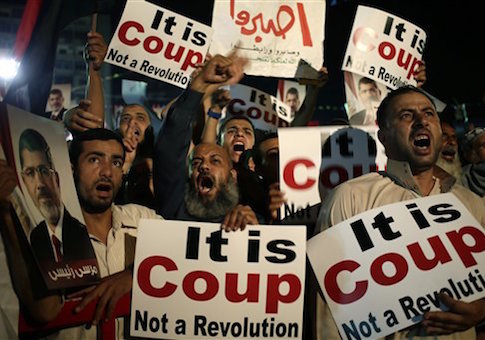
The Muslim Brotherhood called for “a long, uncompromising jihad” in Egypt just one day after a delegation of the Islamist group’s key leaders and allies met with the State Department, according to an official statement released this week.
Just days after a delegation that included two top Brotherhood leaders was hosted at the State Department, the organization released an official statement calling on its supporters to “prepare” for jihad, according to an independent translation of the statement first posted on Tuesday.
The statement also was issued just two days before a major terror attack Thursday in Egypt’s lawless Sinai region that killed at least 25.
“It is incumbent upon everyone to be aware that we are in the process of a new phase, where we summon what is latent in our strength, where we recall the meanings of jihad and prepare ourselves, our wives, our sons, our daughters, and whoever marched on our path to a long, uncompromising jihad, and during this stage we ask for martyrdom,” it states.
Preparation for jihad is a key theme of the Brotherhood’s latest call for jihad.
An image posted with the statement shows two crossing swords and the word “prepare!” between them. Below the swords it reads, “the voice of truth, strength, and freedom.” According to the statement, “that is the motto of the Dawa of the Muslim Brotherhood.”
The statement also invokes the well-known Muslim cleric Imam al-Bana, who founded the Brotherhood and has called for the death of Jews.
“Imam al-Bana prepared the jihad brigades that he sent to Palestine to kill the Zionist usurpers and the second [Supreme] Guide Hassan al-Hudaybi reconstructed the ‘secret apparatus’ to bleed the British occupiers,” the statement says.
The Brotherhood’s renewed call for jihad comes at a time when current Egyptian President Abdel Fattah al-Sisi is cracking down on the group and imprisoning many of its supporters, who notoriously engaged in violence following the ouster of Brotherhood-ally Mohamed Morsi.
Egypt experts said the timing of this declaration is an embarrassment for the State Department.
“The fact that the Brotherhood issued its call to jihad two days after its meeting at the State Department will be grist for endless anti-American conspiracy theories about a supposed partnership between Washington and the Brotherhood,” said Eric Trager, a fellow at the Washington Institute for Near East Policy (WINEP). “The State Department should have foreseen what an embarrassment this would be.”
One member of that U.S. delegation, a Brotherhood-aligned judge in Egypt, posed for a picture while at Foggy Bottom in which he held up the Islamic group’s notorious four-finger Rabia symbol, according to his Facebook page.
“Now in the U.S. State Department. Your steadfastness impresses everyone,” reads an Arabic caption posted along with the photo.
Other members of that group included Gamal Heshmat, a leading member of the Brotherhood, and Abdel Mawgoud al-Dardery, a Brotherhood member who served as a parliamentarian from Luxor.
When asked on Tuesday evening to comment on the meeting, a State Department official told the Washington Free Beacon, “We meet with representatives from across the political spectrum in Egypt.”
The official declined to elaborate on who may have been hosted or on any details about the timing and substance of any talks.
The meeting was described by a member of the delegation, Maha Azzam as “fruitful,” according to one person who attended a public event in Washington earlier this week hosted by the group.
The call for jihad, while surprising in light of the Brotherhood’s attempts to appear moderate, is part and parcel of organization’s longstanding beliefs, Trager said.
“Muslim Brothers have been committing violent acts for a very long time,” Trager explained. “Under Morsi, Muslim Brothers tortured protesters outside the presidential palace. After Morsi’s ouster, they have frequently attacked security forces and state property. “
“But until now, the official line from the Brotherhood was to support this implicitly by justifying its causes, without justifying the acts themselves,” he added. “ So the Brotherhood’s open call to jihad doesn’t necessarily mean a tactical shift, but a rhetorical one.”
Terrorism expert and national security reporter Patrick Poole said he was struck by the clarity of the Brotherhood’s call.
“It invokes the Muslim Brotherhood’s terrorist past, specifically mentioning the ‘special apparatus’ that waged terror in the 1940s and 1950s until the Nasser government cracked down on the group, as well as the troops sent by founder Hassan al-Banna to fight against Israel in 1948,” he said.
“It concludes saying that the Brotherhood has entered a new stage, warns of a long jihad ahead, and to prepare for martyrdom,” Poole said. “Not sure how much more clear they could be.”
Poole wondered if the call for jihad would convince Brotherhood apologists that the group still backs violence.
“What remains to be seen is how this announcement will be received inside the Beltway, where the vast majority of the ‘experts’ have repeatedly said that the Brotherhood had abandoned its terrorist past, which it is now clearly reviving, and had renounced violence,” Poole said. “Will this development be met with contrition, or silence? And what says the State Department who met with these guys this week?”
The State Department did not respond to a request for comment before press time.




 anneinpt
 artaxes
 danmillerinpanama
 davidking1530
 Peter Hofman
 Joseph Wouk
 Peter
Peter Louisiana Steve
 WarSclerotic
Recent Comments