Archive for January 26, 2015

Obama and cognitive dissonance

January 26, 2015

Obama and cognitive dissonance, Dan Miller’s Blog, January 26, 2015

(The views expressed in this article are mine and do not necessarily reflect those of Warsclerotic or its other editors. — DM)

It has been argued that Obama’s cognitive dissonance is demonstrated by His dealings with Iran and His other disruptive efforts in the Middle East.  Perhaps the contrary is more accurate.

Basis of His foreign policies?

Basis of His foreign policies?

An article at Front Page Magazine by Bruce Thorton is titled The Dangers of Obama’s cognitive dissonance (also at Warsclerotic). It argues that Obama mistakenly believes that Iran and “we” want many of the same things and that He acts on that belief.

The heart of this mistake is the belief that whatever their professed beliefs, all peoples everywhere are just like us and want the same things we want. Since our highest goods are peace and prosperity, we think other nations’ privilege the same things. If peoples behave differently, it’s because they are warped by poverty or bad governments or religious superstitions, and just need to be shown that they can achieve those boons in rational, peaceful ways, especially by adopting liberal democracy and free-market economies. Once they achieve freedom and start to enjoy the higher living standards economic development brings, they will see the error of their traditional ways and abandon aggression and violence, and resolve conflicts with the diplomacy and negotiation we prefer. [Emphasis added.]

The Islamic Republic of Iran most likely does want peace and prosperity, but on its own terms.

Iran hangings by crane

Iran wants Islamic “peace” — the peace of universal submission to (a Shiite?) Allah — and at least sufficient prosperity to force its will on others who do not want “peace” of that sort. If Iran gets (or gets to keep) nuclear weapons, along with increasingly longer range missiles, it will be in an increasingly improved position to do that.

Obama may well have very similar goals for Iran. His demands that the P5+1 process continue despite Iran’s persistent refusals to make significant concessions, even as it continues to enhance its nuclear war machine, and His disposition to give Iran whatever concessions it wants, suggest that His and Iran’s objectives are similar. There is support for an alternative, that Obama is simply delusional. However, unless His closest, most trusted and therefore most important advisors are at least equally delusional, that alternative makes little sense. Although she appears to be a despicable person, Valerie Jarrett seems quite competent at what she does on His behalf. Others fall on their swords, fall into line and salute or leave.

Obama’s “extraordinary disconnect” in foreign policy was recently highlighted on CBS’ Face the Nation.

John Bolton said much the same.

Is it more likely that Obama merely fails to understand what’s happening, or that He understands and likes it? His State of Union address was full of foreign policy nonsense, much of it about Iran. However, it seems to have worked quite well with the large segment of the American public which neither understands nor cares about foreign affairs (except amusing affairs of a salacious nature) and believes that He strives mightily to give them the “free stiff” they believe they want, without understanding the economic hardships it has brought and will bring to them. If members of the public who already worship Him (and that includes most of the “legitimate news” media) continue to do so, it may well make little if any difference to Him or to His closest advisors whether those who disagree with Him still like, or continue to like, Him.

Leftist beliefs

After all, as we learned at the Democrat National Convention that nominated Obama for a second term, “we all belong to the Government,” it’s “one big happy family” and Obama is the head of “our family.”

In the final analysis, it may make little difference whether Obama is incompetent and delusional or is competent, understands His plans for Iran and the rest of the world far better than the rest of us and has perverse conceptions of evil and good.

Both theories are worth considering because both can help us to understand what He does, why He does it and what He intends to accomplish. However, delusional actions and intentions are difficult for those who are not delusional to understand and therefore to challenge. Actions and intentions that are, instead, based on a rational thought process — but one that views evil as good and good as evil — are easier to understand and therefore to challenge.

As I have watched Obama and His accomplishments over the years, I have come to lean toward the notion that He is competent, evil, understands what He is trying to achieve and likes it.

Journalist Who Reported on Argentine Prosecutor’s Death Flees to Israel – NYTimes.com

January 26, 2015

Journalist Who Reported on Argentine Prosecutor’s Death Flees to Israel – NYTimes.com.

JERUSALEM — Damián Pachter, the journalist who broke the story of the recent death of an Argentine prosecutor investigating the 1994 bombing of a Jewish center in Buenos Aires, has fled to Israel, saying he feared for his life in Argentina.

In a first-person account of the days before his flight from Argentina published on Monday in the Israeli newspaper Haaretz, Mr. Pachter said he concluded late Friday that he was being followed by an intelligence officer who “wore jeans, a jeans jacket and Ray-Ban sunglasses” and decided to leave the country immediately. He said that he bought a ticket to Montevideo, Uruguay, from Buenos Aires, and that he traveled on to Madrid and Tel Aviv.

After landing in Tel Aviv on Sunday evening, Mr. Pachter told reporters waiting for him at the airport, “They are using their security forces to chase me.”

“I just had to move fast and quick, as fast as I could in order to get onto a plane and leave the country,” he added, speaking in English.

In the televised remarks, he noted that he held Israeli citizenship.

Photo

Damián Pachter, a journalist who fled Argentina after reporting on the death of a prosecutor investigating the 1994 bombing of a Jewish center in Buenos Aires, arrived in Israel on Monday.  Credit Amir Cohen/Reuters

“These are the most important years of my life,” he added. “This is the place where I feel safe.”

Mr. Pachter could not immediately be reached for comment.

Relying on a source he said he considered reliable, Mr. Pachter, a journalist for the English-language Buenos Aires Herald, was the first to publicize the suspicious death of Alberto Nisman, the prosecutor. Mr. Nisman was found dead in his Buenos Aires apartment from a gunshot wound to the head on Jan. 18, the day before he was to testify before lawmakers about his accusations regarding the 1994 attack on the Jewish center and its aftermath.

Mr. Nisman, 51, had been investigating for a decade the bombing in which 85 people were killed. He had accused Iranian officials of planning and financing the attack and Iran’s Lebanese ally, Hezbollah, of carrying it out. He also accused President Cristina Fernández de Kirchner of Argentina and top aides of having conspired with Iran to cover up responsibility for the bombing as part of a deal that would supply Iranian oil to Argentina.

Mr. Pachter first took to his Twitter account to report that there had been “an incident” at Mr. Nisman’s home. He then posted that Mr. Nisman was found in his bathroom in a pool of blood, that he was not breathing, and that doctors were at the apartment.

Argentine officials at first said that evidence at the scene, including a .22-caliber pistol and spent cartridge found near Mr. Nisman’s body, indicated suicide. By Friday, Argentina’s government was asserting that an ousted spymaster was involved.

Mr. Pachter seemed to have first become alarmed about his own safety on Friday. He wrote in Haaretz that he was working in the newsroom when a colleague drew his attention to a story about Mr. Nisman’s death by the state news agency. It quoted what was said to be a post on Twitter by Mr. Pachter, but he denied writing that message.

Mr. Pachter said he realized it was “a kind of coded message” and was advised by a friend to get out of the city. He took a bus to an undisclosed location and, he wrote, and while he waited for his friend at a gas station cafe, he noticed the man wearing the sunglasses — at night — sitting two tables from him.

“When an Argentine intelligence agent is on your tail, it’s never good news,” Mr. Pachter wrote. “He didn’t just want to have a coffee with me, that’s for sure.”

Mr. Pachter added that after he left Argentina, he found that the government was still publishing false information about him on social media. He said the Twitter feed of the Argentine presidential palace had posted the details of the airline ticket he had bought and claimed, wrongly, that he intended to return to Argentina by Feb. 2.

“In other words, I hadn’t really fled the country,” he wrote. “In fact, my return date is in December.”

“Argentina has become a dark place led by a corrupt political system,” he added. “I still haven’t figured out everything that has happened to me over the past 48 hours.”

Jorge Capitanich, Argentina’s cabinet chief, defended the publication of Mr. Pachter’s movements on the Twitter account of the presidential palace. At a news conference on Monday morning, he said, “If a journalist says that he feels threatened, it’s important to publish his whereabouts.”

Télam, the national news agency, also sought to defend itself from Mr. Pachter’s accusation that it had published invented comments, writing in a piece that it had never “alluded to a fake tweet.”

The conduct of Aerolíneas Argentinas, the state-run airline, was also criticized by opposition politicians. It was the airline that released the information about Mr. Pachter’s tickets. Julio Cobos, an opposition figure, said that releasing the information may have constituted a criminal act. He also pointed to the “complete irresponsibility” of the presidential palace’s Twitter account.

Jonathan Gilbert contributed reporting from Buenos Aires.

Why Netanyahu is right to go around Obama to Congress – The Washington Post

January 26, 2015

Why Netanyahu is right to go around Obama to Congress – The Washington Post.

January 26 at 9:41 AM

Do they talk this way about Iranian President Hassan Rouhani?

After learning that Israeli Prime Minister Benjamin Netanyahu had accepted an invitation to address a joint session of Congress about the need for new sanctions to stop Iran’s nuclear program, the Obama administration went . . . well, nuclear.

One “senior American official” threatened Netanyahu, telling the Israeli newspaper Haaretz that “Netanyahu ought to remember that President Obama has a year and a half left to his presidency, and that there will be a price.” Meanwhile a “source close to [Secretary of State John] Kerry” told The Post that the “secretary’s patience is not infinite” and that “playing politics with that relationship could blunt Secretary Kerry’s enthusiasm for being Israel’s primary defender.”

Oh, please. No wonder Netanyahu is going around these people to Congress for support. Is Kerry defending Israel as a favor to Netanyahu, or because it is in the United States’ vital interests to stand with our closest ally in the Middle East? Just the threat of withdrawing that support validates Netanyahu’s suspicion that the Obama administration does not have Israel’s back in its negotiations with Iran.

Using anonymous officials to attack Netanyahu is nothing new. Unnamed officials have called him “chickens—,” “recalcitrant,” “myopic,” “reactionary,” “obtuse,” “blustering,” “pompous,” and “Aspergery” — all to one journalist (Jeffrey Goldberg of the Atlantic, who keeps a running list).

The Obama team’s outrage is a bit overwrought. Clearly, it is not a breach of protocol for a foreign leader to lobby Congress. After all, Obama himself deployed British Prime Minister David Cameron to lobby lawmakers to oppose new sanctions on Iran. It seems Netanyahu’s crime is not so much a breach of diplomatic protocol, but rather, opposing the administration’s position.

The fact that Netanyahu felt compelled to speak directly to Congress in order to oppose the administration’s position speaks poorly, not of Netanyahu, but of Obama. If the leader of one of our closest allies is so worried about the deal Obama is going to cut with Iran that he is willing to risk a diplomatic rift with the administration to speak out, perhaps the problem is not with Israel, but with the Obama administration. And it is not just Israel that opposes Obama’s deal with Iran; Arab leaders have made clear that they share Israel’s view.

No doubt politics plays a role in Netanyahu’s decision to address Congress. His speech will come just two weeks before the Israeli elections. But is it wrong for a politician to use the foreign stage of an ally to buttress his electoral case back home? If it is, then Barack Obama — who gave a campaign speech in Berlin before 200,000 adoring Germans who could not vote for him — is the wrong man to level that criticism.

Obama claims that new sanctions on Iran “will all but guarantee that diplomacy fails.” If the mere threat of sanctions is enough to derail Iran’s nuclear talks, then whatever deal is in the works is not worth having. It means that Obama is far more desperate for a deal than Tehran is — which is a sure-fire way to guarantee a bad agreement.

Obama wants a nuclear deal with Iran because it would be a major feather in his political cap at a time when his foreign policy is imploding across the world, from Yemen to Syria to Iraq. For Israel, Iran’s nuclear program is not a political challenge; it is an existential one.

Obama can afford a bad deal because, as that anonymous official put it, he has a year and a half left to his presidency. The people of Israel, on the other hand, will have to live with the consequences long after Obama is gone.

Netanyahu understands this — which is why it is good that he is coming to Washington, and why House Republicans deserve credit for inviting him.

The Dangers of Obama’s Cognitive Dissonance

January 26, 2015

The Dangers of Obama’s Cognitive Dissonance, Front Page Magazine, January 26, 2015

ol-450x253

The worst crisis we face is the relentless progress Iran is making toward creating nuclear weapons, a development that would set off an arms race in the Middle East and destabilize an already chaotic region. The Islamic Republic has already extended its malign influence into Syria, Lebanon, and Yemen, creating a Shi’a crescent that threatens our allies in the region, especially Israel, Jordon, Egypt, and Saudi Arabia. If a failed gangster-state like North Korea can demand so much international attention just because it possesses nuclear weapons, think what Iran––with 3 times the population and the world’s 3rd largest oil reserves––could do. Oil won’t stay cheap forever.

Obama, in short, can say that “all options are on the table” all he wants, but the mullahs know he will not take military action against them, nor help Israel to. They know that Obama has withdrawn from the region, and at best will make only token gestures of engagement, like the current bombing campaign against ISIL. They know his ultimatums and “red line” threats are empty. They know he wants a deal more than they do, so he can burnish his legacy. Thus the Iranians are spinning out the negotiations, cadging extensions, pocketing concessions without reciprocating, and giving Obama just enough hope to think he can achieve what he thinks will be a Nixon-goes-to-China foreign policy coup, but will in fact will go down in history as a humiliating and dangerous blunder like Chamberlain’s Munich debacle.

*********************

There are many moments from the past 6 years that demonstrate the criminal incompetence of this president and his administration. But for me, Obama’s interview with GloZell––whose claim to YouTube fame comes from eating Cheerios in a bathtub filled with milk––represents best the essential emptiness, triviality, and sheer dumbness of this president. Imagine Franklin D. Roosevelt in 1938 being interviewed by a carnival geek, and you can gauge just how low the most consequential political office in the world has sunk.

This interview, remember, took place the same time as problems requiring urgent presidential attention were escalating. Libya imploding, Iran inching toward a nuclear bomb, ISIS expanding in Syria and holding ground in northern Iraq, Iranian military assets active in Iraq, Yemen falling to an Iranian proxy terrorist group, another Iranian client, Bashar al Assad, strengthening his hold over Syria––and that’s just the Middle East. And don’t forget, the GloZell farce followed hard on Obama’s State of the Union address, a congeries of wishful thinking, narcissistic braggadocio, and outright-lies, a preposterous catalogue in which generous sprinklings of first-person-pronoun fairy dust transmuted every failure into an achievement.

It is the contradiction between fact and fiction, evident in every line of the president’s speech, that typifies progressives in general. This cognitive dissonance may simply be nothing more than the grubby machinations of those who will say and do anything for political power and the wealth and influence it brings. In other words, they know they are hypocrites. But it also could be something more dangerous than a venal character and moral corruption. One gets the feeling that many progressives actually believe what they say, that they are reciting the mantras of their ideological cult, no matter how contrary to reality or their own actions. What’s more important is that whatever the source, this failure to acknowledge reality, to think critically, and to respect intellectual coherence is dangerous to all of us, especially in the many foreign policy crises that have mushroomed on Obama’s watch.

And the worst crisis we face is the relentless progress Iran is making toward creating nuclear weapons, a development that would set off an arms race in the Middle East and destabilize an already chaotic region. The Islamic Republic has already extended its malign influence into Syria, Lebanon, and Yemen, creating a Shi’a crescent that threatens our allies in the region, especially Israel, Jordon, Egypt, and Saudi Arabia. If a failed gangster-state like North Korea can demand so much international attention just because it possesses nuclear weapons, think what Iran––with 3 times the population and the world’s 3rd largest oil reserves––could do. Oil won’t stay cheap forever.

But in the face of this threat, Obama has appeased the mullahs under the guise of diplomatic “engagement” and negotiations, the time-proven way to avoid action while pretending to do something. Indeed, so besotted is he by his faith in diplomacy that he has threatened to veto a Congressional bill that would strengthen his negotiating position by toughening economic sanctions, the best non-lethal shot we have for changing the Iranians’ behavior, given the current decline in their oil revenues. But what we see here is a problem that transcends any one president or Secretary of State, for it reflects the intellectual error and failure of imagination peculiar to modernity.

The heart of this mistake is the belief that whatever their professed beliefs, all peoples everywhere are just like us and want the same things we want. Since our highest goods are peace and prosperity, we think other nations’ privilege the same things. If peoples behave differently, it’s because they are warped by poverty or bad governments or religious superstitions, and just need to be shown that they can achieve those boons in rational, peaceful ways, especially by adopting liberal democracy and free-market economies. Once they achieve freedom and start to enjoy the higher living standards economic development brings, they will see the error of their traditional ways and abandon aggression and violence, and resolve conflicts with the diplomacy and negotiation we prefer.

The problem with this scenario is not that other peoples don’t want freedom and prosperity, or are incapable of achieving them. Rather, it is that they often have other goals more important than the ones we prize. Like religion, for example, or national honor, or revenge. We may think such motives are irrational avatars from an uncivilized past, but they are still drivers of action in individuals and nations alike. They may be, to quote Orwell on the Nazis, “ghosts” out of the premodern world, but they’re still “ghosts which need a strong magic to lay them.”

Of course, if weaker than an enemy or rival, such a people may conceal these motives, and pretend to play by the rules of the more powerful, until they are strong enough to use force to achieve their aims. In such situations, diplomatic engagement becomes a tactic for achieving through words what cannot be gained through deeds. As Robert Conquest said of our Cold War negotiations with the Soviets, “The Soviets did what their interests required when the alternative seemed less acceptable, and negotiation was merely a technical adjunct.”

History shows the truth of this insight, from the Munich Conference in 1938, to the many arms reduction treaties with the Soviet Union, which we know the Soviets and now the Russians have serially violated. More pertinent for Iran is the sorry history of the diplomatic attempts to prevent North Korea from developing nuclear weapons. For decades we indulged in cycles of concessions, agreements, conferences, and violations that all ended up with the North announcing it had gone nuclear. The failure to learn from that recent history is evident in Obama’s current reprise of that sordid dance in his engagement with Iran.

This is not to say that diplomacy can’t ever work. But to be effective, negotiation has to start with a clear understanding of the other side’s motives. One must avoid the “trap,” as Conquest called it, “of thinking that others think, within reason, like ourselves. But this trap is precisely the error that must be avoided in foreign affairs.” The rulers of Iran may lust after wealth and secular power, the default materialist motives recognized by the West. But that greed can coexist with their messianic, apocalyptic strain of Shi’a Islam, and the acceptability of violence in service to their faith that characterizes traditional Islam.

Thus when Muslim warriors tell us, as they have for 14 centuries, that they love death as we love life; when they proclaim, as Mohammed, Iran’s Ayatollah Khomeini, Osama bin Laden, and the Fort Hood jihadist did, “I was instructed to fight all men until they say there is no god but Allah,” we’d better listen and take them seriously, rather than brush aside such profound religious beliefs as mere camouflage for materialist motives. Yet so blind is Obama to this truth, that he and his officials stubbornly refuse even to utter a phrase like “Islamic extremist,” since he has decided that all the Muslim violence roiling the world every day has “nothing to do with Islam.”

Second, diplomacy can work only when backed by a credible threat of force. The other side must believe that mind-concentrating violence will punish them for negotiating in bad faith and violating agreements. In the case of Iran, the mullahs must believe that we will put to the test their love of death and longing for paradise. But our long history with the Islamic Republic has proved the opposite. Iran has never been punished for taking our embassy staff hostage in 1979, for instigating the murder of 241 of our soldiers in Beirut in 1983, or for training and funding the terrorists who have killed our troops in Iraq and Afghanistan, or for being the world’s leading promoter of terrorist violence.

Obama, in short, can say that “all options are on the table” all he wants, but the mullahs know he will not take military action against them, nor help Israel to. They know that Obama has withdrawn from the region, and at best will make only token gestures of engagement, like the current bombing campaign against ISIL. They know his ultimatums and “red line” threats are empty. They know he wants a deal more than they do, so he can burnish his legacy. Thus the Iranians are spinning out the negotiations, cadging extensions, pocketing concessions without reciprocating, and giving Obama just enough hope to think he can achieve what he thinks will be a Nixon-goes-to-China foreign policy coup, but will in fact will go down in history as a humiliating and dangerous blunder like Chamberlain’s Munich debacle.

So much is obvious. Yet in his State of the Union speech Obama astonished even his loyal media retainers when he asserted that his negotiations have “halted the progress of its [Iran’s] nuclear program and reduced its stockpile of nuclear material.” In reality, Iran continues to enrich uranium and is building new nuclear reactors, not to mention constructing missile sites and nuclear facilities in Syria. International inspectors are still barred from numerous sites in Iran, and so the West has no real idea of how many facilities exist there. This means that even if an agreement is signed, it will be worthless if it leaves Iran with the knowledge and technology needed to make nuclear bombs at a time of its choosing. And it means that someday we all will pay the price for our president’s cognitive dissonance.

Saudi Arabia’s New King Helped Fund Radical Terrorist Groups

January 26, 2015

Saudi Arabia’s New King Helped Fund Radical Terrorist Groups

Monarch tied to anti-Semitic Muslim clerics, funding of jihad

By Adam Kredo
January 26, 2015 5:00 am

via Saudi Arabia’s New King Helped Fund Radical Terrorist Groups | Washington Free Beacon.


King Salman, Saudi Arabia’s newly enthroned monarch / AP

King Salman, Saudi Arabia’s newly crowned monarch, has a controversial history of helping to fund radical terror groups and has maintained ties with several anti-Semitic Muslim clerics known for advocating radical positions, according to reports and regional experts.

Salman, previously the country’s defense minister and deputy prime minister, was crowned king last week after his half-brother King Abdullah died at the age of 90.

While Abdullah served as a close U.S. ally and was considered a reformer by many, Saudi Arabia has long been criticized by human rights activists for its treatment of women and its enforcement of a strict interpretation of Islamic law.

President Barack Obama is scheduled to travel to the Saudi capital of Riyadh on Tuesday to pay respects to Abdullah and meet with Salman, who also has been seen as a moderate friend of the United States.

However, throughout his public career in government, Salman has embraced radical Muslim clerics and has been tied to the funding of radical groups in Afghanistan, as well as an organization found to be plotting attacks against America, according to various reports and information provided by David Weinberg, a senior fellow at the Foundation for the Defense of Democracies.

In 2001, an international raid of the Saudi High Commission for Aid to Bosnia, which Salman founded in 1993, unearthed evidence of terrorist plots against America, according to separate exposés written by Dore Gold, an Israeli diplomat, and Robert Baer, a former CIA officer.

Salman is further accused by Baer of having “personally approved all important appointments and spending” at the International Islamic Relief Organization (IIRO), a controversial Saudi charity that was hit with sanctions following the attacks of September 11, 2001, for purportedly providing material support to al Qaeda.

Salman also has been reported to be responsible for sending millions of dollars to the radical mujahedeen that waged jihad in Afghanistan in the 1980s, according to Bruce Riedel, a former CIA officer who is now director of the Brookings Intelligence Project.

“In the early years of the war—before the U.S. and the Kingdom ramped up their secret financial support for the anti-Soviet insurgency—this private Saudi funding was critical to the war effort,” according to Riedel. “At its peak, Salman was providing $25 million a month to the mujahedeen. He was also active in raising money for the Bosnian Muslims in the war with Serbia.”

Salman also has embraced radical Saudi clerics known for their hateful rhetoric against Israel and Jews.

Salman has worked closely with Saleh al-Moghamsy, who tweeted in August 2014 that “Allah only gathered Jews in the land of Palestine to destroy them.”

Al-Moghamsy also stated in a 2014 television interview that “the hatred of Jews toward Muslims is an eternal hatred.” He also claimed in 2012 that Osama bin Laden had died with more “sanctity and honor” than any infidel, or non-Muslim.

Despite this rhetoric, Salman has maintained close ties to al-Moghamsy.

Salman chairs the board of an organization run by al-Moghamsy and has sponsored the cleric’s public events, including a 2013 festival. Salman and al-Moghamsy were pictured many times together at that event, according to regional reports.

Al-Moghamsy also has been an adviser to two of Salman’s sons, one of whom posed for a selfie with the cleric in July.

Salman also has reached out to other hardline preachers, including Safar Hawali, a one-time mentor of Osama bin Laden who has called for non-Muslims to be expelled from Saudi Arabia.

In 2005, Salman called Hawali to inquire about his health and in 2010 praised him upon the release of a book.

While crown prince, Salman also made a point of phoning Aidh Abdullah al-Qarni, a Saudi author currently on the U.S. Terrorist Screening Center’s No Fly List who has praised Hamas and called Israelis “the brothers of apes and pigs.”

Additionally, Salman, in his role as crown prince, has recently visited Saudi Arabia’s grand mufti, the nation’s highest religious authority, who has asserted that 10 is an appropriate age of marriage for girls and called for the destruction of all churches in the Arabian Peninsula.

Weinberg, who has been tracking Salman closely, said that the new monarch is taking up his predecessor’s mantle of moderate reform.

“Just like King Abdullah tried to present himself as a reformer, some are trying to suggest that the new king, Salman, is a moderate who will continue his half-brother’s so-called progressive policies,” Weinberg said. “But just look at where Saudi Arabia is after Abdullah: people are being decapitated and flogged by the state in the streets.”

“Women are systematically oppressed by their own government, and the regime continues to propagate incitement and intolerance,” he continued. “Salman’s background funding mujahedeen abroad and embracing hateful clerics suggests that he is at best a political opportunist who will tolerate continued religious extremism, even if he does not hold such views himself.”

Israel News – Hamas test-fired 10 rockets from Gaza into the sea

January 26, 2015

Hamas test-fired 10 rockets from Gaza into the sea

Hamas fired 10 rockets into the Mediterranean Sea today, testing its rocket range limit.

Jan 26, 2015, 01:30PM | Yael Klein

via Israel News – Hamas test-fired 10 rockets from Gaza into the sea – JerusalemOnline.


Archive photo

Archive photo Photo Credit: Reuters/Channel 2 News

Today (Sun), the Palestinians completed a series of rocket testing. They fired 10 rockets toward the Mediterranean Sea.

Hamas has been conducting many tests over the past several months.  However, a barrage of 10 rockets is considered rare. 70 rockets have been fired by Hamas in tests conducted since Operation Protective Edge. The Palestinians are attempting to improve the rockets’ range limit. However, they are facing difficulties in doing so due to the lack of supplies delivered to them from outside the Gaza Strip. Therefore, they manufacture the explosives themselves, which is another reason for conducting the many tests.

One month ago, a siren alarm went off in a number of communities in the Eshkol Regional Council, after a rocket fired from Gaza exploded in Southern Israel, without causing injuries or damage.

Eshkol Mayor Haim Yalin stated following the incident: “The state had an extraordinary opportunity to agree upon a long-term arrangement with the Palestinians. Instead, we find ourselves with a ticking clock in hour hands, counting down to the next war.”

Boehner: We gave White House heads up on Netanyahu

January 26, 2015

Boehner: We gave White House heads up on Netanyahu

Defending the invitation that angered Obama, House speaker says prime minister is top authority on Iranian threat

By Times of Israel staff January 26, 2015, 1:42 pm

via Boehner: We gave White House heads up on Netanyahu | The Times of Israel.


US Speaker of the House John Boehner said Sunday night that he informed President Barack Obama that he’d asked Prime Minister Benjamin Netanyahu to speak before Congress hours before the invite was made public.

Boehner and Netanyahu agreed that the Israeli prime minister would speak in Washington on March 3 without consulting the administration — the customary policy on such things. But it gave rise to anger in Washington and to criticism in the media.

Asked about the White House’s statements that it had been blindsided by the plan, Boehner told CBS’s “60 Minutes,” “We gave them a heads up that morning.”

He defended the decision to invite Netanyahu to speak to Congress about his position on Iran’s nuclear program, a stance considerably more hawkish than that of the Obama administration.

“There’s nobody in the world who can talk about the threat of radical terrorism — nobody can talk about the threat the Iranians pose, not just to the Middle East and to Israel… but to the entire world — than Bibi (Benjamin) Netanyahu,” he said.

Boehner went on to say he did not believe Obama was giving that threat the attention it deserved.

“The president didn’t spend but a few seconds (in his State of the Union address last week) talking about the threat, the terrorist threat that we as Americans face,” he said.

“This problem is growing all over the world…the president is trying to act as though it’s not there, but it is there and it’s going to be a threat to our homeland if we don’t address it in a bigger way.”

Netanyahu is expected to urge US lawmakers to ready new sanctions on Iran in order to force it to comply with international demands to curb its nuclear program, a move Obama strongly opposes and has vowed to veto.

Senate Majority Leader Mitch McConnell told “60 Minutes” he did not agree with Obama’s insistence that new sanctions at this sensitive time would cause negotiations with Tehran to break down.

“Under the proposal we’re considering those enhanced sanctions would only occur if a deal is not reached,” he said. “In other words it further incentivizes the Iranians to reach an agreement, because they know things could get considerably worse if they do not.”

On Sunday Israel’s Ambassador to the US Ron Dermer also defended Netanyahu’s planned speech, saying it was the prime minister’s “sacred duty” to present his stance on Iran.

Speaking at an Israel Bonds event in Florida, Dermer charged that the nuclear agreement being discussed between the P5+1 and Tehran “could endanger the very existence of the State of Israel,” by leaving Iran as a “nuclear threshold state.”

Israel's ambassador to Washington, Ron Dermer, formerly senior adviser to Prime Minister Benjamin Netanyahu (photo credit: Miriam Alster/Flash90)

Israel’s ambassador to Washington, Ron Dermer, formerly senior adviser to Prime Minister Benjamin Netanyahu (photo credit: Miriam Alster/Flash90)


The six world powers — Britain, China, France, Russia, the United States and Germany — are working with Iran to finalize an agreement that would curb Tehran’s nuclear program, which the West believes is intended to build atomic weapons, a charge the Islamic Republic denies. Two earlier deadlines passed without the final deal and a third deadline is looming on July 1.

Dermer said Netanyahu’s visit was “intended for one purpose: To speak up while there is still time to speak up. To speak up when there is still time to make a difference.”

Netanyahu’s upcoming speech sparked a public row between his government and Obama’s administration. The administration has been at odds with Netanyahu for years over international efforts to reach an agreement on Iran’s nuclear program, with Israel expressing skepticism over emerging terms that would allow Tehran to retain some uranium enrichment capacity.

Amid growing criticism in the US and in Israel of Netanyahu’s move, including by Israel’s former US envoy Michael Oren, who called on the prime minister to cancel the speech, Dermer said the visit was “not intended to show any disrespect for President Obama,” nor was it intended “to wade into your political debate.”

Earlier Sunday, White House Chief of Staff Denis McDonough appeared to downplay the tensions between the White House and Prime Minister Benjamin Netanyahu, insisting that the US relationship with Israel was “many-faceted, deep and abiding.”

McDonough deferred questions about comments attributed to an American official in Friday’s edition of the Haaretz daily, to the effect that Netanyahu “spat in our face publicly, and that’s no way to behave.”

The unnamed official warned that “Netanyahu ought to remember that President [Barack] Obama has a year and a half left to his presidency, and that there will be a price.”

Saudi Arabia Unveils Badass Anti-ISIS Wall That Makes U.S. Border Look Like Swiss Cheese

January 26, 2015

Saudi Arabia Unveils Badass Anti-ISIS Wall That Makes U.S. Border Look Like Swiss Cheese

By Jennifer Van Laar (1 week ago) | Military, Nation

via Saudi Arabia Unveils Badass Anti-ISIS Wall That Makes U.S. Border Look Like Swiss Cheese.


Getty – YASSER AL-ZAYYA
The oldest way to defend land is through a physical barrier, such as a wall. Yet some Americans dispute the efficacy of a wall when defending our southern border against infiltration from either illegal immigrants or terrorists.

One country is not buying into that notion: Saudi Arabia.

Last week, a Saudi general was killed in a skirmish with ISIS at the border with Iraq, along which Saudi Arabia is constructing a 600-mile-long wall:

Image Credit: Telegraph

Image Credit: UPI

The prospect of this wall separating Iraq from Saudi Arabia is not a welcome one for ISIS, whose goals include capturing Saudi Arabia – home to the Holy Mosques of Mecca and Medina.

Saudi Arabia’s oil fields are another key strategic goal for the terror group intent on creating a Sharia-run caliphate.

Construction began on the wall last September and, according to Jane’s,

“…consists of 78 monitoring towers, eight command centers, 10 mobile surveillance vehicles, 32 rapid-response centers, and three rapid intervention squads, all linked by a fiber-optic communications network.”

The Kingdom is also creating a 1,000 mile wall along its border with Yemen to the south.

If the Saudis are putting this much stock in a wall, why do some in the United States claim that tactic won’t work here?

For one thing, the Mexican-U.S. border wall being constructed is more of a fence and not a fully integrated security solution.

Also, the Saudi’s wall is solely constructed in a desert, while the United States boundary includes a river. Wildlife concerns make it difficult to place a fortified border wall next to a body of water.

But, with the economic and public health threat posed by illegal border crossings and potential terrorism concerns, some feel that Congress might do well to take a cue from the Saudi solution–especially with the reported weaknesses with our own border security.

Unfortunately, within the fortress they are building, Saudi Arabia is still denying its citizens the most basic human rights. According to Yahoo News, the kingdom has ‘sparked an international outcry’ for sentencing a blogger to 1,000 lashings for insulting Islam.

Obama administration intervened in Argentine probe of Iranian leader, Jewish center bombing

January 26, 2015

Obama administration intervened in Argentine probe of Iranian leader, Jewish center bombing

Special to WorldTribune.com

via Obama administration intervened in Argentine probe of Iranian leader, Jewish center bombing – World Tribune | World Tribune.


LONDON — The United States pressed Argentina to end its investigation of Iranian complicity in the 1994 bombing of a Jewish center in which nearly 100 people were killed.

Western diplomatic sources said the administration of President Barack Obama urged Argentina on several occasions to either stop or limit the investigation into the bombing of the Argentine-Israeli Mutual Association in Buenos Aires. The sources said the U.S. appeals marked one of the demands by Iran for a reconciliation with Washington.

Ali Akhbar Velayati.

“Argentina had hard evidence against at least one Iranian leader, which prevented him from traveling abroad,” a source said.

A key Iranian suspect was identified as Ali Akhbar Velayati, foreign minister from 1981 until 1987, and deemed close to supreme leader Ali Khamenei. Velayati has been on the official wanted list of Interpol since 2007 and a subject of an international arrest warrant by Argentina.

“One of the first demands by Iran to the administration was that Argentina be pressed to drop the warrant,” the source, close to the Argentine leadership, said. “Within months, the U.S. followed up with a high-level meeting in which Argentina was asked to lay off.”

The sources said Buenos Aires eventually complied. In 2013, Argentina and Iran signed an agreement for a joint investigation of the AMIA bombing, deemed a cover-up by Buenos Aires.

On Jan. 18, a leading Argentinian prosecutor assigned to investigate an alleged government cover-up on AMIA was found shot to death in his home. The prosecutor, Alberto Nisman, had been scheduled to appear in front of Congress and present evidence that President Cristina Kirchner and Foreign Minister Hector Timerman shielded Teheran in connection with the bombing.

“[They] took the criminal decision of inventing Iran’s innocence to satisfy commercial, political and geopolitical interests of the Argentine republic,” a 289-page report by Nisman said.

It was not clear whether the report contained evidence of U.S. intervention in the alleged plot to clear the Iranians. The 51-year-old Nisman, appointed in 2005, had presented evidence that Iran sponsored the bombing, conducted by its main proxy, Hizbullah.

On Jan. 21, the ranking Democrat of the Senate Foreign Relations Committee said Obama has become the leading defender of Iran. Sen. Robert Menendez suggested that the administration was coordinating with Teheran in efforts to block U.S. sanctions on Iran.

“The more I hear from the administration and its quotes, the more it sounds like talking points that come straight out of Iran,” Menendez said. “And it feeds to the Iranian narrative of victimization, when they’re the ones with original sin.”

For her part, Ms. Kirchner said Nisman was killed by opponents of the president. Earlier, officials asserted that Nisman committed suicide.

“I’m convinced that it was not suicide,” Ms. Kirchner said. “They used him when he was alive but then they needed him dead.”

Be Sociable, Share!

Exclusive: Freed Al Qaeda Agent Was Part of Proposed Swap for Jailed Americans

January 26, 2015

Exclusive: Freed Al Qaeda Agent Was Part of Proposed Swap for Jailed Americans, Daily Beast, January 25, 2015

(Please see also Analysis: Former al Qaeda operative freed, sent home to Qatar, a January 20th article from Long War Journal which also raises questions about the release of Al-Marri and notes the grand reception given him as a hero upon arrival in Qatar. Among other points, it states:

According to The Guardian (UK), al Marri’s nephew revealed that upon arrival in Doha, his uncle “was greeted by representatives from the Qatari interior and foreign ministries” and is now in “high spirits.” He thanked Qatari officials for exerting “tremendous efforts” for his uncle’s release.

— DM)

1422235859979.cachedThe Daily Beast

An American couple’s freedom may have come at a steep price: the release of a convicted terrorist from Supermax prison.

Before he was released from a U.S. maximum-security prison last week, a confessed al Qaeda sleeper agent was offered up in a potential prisoner swap that would have freed two Americans held abroad.

The Daily Beast has learned that the proposal was floated in July 2014 to the then-U.S. ambassador in Qatar by an individual acting on behalf of that country’s attorney general. According to two individuals with direct knowledge of the case, the proposition was made shortly after the Obama administration traded five Taliban fighters for Army Sgt. Bowe Bergdahl. Those fighters were also sent to Qatar, where they’re to remain under government watch until later this year. U.S. officials have said they’re at risk of plotting further attacks against the United States.

The proposed swap involving the al Qaeda agent, Ali Saleh Al-Marri, raises troubling questions about whether the Bergdahl trade opened a kind of Pandora’s box, signaling to foreign governments that they can pressure the United States to make concessions on terrorism by trading American prisoners abroad for dangerous extremists held in the United States.

“I believe we must examine the administration’s decision in the case of Al-Marri and determine if his release is connected to negotiations of any kind,” Rep. Duncan Hunter, a frequent critic of the Obama administration’s hostage negotiations, wrote Thursday in a letter to Rep. Mac Thornberry (R-TX), the House Armed Services Committee chairman, obtained by The Daily Beast.

Governments’ hostage negotiations policies are once again taking center stage after ISIS released a photograph Saturday showing the apparent beheading of Haruna Yukawa, one of two Japanese men the group is holding. Unexpectedly, ISIS has now dropped an earlier demand of $200 million ransom and says it will free the remaining hostage, journalist Kenji Goto, in exchange for the release of Sajida Mubarak al-Rishawi, a failed suicide bomber who’s imprisoned in Jordan for her role in an attack on three hotels in Amman in 2005, which killed 60 people.

ISIS has made other demands for freeing prisoners, including a Pakistani woman held in the United Sates, Aafia Siddiqui, known in counterterrorism circles as “Lady Al Qaeda,” who was convicted in 2010 of attempting to kill Americans in Afghanistan. Siddiqui has been used as a bargaining chip in other negotiations, as well. In 2012, Pakistani officials offered to try and win the release of Bergdahl if the United States would free Siddiqui. The Obama administration quickly rejected the idea because releasing her would be seen as offering concessions to terrorist groups and put a potentially dangerous woman back on the streets, according to current and former administration officials.In his letter, Hunter accused the administration of failing to pursue other avenues for freeing Americans abroad and relying on prisoner releases or exchanges, “which are often counter to U.S. security interests, for leverage in negotiations.” The congressman also alluded to other potential swaps, saying it’s his understanding that “other foreign nationals” who are still in U.S. custody “have also been named as potential figures of interest in other cases, with Qatar at the forefront.”

1422235139852.cachedTara Todras-Whitehill/The New York Times, via Redux

Qatar has emerged as a go-between in various hostage negotiations. It agreed to take custody of the five Taliban fighters for a period of one year after Bergdahl’s release. And sources close to efforts to free other Americans held abroad said that Qatar facilitated a ransom payment to help free journalist Peter Theo Curtis, who was held for two years by al Qaeda’s branch in Syria.

Hunter helped spur the administration to review its hostage negotiation policy, which is widely seen by experts and family members of Americans held abroad as dysfunctional.

The proposal to trade Al-Marri came from an individual described by one source as a “government contractor” and close friend of Qatar’s attorney general, Ali Bin Mohsen Bin Fetais Al Marri, who is said to be a relative of the confessed terrorist. The emissary met with the then-U.S. ambassador to Qatar, Susan Ziadeh, and raised the idea of trading Al-Marri for Matthew and Grace Huang, an American couple who’d been living in Qatar and were convicted in the still-unexplained death of their adopted daughter, in what was widely criticized by human-rights groups and legal experts as an unfair show trial.

“Qatari government officials told the Huang team that they floated the idea of a prisoner swap to the U.S. ambassador,” Richard Grenell, a former U.S. diplomat who worked on the Huang case, told The Daily Beast. That account was corroborated by a second source.

A State Department spokesman said that “no such proposal was ever on the table,” and noted that Al-Marri was eventually released from prison and sent home to Qatar as scheduled “and not as the result of any U.S.-Qatari agreement.” Asked for further clarification on whether the swap was raised as described and what the U.S. reaction was, the spokesman declined to comment further. The Qatari embassy in Washington didn’t respond to inquiries from The Daily Beast.

A second administration official pushed back on the idea that Al-Marri’s release was a quid pro quo for freeing the Huangs, who were eventually allowed to leave Qatar in December after their conviction was overturned.

“Al-Marri’s release happened as a matter of course, as a result of his court-imposed sentence being completed,” the administration official said. Al-Marri was given a “good conduct release” from the “supermax” facility in Florence, Colorado, on Jan. 16, after serving 87 percent of his 100-month sentence, said a spokesperson for the Bureau of Prisons. He’d accumulated credit for good behavior while in prison and time already served in jail while awaiting trial, which is why he didn’t serve the remainder of his time.

Administration officials characterized Al-Marri’s release as routine. But Al-Marri was no ordinary prisoner. At one time, he was the only so-called enemy combatant being held on U.S. soil, a status that treated him more like solider in a war than an ordinary criminal. Al-Marri’s release—timely or otherwise—has led to criticism that the Obama administration is repatriating a dangerous man who could help plan more attacks. An individual with knowledge of Al-Marri’s release said President Obama played no role in the process.

Al-Marri was first detained by U.S. authorities in December 2001 at his home in Peoria, Illinois, having arrived in the U.S. on a student visa. Authorities suspected that Al-Marri, who has dual citizenship in Qatar and Saudi Arabia, had ties to al Qaeda. But his future dramatically changed when was declared an enemy combatant in June 2003 and then transferred into military custody.

It turns out that Al-Marri may have been more valuable as a source of intelligence about other terrorist plots than for anything he knew about the 9/11 attacks. Much of the information that U.S. officials have on his plans came from the brutal interrogation of Khalid Sheikh Mohammed, the 9/11 mastermind, which included waterboarding. “Over three quarters of the intelligence reports that the FBI cited in a paper assessing the activities of [Al-Marri] and explaining the reach of al Qaeda’s network in the U.S. were sourced to” Mohammed, the CIA stated in its written response to a blistering report by the Senate Intelligence Committee on the so-called torture program. “Prior to [Mohammed’s] information, CIA and the FBI were aware of Al-Marri’s links to al Qaeda but lacked the detail to more fully understand al Qaeda’s plans for him.”

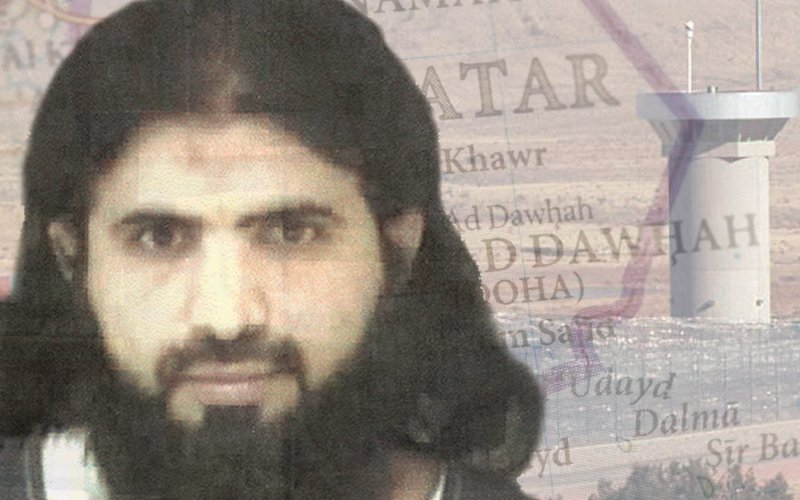
1422235139631.cachedAli Saleh Kahlah al-Marri, former graduate student at Bradley University, Peoria, Illinois, is photographed in this booking photo at Peoria County Sheriff’s Office in Illinois on May 20, 2003. (Peoria County Sheriff’s Office/Reuters)

That may explain why U.S. officials were reluctant to give Al-Marri a criminal trial, where he could have questioned the credibility of the evidence Mohammed provided while being tortured and exposed the details of the CIA’s interrogation program.

Al-Marri was held in a naval brig for more than five years, and his lawyers have claimed he was subjected to harsh and intimidating treatment. Al-Marri’s case took yet another odd turn when, early in the Obama administration, he was transferred back into federal court and pleaded guilty to conspiracy to aid al Qaeda.

Back in Qatar, where Al-Marri has been reunited with his family, he’s being given a hero’s welcome. Members of the public have been invited to a celebration in Al-Marri’s honor held just down the street from a football stadium that will host the 2022 World Cup, said David Weinberg, a senior fellow at the Foundation for Defense of Democracies.

“Several prominent Qatari personalities welcomed Al-Marri home with open arms. That trend has continued, with a longtime board member of Al Jazeeradeclaring on her personal Twitter page that ‘We congratulate the family of Ali bin Kahlah Al-Marri on his return,’” Weinberg told The Daily Beast.

Al-Marri may have other powerful friends in Qatar, in addition to the attorney general. Weinberg noted that in U.S. court documents, Al-Marri is said to have spent nearly a decade working as a “key person” in the audit department of Qatar Islamic Bank, and then as a senior auditor for the government of Qatar. Sending a known moneyman to a country widely seen as a major financial hub for terrorist groups, instead of to Saudi Arabia, where he also has citizenship, “was a big missed opportunity for U.S. policy,” Weinberg said.