Archive for January 21, 2015

Canada’s FM: A Jewish state today is more important than even a few years ago

January 21, 2015

Canada’s FM: A Jewish state today is more important than even a few years ago

‘We have a fundamental difference with the Palestinians’ about their path to statehood, a thoroughly unapologetic John Baird tells The Times of Israel

By Raphael Ahren January 21, 2015, 3:32 pm

via Canada’s FM: A Jewish state today is more important than even a few years ago | The Times of Israel.


ohn Baird has no intention of apologizing. The Palestinians would like the Canadian foreign minister to say he’s sorry for his government’s unabashedly pro-Israel stance. They shouldn’t hold their breath.

In fact, Baird is waiting for an apology from Ramallah — not for having his car pelted with eggs and shoes Sunday during his visit there, but for a top Palestinian official’s comparison between Israel and terrorists of the Islamic State.

“People may disagree with our position with respect to Israel, but so be it,” Baird said Tuesday in Tel Aviv, as he wrapped up a three-day visit to the region. “It’s always wise to speak with moral clarity,” he submitted, adding that despite Ottawa’s unflinching friendship with the Jewish state, “we have a pretty good relationship with most of the Arab countries in the region.”

But evidently not so much with the Palestinians, as his visit to Ramallah Sunday underlined. While Palestinian protestors booed, hurled shoes and eggs at Baird and told him he was unwelcome in their land, senior Palestine Liberation Organization official and ex-chief peace negotiator Saeb Erekat released a statement denouncing Baird and urging him to ask the Palestinian people for forgiveness for his country’s consistent support for Israel.

“The Palestinian people as well as the rest of the Arab and Muslim countries deserve an apology from the Canadian government for years of systematic attempts at blocking the right of the Palestinian people to a state of their own,” Erekat declared. Canada stands “on the wrong side of history” by blindly supporting Israel’s “apartheid policies,” Erekat charged, attacking Baird personally for contributing to alleged Israeli violations of Palestinian rights.

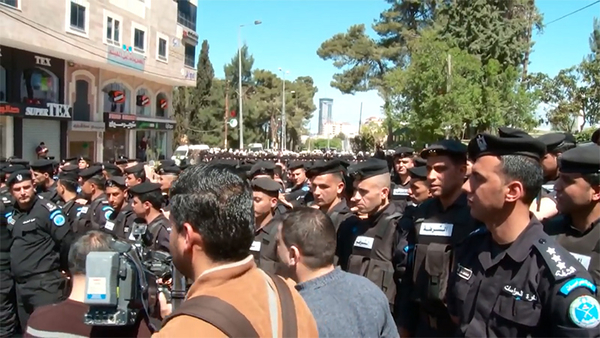
Policemen stand guard in front of Palestinian protesters holding placards before a meeting between Palestinian Authority Minister of Foreign Affairs Riyad al-Maliki and his Canadian counterpart John Baird on January 18, 2015, Ramallah. (AFP/ABBAS MOMANI)

Speaking to The Times of Israel in his Tel Aviv hotel, Ottawa’s top diplomat made crystal clear he makes no apology for his government’s positions on Israel. Instead, he noted that he is awaiting an apology from Erekat, who earlier this month said Israel’s settlement building in the West Bank was “terrorism” tantamount to that practiced by the Islamic State.

“That speaks volumes,” Baird said of Erekat’s comparison. “I’ll leave it to any fair-minded observer to come to conclusions about him,” he added diplomatically.

At the time, Baird’s spokesperson, Rick Roth, said Erekat’s comments “are offensive and ridiculous, and he should apologize immediately.” Such comparisons undermine efforts to combat the IS terrorists and could “inflame tensions in the region,” Roth stated in Baird’s name.

‘We strongly support a Palestinian state. We just believe it’s a byproduct of negotiations with Israel’

“We have a fundamental difference of opinion with the Palestinian leadership,” Baird said Tuesday. But he added that he has a “good relationship” with Palestinian Authority President Mahmoud Abbas and Foreign Minister Riyad al-Maliki, despite Ottawa’s opposition to their unilateral efforts to gain statehood recognition without having to negotiate without Israel.

“They know our position. We don’t say one thing to their face and another thing when we go back home. We strongly support a Palestinian state,” said Baird. “We just believe it’s a byproduct of peace negotiations with Israel. The way to accomplish a Palestinian state is dialogue with Israel and not taking unilateral action.”

A Palestinian protester holds a poster with a photo of Canadian Foreign Minister John Baird that reads in Arabic, "You should be ashamed of your biased position towards Israel," during Baird's meeting with Palestinian Authority Foreign Minister Riad Maliki, in the West Bank city of Ramallah, Sunday, Jan. 18, 2015. Dozens of Palestinian protesters have hurled eggs and shoes at the convoy of the visiting Canadian foreign minister. (photo credit: AP Photo/Nasser Nasser)

The Palestinians “made a huge mistake” by pressing war crimes charges against Israel at the International Criminal Court in The Hague, Baird declared Monday. On Tuesday, he reiterated his opposition to the PA’s move, but was reluctant to discuss which steps, if any, his government would take to in response. “We’ve registered our objection and will continue to advocate for them to take a different course,” he said.

Some pro-Israel activists have called on member states to defund the ICC if it doesn’t reject the Palestinians’ charges, but Baird said it was his government’s call and unfitting for him to speculate on such moves. “We’ll take it one step at a time.”

‘Palestinians should understand the importance of the Jewish state’

Canada is one of the few countries that recognizes Israel as a Jewish state, but Baird steered clear of endorsing Prime Minister Benjamin Netanyahu’s demand that the Palestinians need to recognize “Jewish” Israel as well before any peace deal could be signed.

Not wanting to interfere in an Israeli election campaign, Baird said he won’t tell the Palestinians what they should be doing. He did say, however, that “the Palestinians should have an understanding of the Israeli position and the importance of the Jewish state.”

The existence of a country that all Jews can call their home was important in the aftermath of World War II, and remains so in 2015, the 45-year-old foreign minister said. “With the anti-Semitism rising in so many parts of the world it’s probably more important today than it was even a few short years ago that there be a Jewish state where people can seek refuge.”

‘We will judge Iran by the action that it takes, not by its words’

On the topic of Iran, Baird sees mostly eye to eye with Netanyahu, saying that Tehran must not acquire the means to produce a nuclear weapon and condemning the regime for supporting terrorism and for human rights violations. However, he did not echo Netanyahu’s position that Iran must not be allowed to retain a single centrifuge in a future nuclear agreement with world powers, and hinted that Tehran could be allowed to keep a limited number.

“There is no right to enrichment; there is no need for enrichment,” he said. “In a perfect world, that’s what a deal would look like. We don’t live in a perfect world. Could you have a save facing few dozen, few hundred [centrifuges]? That’s one thing. Obviously, the higher the number goes the more concern that would cause Canada.”

Prime Minister Benjamin Netanyahu (right) shakes hands with Canada's Minister of Foreign Affairs John Baird (left) in Jerusalem, on January 19, 2015. (photo credit: Kobi Gideon/GPO)

Baird suggested that those hoping for rapprochement between Ottawa and Tehran in the wake of progressing nuclear negotiations between Tehran and the so-called P5+1 powers will probably be disappointed.

“We will judge Iran by the action that it takes, not by its words,” he said, adding that the country’s approach to human rights and its support for terrorism have gotten worse over the last two years.

“Iran could be a stabilizing element in the region — if they gave up their support of terrorism, cleaned up their human rights record and took a different path on the nuclear program. Iran can play a leadership role in the region and the world. But they have to change course.”

The Jewish Press » » US Warships in Red Sea, Prepare to Evacuate Embassy in Yemen

January 21, 2015

At least two US warships have been moved to the Red Sea in case the Embassy in Yemen is evacuated.

By: Hana Levi Julian

Published: January 21st, 2015

via The Jewish Press » » US Warships in Red Sea, Prepare to Evacuate Embassy in Yemen.

The capital of Yemen is Sana'a
The capital of Yemen is Sana’a
Photo Credit: Wikimedia

The USS Iwo Jima and the USS Fort McHenry warships sailed into the Red Sea on Wednesday.

Both are positioned to take on foreign service employees and their families fleeing the U.S. embassy in Yemen, if deemed necessary. Iranian-backed Shi’ite Houthi rebels overtook the presidential palace after a long barrage of shelling in Yemen’s capital, Sana’a, on Tuesday, according to CNN. Information Minister Nadia Sakkaf told the news network, “The President has no control [over the country.”

Yemeni President Abdu Rabu Mansour Hadi is believed to be in his private residence, and was not in the presidential palace at the time of the attack. However, the president’s residence is reportedly under attack as well, as is the prime minister’s residence as well, according to Sakkaf.

The attack on the presidential regime apparently comes in response to a decision to introduce a new constitution without the approval of the Houthi constituency. On Saturday, Houthi rebels also abducted presidential chief of staff Ahmed bin Mubarak in Sana’a.

The southern city of Aden is still reportedly under the control of the government regime, which closed the Aden port and sealed roads leading into and out of Sana’a, according to Yemeni state television. But the government has little other control, and it may just be a matter of time before even that much is wrested away by Al Qaeda.

Meanwhile, the situation is becoming increasingly perilous for foreigners in the country – and for Americans in particular, given the ongoing “war on terror” being waged by the U.S. against Al Qaeda.

Yemen is home to Al Qaeda in the Arabian Peninsula (AQAP) – the Al Qaeda branch that partnered with Islamic State in Iraq and Syria (ISIS) in the recent Paris terror attacks. AQAP claimed direct responsibility for the massacre attack on the offices of the French ‘Charlie Hebdo’ satiric weekly magazine.

The takeover of the Yemeni presidential palace came just a day after clashes between government forces and Houthi rebel fighters left nine people dead and 67 others wounded.

That clash followed an attack Monday night on a U.S. embassy vehicle in Sana’a. It is not clear who fired at the vehicle, which was clearly marked. U.S. diplomatic personnel were in the car at the time. No one was injured according to a report by Fox News Insider. So far the embassy is still open.

“[We] are deeply concerned about the turn of events in Yemen over the last few days,” a State Department official also told U.S.-based ABC News. “[We are] continuing to closely monitor developments…and adjust the embassy’s security posture response in accordance to the situation on the ground.”

Obama Lies to Nation About Halting Iran’s Nuke Program

January 21, 2015

Obama Lies to Nation About Halting Iran’s Nuke Program

via Obama Lies to Nation About Halting Iran’s Nuke Program | Washington Free Beacon.

President Barack Obama was less than forthcoming with the nation Tuesday when he said that “for the first time in a decade, we’ve halted the progress of [Iran’s] nuclear program and reduced its stockpile of nuclear material.”

These claims are not supported by any of the facts on the ground in Iran.

Iran, in fact, has bolstered the most controversial aspects of its nuclear infrastructure, while at the same time dragging out negotiations with Western nations. Meanwhile, key economic sanctions on Tehran have been rolled back, allowing the Islamic Republic’s economy to rebound.

Contrary to Obama’s claim that the program is “halted,” Iran has actually made significant progress in all areas of its nuclear weapons infrastructure.

This includes building new nuclear reactors, which give Tehran an alternate plutonium path to a nuke, enriching uranium, and continuing critical work on ballistic missiles.

The below chart, provided by The Israel Project, outlines precisely how Iran has continued to make great progress on the nuclear front.


U.S. to Award Iran $11.9 Billion Through End of Nuke Talks

January 21, 2015

U.S. to Award Iran $11.9 Billion Through End of Nuke Talks

Another $490 million released on Tuesday under deal

via U.S. to Award Iran $11.9 Billion Through End of Nuke Talks | Washington Free Beacon.

BY:
January 21, 2015 5:00 am

The Obama administration on Wednesday paid $490 million in cash assets to Iran and will have released a total of $11.9 billion to the Islamic Republic by the time nuclear talks are scheduled to end in June, according to figures provided by the State Department.

Today’s $490 million release, the third such payment of this amount since Dec. 10, was agreed to by the Obama administration under the parameters of another extension in negotiations over Tehran’s contested nuclear program that was inked in November.

Iran will receive a total of $4.9 billion in unfrozen cash assets via 10 separate payments by the United States through June 22, when talks with Iran are scheduled to end with a final agreement aimed at curbing the country’s nuclear work, according to a State Department official.

Iran received $4.2 billion in similar payments under the 2013 interim agreement with the United States and was then given another $2.8 billion by the Obama administration last year in a bid to keep Iran committed to the talks through November, when negotiators parted ways without reaching an agreement.

Iran will have received a total of $11.9 billion in cash assets by the end of June if current releases continue on pace as scheduled.

The release of this money has drawn outrage from some Republican lawmakers who filed legislation last year to prevent the release of cash due to a lack of restrictions on how Iran can spend the money.

These cash payments by the United States have been made with no strings attached, prompting concerns that Iran could use the funds to finance its worldwide terror operations, which include the financial backing of Hamas, Hezbollah, and other rogue entities.

Senators—including Mark Kirk (R., Ill.), Kelly Ayotte (R., N.H.), and John Cornyn (R., Texas)—sought last year to put a hold on the cash infusions until the White House could certify that Iran was not using the money to support terrorism.

Kirk, who is preparing to offer legislation that would tighten sanctions on Iran, said that the ongoing payments could help Iran fuel its terror empire well into the near future.

“Between November 2014 and July 2015, the interim deal’s direct forms of sanctions relief will allow Iran access to roughly $4.9 billion in frozen money,” Kirk told the Washington Free Beacon “That’s equal to what it’d cost Iran to fund Hezbollah for as much as 50 years.”

The Pentagon estimates Iran has spent $100 to $200 million per year funding Hezbollah.

Entities likely to receive support from Iran include the Palestinian Islamic Jihad (PIJ) and the regime of President Bashar al-Assad of Syria, the legislation suggests.

When final negotiations between the United States and Iran failed in November, negotiators decided once more to extend the talks through June of this year. The terms of that extension granted Iran the 10 payments of $490 million, a State Department official said.

“With respect to sanctions relief, the United States will enable the repatriation of $4.9 billion of Iranian revenue held abroad during the extension,” the official said.

The first two payments were made in December, followed by Wednesday’s payment.

The next release is scheduled for Feb. 11, with two more scheduled for March. The rest of the frozen cash assets will be given back to Iran on April 15, May 6, May 27, and June 22, respectively.

Mark Dubowitz, the executive director of the Foundation for Defense of Democracies (FDD), said the ongoing release of these assets has provided Iran with a critical “financial lifeline.”

“The Obama administration provided Iran with a financial lifeline through both direct sanctions relief and the de-escalation of sanctions pressure that helped the regime stabilize its economy after a severe sanctions-induced economic crisis in 2012 and 2013,” Dubowitz said. “It is not a surprise that this has increased Iranian negotiating leverage and hardened the supreme leader’s nuclear intransigence.”

In addition to decrying the lack of restrictions in place to ensure that Iran does not use the released funds to sponsor terrorism, critics of the sanctions relief protest that Iran is benefitting while the United States receives little in return.

Iran has continued to enrich uranium under the interim deal, adding what one critic, Rep. Brad Sherman (D., Calif.) referred to as “about one bomb’s worth” to its reserves.

Iran also has continued to make advances on the plutonium track, which provides it with a second path to a nuclear bomb.

President Hassan Rouhani of Iran announced last week that the country has begun constructing two new light water nuclear reactors, a move that the U.S. State Department said is permissible under the terms of the interim agreement.

Lavrov on Obama speech: Efforts to isolate Russia will fail

January 21, 2015

Lavrov on Obama speech: Efforts to isolate Russia will fail

Published time: January 21, 2015 08:17

Edited time: January 21, 2015 13:05

via Lavrov on Obama speech: Efforts to isolate Russia will fail — RT News.


Russia’s Foreign Minister Sergey Lavrov prior to the beginning of a press-conference summarizing the results of the Russian diplomacy in 2014.(RIA Novosti / Maxim Blinov)


Attempts at isolating Russia will not work, Foreign Minister Sergey Lavrov said at a press conference on the outcome of 2014.

“We hear from our Western partners that Russia has to be isolated,” Lavrov said. “Specifically, Barack Obama has just repeated that. These attempts won’t be effective. Russian President Vladimir Putin said that Russia will never resort to self-isolation.”

The minister said Moscow is calling on Washington to resume cooperation that was thwarted last year. “Relations between Moscow and Washington significantly deteriorated in 2014. We call for resuming effective cooperation at a bilateral and international level. But dialogue is only possible if based on equality and respect for each other’s interests,” he said.

Cutting ties with NATO was not Russia’s choice, according to Lavrov.

#LAVROV Q&A: #NATO choses confrontational approach, still thinks in Cold War categories – LIVE NOW: http://t.co/DsyEYyz0fk

— RT (@RT_com) January 21, 2015

“NATO followed the US in its drive for confrontation. NATO made an absolutely politicized decision to halt civil and military cooperation. Almost all projects have been frozen,” Lavrov said. Moscow “will not allow a new Cold War,” he added.

Commenting on US President Barack Obama’s State of the Union Speech, Lavrov said it showed Washington wanted to dominate the world and required all the rest to acknowledge their superiority.

“Americans are absolutely non-critical in assessing their own steps, and yesterday’s speech by Obama shows that the core of their philosophy is: ‘we are number one’. And all the rest should accept that.”

Lavrov described US “aggressive” foreign policy as “outdated.”
No proof of Russian military in southeastern Ukraine

Lavrov has denied allegations of a Russian military presence in southeastern Ukraine, calling on those who believe the opposite to prove their point. “I say it every time: if you are so sure in stating that, confirm it with facts. But no one can or wants to provide them,” he said.

Lavrov said he would try to negotiate an immediate ceasefire in eastern Ukraine at talks in Berlin due to take place later in the day. The foreign ministers of Ukraine, Germany and France are expected to be present.

He said it was now vital to withdraw heavy artillery from the line separating militia-held territories from those under Kiev’s control. The move would prevent civilian casualties. “Russia has already persuaded the self-defense fighters to withdraw heavy artillery,” he said. “Now the Ukrainian authorities should do their bit.”

Ukrainian President Petro Poroshenko is, according to Lavrov, ready to discuss the peace plan offered by President Putin on January 15, despite earlier reports of its rejection.

READ MORE: Poroshenko rejected Putin’s artillery withdrawal plan, began assault – Kremlin

“Judging by the reaction of President Poroshenko, we feel he’s ready to discuss it, but raises certain questions, some of those quite technical. They can all be agreed upon equitably.”

Recent days have seen an escalation of violence in eastern Ukraine. Government troops launched a massive assault on militia-held areas, in accordance with a presidential order.

Residential areas have come under fire with reports of several civilian casualties.

More civilian deaths in #Donetsk on Tuesday as shelling of residential areas continues. 3 non combatant deaths so far pic.twitter.com/E9FhIO8CjR

— Roman Kosarev (@Kosarev_RT) January 20, 2015

A hospital in Donetsk was severely damaged on Monday, when at least two shells struck it.

Human rights groups have called on both sides to protect civilians in conflict zones.

Amnesty International called on militias not launch operations from populated areas, and demanded that Kiev stops its indiscriminate shelling of residential blocks.

The President’s Address of Lies

January 21, 2015

The President’s Address of Lies

January 21, 2015

by Daniel Greenfield

via The President’s Address of Lies | FrontPage Magazine.


Obama’s previous State of the Union address claimed last year would be a “breakthrough year.” In this year’s State of the Union address he announced that he would turn the page.

Turning the page on last year’s grandiose and dishonest claims is what Obama does with each new address. Each year terrorism has been permanently defeated and the economy has recovered; Al Qaeda is on the run, unemployed dentists from Poughkeepsie are learning to install solar panels and illegal aliens from Los Angeles are teaching sex ed to kindergarteners.

And then next year he comes out to announce once again that the country has recovered from the crisis that he had already announced that it had recovered from last year.

And everyone applauds.

What exactly is Obama turning the page on? Two lost wars and the lowest employed population since 1977… under his predecessor Jimmy Carter?

When everything on the last page looks so bad, then it’s time to turn the page, offer up a minor variation on the same promises about infrastructure, income inequality and education, before going back to a busy schedule of playing golf, visiting foreign countries on pseudo-vacations and ruling unilaterally without regard for the other two branches of government that don’t control the military.

There are the false claims of victory in the War on Terror. Obama claims credit for the withdrawal from Afghanistan without accepting responsibility for the defeat. There is no mention of Yemen and Libya, which showed up in his 2013 address, now that both countries have been overrun by terrorists.

Turning the page means not having to read any bad news.

Having dragged the United States into two new wars, one in Libya and one in Syria, Obama sneeringly denounces Republicans and more serious Democrats who want to drag the country “into costly conflicts that strain our military and set back our standing.” By that he means imposing new sanctions on Iran’s nuclear program, instead of letting a terrorist state have a nuclear bomb.

In fact it’s Obama, not Republicans, who brought the United States into a proxy war with Iran in Syria while at the same time allowing it to go nuclear in the single greatest act of strategic insanity in history.

Instead Obama urges that we use “all elements of our power to defeat new threats and protect our planet.” Like inviting James Taylor to play in Paris. The terrorists must have been terrified.

Obama is already claiming credit for beating ISIS, even though ISIS has actually doubled the land it controls since his airstrikes began. But that just means ISIS won’t be mentioned in the 2016 address.

The page will once again have been turned.

Obama also claims to have beaten Putin. There’s only one minor problem with that. In the real world, Russia still controls Crimea. While in the unreal world, Obama controls CNN.

After years of pitting Americans against each other and after overtly endorsing the racist #BlackLivesMatter protests which culminated in the murder of two police officers and the racist harassment of gay bars and random white people eating brunch, Obama warns against allowing “ourselves to be sorted into factions and turned against one another.”

That is followed by equally false and misleading claims of an economic recovery. While Obama claims to have created jobs for Americans, in fact net job growth went to immigrants in mostly low-wage jobs. And the vast majority of the new jobs were part-time jobs.

Workers need to get two or three of those jobs that Obama is touting just to make ends meet.

Obama lies about putting Americans back to work while presiding over an economy in which immigrants have taken low-paying part-time jobs while Americans dropped out of the workforce.

But having just unilaterally and illegally passed amnesty, to take away even more jobs from Americans, Obama warns that bills “refighting past battles on immigration” will be vetoed.

This particular past was very recent, but when you’re turning the page on how you screwed Americans only a few months ago, then it’s suddenly the very distant past.

Somewhere between the Cold War and ObamaCare.

Obama insists on taking credit for an energy revolution that he battled every step of the way and continues to fight with his Keystone veto threat. Instead of admitting that fracking and cheap Saudi oil made the difference, he went on touting his solar and wind boondoggles that have cost a fortune.

The only thing solar power and wind turbines have done (besides killing eagles and providing kickbacks to Democratic donors) was make energy more expensive for middle class and working class families.

With a national debt over 18 trillion dollars, which increased more under him than every president combined, and a nearly 4 trillion dollar budget request, Obama describes the entire ugly mess, from ObamaCare to his frenzied spending spree on failed Green Energy wrecks, as “middle-class economics.” Even a snake oil salesman would have winced at selling ramming up health care costs for the working middle class as “middle-class economics.” “Screw the middle class” economics would be more accurate.

That’s why Obama lost the middle class. It’s why the man who took away the health insurance plans of millions is vowing to veto any effort to bring back middle class health insurance to “protect them” from being able to choose their own doctors.

But turning the page means never having to take responsibility for the things you did or the lies you told.

Every State of the Union address, Obama drags out the same claim about the gender pay gap, which even the liberal media fact checked to death, only for him to resurrect it again next time around.

Obama’s claim that he will lower the cost of community college to zero has already been fact checked to death, but still gets shamelessly put forward. The one thing that we have learned about Obama is that unlike George, he will not only tell a lie, but he will keep on smugly telling it without any trace of shame.

That shamelessness is the sum of Obama’s brilliance.

Having taxed prosthetics for ObamaCare while threatening any effort to remove his tax, he talks up “creating revolutionary prosthetics, so that a veteran who gave his arms for his country can play catch with his kid.”

Aside from making it harder to develop and buy those revolutionary prosthetics, Obama cut health care for veterans and let the VA assign them to oblivion for even routine lifesaving medical exams.

Having destroyed the space program, he speaks of “pushing out into the Solar System not just to visit, but to stay” when even visiting the space station requires relying on faulty Russian Soyuz vehicles.

Never mind “pushing out into the solar system.”

When Scott Kelly, whom he mentions by name, goes for his year-long stay in space, he’ll be traveling in a Soyuz vehicle.

An Obama speech is composed of constant lies. Connoisseurs can distinguish different types of lies.

There are the crazy lies, such as when Obama claims that setting aside his worthless Global Warming pact with China will “endanger the health of our children.” And then there are the shameless lies such as his claim that propping up the Castro dictatorship is “standing up for democratic values.”

Is there anything less democratic than propping up a dictatorship?

Finally there are the genuinely evil lies, such as Obama condemning anti-Semitism and explaining how his commitment to gay rights makes us safer right before he discusses his determination to release some of the world’s most dangerous Islamic terrorists from Guantanamo Bay.

And yet all of Obama’s lies are in their own way evil. We expect politicians to lie, but an Obama speech is more than a few lies. It’s an absence of truth.

Obama not only lies about the economy or the war, he lies about his policies, he lies about his motives, he lies about what he did and what he said, and he goes on lying about what he intends to do. He lies boldly and he lies by omission. He lies gleefully. Even when he calls for bipartisanship and decency, he perverts those impulses by lying about his refusal to compromise or show any decency to Americans.

What Obama has delivered is not an address, but a black hole of lies in which each lie clusters next to a dozen more until it is impossible to see the light.

The West Bank Army of the “State of Palestine,” Thanks to the United States

January 21, 2015

The West Bank Army of the “State of Palestine,” Thanks to the United States, The Gatestone InstituteShoshana Bryen, January 21, 2015

(????????????? — DM)

The U.S. Consulate’s determination to provide the trappings of Palestinian statehood to the Palestinian Authority outside the negotiating process should come under scrutiny.

What plan do we have if the Palestinian army attacks the IDF in the future — instead of its presumed enemy, Hamas?

It is revealing that the U.S. appears determined to provide the Palestinian Authority with an army while it is still at war with our ally, Israel.

Last week, officials from the U.S. Consulate in East Jerusalem attended a Palestinian protest over Israel’s removal of olive trees illegally planted in the West Bank. Coordinated with the Palestinian Authority [PA] but not Israel, the Consulate personnel ended up clashing with Israelis living nearby. It was, perhaps, the quietest international almost-incident you never heard of.

This week, with the focus off Paris, the Middle East Quartet (the U.S., EU, Russia & the UN) plans to meet. The U.S. Consulate’s determination to provide the trappings of Palestinian statehood to the PA outside the negotiating process should come under scrutiny.

The olive tree incident prompted an article in the Israeli press about the Consulate, including the use of Palestinian security, rather than IDF combat veterans as required by a 2011 agreement. Some IDF guards were fired, according to the article. Others resigned, blaming the appointment of a new consulate security officer, who they said, established a Palestinian armed militia. “He is training them with weapons, combat and tactical exercises. There is a lack of responsibility here – who ensures that such weapons, once given over to Palestinian guards, won’t make their way to terror groups?”

The change in personnel from IDF veterans to a Palestinian Security Force [PSF] is part of a long series of steps to transform the Palestinian body politic into a state. If the U.S. Consulate becomes the U.S. Embassy to Palestine — a function it already observes — it is understandable that the PA would not want “occupying Israeli soldiers” to guard the symbol of America from Palestinian citizens in “its capital, Jerusalem.” The Consulate, with its mission to the PA, would agree.

Palestinian security forces have been in existence since 1994 and have steadily changed mandates. They have gone from a “police force” under the Oslo formulation of “dismantling the terrorist infrastructure” so Israel could have confidence in security after withdrawing from territory, to a protection force for Mahmoud Abbas so he would continue negotiations under U.S. auspices — but now to an army for the nascent state.

The Clinton Administration signed on to the police phase, but asked how Arafat could be expected to defeat “terrorists” without weapons. Unmentioned were a) Arafat was the prime funder and organizer of the terrorist organizations in question, and b) the PLO had already proven perfectly capable of killing its enemies.

The first funds for equipment and training came in 1994 from international donors including the U.S. Arafat, having a reasonable sized arsenal of his own, wanted arms, but settled for nonlethal items.

In 1996, Western trained Palestinian “police” attacked IDF personnel with weapons, killing 15 soldiers and border guards, after the opening of an exit from an ancient Hasmonean tunnel in Jerusalem, near the Western Wall in the Old City.

Despite these attacks, according to Jeffrey Boutwell, Director
 of the Pugwash Conferences on Science and World Affairs, the 1997 Hebron Protocol “provided for a Palestinian police force of some 30,000 personnel, equipped with 15,000 automatic rifles and pistols, 240 heavy machine guns, 45 armored vehicles, lightly armed shore patrol vessels, and associated communications and transportation equipment.” An Israeli-Palestinian Joint Security Coordination and Cooperation Committee [JSC] was formed to oversee “arrangements for entry of the Palestinian Police and the introduction of police arms, ammunition, and equipment.”

Between the onset of Western arms deliveries and a thriving black market, the PA “police” had all the lethal equipment they could handle.

Training stopped during the 2001-2004 so-called “second intifada” with the (unsurprising) revelation that the PA “police” found their Western assets invaluable in attacking Israelis. In 2005, however, history began again and the U.S. decided that the Palestinians should have a new security service. LTG William Ward USA (Deputy Commanding General, U.S. Army Europe, and Chief of Staff, U.S. Seventh Army) was the point man. In the words of then-Secretary of State Condoleezza Rice, his mission was:

  • “To make sure the parties understand each other and we understand what the parties are doing, so we can raise it at the appropriate level” if action is required.
  • “To provide a focal point for training, equipping, helping the Palestinians to build their security forces and also for monitoring, and if necessary, to help the parties on security matters.”

The missions were incompatible and inappropriate. The first involved “translating for the parties” with an eye toward U.S. intervention, a political job that should not have been done by a military officer. Further, having part of the mission directed toward a Palestinian force gave the General a stake in the success of the Palestinians over the concerns of Israel.

And so it happened. The Ward mission, the sole conduit for U.S. aid to the new Palestinian Security Force, resulted only in better-trained terrorists.

LTG Keith Dayton (Director of Strategy, Plans and Policy, Office of the Deputy Chief of Staff, G-3, U.S. Army), well respected and liked by Israel and the IDF, succeeded LTG Ward. His job, however, was complicated by the deterioration relations Hamas-Fatah in Gaza. According to acontemporaneous Ha’aretz story, Dayton was to arm and train “the Presidential Guard of PA Chairman Mahmoud Abbas to prepare it for a potential violent confrontation with Hamas forces in Gaza. Palestinian sources say the training of 400 Force 17 troops… started [in November 2006] in Jericho under the guidance of an American military instructor.” Force 17 had been Arafat’s Praetorian Guard, attacking recalcitrant Palestinians as well as Israelis. Abbas had inherited it.

Throwing American support to one Palestinian faction over another was a political decision to side with what our government assumed was “better” or more “moderate” Palestinians, hoping it would use our help to put down Hamas rather than using it to kill ever more Israelis.

What it did was legitimize the creeping movement of the Palestinians toward a full-fledged army.

This new mission needed IDF participation — which Israel approved in part because of its relations with LTG Dayton, and because it allowed Israel to operate in West Bank territory with a relatively free hand to arrest both Hamas operatives and Fatah bad guys. It also made Abbas beholden to Israel for his personal security and that of his kleptocracy. That part worked, and even now, PA figures have admitted publicly that without IDF cooperation, the PA would fall.

Dayton’s successors, LTG Michael Moeller, USAF and ADM Paul Bushong, USN, have quietly continued and upgraded both training and weapons.

893Hundreds of troops from the Palestinian Security Force line a street in Ramallah, in order to block anti-American protestors, during President Obama’s 2013 visit to the city.

The question always was twofold: What constitutes “appropriate” weapons for the PSF, and how does the U.S. justify training security forces the ultimate loyalty of whom will be a government that we cannot foresee and may become something — or already is something — we don’t like? The corollary is: What plan do we have if the Palestinian Army attacks IDF forces in the future — instead of its presumed enemy, Hamas?

To raise the questions is to understand that there are no sound answers from either the Consulate or the State Department. In their absence, concern over the choice of security guards by the U.S. Consulate in Jerusalem is appropriate, but insufficient. It is revealing that the U.S. appears determined to provide the PA with an army while it is still at war with our ally, Israel.

12 Israelis wounded in stabbing attack on Tel Aviv bus

January 21, 2015

12 Israelis wounded in stabbing attack on Tel Aviv bus – Diplomacy and Defense – Israel News | Haaretz.

Three in serious condition; assailant, West Bank male who entered Israel illegally, was shot in the leg; Hamas official hails ‘bold, heroic act’; Netanyahu blames PA for attack, Lieberman blames Palestinian and Israeli Arab leadership.

By , , and | Jan. 21, 2015 | 11:29 AM
The scene of the stabbing attack in Tel Aviv, January 21, 2015.

The scene of the stabbing attack in Tel Aviv, January 21, 2015. Photo by Moti Milrod

12 Israelis were wounded in a stabbing attack on a Tel Aviv bus on Wednesday morning, three of them seriously.

The assailant, a 23-year-old male from the West Bank city of Tulkarem who entered Israel illegally, was shot in the leg by an Israel Prison Service officer on Hamasger Street, near the scene of the incident, and taken into custody.

The attack took place on Bus number 40 on Menachem Begin Road, a major thoroughfare in Tel Aviv, near the Ma’ariv Bridge. Three other people were moderately wounded, and five of the casualties were in light condition, according to Magen David Adom emergency services. A further five were suffering from shock.

The stabbing is being treated as a “terror attack,” Israel Police foreign press spokesman Micky Rosenfeld wrote on Twitter.

According to a preliminary investigation, the assailant got to Tel Aviv on Wednesday morning and boarded the bus at the Old Central Bus Station, a short distance from the scene of the attack. After the bus passed two stops and more passengers got on, the attacker took out a knife and started stabbing people. Given that the perpetrator bought the knife in the West Bank, he will be brought before a military court in Ariel. As he is still in hospital with the wound to his leg, he wasn’t taken to court on Wednesday. His detention will be extended by 96 hours.

Prime Minister Benjamin Netanyahu blamed the Palestinian Authority for the attack, saying it was a “direct result of the Palestinian Authority’s venomous incitement against the Jews and their state. The same terror tries to hurt us in Paris, Brussels and everywhere,” he said.

Foreign Minister Avigdor Lieberman, meanwhile, condemned all the Palestinian and Israeli Arab leadership, stating that those behind the attack “stand behind the Rahat riots,” and Jerusalem attacks: Abu Mazen [Mahmoud Abbas], [Ismail] Haniyeh, Raed Saleh, Haneen Zoabi, Ahmed Tibi and their partners. It’s all part of the same process of undermining Israel’s right to exist as a Jewish state.”

Habayit Hayehudi leader Economy Minister Naftali Bennett also blamed Abbas for the attack. Labor leader Isaac Herzog, meanwhile, said that Israelis don’t feel safe in Israel today.

Izzat al-Risheq, a member of Hamas’ political bureau, described the attack as a “heroic act.”

“The attack carried out this morning is a bold, heroic act and a natural response to the crimes of the occupation and terrorism against the Palestinian people.”

An Israeli police officer secures the scene after a stabbing in Tel Aviv, January 21, 2015. (Credit: AP)

One of the serious casualties, two of the moderate casualties and three of the light casualties were evacuated to Sheba Medical Center at Tel Hashomer. Meanwhile, two people in serious condition, two in moderate condition, and two in light condition, were evacuated to Tel Aviv’s Ichilov Hospital. Two people were also being treated there for shock.

Dr. Rafi Strugo, medical director of Magen David Adom services, said the wounded had “deep stab wounds and bleeding, especially in the chest, back and neck.” He added that they were scattered within a radius of about 50 meters from the bus. “Those who were capable of running fled after being stabbed.”

“When I got to Yitzhak Sadeh St., civilians signaled for me to stop and led me to a nearby parking lot,” Magen David Adom emergency responder Yiftah Levy said.

“When I arrived, I saw a woman of about 60-years-old lying in pain on the ground, suffering from stab wounds to the chest and back – she had been on the bus. When she noticed she was injured, she ran about a kilometer before collapsing on Yitzhak Sadeh Street, where we gave her medical treatment. She was evacuated to Tel Hashomer in moderate-but-stable condition.”

The Israel Prison Service officer who stopped the assailant was in the area by chance, on the way to a nearby court. “We were on an escort mission to [a nearby] courthouse and identified a large gathering of people crying out for help on Ma’ariv Bridge,” Benny Botroshveli of the Israel Prison Services’ Nachson Unit said.

When they realized it was a terror attack, he said, “Me and my team of three others identified the terrorist and chased after him. The terrorist collapsed after we shot at his legs. We then shackled him and awaited the arrival of police officers.”


After the end of the Gaza war in summer 2014, Israel saw heightened tensions and clashes in Jerusalem, with a series of lone-wolf terror attacks against Israelis in East Jerusalem and the West Bank, including an attack on a synagogue in Har Nof, in which five people were killed.

Two weeks ago, a young Jewish man in Jerusalem was stabbed in the back with a screwdriver, apparently by a Arab man who fled the scene.

In December 2014, the Shin Bet security service announced that they arrested a Palestinian woman who was allegedly planning to commit a suicide attack in Tel Aviv using a belt fitted with explosives.

The month prior, an Israel Defense Forces soldier was stabbed and killed in a terror attack near the Haganah train station in south Tel Aviv.

Sophisticated Russian S-400 missiles for Iran under new military pact, S-300s for Egypt, Syria, Hizballah

January 21, 2015

Sophisticated Russian S-400 missiles for Iran under new military pact, S-300s for Egypt, Syria, Hizballah.

DEBKAfile Special Report January 21, 2015, 11:26 AM (IDT)

Russian S-300 defense missiles


The cash-strapped Russians have become less choosy these days about clients for their prized S-300 defensive systems and even more advanced S-400 missiles. They are now ready to sell the former – not just to Iran, but also to Egypt, Syria and the Lebanese Shiite Hizballah.

Iran won this breakthrough with the signing of a new military cooperation pact in Tehran Tuesday, Jan. 20, between Russian Defense Minister Sergei Shoigu and his Iranian counterpart Brig. Gen. Hossein Dehqan.

“The two countries have decided to settle the S-300s problem,” the Iranian defense ministry said, while Col. Gen. Leonid Ivashov, a former ministry official, added: “A step was taken in the direction of cooperation on the economy and arms technology, at least for such defensive systems as the S-300 and S-400. Probably we will deliver them.”

The S-300 has been a bone of contention between Moscow and Tehran since 2007, when Russia contracted to sell Iran the S-300 missile system, for which Tehran paid $800 m, and never delivered because of strong objections by United States and Israel.

Today, both Iran and Russia are under Western sanctions and willing to help each other impede US Middle East interventions. President Obama is leaning hard on Europe to withhold arms and weapons systems from the Russian army, to punish President Vladimir Putin for his actions in Ukraine and his annexation of Crimea.

Until now, the Russians were wary of burning all their bridges to the US administration and sidestepped outright confrontation with Washington by keeping open controlled exit hatches, in case an opening for a fresh start presented itself.

One such hatch served to set Russia and the United States on the same side of the table in the six-power nuclear talks with Iran.

However, as the prospect receded of further let-ups in the frozen relations between Presidents Obama and Putin, Moscow began shutting those exits down.
Five months ago, Moscow signed a huge $3.5 bn arms deal with Egypt, financed by Saudi Arabia. This closed the Egyptian military market to the US munitions industry.
With its cooperation pact of Jan. 20, Russia became the Iranian armed forces’ primary supplier of new and sophisticated weapons systems,up to and including S-400 missiles – in defiance of the arms embargo against the Islamic Republic and US policies at large.

Iran’s Defense Minister Hossein Dehghan, in particular, stood up and urged greater cooperation as a means of opposing American ambitions in the region. “Iran and Russia are able to confront the expansionist intervention and greed of the United States through cooperation, synergy and activating strategic potential capacities,” Dehghan said. “As two neighbors, Iran and Russia have common viewpoints toward political, regional and global issues.”
He said that the new agreement includes expanded counter-terrorism cooperation, exchanges of military personnel for training purposes and an understanding for each country’s navy to more frequently use the other’s ports. They already cooperate in supporting Syria’s Bashar Assad.

Most of all, debkafile’s political sources note that the pact with Moscow strengthens Tehran’s hand in the ongoing nuclear talks with the six powers. Iran’s negotiators are better able to stand up to the efforts of President Obama and Secretary of State John Kerry to extract more concessions on its nuclear ambitions, in order to reach a comprehensive accord, after interminable postponements, by the next deadline of June 30, 2015.

The S-300 missile system, which is designed to intercept aircraft and missiles, including cruise missiles, was for years the emblem of the most advanced Russian weaponry, capable in Iranian hands of deterring Israel from attacking their nuclear program.

However, over the years, the Israeli Air Force will have developed and tested methods, whether by aerial or cyber warfare, for beating the S-300, whose workings became increasingly exposed as they were supplied to European countries, notably Greece.

On the quiet, as recently as 2013, Russia let Iran and Syria have components of S-300 batteries as installments in advance of supplies of complete systems.  Last year, Moscow promised to consider future supplies to Hizballah in Lebanon as well.

Russia’s policy evidently envisages Israel’s partial encirclement by batteries of S-300 missile systems from the north and south and both S-300 and S-400 batteries from Iran to the east.

Turkish military says MIT shipped weapons to al-Qaeda

January 21, 2015

Turkish military says MIT shipped weapons to al-Qaeda

By Fehim Taştekin

January 15, 2015 03:38

via Turkish military says MIT shipped weapons to al-Qaeda – Al-Monitor: the Pulse of the Middle East.


According to information published on and then banned from the Internet in Turkey, on Jan. 19, 2014, the prosecutor of an Adana court instructed the Adana Provincial Gendarmerie Command to stop and search three trucks.  (photo by Anonymous)


Secret official documents about the searching of three trucks belonging to Turkey’s national intelligence service (MIT) have been leaked online, once again corroborating suspicions that Ankara has not been playing a clean game in Syria. According to the authenticated documents, the trucks were found to be transporting missiles, mortars and anti-aircraft ammunition. The Gendarmerie General Command, which authored the reports, alleged, “The trucks were carrying weapons and supplies to the al-Qaeda terror organization.” But Turkish readers could not see the documents in the news bulletins and newspapers that shared them, because the government immediately obtained a court injunction banning all reporting about the affair.

When President Recep Tayyip Erdogan was prime minister, he had said, “You cannot stop the MIT truck. You cannot search it. You don’t have the authority. These trucks were taking humanitarian assistance to Turkmens.”

Since then, Erdogan and his hand-picked new Prime Minister Ahmet Davutoglu have repeated at every opportunity that the trucks were carrying assistance to Turkmens. Public prosecutor Aziz Takci, who had ordered the trucks to be searched, was removed from his post and 13 soldiers involved in the search were taken to court on charges of espionage. Their indictments call for prison terms of up to 20 years.

In scores of documents leaked by a group of hackers, the Gendarmerie Command notes that rocket warheads were found in the trucks’ cargo.

According to the documents that circulated on the Internet before the ban came into effect, this was the summary of the incident:

  • On Jan. 19, 2014, after receiving a tip that three trucks were carrying weapons and explosives to al-Qaeda in Syria, the Adana Provincial Gendarmerie Command obtained search warrants.
  • The Adana prosecutor called for the search and seizure of all evidence.
  • Security forces stopped the trucks at the Ceyhan toll gates, where MIT personnel tried to prevent the search.
  • While the trucks were being escorted to Seyhan Gendarmerie Command for an extensive search, MIT personnel accompanying the trucks in an Audi vehicle blocked the road to stop the trucks. When MIT personnel seized the keys from the trucks’ ignitions, an altercation ensued. MIT personnel instructed the truck drivers to pretend their trucks had malfunctioned and committed physical violence against gendarmerie personnel.
  • The search was carried out and videotaped despite the efforts of the governor and MIT personnel to prevent it.
  • Six metallic containers were found in the three trucks. In the first container, 25-30 missiles or rockets and 10-15 crates loaded with ammunition were found. In the second container, 20-25 missiles or rockets, 20-25 crates of mortar ammunition and Douchka anti-aircraft ammunition in five or six sacks were discovered. The boxes had markings in the Cyrillic alphabet.
  • It was noted that the MIT personnel swore at the prosecutor and denigrated the gendarmerie soldiers doing the search, saying, “Look at those idiots. They are looking for ammunition with picks and shovels. Let someone who knows do it. Trucks are full of bombs that might explode.”
  • The governor of Adana, Huseyin Avni Cos, arrived at the scene and declared, “The trucks are moving with the prime minister’s orders” and vowed not to let them be interfered with no matter what.
  • With a letter of guarantee sent by the regional director of MIT, co-signed by the governor, the trucks were handed back to MIT.
  • Driver Murat Kislakci said in his deposition, “This cargo was loaded into our trucks from a foreign airplane at Ankara Esenboga Airport. We are taking them to Reyhanli [on the Syrian border]. Two men [MIT personnel] in the Audi are accompanying us. At Reyhanli, we hand over the trucks to two people in the Audi. They check us into a hotel. The trucks move to cross the border. We carried similar loads several times before. We were working for the state. In Ankara, we were leaving our trucks at an MIT location. They used to tell us to come back at 7 a.m. I know the cargo belongs to MIT. We were at ease; this was an affair of state. This was the first time we collected cargo from the airport and for the first time we were allowed to stand by our trucks during the loading.”
  • After accusations of espionage by the government and pro-government media, the chief of general staff ordered the military prosecutor to investigate,. On July 21, the military prosecutor declared the operation was not espionage. The same prosecutor said this incident was a military affair and should be investigated not by the public prosecutor, but the military. The civilian court did not retract its decision.

The government cover-up

Though the scandal is tearing the country apart, the government opted for its favorite tactic of covering it up. A court in Adana banned written, visual and Internet media outlets from any reporting and commenting on the stopping of the trucks and the search. All online content about the incident has been deleted.

The court case against the 13 gendarmerie elements accused of espionage has also been controversial. The public prosecutor, who in his indictment said the accused were involved in a plot to have Turkey tried at the International Criminal Court, veered off course. Without citing any evidence, the indictment charged that there was collusion between the Syrian government, al-Qaeda and the Islamic State (IS). The prosecutor deviated from the case at hand and charged that the killing by IS of three people at Nigde last year was actually carried out by the Syrian state.

At the moment, a total blackout prevails over revelations, which are bound to have serious international repercussions