Archive for January 21, 2015

Obama Administration: Our Goal is Not to Eliminate Iran’s Nuke Program

January 21, 2015

Obama Administration: Our Goal is Not to Eliminate Iran’s Nuke Program

Senators grill officials for capitulating to Tehran

BY 
January 21, 2015 12:50 pm

via Obama Administration: Our Goal is Not to Eliminate Iran’s Nuke Program | Washington Free Beacon.


President Hassan Rouhani of Iran visits one of the country’s nuclear plants / AP
A senior official in the State Department admitted on Wednesday that the Obama administration’s goal during negotiations with Iran is delaying the regime’s development of nuclear weapons rather than shutting down the Islamic Republic’s contested nuclear program.

Deputy Secretary of State Tony Blinken acknowledged during a tense exchange with senators on Capitol Hill a deal being sought by the Obama administration that would constrain its nuclear breakout capability without eliminating its nuclear program.

Blinken also floated the possibility of extending nuclear talks past the June deadline should additional time be needed to finalize details of a possible deal with Iran.

Leading senators on both sides of the aisle grilled Blinken and other officials in the administration over Iran’s nuclear program, which has continued despite restrictions imposed under an interim nuclear agreement made in November 2013.

Many believe that the interim deal has done little to halt the program and allows the regime to continue some of its most controversial nuclear operations, including the construction of new reactors and work on ballistic missiles.

“Let me ask you this, isn’t it true that even the deal that you are striving towards is not to eliminate any Iranian [nuclear] breakout capability, but to constrain the time in which you’ll get the notice of such breakout capability?” Sen. Robert Menendez (D., N.J.), a vocal critic of the White House’s dealings with Iran, asked Blinken during Wednesday’s Senate Foreign Relations Committee hearing. “Is that a fair statement, yes or no?”

“Yes, it is,” Blinken responded.

This admission appeared to frustrate and anger Menendez, who accused the administration of issuing “talking points that come straight out of Tehran.”

“We’re not eliminating Iran’s ability to break out,” Menendez said. “We’re just getting alarm bells, and the question is how long are we going to get those alarm bells for?”

Asked at a later point in the hearing if the administration would consider prolonging talks yet again, Blinken said that this is a possibility.

“We might want a little more time,” he said. “That’s possible. I wouldn’t want to rule it out.”

Under the terms of the interim agreement, which the administration claims has “halted” Iran’s progress, Tehran can still enrich uranium up to a point, pursue unlimited construction of plutonium light water reactors, and advance its ballistic missile program.

Iran has enriched enough uranium to fuel two nuclear bombs in the past year, according to experts.

Menendez expressed particular frustration with the administration’s attempts to appease Iran, even as it blatantly continues nuclear work during the talks.

“The bottom line is, they get to cheat in a series of ways—and I’ll call it ‘cheat,’ you won’t—but they get to cheat in a series of ways and we get to worry about their perceptions,” Menendez said.

Despite the pressure from Menendez and others, Blinken was adamant that the administration opposes any new sanctions on Iran, even if they were scheduled to take effect only if negotiations fail.

Bliken also made clear his opposition to Congress holding an up or down vote on any possible deal that the administration may agree to.

“Why would you oppose Congress weighing in on an issue of this importance?” asked Sen. Bob Corker (R., Tenn.), the committee’s chairman, who has championed legislation that would give Congress a final say over the deal.

Corker described a White House that “continues to stiff arm every effort” and “push away Congress, who represents more fully this nation than the negotiators.”

Blinken said that the administration is apprehensive about a possible congressional role in the process.

“In terms of the negotiations themselves, the knowledge that there would be very early on this kind of vote, in our judgment, could actually undermine the credibility of the commitments we would make [to Iran] in the context of negotiations,” Blinken said.

“There’s a concern that if a judgment is reached immediately [by Congress], yea or nay on this, it may be too soon to see if Iran has complied with its agreements,” Blinken added.

Corker seemed to find these explanations wanting.

“I’m very disappointed that in essence what the administration is saying is, ‘We really don’t want, even though Congress put us in this place, we really don’t want Congress to play a role in one of the most important geopolitical agreements that may take place during this administration,’” he said.

Sen. Tim Kaine (D., Vir.) expressed fear during the hearing that the United States is ignoring Iran’s pattern of deception on the nuclear front.

“Iran has made it plain in the course of this negotiation [that] this is not a negotiation about Iran dismantling a nuclear weapons program,” Kaine said. “It’s a negotiation about trying to buy a year of time to have an alarm bell ring and act.”

The administration is giving up too much, particularly on the issue of uranium-enriching centrifuges, he said.

“The kinds of things I’ve been hearing about the number of centrifuges contemplated in this deal, this is not consistent with a purely civilian program,” Kaine said.

Israeli TV shows ‘Iranian missile’ that ‘can reach far beyond Europe’

January 21, 2015

Israeli TV shows ‘Iranian missile’ that ‘can reach far beyond Europe’

Satellite images taken outside Tehran feature first look at long-range missile newly developed by Iran, TV report says

By Times of Israel staff January 21, 2015, 9:21 pm

via Israeli TV shows ‘Iranian missile’ that ‘can reach far beyond Europe’ | The Times of Israel.


A satellite image shown on Israel’s Channel 2 news, January 21, 2015, said to show a new long-range Iranian missile on a launch pad outside Tehran. (Channel 2 screenshot)


Iran has built a 27-meter-long missile, capable of delivering a warhead “far beyond Europe,” and placed it on a launch pad at a site close to Tehran, an Israeli television report said Wednesday, showing what it said were the first satellite images of the missile ever seen in the West.

It stressed that the missile could be used to launch spacecraft or satellites, but also to carry warheads.

The Channel 2 news report showed satellite imagery documenting what it said was Iran’s “very rapid progress” on long-range missile manufacture.

It showed one photograph of a site near Tehran, which it said the West had known about for two years, where Iran was working on engines for its long-range missiles.

It then showed a satellite photograph of a second site, nearby, which featured a launch pad, with the 27-meter missile on it — an Iranian missile “never seen before” by the West.

The missile is capable of taking a manned spacecraft or satellite into space, the TV report said.

It is also capable of carrying a conventional or non-conventional warhead “far beyond Europe,” the report added.

The TV report said the satellite images were taken by the Eros B commercial Earth observation satellite, which was designed and manufactured by Israel Aircraft Industries, launched in 2006, and is owned by the Israeli firm ImageSat International.

Israel has long charged that Iran is working toward a nuclear weapons capability, and has publicly opposed any negotiated accommodation with Iran that would leave it with a uranium enrichment capability for potential nuclear weapons use.

White House: Boehner Invite to Netanyahu Breach of Protocol

January 21, 2015

White House: Boehner Invite to Netanyahu Breach of Protocol, New York Times, January 21, 2015

Earnest says they are reserving judgment about the invitation until they’ve had a chance to speak to the Israelis about what Netanyahu might say.

*********************

ABOARD AIR FORCE ONE — The White House says House Speaker John Boehner’s invitation for Israel’s prime minister to come to Washington is a breach of normal diplomatic protocol.

President Barack Obama’s press secretary, Josh Earnest, says the White House has not heard from Israelis about whether Benjamin Netanyahu plans to speak to Congress Feb. 11. Earnest says they are reserving judgment about the invitation until they’ve had a chance to speak to the Israelis about what Netanyahu might say.

Earnest says typical protocol is that a country’s leader would contact the White House before planning to visit the United States. But Earnest says they didn’t hear about Boehner’s invitation until Wednesday morning, shortly before the speaker announced it publicly.

Earnest was speaking to reporters traveling aboard Air Force One to Idaho on Wednesday.

“We Must be Alert and Well-Prepared”

January 21, 2015

“We Must be Alert and Well-Prepared”.

The commanders of the IDF Navy’s routine security squadrons in an exclusive joint interview about the lessons derived from Operation Protective Edge and the challenges of defending Israel’s offshore drilling rigs

It was extremely difficult, nearly downright impossible, convening all three commanders of the IDF Navy’s routine security squadrons to attend the same conversation at the same time and at the same place. One is stationed in Eilat, operating in the Red Sea against attempted terrorist attacks and arms smuggling, the other is stationed in Ashdod, enforcing the naval blockade on the Gaza Strip pursuant to Operation Protective Edge, and the third one is stationed in Haifa, sailing all the way to Lebanon on a daily basis, possibly in preparation for the third Lebanon war in view of the recent escalation along the northern borders. One thing is certain: even after Operation Protective Edge, the Navy’s routine security squadrons have their hands full.

We begin this review by referring to the southernmost point where IDF elements are deployed – on the Red Sea.

The commander of the IDF Navy’s 915th Routine Security Squadron, the Red Sea Squadron, is Major Steven Gordon. “I took part in all of the rounds of fighting of the last few years. During Operation Protective Edge, I was the commander of the Sa’ar-4.5 missile frigate INS Keshet, operating in the Mediterranean Sea and opposite the Gaza Strip. We provided support for IDF elements on land and defended the offshore drilling rigs – everything we were required to do, especially with regard to the defensive aspect.

“The 915th Squadron’s mission is to defend the city of Eilat and all of the elements thereof, including the local residents and the tourism activities,” he recounts in a conversation with Israel Defense. “The primary challenge faced by this squadron, unlike the other squadrons, involves the crowded space around the vessels and around the theater. There are vessels out there that can approach and violate the tranquility in Eilat with regard to the local population as well as with regard to the tourism aspect. Eilat is known as a holiday resort and in the summer the beaches here are extremely crowded. We should safeguard them against terrorism and the approach of hostile vessels.

“As we are in a state of good neighborly relations and peace with Egypt and with Jordan, our primary concern are the terrorists. We cooperate closely with the Israel Police, the Border Guard and the infantry elements of the IDF. The Klos C arms ship ended up in Eilat and the Karine A arms ship had also ended up in Eilat. We have preventive operations under way all the time. We prevent crossing attempts in advance, so that they do not develop into terrorist attacks. Today, one of our major challenges is preventing smuggling. Every personal watercraft and speedboat is a potential smuggling vessel – as we have seen in recent years.

“We are fully deployed 24/7, regardless of sea conditions, including Saturdays and holidays. During periods of actual fighting, we reinforce according to the intelligence we receive – we hone our deployment. The vessels are at sea, safeguarding Eilat.”

What did the Red Sea Theater look like during Operation Protective Edge?

“The center of combat activities was not here in our theater, but we stepped up our activity and were on the alert for rocket attacks against Eilat and for dealing with any evil – wherever it may come from. We cooperate closely with the IAF and the Iron Dome battery deployed in Eilat and help with the shoreline patrols.”

Where does your cooperation and security coordination with the Egyptian Navy in the theater stand during this so-called “honeymoon” with the el-Sisi regime?

“We speak to the Jordanians as well as to the Egyptians on a daily basis, as well as during incidents on our side and on their side. We never rest on our laurels when we see an Egyptian vessel or a Jordanian vessel during an incident, as an attacker could have taken control of one of their vessels. We assist one another and this cooperation enables me to seal the theater properly.”

As a routine security squadron, how far into the Red Sea do you sail?

“In the context of operational activity, we know how to reach any point, but during routine security operations we remain within our territorial waters. We can operate throughout the Red Sea Theater. Because I want to maintain 24/7 routine security, I remain here in my sector, but the coverage of our Radar and electronic resources extends beyond the sector.

“Occasionally, we refresh our competence and head south beyond Sharem el-Sheik, about 100 nautical miles, and study the activity of the merchant ships sailing these waters. It is a good area for training activities. Here we have training restrictions and resources that we cannot employ, so we head south to the Straits of Gubal – the area where the Red Sea meets the Suez Canal.”

What can you say about the status picture regarding arms smuggling from Iran into our region through your theater – the Red Sea?

“The Red Sea Theater provides logistic support for the Navy’s anti-smuggling efforts. Our squadron provides defense inside the territorial waters. In the event that we are required to go beyond that limit, we will board vessels for questioning purposes. Any vessel regarding which there is any doubt, we will identify the vehicle and check the crew members by name, one by one. This applies mainly to ships from the Far East, fuel containers coming in, almost everything that arrives in the Mediterranean comes through the Red Sea.”

How does the Navy contribute to the efforts to prevent terrorist attacks and rocket fire from the Sinai toward Eilat?

“Admittedly, we are at peace with Egypt, but we fully understand that a terrorist attacker may arrive from there at any opportunity. When the ground fence system along the border with Egypt is completed, we are aware that the smuggling activity could be transferred to the sea. Nothing has managed to come in or pass through us. I believe they will try. Our job is to prevent the smugglers from doing their job.”

Are you preparing at the Eilat sector for a terrorist attack from the sea in view of the incident in Zikim during Operation Protective Edge?

“I know very well what’s going on around here, and would seriously avoid any attempt to infiltrate from the Sinai or from Jordan. We are deployed on the shore as well, and I would not suggest to anyone to put our alertness to the test. That incident has definitely honed our alertness. Like any other incident, in the Navy we draw conclusions and lessons for future incidents.”


“Smuggling from the Sea has intensified”

The Navy’s 916th Routine Security Squadron is stationed at the Navy base in Ashdod, under command of Lt. Col. Liav Zilberman. “I started out in the naval officer cadet course. I grew up on board the Dvora fast patrol boats and converted to missile frigates. I was the commander of the missile frigate INS Herev and also traveled overseas to study at the US Naval Academy.”

What was Operation Protective Edge like for you?

“I am a ‘fresh’ squadron commander – my appointment became effective only a month ago (after the end of Operation Protective Edge – O.H.), during Operation Protective Edge, I was having my orientation training. We had predated the orientation training process. Eventually, I saw the emergency operations and the implementation of the operative plans firsthand and sailed on board many vessels, so that I had the chance to experience many things and cut the planned orientation time short, so that we could predate the actual changeover by a week.

“This unit operates opposite the Gaza Strip all the time, performing routine security missions. It possesses fire directing and support capabilities. The first week of the operation consisted almost exclusively of attacks by IAF and the Navy, and following that was the peak of combined operations and support for the ground forces. By now we have completed the debriefing and analysis process and every brigade commander and battalion commander in the sector is familiar with the 916th Squadron. One other aspect consisted of the special operations with the 13th Flotilla (Naval Commandos) and other units. Additionally, there was an operation that involved support for a 13th Flotilla detachment on the ground. That was in al-Sudaniya.

“A running engagement took place, and support was provided by the Dvora boats. We fired our Typhoon gun systems, which are highly accurate and possess both night and day target engagement capabilities. You come in to within very close ranges, and we fired quite a lot over there. As far as I am concerned, if I have a (rocket) launcher on my crosshairs, I will hit it, and during the operation we hit launchers and targets that were in our line of fire. During the operation, we also employed the naval version of the Tamuz (Spike) missile,” he recounts.

Are you concerned about the possibility of another terrorist attack such as the one Hamas had staged in Zikim?

“Just before the incident in Zikim we were in Ashdod. Pursuant to intelligence information we received, we put Dvora fast patrol boats to sea. You can see Typhoon gun and MAG machine gun fire in the clips that were publicized. We managed to kill two of the terrorists from the Hamas naval detachment.”

Were you fired upon during the fighting?

“On several occasions we came under machine gun and small arms fire when we approached the shore to engage enemy targets. We returned fire toward the sources of this fire. We exerted a lot of pressure so they were unable to produce anything more substantial.”

What about the naval threat imposed on the Israeli offshore gas drilling rigs in the Mediterranean Sea?

“Immediately following Operation Protective Edge, the Palestinians went back to commercial fishing. We enforce fishing bans in order to prevent irregularities. At this time the fishing zone range is six miles. The Palestinians requested that it be extended to 12 miles. Such extension will produce an operational problem, as it would place them substantially closer to the Tethys and Tamar offshore rigs, while we maintain a very intensive defensive effort around those rigs. It will shorten our response intervals. One should bear in mind the fact that the drilling rigs are located 16 miles off shore. One other thing – an extension of the fishing zone will enable the Palestinians to link up with smuggling vessels coming from the outside, for example – arms smuggling from Syria.

“However, we would execute whatever the Government of Israel will decide. As the Navy, we place the implications on the table and will handle any decision.”


“There is no ActualFence at Sea”

“The function of this squadron is to provide security to the northern settlements. To guard the northern border from Rosh Hanikra (in the north) all the way south,” is how the commander of the IDF Navy’s 914th Squadron, Lt. Col. Ronen Hajaj, delineated the boundaries of the sector assigned to his responsibility. “The hotter and more relevant section is the area near Rosh Hanikra. This routine is a very tense one. It is a routine where you are fully aware that the other side is engaged in procurement, outfitting, planning – but outwardly everything is quiet and there are vacationers and holidaymakers while the danger lurks just a few meters away from all the civilians out there. It is a very tense tranquility and sometimes it is interrupted.

“We must be alert and well-prepared at all times. There is no actual fence at sea, and we must seal the sector using radar resources in order to detect divers and have people constantly observing the systems and examining and vessels out at sea all the time, ready to scramble and intercept, winter and summer.”

What was last summer like for you?

“We cut back a major portion of our force. We left only what we needed and reinforced the southern sector. Almost all of our vessels participated in the fighting in the Gaza Strip and we were very active down there. We participated in the fighting in the south but did not neglect our alert in the north, ‘á la guerre comme á la guerre’. Everyone is out at sea and no one goes home. The guys were very satisfied as they felt they had given a lot of themselves. Whatever the crews in Ashdod had experienced, my crews experienced as well: providing cover to complex operations, including sea-to-shore fire from the vessels to targets on the shore, and other operations from the sea that required our presence there.”

Did you take anything with you from the operations in Gaza to the Lebanon sector?

“The story of the fire attacks from the sea is a capability we had had in the north long before it was employed in the south. Over here, this capability has been used since 2000 and, quite naturally, the guys over here are much more accurate. The sea is the sea and the shore is the shore and we derived many lessons regarding attacks against targets on the shore using gun fire and missiles to be implemented in the north. It is no secret that the threats imposed on naval vessels in the south are far less severe than the threats we face in the northern sector. The northern sector is much more threatening. Shore-to-sea missiles, antitank missiles and guns that may be used to engage naval targets. Hezbollah has everything planned regarding guns and the deployment of naval radars. The south is nothing compared to the threat we are expecting in the north.

“We have been practicing our role in providing support to the ground maneuver in Lebanon very intensively, and the guys in the north will receive from the Navy a solution in the form of close support for their ground maneuver, including the clearing of routes of advance and anything else they may require. That is what we used to do before the pull-out (from Lebanon) in 2000: every convoy entering Lebanon along the coastal route received our support in the clearing of the route as part of the routine security procedure. We clear the route and then give the infantry the OK to advance.

“The northern border is far less stable. The routine security operations are highly dynamic and every week we have a fresh situation appraisal in view of the intelligence received. We have upgraded our diver spotting capabilities. Hezbollah has a naval unit that includes divers. This story of the underwater activity was a vulnerability until about a year ago, but today we have addressed this issue, too. The post at Rosh Hanikra seals the entire area just as we require when the alert state is raised.

“The feeling here is that the border is not stable at all and that the tranquility in Rosh Hanikra is misleading. Just a few meters away Hezbollah observes, collects intelligence and prepares. Routine security is something you do every day, all day. I ask the commanders in my unit to regard every routine security patrol as their first patrol – to maintain operational tension even when the tranquility is maintained, when the sector is quiet and Lebanese boats do not deviate and do not cross the border. You can find yourself on a 48-hour patrol watch without firing a single round. If they manage to pass us, they will be able to stage an attack in less than a minute. On land, a terrorist can attack from a few meters away, through the fence, and there is nothing you can do about it. If someone starts up the engines and attempts to land on our shore, it will be just a matter of seconds. Whether I succeed in intercepting them or not is a matter of seconds.

Did you derive any lessons from the incident in Zikim?

“We beefed up the weapon system arrays vis-à-vis the aspect of diver detection – detecting diver vehicles and everything else under water. A Dvora fast patrol boat alone at sea, without a shore base station that controls and assembles a status picture, is restricted by its on-board capabilities. As far as our operational doctrine is concerned, we derived lessons regarding underwater explosive charges, and the Dvora fast patrol boats now carry underwater explosive charges that can kill divers. When the Hamas terrorists landed in Zikim, they landed at a locality where the military was deployed and ready. In the Rosh Hanikra sector, the equivalent of Kibbutz Zikim, as far as I am concerned, are the bathers on the beach and Kibbutz Rosh Hanikra. You just land and you’re there, and we cannot afford the privilege of allowing them to land. We must handle them while they are still out at sea.”

What about the task of defending the offshore gas drilling rigs?

“The Navy is making an extra effort with regard to the task of defending the offshore drilling rigs against shore-to-sea missiles and terrorist attacks. The defensive plan for the rigs is progressing at its own pace. In the context of a war against Hezbollah, we will be prepared and deployed to defend the offshore rigs as well. During Operation Protective Edge we invested considerable efforts in defending the rigs.”

End of the Classic War Era

January 21, 2015

End of the Classic War Era.

Israel has been engaged in a different kind of war since the late 1990s. The defense establishment must, therefore, develop relevant new tools for dealing with the challenges and threats looming along our borders

End of the Classic War Era

In order to understand what could happen in 2015 it is important to carry out the analysis through the perspective of the past decades and even regard 2014 as a stand-alone year, a test case – nothing more.

The year 2014 also evolved as a year that represents the broadest common denominator in the world generally and in the Middle East and Israel in particular. That common denominator is the phenomenon of uncertainty and surprise developments. When I refer to “surprises” it is not my intention to claim that only national leaders and decision makers are “taken by surprise”. What I have in mind is that in view of the actual results, looking back – whether I am a national leader or an ordinary citizen – we can honestly say: “In all honesty, we never anticipated that or thought that’s how it would happen.”

If we had attempted to predict, a year ago, what the end of this year (2014) would be like, it is doubtful whether anyone would have hit the mark, even if he had access to what ISA and/or Israeli Military Intelligence knew at the time. In effect, the State of Israel and the range of difficulties with which it has to cope is a mirror image of all of the occurrences in the Middle East and around the globe.

In recent years we have experienced in our region the famous “Spring of Nations”, whose manifestations were the rise of radical Islamist organizations and the emergence of ungoverned areas (UGA). Additionally, the simmering pot that is the Gaza Strip and the ever glowing embers of Hezbollah and its satellite organizations in Lebanon and Eastern Syria are still there, as always.

The reader has already gathered by now that it is not my intention to address specific events. Instead, I intend to address their implications on the future on the one hand, and equally importantly – how they reflect on us, in terms of the endless ritual (“spiral of challenges”) involving the aspects of operational readiness and competence, along with political and international leverages, in our daily routine as a state, and particularly on the defense and security organizations charged with the task of safeguarding our homeland in conjunction with all of our intelligence agencies.

So, what factors derived from the range of threats and operational challenges around us shape our defense and security?

It is important to view that range of threats as a multiple-theater vector that keeps developing under slightly different characteristics. It is geographically and organizationally biased, but has a very broad common denominator that produces, for all of the world’s classic states including Israel, a significant security challenge. That challenge is the endless struggle against small, threatening molecules, dispersed over different geographic spaces and jointly weaving a disturbing cobweb that threatens various elements within the states. On the other hand, when those states go out of their own territories in order to crush that threat, they will encounter anything but regular, structured military fighting forces or state assets. This actually means that various sorts of scattered and unrelated phenomena that were elements of different conflicts here and there over the last decades have amalgamated into one solid mass of threats and challenges for many countries around the world. This is not a passing phenomenon but a solid fact that strikes deeper and deeper roots.

By the end of 2014 and going into 2015, the State of Israel is engaged in about 7 circles of conflict, with varying intensity levels, at the same time: in the Judea & Samaria district, the third Intifada (“The Jerusalem Intifada”?) is on the way. In the Gaza Strip, Operation Protective Edge has just ended – when will the next round take place? In Lebanon, Hezbollah has remained a “glowing ember” – when will it develop into a fire again? Syria has evolved into an ungoverned area and a habitat for Global Jihad – when will it strike us? On the Israeli-Egyptian border, the security fence project has been effective for the time being – how long will it remain effective? Iran, the “third circle” with its nuclear program, has been regarded as the No.1 threat until recently. Global jihad means international terrorism against Jewish institutions all over the world (Burgas, Mumbai, Brussels, et al.). All of the radical Jihadist organizations and their various factions are gaining strength, with the various branches of ISIS and, naturally, Al-Qaeda, occupying center stage.

The End of Classic Wars

The kind of warfare we have faced for a number of years now is not asymmetrical warfare. It is not a phenomenon – it is a reality, a fact for which we should prepare – with consciousness preparation being out topmost priority.

The era of classic wars is over. If such wars ever recur, they will be regarded as a new phenomenon at this time, while the kind of warfare that is common everywhere around the globe is the current warfare. This is by no means an occurrence that is likely to fade away. On the contrary – it will consolidate itself further as the threats with which we cope set forth a fundamentally different warfare pattern. It will be wrong to devote a separate chapter in the various military courses where guerrilla organizations, what they plan and what they do, etc. are being analyzed. These are the primary, dominating chapters, the main compass for the build-up of force in all of the world’s military organizations including IDF. Accordingly, we must not look at the reality-shaping operations in the Gaza Strip (Operation Pillar of Defense, Operation Cast Lead and Operation Protective Edge) and say: “Well, these were localized and non-characteristic conflicts, and we should not draw any conclusions from them with regard to other places as they only apply to the Gaza Strip as a specific, localized case” – that would be a serious mistake.

The various operations in the Gaza Strip, including the events of Operation ‘Shuvu Achim’ (the military operation pursuant to the kidnapping and murdering of the three Jewish youngsters in the Judea and Samaria in June 2014) should be regarded as events that will become increasingly more frequent, not because the opponent has just decided that this is what they are going to do until the next full-scale war, but rather as a clear understanding that this will be the form of the present conflict in the coming decades.

To the best of my understanding, the deceptive reality of 2014 will continue to produce local surprises and flare-ups of various types, along with the increasing probability of a higher intensity confrontation opposite Hezbollah in Lebanon. This will not necessarily happen, but is definitely likely to materialize, and then we will find ourselves, once again, engaged in combat in areas saturated with uninvolved civilians, trying to cope with the evolving phenomena of the subterranean medium. We will definitely experience steep trajectory attacks into central Israel, except there is nothing new about this particular threat. In addition, I fear, however, that they will attempt to damage our fundamental airspace defense capabilities by intensively employing unmanned vehicles, extensive and sophisticated cyber warfare and other means.

Additionally, as long as we’re referring to Hezbollah, one cannot ignore the various empowerment processes this organization has undergone since the Second Lebanon War. Accordingly, we must not be surprised if we find ourselves being attacked by sizable ground forces – even up to an infantry brigade – inside Israeli territory, in the areas close to the northern border.

But even if a confrontation against Hezbollah does not materialize, a confrontation along the eastern border, facing Syria, will present a substantial, large-scale operational challenge possessing various characteristics that will require an extremely high level of preparedness on our part. Our ground forces will be required to further expand and hone their capabilities and competence so that they can effectively engage in dense, close-range combat in the midst of uninvolved civilians.

The world of natural and man-made obstacles will expand and challenge us with booby-traps, subterranean systems and other “goodies”. In addition to the ground forces, there is no doubt that safeguarding the national airspace and retaining our naval superiority, air superiority and equally importantly – cyber superiority, will continue to be major objectives of our force build-up process as well as primary criteria for operational battlefield effectiveness.

Any confrontation on one front could – and is highly likely to – ignite other and/or additional sectors. Accordingly, we should prepare (and there is nothing new about this either) for fighting on more than one front and/or in more than one theater.

In my estimate, 2015 will prove to be the continuation of 2014. On the one hand, everything appears to be calm, but on the other hand – anything is likely and possible. In the era of social media and global jihad, the law of connected vessels of terrorism is working overtime. Consequently, at any given moment, a terrorist organization in some territory is poised to attack and terrorize us.

The supreme imperative at this time, just like in the past, is not to prepare for the past but for the future. The future is not always clear or predictable, and for this purpose we should develop “toolboxes” that offer adaptability and flexibility to the maximum extent possible. The State of Israel is hard at work building its layouts, and should persist with the build-up of a force that would match the reality we face. .

Our toolboxes must be filled with modern tools that are relevant to the present reality and to the reality we will face in the future. 

Colonel (res.) Atai Shelach is a former senior officer in the IDF Combat Engineering Corps. Among other positions, he served as the commander of the YAHALOM Unit, as the commander of the IDF Dignitary Protection Unit and as the commander of the IDF CBRN Warfare Center. Today, he is the CEO of the Engineering Solutions Group (ESG).

Andrea Mitchell: Obama’s Foreign Policy SOTU Claims “Not Close To Reality”

January 21, 2015

Andrea Mitchell: Obama’s Foreign Policy SOTU Claims “Not Close To Reality”, NBC via You Tube, January 21, 2015

(Consider the source, NBC. — DM)

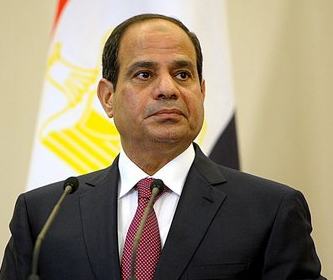
Sisi’s Brave New Egypt?

January 21, 2015

Sisi’s Brave New Egypt? Front Page Magazine, January 21, 2015

El-Sisi

Originally published by PJ Media.

Egyptian President Abdel Fattah al-Sisi continues to be the antithesis of longstanding mainstream media portrayals of him.

First there was his historic speech where he, leader of the largest Arab nation, and a Muslim, accused Islamic thinking of being the scourge of humanity—in words that no Western leader would dare utter. This remarkable speech—which some say should earn him the Nobel Peace Prize—might have fallen by the wayside had it not been posted on my website and further disseminated by PJ Media’s Roger L. Simon, Michael Ledeen, Roger Kimball, and many others, including Bruce Thornton and Robert Spencer.

Instead, MSM headlines on the day of and days after Sisi’s speech included “Egypt President Sisi urged to free al-Jazeera reporter” (BBC, Jan 1), “Egyptian gays living in fear under Sisi regime” (USA Today, Jan. 2), and “George Clooney’s wife Amal risks arrest in Egypt” (Fox News, Jan. 3).

Of course, the MSM finally did report on Sisi’s speech—everyone else seemed to know about it—but, again, to portray Sisi in a negative light. Thus, after briefly quoting the Egyptian president’s call for a “religious revolution,” the New York Times immediately adds:

Others, though, insist that the sources of the violence are alienation and resentment, not theology. They argue that the authoritarian rulers of Arab states — who have tried for decades to control Muslim teaching and the application of Islamic law — have set off a violent backlash expressed in religious ideas and language.

In other words, jihadi terror is a product of Sisi, whom the NYT habitually portrays as an oppressive autocrat—especially for his attempts to try to de-radicalize Muslim sermons and teachings (as discussed in this article).

Next, Sisi went to the St. Mark Coptic Cathedral during Christmas Eve Mass to offer Egypt’s Christian minority his congratulations and well wishing. Here again he made history as the first Egyptian president to enter a church during Christmas mass—a thing vehemently criticized by the nation’s Islamists, including the Salafi party (Islamic law bans well wishing to non-Muslims on their religious celebrations, which is why earlier presidents—Nasser, Sadat, Mubarak, and of course Morsi—never attended Christmas mass).

Accordingly, the greetings Sisi received from the hundreds of Christians present were jubilant. His address was often interrupted by applause, clapping, and cheers of “We love you!” and “hand in hand”—phrases he reciprocated. Part of his speech follows:

Egypt has brought a humanistic and civilizing message to the world for millennia and we’re here today to confirm that we are capable of doing so again. Yes, a humanistic and civilizing message should once more emanate from Egypt. This is why we mustn’t call ourselves anything other than “Egyptians.” This is what we must be—Egyptians, just Egyptians, Egyptians indeed! I just want to tell you that Allah willing, Allah willing, we shall build our nation together, accommodate each other, make room for each other, and we shall like each other—love each other, love each other in earnest, so that people may see… So let me tell you once again, Happy New Year, Happy New Year to you all, Happy New Year to all Egyptians!

Sisi stood side-by-side with Coptic Christian Pope Tawadros II—perhaps in remembrance of the fact that, when General Sisi first overthrew President Morsi and the Muslim Brotherhood, Pope Tawadros stood side-by-side with him—and paid a heavy price: the Brotherhood and its sympathizers unleashed a Kristallnacht of “reprisals” that saw 82 Christian churches in Egypt attacked, many destroyed.

It is also significant to recall where Sisi came to offer his well-wishing to the Christians: the St. Mark Cathedral—Coptic Christianity’s most sacred church which, under Muhammad Morsi was, for the first time in its history, savagely attacked, by both Islamists and the nation’s security (see pictures here).

Once again, all of this has either been ignored or underplayed by most mainstream media.

There is, of course, a reason the MSM, which apparently follows the Obama administration’s lead, has been unkind to Sisi. One will recall that, although Sisi led the largest revolution in world history—a revolution that saw tens of millions take to the streets and ubiquitous signs and banners calling on U.S. President Obama and U.S. ambassador to Egypt Anne Patterson to stop supporting terrorism (i.e., the Brotherhood)—U.S. leadership, followed by media, spoke only of a “military coup” against a “democratically elected president,” without pointing out that this president was pushing a draconian, Islamist agenda on millions who rejected it.

So what is the significance of all this—of Sisi? First, on the surface, all of this is positive. That Sisi would criticize the Muslim world and Islamic texts and thinking—in ways his Western counterparts could never—and then continue his “controversial” behavior by entering the Coptic Christian cathedral during Christmas mass to offer his greetings to Christians—a big no-no for Muslim leaders—is unprecedented. Nor can all this be merely for show. In the last attack on a Coptic church, it was two Muslim police officers guarding the church who died—not the Christian worshipers inside—a rarity.

That Sisi remains popular in Egypt also suggests that a large percentage of Egyptians approve of his behavior. Recently, for instance, after the Paris attacks, Amru Adib, host of Cairo Today, made some extremely critical comments concerning fellow Muslims/Egyptians, including by asking them “Are you, as Muslims, content with the fact that today we are all seen as terrorists by the world?… We [Egyptians] used to bring civilization to the world, today what? — We are barbarians!  Barbarians I tell you!” (More of Adib’s assertions here.)

That said, the others are still there—the Muslim Brotherhood, the Salafis, those whom we call “Islamists,” and their many sympathizers and allies.

Worst of all, they have that “corpus of [Islamic] texts and ideas” that has been “sacralized over the centuries” (to use Sisi’s own words) to support them—texts and ideas that denounce Sisi as an “apostate” deserving of death, and thus promising a continued struggle for the soul of Egypt.

Obama’s White Flag On Assad a Gift for Iran

January 21, 2015

Obama’s White Flag On Assad a Gift for Iran, Commentary Magazine, January 21, 2015

[T]he American white flag acknowledging his continued reign of terror is more than merely an admission that he can’t be pushed out of Damascus. It must now be understood as part of a comprehensive policy that is aimed at appeasing Iran. That presents a danger not only to the oppressed people of Syria but to every other nation in the region, including both moderate Arabs and Israel, who are targets of Iran’s predatory ambition.

************************

As anyone who has heard President Obama discuss his opposition to more sanctions being placed on Iran knows, the White House is deeply disturbed at the notion of the United States doing anything to disturb those who run the Islamist regime. Thus, the news that the United States is signaling what may be the formal end of its opposition to Bashar Assad’s rule over Syria must be seen in the context of a general American push for détente with that dictator’s allies in Tehran. This is bad news for the people of Syria who are seeking an alternative to Assad’s murderous rule–other, that is, than the ISIS terrorists. But it is very good news for the Iranians who are pleased about the way the rise of ISIS has led to a de facto alliance on the ground between the U.S. and Iran’s allies Assad and Hezbollah in the effort to fight ISIS. This has led not only to a tacit green light for Assad to go on killing Syrians but also for negotiations that seemed fated to grant a Western seal of approval for Iran’s aspiration to become a threshold nuclear power.

It must be acknowledged that at this point the United States has no good options open to it on Syria. If the U.S. had acted swiftly to aid moderate opponents to the Assad regime after the Arab Spring protests began, it might have been possible to topple Assad, something that would have been a telling blow to Iran’s ambitions for regional hegemony. But President Obama was characteristically unable to make a decision about what to do about it for years despite continually running his mouth about how Assad had to go. By the time he was ready to strike—after Assad crossed a “red line” enunciated by the president about his use of chemical weapons against his own people—the moderate option looked less attractive. The president quickly backed down and punted the task of cleaning up the chemical weapons to Assad’s Russian ally.

Even worse, after Obama’s precipitate withdrawal of U.S. forces from Iraq and inaction on Syria led to the rise of ISIS terrorists, Washington seemed more interested in using this crisis as an excuse to make common cause with Iran than in actually fighting the Islamist group. Thus, while U.S. air attacks on ISIS have barely made a dent in the terrorists’ grip on control of much of Syria and Iraq, the administration is signaling enthusiasm for Russian and United Nations-sponsored diplomatic events that will effectively doom a framework agreed to by the West last year in Geneva by which Assad would be forced to yield power.

The administration will defend this switch as something that will aid the effort to end a war that has killed hundreds of thousands. They also justify the tacit alliance with Iran, Assad, and Hezbollah on the Syrian battlefield as the only possible option available to those who wish to combat ISIS. At this point with non-Islamist Syrian rebels effectively marginalized and the battlefield dominated by the Iran/Hezbollah/Assad alliance and their ISIS foes, forcing Assad out may no longer be an option.

But the chain of events that led to this American move to allow Assad to survive despite his crimes must now be viewed from a different perspective than merely one of Obama’s Hamlet routine on difficult issues.

The decision to gradually back away from the president’s campaign pledge to dismantle the Iranian nuclear program and to engage in negotiations aimed at granting Tehran absolution for its ambitions will, if it results in an agreement, at best make Iran a threshold nuclear power. A weak nuclear deal will further buttress Iran’s hopes for regional hegemony by which it will further threaten moderate regimes and strengthen its Hezbollah and Hamas terrorist allies.

It’s not clear yet whether the Iranians will ever sign a nuclear agreement with the U.S. or if, instead, it will continue to run out the clock on the talks. That’s something that the president’s zeal for a deal may permit because he refuses to admit failure or pressure the Iranians as Congress would like him to do by toughening sanctions in the event the talks collapse.

But what we do know now is that this administration’s Syria policy must now be viewed through the prism of its infatuation with the idea of, as the president put it last month, letting “Iran get right with the world.”

Options for getting rid of the butcher Assad may be few these days. But the American white flag acknowledging his continued reign of terror is more than merely an admission that he can’t be pushed out of Damascus. It must now be understood as part of a comprehensive policy that is aimed at appeasing Iran. That presents a danger not only to the oppressed people of Syria but to every other nation in the region, including both moderate Arabs and Israel, who are targets of Iran’s predatory ambition.

Boehner invites Israeli PM Netanyahu to address Congress

January 21, 2015

Boehner invites Israeli PM Netanyahu to address Congress, The Washington TimesStephen Dinan, January 21, 2015

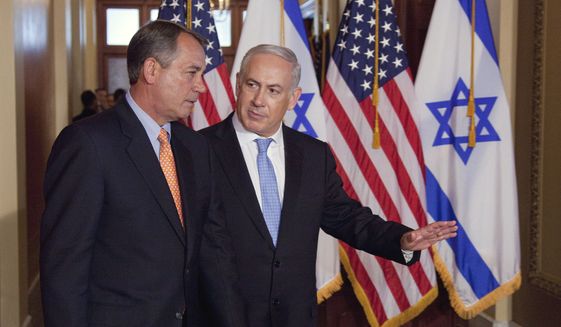
us-israel-iranjpeg-088fd_c0-0-3500-2040_s561x327FILE – In this May 24, 2011 file photo, Israeli Prime Minister Benjamin Netanyahu walks with House Speaker John Boehner of Ohio to make a statement on Capitol Hill in Washington. Boehner has invited Netanyahu to address Congress about Iran.

House Speaker John A. Boehner said Wednesday he’s invited Israeli Prime Minister Benjamin Netanyahu to speak to a joint session of Congress in February.

“In this time of challenge, I am asking the prime minister to address Congress on the grave threats radical Islam and Iran pose to our security and way of life,” Mr. Boehner said. “Americans and Israelis have always stood together in shared cause and common ideals, and now we must rise to the moment again.”

The invitation comes a day after President Obama told Congress he would veto any legislation imposing stiffer sanctions on Iran — a move that has bipartisan support on Capitol Hill, but which the president said would squelch chances for a deal to control Iran’s nuclear program, and could move closer to war.

The speech is slated for Feb. 11. Mr. Netanyahu has addressed Congress twice before, in 1996 and again in 2011.


Inside the Fight against ISIS in Iraq

January 21, 2015

Inside the Fight against ISIS in Iraq

January 21, 2015 by Victor Soehngen

via Inside the Fight against ISIS in Iraq | FrontPage Magazine.


Kurdish Brigadier General Qadir points to a plume of smoke that emerged immediately following a US airstrike on an ISIS target. Kirkuk, Iraq (Victor Soehngen).

Amongst the wheat fields of Iraq’s Fertile Crescent, the battle for the nation’s future and the safety of the Kurdistan regional capital of Erbil, continues to rage.

In this sector of the 650-mile Kurdish front Against ISIS (or its Arabic acronym- DAESH, as it is referred to locally) the fight is close quarters, intimate, and fought between relatively small groups of men. The terrain is wide, open, and grassy with features Americans would associate more with the state of Nebraska than with Iraq.

Just a few days ago this area was completely under the control of DAESH militants. They had taken over peoples homes, held local women captive for months, and implemented their own brand of Sharia Law. That just changed due to the brave actions of the Kurdish Peshmerga (with the help of closely coordinated US airstrikes) who liberated the town of Makhmour and several neighboring villages.

I met with the commander of Peshmerga forces in the area, General Najad, who candidly explained the situation from the Kurdish point of view. Holding a BA in political science and his masters in Foreign Policy, the general spoke (in English) with an air that was as much statesman as it was field commander. He was understandably busy; men under his command just retook 6 villages each with 25-30 ISIS fighters in them over the last 48 hours.

When asked if US airstrikes were helping his forces on the ground, his leathered and serious face produced a child like grin. “They have taken out their heavy weapons.” He went on to explain that DAESH has proven to be deadly accurate with artillery, armor, and mortars alike. Is that because some of its members had specialized military training or had experience from foreign armies? He simply replied, “I don’t know, no prisoners have been taken.”

Obama Not Doing Enough

When asked about whether or not he felt that President Obama was doing enough to help the Kurdish people, Najad pointed out how large and powerful America is and how (comparatively) small the fight is here. “If Mr. Obama really wanted to, DAESH could be destroyed in days,” he told me. That is a feeling I heard echoed up and down the front. One Peshmerga Sgt. told me in broken English plainly, “Bush good for Kurdistan, Obama bad,” adding a thumb up and thumb down sign to illustrate his point.

Historically, US support for the Kurds has been erratic going all the way back to the days when the Shah of Iran was Iraq’s greatest threat. The CIA worked with the Iranians at the time to arm the Kurdish rebels against the government in Baghdad, but after Iraq and Iran signed the Algiers Agreement in 1975, support ceased. To make matters worse, as the Iraqi army renewed its campaign to exterminate the (now almost defenseless) Kurds, the Shah denied them access to escape to Iran. For our part, the US under the Carter Administration did nothing to intervene. When asked about the crisis, Henry Kissinger famously quipped, “covert action should not be confused for missionary work.”

The Kurds Have Two Friends: The Mountains and the United States of America

Although temporarily soured, US-Kurdish relations would have a major turn around under the first Bush Administration. Not only did the US-led coalition blunt Saddam Hussein’s territorial ambitions, but Bush Senior also helped implement “Operation Southern Watch,” the no-fly zone that protected the Kurdish region from the feared chemical attacks for the next 12 years. This relationship was only to grow stronger when George W. Bush’s administration ordered Operation Iraqi Freedom (in which the Kurds were actively involved).

These are not things the Kurdish people have forgotten. The Bush family is spoken of more highly here than in west Texas. For the Kurds, who are literally surrounded by enemies on all sides, it is comforting to know you have a friend in the strongest military power on earth. More so than other allies, they have enthusiastically worked with US special operation units and have been strong advocates of democracy in a region not known for its free principles. Maybe because of their simple and good-hearted nature, the Kurds have always been a people who appreciate action over talk. After all the work previous administrations have done to create such a strong alliance, it would be very unwise for the current administration to use hot air and half measures to lose one of its only strong allies in the region.

The Flag of ISIS Flew Proudly in the Distance

Back on the front line, the General provided me with a military escort and allowed me to tour villages still being contested with ISIS. Aliawa, Geheba, Jewerla — these small hamlets are little know even amongst Kurds and would probably mean nothing to an American, but this is where the modern war on terror is playing out. Populated with not more than 100 people per village (mostly by wheat farmers and their families), these villages are of both a strategic importance for the Kurdistan Regional Government (KRG) and ISIS.

To begin with, they’re less than 50 miles from the regional capital of Erbil, which has served as an impromptu refugee camp for thousands of Christians, Yazidis, and other minorities seeking safety behind the Peshmerga line. Beyond that, they sit near a major crossroads between DAESH-occupied Mosul and the contested area around Kirkuk.

I first visited the village of Aliawa, where I met with Captain Ziryan and a small group of 20-25 soldiers. Theirs was the unit that just reclaimed the village — and the ISIS fighters did not leave without a fight. The captain took me to a house where two mornings prior he led a group of men in to a fierce firefight with eight militants who were lying in wait for them. Pools of blood were still damp on the floor where the Captain said he personally shot one of them who came charging down the stairs firing in either a last ditch effort at escape or suicide. Three more were killed in the house, while four others managed to escape, speeding away in a lightly armored pickup truck over the open expanse to the next ISIS-controlled village.

This is the type of combat that has come to characterize the fight against DAESH, at least along the Kurdish Front. They were able to achieve remarkable success fighting “symmetrically” at first — that is to say, using relatively conventional tactics to capture and control territory. However, as air strikes, numerical superiority, and the dogged determination of its adversaries begin to prevail against it, a serious question arises: Will we start to see ISIS begin returning to the tactics of one of its predecessors, Al Qaida?

If the fighting method DAESH has been using most recently is evidence of anything, then all signs point to yes.

When I visited the commander of the last Kurdish-controlled village before ISIS took control of the territory, buildings still smoldered in the aftermath of a US airstrike and the smell of burnt gasoline from destroyed enemy trucks lingered in the air. Colonel Shabak met me in traditional Kurdish style; sitting cross-legged on the floor and with a piping hot cup of tea waiting. When I asked him point blank what supplies he believed that America could offer him that would help most on the ground, he did not hesitate: “Military engineers to help train us against the bombs.” By that, of course, he meant specialized training in IED detection.

He told me that when DAESH first attacked, it used heavy weapons, even Abrams tanks (recently seized from an Iraqi brigade in nearby Mosul), but as American and European airstrikes have degraded its capability to utilize these weapons, the open plains of this territory have left small groups of militants defending increasingly isolated “island” villages that scatter the open countryside every few kilometers.

As the Peshmerga is “systematically” over running these positions one by one (with infantry, light armor, and air strikes), ISIS fighters are doing what the Kurdish officers are telling me they have been seeing up and down the front: They are littering roads, fields, and neighborhoods with IEDs. This has been slowing the advance of Kurdish forces and is perhaps evidence that the now highly visible ISIS might soon be shrinking in to a more shadowy, subversive role.

A role that is all too familiar for US military personnel, who spent years fighting that type of fight in the region.

The shrinking of ISIS will obviously not happen overnight. DAESH still occupies large swaths of territory, the recapturing of which will take the consolidated effort of several unlikely bedfellows. In much of the land that it occupies, there is a genuine support base amongst some of the populace, mostly old Ba’ath Party loyalists and Sunni Arabs who felt ostracized by Malaki’s government in Baghdad. In addition, the militants still have an arsenal at their disposal — an arsenal that, mind you, would put dozens of legitimate armies to shame — and they don’t appear to be giving up anytime soon.

Yet sipping tea with a Peshmerga Colonel on the front line, I couldn’t help but think that ISIS commanders, in this region at least, might just have bitten off more than they can chew.