A Sad State of Affairs: The Kerry Record, World Affairs Journal, Joshua Muravchik, November/December, 2014
(Kerry likely agrees with Obama as to his quite foreign foreign policies and, equally likely, we are stuck with both at least until Obama leaves the White House.

The most bothersome current aspects of Obama-Kerry foreign policies are the extent to which they trust Iran and how they deal with it and the P5+1 negotiating group. — DM)

Although Kerry’s anti-American ideology has moderated to some degree from his fiery days as an antiwar leader, he has misrepresented but never repudiated his past. Especially consistent has been his inclination to see the best in America’s enemies, from Madame Binh to Comandante Ortega to Bashar Assad. Israelis were shocked this summer that Kerry came up with a plan molded by Turkey and Qatar to fit the interests of Hamas at their own expense. Had they known him and his record better, they might not have been.
***************
The Gaza war of July and August 2014 occasioned the sharpest frictions in memory between the United States and Israel, highlighted by a cease-fire proposal offered by Secretary of State John Kerry that Israel’s security cabinet rejected unanimously. Kerry’s plan envisioned a seven-day cease-fire, during which the parties would negotiate “arrangements” to meet each of Hamas’s demands about the free flow of people and goods into Gaza and the payment of salaries of Hamas’s tens of thousands of employees. As for Israel’s demands about destruction of tunnels and rockets and the demilitarization of Gaza, these were not mentioned at all, except in the add-on phrase that the talks would also “address all security issues.”
The document cited the important role to be played by “the United Nations, the Arab League, the European Union, the United States, Turkey, [and] Qatar.” Conspicuous by their absence from this list were Israel, Egypt, and the Palestinian Authority. These three had also not been invited to the Paris meetings where Kerry worked on his ideas with leaders of the countries and bodies mentioned.
Barak Ravid, diplomatic correspondent for the liberal Israeli newspaper Haaretz, wrote that the proposal “might as well have been penned by Khaled Meshal [head of Hamas]. It was everything Hamas could have hoped for.” The centrist Times of Israel’s characteristically circumspect editor, David Horovitz, branded Kerry’s initiative “a betrayal.” And left-leaning author Ari Shavit commented that “Kerry ruined everything. [He] put wind in the sails of Hamas’ political leader Khaled Meshal, allowed the Hamas extremists to overcome the Hamas moderates, and gave renewed life to the weakened regional alliance of the Muslim Brotherhood.”
Turkey and Qatar are the mainstays of that alliance and were chosen by Kerry as his principal interlocutors because they are Hamas’s main backers. This brought protests from the Palestinian Authority, led by President Mahmoud Abbas’s movement, Fatah, the secularist rival to Hamas. That group declared that “whoever wants Qatar and Turkey to represent them can emigrate and go live there. Our only legitimate representative is the PLO.”
The shock of Palestinian and Israeli leaders would have been less, however, if they had been more familiar with the record of John Kerry. Spurning America’s friends in pursuit of deals with their nemeses was perfectly in character for the secretary of state. The hallmark of his career has been to denigrate America itself, while supporting the claims of its enemies.
That career began in 1969, when, months after returning from a tour of duty in Vietnam, Kerry sought and received a military discharge so that he might run for Congress. His campaign as a peace candidate sputtered, but his authenticity as a Vietnam vet established him as a presence in the burgeoning antiwar movement. In May 1970, he traveled to Paris for an unpublicized meeting with Viet Cong representatives, and, perhaps at their suggestion, he joined up upon his return with Vietnam Veterans Against the War. VVAW was headed by Al Hubbard, a former Black Panther. Kerry was instantly given a top role, twinning with Hubbard as the public face of the organization.
At a VVAW protest in Washington, DC, in April 1971, Kerry joined other veterans in throwing away their military medals in front of news cameras. The entire demonstration was punctuated by Kerry’s appearance before the Senate Foreign Relations Committee, where he offered dramatic testimony about American atrocities in Vietnam based on accounts heard at a VVAW inquest a few months earlier. He spoke of veterans who said:
They had personally raped, cut off ears, cut off heads, taped wires from portable telephones to human genitals and turned up the power, cut off limbs, blown up bodies, randomly shot at civilians, razed villages . . . poisoned food stocks, and generally ravaged the countryside.
These acts, Kerry emphasized, “were not isolated incidents but crimes committed on a day-to-day basis with the full awareness of officers at all levels of command.”
When, at the behest of aghast senators, the Naval Criminal Investigative Service conducted a formal inquiry into the stories presented at the VVAW inquest, it reported that many of the VVAW witnesses cited by Kerry refused to cooperate, although promised immunity. Others were clearly crackpots, and several swore, and provided witness corroboration, that they had not participated at the inquest at all and had no idea who had appeared in their names. The entire exercise had been inspired and largely engineered by Mark Lane, whose book on the same subject earlier that year had been panned by New York Times columnist James Reston Jr. as “a hodgepodge of hearsay,” while that paper’s book reviewer, Neil Sheehan, who had reported from Vietnam and would soon break the Pentagon Papers, revealed that some of Lane’s “witnesses” had not served in Vietnam. (The political scientist Guenter Lewy documents these events in his 1978 book America in Vietnam.)
In August 1971, four months after his Senate appearance, Kerry made another trip to Paris, to meet with Madame Nguyen Thi Binh, foreign minister of the Viet Cong, this time in full view, for his first exercise in international diplomacy. He returned touting the “peace plan” of the Viet Cong, explaining: “If the United States were to set a date for withdrawal, the prisoners of war would be returned.” Although he frequently accused American leaders of lying, he took the Communist leaders’ statements at face value, asserting that their peace plan “negates very clearly the argument of the president [Nixon] that we have to maintain a presence in Vietnam to use as a negotiating [chip] for the return of those prisoners.”
Kerry’s dismissal of the statements of US leaders as lies and his credulity toward those of the Vietnamese Communists reflected a broader difference in attitude toward the two sides to the conflict. Ho Chi Minh, who had spent long years as a henchman of Stalin’s, serving the Comintern in several countries, was in Kerry’s admiring eyes “the George Washington of Vietnam” who aimed only “to install the same provisions into the government of Vietnam” that appeared in the American Constitution. America, in contrast, had itself strayed so far from those principles that it needed a “revolution” to restore them.
Kerry’s colleagues in VVAW undoubtedly shared this sentiment, and in November 1971, at a conference of its leadership in Kansas, the group considered just how far down the path of revolution it was willing to go. It debated, although ultimately rejected, a proposal to commence a campaign of terrorist violence and assassination of pro-war US senators. When he ran for president in 2004, Kerry denied he had been present at this conclave, but when FBI files secured by the Los Angeles Times under the Freedom of Information Act placed him there, he retracted that denial in favor of the statement that he had “no personal recollection” of it.
Is this plausible? Gerald Nicosia, author of a highly sympathetic history of the antiwar movement, reported, in May 2004, that “several people at the Kansas City meeting recently said to me or to mutual friends that they had been told by the Kerry campaign not to speak about those events without permission.” Why the urgency to cover up? And how would the campaign know who was there, that is, whose silence to seek, if Kerry had no recollection of the meeting? One of Nicosia’s interviewees, John Musgrave, said “he was asked by Kerry’s veterans coordinator to ‘refresh his memory’ after he told the press Kerry was in Kansas City. Not only is Musgrave outraged that ‘they were trying to make me look like a liar,’ but he also says ‘there’s no way Kerry could have forgotten that meeting—there was too much going on.’”
This puts it mildly: the event was memorably raucous, with debates over the proposals for violence and for napalming the national Christmas tree, furious factional fighting, the discovery of eavesdropping bugs in the building leading to a quick move to another location, and above all an angry showdown between Kerry and Hubbard over revelations that the latter had never been in Vietnam. This particular contretemps was punctuated by Hubbard’s dramatically pulling down his pants to show scars he claimed he sustained in Vietnam. The mayhem culminated in Kerry’s announcing his resignation from the group’s executive. And Kerry had “no personal recollection” of being there?
Although Kerry appeared as a speaker for VVAW for about a year following this resignation, he then faded from national view for a decade, climbing the ladder of local and state politics in Massachusetts before winning election to the US Senate in 1984. The Senate, he later said, “was the right place for me in terms of . . . my passions. The issue of war and peace was on the table again.” What put it on the table were the anti-communist policies of President Ronald Reagan, which Kerry deeply opposed. A year earlier, Reagan had ordered the invasion of Grenada, which Kerry scorned as “a bully’s show of force [that] only served to heighten world tensions and further strain brittle US-Soviet and North-South relations.”
In contrast, Kerry ran on a platform of the Nuclear Freeze, a popular movement opposing US plans to counterbalance a large Soviet nuclear buildup over the previous decade. Kerry made sure to score one hundred percent on a test of candidates’ positions presented by a group called Freeze Voter ’84, and he proposed to cut the defense budget by nearly twenty percent, including “cancellation of twenty-seven weapons systems” and “reductions in eighteen other[s],” according to the Boston Globe. He cited his own work with VVAW as a counterpoint: “We were criticized when we stood up on Vietnam. . . . But we’ve been borne out. We were correct. Sometimes you just have to stand and hold your ground.”
In the Senate, he secured a coveted seat on the Foreign Affairs Committee and turned his attention to the fraught issue of policy toward Central America, a small region that had assumed inordinate geopolitical importance by becoming one of the front lines in the Cold War. A Marxist-Leninist party, the Sandinista National Liberation Front, had seized power in Nicaragua and was aiding likeminded movements in El Salvador and other nearby states while the Reagan administration supported anti-Communist guerrillas inside Nicaragua, the so-called “Contras.”
Kerry lent his name to Medical Aid for El Salvador, which gave non-lethal aid to the Communist side in that civil war. On February 16, 1982, an Associated Press story quoted actor Ed Asner, leader of a Hollywood group that raised much of the funding for this project, as explaining that “medical supplies are to be purchased in Mexico and shipped clandestinely to the Democratic Revolutionary Front in El Salvador.” However, the issue of US aid to El Salvador’s anti-Communist government became overshadowed by debate about aid to the Nicaraguan “Contras.”
As the Senate neared a decisive vote, Kerry and Senator Tom Harkin undertook a dramatic maneuver to try to head off approval of the Reagan administration’s request for Contra funding. They flew to Managua, the Nicaraguan capital, for their own summit meeting with the country’s strongman, “Comandante” Daniel Ortega. The results resembled those of his 1971 meeting with Madame Binh. Ortega handed Kerry a “peace plan” according to which the US would first end all aid to the Contras, and the Sandinistas would then initiate a cease-fire and restore civil liberties. Kerry justified undercutting the US government in this way by faulting Reagan’s failure “to create a climate of trust” with the Sandinistas. He, in contrast, offered them trust in abundance, calling Ortega’s plan “a wonderful opening.” He took to the Senate floor to say, “Here, in writing, is a guarantee of the security interest of the United States.”
A year later, in 1986, in another Senate debate on Contra aid, Kerry voiced one of the odder claims about his Vietnam experience. Warning against the slippery slope of military involvement and against the duplicity of our own government, Kerry delivered a floor speech containing this assertion:
I remember Christmas of 1968, sitting on a gunboat in Cambodia. I remember what it was like to be shot at by Vietnamese and Khmer Rouge and Cambodians, and have the president of the United States telling the American people that I was not there; the troops were not in Cambodia. I have that memory which is seared—seared—in me.
The “seared” part was a nice touch, especially in view of the fact that the whole thing had not happened (although Kerry had been repeating the story since as early as 1979). In the course of Kerry’s 2004 presidential campaign, the Swift Boat Veterans for Truth, former crewmen on the type of vessel on which Kerry served who were angered by his antiwar activities, attacked this claim among other aspects of Kerry’s military history. In this case, however, unlike in response to some points raised by Kerry’s detractors, no shipmate of Kerry’s could be found to corroborate his version. Soon, his spokesmen began to hedge. One aide explained that Kerry’s boat had been “between” Vietnam and Cambodia. But the two countries are contiguous: there is no “between,” so another spokesman backed down further, explaining that Kerry had merely been “near” Cambodia.
Then, Douglas Brinkley, who authored a laudatory history of Kerry’s military service, issued another explanation, apparently at the behest of the campaign. On Christmas 1968, the moment of Kerry’s “seared” memory, he was fifty miles from Cambodia, said Brinkley, but his boat “went into Cambodia waters three or four times in January and February 1969.” Oddly, however, Brinkley’s book, which covered those two months in painstaking detail at a length of nearly one hundred pages, even to the extent of locating the sites of battles, made no mention of Kerry’s having crossed into Cambodia. And the campaign soon pulled the rug from under Brinkley by issuing a new claim, namely, that Kerry’s boat had “on one occasion crossed into Cambodia.” Three of Kerry’s shipmates, two of whom were supporting his campaign, categorically denied even this minimized claim.
In that, they are supported by no less a source than Kerry himself, in the form of a journal he kept while on duty. Substantial passages of it are reproduced in Brinkley’s book, and one of them reads:
The banks of the [Rach Giang Thanh River] whistled by as we churned out mile after mile at full speed. On my left were occasional open fields that allowed us a clear view into Cambodia. At some points, the border was only fifty yards away and it then would meander out to several hundred or even as much as a thousand yards away, always making one wonder what lay on the other side.
He was never to learn the answer because this diary entry was from his final mission.
Kerry was of course right to link Central America to Southeast Asia. They were both nodes in the Cold War, the epic struggle that defined international politics for forty years, including the first two decades of Kerry’s political engagement, from the time he returned from Vietnam in 1969 until the Berlin Wall came down in 1989. Whatever the rights and wrongs of America’s entry into Vietnam, or its actions in Central America or elsewhere, Kerry perverted the basic issue of the Cold War, always viewing America’s actions as bellicose and malign, while casting those of the Communists, like “George Washington” Ho Chi Minh, in the most favorable light.
To many, the Cold War’s benign denouement—the fall of the Wall and the USSR’s disappearance into the ash bin of history—vindicated Reagan’s approach, but Kerry appears to have entertained no second thoughts despite these outcomes. When it came to addressing post–Cold War issues, he remained reflexively averse to the exercise of American power. Kerry had lamented as “not proportional” Reagan’s 1986 bombing of Libyan dictator Muammar el-Qaddafi’s residence in response to a Libyan terror attack on US servicemen in Germany. The Middle East was also the scene of the first military showdown after the Cold War, when Saddam Hussein’s Iraq swallowed whole the neighboring state of Kuwait, in 1990. At the time, Kerry opposed the Bush administration’s request for authorization of military action, saying that those “of the Vietnam generation . . . come to this debate with a measure of distrust [and] a resolve . . . not [to be] misled again.” He concluded his Senate speech by reading a passage from an antiwar novel by the American Communist Dalton Trumbo.
With the Cold War’s end, and America’s demonstration of will and strength in driving Hussein’s forces from Kuwait, the defining issue of the 1990s became the wars of Yugoslavia’s dissolution. Here, the prime issue was whether or not to lift an international arms embargo that rendered Bosnia’s Muslims naked before their predators, the well-armed Serbs. As public opinion reacted to news accounts of the grisly results of this imbalance, the Senate voted to lift the embargo, over the objections of Kerry, who helped to lead the opposition.
With the terrorist attacks of September 11, 2001, the American public was awakened from its post–Cold War indifference toward foreign affairs. A fierce patriotism burst forth, and with it a determination to take down those who had attacked us. Thus, preparing for a 2004 presidential bid, Kerry moved to reconfigure his image. The antiwar veteran was suddenly replaced by the military hero, and the Democratic nominating convention was replete with uniforms and military gestures, highlighted by Kerry’s sharp salute to the assemblage while uttering the words, “reporting for duty.” Already, his rejected service medals had miraculously reappeared mounted and framed on his Senate office wall. Asked how that was possible, as he had been photographed throwing them away, Kerry explained that the medals he tossed were not his own but actually belonged to another veteran.
The dramatic reincarnation did not quite come off, as Kerry was dogged by Vietnam veterans, led by fellow Swift Boat crewmen, still furious at how he had blackened their names. And the awkwardness of his transformation was symbolized by his much-ridiculed explanation of his stance on funding the 2003 US invasion of Iraq: “I actually did vote for the $87 billion before I voted against it.”
In his later years in the Senate, Kerry made the issue of Syria his own. He took several trips to Damascus where, according to a June 2011 account in the Wall Street Journal, he “established something approaching a friendship with [Syrian dictator Bashar] Assad.” When Barack Obama came to office, he made Kerry his point man in efforts to improve US-Syrian relations. Kerry put his endorsement on diplomatic proposals he received in Damascus, including an offer by Assad to engineer a Palestinian unity government embracing Fatah and Hamas. The benefits to the US, not to mention Israel, of such unity were not self-evident, but in any event, talks between the two Palestinian factions were already under way, mediated by Egypt, which was closer to Fatah. Why it would be advantageous to switch the sponsorship to Syria, the ally of Hamas, was hard to grasp. Nonetheless, Kerry saw in Assad’s proposal the prospect of “a major step forward in terms of how you reignite discussions for the two-state solution . . . . Syria indicated to me a willingness to be helpful in that respect.” In all, as the Journal put it, “Kerry . . . became . . . Assad’s champion in the US, urging lawmakers and policymakers to embrace the Syrian leader as a partner in stabilizing the Mideast.”
In sum, although Kerry’s anti-American ideology has moderated to some degree from his fiery days as an antiwar leader, he has misrepresented but never repudiated his past. Especially consistent has been his inclination to see the best in America’s enemies, from Madame Binh to Comandante Ortega to Bashar Assad. Israelis were shocked this summer that Kerry came up with a plan molded by Turkey and Qatar to fit the interests of Hamas at their own expense. Had they known him and his record better, they might not have been.
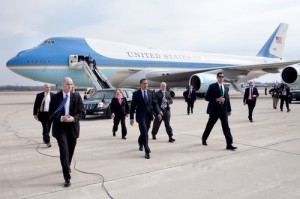 President Barack Obama arrives at Port Columbus International Airport. Photo: White House.







 anneinpt
 artaxes
 danmillerinpanama
 davidking1530
 Peter Hofman
 Joseph Wouk
 Peter
Peter Louisiana Steve
 WarSclerotic
Recent Comments