Archive for December 10, 2014

Arab Culture & the Arab-Israeli Conflict

December 10, 2014

Arab Culture & the Arab-Israeli Conflict, Front Page Magazine, December 10, 2014

ac-450x337

For the Arabs, the Israelis are the ‘others’, suspected of manipulation and treachery, and a permanent adversary and enemy, as taught in the Arabic Koran.

It is essential to unlock the Arab culture code, and cease viewing the Middle East through a Western prism that leads only to delusion, disdain, and a host of ill-consequences and dashed hopes.

****************

The multi-faceted essence of the Arab-Israeli conflict and Israeli-Palestinian war is territorialpolitical, ideological, and religious – a convulsive confrontation between the mutually exclusive claims of Judaism and Islam.

But a fifth dimension of the conflict is culture – popular culture – embodied in a code of identity that differentiates one human community from another.

Culture is not negotiable or alterable: it is the texture of the life people live, and the local rhythm of things they know from their earliest memories. It is an inbred code of behavior and, as for all peoples, precedes and precludes morality, thought, and judgment.

The reason why the cultural component of the conflict is ignored stems from the fact that in order to appreciate a culture, you basically have to know it from the inside; and outsiders, non-Arabs, are ignorant of Arab culture, and haughtily assume that it has no value.

Add to this obstacle the fact that a native always behaves differently when he is with a foreigner than with a fellow-native. Surface-like conversations between people from different cultures can reveal very little. To call the Arabs rhetorically flexible is a kind way to infer their masterful command of deception.

It is Arab culture in particular, atavistic and organic, encased in the old binding from its historical origin, which must be addressed in order to better explore the intractability of the long Arab-Israeli rivalry

1

Arab culture is a family-clan-national social reality. An Arab owes absolute and blind loyalty to the group of his birth. He belongs to family and village, as a Bedouin belongs to his tribe. You can’t change your tribe, and you don’t change your family; and no other social framework demands more adhesion than blood relations. It follows from this premise that the Arab mistrusts outsiders. For the Arabs, the Israelis are the ‘others’, suspected of manipulation and treachery, and a permanent adversary and enemy, as taught in the Arabic Koran.

2

For the Arabs, language reflects culture in a way that prevents it being a vehicle for direct and clear communication. Words are used to impress, deflect intentions, disarm interlocutors, confuse listeners, and offer promises never to be fulfilled. The cultural subtext in discussions and negotiations with Arabs is often garnished in polite commitments and even written agreements. But there is little conviction to adhere to the summary accord because the culture code calls for gingerly saying what the other wants to hear; then agreeing to an appointment never to be kept, or promising a phone call that will never come. The Israelis were enthused that the Palestinians moved toward peace in the Oslo Accord, but it was followed by blood and murder, not reconciliation and brotherhood.

3

For the Arabs, the past defines the present because history is the anchor for all aspects of identity and aspirations. There is a mythological fascination with ancestors – as for the contemporary Salifiyyamovement – combined with an axiomatic belief that sees the future as necessarily emerging from and even repeating the glorious Arab past. This contributes to an iron-will and patience until victory is assured. For the Arabs – Israel beware forget any perceived ill act against them. The early Islamic days of conquest and caliphate will be renewed, even if the shift in power takes forever.

4

Arab self-consciousness, spared any identity crisis, provides a psychological foundation for imposing the collective will upon others. To be a Muslim and an Arab, as Allah’s chosen people, launches the Arab on a path of self-justification, whose flip-side is to blame the non-Arabs for all Arab misfortunes and failures. Israel is always excoriated for crimes of aggression and violence. The composed Arab never doubts that justice is on his side: he can do no wrong. Thus, all the Arab-Israeli wars since 1948 are blamed on Israel. Considering that self-criticism is an ancient Jewish practice, Arab self-justification creates an imbalanced ethical equation that demoralizes the Jews while radicalizing the Arabs. In short, the Arabs seek victory, not peace.

5

Islamic truth claims, as in Koranic deviations from Biblical narratives, do not require proof or evidence, or even common sense validity. The Arabs are not perturbed by the lack of facts; their discourse is internal and self-enclosed, as reality is in their mind and not in the external objective world. The Arab mind-set inhabits a world of entrenched fantasy or diabolical conspiracy theories. Note the revelatory comment by Anwar Sadat that ‘all life is play-acting’. He was one to know. In 1993 Arafat demonstrated his theatrical adeptness at the Oslo signing ceremony at the White House.

*

It is essential to unlock the Arab culture code, and cease viewing the Middle East through a Western prism that leads only to delusion, disdain, and a host of ill-consequences and dashed hopes.
Non-intervention with a wink

December 10, 2014

Non-intervention with a wink, Israel Hayom, Prof. Abraham Ben-Zvi, December 10, 2014

[T]he president has also indicated, with extra emphasis, that he intends to play an especially active foreign policy role, even in the twilight of his presidency, and will seek to forge a new diplomatic horizon on the Palestinian front after Israel holds its elections.

*********************

Despite unequivocal promises issued publicly by the U.S. administration just a few days ago, to refrain from intervening in the Israeli general elections campaign, it appeared the dam had already been breached on Tuesday during a speech at Bar-Ilan University by U.S. Ambassador to Israel Dan Shapiro.

Even though the message he delivered underwent a few cosmetic tweaks and was embedded in rhetoric of pleasantries and appeasement, the cellophane packaging and pastel colors were unable to blur the fundamental underlying significance. Indeed, underneath the heartwarming coating the ambassador time-traveled backward, straight to the beginning of the Obama era, a time when all the president’s men emphasized their belief in the linkage between diplomatic progress in the Israeli-Palestinian arena to the American superpower’s general array of diplomatic and strategic goals in the region.

And while the Arab spring shattered this conception on the jagged rocks of reality, the president has reverted — through his ambassador to Israel — to championing this idea; and at a politically sensitive time no less.

In essence, Obama is expanding and empowering the linkage principle, and is doing so while formulating an equation in which he has positioned the improvement of America’s status and clout as a superpower as a derivative of Israeli policies, and the extent to which those take into account American interests and goals, as opposed to strictly reflecting Israel’s immediate security needs and constraints.

By doing so the president has also indicated, with extra emphasis, that he intends to play an especially active foreign policy role, even in the twilight of his presidency, and will seek to forge a new diplomatic horizon on the Palestinian front after Israel holds its elections.

The goal of this message is obvious — the administration is looking squarely toward March 17 (the date of Israeli elections), and is clearly signaling that the political conditions it wants created as a result will ensure the continuation of the American-Israeli alliance with all the benefits and support associated with it.

From this perspective, the carrot of benefits is being waved alongside the whip of warnings and threats, functioning as a type of “guide for the Israeli voter,” who values this partnership with the American patron. This was indeed the opening salvo of the administration’s interventionism in the current political campaign.

ISIS posts a new forward command group to Egyptian Sinai – at Israel’s back door

December 10, 2014

ISIS posts a new forward command group to Egyptian Sinai – at Israel’s back door, DEBKAfile, December 10, 2014

Abu_Bakr_al-Baghdadi_speaks_at_a_mosque_in_Mosul_2014Abu Bakr al-Baghdadi speaking at a mosque in Mosul

On arrival in Sinai, Islamic State commanders announced their movement’s mission had been overhauled and redirected from Egypt alone to the “Egyptian-Zionist alliance.”

******************

A group of at least ten ISIS operations and intelligence officers, led by a senior commander, has arrived in Sinai and taken charge of the local Ansar Beit al-Maqdas jihadis, thereby opening up a dangerous new front against Egypt and Israel, in proximity to the Suez Canal, the Gaza Strip and the West Bank, DEBKAfile’s exclusive counter-terror sources report.

Their identities are not known, but their relocation from Iraq to the Egyptian peninsula was carefully arranged. They came posing as tourists coming for a holiday at the Sinai resort of Sharm el-Sheikh, arriving on charter flights from Middle East and European locations on fake passports. This enabled them to evade the strict security checks at Cairo international airport.

By assuming command of the local Ansar Beit al-Maqdas terrorist group, which last month pledged allegiance to the Islamic State, Abu Bakr al-Baghdadi has moved to add Sinai as a new province to the caliphate he established in parts of Iraq and Syria.

In recent weeks, our counter-terror sources reveal, Islamic State tacticians have provided the Sinai outfit in with a strategic reserve by posting 300 combatants from Iraq to eastern Libya. This group also supplies the Egyptian contingent with arms.

Egypt therefore finds itself encircled by IS forces on its western border from Libya and deeply threatened from the northeast in Sinai; whereas Israel faces the same jihadi menace in the southwest from Sinai and in the north from Syria.

On arrival in Sinai, Islamic State commanders announced their movement’s mission had been overhauled and redirected from Egypt alone to the “Egyptian-Zionist alliance.”

One of their first tasks will be to counteract recent Egyptian military successes in broadening their penetration of the peninsula’s Bedouin tribes and so inflicting heavy losses on Ansar Beit al Maqdas.

Israel finds itself outflanked by the new IS deployment in Sinai. The IDF heavily built up its northern strength to meet any Al Qaeda menace from Syria to the Golan, creating the Bashan Division to fight off jihadist incursions. In the event, the IS’s Syrian units have given the Israeli border a wide berth and are focusing on fighting in northern and eastern Syria.

And so, while preparing to tackle Islamist encroachment from the north, Israel finds them cropping up along its southern border, where no comparable military buildup is in place.

Abu Bakr’s Sinai move contradicts the claims of senior US commanders that IS is on the run in Iraq after being badly hurt by US and coalition air strikes. (Last week there were no more than 31 air raids over Iraq and 15 in Syria.) All that the light US-led air campaign has achieved so far is to induce the Islamic State’s leaders to shift ground tactically from territorial expansion to defense and entrenchment.

SecDef Nominee Says Iranian Nukes ‘Most Significant Strategic Threat’

December 10, 2014

SecDef Nominee Says Iranian Nukes ‘Most Significant Strategic Threat,’ Washington Free Beacon, December 10, 2014

(If Mr. Carter fails to change his views on Iran, or at least stop talking about them, how long will he last as Obama’s Secretary of Defense? — DM)

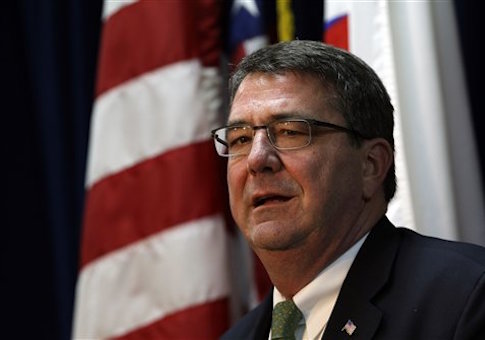
Ashton CarterAshton Carter / AP

President Barack Obama’s nominee for secretary of defense Ashton Carter has a very strong position on nuclear non-proliferation issues, the Tower reports.

Some of those positions stand in contrast with those of the Obama administration.

Politico on Tuesday described him as a “leading member of a clique of defense intellectuals long concerned with the possibility of a nuclear terrorist attack” and suggested he “could be more consequential when it comes to Obama’s plans for dealing with Iran’s nuclear program.”

Two months before President Obama’s 2008 election, Carter argued, in a paper coauthored with diplomatic heavyweights including former Special Middle East Coordinator Dennis Ross and Nonproliferation Policy Education Center Executive Director Henry Sokolski, that “Iran’s nuclear development may pose the most significant strategic threat to the United States during the next Administration.” The Times of Israel covered Carter’s nomination, noting that he was a “vocal proponent of stronger action to stymie nuclear proliferation.” Carter had visited the Jewish state in 2013, and was quoted as telling a group of Israeli soldiers that “protecting America means protecting Israel, and that’s why we’re here in the first place.”

The Jerusalem Post reported on Friday that as part of the Pentagon’s Defense Advisory Acquisition Group, Carter played an “instrumental” role in the transfer of F-35 fighter jets from the U.S. to Israel. Israel recently placed a preliminary order to purchase 25 more of the state of the art fighters. Speaking Friday to reporters at the State Department press briefing about U.S.-Israel ties, Deputy Spokesperson Marie Harf reaffirmed the closeness of the relationship, calling ties between the countries “incredibly close, essential” and “unshakable” and noting that it is “arguably the closest military-to-military relationship” the countries have ever had.

Implications of Iranian Cheating at Arak

December 10, 2014

Implications of Iranian Cheating at Arak, Commentary Magazine, December 10, 2014

[T]he State Department never conducts lessons-learned exercises to determine why previous episodes of diplomacy have failed.

Kerry is like a gambler who has lost everything, but figures if only he is given one more round at the craps table, he can win big. American national security, however, is nothing with which to gamble. Especially when a gambler is desperate, the house will always win. In this case, however, the house is not Washington, but rather Tehran.

**********

As Jonathan Tobin notes, Colum Lynch’s Foreign Policy bombshell report about Iran’s covert efforts to buy equipment for its Arak plant, a facility which could produce plutonium for a nuclear bomb, raises questions about the logic of the Obama administration, and the recent comments by both Vice President Joe Biden and Secretary of State John Kerry with regard to the wisdom of extending nuclear talks with Iran.

If Lynch’s report is true—and it appears very much to be so—then there are two possibilities as to what happened vis-à-vis American diplomacy. The first is that Iranian diplomats were always insincere in pursuit of a nuclear resolution, and lied outright to Kerry, Undersecretary Wendy Sherman, Clinton, Biden-aide Jake Sullivan, and other officials who have championed the drive for nuclear talks with the current Iranian administration. That possibility is troubling enough, but the second scenario is as troubling, and that is that Iranian diplomats were perfectly sincere, but that the regime simply couldn’t care less what its diplomats said and pursued its own goals irrespective of any commitments they made.

A key theme of my recent book exploring the history of U.S. diplomacy with rogue regimes (of which Iran is the marquee example) is that the State Department never conducts lessons-learned exercises to determine why previous episodes of diplomacy have failed. One example they might consider is the pre-Iraq War negotiations with Iran: Immediately prior to the U.S.-led invasion of Iraq, National Security Council official Zalmay Khalilzad along with Ambassador Ryan Crocker met with Mohammad Javad Zarif, Iran’s UN ambassador (and its current foreign minister) in secret talks in Geneva. Almost simultaneously, British Foreign Secretary Jack Straw met with Iranian Foreign Minister Kamal Kharrazi. Both talks solicited the same Iranian pledge: Iranian officials would not interfere with coalition forces in Iraq, and Iran would not insert its own personnel or militias into Iraq.

In hindsight, the Iranians there, too, lied. Soon after Saddam’s fall, the Islamic Revolutionary Guard Corps (IRGC) infiltrated 2,000 fighters, militiamen, and Qods Force personnel into Iraq replete with radio transmitters, money, pamphlets, and supplies. The source for that statement? Iranian journalists. Those most enthusiastic for rapprochement, however, are now placing their hopes in the same Mr. Zarif, the man who a decade ago either lied shamelessly or bluffed about the power he did have to control the behavior of the IRGC and influence the supreme leader. Then again, there is a reason why, before he became vice president, Joe Biden was Tehran’s favorite senator.

Kerry is like a gambler who has lost everything, but figures if only he is given one more round at the craps table, he can win big. American national security, however, is nothing with which to gamble. Especially when a gambler is desperate, the house will always win. In this case, however, the house is not Washington, but rather Tehran.

Iran Launches ‘We Love Fighting Israel’ Campaign

December 10, 2014

Iran Launches ‘We Love Fighting Israel’ Campaign, Washington Free Beacon, ,December 10, 2014

(But the humanitarian, peace-loving Islamic Republic of Iran, where sanity, good will toward all and freedom flourish, needs nukes to take its rightful place in our multicultural International Community. Right? — DM)

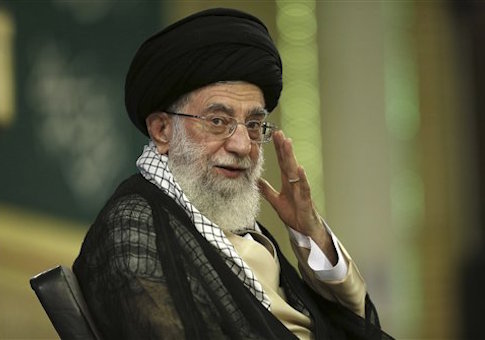
Ali KhameneiAli Khamenei / AP

The Iranian regime has launched a nationwide social media campaign called, “We Love Fighting Israel,” which encourages Iranian children, teens, and Internet users to photograph themselves alongside messages of hate for the Jewish state.

The movement has sprouted online in the last few days across social media sites such as Twitter, Instagram, and other platforms as a result of a recent call by Iranian Supreme Leader Ayatollah Ali Khamenei rallying the nation to take on Israel.

The campaign drew outrage from opponents of Iran’s hardline regime and calls for sites such as Instagram to shut it down for violating policies against hate speech.

Thousands of Iranians are reported to have already joined the electronic movement following comments by Khamenei’s outlining Iran’s goal of destroying the Jewish state.

“Our people love fighting against the Zionists and the Islamic Republic has proved this as well,” Khamenei was quoted as saying in a recent speech by the country’s state-run media. “By Allah’s Favor and Grace, we have passed through the barrier of denominational discord.”

These remarks inspired Iranian social media users to take to the Internet and launch the “We Love Fighting Israel” movement. The campaign even has spawned its own hashtag on Twitter, “#FightingtheZionists.”

The anti-Israel campaign now “has gone viral on the web,” according to Iran’s state-controlled Mehr News Agency, “getting more and more boost from individuals who post photos reading similar sentences, [and] sharing the #Fightingthezionists hash tag.”

More than 300 pictures have already been posted to an Instagram account titled, “FightingTheZionists.” The account, which had some 3,000 followers as of Tuesday evening, links to Khamenei’s personal Instagram account.

Users post pictures with messages declaring, “We love fighting against Israel,” “I love to fight Israel,” “We are lovers of fighting Israel,” and “I love fighting against Zionists,” among other similar messages.

One picture in particular has caught the eye of Iran critics on the web and prompted a harsh response to the anti-Israel campaign.

The photo shows a young child decked out in military gear and holding a sign that translates from Farsi as, “I love fighting against Zionists.”

Captioned alongside the photo is an English language message that reads: “Our people love fighting against the Zionists and the Islamic Republic has proved this as well, Ayatollah Khamenei.”

[Please see Washington Free Beacon article for a photo which I can’t reproduce here. Many other photos are available here. — DM]

It is not the only photo to depict young children as participating in the campaign to fight Israel.

The photos posted on the Instagram page depict “several groups of people including war veterans, students, journalists, and people from all walks of life joining the campaign,” according to Mehr News.

The American nonprofit group United Against Nuclear Iran (UANI), which works to prevent Tehran from obtaining a nuclear weapon, expressed disgust at the campaign on its Twitter account.

UANI lashed out at the Iranian regime for promoting “vile hate” and the “indoctrination of hate children.”

Additionally, Matan Shamir, UANI’s director of research, called on social media sites to immediately take steps to remove the Iranian campaign.

“The Iranian regime’s brazen exploitation and indoctrination of innocent children to hate and commit violence is utterly deplorable,” Shamir said. “Instagram and its parent company Facebook must enforce their own guidelines prohibiting hate speech and incitement to violence, and remove such propaganda immediately.”

Shamir went on to criticize Iran for its own domestic human rights abuses, such as preventing average citizens from accessing the Internet.

“It is intolerable that while the regime blocks its own citizens from accessing many popular social media platforms, it uses them to advance its own crude and hateful ideology,” he said.

Poll: Most Palestinian Arabs Support Recent Terror Wave

December 10, 2014

Poll: Most Palestinian Arabs Support Recent Terror Wave, Israel National News, Ben Ariel, December 10, 2014

The poll found 86 percent of respondents believe the Al-Aqsa mosque is in “grave danger” from Israel. It said 80 percent supported individual attacks by Arabs who have stabbed Israelis or rammed cars into crowded train stations.

****************

An overwhelming majority of Palestinian Arabs support the recent spate of terrorist attacks against Israelis, an opinion poll released Tuesday finds, according to The Associated Press (AP).

The poll also found that more than half of Palestinian Arabs support a new “intifada” (uprising) against Israel, and that Hamas would win presidential elections if they were held today.

Palestinian Arab pollster Khalil Shikaki said the results reflected anger over Israeli statements about Jerusalem, as well as a loss of hope following the collapse of U.S.-brokered peace talks and Israel’s recent war with Hamas in Gaza.

Shikaki heads the Palestinian Center for Policy and Survey Research, which interviewed 1,270 people in the Palestinian Authority-assigned areas of Judea and Samaria and Gaza last week. The poll had an error margin of 3 percentage points.

“There is an environment in which violence is becoming a dominant issue,” Shikaki told AP. “This seems to be one of the most important driving forces.”

There has been a spate of attacks in Jerusalem over the past month and a half, at a time of rising tensions over the Temple Mount. The wave of attacks has come to be known as the “silent intifada”.

The poll found 86 percent of respondents believe the Al-Aqsa mosque is in “grave danger” from Israel. It said 80 percent supported individual attacks by Arabs who have stabbed Israelis or rammed cars into crowded train stations.

Islamists have been regularly clashing with Israeli police on the Temple Mount and escalated a campaign of harassment against Jewish visitors, who are already under severe restrictions due to Muslim pressure. The violence reached a peak with the recent attempted murder of prominent Jewish Temple Mount activist Yehuda Glick.

Palestinian Authority (PA) Chairman Mahmoud Abbas has blamed Israelfor the ongoing tensions in Jerusalem.

Israel air strikes wiped out Russian hardware for thwarting US no-fly zone plan over Syria

December 10, 2014

Israel air strikes wiped out Russian hardware for thwarting US no-fly zone plan over Syria, DEBKAfile, December 8, 2014

Israeli_jets_of_bombing_two_installations_inside_Syria7.12.14Israel jets bombing Syrian targets

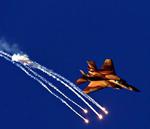
High-ranking American military sources revealed Monday, Dec. 8, that Israel’s air strikes near Damascus the day before wiped out newly-arrived Russian hardware including missiles that were dispatched post haste to help Syria and Hizballah frustrate a US plan for a no-fly zone over northern Syria.

The advanced weapons were sent over, as DEBKAfile reported exclusively Sunday, after Russian President Vladimir Putin learned that the Obama administration and the Erdogan government were close to a final draft on a joint effort to activate a no-fly zone that would bar Syrian air force traffic over northern Syria.

The Kremlin has repeatedly warned – of late in strong messages through back channels – that the establishment of a no-fly or buffer zone in any part of Syria would be treated as direct American intervention in the Syria war and result in Russian military intervention for defending the Assad regime.

According to the US-Turkish draft, American warplanes would be allowed to take off from the Turkish airbase of Incirlik in the south for operations against Syrian warplanes, assault helicopters or drones entering the no-go zone. Thus far, Ankara has only permitted US surveillance aircraft and drones the use of Incirlik for tracking the movements of Islamic State fighters in northern Syria.

The Obama administration was long deterred from implementing a no-fly zone plan by the wish to avoid riling Moscow or facing the hazards of Syria’s world-class air defense system.

But Washington was recently won over to the plan by a tacit deal with Damascus for American jets to be allowed entry to help Kurdish fighters defend their northern Syrian enclave of Kobani against capture by al Qaeda’s IS invaders.

However, the US administration turned down a Turkish demand to extend the no-fly zone from their border as far as Aleppo, Syria’s largest city, over which Syrian army forces are battling rebels and advancing slowly into the town.

The no-fly zone planned by US strategists would be narrow – between a kilometer and half a kilometer deep inside Syria. However Moscow is standing fast against any such plan and objects to US planes making free of Syrian airspace, a freedom they are now afforded over Kobani.

To drive this point home, the Russians delivered a supply of advanced anti-air missiles and radar, whose use by the Syrian army and transfer to Hizballah in Lebanon were thwarted by the Israeli air strikes Sunday.

Moscow reacted swiftly and angrily with a Note to the United Nations Monday accusing Israel of “aggressive action” and demanding “that such attacks should not happen again… Moscow is deeply worried by this dangerous development, the circumstances of which demand an explanation.”

The Assad regime has held back from reacting to past Israeli air raids for preventing advanced weaponry from reaching Hizballah. This time, spokesmen in Damascus warned that their government’s response would be clandestine and cause Israel “unimaginable harm.”