Archive for December 6, 2014

In Iraq, Regionalism Another Casualty of Islamic State

December 6, 2014

In Iraq, Regionalism Another Casualty of Islamic State, World Politics Review, December 5, 2014
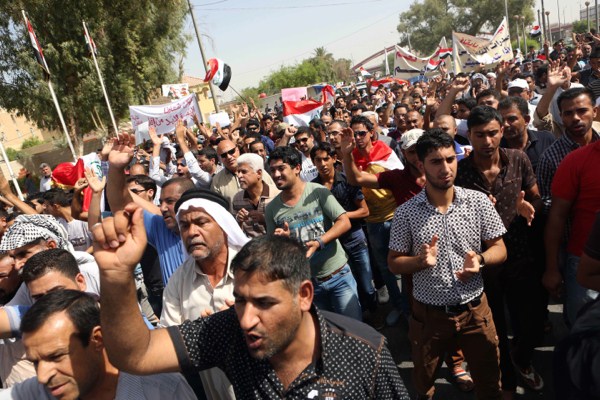
l_iraq_basra_12052014Residents chant slogans supporting the creation of Basra region, in front of the Basra provincial headquarters, Basra, Iraq, Sept. 27, 2014 (AP photo by Nabil al-Jurani)

As for regional governments, there will be no more of them. Iraqi Kurdistan will become independent at some point; it is a matter of when rather than if. The Sunni autonomy effort is dead, and the Shiite establishment will use all means fair and foul to ensure Basra is never autonomous. Right now the Sumer movement is mostly an Internet phenomenon without a mass street following, but were it to take off, it would destroy the state, not create an autonomous region.
*****************

The Iraqi government agreed Tuesday to a long-term oil wealth sharing deal with the Kurdistan Regional Government (KRG). In an email interview, Kirk Sowell, a political risk analyst who is the publisher of the biweekly newsletter Inside Iraqi Politics, discussed regionalism in Iraq.

WPR: What are the main non-Kurdish regional movements (i.e., potential autonomous regions) in Iraq, and what grievances are driving their regional aspirations?

Kirk Sowell: There are three. The first, chronologically speaking, is what might be called the “southernist tendency,” which has existed in two variants. One focused on Basra province, and another on combining Basra with the other southern oil producers, Maysan and Dhi Qar provinces. These were driven by a feeling of material deprivation, despite the wealth these provinces produce. The second is the Sunni Arab autonomy movement, driven by the abuses of former Prime Minister Nouri al-Maliki’s government, in particular illegal arrests. It started in Salah al-Din and Diyala provinces in late 2011 and made a second push through the Sunni protest movement of 2013. The third, newer tendency might be called “Sumerism,” and is essentially a Shiite effort to break the south and the center away from the Sunni Arabs and just have a state from the city of Samarra southward.

WPR: How have these movements been affected by the rise of the Islamic State, the post-Maliki political shifts in Baghdad and the oil revenue-sharing deal with the KRG?

Sowell: The southernist tendency has never really gotten off the ground. Referenda efforts have failed. The main party pushing it, the Islamist Fadhila, has lost seats, and its main secular proponent, Wael Abd al-Latif, failed to win a seat in Basra in the last election. The Sunni autonomy movement has essentially been destroyed by the jihadists’ dominance of more nationalist Sunni movements, and their leaders are now just trying to get more decentralized local control without full autonomy. The “Sumer” movement, on the other hand, was basically created by the jihadists’ unexpected success; its backers have lost patience with Sunni uprisings of any kind.

As for the potential Baghdad-Irbil oil deal, which is rather vague at points and will not be final until and unless it is passed into law, it is just a holdover deal until the Kurds are ready to declare independence. If it succeeds, the Kurds will have less need to rush that process, but it will not last forever.

WPR: What role can provincial and regional governments play in addressing Iraq’s challenges, including sectarianism, security and governance in general?

Sowell: Provincial governments could potentially play a role in improving governance, but their lack of independent revenue sources makes them dependent on Baghdad’s willingness to let them take control of service functions. So far a mixture of deliberate suppression and bureaucratic paralysis has frozen efforts at localization. Even where enshrined in statute, such as governors’ control over local security, Baghdad has held a firm grip, and it is unclear whether Prime Minister Hayder al-Abadi’s rhetorical support for a stronger provincial role will mean anything.

As for regional governments, there will be no more of them. Iraqi Kurdistan will become independent at some point; it is a matter of when rather than if. The Sunni autonomy effort is dead, and the Shiite establishment will use all means fair and foul to ensure Basra is never autonomous. Right now the Sumer movement is mostly an Internet phenomenon without a mass street following, but were it to take off, it would destroy the state, not create an autonomous region.

Netanyahu’s epic understandings with Egyptian, Saudi and UAE rulers – a potential campaign weapon

December 6, 2014

Netanyahu’s epic understandings with Egyptian, Saudi and UAE rulers – a potential campaign weapon, DEBKAfile, December 6, 2014

Abdullah-al_sisiEgyptian and Saudi rulers take charge of Arab affairs

Netanyahu may or may not opt to brandish Israel’s diplomatic breakthrough to the Arab world as campaign fodder to boost his run for re-election.  Whatever he decides, the rulers of Saudi Arabia, the Arab emirates and Egypt are turning out to have acquired an interest in maintaining him in office as head of the Israeli government, in direct opposition to President Obama’s ambition to unseat him.

******************

The six Gulf Cooperation Council (GCC) rulers meet in the Qatari capital of Doha next week amid high suspense across the Arab world. Its agenda is topped by moves to finally unravel the 2010 Arab Spring policy championed by US President Barack Obama, moves that also bear the imprint of extensive cooperation maintained on the quiet between Israel and key Arab rulers.

DEBKAfile reports that the Doha parley is designed to restore Egypt under the rule of President Abdel Fatteh El-Sisi to the lead role it occupied before the decline of Hosni Mubarak. Another is to root out the Muslim Brotherhood by inducing their champion, the young Qatari ruler, Emir Tamim bin Hamad Al Thani, to drop his government’s support.

At talks taking place in Riyadh ahead of the summit, Qatari officials appeared ready to discontinue the flow of weapons, funds and intelligence maintained since 2011 to the Brothers and their affiliates across the Arab world (Libya, Egypt, Syria, Jordan and Hamas-ruled Gaza), as well shutting down the El Jazeera TV network – or at least stopping the channel’s use as the Brotherhood’s main propaganda platform.

The Doha summit is designed to crown a historic effort led by Saudi King Abdullah, UAE ruler Sheikh Mohammed bin Zayed and President El-Sisi to undo the effects of the Obama administration’s support for elements dedicated to the removal of conservative Arab rulers, such as the Brotherhood.

They have found a key ally in this drive in Israel’s Prime Minister Binyamin Netanyahu, who took advantage of the chance of an epic breakthrough in relations with the leading bloc of Arab nations, with immediate and far-reaching effect on Israeli security and its standing in the region.

Yet at the same time, Netanyahu has kept this feat under his hat – even while smarting under a vicious assault by his detractors – ex-finance minister Yair Lapid and opposition leader Yakov Herzog of Labor – on his personal authority and leadership credibility (“everything is stuck,” “he’s out of touch.”) and obliged to cut short the life of his government for a general election on March 17.

He faces the voter with the secret still in his pocket of having achieved close coordination with the most important Arab leaders – not just on the Iranian nuclear issue and the Syrian conflict, but also the Palestinian question, which has throughout Israel’s history bedeviled its ties with the Arab world.

When Yair Lapid, whom Netanyahu sacked this week, boasted, “I am talking to the Americans” while accusing the prime minister of messing up ties with Washington, he meant he was talking to the Americans close to Barack Obama, whom Egypt, Saudi Arabia and Abu Dhabi, hand in hand with Netanyahu, have judged adverse to their regimes.

This Arab-Israeli collaboration encompasses too many areas to keep completely hidden. Its fruits have begun breaking surface in a string of events.

This week, Israel apparently out of the blue, quietly agreed to Egypt deploying 13 army battalions in Sinai (demilitarized under their 1979 peace treaty), including tanks, and flying fighter jets over terrorist targets.

A joint Saudi-Israeli diplomatic operation was instrumental in obstructing a US-Iran deal on Tehran’s nuclear program.

Another key arena of cooperation is Jerusalem.

Friday, Dec. 5, Jordan announced the appointment of 75 new guards for the Al Aqsa Mosque compound on Temple Mount. The director of the mosque, Sheikh Omar al-Kiswani, said they will begin work in the coming days.

This was the outcome of Jordanian King Abdullah’s talks with the Egyptian president in Cairo Sunday, Nov. 30, in which they agreed that the Muslim Waqf Authority on Temple Mount must change its mode of conduct and replace with new staff the violent elements from Hamas, the Al Tahrir movement and Israeli Arab Islamists, which had taken charge of “security.”.

The Moslem attacks from the Mount on Jewish worshippers praying at the Western Wall below and Israeli police have accordingly ceased in the two weeks since Israel lifted its age restrictions on Muslim worshippers attending Friday prayers at Al Aqsa. Israel groups advocating the right to Jewish prayer on Temple Mount were discreetly advised to cool their public campaign.

The Palestinian riots plaguing Jerusalem for months have died down, except for isolated instances, since, as DEBKAfile revealed, Saudi and Gulf funds were funneled to pacify the city’s restive Palestinian neighborhoods.

Cairo and the Gulf emirates have used their influence with Palestinian Authority Chairman Mahmoud Abbas to get him to moderate his invective against Israel and its prime minister, and slow his applications for Palestinian membership of international bodies as platforms for campaigning against the Jewish state.

Concerned by the way the mainstream Arab world was marginalizing the Palestinian question, Hamas leader Khaled Meshaal chose his moment Friday – ahead of the White House meeting between the Jordanian monarch and President Obama – to try and re-ignite the flames of violence in Jerusalem. He went unheeded.

Netanyahu may or may not opt to brandish Israel’s diplomatic breakthrough to the Arab world as campaign fodder to boost his run for re-election.  Whatever he decides, the rulers of Saudi Arabia, the Arab emirates and Egypt are turning out to have acquired an interest in maintaining him in office as head of the Israeli government, in direct opposition to President Obama’s ambition to unseat him.

Britain reopens Bahrain navy base after 40 yrs – to fight ISIS

December 6, 2014

Britain reopens Bahrain navy base after 40 yrs – to fight ISIS

Published time: December 06, 2014 11:08

via Britain reopens Bahrain navy base after 40 yrs – to fight ISIS — RT News.


Mina Salman port (image from www.globalsecurity.org)

Mina Salman port (image from http://www.globalsecurity.org)

The UK is returning to its naval base in Bahrain, a former British protectorate, after more than 40 years. The base will serve as the main British hub for operations in the Persian Gulf.

Under an agreement with Bahrain, the Royal Navy will be able to deploy ships of larger deadweight and in greater numbers.

The base will become the Royal Navy’s largest center of operations outside the UK.

“This new base is a permanent expansion of the Royal Navy’s footprint and will enable Britain to send more and larger ships to reinforce stability in the Gulf,” British Defense Secretary Michael Fallon said.

“We will now be based again in the Gulf for the long term,” he said.

Bahraini Foreign Minister Sheikh Khalid said the deal “reaffirms our joint determination to maintain regional security and stability in the face of challenging circumstances”.

The USS Ashland (Reuters / Abraham Faroujian AJ / AH)

The USS Ashland (Reuters / Abraham Faroujian AJ / AH)

Construction of the new UK Maritime Component Command (UKMCC) complex in Bahrain began in April.

Britain’s Defense Ministry is constructing new facilities at Mina Salman port, the Royal Bahrain Naval Force’s primary military installation used by the British military for over 30 years. Today, Mina Salman serves the base for four British mine-hunter warships.

The work at Mina Salman is due to be completed by mid-2015.

Immediate plans include using the Mina Salman facility in operations against the terrorist Islamic State organization occupying large territories in Iraq and Syria.

The UK, together with the US, Canada and a number of other states of the anti-Islamic State coalition, is already conducting airstrikes against the IS starting September, but uses its air base in Cyprus as its major airfield.

Bahrain used to be Britain’s primary naval stronghold in the Persian Gulf region. Starting from 1935 it hosted the Royal Navy’s whole Middle Eastern command and for nearly four years, from 1967 until gaining formal independence from the UK in 1971, Bahrain was Britain’s main regional naval base.

The Echo, the Britain Royal Navy ship (Reuters / Thaier Al-Sudani)

The Echo, the Britain Royal Navy ship (Reuters / Thaier Al-Sudani)

Bahrain already host the region’s largest naval base, which is dominated by the American military.

Naval Support Activity Bahrain (or NSA Bahrain) in Manama is actually a former installation of the Royal Navy, transferred to the US government in 1971, the year when Britain withdrew from the Gulf. The NSA Bahrain is homeport to the US Fifth Fleet and headquarters to the US Naval Forces Central Command in the region.

The US has major bases in every country in the Persian Gulf, save Iran.


Location of Bahrain


