Archive for November 17, 2014

The Ivory Tower’s Nazification of Israel

November 17, 2014

The Ivory Tower’s Nazification of Israel, Front Page Magazine, November 17, 2014

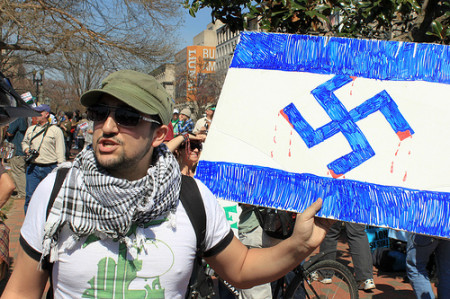
(Leftists, long enamored of Jonathan Gruber’s techniques, depict Israel as Nazi Germany reincarnated. The characterization has metastasized far beyond academia.

— DM)
israeli-flag-turned-swastika-4453720158_3f639a1ea52-450x299

“What if the Jews themselves were Nazis?” mused French philosopher, Vladimir Jankélévitch in 1986. “That would be great. We would no longer have to feel sorry for them; they would have deserved what they got.”

The recasting of Israelis, and, by extension, Jews as Nazis has, in fact, taken place, just as Jankélévitch envisioned. This summer’s Israeli incursion, Operation Protective Edge, provided anti-Semites and loathers of the Jewish state with resurgent justifications for assigning the epithet of Nazi on the Jews yet another time, together with oft-heard accusations of “crimes against humanity, “massacres,” genocide,” and, according to recent comments by Turkey’s prime minister Tayyip Erdoğan, in their treatment of the Palestinians, Israel has demonstrated that “. . . their barbarism has surpassed even Hitler’s.”

The Nazification of Israelis—and by extension Jews—is both breathtaking in its moral inversion and cruel in the way it makes the actual victims of the Third Reich’s horrors a modern-day reincarnation of that same barbarity. It is, in the words of Boston University’s Richard Landes, “moral sadism,” a salient example of Holocaust inversion that is at once ahistorical, disingenuous, and grotesque in its moral and factual inaccuracy.

In reflecting on the current trend he perceived in the burgeoning of anti-Israelism around the world, Canadian Member of Parliament, Irwin Cotler, once observed that conventional strains of anti-Semitism had been masked, so that those who directed enmity towards Jews were now able to transfer that opprobrium to the Jew of nations, Israel. How had they effected that? According to Cotler, they did so by redefining Israel as the most glaring example of those human predations, what he called “the embodiment of all evil” of the Twentieth Century: apartheid and Nazism. He defined the process of grafting this opprobrium on Israel as “ideological anti-Semitism,” one which “involves the characterization of Israel not only as an apartheid state—and one that must be dismantled as part of the struggle against racism—but as a Nazi one.”

Most important for the anti-Israel cause, Cotler contended, once Israel had been tarred with the libels of racism and Nazism, the Jewish state had been made an international outlaw, a pariah, losing its moral right to even exist—exactly, of course, what its foes have consistently sought. “These very labels of Zionism and Israel as ‘racist, apartheid and Nazi’ supply the criminal indictment,” said Cotler. “No further debate is required. The conviction that this triple racism warrants the dismantling of Israel as a moral obligation has been secured. For who would deny that a ‘racist, apartheid, Nazi’ state should not have any right to exist today?”

What is more troubling is that the characterization of the Israeli as Nazi is a trope now promulgated by Western elites and so-called intellectuals, including a broad contingent of academics who are complicit in, and in fact intellectual enablers of, the campaign to defame Israel by Nazifying its people and accusing Jews again as being the world’s moral and existential enemies as demonstrated by their oppression and brutality toward the long-suffering Palestinians. Thus, campus anti-Israel hate-fests sponsored by radical student groups have such repellant names as “Holocaust in the Holy Land,” “Israel: The Politics of Genocide,” or “Israel: The Fourth Reich,” creating a clear, though mendacious, linkage between Nazism and Zionism.

One of the early academic voices to have assigned the Nazi epithet to Israel was heard in a November 2000 speech by Francis A. Boyle, a law professor at the University of Illinois and one of the principal promoters of the global Boycott, Divest, and Sanctions (BDS) movement. In that speech, Boyle made the exact linkage to which Cotler alluded, conflating Israel’s alleged racism with apartheid-like behavior and suggesting, even more ominously, that the ongoing “genocide” against the Palestinians had parallels with the Nazi’s own heinous offenses. “The paradigmatic example of a crime against humanity is what Hitler and the Nazis did to the Jewish People,” Boylesaid. “This is where the concept of crime against humanity was formulated and came from. And this is what the U.N. Human Rights Commission is now saying that Israel is doing to the Palestinian People. A crime against humanity.”

That same trope is repeated and reinforced by other academics, such as Richard Falk, professor emeritus of International Law and Policy at Princeton University and the UN’s former, preposterously-titled “Special Rapporteur on the situation of human rights in the Palestinian territories occupied since 1967,” who wondered aloud if it was “an irresponsible overstatement to associate the treatment of Palestinians with this criminalized Nazi record of collective atrocity?” on the part of Israel, and then quickly answered his own question by saying, “I think not.”

In the morally-defective pantheon of the academic defamers of Israel, perhaps no single individual has emerged as the paradigmatic libeler, the most vitriolic and widely-followed character in an inglorious retinue as Norman Finkelstein, late of DePaul University. Finkelstein has loudly and notoriously pronounced his extreme views on the Middle East, not to mention his loathing of what he has called the Holocaust “industry,” something he has called an “outright extortion racket;” in fact, he blames Jews themselves for anti-Semitism.

Hamas, designated a terrorist organization by the U.S. State Department, has pure political intentions and passively yearns for truces and safe borders, according to Mr. Finkelstein, while the invidious state of Israel, fearing moderate Arab foes who will force it into peace, is obdurate, conniving, and bellicose. In fact, Finkelstein suggested, Israel is collectively going mad, while everyone else in the rational world yearns for Middle Eastern peace:I think Israel, as a number of commentators pointed out, is becoming an insane state. . . In the first week of the massacres, there were reports in the Israeli press that Israel did not want to put all its ground forces in Gaza because it was preparing attacks on Iran. Then there were reports it was planning attacks on Lebanon. It is a lunatic state.”

If Finkelstein lives in an academic netherworld of political fantasies, conspiracies, and intellectually-imbecilic distortions of history and fact, his spiritual mentor, MIT’s professor emeritus of linguistics Noam Chomsky, has inhabited a similar ideological sphere, but has become an even more widely-known, eagerly-followed creature of the Israel-hating, America-hating Left.

While he is happy to, and regularly does, ignore the murder of Jews by Palestinians, Chomsky never hesitates to point to the perfidy of Israel, and its barbarous assault on their Arab neighbors who, in his socialist fantasies, wish for nothing more than to live in peace. He draws the perverse parallel between Israelis and Nazis so frequently in his writings that, to paraphrase the wry Professor Edward Alexander, he would be rendered nearly speechless if he was unable to use the epithet of Nazi against Israel in every sentence he utters. The rogue state of “Israel has tried killing, beating, gassing, mass arrests, deportation, destruction of houses, curfews and other forms of harsh collective punishment,” Chomsky wrote, and yet, even in the face of this hideous, Nazi-like behavior by Israel, “nothing has succeeded in enforcing obedience or eliciting a violent response.”

In January of 2009, a tenured sociology professor, William I. Robinson, of the University of California, Santa Barbara, sent an odious email to the 80 students in his “Sociology 130SG: The Sociology of Globalization” course with the explicit message that Israelis are the new Nazis.  Under the heading “Parallel images of Nazis and Israelis,” the email displayed a photo-collage of 42 side-by-side, grisly photographs meant to suggest an historical equivalence between Israel’s treatment of Palestinians in its occupation of Gaza and the Third Reich’s subjugation of the Warsaw Ghetto and its treatment of Jews during the Holocaust. Robinson sent the email without supplying any context for it, nor did it seemingly have any specific relevance to or connection with the course’s content.

At Columbia University’s department of Department of Middle Eastern, South Asian, and African Studies (MESAAS), an academic division with a long history of anti-Israel, anti-American bias and politicized scholarship, Joseph Massad, an associate professor of modern Arab politics, regularly espouses his loathing of Israel in fringe, anti-Semitic publications like Counterpunch and The Electronic Intifada, or in the Arab press, and never misses an opportunity to denigrate the Jewish state as a racist, colonial enterprise, a moral stain on the world without any semblance of legitimacy. In his perfervid imagination, Israelis, as he never tires as mentioning, have become the new Nazis and the Palestinians the Jews. “As Palestinians are murdered and injured in the thousands,” he wrote after Operation Cast Lead in January of 2009 when Israel was defending itself against some 6000 rockets attacks from Gaza, “world powers are cheering on . . , and it even happened during World War II as the Nazi genocide was proceeding.” Perversely likening the barbaric aggression of Hamas from within Gaza to the efforts of Warsaw Jews to repel imminent extermination by the Nazis, Massad obscenely suggested that “The Gaza Ghetto Uprising will mark both the latest chapter in Palestinian resistance to colonialism and the latest Israeli colonial brutality in a region whose peoples will never accept the legitimacy of a racist European colonial settlement in their midst.”

It is Israel’s actions alone―that and the support of the United States―which are the root cause of the Israeli/Palestinian conflict, and the Jewish state’s behavior is murderous, unethical, and brutal, according to University of Wisconsin-Madison’s Jennifer Loewenstein, Associate Director of the Middle East Studies Program. Israel, she wrote, “speaks with a viper’s tongue over the multiple amputee of Palestine whose head shall soon be severed from its body in the name of justice, peace and security,” and “Israel has made its view known again and again in the strongest possible language, the language of military might, of threats, intimidation, harassment, defamation and degradation.” 

This summer, while the Gaza incursion was raging, Dr. Julio Pino, associate professor of history at Kent State University, published a vitriolic open letter in which he chastised the “academic friends of Israel” who have “chosen to openly work for and brag about academic collaboration with a regime that is the spiritual heir to Nazism . . . I curse you more than the Israelis,” he told his academic colleagues, “for while The Chosen drain the blood of innocents without apologies you hide behind the mask of academic objectivity, nobility of research and the reward of teaching to foreign youth . . . Lest you think this is a personal attack I swear it applies equally to all who engage in collaboration with fascism, and we both know the fate of collaborators. In the same manner, only with more zeal, than you have sworn to the Jewish State I pledge to you, and every friend and stooge of Zionism.”

Occasionally, when an academic makes public his loathing of the Jewish state, and continues to demonize and libel Israel beyond the bounds of what would be considered acceptable scholarly discourse, there are consequences—though rarely. This summer, for instance, Steven Salaita, author of Israel’s Dead Soul and perennial critic of Zionism, had an employment offer from the University of Illinois withdrawn once the school’s president was made aware of some of Salaita’s virulent Twitter posts about Israel.  During the widely-criticized Gaza incursion, Salaita tweeted that “At this point, if Netanyahu appeared on TV with a necklace made from the teeth of Palestinian children, would anybody be surprised?” He also blamed anti-Semitism on Jews themselves, as many anti-Semites do, by asserting that Israel’s behavior causes the hatred of Jews, that “By eagerly conflating Jewishness and Israel, Zionists are partly responsible when people say antisemitic shit in response to Israeli terror.”

As grotesque and distorted as these calumnies against Israel are, as perverse and inaccurate the comparisons drawn between Nazism and Zionism and between Nazis and Israelis are, and as wildly hateful these libels are to the point of being, as defined by the State Department’s own working definition, anti-Semitic in nature—the branding of Israel as the Nazi of nations by these academics serves to reinforce, and give credibility to, similar hatreds and biases expressed outside the university walls.

This is a lethal narrative because when it is believed the world naturally asks itself, as Cotler warned: if Israel is a Nazi-like, apartheid regime, standing in opposition to everything for which the civilized community of nations stands, who cannot hold Israel accountable and judge it harshly for its transgressions? That against all historical evidence and the force of reason the calumny against Israel that it is a murderous, sadistic, and genocidal regime has been successfully promoted and continues to gain traction indicates that Israel’s academic defamers have been successful in inverting history as part of the modern day incarnation of the world’s oldest hatred.

Obama: ISIS Beheadings ‘Represent No Faith, Least of All the Muslim Faith’

November 17, 2014

Obama: ISIS Beheadings ‘Represent No Faith, Least of All the Muslim Faith’

17 Nov 2014, 5:39 AM PDT

via Obama: ISIS Beheadings ‘Represent No Faith, Least of All the Muslim Faith’.


Returning from his trip to Asia, President Obama issued a statement reacting to the beheading of U.S. aid worker Peter Kassig by Islamic State (ISIS/ISIL) terrorists.

Kassig, a convert to Islam, took the name Abdul-Rahman and was captured and held hostage by members of ISIS a year ago.

“ISIL’s actions represent no faith, least of all the Muslim faith which Abdul-Rahman adopted as his own,” Obama wrote. “Today we grieve together, yet we also recall that the indomitable spirit of goodness and perseverance that burned so brightly in Abdul-Rahman Kassig, and which binds humanity together, ultimately is the light that will prevail over the darkness of ISIL.”

Obama called the action “an act of pure evil by a terrorist group that the world rightly associates with inhumanity.”

The White House

Office of the Press Secretary
For Immediate Release

Statement by the President on the Death of Abdul-Rahman Kassig
Today we offer our prayers and condolences to the parents and family of Abdul-Rahman Kassig, also known to us as Peter.  We cannot begin to imagine their anguish at this painful time.
Abdul-Rahman was taken from us in an act of pure evil by a terrorist group that the world rightly associates with inhumanity.  Like Jim Foley and Steven Sotloff before him, his life and deeds stand in stark contrast to everything that ISIL represents.  While ISIL revels in the slaughter of innocents, including Muslims, and is bent only on sowing death and destruction, Abdul-Rahman was a humanitarian who worked to save the lives of Syrians injured and dispossessed by the Syrian conflict.  While ISIL exploits the tragedy in Syria to advance their own selfish aims, Abdul-Rahman was so moved by the anguish and suffering of Syrian civilians that he traveled to Lebanon to work in a hospital treating refugees.  Later, he established an aid group, SERA, to provide assistance to Syrian refugees and displaced persons in Lebanon and Syria.  These were the selfless acts of an individual who cared deeply about the plight of the Syrian people.

ISIL’s actions represent no faith, least of all the Muslim faith which Abdul-Rahman adopted as his own.  Today we grieve together, yet we also recall that the indomitable spirit of goodness and perseverance that burned so brightly in Abdul-Rahman Kassig, and which binds humanity together, ultimately is the light that will prevail over the darkness of ISIL.

A Dead Caliph vs. the Hydra of Jihad

November 17, 2014

A Dead Caliph vs. the Hydra of Jihad

By Raymond Ibrahim on November 13, 2014

via A Dead Caliph vs. the Hydra of Jihad | Raymond Ibrahim.


Is Abu Bakr al-Baghdadi, the self-styled “caliph” of the Islamic State, injured or dead, as some in the media are eagerly speculating?

Better question: does it really matter?

For almost a decade now, every time an Islamic jihadi leader is killed, the Western mainstream media exult, portraying the death as a major blow to the jihad.  And, for almost a decade now, I have responded by posting an article that I first wrote in 2006 for Victor Davis Hanson’s website, Private Papers.

Although I changed the names of the jihadi leaders killed to suit the occasion—first Abu Mus‘ab al-Zarqawi, then Abu Laith al-Libi, then Abu Omar al-Baghdadi and Abu Ayub al-Misri, and finally Osama bin Laden—my conclusion has remained the same:

The West’s plight vis-à-vis radical Islam is therefore akin to Hercules’ epic encounter with the multi-headed Hydra-monster.  Every time the mythical strongman lopped off one of the monster’s heads, two new ones grew in its place.  To slay the beast once and for all, Hercules learned to cauterize the stumps with fire, thereby preventing any more heads from sprouting out.

Similarly while the West continues to lop off monster heads like figurehead Zarqawi [or bin Laden, al-Baghdadi, etc.] it is imperative to treat the malady — radical Islam—in order to ultimately prevail.  Victory can only come when the violent ideologies of radical Islam are cauterized with fire.

But alas, the Hydra-monster is myth, while radical Islam is stark reality.

Eight years later, this “stark reality” has manifested itself into a head-chopping, infidel-crucifying, mass-murdering, female-enslaving Islamic State.

And yet, in the previous years, proclamations of “victory” were habitually made by media and politicians whenever a top jihadi was killed.

Recall all the exultation that took place in 2006 after al-Zarqawi—the forefather of the Islamic State, or “Al-Qaeda Second Generation”—was killed.   Then, almost every major politician, including President Bush, Prime Minister Blair, and Iraq’s Prime Minister Maliki, gave some sort of victory speech.  The New York Times called his death a “major watershed in the war.”

Similarly, in 2008, after Abu Laith al-Libi was killed, Congressman Peter Hoekstra issued a statement saying that his death “clearly will have an impact on the radical jihadist movement.”

More myopic triumphalism was in the air after Abu Omar al-Baghdadi and Abu Ayub al-Masri were killed in 2010 during a joint U.S.-Iraqi operation.  Then, U.S. Vice-President Joe Biden said the “deaths are potentially devastating blows to al-Qaeda in Iraq [the original name of the Islamic State],” adding “This operation is evidence in my view, that the future of Iraq will not be shaped by those who would seek to destroy that country”—an assertion that has now proven woefully wrong.

Similarly, U.S. commander Gen. Raymond Odierno asserted that “The death of these terrorists is potentially the most significant blow to al-Qaeda in Iraq since the beginning of the insurgency,” adding that it would be “very difficult” for the al Qaeda network to replace the two men.

And who could forget all the media triumphalism, if not hysteria, surrounding the 2011 death of Osama bin Laden?  Then, CNN security analyst Peter Bergen declared that “Killing bin Laden is the end of the war on terror. We can just sort of announce that right now.” Insisting that the “iconic nature of bin Laden’s persona” cannot be replaced, Bergen further suggested that “It’s time to move on.”

Another CNN analyst, Fareed Zakaria, assured us that “this is a huge, devastating blow to al-Qaeda, which had already been crippled by the Arab Spring. It is not an exaggeration to say that this is the end of al-Qaeda in any meaningful sense of the word.”

In retrospect, surely all these assertions and assurances have proven to be immensely puerile—even for mainstream media “analysts.”

To recap, for years, U.S. leadership and its media mouthpiece so misled Americans about the status of al-Qaeda (code name for the amorphous jihad)—thus directly contributing to the rise of the Islamic State: we were repeatedly told that al-Qaeda was suffering “devastating blows”; that the killing of individual jihadis were “major watersheds in the war”; that “the end of the war on terror” occurred in 2011, when bin Laden died (“it’s time to move on,” counseled Peter Bergen); and “that the future of Iraq will not be shaped by those who would seek to destroy that country,” according to Biden.

Yet, lo and behold: an Islamic State, a caliphate engaged in the worst atrocities of the 21st century, has been born—despite the deaths of Zarqawi, bin Laden, et. al.

When it comes to the significance of the killing of this or that jihadi leader, the best prediction I have ever read—a prediction that has proven too true—comes not from U.S. politicians, “experts,” or media.  It comes from al-Qaeda leader Ayman al-Zawahiri. Asked in a 2005 interview about the status of bin Laden and the Taliban’s Mullah Omar, he confidently replied:

Jihad in the path of Allah is greater than any individual or organization. It is a struggle between Truth and Falsehood, until Allah Almighty inherits the earth and those who live in it. Mullah Muhammad Omar and Sheikh Osama bin Laden—may Allah protect them from all evil—are merely two soldiers of Islam in the journey of jihad, while the struggle between Truth [Islam] and Falsehood [non-Islam] transcends time (The Al Qaeda Reader, p.182, emphasis added).

And there it is: jihad “transcends time” and is not personified by this or that leader—something our myopic leaders and experts, who apparently can’t see beyond their noses, will never comprehend (and how can they, when Barack Obama has banned knowledge of Islam from U.S. intelligence?).

Jihadi leaders, ideologues, emirs, sultans, caliphs, even the prophet of Islam himself, have come and gone for nearly 1,400 years—but the jihad rages on.  It’s time Western leaders began to respond to the jihad and not just its individual practitioners.

Increasing cooperation between Muslim Brotherhood and IS

November 17, 2014

Increasing cooperation between Muslim Brotherhood and IS

Obama’s failed policy in Syria has transformed IS into the leader of radical Islamism.

Nov 17, 2014, 02:32 PM | Rachel Avraham

via Israel News – Increasing cooperation between Muslim Brotherhood and IS – JerusalemOnline.

Failed policy is an understatement if you add the obama support for the brotherhood in Egypt.

IS announces execution of American hostage last night

Increasing evidence is emerging that the Muslim Brotherhood and IS have formed an alliance aimed at eliminating all the existing Arab countries, enabling the creation of a Muslim Caliphate stretching from Morocco to Iraq.

Several Arab countries have recently made official announcements on this subject, based on information from their intelligence services.

“No doubt there are connections between IS and the Muslim Brotherhood,” a statement from the Egyptian Ministry of Religious Endowments read in Egypt’s Daily News. “They are both waging a war against their homelands with vandalism, destruction and murder—murder on behalf of the enemies of the state who fund them. Their religious leaders are ignorant and unqualified. They use religion to play with the minds of the public. The main commonality between the two groups is their terrorist acts.”

Last week, the United Arab Emirates (UAE) joined Saudi Arabia, Egypt, and other Gulf states by banning the Muslim Brotherhood as a terrorist organization. Interestingly, one conservative Arab country that has not banned the Muslim Brotherhood and its affiliates is the Hashemite Kingdom of Jordan. 81 Muslim Brotherhood affiliates were also outlawed by the United Arab Emirates.

One of the Muslim Brotherhood’s affiliates is the Council on American-Islamic Relations (CAIR). According to a report in the Clarion Project, CAIR was labeled an unindicted co-conspirator in the Holy Land Foundation trial due to their financing of Hamas. In a December 2007 federal court filing, prosecutors described CAIR as “having conspired with other affiliates of the Muslim Brotherhood to support terrorism.” The US government asserted then that CAIR used deception to “conceal from the American public their connections to terrorists.” In 2009, a US federal judge established links between CAIR and Hamas.

Additionally, the US Justice Department listed CAIR as a member of the US Muslim Brotherhood’s Palestine Committee, a secret body established to support Hamas. An internal memo calls on the Palestine Committee members to work to “increase the financial and moral support for Hamas to fight surrendering solutions and to publicize the savagery of the Jews.”

Other terror groups banned by the UAE include Islamic State, the Jabhat Al Nusra Front, the Pakistani Taliban, Lashkar e-Taiba, the East Turkestan Islamic Movement, Hezbollah, Al Qaeda, Army of Islam in Palestine, Boko Haram, etc. The Muslim American Society and Islamic Relief Worldwide were also banned. According to the Chicago Tribune, the Muslim American Society was secretly created by the Muslim Brotherhood. The Clarion Project reports that Islamic Relief Worldwide has extensive Muslim Brotherhood links, financed Hamas during Operation Protective Edge, and works closely with a Hamas linked group in Turkey.

In an interview that JerusalemOnline conducted with prominent Middle East scholar and former senior intelligence officer Mordechai Kedar, he stressed that IS and the Muslim Brotherhood share the same ideological foundations. Both groups reject Arab nationalism in favor of Islamic nationalism; both ultimately seek to eradicate the alien political map and culture the West imposed on the Middle East after WW1 and return Arab societies to their Islamic roots. The main differences between the two are, according to Kedar, over tactics, not strategy. IS uses extreme violence as a marketing tool, hence its beheadings. The Muslim Brotherhood combines terrorism with community activism and charity, providing communities with services their governments are supposed to provide, but fail to do so due to corruption and incompetence.

Exiled Jordanian-Palestinian journalist Mudar Zahran, a respected commentator on the Arab world, stressed in an interview with JerusalemOnline: “What most people don’t realize is that Islamic State is an offshoot of Muslim Brotherhood ideology. It’s not just an agreement of ideology between Islamic State and the Muslim Brotherhood. Islamic State is an extension of Al Qaeda. Bin Ladin and Zahrawi are former Muslim Brotherhood members. In addition, the Muslim Brotherhood today does not hide its support for Islamic State. For example, the Muslim Brotherhood’s de facto spokesperson Sheikh Wajdi Ghunaim openly on youtube pledges support for Islamic State. The conclusion is that the Muslim Brotherhood at least supports Islamic State.”

Hana Julian from the Jewish Press cited an interview with Istanbul-based scholar Adnan Oktur, who in an interview on A9TV stressed that the Muslim Brotherhood is at the root of Islamic State: “The Brotherhood in Egypt could soon entirely come under IS control. Hamas may also join IS. Very few groups in the Islamic world will not join. The Brotherhood is at the roots of Al Qaeda and Hamas. The Brotherhood fed them both.”

Already, Reuters reported that Islamic State has recently been training Egyptian Islamist groups such as Ansar Bait Al Maqdis how to implement terror attacks. Jerusalem Post reported that Ansar Bait Al Maqdis also pledged allegiance to Islamic State, a claim which the terror group later denied, stressing they support Islamic State ideologically but maintain their independence. According to Breitbart, the founder of the Egyptian Islamic Jihad Nabil Naeim confirmed that Ansar Bait Al Maqdis is funded by the Muslim Brotherhood, who also supplies them with weapons smuggled through Libyan and Gazan tunnels. The same report cites Islamist terror expert Sameh Eid as describing Ansar Bait Al Maqdis as the “military wing of the Muslim Brotherhood in the Sinai Peninsula.”

Given the Obama administration’s failed Syrian policy, Islamic State has been transformed into the leader for radical Islamists worldwide. This is why other Islamist groups such as Ansar Bait Al Maqdis and the Muslim Brotherhood have been increasingly cooperating with them. They share the same vision and Islamic State has the aura of success, which is a powerful magnet.

Iran Nuclear Pact Faces an Array of Opposing Forces – NYTimes.com

November 17, 2014

Iran Nuclear Pact Faces an Array of Opposing Forces – NYTimes.com.

WASHINGTON — When President Obama wrote last month to Iran’s supreme leader, Ayatollah Ali Khamenei, urging him to overcome a decade of mistrust and negotiate a deal limiting Tehran’s nuclear ambitions, it was perhaps the president’s last effort to reach a reconciliation with Iran that could remake the Middle East.

Today, Mr. Obama needs a foreign policy accomplishment more than ever, and he sees time running out on his hope of changing the calculus in a Middle East where Americans are, against his instincts, back on the ground. But the forces arrayed against a deal are formidable — not just Mr. Khamenei and the country’s hard-liners, but newly empowered Republicans, some of his fellow Democrats, and many of the United States’ closest allies.

As negotiators head back to Vienna this week for what they hope will be the final round of talks, Mr. Obama’s top national security advisers put the chance of reaching an agreement this month at 40 to 50 percent. “In the end this is a political decision for the Iranians,” Mr. Obama told a small group of recent visitors to the White House, a statement that could be true for him as well.

Yet even if a deal is struck it will be the beginning of an argument, rather than the end of one. For many of the president’s adversaries, the details of whatever deal he emerges with — how much warning the West would have if Iran raced for a bomb, for example — are almost beside the point.

“In every nation involved, this negotiation is a proxy for something bigger,” argues Robert Litwak, a Wilson Center scholar and author of “Iran’s Nuclear Chess: Calculating America’s Moves.”

“Here it is a test of Obama’s strength and strategy,” he said. “In Tehran it is a proxy for a fundamental choice: whether Iran is going to continue to view itself as a revolutionary state, or whether it’s going to be a normal country,” which so many of its young people yearn for it to become.

So far, Mr. Khamenei has avoided making that choice, intelligence assessments by the United States and its allies conclude. While he has authorized President Hassan Rouhani and his foreign minister, Mohammad Javad Zarif, to negotiate with the United States and its partners, they believe that the supreme leader may decide whether to approve a deal only after his negotiators come home with the details.

That is what happened with a much smaller deal in 2009, which he killed after an agreement was reached in Vienna. And surrounding the ayatollah are hard-liners who have opposed any accord, as well as leaders of the Revolutionary Guards Corps, which is responsible for the military side of the nuclear program.

But Mr. Litwak’s observation about how the deal is a proxy for other issues applies equally to the rest of the key players in the negotiations: Israel, Saudi Arabia, Russia and Western Europe.

Israel’s prime minister, Benjamin Netanyahu, has described Iran as an “existential threat” for so long that it is hard for American officials to imagine any deal Israel would support. For years a succession of Israeli governments have described Iran as just six months or so away from a bomb; last year the Netanyahu government opposed even the modest lifting of sanctions.

In recent weeks Mr. Netanyahu has repeated his warning that “the Islamic State of Iran is not a partner of America, it’s an enemy of America,” and said Israel would not abide by any arrangement that leaves Iran as a “threshold” nuclear state — one poised to build a weapon in a matter of months or years.

Israeli officials play down their influence in Congress on the issue and disagree internally on the merits of a deal; some in the intelligence agencies see advantages to more intrusive inspections in Iran. “We have no formal status and no real capacity” in the talks, said Yuval Steinitz, the strategic affairs minister who has been Israel’s primary point man, apart from the prime minister himself, on Iran. “We can only convince, we can only speak and explain.”

The Saudis have a parallel worry: that any deal with Iran would be the opening wedge to a reordering of American alliances in the region, one in which Washington would begin to work on regional issues with the Shiite Iranian state instead of with Sunni Saudi Arabia.

No one has been more outspoken on the issue than Saudi Arabia’s former intelligence chief, Prince Turki bin Faisal, who in recent weeks has warned that the Saudis will build uranium enrichment facilities to match whatever Iran is allowed to retain — even if the kingdom has no use for them. That has raised the specter of an arms race, even if a deal is struck.

Perhaps the most complex political player is Russia. It has remained a key element of the negotiating team, despite its confrontations with the West over Ukraine. It has been a central player in negotiating what may prove the key to a deal: a plan for Iran to ship much of its low-enriched uranium to Russian territory for conversion into fuel for the Bushehr nuclear power plant.

But Russian officials may want an extension of the talks that keeps any real agreement in limbo — and thus keeps Iranian oil off the market, so that it cannot further depress falling prices.

Apart from Mr. Obama, the most unambiguous proponents of reaching a deal are the European nations, said Mark Fitzpatrick, an Iran nuclear expert at the International Institute for Strategic Studies in London.

Many Europeans feel little threat from Iran, and believe that Israel, with its own unacknowledged but widely known nuclear arsenal, exaggerates the threat of a nuclear-able Tehran. The notable exception are the French, who have publicly argued for tougher terms in the negotiations and say they see their role as to serve, in the words of one Western diplomat, as “a significant counterweight on the impulse of Obama to make concessions.”

But the biggest counterweight to a negotiating success with Iran may be the new Republican majority in the Senate — including some members, like Senator Lindsey Graham, who have argued that Mr. Obama is overly eager for a deal.

Obama administration officials reject the charge and say that though Mr. Obama is hopeful, he would never sign an accord that did not put Iran a year or more away from being able to produce enough fuel for a single bomb. “Whatever we negotiate we will have to sell in Congress, sooner rather than later,” said one of Mr. Obama’s senior strategists, declining to speak on the record because of diplomatic sensitivities.

“And that works to our advantage in the negotiating room, because it means we can say to Zarif,” the Iranian foreign minister, “ ‘Even if we agreed to lifting sanctions early, or letting you keep all your centrifuges in place — and we wouldn’t — Congress would rebel.’ ”

That rebellion has started. When Congress came back into session last week Senator Robert Menendez, the New Jersey Democrat who leads the Senate Foreign Relations Committee, and Senator Mark Kirk of Illinois issued a statement saying that “as co-authors of bipartisan sanctions laws that compelled Iran to the negotiating table, we believe that a good deal will dismantle, not just stall, Iran’s illicit nuclear program and prevent Iran from ever becoming a threshold nuclear state.” They would enact new sanctions “if a potential deal does not achieve these goals.”

It is a view the new Republican majority will back, along with many Democrats. Mr. Obama could always veto new sanctions, but the warnings themselves may make it harder, administration officials fear, to get Iran to reach a final agreement.

Mr. Obama has made clear that in the near term, he would act on his own authority to temporarily suspend sanctions step by step, as the Iranians complied with a deal; a vote to repeal those sanctions might not come for several years. But he confronts that problem only if there is a deal. If not, American officials hint, they will press for another extension of talks — betting that the combination of falling oil prices, the threat of new sanctions, and the possibility of more sabotage or military action will eventually lead to an accord.

Yet Mr. Khamenei, American and European intelligence officials say, may be betting that time is on Iran’s side. They have concluded that the supreme leader believes the recent election has weakened Mr. Obama, and that the talks have already led to an acknowledgment of Iran’s right to enrich uranium on its own soil — at least in small amounts — and an understanding that whenever a final agreement expires, it will be able to have an industrial enrichment ability much as Japan does.

“What the Iranians are looking for is a narrative of victory,” one American diplomat said last week, “a way to say the West backed down, and admitted Iran will be able to produce its own nuclear fuel one day, in unlimited quantity.” What Congress needs, the diplomat said, “is a narrative that Iran was forced to dismantle what it has.”

Satisfying both, he added, “is what makes the politics of this so much harder than the physics of slowing the bomb program.”

David E. Sanger reported from Washington, Steven Erlanger from London, and Jodi Rudoren from Jerusalem.


