The Islamic State and Hezbollah Fight For Lebanon, Vice News via You Tube, November 6, 2014
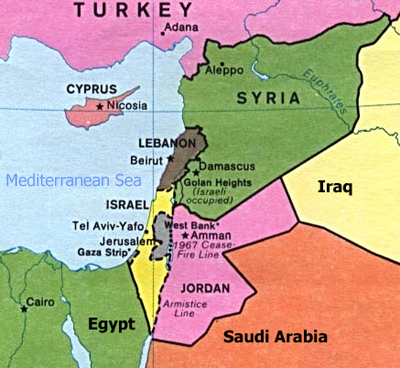
State Department Spokeswoman Picks Another Fight with Israel

via The PJ Tatler » State Department Spokeswoman Picks Another Fight with Israel.
According to Haaretz, Gen. Martin Dempsey, U.S. chairman of the Joint Chiefs of Staff, made some helpful and conciliatory comments toward Israel. The nation’s top military officer lauded Israel for going to “extraordinary lengths” to avoid civilian casualties during the latest round of fighting with the Palestinians.
Dempsey’s comments come after unknown figures within the Obama administration blasted Israeli Prime Minister Benjamin Netanyahu as a “chickensh*t” and a coward. Relations between the U.S. and its ally, already shaky, were made shakier by those comments, and by the administration’s refusal to investigate who made the comments and reprimand them.
State Department spokeswoman Jen Psaki was asked to react to Dempsey’s diplomatic comments during today’s press conference, by the AP’s Matt Lee. Psaki had the choice of agreeing with Gen. Dempsey, refusing to offer an opinion, or disagreeing with him — the latter, carrying the possibility of opening up another argument with Israel.
Psaki chose the latter.
Lee asked Psaki to comment on whether the Obama administration believes that the Israelis lived up to their own “high standards” on civilian casualties.
Psaki undiplomatically replied, “It remains the broad view of this administration that they could’ve done more. And they shouldv’e taken feasible precautions to prevent more civilian casualties.”
Such as?
Psaki’s comment here sets the United States up for criticism on the question of civilian casualties should we get more deeply involved on the ground fighting ISIS in Iraq and Syria. She has also singled out Israel for criticism that is ultimately unfair and impossible to satisfy. One can always “do more” to avoid civilian casualties, but the Israelis are fighting Hamas, which goes out of its way to increase civilian casualties and use them for propaganda.
How to understand Obama’s Iran diplomacy, Power Line, Scott Johnson, November 7, 2014
I think the easiest way to understand Obama’s diplomacy is this. Assume that Obama believes Iran should have nuclear weapons and would like to facilitate the mullahs’ nuclear weapons program. This assumption is the Occam’s Razor that clarifies what might otherwise be obscure. The assumption may not be correct, but it should prove a handy guide to coming attractions.
Obama bids against himself chasing after the mullahs. You can say that he doesn’t know how to negotiate, and it’s a plausible hypothesis. As Michael Rubin explains, “Desperation is not a good negotiating position” (unless you want to give it away).
But how explain Obama’s vehement opposition in the past to the imposition of sanctions against Iran by Congress, or the threat of such sanctions in the future in the case no final deal were to be reached?
How explain his concession up front (in the P5+1 interim agreement with Iran) to Iran’s nuclear enrichment?
How explain the offer to agree to an ever increasing number of centrifuges for enrichment?
How explain the apparent acceptance of a prospective deal without proof that Iran’s nuclear program is peaceful in nature, which is in itself an absurd and unbelievable proposition?
And so on, and so on.
When Obama makes the famously false promise that he is from the government and he is here to help, he means it in the case of the mullahs.
Today’s page-one story in the Wall Street Journal reveals Obama’s fourth secret letter to the mullahs in search of a deal. He is pleading with them. He will not take no for an answer. See Michael Rubin, “White House ignores Khameni response to letters.”
Obama’s most recent letter is already yesterday’s news. Today’s news comes via the IAEA. Omri Ceren summarizes it as follows in an email message this morning:
The new IAEA report went online about two hours ago. No changes from last time: not only are the Iranians continuing to block the Agency’s work, but they’re refusing to offer new ways of moving forward. Zero progress during the reporting period, and no sign that the next one will be any better.
The report is here The key lines are:
“The Agency is not in a position to provide credible assurances about the absence of undeclared nuclear material and activities in Iran, and therefore to conclude that all nuclear material in Iran is in peaceful activities”
“Iran has not provided any explanations that enable the Agency to clarify the outstanding practical measures, nor has it proposed any new practical measures in the next step of the Framework for cooperation”
The Iranians seem to be betting that the West will eventually drop the demand that Tehran come clean about the possible military dimensions (PMDs) of its nuclear program. Negotiations will come down to the wire, all of the other issues will have been massaged, and Iranian negotiators will look up and say the equivalent of ‘you’re not really going to blow up this whole deal over something we did in the past, are you?’ Under that scenario the message will be echoed by a few advocates in the nonproliferation world, the P5+1 will latch on to the reasoning, and that’ll be that.
The problem is that the PMD issue has very little to do with the past and everything to do with future verification. Unless the Iranians disclose what they’ve been doing on the nuclear front – including whatever the military is doing to surreptitiously enrich and store uranium – there’s no way to verify that they’ve stopped doing those things.
Remember how we got here. The P5+1 was supposed to be working with Iran on uranium, plutonium, and ballitsic missiles. Underneath all of those issues, the IAEA was supposed to be working on getting Iran to come clean on the full scope of its program: both the civilian and the military aspects (i.e. the PMDs).
People often talk and write about the PMD issue as if it’s just about weapons work – suspected Iranian experiments with detonators, warheads, etc. Those things matter but the issue is much broader. The IAEA wants access to all the places where the Iranian military had its hand in any atomic work – uranium mining, centrifuge construction, enrichment, and so on. The goal is to get a full picture of everything the Iranians are doing, so that the IAEA can confirm that they’ve stopped.
When the Iranians jam the IAEA up on PMDs, it’s not just another fourth core issue that can be negotiated alongside uranium, plutonium, and ballistic missiles. Transparency is the prerequisite to creating any robust verification scheme on those other three issues. It’s not possible for Western negotiators to say something like: ‘ok, we’ll give you a little on PMDs, but you have to give us something back on centrifuges.’ Without disclosure, there’s no way to verify that the Iranians are actually living up to their half of the trade.
Isn’t this obviously true? That’s where my Occam’s Razor cuts through the fog to help us understand what is happening now and what will in all likelihood be happening soon.
In related news, see Adam Kredo, “Report: Iran nuclear program more advanced than previously believed” and “Pentagon: Iran giving ‘lethal aid to the Taliban’ to fight US.”
UPDATE: Omri Ceren writes to update his message with news of today’s State Department briefing:
The issue came up in today’s State Department press briefing between the AP’s Matt Lee and State spox Jen Psaki. It actually came up twice, with [AP State Department reporter] Matt [Lee] circling back to it….The [short] version is that Jen left open the possibility that the US will take a deal with Iran even if the Iranians continue to obstruct the IAEA, i.e. even if they refuse to come clean on their past nuclear activity including military atomic work. If that happens it would mark another erosion in the US position, alongside reported walkbacks in the other three core areas: uranium, plutonium, and ballistic missiles. More problematically, letting Iran slide on IAEA inspections now risks gutting any verification regime set up later.
It is “problematic,” however, only if your (our) goal is to prevent Iran from obtaining nuclear weapons.
Iran and Israel, compare and contrast, Power Line,
As Scott noted earlier today, the Obama administration’s warm attitude toward Iran’s mullahs has been in the news. Its view of Israel, on the other hand, is much chillier.
Last night, General Martin Dempsey, Chairman of the Joint Chiefs of Staff, gave a talk in which he lauded Israel’s avoidance of civilian casualties during the recent Gaza conflict, and stated that the U.S. military has sent a team of experts to Israel to study best practices in that regard. Via Yid With Lid:
I actually do think that Israel went to extraordinary lengths to limit collateral damage and civilian casualties. In fact, about 3 months ago we sent, we asked [IDF Chief of Staff] Benny [Gantz] if we could send a lessons learned team – one of the things we do better than anybody I think is learn – and we sent a team of senior officers and non-commissioned officers over to work with the IDF to get the lessons from that particular operation in Gaza. To include the measures they took to prevent civilian casualties and what they did with tunneling….
But they did some extraordinary things to try to limit civilian casualties to include calling out, making it known that they were going to destroy a particular structure. Even developed some techniques, they call it roof knocking, to have something knock on the roof, they would display leaflets to warn citizens and population to move away from where these tunnels. But look, in this kind of conflict, where you are held to a standard that your enemy is not held to, you’re going to be criticized for civilian casualties. So I think if Benny were sitting here right now he would say to you we did everything we could and now we’ve learned from that mission and we think there are some other things we could do in the future and we will do those. The IDF is not interested in creating civilian casualties, they’re interested in stopping the shooting of rockets and missiles, out of the Gaza Strip and in to Israel, and its an incredibly difficult environment, and I can say to you with confidence that I think that they acted responsibly.
So today a reporter asked State Department spokeswoman Jen Psaki whether the Department agrees with General Dempsey’s assessment. Psaki parroted the Obama administration line: Israel should have done more. Here she is:
What that “more” might be is, of course, unspecified; nor is there any suggestion that Hamas and Fatah should have done more to stop the firing of rockets at Israeli civilians. But of course, civilian casualties are a greater or lesser issue, depending on which administration is under discussion. Just yesterday, a reporter asked Ms. Psaki about reports that civilians had been killed in a U.S. drone strike. Her answer, in essence: Hey, we’re doing the best we can:
QUESTION: Do you have any confirmation of reports that any civilians were killed in these – this latest round of strikes?
MS. PSAKI: Well, as you know, this is – any reports of civilian casualties we take very seriously. The Department of Defense looks into that. We understand that there have been reports from activists alleging that civilian casualties occurred. I’ll just reiterate that no other military in the world works as hard as we do to be precise and avoid civilian casualties. But while we strive to avoid them, when any allegation is presented we investigate it fully and strive to learn from it as to avoid it in the future. So that would, of course, be under the Department of Defense.
QUESTION: Yes.
MS. PSAKI: Asia?
QUESTION: Yes.
QUESTION: Wait. No other military in the world –
QUESTION [SIC]: Other than Israel.
QUESTION: Yeah, exactly. I seem to recall the Israelis saying this – the same thing. You think you’re better at it than the Israelis are?
MS. PSAKI: We think we hold ourselves to a high standard, and we continue – encourage all countries to do the same.
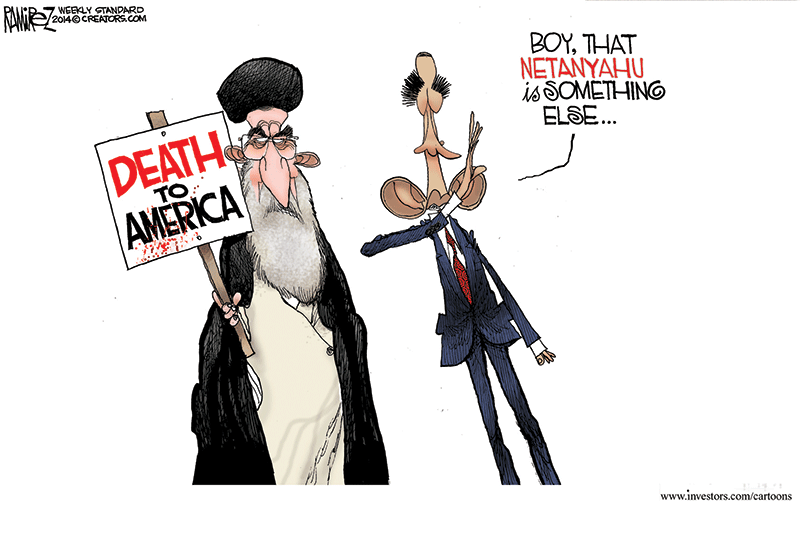
Michael Ramirez gets the last word. Click to enlarge:
Obama deploys 1,500 more U.S. troops to Iraq, Washington Times, Dave Boyer and Maggie Ybarra, November 7, 2014
(Will they be permitted to wear combat boots? — DM)
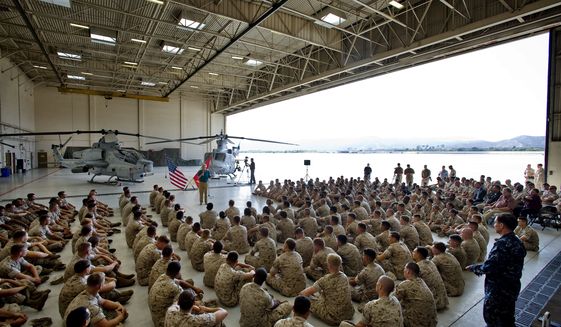 A group of selected Marines representing Camp Pendleton listen as Secretary of Defense Chuck Hagel answers their questions during his short visit to the base Tuesday Aug. 12, 2014. Hagel announced the deployment of another 130 U.S. troops to Iraq in remarks to Marines at this Southern California base on the final stop of a weeklong, around-the-world trip that also took him to India, Germany and Australia. (AP Photo/The Orange County Register, Paul Rodriguez)
“The president also authorized U.S. personnel to conduct these integral missions at Iraqi military facilities located outside Baghdad and Erbil,” the statement said. “U.S. troops will not be in combat, but they will be better positioned to support Iraqi Security Forces as they take the fight to ISIL.”
***********
President Obama is sending up to 1,500 more U.S. military personnel to Iraq to serve as non-combat advisers in the fight against Islamic State terrorists, the White House said Friday.
The troops will “train, advise, and assist Iraqi Security Forces, including Kurdish forces,” the White House said.
“The president also authorized U.S. personnel to conduct these integral missions at Iraqi military facilities located outside Baghdad and Erbil,” the statement said. “U.S. troops will not be in combat, but they will be better positioned to support Iraqi Security Forces as they take the fight to ISIL.”
It’s the latest escalation of U.S. military personnel in Mr. Obama’s fight to rescue the besieged government in Baghdad, where the president withdrew all U.S. forces in 2011. Since August, the U.S. has been conducting hundreds of airstrikes against the Islamic State in Iraq, and more recently in Syria.
The surge in military advisers will more than double the number of U.S. personnel in Iraq, which currently totals about 1,400.
U.S. troops will be asked to train nine Iraqi brigades and three Kurdish fighter brigades, said Pentagon spokesman Rear Adm. John Kirby.
“These sites will be located in northern, western, and southern Iraq,” Adm. Kirby said. “Coalition partners will join U.S. personnel at these locations to help build Iraqi capacity and capability. The training will be funded through the request for an Iraq train-and-equip fund that the administration will submit to Congress as well as from the government of Iraq.”
The White House said the Iraqi government requested the additional forces, and Defense Secretary Chuck Hagel agreed.
White House press secretary Josh Earnest said the Islamic State “has suffered a series of defeats in Iraq against the Iraqi Security Forces and Peshmerga, with the support of U.S. and coalition airstrikes and Intelligence, Surveillance and Reconnaissance, and as well as U.S. military advice.”
“The United States and its coalition partners will continue to confront the threat of [the Islamic State] with strength and resolve as we seek to degrade and ultimately defeat” the terrorist group,” he said.
Shaun Donovan, director of the White House Office of Management and Budget, said the administration is sending a request to Congress for $5.6 billion to pay for the military operations.
The request includes $1.6 billion to establish the Iraq train-and-equip fund to develop and support Iraqi security forces, including Kurdish forces.
“This funding will help reconstitute the Iraqi army and strengthen the capability and capacity of our Iraqi partners to go on the offensive against” the Islamic State, Mr. Donovan said.
IAEA: No Progress on Iranian Nukes, Daily Beast, November 7, 2014
(Don’t bother P5+1 with irrelevant details. The deal has to be based on mutual trust! — DM)




 anneinpt
 artaxes
 danmillerinpanama
 davidking1530
 Peter Hofman
 Joseph Wouk
 Peter
Peter Louisiana Steve
 WarSclerotic
Recent Comments