Ezra Levant with Mark Steyn – The aftermath of the jihad terror attack on Canada’s Parliament, You Tube, October 23, 2014
The Poison Tree, Washington Free Beacon, Matthew Continetti, October 24, 2014
(Rather than chopping the tree down, we are watering and fertilizing it. — DM)
 Arab protesters wave Islamic flags in front of the U.S. embassy in Tel Aviv, Israel / AP
Six years into the Obama presidency, not only has the vocabulary of jihad been removed from official rhetoric and counterterrorism policy, but troops have been removed from Iraq, troops are withdrawing from Afghanistan, the administration has condemned Israeli settlement activity while coddling Hamas’ backers in Ankara and Doha, “torture” has been banned, the White House intends to close Guantanamo unilaterally, Hosni Mubarak was abandoned in favor of the Muslim Brotherhood, and the president is desperate for a partnership with the Islamic theocracy of Iran.
We must recognize the global and unitary nature of the threat. We must recognize that there is only one way to deal with a poison tree: You chop it down.
***************
Last month, addressing the U.N. General Assembly, Benjamin Netanyahu made a connection between the Islamic State and Hamas. These terrorist entities, Netanyahu said, have a lot in common. Separated by geography, they nonetheless share ideology and tactics and goals: Islamism, terrorism, the destruction of Israel, and the establishment of a global caliphate.
And yet, Netanyahu observed, the very nations now campaigning against the Islamic State treated Hamas like a legitimate combatant during last summer’s Israel-Gaza war. “They evidently don’t understand,” he said, “that ISIS and Hamas are branches of the same poisonous tree.”
The State Department dismissed Netanyahu’s metaphor. “Obviously, we’ve designated both as terrorist organizations,” said spokesman Jen Psaki. “But ISIL poses a different threat to Western interests and to the United States.”
Psaki was wrong, of course. She’s always wrong. And, after the events of the last 48 hours, there ought not to be any doubt as to just how wrong she was. As news broke that a convert to Islam had murdered a soldier and stormed the Canadian parliament, one read of another attack in Jerusalem, where a Palestinian terrorist ran his car over passengers disembarking from light rail, injuring seven, and killing 3-month-old Chaya Zissel Braun, who held a U.S. passport.
Islamic State, al Qaeda, Hamas—these awful people are literally baby killers. And yet they produce a remarkable amount of dissension, confusion, willful ignorance, and moral equivalence on the part of the men and women who conduct U.S. foreign policy. “ISIL is not ‘Islamic,’” President Obama said of the terrorist army imposing sharia law across Syria and Iraq. “Obviously, we’re shaken by it,” President Obama said of the attack in Canada. “We urge all sides to maintain calm and avoid escalating tensions in the wake of this incident,” the State Department said of the murder of a Jewish child.
“Not Islamic,” despite the fact that the Caliphate grounds its barbarous activities in Islamic law. “Shaken,” not stirred to action. “All sides,” not the side that targets civilians again and again and again. The evasions continue. They create space for the poison tree to grow.
The persistent denial of the ideological unity of Islamic terrorism—the studied avoidance of politically incorrect facts that has characterized our response to the Ft. Hood shooting, the Benghazi attack, the Boston Marathon bombing, the march of the caliphate across Syria and Iraq, and the crimes of Hamas—is not random. Behind it is a set of ideas with a long history, and with great purchase among the holders of graduate degrees who staff the Department of Justice, the National Security Council, Foggy Bottom, and the diplomatic corps. These ideas are why, in the words of John McCain, the terrorists “are winning, and we’re not.”
A report by Katherine Gorka of the Council on Global Security, “The Bad Science Behind America’s Counter-Terrorism Strategy,” analyzes the soil from which the poison tree draws strength. Since the Iranian revolution of 1979, Gorka writes, U.S. policymakers have faced a dilemma: “how to talk about Islam in a way that is instructive in dealing with Muslims who are enemies but not destructive to those who are friends.” For decades, the preferred solution has been to declare America’s friendship with Islam, and to distinguish between jihadists and everyday Muslims.
One of Gorka’s earliest examples of this policy comes from former Assistant Secretary of State Edward Djerejian, who said in 1992, “The U.S. government does not view Islam as the next ‘ism’ confronting the West or threatening world peace.” Similar assurances were uttered by officials in the Clinton administration, by Clinton himself, and by President George W. Bush. The policy was meant to delegitimize terrorism by denying the terrorists’ claim that they are acting according to religious precepts. “Policymakers believed that by tempering their language with regard to Islam, they might forestall further radicalization of moderate Muslims and indeed even potentially win moderates into the American circle of friendship.”
George W. Bush, Gorka notes, combined his rhetorical appeals to moderate Muslims with denunciations of the immorality of terrorism and illiberalism. And yet, for the government at large, downplaying the religious and ideological component to terrorist activities became an end in itself.
The Global War on Terror was renamed the “global struggle against violent extremism.” In 2008 the Department of Homeland Security published a lexicon of terrorism that said, “Our terminology must be properly calibrated to diminish the recruitment efforts of extremists who argue that the West is at war with Islam.” State Department guidelines issued in 2008 said, “Never use the terms jihadist or mujahedeen to describe a terrorist.”
Then came Obama. As a candidate, he stressed his experiences in Indonesia and Pakistan. He told Nick Kristof of the New York Times that the call of the muezzin is “one of the prettiest sounds on Earth at sunset.” In one of his first major addresses as president, he traveled to Cairo to inaugurate a new beginning with the Muslim world. His counterterrorism adviser, now director of the CIA, called jihad a “legitimate tenet of Islam,” and referred to Jerusalem as “Al Quds.”
The change in the manner in which the government treated Islamism was profound. “Whereas the 9/11 Commission report, published under the presidency of George W. Bush in July 2004 as a bipartisan product, had used the word Islam 322 times, Muslim 145 times, jihad 126 times, and jihadist 32 times,” Gorka writes, “the National Intelligence Strategy of the United States, issued by the Obama administration in August 2009, used the term Islam 0 times, Muslim 0 times, jihad 0 times.” The omission is stunning.
For Bush, terrorism consisted of immoral deeds committed by evil men animated by anti-Western ideology. Obama downplayed such judgmental language. He preferred an interpretation of terrorism as discrete acts of wrongdoing by extremists, driven by resentments and grievances such as the American failure to establish a Palestinian state, American support for secular Arab dictatorships, American forces in the Middle East, U.S. wars in Afghanistan and Iraq, the terrorist prison at Guantanamo Bay, and, infamously, an anti-Islamic YouTube video. “The logic that follows,” Gorka writes, “is that once those grievances are addressed, the extremism will subside.”
Some logic. Six years into the Obama presidency, not only has the vocabulary of jihad been removed from official rhetoric and counterterrorism policy, but troops have been removed from Iraq, troops are withdrawing from Afghanistan, the administration has condemned Israeli settlement activity while coddling Hamas’ backers in Ankara and Doha, “torture” has been banned, the White House intends to close Guantanamo unilaterally, Hosni Mubarak was abandoned in favor of the Muslim Brotherhood, and the president is desperate for a partnership with the Islamic theocracy of Iran.
The result? The Islamic State rules Mosul, threatens Baghdad, and has conquered half of Syria as Bashar Assad gasses the other half. Libya has collapsed into tribal warfare. Egypt has gone from military dictatorship to Islamic authoritarianism and back again. An Islamic strongman rules Turkey, Hamas murders with impunity, Al Jazeera broadcasts anti-American and anti-Semitic propaganda around the world, and the Taliban are biding time in Afghanistan. Not only is al Qaeda not on the run, it governs more territory than at any point since 2001. It is once again the “strong horse,” attracting jihadists to its crusade who inevitably turn their attention to the West.
“Without an ideological catalyst,” Gorka writes, “grievances remain merely grievances. They are dull and banal. They only transform into acts of transcendental violence when ignited by Sayyid Qutb or Osama bin Laden or Abu Bakr al Baghdadi. It is the narrative of Holy War that gives value to local grievances, not the other way around.” Before we can hope to “degrade and ultimately destroy” the Islamic State or the al Qaeda movement, we must recognize the poison tree of jihad for what it is. We must recognize the global and unitary nature of the threat. We must recognize that there is only one way to deal with a poison tree: You chop it down.
Video: Hatchet-wielding attacker has “Islamic extremist leanings” Hot Air, Ed Morrissey, October 24, 2014
(There may be a possible connection with Islamist “extremism.” In other breaking news, there may be a possible connection between the daily rising of the sun and mornings. However, we must not “jump to conclusions.” — DM)
Yesterday, a man wielding a hatchet attacked four New York City police officers, inflicting a head wound on one that left the officer in critical condition. The other officers opened fire on the attacker, killing him and wounding a bystander. At first, the attack could have been chalked up to simple insanity, but then SITE took a look at Zale Thompson’s Facebook page:
The man who attacked New York City police officers with a hatchet before being shot dead was reported to have Islamic “extremist leanings” police and a monitoring group said.
The man, identified in the US media as Zale Thompson, had posted an array of statements on YouTube and Facebook that “display a hyper-racial focus in both religious and historical contexts, and ultimately hint at his extremist leanings,” the SITE monitoring group said. …
SITE, which monitors radical Muslim groups, said that in a comment Thompson had posted to a pro-Islamic State video on September 13, 2014, he described “jihad as a justifiable response to the oppression of the ‘Zionists and the Crusaders.’”
Police commissioner Bill Bratton advised people not to jump to conclusions:
“There is nothing we know of at this time that would indicate that were the case,” he said.
“I think certainly the heightened concern is relative to that type of assault, based on what just happened in Canada and recent events in Israel — certainly one of the things that first comes to mind — but that’s what the investigation will attempt to determine,” Bratton said.
CNN’s Anderson Cooper asked Jim Sciutto, their national-security correspondent, about the issue later last night. Sciutto reports that the NYPD is looking at the same data as SITE:
The New York Daily News notes that Thompson had recently been talking about terrorism with a Facebook friend, according to the police:
Police are investigating the possibility that the attacker killed on a rainswept shopping corridor, identified by police sources as Zale Thompson, 32, had links to terrorism. A Zale Thompson on Facebook is pictured wearing a keffiyeh and had a recent terrorism-related conversation with one of his Facebook friends, according to a police source.
Thompson made no statements as he approached the four officers with hatchet in hand on Jamaica Ave. near 162nd St. in Jamaica at 2 p.m., officials said.
According to a CNN report this morning, Thompson had a criminal record and had been discharged from the US Navy for disorderly conduct, and some “commonalities” that have investigators worried enough to issue a warning to all law-enforcement agencies:
And there are uncomfortable commonalities with other Islamist attacks that have law enforcement in New York and Washington on high alert.
On a Facebook page bearing Thompson’s name, a warrior masked in a head and face scarf and armed with spear, sword and rifle gazes out at the beholder. The vintage black and white photo is the profile picture of the user, who lives in Queens.
A Quran quote in classic Arabic calligraphy mentioning judgment against those who have wandered astray serves as the page’s banner.
Some of the user’s Facebook friends posted articles about Thompson’s attack and death, referring to him by name and linking back to the Facebook page.
Thompson has been in trouble with the law before. He had a criminal record in California, a law enforcement official said, and the Navy discharged him for disorderly conduct.
This report notes another “commonality” — the somewhat similar circumstances of the murder of UK soldier Lee Rigby in London last December. There are also differences; two men conducted that murder on a single target, which they ran down in a car first. Both attacks, though, involve very personal attacks on figures of authority with cutting weapons by people who have publicly associated themselves with radical Islam. Sciutto notes that it’s these commonalities, plus the proximity of other lone-wolf attacks, that has police leaning toward terrorism as an explanation, rather than workplace violence.
NEW YORK (TheBlaze/AP) — A hatchet-wielding man attacked a group of patrol officers in a busy commercial district in Queens on Thursday, injuring two before the other officers shot and killed him, New York City police said. A bystander was wounded in the gunfire.
The deceased suspect has been identified in multiple reports as 32-year-old Zale Thompson, an apparent Muslim who lived in Queens.
At a news conference at a hospital where one officer was being treated for a serious head wound, Police Commissioner William Bratton said that investigators were still trying to determine a motive.

Asked if the attack could be related to terrorism, Bratton didn’t rule it out. He cited the fatal shooting of a solider in Canada earlier this week – what officials there have called a terror attack – as reason for concern.
“This early on, we really cannot say yes or no to that question,” Bratton said.
However, law enforcement sources told Vocative that Thompson appeared to have ties to a radical Islamic leader who supports “aggression” towards the United States government. More from the report:
Last month, Thompson, who says on his Facebook page that he graduated from the Teachers College, Columbia University in New York, commented on YouTube: “If you’re looking for ‘perfect’ Muslims who never make any mistakes in their Jihad, then you will be looking in vain! If the Zionists and the Crusaders had never invaded and colonized the Islamic lands after WW1, then there would be no need for Jihad! Which is better, to sit around and do nothing, or to Jihad fisabeelallah!”
Thompson’s comment was on a video explaining the idea of creating an Islamic caliphate, or borderless kingdom, which is ISIS’s ultimate aim.
While we couldn’t find the YouTube comment reported by Vocative, we did find another comment apparently made by Thompson on a YouTube video speaking out against “whites.”
“It’s ok for white people to draw pictures of a white jesus, and then colonize Africa, and enslave the negro in America, wipe out the native American, and invade the middle east. They call black people racist for rejecting the oppression they suffered from whites,” he wrote. “Listen, when black people have colonized the entire continent of Europe, enslaved its people, and sold them into bondage to foreign lands, then you can call them racist.”
Further, images on Thompson’s apparent Facebook page are raising additional questions about the suspect’s possible connection to radical Islam or any terrorist groups:

Other law enforcement sources told CNN that officials are investigating whether the attack is in any way related to calls by terrorists calling on radical Islamists to attack military and police officers, a development covered by TheBlaze’s “For the Record.”
The attack occurred in the commercial district in Queens at about 2 p.m., while four rookie New York Police Department officers on foot patrol were posing for a photo, police said. Without a word, the man charged the officers and began swinging the hatchet, first hitting one in the arm and another in the back of the head, they said.
After the second officer fell to the ground, the two uninjured officers fired several rounds. The bullets killed the assailant and wounded the bystander, police said.
The officer was in critical but stable condition and was expected to undergo surgery. The woman who was struck by a stray bullet also was hospitalized with a gunshot wound to the back.
Top Iranian Official: Obama is ‘The Weakest of U.S. Presidents’ Washington Free Beacon,
Adviser to Iranian president mocks Obama’s ‘humiliating’ presidency (UPDATED)
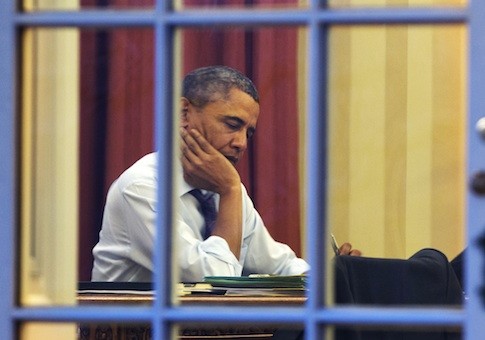
The candid comments by Rouhani’s right-hand-man could provide a window into the regime’s mindset as nuclear talks wind to a close.
The Obama administration has maintained for months that it will not permit Congress to have final say over the deal, which many worry will permit Iran to continue enriching uranium, the key component in a nuclear weapon.
*****************
The Iranian president’s senior advisor has called President Barack Obama “the weakest of U.S. presidents” and described the U.S. leader’s tenure in office as “humiliating,” according to a translation of the highly candid comments provided to the Free Beacon.
The comments by Ali Younesi, senior advisor to Iranian President Hassan Rouhani, come as Iran continues to buck U.S. attempts to woo it into the international coalition currently battling the Islamic State (IS, ISIL, or ISIS).
And with the deadline quickly approaching on talks between the U.S. and Iran over its contested nuclear program, Younesi’s denigrating views of Obama could be a sign that the regime in Tehran has no intent of conceding to America’s demands.
“Obama is the weakest of U.S. presidents, he had humiliating defeats in the region. Under him the Islamic awakening happened,” Younesi said in a Farsi language interview with Iran’s semi-official Fars News Agency.
“Americans witnessed their greatest defeats in Obama’s era: Terrorism expanded, [the] U.S. had huge defeats under Obama [and] that is why they want to compromise with Iran,” Younesi said.
The criticism of Obama echoes comments made recently by other world leaders and even former members of the president’s own staff, such as Former Defense Secretary Robert Gates.
Younesi, a former minister of intelligence in the country, also had some harsh comments about U.S. conservatives and the state of Israel.
“Conservatives are war mongers, they cannot tolerate powers like Iran,” he said. “If conservatives were in power they would go to war with us because they follow Israel and they want to portray Iran as the main threat and not ISIS.”
Younesi took a more conciliatory view towards U.S. Democrats, who he praised for viewing Iran as “no threat.”
“We [the Islamic Republic] have to use this opportunity [of Democrats being in power in the U.S.], because if this opportunity is lost, in future we may not have such an opportunity again,” Younesi said.
The candid comments by Rouhani’s right-hand-man could provide a window into the regime’s mindset as nuclear talks wind to a close.
The Obama administration has maintained for months that it will not permit Congress to have final say over the deal, which many worry will permit Iran to continue enriching uranium, the key component in a nuclear weapon.
About the potential for a nuclear deal, Youseni said, “I am not optimistic so much, but the two sides are willing to reach results,” according to an official translation posted online by Fars News.
Lawmakers on both sides of the aisle have adopted a much more pessimistic view of Iran’s negotiating tactics, which many on the Hill maintain are meant to stall for time as Tehran completes its nuclear weapon.
Rep. Ileana Ros-Lehtinen (R., Fla.), for instance, wrote a letter to the White House this week to tell Obama his desire to skirt Congress is unacceptable.
“Congress cannot and will not sit idly by if the Administration intends on taking unilateral action to provide sanctions relief to Iran for a nuclear deal we perceive to be weak and dangerous for our national security, the security of the region, and poses a threat to the U.S. and our ally, the democratic Jewish State of Israel,” Ros-Lehtinen wrote.
“If the Administration opts to act in a manner that directly contradicts Congress’ intent, then Congress must take all necessary measures to either reverse the executive, unilateral action, or to strengthen and enhance current sanctions law,” she told the president.
“President Obama does believe that by rewarding Iran and permitting it to do whatever it wants in the region, the mullahs in Tehran will be convinced to compromise,” said Saeed Ghasseminejad, an Iranian dissident and associate fellow at the Foundation for Defense of Democracies (FDD).
However, “the result has been disastrous: Iran controls 3 Arab capitals (Damascus, Beirut, and Baghdad) and its allies just captured the fourth one (Sana in Yemen) and Iran’s economy has significantly improved,” Ghasseminejad explained.
“Unfortunately, it does not seem that the mullahs reached the conclusion desired by the administration,” he said. “Iranians believe this administration is weak, it has lost its economic leverage over Iran and there is no credible military option on the table. Iran has been rewarded upfront, they now ask for more while are determined to keep their nuclear program intact.”




 anneinpt
 artaxes
 danmillerinpanama
 davidking1530
 Peter Hofman
 Joseph Wouk
 Peter
Peter Louisiana Steve
 WarSclerotic
Recent Comments