Uncertain Future for Kobane Prisoners: Turkey’s Border War (Dispatch 3), You Tube, Vice News, October 20, 2014
The battle for Jerusalem | Anne’s Opinions, 21st October 2014
Arab anti-Jewish violence in Jerusalem is predicated on the theory that the Jews are trying to “Judaize” Jerusalem – as if it could be anything else! And also on the widely spread myth that the Jews are out to destroy Al Aqsa and replace it with the Third Temple. “If only” is what I say. –AP)
Jerusalem has been under fire, both literally and diplomatically, for a long while now, but in recent weeks the situation has deteriorated sharply. If the authorities, i.e Binyamin Netanyahu and his Public Security Minister Yitzchak Aharanovitch don’t get matters in hand very soon I dread to think what might happen next.
Starting with the Silwan neighbourhood: contrary to the received wisdom, this is no “Arab East Jerusalem” neighbourhood. This was once a Jewish or mixed area, settled (oops, there goes that word again) by Yemenite Jews at the end of the 19th century.
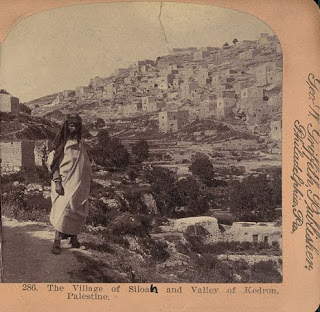
Yemenite Jew in Shiloah (Silwan) c. 1882
The Jews were driven out in the Arab riots of 1929 and were finally ethnically cleansed in 1948 by the marauding Arabs. The area remained Judenrein until Jerusalem was liberated in 1948. Somehow, since those 19 years of Arab occupation, the “Arab identity” of the area stuck and it is considered unacceptable for Jews to live there.
However over the last few years, Jewish individuals and organizations have started buying property in Silwan, which in any other area literally anywhere in the civilized world (I do not consider most Arab countries civilized) would not even raise an eyebrow. In the last few weeks two properties were purchased by Jews and the purchasers moved in, thereby doubling the Jewish presence in Silwan.
The Arabs have been seething ever since. Because Silwan is designated nowadays as an “Arab neighbourhood”, these purchases have been called provocation, theft and generally outrageous and inflammatory. The condemnations have come in swift and sharp from the likes of the PLO and various foreign ministries.
The fact is that it is an outrage that these people consider it an outrage for a Jew to buy a house, and – gasp! – move into it, in his own capital city, or any other city anywhere in Israel. The outrage, faux or real, only encourages the Palestinian irredentists to entrench themselves in their rejectionist positions. If the world is so concerned about peace in the region, they ought to internalise for themselves, and then teach the Palestinians that Jews are allowed to buy property and live in it wherever they so wish, just as the Israelis are pushed to allow the Palestinians to live where they wish.
“Deebo” at Israellycool has an excellent take-down of the Palestinian point of view as reported by the Palestinian newspaper Ma’an, which illustrates so clearly how slanted is the view about Israel, Jews and Jerusalem. One small example – with Deebo’s remarks in brackets:
The (previous) owners of the buildings, Salah al-Rajabi and Imran al-Qawasmi, sold the properties to a Palestinian man identified as Shams al-Din al-Qawasmi, who in turn sold the buildings to Jewish settler groups, the center said. (Oh that guy is dead meat now)
The previous Palestinian tenants left the buildings over four months ago. (so they “raided” and “occupied” an empty home, that was legally purchased, but some will still claim the previous inhabitants were forced into homelessness)
For more background and history of Silwan, and Jerusalem in general, read this scholarly article by Shaul Bartal in Middle East Quarterly. One very important point that he makes is this:
The ultimate goal of the Palestinians and their allies is to advance the idea that Jerusalem in general, and neighborhoods like Silwan in particular, have no Jewish ties. Archeological remnants found in Jerusalem are thus presented as either Canaanite or Muslim.
On the Temple Mount, Arab riots and Muslim provocations continue against Jewish visitors. I use the word “visitors” advisedly because Heaven forfend that they should be worshippers for that is forbidden by the Waqf and the Israeli police.
In the latest incidents Mahmoud Abbas has called Jewish visitors to their holiest site “herds of cattle”, and has now called for Jews to be banned completely from the Temple Mount, using “all means”. If that is not a call to violence I don’t know what is.
This follows the shocking daubing of swastikas on the Temple Mount, discovered this week:
Swastikas daubed on the Temple Mount
Avigdor Liberman got it right when he said that Abbas is an anti-semite trying to ignite a holy war in Jerusalem. The terrifying thing is that Abbas might well get what he wants. But he will be the loser – yet it will be blamed on Israel as usual.
The American blogger Meryl Yourish (so glad she has resumed writing) takes AP to task for calling Abbas’s inflammatory words “a suggestion” and concurs with Liberman’s accusations against Abbas:
In a speech quoted by the official Palestinian news agency Wafa, Abbas said Jewish “settlers” should be prevented from entering the site “by any means.”
“This is our Noble Sanctuary … they have no right to enter and desecrate it,” Abbas added.
That is outright religious hatred. He’s not talking about the mosque. He’s talking about the entire Temple Mount. You know, the holiest site in Judiasm. And “suggested”? really? You know what a suggestion is? “Hey, I think you should try putting a purple streak in your hair and see how it looks.” That’s a suggestion.
This? This is outright saying Jews have no right to their own holy place. No right to the site where both Temples stood, where the Ark of the Covenant resided, where Jewish priests blew the shofar on Rosh Hashanah–the site, in fact, where Judaism was practiced for centuries before Islam existed. This is part of the Palestinian strategy to pretend that the area was wholly Muslim and Jews have nothing to do with it. It is, straight out, a lie. And the AP calls it a suggestion.
The Muslim desecration of Jewish holy places extends even to the dead, as Arabs vandalised over 40 graves at the ancient Jewish cemetery on the Mount of Olives.

Jewish graves vandalised on the Mt. of Olives cemetery
Meanwhile, Arab anti-Jewish violence in Jerusalem continues, with lynching attempts, stonings, firebombings, not to mention the severe damage caused to the Jerusalem light rail, putting almost 40% of the line out of action.

Damage to Jerusalem light rail station

Jerusalem light rail train carriage windows smashed by Arab rioters
It has taken until now, but PM Binyamin Netanyahu has finally lost patience with the incompetence of the police and their lack of response to the Arab violence in Jerusalem.
Prime Minister Benjamin Netanyahu on Tuesday demanded Israeli police and security agencies take a harsher stand against escalating firebombing, stoning, and vandalism attacks against Jewish residents by pro-Palestinian Arabs in Jerusalem in recent months.
Calling to bolster police presence in the streets of the capital as a show of deterrence, Netanyahu “instructed that forces be increased in the confrontation areas and that vigorous action be taken against those who disturb the peace.”
…
However, despite the staunch calls for a crackdown on crime, a government official told the 0404 news site that Netanyahu is “furious” at Aharonovitch over his inability to quell the burgeoning violence.
According to the source, Netanyahu has expected that Aharonovitch know what steps to take in order to get the streets under some semblance of control.
“Netanyahu is furious with Aharonovitch’s lack of treatment on the terrorist attacks in Jerusalem,” the official said. “The situation is catastrophic. Aharonovitch ‘fell asleep on his watch,’ and now everyone’s getting hit by the ricochets.
“This verges on scandalous,” the official said.
Eyewitnesses at the meeting earlier in the day between Netanyahu, Aharonovitch, Barkat, police officials, and others who deal with the attacks in Jerusalem, said Netanyahu slammed his fist on the table as he turned to speak with Aharonovitch.
Netanyahu, according to those present, gave Aharonovitch five days to boost forces and stop the violence.
But since Netanyahu was the one who appointed Aharonovitch in the first place, why does he not fire him and find a more competent replacement?
This is not a matter of mere politics any more.
Unfortunately, the battle for Jerusalem is not only in our own hands. As Shaul Bartal in the above-mentioned Middle East Quarterly article sums up with these sad words:
Sadly, the battle over Silwan (and for that matter the wider Palestinian-Israeli conflict) is likely to continue as long as Palestinian Arabs and their brethren refuse to recognize that another people, the Jews, have a claim to the Land of Israel.
What do Kobani airdrops mean for regional politics? Al-Monitor, Amberin Zaman, October 20, 2014
 Smoke and flames rise over the Syrian town of Kobani after an airstrike, as seen from the Mursitpinar crossing on the Turkish-Syrian border in the southeastern town of Suruc, Oct. 20, 2014. The United States told Turkey that a US military airdrop of arms to Syrian Kurds battling the Islamic State in Kobani was a response to a crisis situation and did not represent a change in US policy. (photo by REUTERS/Kai Pfaffenbach
The US will use its new leverage over the PYD to push the Kurds to engage with factions opposed to Syrian President Bashar al-Assad, particularly the Free Syrian Army. The YPG’s existing battleground alliance with various rebel factions will, therefore, probably expand.
****************
On Oct. 19, the US Central Command (CENTCOM) announced that it had conducted multiple airdrops near the Syrian Kurdish town of Kobani, which has remained under siege by Islamic State (IS) fighters for more than a month. CENTCOM said US C-13 cargo planes had made multiple drops of arms, ammunition, and medical supplies provided by Kurdish authorities in Iraq. The move is set to have a profound effect on regional balances between Turkey, the Kurds and the United States that will likely reverberate in Tehran and in Damascus as well.
For several weeks now, the US and its allies have been bombing IS positions around Kobani. But the delivery of weapons takes the de facto alliance between the Syrian Kurds and the United States to a new level.
Turkey, which borders Kobani, is best positioned to help the Syrian Kurds. But the country’s ruling Justice and Development (AKP) party has spurned repeated Syrian Kurdish demands to allow weapons and fighters to cross through Turkey into the Syrian Kurdish enclave. On Oct. 18, Turkish President Recep Tayyip Erdogan said that the Syrian Kurdish Democratic Union Party (PYD), whose armed wing the People’s Protection Units (YPG) is battling IS in Kobani, were “the same as the PKK. “It’s a terrorist organization. It would be very, very wrong to expect us to openly say ‘yes’ to our NATO ally America to give this kind of [armed] support [to the PYD],” Erdogan declared.
Erdogan was referring to the PYD’s close links to the Kurdistan Workers Party (PKK), which has been fighting on and off for self-rule inside Turkey since 1984. The PKK is on the State Department’s list of terrorist organizations, and until last month successive US administrations refused to have any contact either with the PKK or the PYD. But the PKK and the YPG’s effectiveness against IS both in Iraq and Syria has triggered a paradigm shift in US strategic thinking. The US and the Syrian Kurds are now allies in the war against IS.
US Secretary of State John Kerry told reporters in Jakarta, Indonesia that while the Obama administration understood Turkey’s concerns, it would have been “irresponsible” and “morally difficult” not to support the Syrian Kurds in their fight against IS.
Kerry said IS had chosen to “make this a ground battle, attacking a small group of people there who, while they are an offshoot group of the folks that our friends the Turks oppose, they are valiantly fighting ISIL and we cannot take our eye off the prize here.” Kerry stressed, however, that it was “a momentary effort” and that the US had “made it very clear” to Turkey that it “is not a shift in the policy of the United States.”
Kerry’s words came hours after US President Barack Obama spoke over the telephone with Erdogan about Kobani. News emerged soon after that Turkey would be allowing Iraqi Kurdish peshmerga fighters to cross through Turkey into Kobani carrying fresh weapons for the YPG. How in the space of 48 hours did Turkey go from calling the PYD terrorists to opening an arms corridor for them?
As analysts ponder these dizzying changes, here a few immediate factors to consider:
Turkey could have led the effort to support anti-IS forces in Kobani by letting arms and fighters through its borders weeks ago. This would have bolstered the peace process between Turkey and its own Kurds, while averting the public relations disaster caused by images of Turkish tanks and soldiers looking on as the Syrian Kurds battled IS in Kobani, thereby reinforcing claims that “Turkey supports IS.
The fact that Turkey was forced into opening a corridor to Kobani only after the US informed Ankara that it would go ahead with the airdrops anyway only increases doubts about Turkey’s commitment to working with its Western partners. It also plays into the hands of Erdogan’s domestic rivals, who will now say he is America’s poodle and that the US is using the PKK to tame Turkey.
One big question is whether the recent days’ events mean that the PYD will move away from the PKK. The likely answer is that the PKK will seek to move closer to the US. The PKK has already established a channel of communication with the US via the PYD in Syria, and is also fighting alongside US-supported Kurdish peshmerga forces in Iraq. Any attempt to drive a wedge between the PYD and the PKK is doomed to fail. Abdullah Ocalan, the imprisoned founder and leader of their PKK, commands the loyalty of Syrian and Turkish Kurds alike.
Any US-PKK dialogue would make the PKK less likely to resume violence against the Turkish army, as this would tarnish its burgeoning legitimacy. Turkey could yet turn the situation to its advantage and make goodwill gestures to the Syrian Kurds. These could include opening the sealed border with the PYD-controlled town of Serkaniye (Ras al Ain). The fact that US drones flew drone reconnaissance missions over Kobani out of the Incirlik air base has gone largely unnoticed in the media. So Turkey actually has helped, but chose not to advertise this.
The Kurds adeptly used the media and global public opinion — which depicted them as the region’s secular, pro-Western force, a space formerly occupied by Turkey — to draw the US into the battle for Kobani. The battle for Kobani then became a symbol of the contest between IS and the coalition, one that the US could no longer afford to lose. Moreover, the concentration of IS forces around Kobani allowed the US to inflict heavy losses on IS fighters.
Iraqi Kurdish President Massoud Barzani is probably unhappy about US engagement with the PYD/PKK, which he views as rivals. But, unlike Turkey, he has turned the situation to his own advantage by projecting himself as a benevolent leader who has aided fellow Kurds in their time of need.
The US will use its new leverage over the PYD to push the Kurds to engage with factions opposed to Syrian President Bashar al-Assad, particularly the Free Syrian Army. The YPG’s existing battleground alliance with various rebel factions will, therefore, probably expand.
Is the de facto non-aggression pact between the Syrian regime and the Kurds coming unstuck? It’s too early to say, because the US insists that its military intervention in Syria is limited to countering IS. The Kurds are likely to continue to hedge their bets for as long as they can.
And what of the PYD’s other primary benefactor, Iran? Will its friendship with the Americans anger the clerics? Much will depend on whether the US and Iran can reach a deal over Iran’s nuclear program. Should the talks fail, the PKK may become an instrument of US policy to be used against Iran.
Any alliance in the Middle East should never be taken for granted.
Syria tribal revolt against Islamic State ignored, fueling resentment, Washington Post, Liz Sly, October 20, 2014
(Aside from responding to anticipated domestic political pressure after the (non-Islamic) Islamic State beheaded an American, what are we doing in Iraq and Syria and why? Are we trying to win hearts and minds, to maintain the semblance of a coalition of the unwilling or merely to do “something?” — DM)
“When you see your relatives being slaughtered, you will be forced to accept compromises you would otherwise never have been prepared to accept,” he said. “And when you see the world has abandoned you, you will do nothing about it.”
******************
REYHANLI, Turkey — The cost of turning against the Islamic State was made brutally apparent in the streets of a dusty backwater town in eastern Syria in early August. Over a three-day period, vengeful fighters shelled, beheaded, crucified and shot hundreds of members of the Shaitat tribe after they dared to rise up against the extremists.
By the time the killing stopped, 700 people were dead, activists and survivors say, making this the bloodiest single atrocity committed by the Islamic State in Syria since it declared its existence 18 months ago.
The little-publicized story of this failed tribal revolt in Abu Hamam, in Syria’s eastern Deir al-Zour province, illuminates the challenges that will confront efforts to persuade those living under Islamic State rule — in Iraq as well as Syria — to join the fight against the jihadist group, something U.S. officials say is essential if the campaign against the militants is to succeed.
The Abu Hamam area has now been abandoned, and many of the bodies remain uncollected, offering a chilling reminder to residents elsewhere of the fate that awaits those who dare rebel.
Just as powerful a message for those living under the militants’ iron fist was the almost complete international silence on the bloodbath.
(Please go to the link for a video — DM)
The fiercest fighting in days shook the Syrian border town of Kobane, forcing more refugees to pour into Turkey for shelter from the violence. (Reuters)News of the massacre coincided with President Obama’s decision to order airstrikes to turn back an Islamic State advance unfolding farther east in Iraq, toward the Kurdish regional capital of Irbil, as well as humanitarian airdrops to help desperate Iraqi Yazidis trapped on a mountain by the onslaught.
Many Syrians in the opposition are starting to complain about unequal treatment.
U.S. warplanes have carried out more airstrikes on Islamic State forces besieging the Kurdish town of Kobane on Syria’s border with Turkey than on any other single location in Iraq or Syria. And Washington announced Sunday that U.S. planes had airdropped weapons and medical supplies to the beleaguered Kurdish fighters there.
Yet even now, Washington has directed little effort toward helping Sunni Arabs who want to fight the militants but lack the resources to do so, said Abu Salem, who was among the Shaitat tribesman and rebel commanders who gathered recently in an apartment in the Turkish border town of Reyhanli to recount the killings of their clansmen.
“We saw what the Americans did to help the Yazidis and the Kurds. But they have done nothing to help the Sunnis against the Islamic State,” he said.
Abu Salem and the other men said they did not so much begrudge the efforts to help Kurds as wonder why no one had helped them when their community was under attack. The carnage inflicted on the Shaitat tribe has instilled in the Abu Hamam survivors a loathing for the Islamic State and the warped brand of Islamist politics for which it stands, said Abu Siraj, another of the tribesmen. A former lawyer, he, like most of the men, asked to be identified only by his nom de guerre because he fears being tracked even to Turkey by the jihadists.
“Now we hate everyone who prays,” he said. “Now we hate even beards.”
“When you see your relatives being slaughtered, you will be forced to accept compromises you would otherwise never have been prepared to accept,” he said. “And when you see the world has abandoned you, you will do nothing about it.”
U.S. officials say the Kobane attacks were not intended to show preference for one community over another, but rather served as an opportunity to take aim at the large number of militant fighters who converged on the town to capture it. The Pentagon claims to have killed hundreds of Islamic State militants around Kobane, in keeping with the wider U.S. goal of targeting the Islamists’ infrastructure and resources in Syria to downgrade their ability to reinforce and finance their operations in Iraq.
The primary focus of the American strategy, Gen. Lloyd Austin, the U.S. Central Command leader, stressed last week, remains on Iraq, and on preventing the Islamic State from projecting power there.
“Iraq is our main effort, and it has to be,” he said at a news conference in Washington. “And the things we are doing right now in Syria are being done primarily to shape the conditions in Iraq.”
Such comments have reinforced perceptions among Syrians that the U.S.-led air war does not have their interests at heart. Differences over the purposes and direction of the war risk alienating the many rebel groups that were engaged in battling the Islamic State before the U.S. government intervened, said Steven Heydemann of the U.S. Institute of Peace.
“It’s already become an impediment,” he said. “I don’t think the administration has fully taken on board how much damage the way they’ve conducted this campaign has done to the relationships they’ve developed with some of these actors.”
The Sunni areas of Syria occupied by the Islamic State would seem to be a more likely venue for a revolt than Iraq, where the extremists’ extensive territorial gains this year were aided by local Sunni insurgents and tribes alienated by the discriminatory behavior of the Shiite-led Iraqi government.
In Syria, however, the Islamic State’s conquests came at the expense of local rebels who already had fought to eject their government and then found themselves outgunned and outmaneuvered by the newly emerging Islamist extremists.
The Shaitat tribe, along with many others in the oil-rich province of Deir al-Zour bordering Iraq, spent much of this year battling to retain control of their area against encroachments by the Islamic State, and they might have prevailed had the Islamic State not swept into the Iraqi city of Mosul in June, rebels say. The vast amounts of U.S. weaponry the Islamic State captured were trundled across the rapidly dissolving border with Syria, said Abu Salem, who commanded a rebel battalion in the area before he escaped to Turkey.
“After they took Mosul, we were finished,” he said.
Abu Hamam and a cluster of villages nearby were targeted. After the new armaments from Iraq arrived, “we realized we had no hope. We were surrounded. We wanted to save our people,” said Abu Abdullah, another of the Shaitat fighters, describing how they agreed to a truce with the militants in mid-July.
The Islamic State was permitted to enter the town and establish a garrison, but local leaders were left in charge, he said.
Relations quickly frayed. The crunch came, the tribesmen in Reyhanli said, when Islamic State fighters whipped a local man who was caught smoking a cigarette in the street, a crime under the Islamic State’s harsh interpretation of Islam. The man’s brother, incensed, shot at a passing Islamic State patrol, killing one of its fighters.
The brother was arrested and publicly beheaded, triggering an outpouring of rage. Residents marched on the Islamic State’s headquarters, forcing its fighters to flee. The militants then brought in reinforcements and began shelling the town, using artillery they had captured the previous month in Iraq.
After a three-day barrage, the Islamic State militants moved in. They rounded up all the surviving men and boys older than 15 they could find and set about systematically killing them, the fighters in Reyhanli said.
A photo essay on an Islamic State blog boasted of the different ways tribesmen were killed, including beheadings, mass shootings and a crucifixion. A video shows how the militants lined up scores of captives on a road, their hands bound, then set about clumsily decapitating them, one by one. The executioners, speaking in Tunisian, Egyptian and Saudi accents, taunted those not yet dead by swinging severed heads in front of their faces and telling them, “It’s your turn next.”
The tribesmen in Reyhanli, like many other rebel fighters in Deir al-Zour now living in Turkey or elsewhere in Syria, said they managed to slip away using fake identity cards or escape routes honed during their battle against the government.
They said they are plotting their return, to take revenge and fight — without counting on international support.
“We are tribal people. We will never forget to avenge,” said Abu Salem, the commander of the group. “But we will do it by ourselves, in our own way. We won’t take any help from anyone.”
Boo Hoo Palestine, You Tube, Pat Condell, October 20, 2014




 anneinpt
 artaxes
 danmillerinpanama
 davidking1530
 Peter Hofman
 Joseph Wouk
 Peter
Peter Louisiana Steve
 WarSclerotic
Recent Comments