(I.A.E.A. verification that Iran will not get (or keep) nukes seems to be less important in getting a deal than maintaining the fiction that effective sanctions can be restored in several years if appropriate. However, they have already been extended, breached and enjoyed by Iran’s many trading partners to the degree that restoring them successfully even now would be virtually impossible. — DM)
“We have been clear that initially there would be suspension of any of the U.S. and international sanctions regime, and that the lifting of sanctions will only come when the I.A.E.A. verifies that Iran has met serious and substantive benchmarks . . . ”
************************
WASHINGTON — No one knows if the Obama administration will manage in the next five weeks to strike what many in the White House consider the most important foreign policy deal of his presidency: an accord with Iran that would forestall its ability to make a nuclear weapon. But the White House has made one significant decision: If agreement is reached, President Obama will do everything in his power to avoid letting Congress vote on it.
(How about the “one state solution” satirically proposed by Andrew Klavan in 2011?
Nope, that makes more sense but wouldn’t work either. — DM)
The “Arab Spring” did not erupt as a result of the Israeli-Palestinian conflict. Rather, it was the outcome of decades of tyranny and corruption in the Arab world. The Tunisians, Egyptians, Libyans and Yemenis who removed their dictators from power did not do so because of the lack of a “two-state solution.” This is the last thing they had in mind.
The thousands of Muslims who are volunteering to join the Islamic State [IS] are not doing so because they are frustrated with the lack of progress in the Israeli-Palestinian peace talks.
The only solution the Islamic State believes in is a Sunni Islamic Caliphate where the surviving non-Muslims who are not massacred would be subject to sharia law.
What Kerry perhaps does not know is that the Islamic State is not interested in the Israeli-Palestinian conflict at all. Unlike Kerry, Sunni scholars fully understand that the Islamic State has more to do with Islam and terrorism than with any other conflict.
U.S. Secretary of State John Kerry’s claim that the lack of a “two-state solution” has fueled the rise of the Islamic State [IS] terrorist group reinforces how clueless the U.S. Administration is about what is happening in the Arab and Islamic countries.
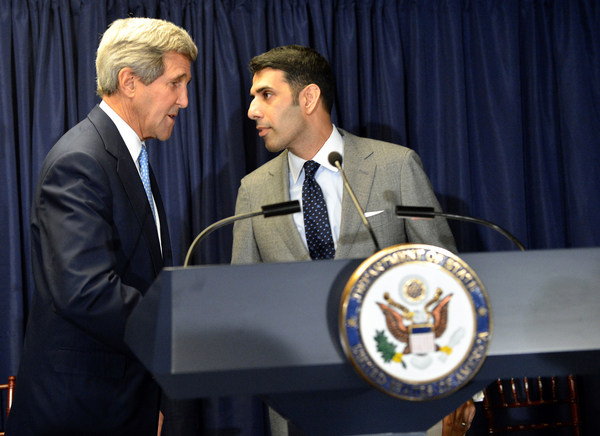
Speaking at a State Department ceremony marking the Muslim holiday of Eid al-Adha, Kerry said that the resumption of peace negotiations between Israel and the Palestinians was vital in the fight against Islamic extremism, including Islamic State.
‘Forget ISIS… let’s talk more about a Palestinian state.’ Above, U.S. Secretary of State John Kerry greets U.S. Special Representative to Muslim Communities Shaarik Zafar during an Eid al-Adha reception on Oct. 16, 2014 at the U.S. Department of State in Washington, D.C. (Image source: State Dept.)
“There wasn’t a leader I met with in the region who didn’t raise with me spontaneously the need to try to get peace between Israel and the Palestinians, because it was a cause of recruitment and of street anger and agitation,”Kerry said. “People need to understand the connection of that. And it has something to do with the humiliation and denial and absence of dignity.”
The U.S. State Department later denied that Kerry had made the statement attributed to him.
Deputy Spokesperson Marie Harf told reporters that Kerry’s comments were distorted for political gains; she pointed a finger at Israeli Economy Minister Naftali Bennett.
“What [Kerry] said was that during his travels to build a coalition against the Islamic State, he was told that should the Israeli-Palestinian conflict be resolved, the Middle East would be a better place,” Harf explained.
The Islamic State is one of the by-products of the “Arab Spring,” which began as a secular revolt against Arab dictatorships and degenerated into anarchy, lawlessness, terrorism and massacres that have claimed the lives of hundreds of thousands of Arabs and Muslims.
The “Arab Spring” did not erupt as a result of the Israeli-Palestinian conflict. Rather, it was the natural and inevitable outcome of decades of tyranny and corruption in the Arab world.
The Tunisians, Egyptians, Libyans and Yemenis who removed their dictators from power did not do so because of the lack of a “two-state solution.”
Nor did the Arabs revolt because of the failure of the peace process between Israel and the Palestinians. This is the last thing these Arabs had in mind when they took to the streets to protest against decades of dictatorship and bad government.
It is this “Arab Spring,” and not the Israeli-Palestinian conflict, that brought the Muslim Brotherhood to power in Egypt. And it is the same “Arab Spring” that saw the emergence of Islamic terror groups such as the Al-Nusra Front, the Islamic Front, the Army of Mujahedeen, Jund al-Sham and, most recently, the Islamic State in Syria and Iraq.
The rise of the Islamic State is a direct result of the anarchy and extremism that have been sweeping the Arab and Islamic countries over the past few years.
The thousands of Muslims who are volunteering to join Islamic State are not doing so because they are frustrated with the lack of progress in the Israeli-Palestinian peace talks. They are not knocking on the Islamic State’s doors because they are disappointed that the two-state solution has not materialized.
Kerry is anyway naïve to think that the jihadis believe in something called a “two-state” solution. The only solution the Islamic State believes in is the one that would lead to the establishment of a radical Sunni Islamic Caliphate across the Middle East where the surviving non-Muslims who are not massacred would be subject to sharia law.
Not only is the Islamic State opposed to the “two-state solution,” it is also opposed to the existence of both Israel and a Palestinian state. Under the new Islamic Caliphate, there is no room for Israel or Palestine or any of the Arab and Islamic countries.
Had Kerry studied the goals and ideology of the Islamic State, he would have discovered that the Israeli-Palestinian conflict is not even at the top of the group’s list of priorities.
In fact, the “liberation of Bait al-Maqdis” [Jerusalem] is ranked sixth among Islamic State’s objectives.
The group’s first goal envisages stirring chaos in the Arab and Islamic countries.
Second, the group will move on to what it calls “management of savagery” in these countries.
Third, Islamic State will embark on the process of establishing an Islamic Caliphate.
Fourth, it will proceed with “liberating neighboring countries and expanding the size of the Islamic Caliphate.
Fifth, the group will start the process of “liberating the Islamic countries,” including Bait al-Maqdis.
Obviously, Kerry must have missed the speech delivered by Islamic State leader Abu Bakr al-Baghdadi last July.
Al-Baghdadi did not talk about the “two-state solution.” Nor did he call on Muslims to join his group because of the lack of progress in the Israeli-Palestinian peace process.
Instead, al-Baghdadi told his followers that, “Allah likes us to kill his enemies, and make jihad for his sake. O Allah, give Islam victory over the disbelief and the disbelievers, and give victory to the mujahideen, in the East of this earth and its West.”
What Kerry perhaps does not know is that the Islamic State is not interested in the Israeli-Palestinian conflict at all. The terrorist group did not even bother to comment on the last military confrontation between Israel and Hamas in the Gaza Strip.
The failure of the Islamic State to express solidarity with the Palestinians or Hamas during the war drew strong condemnations from some of the Arab world’s leading columnists.
“What is shocking and strange is that the Islamic State and other terrorist groups that claim to speak on behalf of Islam did not make a single move as Israeli planes were shelling civilians inside the Gaza Strip,” remarked Egyptian columnist Jamil al-Afifi. “Nor did any of their wise men come out to condemn the ruthless killings (in the Gaza Strip).
Kerry did not reveal the identity of the “leaders” who told him that the absence of peace between Israel and the Palestinians was a “cause of recruitment and of street anger and agitation” in the Arab and Islamic countries.
What is clear, however, is that Sunni scholars do not seem to share Kerry’s assessment.
Last month, over 120 Sunni scholars issued an open letter denouncing the Islamic State and its religious arguments. “You have misinterpreted Islam into a religion of harshness, brutality, torture and murder,” the letter said. “This is a great wrong and an offence to Islam, to Muslims and to the entire world.”
Needless to say, the scholars did not mention the Israeli-Palestinian conflict as a cause for the rise of Islamic State.
That is because unlike Kerry, the Sunni scholars know that the Islamic State is completely unrelated to the Israeli-Palestinian conflict. And unlike Kerry, the Muslim scholars fully understand that Islamic State has more to do with Islam and terrorism than with any other conflict.
Not only are foodstuffs, medical supplies—even clinics—going to ISIS, the distribution networks are paying ISIS ‘taxes’ and putting ISIS people on their payrolls.
While aid is still going into ISIS-controlled areas, only a little is going into Kurdish areas in northeast Syria.
***************
GAZIANTEP, Turkey — While U.S. warplanes strike at the militants of the so-called Islamic State in both Syria and Iraq, truckloads of U.S. and Western aid has been flowing into territory controlled by the jihadists, assisting them to build their terror-inspiring “Caliphate.”
The aid—mainly food and medical equipment—is meant for Syrians displaced from their hometowns, and for hungry civilians. It is funded by the U.S. Agency for International Development, European donors, and the United Nations. Whether it continues is now the subject of anguished debate among officials in Washington and European. The fear is that stopping aid would hurt innocent civilians and would be used for propaganda purposes by the militants, who would likely blame the West for added hardship.
The Bible says if your enemy is hungry, feed him, and if he is thirsty, give him something to drink—doing so will “heap burning coals” of shame on his head. But there is no evidence that the militants of the Islamic State, widely known as ISIS or ISIL, feel any sense of disgrace or indignity (and certainly not gratitude) receiving charity from their foes.
Quite the reverse, the aid convoys have to pay off ISIS emirs (leaders) for the convoys to enter the eastern Syrian extremist strongholds of Raqqa and Deir ez-Zor, providing yet another income stream for ISIS militants, who are funding themselves from oil smuggling, extortion and the sale of whatever they can loot, including rare antiquities from museums and archaeological sites.
“The convoys have to be approved by ISIS and you have to pay them: the bribes are disguised and itemized as transportation costs,” says an aid coordinator who spoke to The Daily Beast on the condition he not be identified in this article. The kickbacks are either paid by foreign or local non-governmental organizations tasked with distributing the aid, or by the Turkish or Syrian transportation companies contracted to deliver it.
And there are fears the aid itself isn’t carefully monitored enough, with some sold off on the black market or used by ISIS to win hearts and minds by feeding its fighters and its subjects. At a minimum the aid means ISIS doesn’t have to divert cash from its war budget to help feed the local population or the displaced persons, allowing it to focus its resources exclusively on fighters and war making, say critics of the aid.
One of the striking differences between ISIS and terror groups of the past is its desire to portray the territory it has conquered as a well organized and smoothly functioning state. “The soldiers of Allah do not liberate a village, town or city, only to abandon its residents and ignore their needs,” declares the latest issue of the group’s slick online magazine, “Dabiq.” Elsewhere in the publication are pictures of slaughtered Kurdish soldiers and a gruesome photograph of American journalist Steven Sotloff’s severed head resting on top of his body. But this article shows ISIS restoring electricity in Raqqah, running a home for the elderly and a cancer treatment facility in Ninawa, and cleaning streets in other towns.
Last year, a polio outbreak in Deir ez-Zor raised concerns throughout the region about the spread of an epidemic. The World Health Organization worked with the Syrian government and with opposition groups to try to carry out an immunization campaign. This has continued. In response to a query by The Daily Beast, a WHO spokesperson said, “Our information indicates that vaccination campaigns have been successfully carried out by local health workers in IS-controlled territory.”
“I am alarmed that we are providing support for ISIS governance,” says Jonathan Schanzer, a Mideast expert with the Washington D.C.-based think tank Foundation for Defense of Democracies. “By doing so we are indemnifying the militants by satisfying the core demands of local people, who could turn on ISIS if they got frustrated.”
U.S. and Western relief agencies have been caught before in an aid dilemma when it comes to the war on terror. Last December, the Overseas Development Institute, an independent British think tank focusing on international development and humanitarian issues, reported that aid agencies in Somalia had been paying militants from the al Qaeda offshoot al-Shabab for access to areas under their control during the 2011 famine.
Al-Shabab demanded from the agencies what it described as “registration fees” of up to $10,000. And in many cases al-Shabab insisted on distributing the aid, keeping much of it for itself, according to ODI. The think tank cited al-Shabab’s diversion of food aid in the town of Baidoa, where it kept between half and two-thirds of the food for its own fighters. The researchers noted the al Qaeda affiliate developed a highly sophisticated system of monitoring and co-opting the aid agencies, even setting up a “Humanitarian Co-ordination Office.”
Something similar appears to be underway now in the Syrian provinces of Raqqa and Deir ez-Zor.
Aid coordinators with NGOs partnering USAID and other Western government agencies, including Britain’s Department for International Development, say ISIS insist that the NGOs, foreign and local, employ people ISIS approves on their staffs inside Syria. “There is always at least one ISIS person on the payroll; they force people on us,” says an aid coordinator. “And when a convoy is being prepared, the negotiations go through them about whether the convoy can proceed. They contact their emirs and a price is worked out. We don’t have to wrangle with individual ISIS field commanders once approval is given to get the convoy in, as the militants are highly hierarchical.” He adds: “None of the fighters will dare touch it, if an emir has given permission.”
That isn’t the case with other Syrian rebel groups, where arguments over convoys can erupt at checkpoints at main entry points into Syria, where aid is unloaded from Turkish tractor-trailers and re-loaded into Syrian ones.
Many aid workers are uncomfortable with what’s happening. “A few months ago we delivered a mobile clinic for a USAID-funded NGO,” says one, who declined to be named. “A few of us debated the rights and wrongs of this. The clinic was earmarked for the treatment of civilians, but we all know that wounded ISIS fighters could easily be treated as well. So what are we doing here helping their fighters, who we are bombing, to be treated so they can fight again?”
What becomes even more bizarre is that while aid is still going into ISIS-controlled areas, only a little is going into Kurdish areas in northeast Syria. About every three or four months there is a convoy into the key city of Qamishli. Syrian Kurds, who are now defending Kobani with the support of U.S. warplanes, have long complained about the lack of international aid. Last November, tellingly, Syrian Kurds complained that Syria’s Kurdistan was not included in a U.N. polio vaccination campaign. U.N. agencies took the position that polio vaccines should go through the Syrian Red Crescent via Damascus when it came to the Kurds.
The origins of the aid programs pre-date President Barack Obama’s decision to “degrade and defeat” ISIS, but they have carried on without major review. The aid push was to reach anyone in need. A senior State Department official with detailed knowledge of current aid programs confirmed to The Daily Beast that U.S. government funded relief is still going into Raqqa and Deir Ez-Zor. He declined to estimate the quantity. But an aid coordinator, when asked, responded: “A lot .”
The State Department official said he, too, was conflicted about the programs. “Is this helping the militants by allowing them to divert money they would have to spend on food? If aid wasn’t going in, would they let people starve? And is it right for us to withhold assistance and punish civilians? Would the militants turn around,. as al-Shabab did when many agencies withdrew from Somalia, and blame the West for starvation and hunger? Are we helping indirectly the militants to build their Caliphate? I wrestle with this.”
Western NGO partners of USAID and other Western agencies declined to respond to Daily Beast inquiries about international relief going to ISIS areas, citing the complexity of the issue and noting its delicacy.
Mideast analyst Schanzer dismisses the notion that ISIS can use an aid shutdown as leverage in its PR campaign: “I think this is false. In areas they control everyone understands they are a brutal organization. This is their basic weakness and by pushing in aid we are curtailing the chances of an internal revolt, which is the best chance you have of bringing down ISIS.”
With Nov. 24 deadline approaching for final nuclear agreement between world powers and Iran, PM Benjamin Netanyahu warns against deal that would leave Iran as a nuclear threshold state • Iran poses a greater threat than Islamic State, says Netanyahu.
Shlomo Cesana, Yori Yalon and Israel Hayom Staff
Prime Minister Benjamin Netanyahu at an event honoring the late former Prime Minister Yitzhak Shamir, Jerusalem, Sunday
|
Photo credit: Dudi Vaaknin
With the Nov. 24 deadline for a final nuclear deal between world powers and Iran approaching, Prime Minister Benjamin Netanyahu warned on Sunday of the dangers a nuclear-armed Iran would pose.
“This is a threat to the entire world, and, first and foremost, this is a threat to us,” Netanyahu said at an event honoring the late former Prime Minister Yitzhak Shamir.
“This threat is grave to all of us, far more than the threat of the Islamic State group. Today, we are facing the danger of an agreement [between world powers and Iran] that would leave Iran as a nuclear threshold state, with thousands of centrifuges with which it could produce material for a nuclear bomb within a short period of time.”
At Sunday’s event, Highway 9 in Jerusalem was named after Shamir, who served as prime minister from 1983 to 1984 and again from 1986 to 1992. At the ceremony, Netanyahu spoke highly of the deceased leader, saying Shamir had understood that “we must rely, first of all, on ourselves, on our power to defend ourselves.”
Israeli officials said they were “deeply concerned” about the emerging agreement between world powers — led by the U.S. — and Iran. Based on the information it has about the potential deal, Israel is increasingly worried that Iran would remain a nuclear threshold state with the capability to build a nuclear bomb within just a few months.
According to a Channel 2 report, the U.S. is willing to accept an agreement with Iran that would permit it to retain 5,000 centrifuges.
In an op-ed published in The New York Times on Sunday, International Relations, Intelligence and Strategic Affairs Minister Yuval Steinitz called on world powers not to reach a nuclear agreement with Iran.
“Iran has softened its inflammatory anti-Western rhetoric and shown some flexibility on less important issues, but we must not be duped by these gestures,” Steinitz wrote. “President [Barack] Obama must stand by his declaration that no deal with Iran is better than a bad deal.”





 anneinpt
 artaxes
 danmillerinpanama
 davidking1530
 Peter Hofman
 Joseph Wouk
 Peter
Peter Louisiana Steve
 WarSclerotic
Recent Comments