Archive for October 19, 2014

Chasing a bad deal with Iran – The Washington Post

October 19, 2014

Chasing a bad deal with Iran – The Washington Post.

October 19 at 2:00 PM

Reporting on the “P5+1″ talks over the last month or so suggests the administration is trying one gambit after another in a desperate attempt to strike a deal by the Nov. 24 deadline, which was extended from July 20. Now the Associated Press reports:

Ahead of a Nov. 24 deadline to seal a deal, diplomats told the AP last month that U.S. had begun floating alternates to reducing centrifuges that would eliminate the disagreement but still accomplish the goal of increasing the time Iran would need to make a nuclear weapon.
Among them was an offer to tolerate more centrifuges if Tehran agreed to reduce its stockpile of low-enriched uranium, which can fuel reactors but is also easily turned into weapons-grade material. . . . Experts say the low-enriched uranium Iran has stored, if further enriched, could arm up to seven nuclear weapons. They estimate it would take Tehran between 3-to-12 months to have enough weapons-grade uranium for one bomb.

“This is simply one more long slide down the slippery slope,” says former ambassador to the United Nations John Bolton. “No enrichment activity should be permitted as long as the ayatollahs remain in power. Every retreat from that principle  — and this is a long one  –  makes it easier for Iran to enrich to weapons-grade levels quickly and efficiently.” All of these plans share a common flaw. Bolton argues that “this entire negotiation assumes that the United States has perfect knowledge about Iran’s nuclear program, and that nothing is hidden from our view.” We obviously don’t have intelligence this sophisticated, as was proved whenever a “secret” enrichment plant eventually popped up or when the administration’s assessments of threats throughout the region turned out to be dead wrong. (If President Obama blames the intelligence community for missing the rise of the Islamic State, why should we assume we would have perfect knowledge of a concealed Iranian nuclear program?)

Moreover, to this day Iran has not allowed unrestricted  inspections of all facilities (such as the Parchin military complex where an explosion recently occurred). Iran has yet to clear up existing inspection issues with the International Atomic Energy Agency. If it is not complying now, what makes the administration think Iran won’t interfere with or throw out inspectors as sanctions are gradually lifted?

Letting Iran keep thousands of centrifuges is contrary to the position of this, the previous administration and six U.N. resolutions. The reason is obvious. Mark Dubowitz of the Foundation for Defense of Democracies observes that we would have little recourse under the scheme being floated if Iran simply decided to halt the transfer of enriched materials. “One day, it would find an excuse why it no longer can ship its [enriched uranium] to Russia and why it needs to stockpile it at home,” he said.

This idea is not even new. We tried this out when Iranian President Mahmoud Ahmadinejad was still in office — before Iran got several more years of enrichment and development of even faster centrifuges. Michael Makovsky of JINSA explains, “If Iran shipped all or almost all of its fuel out plus accepted other restrictions on enrichment then would be welcome, but I doubt that’s what’s on the table.” Moreover if it plans to ship the materials to Russia, for example, our ability to monitor what is coming out is further limited. (Syria managed to keep some of its chemical weapons in a similar arrangement.) “The administration is struggling how to allow Iranians to adhere to their red line while reducing its nuclear program in the near-term,” says Makovsky. “And that circle isn’t easily squared especially since we’ve unilaterally reduced our leverage over last year [by partially rolling back sanctions].”

It is not clear if the current proposal is one more variation on another idea experts like  Robert Joseph,  former undersecretary of state for arms control and international security, has already discredited. He wrote this summer:

To break the impasse over centrifuges, the negotiators reportedly are considering a different metric to limit Iran’s uranium-enrichment capability: separative work units, or SWU, as the concept is known. . . . On the surface, SWU provides a politically defensible means to measure output for enrichment. It is a unit of calculation used widely in the nuclear-energy industry, as well as by the IAEA in its quarterly reports on Iran’s nuclear program. But using SWU as a substitute for limiting the number of centrifuges is nothing more than sleight of hand. While it is necessary for any agreement to limit how much enriched material Iran can produce and stockpile, this is not the stated U.S. goal. That goal – to extend the time of breakout – requires strict and verifiable limits on centrifuges along with additional prohibitions on next-generation replacements and effective constraints on maintenance, research, and development.

Joseph therefore concludes, “Moving away from a centrifuge limit to the SWU metric would represent the next step to a failed outcome. But whether SWU is adopted or not, if there are no restrictions on missiles, no effective constraints on R&D, only managed access on inspections, no tight controls on imports and manufacture of equipment, and other gaps that Iran can and will exploit (such as failing to come clean on past weaponization activities), the agreement will allow Iran to remain what it is today: a nuclear-weapons-threshold state.”

In sum, taking away Iran’s illicitly enriched materials (presumably without coming clean on its past military program) but not the centrifuges would be nothing more than a thinly disguised capitulation to the mullahs. Likewise, switching to a SWU metric would be conceding Iran will control the timing of its nuclear breakout. While these schemes might be acceptable to the administration, Congress will no doubt see things differently and refuse to lift sanctions. Moreover, Israel has already warned it will not be bound by (i.e. refrain from military action) by a bad deal. And a bad deal seems to be precisely what the  administration is chasing.
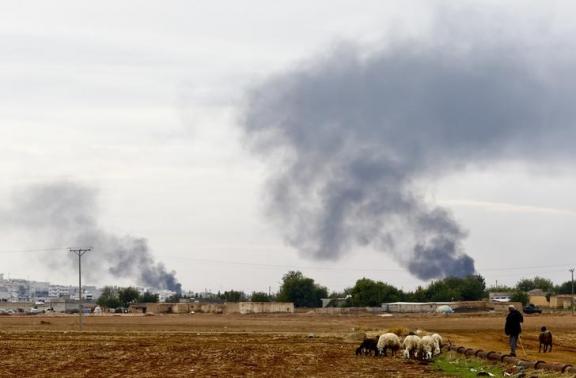
Fiercest fighting in days hits Syrian border town

October 19, 2014

Fiercest fighting in days hits Syrian border town, ReutersHumeyra Pamuk, October 19, 2014

(Islam is the religion of peace. The (non-Islamic) Islamic State recruits Islamists who then engage in violence because of Israeli intransigence when ordered to commit suicide; thus spake Ubermench Zarathustra Secretary Kerry. — DM)

Smoke rises over the Syrian town of KobaniSmoke rises over the Syrian town of Kobani after an airstrike, as seen from the Turkish-Syrian border in the southeastern town of Suruc, October 19, 2014.

The fiercest fighting in days shook the Syrian border town of Kobani overnight as Islamic State fighters attacked Kurdish defenders with mortars and car bombs, sources in the town and a monitoring group said on Sunday.

Islamic State, which controls much of Syria and Iraq, fired 44 mortars at Kurdish parts of the town on Saturday and some of the shells fell inside nearby Turkey, according to the British-based Syrian Observatory for Human Rights. It said four more mortars were fired on Sunday.

The month-long battle for Kobani has ebbed and flowed. A week ago, Kurds said the town would soon fall. The United States and its coalition partners then stepped up air strikes on Islamic State, which wants to take Kobani in order to strengthen its position in northern Syria.

The coalition has been bombing Islamic State targets in Iraq since August and extended the campaign to Syria in September after Islamic State, a group that espouses a rigid interpretation of Islam and initially fought Syrian President Bashar al-Assad’s forces, made huge territorial gains.

Raids on Islamic State around Kobani have been stepped up, with the fate of the town seen as an important test for U.S. President Barack Obama’s campaign against the Islamists.

NATO member Turkey, whose forces are ranged along the border overlooking Kobani, is reluctant to intervene. It insists the allies should also confront Assad to end Syria’s civil war, which has killed close to 200,000 people since March 2011.

“We had the most intense clashes in days, perhaps a week, last night. (Islamic State) attacked from three different sides including the municipality building and the market place,” said Abdulrahman Gok, a journalist in Kobani.

“Clashes did not stop until the morning. We have had an early morning walk inside the city and have seen lots of damaged cars on the streets and unexploded mortar shells,” he said.

CAR BOMBS

The Observatory reported two Islamic State car bombs hit Kurdish positions on Saturday evening, leading to casualties. A cloud of black smoke towered over Kobani on Sunday.

A fighter from one of the female units of the main Syrian Kurdish militia in Kobani, YPG, said Kurdish fighters were able to detonate the car bombs before they reached their targets.

“Last night there were clashes all across Kobani … this morning the clashes are still ongoing,” she said, speaking on condition of anonymity.

The Observatory said 70 Islamic State fighters had been killed in the past two days, according to sources at the hospital in the nearby town of Tel Abyab, where Islamic State bodies are taken. Reuters cannot independently confirm the reports due to security restrictions.

The Observatory said some Syrian Arab fighters from the Revolutionaries of Raqqa Brigade, who are fighting alongside Kurdish fighters, had executed two Islamic State captives.

“One was a child of around 15 years old. They shot them in the head,” he said.

Islamic State have also used executions throughout their campaigns in Syria and Iraq, killing hundreds of enemy combatants and civilians who oppose their cause, according to Islamic State videos and statements.

Welat Omer, a doctor caring for the few remaining civilians in Kobani, told Reuters by telephone that he was looking after 15 patients, including children and the elderly.

“We need medicine, including antibiotics and milk for the children, and medicine for the elderly, who have heart conditions, diabetes and high blood pressure,” Omer said.

Hundreds of thousands have fled Islamic State’s advance. Turkey hosts about 1.5 million Syrian refugees, including almost 200,000 Syrian Kurds from Kobani.

Ankara has refused to rearm beleaguered Kurdish fighters, who complain they are at huge disadvantage in the face of Islamic State’s weaponry, much of it seized from the Iraqi military when the militants took the city of Mosul in June.

Turkey views the YPG with suspicion for its long-standing links with the Kurdistan Workers Party (PKK), which has waged a 30-year armed campaign for self-rule in Turkey.

President Tayyip Erdogan was quoted in the Turkish media on Sunday as saying Ankara will never arm the YPG through its political wing, the PYD.

“There has been talk of arming the PYD to establish a front here against Islamic State. For us, the PYD is the same as the PKK, it’s a terrorist organization,” he was quoted as saying.

This stance has sparked outrage among Turkey’s own Kurds, who make up about 20 percent of the population. Riots in several cities earlier this month killed left than 35 people dead.

In a call with Erdogan on Saturday night, Obama expressed appreciation for Turkey hosting over a million refugees, including thousands from Kobani.

“The two leaders pledged to continue to work closely together to strengthen cooperation against ISIL (Islamic State),” the White House said.

Obama’s approach to Islamic State has drawn fire from his political opponents at home.

“We have dropped a bomb here and a missile there, but it has been a photo-op foreign policy,” U.S. Senator Ted Cruz of Texas, a Republican and a potential presidential candidate in 2016, said on CNN’s “State of the Union” show.

He criticized Obama for delays in aiding Kurdish fighters in desperate need of weapons and assistance.

John Kerry’s Dangerous Worldview

October 19, 2014

John Kerry’s Dangerous Worldview, IsraellycoolMirabelle, October 19, 2014

(Please watch the Kerry video at the bottom, or at least the part about Israel, “Palestine” and world peace beginning at 11:20. The world is probably not completely insane — yet: Kerry did not blame Israel or the Jews for the Holocaust and World War II. — DM)

Kerry’s scapegoating of Israel has become a dangerous pattern, one that is indicative of a worldview that underlies his behavior and his decisions with respect to the Jewish State.

******************

The operative question for the US State Department now appears to be, is there anything left that John Kerry won’t blame on the Jews?

Earlier this year, the Secretary of State famously sat before Congress and blamed Israel for the failure of the peace talks that he pushed so hard for, even though, as was subsequently revealed, it was Kerry’s own miscommunications that doomed the talks from the start. Prior to that, he had implied that if a third intifada started, it would be Israel’s doing. Now it seems that, at a State Department event for the festival of Eid al-Adha onThursday, Kerry has blamed Israel for the rise of ISIS.

Kerry’s pronouncement calls to mind this satire piece from PreOccupied Territory, titled “Free Will Is Only For White People,” and “attributed” to Kerry’s former right-hand man and Qatar-stooge Martin Indyk:

Since Arabs, as nonwhites, lack free will, the only ethical method of achieving change is to demand concessions from Israel. A society or individual with genuine volition and sense of right and wrong could be held accountable for translating political grievances into the bombings of cafes and buses, but that is not how we, or our European allies, view the Palestinians. They have no choice but to resort to brutality, since that is their nature.

Satire. Except, it’s not. Kerry’s various statements about the peace talks, Palestinian terrorism, or ISIS all remove the agency of the actors involved. The individuals who join ISIS — at least those who are adults and not teenagers — do so of their own accord. They have agency, and they alone are responsible for their own actions. Kerry would never excuse the actions of a rapist on the ground that he had been provoked or led on by his victim. He should never justify the actions of the most depraved terrorists on the ground that they have a political gripe.

Taking this mentality a step further and making the claim that Israel’s actions towards the Palestinians have anything to do with the rise of ISIS requires a logical leap into the absurd. Kerry claimed that “there wasn’t a leader I met with in the region who didn’t raise with me spontaneously the need to try to get peace between Israel and the Palestinians, because it was a cause of recruitment and of street anger and agitation.” Even setting aside the issue of holding individuals to account for their own actions, one still must wonder, why Kerry would take such assertions at face value. ISIS directs its jihad against Christians, Yazidis, Kurds, and other Muslims but, somewhat surprisingly, it has not attacked Israel. If Israel were the source of ISIS rage, wouldn’t ISIS have attacked Israel? ISIS’s gripe, however, is with all of western society, not with Israel. And it recruits from Europe and the US, as well as from the Mideast. The suggestion that Israel has caused ISIS makes about as much sense as the suggestion that Israel has caused global warming. There simply is no cause-and-effect relationship.

The State Department’s division of black-is-white-and-day-is-night, in the person of Deputy Spokesperson Marie Harf, has of course attempted to walk back Kerry’s comments, saying, Kerry “didn’t make a link between growth of ISIL and Israel, period.” But this is not a case of he said, she said, and it is not a case of misplaced context. Kerry’s entire speech is on theState Department website for anyone to see:

As I went around and met with people in the course of our discussions about the ISIL coalition, the truth is we – there wasn’t a leader I met with in the region who didn’t raise with me spontaneously the need to try to get peace between Israel and the Palestinians, because it was a cause of recruitment and of street anger and agitation that they felt – and I see a lot of heads nodding – they had to respond to. And people need to understand theconnection of that.

Doofus

That is to say, that in the context of discussions regarding ISIL/ISIS, other Arab leaders raised the issue of the Palestinians, and Kerry feels that people need to understand the connection. To say that this is not an attempt to link ISIS to the Palestinian issue is the most obfuscatory double-speak. For those who have the stomach for it, you can watch the video yourself, embedded below. The relevant comments start at about 11:20. Note the way that Kerry uses hand gestures for extra emphasis when he says “understand the connection.”

Kerry’s scapegoating of Israel has become a dangerous pattern, one that is indicative of a worldview that underlies his behavior and his decisions with respect to the Jewish State. Although Jeff Goldberg wrote persuasively in 2013 that “the past two years have proved the theory of linkage [i.e., the theory that the Mideast would be stable if the Israeli-Palestiniandispute were solved] to be comprehensively false,” Kerry appears unwilling to move on from it and to accept a more reality-based perspective. It is no wonder, then, that his actions in the Mideast have been, to put it kindly, ineffective.

In the same speech, Kerry also spoke about introspection on the Muslim and Jewish holidays. It seems that Kerry would benefit from some introspection of his own. In doing so, he might consider that, had he not been so obsessively focused on Israel and its real or perceived failings, he might have woken up to the ISIS threat sooner. He might also consider his own department’s definition of anti-semitism: “Accusing Jews as a people of being responsible for real or imagined wrongdoing committed by a single Jewish person or group, the state of Israel, or even for acts committed by non-Jews.” Kerry’s scapegoating of Israel for his own failures and for those of others is one of the most traditional forms of anti-Semitism around.


