Archive for October 15, 2014

The UN’s terrorism apologists

October 15, 2014

The UN’s terrorism apologists, New York Daily News, October 15, 2014

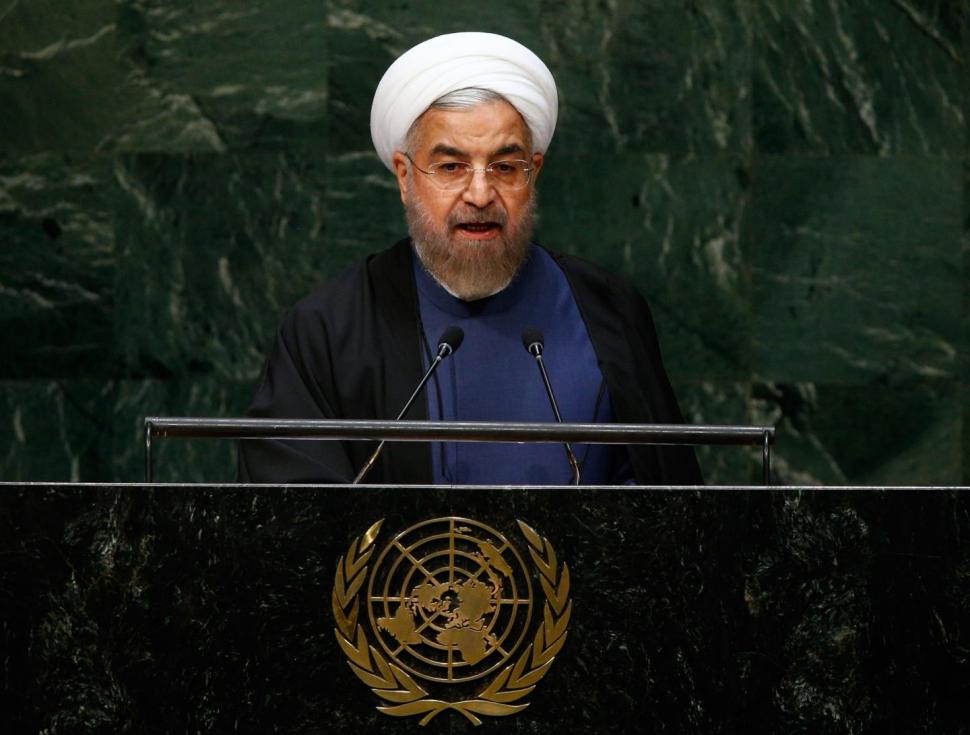
bayefsky16e-1-webHassan Rouhani of Iran.

It’s a two-step charade. First, since the UN has no definition of terrorism, state sponsors of terrorism happily denounce “terrorism” at the very same time as they promote it. Second, the terrorist funders and weapons suppliers redirect the world’s attention to the supposed “root causes” of terrorism.

On Oct. 7, at the legal committee meeting at UN headquarters, Hezbollah-controlled Lebanon listed “root causes that may lead to radicalism such as . . . poverty, social exclusion and marginalization” along with “Islamophobia.”

Iranian President Hassan Rouhani played the same card in an address to the General Assembly in September when he whined about “Iranophobia.

******************

While we are looking for terrorists sneaking across borders, lurking in mosques and holed up in caves, pro-terrorist ideology is spreading across America and around the globe — disseminated in plain sight from the United Nations, in the heart of New York City.

Over the past week, the UN’s top legal committee — a General Assembly body where all 193 states are represented — met to discuss terrorism. The webcasts are broadcast globally in multiple languages. The documents are translated and disseminated on a mammoth website free of charge.

It’s a two-step charade. First, since the UN has no definition of terrorism, state sponsors of terrorism happily denounce “terrorism” at the very same time as they promote it. Second, the terrorist funders and weapons suppliers redirect the world’s attention to the supposed “root causes” of terrorism.

Conveniently, the catalog of root causes of terrorism dreamed up in these circles never includes religiously driven bigotry doled out by anti-Semites and misogynist, homophobic sociopaths — whose need to torture, rape and kill requires no deep explanation.

A quick moral inversion, and the terrorist becomes the victim.

The UN was full of such dangerous canards last week.

On Oct. 7, at the legal committee meeting at UN headquarters, Hezbollah-controlled Lebanon listed “root causes that may lead to radicalism such as . . . poverty, social exclusion and marginalization” along with “Islamophobia.”

Iranian President Hassan Rouhani played the same card in an address to the General Assembly in September when he whined about “Iranophobia.”

Iran is the leading state sponsor of terrorism. And to the organization’s great shame, Iran is also the president of the so-called “Non-Aligned Movement” — a group of nations routinely aligned against the West. As such, Iran speaks for 120 UN member states — a majority of the 193 UN countries.

Here’s the Iranian speech to the UN legal beagles that was webcast Oct. 7: “Terrorism should not be equated with the legitimate struggle of peoples under colonial or alien domination and foreign occupation for self-determination and national liberation.”

Here’s state sponsor of terrorism North Korea on the same day: “Domination and interference, poverty and social inequality, and racial or religious discrimination constitute the root cause of terrorism. International efforts to put an end to terrorism should be preceded by removing the root cause of terrorism.”

All 56 member states of the Organization of Islamic Cooperation have signed on to the Islamic Convention on Combating International Terrorism, which gives a green light to killing Israelis, Americans and anybody else deemed fair game. The treaty says: “Peoples’ struggle, including armed struggle against foreign occupation, aggression, colonialism and hegemony, aimed at liberation and self-determination . . . shall not be considered a terrorist crime.”

Speaking on behalf of the Organization of Islamic Cooperation on Oct. 7, Egypt reiterated this pro-terror exemption clause. Over the course of Oct. 7 and 8, the UN trumpeted support for the Iranian and Organization of Islamic Cooperation call to arms from half of all the speakers.

Compounding the efficacy of this outrage, unfortunately, is the Obama administration. With great fanfare, on Sept. 24,, President Obama chaired a Security Council meeting that unanimously adopted a resolution on foreign terrorist fighters.

But the only reason everybody could agree that “terrorism constitutes one of the most serious threats to international peace and security” was because terrorism was left undefined.

Moreover, the Security Council didn’t just denounce terrorism. It demanded we “address the conditions conducive to the spread of terrorism.” Next it insisted we “counter the violent, extremist narrative that can incite terrorist acts.” And then it ordered us to “address the conditions conducive to the spread of violent extremism.”

In other words, Obama sold us an infinite regression. Because at the UN, the buck never stops with radical Islamists or the governments that support them.

‘Inherent Resolve’: Military campaign against ISIS gets a name

October 15, 2014

‘Inherent Resolve’: Military campaign against ISIS gets a name, Fox News, October 15, 2014

(How about naming the enemy, Islamism? That would not be suitably multicultural. Here are some of the names for the U.S. military operation suggested by Foreign Policy Situation Report readers (via e-mail):

The response to my request for names of the US mission against IS was overwhelming. It’s hard to draw any conclusions from the names offered, but I will say this: SitRep has an engaged, intelligent and global audience (I got responses from all over the world), and the names offered up show a huge disparity in opinion. Some show resolve, while others reflect a growing criticism – one might say cynicism – of Obama’s strategy. Some of the best are below; email me if you’d like to receive the full list.

Operation Empty Chair; Operation Oops, Sorry About That; Operation Good Intentions; Operation Seriously?  Again?; Operation Passive-Aggressive; Operation Coalition of the Dragged Kicking and Screaming; Operation Did I Leave My Keys Here?; Operation Slam Dunk; Operation IS you IS, or IS you Ain’t? Operation Syri-ous about Iraqi Freedom; and Operation Iraqi Freedom 2: Electric Boogaloo.

Make sense. How about “Inherent Dithering?” — DM)

ff_isis_101514US strategy failing as ISIS militants march on

More than two months after the U.S. first launched airstrikes against the Islamic State, the military mission has a name: “Inherent Resolve.”

A senior military source confirmed to Fox News that “Inherent Resolve” officially has been chosen as the title of the operation.

The name comes after questions were raised about why the administration had not named a mission that has escalated to involve several coalition partners and hundreds of airstrikes in both Iraq and Syria.

As of Sunday, the U.S. had conducted nearly 400 strikes in both countries. The number has risen since then – on Wednesday, the U.S. military said it launched another 18 airstrikes overnight near the contested Syrian city of Kobani, intensifying an air campaign against Islamic State militants’ efforts to capture the city near the Turkish border.

Why the mission was not named until now is unclear.

Every U.S. military intervention since the invasion of Panama in 1989, code-named Operation Just Cause, has had a name.

Even the operation to combat Ebola in West Africa was given an operational name the same day it was announced: Operation United Assistance.

An unnamed Defense official was quoted in a recent Wall Street Journal report suggesting the administration was reluctant to name the anti-ISIS mission because: “If you name it, you own it. … And they don’t want to own it.”

But Pentagon spokesman Rear Adm. John Kirby rejected that claim.

He said earlier this month that officials were considering a potential title. Kirby explained that one reason for waiting to name the operation has to do with the complex evolution of the mission.

The demise of ‘responsibility to protect’ at the U.N.

October 15, 2014

The demise of ‘responsibility to protect’ at the U.N., Washington Times, Clifford D. May, October 14, 2014

(The UN’s “responsibility to protect” doctrine now applies principally to groups favored by the multicultural international community, such as the “Palestinians” from wicked Israel, disfavored by the international community. Those needing protection from Islamic terror must look elsewhere. But where? The U.S. of Obama?– DM)

UN logoIllustration on the illusion of “Responsibility to Protect” by Linas Garsys

[I]’s ludicrous to propose that the U.N. Security Council — whose permanent members include neo-Soviet Russia and anti-democratic China — should be vested with the authority to pass judgment on the legitimacy of such missions.

While the Islamic State is currently attracting the most attention, it is the Islamic Republic of Iran — which has been using proxies to kill Americans on and off for the past 35 years — that could soon have nuclear weapons as well as missiles to deliver them to targets anywhere in the world. Hezbollah and other terrorist groups offer an alternative means of delivery. Iran’s radical Shia rulers are more sophisticated than the Sunni jihadis displaying disembodied heads on pikes. However, their goals differ little from those of their rivals.

[T]he notion of an international community that can prevent or halt mass atrocities is a chimera.

***************

Remember R2P? Not to be confused with R2-D2 (a robotic character in the “Star Wars” movies), “Responsibility to Protect” was an international “norm” proposed by United Nations Secretary-General Kofi Annan following the genocide in Rwanda in 1994 and the mass murders in the Bosnian town of Srebrenica a year later. The idea was for the “international community” to assume an obligation to intervene, militarily if necessary, to prevent or halt mass atrocities.

Why has R2P not been invoked to stop the slaughters being carried out in Syria and Iraq? Why isn’t it mentioned in regard to the Syrian-Kurdish city of Kobani, which, as I write this, may soon be overrun by barbarians fighting for what they call the Islamic State?

Here’s the story: In 2009, Mr. Annan’s successor, U.N. Secretary-General Ban Ki-moon, issued a report on “implementing” R2P. The foreign-policy establishment cheered. For example, Louise Arbour, a former U.N. high commissioner for human tights, called R2P “the most important and imaginative doctrine to emerge on the international scene for decades.” Anne-Marie Slaughter, an academic who served under Hillary Clinton at the State Department, went further, hailing R2P as “the most important shift in our conception of sovereignty since the Treaty of Westphalia in 1648.”

In 2011, President Obama cited R2P as his primary justification for using military force to prevent Libyan dictator Moammar Gadhafi from attacking the opposition stronghold of Benghazi.

If that was the apogee of R2P, the nadir was not far off. The intervention in Libya has led to chaos and bloodshed with no end in sight. Meanwhile, in Syria, four years ago this spring, Bashar Assad brutally cracked down on peaceful protesters.

Mr. Obama made Mr. Assad’s removal American policy but overruled the recommendation of his national security advisers to assist Syrian nationalist opposition groups. Civil war erupted. Self-proclaimed jihadis from around the world flocked to Syria to fight on behalf of the Sunnis. The opposition was soon dominated by the al Nusra Front, an al Qaeda affiliate, and the Islamic State (also known as ISIS or ISIL), whose leader, Abu Bakr al-Baghdadi, broke with al Qaeda and, audaciously, declared himself caliph, or supreme leader.

As for Mr. Assad, he is supported by the Islamic Republic of Iran, deploying both its elite Quds Force (designated in 2007 by the U.S. government as a terrorist organization) and Hezbollah, a Lebanon-based militia loyal to Iran’s supreme leader, Ayatollah Ali Khamenei. Russia also backs Mr. Assad, even supplying on-the-ground military intelligence specialists.

With no U.N.-approved R2P effort to rescue the innocent civilians of the region from these brutal forces, the death toll in Syria and Iraq has topped 200,000, and the number of refugees is in the millions.

Failed experiments, like crises, should not go to waste. Among the lessons to be learned from the R2P debacle: First, the notion of an international community that can prevent or halt mass atrocities is a chimera. If such work is going to get done, the United States has to do it, perhaps supported by a coalition of the willing and, with few exceptions, not particularly able. Second, it’s ludicrous to propose that the U.N. Security Council — whose permanent members include neo-Soviet Russia and anti-democratic China — should be vested with the authority to pass judgment on the legitimacy of such missions. Third, American power should be used primarily in pursuit of American interests. Sometimes that will include humanitarian interventions, but that’s a decision for Americans to make.

This, too, should be clear: While the Islamic State is currently attracting the most attention, it is the Islamic Republic of Iran — which has been using proxies to kill Americans on and off for the past 35 years — that could soon have nuclear weapons as well as missiles to deliver them to targets anywhere in the world. Hezbollah and other terrorist groups offer an alternative means of delivery. Iran’s radical Shia rulers are more sophisticated than the Sunni jihadis displaying disembodied heads on pikes. However, their goals differ little from those of their rivals.

In response to this dire and deteriorating situation, Mr. Obama should be instructing his advisers to present him with a range of strategic options. I’d recommend conceptualizing the global conflict not as disconnected “overseas contingency operations,” and not as akin to World War II, but more like the Cold War. That is to say, the United States should plan for a long, low-intensity struggle. In particular, we should support those willing to fight the jihadis who threaten them.

Economic weapons can be powerful if used correctly, which has not been the case in the past. For example, though sanctions brought Iran’s rulers to the negotiating table, premature relief from sanctions pressure has encouraged Iranian intransigence as the talks proceeded.

Also long overdue is a serious war of ideas — it’s insufficient to leave that to Bill Maher and Ben Affleck on HBO. Bottom line: We are not really engaged in a conflict against “violent extremism” or even “terrorism.” What we’re confronting are ideologies derived from fundamentalist readings of Islamic scripture. Proponents of those ideologies stress the supremacy of one religion — much as communists stressed the supremacy of one class, and Nazis of one race. There is no reason to suppose that saying this clearly, rather than obfuscating, will radicalize Muslims not already favorably inclined toward killing infidels.

Our aim should be, to borrow a phrase from Mr. Obama, to “degrade and eventually defeat” jihadism. Nothing is more imperative than preventing Iran’s rulers from taking the next, short steps toward a nuclear-weapons capability that they clearly intend to use to threaten not just their neighbors, but also Americans for decades to come. For an American president, this is where the R2P needs to begin.


Not Satire: Kerry: Defaming Islam is as Bad as Rape

October 15, 2014

Kerry: Defaming Islam is as Bad as Rape, Front Page Magazine, Daniel Greenfield, October 15, 2014

(Defamation: “the communication of a false statement that harms the reputation of an individual, business, product, group, government, religion, or nation.” Is Kerry “defaming” Islam with his false statements, or is he getting into the “war on women” by minimizing rape?– DM)

Kerry whispering

[T]he Islamic State is not insulting Islam. Its religious scholars know Islam far better than a scholar of windsurfing like Kerry does. Kerry released a press release in response to an ISIS magazine explaining the Islamic basis for their actions.

*****************

The Islamic State is Un-Islamic. But so is Islam.

U.S. Secretary of State John Kerry harshly condemned the treatment of women by the arch-terrorist organized death squad known as ISIS.

Kerry is horrified that ISIS “takes credit for the abduction, enslavement, rape, forced marriage and sale of several thousand Yezidi and other minority women and girls.”

“Just as despicably, ISIL rationalizes its abhorrent treatment of these women and girls by claiming it is somehow sanctioned by religion. Wrong. Dead wrong.”

“ISIL does not represent Islam and Islam does not condone or honor such depravity. In fact, these actions are a reminder that ISIL is an enemy of Islam.”

I don’t really see that ISIS’ supposed defamation of Islam is as bad as rape. Western elites are stuck in permanent hysteria over supposed Islamophobia, but the sale and rape of women and girls is a lot worse than any supposed insult to Islam.

Furthermore the Islamic State is not insulting Islam. Its religious scholars know Islam far better than a scholar of windsurfing like Kerry does. Kerry released a press release in response to an ISIS magazine explaining the Islamic basis for their actions.

If Kerry were really capable of debating the issue, he would have responded with citations from the Koran instead of hot air.

Mohammed, the prophet of Islam, enslaved and raped women. He married and raped a little girl. These facts are not in dispute.

His companions seized and looted property as well as people. Mohammed pocketed a percentage of the things they stole and the people. The women were raped. Sometimes he chose to marry them if they converted to Islam to get some control over the sexual violence that the earliest followers of Islam had subjected them to.

ISIS is pure Islam. It’s naked Islam. It’s Islam as it was practiced by Mohammed and his followers.

“We conquered Khaibar, took the captives, and the booty was collected. Dihya came and said, ‘O Allah’s Prophet! Give me a slave girl from the captives.’ The Prophet said, ‘Go and take any slave girl.’ He took Safiya bint Huyai. A man came to the Prophet and said, ‘O Allah’s Apostles! You gave Safiya bint Huyai to Dihya and she is the chief mistress of the tribes of Quraiza and An-Nadir and she befits none but you.’ So the Prophet said, ‘Bring him along with her.’ So Dihya came with her and when the Prophet saw her, he said to Dihya, ‘Take any slave girl other than her from the captives.’

Bukhari: 1:8:367

When Dihyah protested, wanting to keep Safiyah for himself, the Apostle traded for Safiyah by giving Dihyah her two cousins. The women of Khaybar were distributed among the Muslims.

Ishaq:511

How to defeat Islamic State’s war machine

October 15, 2014

How to defeat Islamic State’s war machine, Al-MonitorMetin Turcan, October 14, 2014

(Which team is the “junior varsity?”

The article suggests the obvious need for close air support using trained ground forces to guide aircraft to strike useful targets. The U.S. has trained “boots” capable of doing that, but Obama continues to assert that the U.S. will have no ground combat presence in Iraq or Syria. U.S. spotters would need be in combat areas, would be targeted by Islamic State forces and would therefore need to engage in combat. Non-U.S. target spotters, in addition to needing substantial technical training, would also need to be capable of communicating with aircraft pilots. In many if not most case, spotters capable of communicating in English would be needed. –DM)

Although much has been written to explain the tactical military successes of the Islamic State (IS), there has not yet been a comprehensive assessment of how, since June 2014, IS has managed to rule over terrain larger than Lebanon to include 8 million Iraqis and Syrians.

How has it been possible that in a short three months IS has been able to control extensive terrain, with 3,000 IS fighters capturing Mosul, which was guarded by 30,000 Iraqi soldiers, and after seizing Mosul on June 10 engage in battles two days later with Iraqi forces in towns north of Baghdad, 230 miles from Mosul?

Although one can allude to the delayed reaction of the international community, the lack of strong military opposition to IS, the international support IS has acquired and the support from Sunni tribes and political bodies in areas it captures, none of it defies the reality that — at the tactical level — IS is an extremely lethal and effective war machine. To understand this key determinant of IS gains, one has to understand that reality. This article will attempt to analyze the factors contributing to IS’ military efficiency, particularly at the tactical level.

Factors that boost tactical effectiveness of IS can be summarized as fluid and decentralized command and control structure; novel hybrid military tactics blending conventional warfare with terrorist tactics; effective use of armored platforms in offensive operations; dispersion; preservation of momentum at all costs; effective exploitation of topographic and human terrains; simplicity and flexibility in planning; and conducting operations and high levels of initiative and morale.

Fluid and decentralized command control structure

IS does not have permanent and centralized command and control structure in the traditional sense of warfare. Unlike contemporary armies of the world, IS doesn’t make sharp distinctions between strategic, operative and tactical levels. In their traditional warfare, tactical achievements is the way to achieve strategic objectives. For IS, the basic goal is to score tactical successes and expand on them step by step. Deviating from the traditional approach, what IS fields is a bottom-up command structure focused on a fast pace for small military achievements. At the moment, US-led airstrikes have been mostly against IS communication and training facilities. It is extraordinary that there is not a single control facility that has been hit by allied airstrikes.

IS warfare combines and hybridizes terrorist tactics, urban guerrilla warfare and conventional warfare.

IS is adept enough to conduct armor attacks at night and is skilled in accurate firing of their main tank guns with thermal cameras, and is capable of planting improvised explosive devices in critical areas and routes. It wages hybridized guerrilla warfare and conventional armored warfare by deploying eight to 10 men teams carrying out building-by-building, block-by-block clear and hold operations in urban terrain.

After the recent air attacks, IS has dispersed its forces to the extreme. Its teams have been minimized to two or three vehicles and eight to 10 men. Their concealment has been highly professional. IS’ executive orders are brief, setting out what the mission is in simple terms, leaving how it is to be carried out to field units.

It is imperative to acknowledge that a typical IS militant is endowed with a win-win mindset that assures him that to kill in jihad is a blessing, but if he is martyred he will end up in paradise also. No wonder IS combatants are high-adrenalin fighters who can kill and get killed without hesitation.

A typical IS operation goes like this: An IS armored unit of tanks or a mobile unit of eight to 12 fighters with two to three vehicles are informed by WhatsApp, a message on Facebook or Twitter or phone text message, and if this mode is not available through their own radio net, to assemble at a certain place at a certain time. This is the first time we are seeing combat units making use of social media in combat operations. Before its operations, IS disseminates propaganda messages via social media to enemy fighters and civilians living in the targeted urban settlements to demoralize and dishearten them. IS operations and logistics units that are thus alerted assemble at a meeting point within two to three hours, and after another 1 ½ hours of coordination discussions and logistics preparations the operation is underway.

One must remember that a regular IS tank driver is trained to drive his tank at night with a thermal camera, and that the commander of the team has enough tactical military knowledge to best deploy his tanks. Then it is a matter of attacking the enemy’s weakest point, preferably after the morning prayers. Vehicles stage the first phase of the attacks, followed by infantry attacks that depend on the nature of the enemy’s opposition. In these attacks, IS has been remarkably successful in creating a balance between the phased campaign design and maintaining the tempo of warfare. The high tempo of combat is routine for an IS fighter, but usually too high for opposing soldiers.

How to defeat IS?

How to first stop IS and then defeat it? The secret is in a concept that has so far been lacking the forces fighting IS in Syria and Iraq: Close air support that can only be provided by intense cooperation between ground troops and air units. Coalition air attacks so far are at least limiting IS advances; close cooperation between ground forces and armed helicopters such as AH-64 or fixed-wing platforms such as A-10 Thunderbolts can enable full integration of each air mission with fire and movement of ground forces, and bring the end to IS.

The question then becomes how the US-led coalition can provide that level of air support, and who has the substantial technical know-how and military expertise needed on the ground.

We know special forces elements of countries contributing to the coalition are participating in operations to provide precision target guiding with laser pointers. But this has been limited. Then what can be the solution?

Either the local forces fighting against IS will have to learn this technique that requires high military expertise, or special detachments formed by countries contributing to the coalition will be assigned to each combat zone or to major units as a close air support coordinator. It is no surprise then that the hottest topic in ongoing military discussions is who will provide this close air support and how. When tailoring strategies of close air support, one should keep in mind that IS has MANPADs (man-portable air defense systems) that make air units providing close air support highly vulnerable in their low-speed and low-altitude missions.


Islamic Jihad Chief, Iranian Officials to Discuss Regional Security Concerns

October 15, 2014

Islamic Jihad Chief, Iranian Officials to Discuss Regional Security Concerns, Fars News Agency (Iran), October 15, 2014

(According to Wikipedia,

The Islamic Jihad Movement in Palestine (Arabic: حركة الجهاد الإسلامي في فلسطين‎,Harakat al-Jihād al-Islāmi fi Filastīn) known in the West as simply Palestinian Islamic Jihad (PIJ), is a Palestinian Islamist organization formed in 1981 whose objective is the destruction of the State of Israel and the establishment of a sovereign, Islamic Palestinian state.[2] PIJ has been labelled a terrorist organisation by the United States,[3] the European Union,[4] the United Kingdom,[5] Japan,[6] Canada,[7] Australia,[8] New Zealand[9][10] and Israel. Iranis a major financial supporter of the PIJ.[11][12][13][14] Following the Israeli and Egyptian squeeze on Hamas in early 2014, PIJ has seen its power steadily increase with the backing of funds from Iran.[15] Its financial backing is believed to also come from Syria.

Iran is a welcome addition to the International Community’s anti-Israel world of nukes for (Islamic) peace. Please see also The danger of Obama’s strategy of linking Iran and ISIS for Israel. — DM)

Islamic Jihad MovementSecretary-General of the Islamic Jihad Movement Ramazan Abdullah arrived in Iran on Tuesday to confer with senior officials of the country on the latest security developments in region.

Abdullah, who arrived in Tehran last night, is to hold separate meetings with Secretary of Iran’s Supreme National Security Council (SNSC) Ali Shamkhani, and Member of Iran’s Expediency Council Saeed Jalili later today.

He will also hold meetings with some other Iranian officials during his stay in the country.

Late in August 2012, Supreme Leader of the Islamic Revolution Ayatollah Seyed Ali Khamenei asked participants in the 16th Non-Aligned Movement (NAM) summit in Tehran to pay special attention to the Palestinian issue, and called on the American backers of the Israeli regime to accept Iran’s proposal for holding a referendum in Palestine.

The Leader reminded the Zionists’ bloody occupation of Palestine over 6 decades ago, and blamed the Zionist regime for waging various wars, massacre and state-sponsored terrorism in the last decades.

He blamed the western world for supporting and defending the Zionist regime of Israel against the oppressed Palestinian nation.

The leader further renewed Iran’s solution to the Palestinian issue, calling for a “comprehensive referendum to be attended by all the indigenous residents of Palestine, including those refugees who have been away from their motherland for decades to determine the country’s fate”.

The Iranian supreme leader cautioned the US against the continue support and defense for the Zionist regime of Israel, reminding that decade-long support for the Israeli regime has incurred many costs and losses on the American people.

The leader called on the White House leaders to revise their Middle-East policy and “show courage and opt for the referendum solution” presented by Iran to put an end to the astronomical spending that has been inflicted on the American nation for its support for the Zionist regime of Israel.

To conclude his remarks, he urged for collective management of global issues, asking the NAM member states “not to be afraid of the bullying powers and remain loyal to their own causes”.

He reminded failure of communism and capitalism, and said the world is pregnant to new events, saying the Islamic Awakening and the US and Israeli failures in North Africa and the Middle-East are indicative of the very same fact.

Kurds make grisly discoveries after retaking ISIS-held territory

October 15, 2014

Kurds make grisly discoveries after retaking ISIS-held territory, Hot Air, Noah Rothman, October 14, 2014

(How serious are we and our coalition of the unwilling about at least degrading the Islamic State? — DM)

There is mixed news from the two fronts in Iraq and Syria where coalition airpower and indigenous partner forces on the ground are fighting Islamic State militants.

Near the Syrian border city of Kobani, reports indicate that Kurdish defenders are beginning to make some gains as they continue to defend the city against the ISIS onslaught. A key hill atop which ISIS fighters famously planted their flag late last week has reportedly been retaken by Kurdish forces.

“The advance came as the US said it had conducted 21 air strikes near the town, slowing down the IS advance,” the BBC revealed. “Tall Shair hill had been captured more than 10 days ago by IS militants.”

As ISIS retreated from the front near the Syrian-Turkish border, Kurdish forces made a series of gruesome discoveries.

“Refugees in Suruc, Turkey, have told how relatives and neighbors were beheaded by [ISIS] militants, while another spoke of how he had seen ‘hundreds’ of decapitated corpses in the besieged town,” The Independent reported on Tuesday.

Amin Fajar (38) a father-of-four who left Kobane and made it across the border and into Suruc, told a British newspaper: “I have seen tens, maybe hundreds, of bodies with their heads cut off.

“Others with just their hands or legs missing. I have seen faces with their eyes or tongues cut out – I can never forget it for as long as I live.”

The Daily Telegraph confirmed The Independent’s reporting about the activities in which ISIS engaged in the areas under their control:

“I have seen tens, maybe hundreds, of bodies with their heads cut off. Others with just their hands or legs missing. I have seen faces with their eyes or tongues cut out — I can never forget it for as long as I live,” Amin Fajar, a 38-year-old father of four, told the Daily Mail about the incredible scene in Kobane.

“They put the heads on display to scare us all.”

Another resident, 13-year-old Dillyar, watched as his cousin Mohammed, 20, was captured and beheaded by the black-clad jihadis as the pair tried to flee the battle-scarred town.

“They pushed him to the ground and sawed his head off, shouting, ‘Allahu Akbar,’ ” the boy said. “I see it in my dreams every night and every morning I wake up and remember everything.”

This unconfirmed video featuring Kurdish fighters in Kobani, flagged by Jeff Gauvin, reveals the extent of the damage done to the city over the course of weeks of fighting.

While America’s partners on the ground are enjoying some successes in Syria, the dispatches from Iraq are far more grim.

There, ISIS continues its siege on Anbar province in preparation for an assault on the capital city of Baghdad. After taking control of a military training base on Monday, CNN reported that ISIS has surrounded one of the largest Iraqi airbases in the country on Tuesday and is preparing to take it.

“According to police sources,” CNN’s Ben Wedeman reported, “the Ayman Asad Airbase, which is about 110 miles to the west of Baghdad – one of the biggest bases in Anbar province – is now surrounded by ISIS fighters, and the people on the base are expecting an attack within the coming hours on that base.”

“We understand that there are Iraqi soldiers who have already fled the base,” Wedeman continued. “We were getting reports for several hours that some of the soldiers had left, shedding their uniforms, leaving their weapons behind.”

That depressing revelation should concern military advisors who believe Iraqi forces defending Baghdad can hold out against an ISIS assault on Baghdad despite outnumbering the attackers by a reported six-to-one ratio. These latest developments reinforce the position of Army Chief of Staff Gen. Raymond Odierno who said with some trepidation recently he was only “somewhat” confident Baghdad could hold out.

Kurds Left Helpless as Kobane Falls to Islamic State: Turkey’s Border Wars (Dispatch 1)

October 15, 2014

 Vice News via You Tube, October 14, 2014

(Whose side is our NATO ally, Turkey, on in Kobane? The (“non-Islamic”) Islamic State or those best able to combat it effectively? How about the Obama Nation?  — DM)

Rival militias fight for Libya’s Benghazi

October 15, 2014

Rival militias fight for Libya’s Benghazi
Forces loyal to retired general Khalifa Haftar launch offensive to “liberate” eastern city from rival armed groups.
Last updated: 15 Oct 2014 11:49

via Rival militias fight for Libya’s Benghazi – Middle East – Al Jazeera English.


The militias controlling Benghazi are allied with the al-Qaeda-linked armed group Ansar al-Sharia [Reuters]


The militias controlling Benghazi are allied with the al-Qaeda-linked armed group Ansar al-Sharia [Reuters]

Renewed fighting has broken out in Libya’s second largest city of Benghazi, hours after a televised statement in which retired army general Khalifa Haftar vowed to “liberate” the city from what he called terrorists.

Sources told Al Jazeera that gunfire and explosions were heard early on Wednesday and that aircraft belonging to the general’s forces were striking targets around the eastern city.

Witnesses said tanks and fighter jets had targeted a rival militia to Haftar known as the “February 17 Martyrs Brigade”, who operate parts of Benghazi.

The group is part of the Shura Council of Benghazi Revolutionaries, a military coalition allied with the al-Qaeda-linked armed group Ansar al-Sharia, who control most of the city.

Haftar said in a a televised statement that his fighters are “fully prepared to achieve their intermediate goal … to liberate the city of Benghazi”.

He said that a suicide attack on his forces had resulted in “a great loss” and that Wednesday will be a “decisive day”.

“We have taken the oath to take revenge for those martyrs, whether military or policemen or civilians,” Haftar said.

“We cannot tolerate to see their bloods going down the drain.

“We must ensure that the criminals will meet their just punishment,” he said on Tuesday.

Al Jazeera’s Mahmood Abdulwahid, reporting from Tripoli, said that the offensive launched by Haftar’s forces was responded to by a counter-offensive by the militia groups.

“The situation is very tense [and] the battle is going on around the Benina airport, located just outside of Benghazi,” he said.

Contested parliament

The oil-rich North African nation has been gripped by turmoil since the 2011 uprising that toppled long-time leader Moammar Gaddafi, with the authorities struggling to control powerful militias that ousted and killed him.

A parliament, elected in June, is recognised by the international community but contested by the militia controlling most of Tripoli, where an alliance of armed groups hold sway, and by other armed groups who dominate Benghazi.

Prime Minister Abdullah al-Thinni and the elected parliament have decamped to the far eastern city of Tobruk because of widespread insecurity, including in the capital, where a rival administration has been set up.

The new forces controlling Tripoli, led by brigades from the western city of Misrata, have helped install an alternative parliament and prime minister.

Haftar launched a military offensive dubbed “Operation Dignity” against militias in Benghazi in May, but with little success.

The militias drove Haftar’s forces from their main bases in Benghazi at the end of July, killing dozens of his fighters, and have targeted the city’s airport for the past month.

At least 22 people, including soldiers, have been killed in violence in Benghazi over the past 48 hours, the AFP news agency reported. citing military and hospital sources.

On Tuesday, seven soldiers were killed in a car bomb near the airport, according to a spokesman for forces loyal to the former general.

Also on the same day, hospital officials said that fighting had continued in the small western town of Kikla, 150km west of Tripoli, leaving at least 17 people dead.

Iranian Speaker: Stop focusing on ‘trivial matters’ like centrifuges

October 15, 2014

Iranian Speaker: Stop focusing on ‘trivial matters’ like centrifuges

US rejects Tehran, Moscow’s suggestion to extend deadline for nuclear talks; ‘There is still time to get this done, if everybody can make the decisions they need to,’ says State Department official.

ReutersLatest Update: 10.15.14, 14:09 / Israel News

via Iranian Speaker: Stop focusing on ‘trivial matters’ like centrifuges – Israel News, Ynetnews.

US nuclear negotiators should stop focusing on Iran’s number of centrifuges and should push for a deal, which could help build confidence between Iran and the coalition of countries fighting against Islamic State militants, a senior Iranian politician said on Wednesday.

“This is something like a trivial matter and we should not bargain over trivial matters,” Iran’s Parliament Speaker Ali Larijani, formerly Iran’s top nuclear negotiator, told a news conference in Geneva. “This is not going to be useful, this is not going to solve any real problems.”

The confidence-building Larijani said, could also help in efforts to combat the Islamic State. And while there is no natural, direct link between discussions over Iran’s nuclear infrastructure and the struggle against Islamic State fighters, Larijani said, that the discussions “can be linked because there is confidence to be built here.”

‘Deal can still be reached by deadline’

A US State Department official said Wednesday world powers and Iran were not discussing extending the November 24 deadline for reaching an accord over Tehran’s nuclear program, adding there was still time to strike a deal.

However, the State Department official said there were still some significant gaps in negotiating positions on Iran’s uranium enrichment program: “We don’t know if we’ll be able to get to an agreement, we very well may not.”

The official spoke ahead of a meeting on Wednesday between US Secretary of State John Kerry, Iranian Foreign Minister Mohammad Javad Zarif and European Union foreign policy chief Catherine Ashton in Vienna.

Kerry, Ashton and Zarif in nuclear talks (Photo: Reuters)

“We’re not talking about extension or anything like that in the room. We’re talking about getting this done by the 24th (of November),” the US official said.

Iran and the six major powers – the United States, France, Germany, China, Russia and Britain – aim to end a decade-old dispute over Tehran’s nuclear program by a self-imposed November 24 deadline. The talks are centred on curbing Iran’s atomic activities in exchange for a lifting of sanctions hurting its economy.

One of Iran’s chief negotiators, Deputy Foreign Minister Abbas Araqchi, last week raised the possibility that the talks could be extended, and Russian Foreign Minister Sergei Lavrov on Tuesday said the deadline date was not “sacred”.

“I’m sure that a compromise is possible,” said Lavrov, during a visit to Paris where he met US Secretary of State John Kerry on Tuesday.

“I can’t guarantee you that it would be reached by November 24. This date is not sacred,” he told Russian television. “We are striving to reach a result before this date, but I’m sure that the main thing is not artificial schedules but the essence of the agreements. That is the main thing for us.”

But the State Department official said: “There is still time to get this done. There’s enough time to get the technical work done, to get the political agreement … if everybody can make the decisions they need to.”

“We keep chipping away … In places gaps have narrowed, but the Iranians have some fundamental decisions to make.”

Kerry said in Paris on Tuesday he did not believe that reaching a lasting accord within six weeks was out of reach, although he noted that many issues remained to be resolved.

Iran rejects Western allegations that it is seeking nuclear weapons capability, but has refused to halt uranium enrichment, and has been hit with US, EU and UN Security Council sanctions as a result.

Iranian Foreign Minister Mohammad Javad Zarif said the sides “might need more time” to discuss the issues and potential solutions, Iran’s ISNA news agency reported on Wednesday.

“We are reviewing all the possible solutions to end the disputes. The fact that there are eye-catching disputes, does not mean they cannot be resolved,” it quoted Zarif as saying after meeting Ashton in Vienna on Tuesday, where they will hold talks with Kerry on Wednesday.

“We have not reached a common conclusion yet, but I think it can be reached if there is a political will,” he added.