Archive for October 10, 2014

Turkey ‘providing direct support’ to ISIS

October 10, 2014

Turkey ‘providing direct support’ to ISIS, World Net DailyAaron Klein, October 9, 2014

(????????????????????? — DM)

kurdish-fighter

TEL AVIV – NATO member Turkey is providing direct intelligence and logistical support to the ISIS terrorist organization, according to a senior Egyptian security official speaking to WND.

The official said Egypt has information Turkish intelligence is passing to ISIS satellite imagery and other data, with particular emphasis on exposing to ISIS jihadists the positions of Kurdish fighters and the storage locations of their weapons and munitions.

The official confirmed reports that Turkey released ISIS terrorists from jail in a sweeping deal with the jihadist organization that saw the release of 49 hostages from the Turkish embassy in Mosul who were being held by ISIS.

While some news media reports say Turkey may have released at least 180 ISIS terrorists in the deal, including two British jihadists, the Egyptian official said the number of ISIS terrorists released by Turkey was closer to 700.

Tensions between the Turkish government and its Kurdish population have been high as Kurds have sought autonomy for three decades and have faced mass ISIS attacks.

Kurdish forces have been leading a military campaign targeting ISIS in Iraq and Syria.

On Tuesday, Kurdish protesters demanding help in the fight against ISIS clashed with police in Turkey, leaving at least 14 people dead and scores injured, according to reports.

The Egyptian information about Turkey’s alleged role in providing support to ISIS seems to bolster accusations against Turkey and Arab allies made last week by Vice President Joseph Biden.

It was reported Biden last weekend apologized to Turkish President Recep Tayyip Erdogan for “any implication” that Turkey or Arab allies had intentionally supplied weapons to ISIS or helped in the growth other Islamic jihadist groups in Syria, according to the White House.

One week ago, Biden told an audience at Harvard’s Kennedy School of Government that ISIS had been inadvertently strengthened by actions taken by Turkey, the United Arab Emirates and Arab allies who were supporting the insurgency against Syrian President Bashar al-Assad.

Biden further implied Turkey, the UAE and other Arab countries were supplying weapons to al-Qaida and its offshoots in Syria, including the al-Nusra front.

“They poured hundreds of millions of dollars and thousands of tons of weapons into anyone who would fight against Assad,” Biden told students. “Except that the people who were being supplied were al-Nusra and al-Qaida and the extremist elements of jihadis coming from other parts of the world.

“We could not convince our colleagues to stop supplying them,” Biden said.

Regarding Turkey’s alleged role, Biden said, “President Erdogan told me, he’s an old friend, said, ‘You were right. We let too many people (including foreign fighters) through.’ Now they are trying to seal their border.”

Erdogan told reporters he vehemently denied making such a statement.

ISIS: Can the West Win Without a Ground Game?

October 10, 2014

ISIS: Can the West Win Without a Ground Game? Middle East Forum, Jonathan Spyer, October 2014

(It should be (but appears not to be) obvious to our “leaders” that before we have a chance of “winning” the fight against the Islamic State, et al, we need to define “win” and to decide who are our allies and who are our enemies. That has not yet happened. As to ground troops, how many will we need to do what and where? Those questions need to be answered as well, based largely on answers to the first set of questions. — DM)

[A] lack of strategic understanding of the nature of the conflict being waged is preventing the development of a coherent response to the specific problem of the Islamic State, along with the parallel problems of Shia terror groups such as Hezbollah, and the ambitions of the Islamic Republic of Iran. At root is the failure to grasp the implacable nature of political Islam in both its Sunni and Shia variants at the present time.

From this original error, all further errors, and as we can see there are many, inevitably follow.

**********************

The United States and its allies have launched a military campaign whose stated goal is, in the words of President Barack Obama, to “degrade and ultimately destroy” the Islamic State (I.S., also known as ISIS or ISIL) established by Sunni jihadis in a contiguous land area stretching from western Iraq to the Syrian-Turkish border.
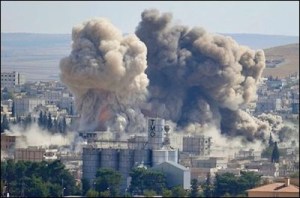
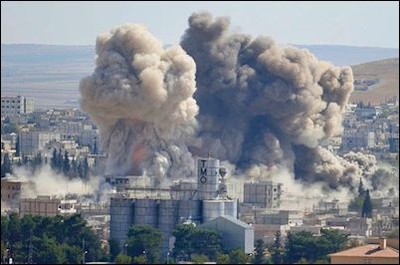
686Smoke rises from a U.S. air strike on Islamic State positions in Kobani.

As the aerial campaign begins in earnest, many observers are wondering what exactly its tactical and strategic objectives are, and how they will be achieved. A number of issues immediately arise.

Any state—even a provisional, slapdash, and fragile one like the jihadi entity now spreading across Iraq and Syria—cannot be “destroyed” from the air. At a certain point, forces on the ground will have to enter and replace the I.S. power. It is not yet clear who is to play this role—especially in the Islamic State’s heartland of Raqqa province in Syria.

In Iraq, the national military and the Kurdish Pesh Merga are now having some successes at chipping away at the Islamic State’s outer holdings. The role of U.S. air support is crucial here. But the center of the Islamic State is not Iraq, and both the Iraqi forces and the Pesh Merga have made clear that they will not cross the border into Syria. This leaves a major question as to who is to perform this task, if the objectives outlined by President Obama are to be achieved.

The answer we have heard most often of late is that elements among the Syrian rebels will be vetted by the U.S., trained in cooperation with the Saudis, and then deployed as the force to destroy the IS on the ground.

If this is indeed the plan, it is deeply problematic.

The Syrian rebels are characterized by extreme disunity, questionable effectiveness, and the presence of hardline Sunni Islamist elements among their most committed units. There are certainly forces of an anti-jihadist ideology among them—the most well-known being the Syrian Revolutionaries Front, headed by Jamal Ma’arouf from the Jebel Zawiya area in northern Syria, and the smaller Harakat Hazm. Both movements have benefitted from Western aid in recent months.

The problem, however, is that these organizations are quite prepared to work with salafi groupings whose worldview is essentially identical to that of the I.S., even if their methods are somewhat different. Thus, if we observe the recent fighting between Assad’s forces and rebels in the Quneitra area along the border with the Israeli Golan Heights, it is clear that the main contribution to rebel achievements came from the Jabhat al-Nusra group, which constitutes the “official franchise” of the core al-Qaeda group in Syria.

Reliable sources confirm that Nusra cooperates with other rebel groups in southern Syria and has even been prepared to minimize its own role, so as to allow other groups to present achievements as their own to Western and Arab patrons and thus secure a continued flow of arms, benefiting all factions.

What this means is that by championing these rebel elements as the ground force which will seek to enter and destroy a weakened I.S. in Raqqa province, the U.S. would be putting itself in the position of supporting one group of Sunni jihadis against another.

In Iraq, while the Kurdish Pesh Merga cooperates de facto with Iran, their alliance is pragmatic and tactical, one that the Kurds would gladly break given the possibility of clear Western sponsorship.

But the fierce condemnations in recent days (even by supposedly “pro-Western” rebel groups such as Hazm) of the U.S. bombing raids into Syria indicate that there is a deeper problem here. The alliance between these Sunni rebel groups and the salafis has a common anti-Western component to it.

It is, in any case, not clear if these Sunni rebels will prove able to defeat the I.S., but even if they were to do so, the presence of radical anti-Western elements among them attests to the danger of a policy of support and sponsorship of them.

Of course, the Sunni jihadis are not the only dangerous players on the ground. Another possible, no less troubling, outcome of the air campaign against the Islamic State could be the return of Bashar al-Assad’s forces to eastern Syria, from which they have been largely expelled over the last year. It is not at all hard to imagine a scenario in which once the I.S. has been weakened by Western air attacks, the Syrian military and its Iranian-backed allies will be able to make gains.

Indeed, the Iranian Revolutionary Guard Corps (IRGC) are already present in northern Iraq (and, of course, in Syria as well) and IRGC personnel have taken part in the fighting in Iraq in recent weeks. Qods force teams are reportedly located at Samarra, Baghdad, Karbala, and the former al-Sahra Air Base near Tikrit. Iran has deployed seven SU-25 ground attack aircraft which have played a role in offering air support to the Kurds and Iraqi special forces.

Following intensive Western bombing, the possibility of the Islamic State eventually being sandwiched between pro-Iranian forces on either side before being destroyed would be a real one. This would achieve the desired goal of destroying the jihadi entity, but it could end up handing a major victory to the Assad regime and its Iranian backers—enemies of the West of significantly greater potency and seriousness than the Islamic State itself.

Such a result would be somewhat reminiscent of the Iraq invasion of 2003, in which the destruction of the Sunni regime of Saddam Hussein ended up largely helping Iran.

How does the West get out of this mess? The discussion about which ground force should be used to replace the Islamic State is itself confused by a much larger misunderstanding regarding the nature of the war now taking place in Iraq and in Syria (and periodically spilling over into Lebanon).

The I.S. has now been depicted as the main problematic factor emerging from this conflict. But the Islamic State is in fact merely a particularly extreme and brutal manifestation of a broader process taking place in this area, in which political Islam of a Sunni variety is at war with the Shia political Islam of Iran and its proxies (especially Hezbollah and the Assad regime).

The I.S. may promote a particularly lurid and repulsive version of Sunni political Islam, but in its beliefs and in its practices it does not represent some unique presence in the Syrian and Iraqi context. Rather, it is little more than a particularly virulent manifestation of a strain of politics and ideology which is the primary cause of the conflict taking place across the region.

In the two scenarios discussed above, both quite plausible outcomes of a Western air campaign, the I.S. would be defeated and replaced by another version of Islamism—either that of its fellow Sunnis, or that of the rival Shi’ites.

A third possibility, however, is that the White House does not actually intend to pursue a policy intended to physically destroy the Islamic State in its heartland in northern Syria. Certainly, more recent statements emerging from the Administration appear to be preparing to “walk back” the President’s comments.

White House Chief of Staff Denis McDonough said in mid-September that success for U.S. policy vis-à-vis the I.S. would come when the group “no longer threatens our friends in the region, no longer threatens the United States.” This sounds like the introduction to a more modest policy of degrading I.S. capabilities, rather than seeking to “destroy” the Islamic State.

Of course, such a modified objective would end the dilemma over which ground forces to ally with. On the other hand, it would also have the effect of a tacit admission that the U.S. did not intend to promote its policy as originally stated by the President in the aftermath of the horrific murder of two U.S. citizens by the Islamic State.

But whether or not the goal of destroying the Islamic State is pursued with vigor, the current failure to see accurately what is happening in the Levant and Mesopotamia looks set to remain. This, in turn, looks set to prevent the emergence of a coherent policy and a coherent allocation of resources.

What is taking place across Syria and Iraq, and across their borders into Lebanon, Turkey, and Iran, is a sectarian war, made possible because of the decline of the police states which for half a century kept the lid on sectarian differences. The regional ambitions of Iran, which has clients and proxies in all three countries, exacerbate this dynamic. The attempts by Saudi Arabia to block Iran’s advance toward the Mediterranean, and by Qatar and Turkey to sponsor various Sunni jihadi elements, have produced a far more confused, and far less effective, Sunni side in this struggle.

The struggle itself, in turn, can be traced back to the failure by these states to develop coherent notions of citizenship or stable national identities in the post-Ottoman period. In other words, this war has been a long time coming, but now it is here.

Because the nature of this struggle is not widely grasped in the West, policy appears somewhat rudderless. This is reflected in the current discussion regarding the response to the Islamic State.

First, Assad was the enemy. This was made clear enough not only by his support for Hezbollah and attempts to nuclearize, but also by his unspeakable brutality and use of chemical weapons against his own citizens.

Then, when the brutality of some of the rebels became apparent, Western public interest in supporting the rebels receded. Soon the I.S. emerged as the new bogeyman. Declarations for its destruction became de rigueur, though it is far from clear how this is going to be carried out—and a de facto alliance with Iran and its clients, at least in Iraq, has emerged. This was seen in the expulsion of the I.S. from the town of Amerli, a pivotal moment in the major setbacks faced by the organization in recent days. In that town, Shi’ite militias were backed by American air power—to telling effect against the Sunni jihadis.

But is it really coherent policy to be backing murderous Shi’ite sectarians against murderous Sunni ones? It is not. Of course, when the West backs the Sunni rebels in Syria, the precise opposite is happening. Weaponry donated to “moderate” rebels then inevitably turns up in the hands of Sunni jihadis, who do most of the fighting associated with the Syrian “rebellion.” The result is that in Iraq the U.S. is helping one side of the Sunni-Shia war, and in Syria it’s helping the other side.

Only when it is understood that the West cannot partner with either version of political Islam does it become possible to formulate a coherent policy toward the Sunni jihadi forces, on the one hand, and toward the Iran-led bloc, on the other.

Such a policy must rest on the identification and strengthening of non-Islamist forces willing to band together and partner with the West. Not all of them are perfect characters, but they all understand the threat that political Islam poses.

Most obviously, there is a line of pro-American states along the southern side of the arena of the war. These are Israel, Jordan, and in a far more partial and problematic way, Saudi Arabia. Both Israel and Jordan have demonstrated that they are able to successfully contain the spread of the chaos coming out of the north. Both are well-organized states with powerful militaries and intelligence structures. Jordan has clearly benefitted from the deployment of U.S. special forces to prevent incursions by the I.S. Israel has also made clear that its resources will be available to assist the Jordanians should this be required. (Egypt, too, while not in the immediate vicinity of the conflict, can be a silent partner as well—as its campaign against the Muslim Brotherhood and tough line against Hamas have shown, it is nothing if not a virulent opponent to political Islam.)

This is what the proper coordination of allied states is supposed to look like. And it works in containing the conflict. To the east of the war’s arena is of course Iran. To its west is the Mediterranean Sea. To its north is a long, contiguous line of Kurdish control, shared between the Kurdish Regional Government of President Massoud Barzani in northern Iraq, as well as the three enclaves created by the PKK-linked Democratic Union Party (PYD) in northern Syria. The YPG militia, which is the military force in these enclaves, has fought the I.S. almost since its inception, and has largely prevailed in keeping the jihadis out of the Kurdish areas.

As part of a strategy of containment, the West should increase support for and recognition of both the Kurdish enclaves in the north of Syria and the Kurdish Regional Government itself. Both are elements capable of containing the spread of the jihadis from the north. It has become clear in recent days that the Pesh Merga, despite early setbacks, is a useful instrument in preventing the further advance westward of the Islamic State, and in so doing protecting the investment of international oil companies in the oil-rich parts of Iraq. The YPG militia, though poorly equipped, has also avoided major losses.

Such a principle of alliance will also encourage the West to reconsider the involvement of Turkey. As events of the last few years have shown, Turkey cannot be a reliable ally in the struggle against political Islam, because its ruling party, AKP, is itself an Islamist party. This is not a theoretical formulation. Turkey’s support for Islamist militias in northern Syria and its opening of its border for them has been a major contributing factor in the proliferation of these elements. There is also considerable evidence that Turkey at the very least turned a blind idea to the activities of the I.S. in the border area in 2013, and may well have offered some help to the jihadis in their fight with the YPG.

In order to grasp the rationale for a policy of dual containment, the nature of the war between rival sectarian forces must be grasped. There is also a need for the clear understanding that the effort to preserve at all costs the territorial integrity of “Iraq” and “Syria” is mistaken. Rather, what should take place is support for those forces committed to order, as listed above, and non-support for the forces of political Islam.

In other words: If political Islam (rather than one specific jihadi group, to quickly be replaced by another) is the real problem, then the real solution is to ally, forcefully and over the long haul, with those forces most committed to stopping it: Israel, Jordan, the Saudis, and the Kurds.

So it may be seen that a lack of strategic understanding of the nature of the conflict being waged is preventing the development of a coherent response to the specific problem of the Islamic State, along with the parallel problems of Shia terror groups such as Hezbollah, and the ambitions of the Islamic Republic of Iran. At root is the failure to grasp the implacable nature of political Islam in both its Sunni and Shia variants at the present time.

From this original error, all further errors, and as we can see there are many, inevitably follow.

The Unresolved Problem with Boots on the Ground

October 10, 2014

The Unresolved Problem with Boots on the Ground, Commentary Magazine, October 10, 2014

(If the U.S. were to put boots on the ground, how many would be needed to do what? Trainers? Spotters for airstrikes? Infantry? Artillery? Psychological operations? Field medics? Something else? Could we shift from a peacetime mode to a wartime mode in time to do significant damage to the Islamic State, et al? — DM)

[T]here is nothing more dangerous to any potential ground troops than to be inserted into a warzone without broad public consensus about their mission and to have a commander-in-chief who has consistently met the requests of forces in the field with indecision and a failure to deliver what ground commanders consider their minimum basic needs.

****************

A growing chorus of analysts, generals, and even cabinet secretaries who served under President Obama suggest that Obama’s stated goal to “degrade and ultimately destroy” ISIS is not going to occur by means of air power alone. That might be true, although it’s also true that Obama hasn’t used airpower to its full effect. To read a Pentagon press release is to read reports of five, six, or seven airstrikes. Given that an aircraft carrier can launch planes every 30 to 40 seconds, this suggests that the Obama administration is effectively committing the equivalent of three or four minutes of dedicated aircraft carrier time to achieve its goals. And even then, many of the strikes Obama has ordered (and the president has said that he approves every strike carried out inside Syria) attack empty buildings or equipment far away from the fronts of the fight.

But even if boots on the ground are necessary with an augmented air campaign, there is one problem that is unsolvable, and that is the personality and lack of commitment of the commander-in-chief. President Obama has the strategic equivalent of Attention Deficit Disorder. Despite his September 10 speech, it’s unclear whether he is truly committed to destroying ISIS or was simply reacting to the spike in public outrage following the murder of James Foley.

Now make no mistake: I personally feel that the defeat of ISIS is an overwhelming national interest, and that the goal should not simply be “deradicalization” for its fighters, but rather their death. That said, there is nothing more dangerous to any potential ground troops than to be inserted into a warzone without broad public consensus about their mission and to have a commander-in-chief who has consistently met the requests of forces in the field with indecision and a failure to deliver what ground commanders consider their minimum basic needs.

What can be done? Unfortunately, there’s no good answer with such lackluster leadership in the White House and Congress. But those serving in uniform and placing themselves in harm’s way should not be a political football. At present, however, that is exactly how the president and some members of both parties treat them and the ISIS problem. Until there is focus and responsibility in both the White House and Congress, and recognition that military action cannot be governed by polls or political timelines, it is foolhardy to insert ground forces.  Regardless of how they might be needed and how determined ISIS is to strike the United States, ground troops without serious leadership would be unwise. Never again should there be a deployment of ground forces without political consensus, broad public support. If these are lacking and we have to pay the consequence, then that will be a “teachable moment” for the public about the importance of freedom and the nature of the evil that the United State must confront.

Bombing for show? Or for effect?

October 10, 2014

Bombing for show? Or for effect? Washington Post OpinionCharles Krauthammer, October 9, 2014

The indecisiveness and ambivalence so devastatingly described by both of Obama’s previous secretaries of defense, Leon Panetta and Bob Gates, are already beginning to characterize the Syria campaign.

The Iraqis can see it. The Kurds can feel it. The jihadists are counting on it.

*********************

During the 1944 Warsaw uprising, Stalin ordered the advancing Red Army to stop at the outskirts of the city while the Nazis, for 63 days, annihilated the non-Communist Polish partisans. Only then did Stalin take Warsaw.

No one can match Stalin for merciless cynicism, but President Recep Tayyip Erdogan of Turkey is offering a determined echo by ordering Turkish tanks massed on the Syrian border, within sight of the besieged Syrian town of Kobane, to sit and do nothing.

For almost a month, Kobane Kurds have been trying to hold off Islamic State fighters. Outgunned, outmanned and surrounded on three sides, the defending Kurds have begged Turkey to allow weapons and reinforcements through the border. Erdogan has refused even that, let alone intervening directly. Infuriated Kurds have launched demonstrations throughout Turkey protesting Erdogan’s deadly callousness. At least 29 demonstrators have been killed.

Because Turkey has its own Kurdish problem — battling a Kurdish insurgency on and off for decades — Erdogan appears to prefer letting the Islamic State destroy the Kurdish enclave on the Syrian side of the border rather than lift a finger to save it. Perhaps later he will move in to occupy the rubble.

Moreover, Erdogan entertains a larger vision: making Turkey the hegemonic power over the Sunni Arabs, as in Ottoman times. The Islamic State is too radical and uncontrollable to be an ally in that mission. But it is Sunni. And it fights Shiites, Alawites and Kurds. Erdogan’s main regional adversary is the Shiite-dominated rule of Syria’s Bashar al-Assad. Erdogan demands that the United States take the fight to Assad before Turkey will join the fight against the Islamic State.

 It took Vice President Biden to accidentally blurt out the truth when he accused our alleged allies in the region of playing a double game — supporting the jihadists in Syria and Iraq, then joining the U.S.-led coalition against them. His abject apologies to the United Arab Emirates, Saudi Arabia and Turkey notwithstanding, Biden was right.

The vaunted coalition that President Obama touts remains mostly fictional. Yes, it puts a Sunni face on the war. Which is important for show. But everyone knows that in real terms the operation remains almost exclusively American.

As designed, the outer limit of its objective is to roll back the Islamic State in Iraq and contain it in Syria. It is doing neither. Despite State Department happy talk about advances in Iraq, our side is suffering serious reverses near Baghdad and throughout Anbar province, which is reportedly near collapse. Baghdad itself is ripe for infiltration for a Tet-like offensive aimed at demoralizing both Iraq and the United States.

As for Syria, what is Obama doing? First, he gives the enemy 12 days of warning about impending air attacks. We end up hitting empty buildings and evacuated training camps.

Next, we impose rules of engagement so rigid that we can’t make tactical adjustments. Our most reliable, friendly, battle-hardened “boots on the ground” in the region are the Kurds. So what have we done to relieve Kobane? About 20 airstrikes in a little more than 10 days, says Centcom.

That’s barely two a day. On the day after the Islamic State entered Kobane, we launched five airstrikes. Result? We hit three vehicles, one artillery piece and one military “unit.” And damaged a tank. This, against perhaps 9,000 heavily armed Islamic State fighters. If this were not so tragic, it would be farcical.

No one is asking for U.S. ground troops. But even as an air campaign, this is astonishingly unserious. As former E.U. ambassador to Turkey Marc Pierini told the Wall Street Journal, “It [the siege] could have been meaningfully acted upon two weeks ago or so” — when Islamic State reinforcements were streaming in the open toward Kobane. “Now it is almost too late.”

Obama has committed the United States to war on the Islamic State. To then allow within a month an allied enclave to be overrun — and perhaps annihilated — would be a major blow.

Guerrilla war is a test of wills. Obama’s actual objectives — rollback in Iraq, containment in Syria — are not unreasonable. But they require commitment and determination. In other words, will. You can’t just make one speech declaring war, then disappear and go fundraising.

The indecisiveness and ambivalence so devastatingly described by both of Obama’s previous secretaries of defense, Leon Panetta and Bob Gates, are already beginning to characterize the Syria campaign.

The Iraqis can see it. The Kurds can feel it. The jihadists are counting on it.

Islamic State, Al-Qaeda, Islam and Iran

October 10, 2014

(Please listen to this twenty-two minute interview with Clare M. Lopez. She highlights Iran’s central involvement and the benefits it receives. — DM)


Why Ebola worries the Defense Department

October 10, 2014

Why Ebola worries the Defense Department

By Rick Noack August 5  Follow @rick_n

via Why Ebola worries the Defense Department – The Washington Post.


A Liberian military policeman holds his rifle with gloves to avoid contact with the deadly Ebola virus during the burial of several Ebola victims in the Johnsonville community outside Monrovia, Liberia 02 August 2014. EPA/AHMED JALLANZO


While the public discourse on Ebola has so far been fixated on the public health hazard caused by the disease itself, it may also have awoken an older fear for anti-terror agencies: Could a lethal disease actually be used as a bio-weapon? That fear is made worse by the fact that the current outbreak is occurring near a volatile region that has seen the rise of a variety of terrorist groups nearby such as Boko Haram – the group that abducted more than 200 girls earlier this year.

The potential terror risk posed by Ebola does not only add a new dimension to the African outbreak, but it may also speed up efforts to find an effective treatment. The “secret serum” used to treat two Americans who are infected with the virus was developed by a biotech firm called Mapp Biopharmaceutical Inc., which reportedly works with the National Institutes of Health as well as with the Defense Threat Reduction Agency (the latter a military agency specializing in bio-defense).  There are also other examples of U.S. interest in Ebola research. In 2010, the U.S. Department of Defense signed a $140 million contract with a company called Tekmira  to develop a treatment for Ebola infections, according to a statement by the company. After the collaboration was extended in 2013, Tekmira was granted a so-called Fast Track designation in March 2014 when the first cases of Ebola began to reemerge.

“That the U.S. government takes the potential of Ebola as a bio-terror agent seriously is clear from the fact that it has invested tens of millions of dollars in vaccine and therapy research over the last decade,” says Peter D. Walsh, a professor at Cambridge University. When asked by The Post if the Department of Defense thought there was a serious risk of Ebola being used as a bio-weapon, Amy Derrick-Frost, a spokeswoman for the department, replied: “The Department of Defense maintains research interests both for protection against intentional use and natural exposure to many diseases that can impact the health of its personnel around the world, and that concern extends to viruses, such as Ebola.”

Tekmira’s studies were closely tied to the U.S. Army Medical Research Institute for Infectious Diseases and partly funded by the U.S. Department of Defense’s Joint Project Manager Transformational Medical Technologies Office. On the program’s Web site, its mission is defined as “protecting the Warfighter from emerging, genetically altered, and unknown biological threats.”

While the U.S. government seems to be funding the Ebola vaccine research out of national security considerations, the outcome could save lives abroad. Without such support, the fight against Ebola would lag even further behind as it does today. “There are no financial incentives to develop a treatment because Ebola is such a rare disease,” says University of Texas Medical Branch Professor Thomas W. Geisbert, who is currently working on a different Ebola project.

The fear of Ebola being abused by other states or terrorists is not theoretical: It dates back to the 1970s when the Soviet Union launched a program called VECTOR, aimed at researching biotechnology and virology. Kenneth Alibek, who claims to have worked for the secret biological weapons program of the Soviets, said in a 1998 interview that among his tasks had been “the creation of Ebola and Marburg biological weapons.” And while some of his remarks and testimonies before Congress have since been questioned, the fear they raised never really went away.

In 1996, a magazine reported about another worrisome case involving a Japanese cult group called Aum Shinrikyo that traveled to Zaire in 1992 with the purpose of collecting samples of the Ebola virus. While the group’s Ebola efforts probably failed, it ended up killing several dozen people with sarin nerve-gas in the Tokyo subway system in 1995. The U.S. government’s recent funding efforts on Ebola research seem to be directly related to these incidents. “We have a long standing interest in highly fatal hemorrhagic fevers,” Derrick-Frost explained. “Ebola is among a handful of emerging infectious diseases that have historically been explored as a potential biological weapon, and we are closely monitoring these types of infectious diseases.”

Efforts to transform Ebola into a bio-weapon seem to have failed in the past, but could they succeed today? Experts doubt that west African terror groups are currently capable of abusing the Ebola virus for attacks in foreign countries. “You would need to have a lot of scientific skills to transform the virus in a way that it can be easily used as a weapon,” Geisbert explains. Another reason to doubt Ebola’s abuse by terrorists is that the virus does not spread readily between people, which would limit the number of casualties.

In 2013, Amanda M. Teckman published an essay in the Global Policy Journal that called on policymakers to not underestimate the danger posed by Ebola. The increase in recent outbreaks as well as the potential recruitment of experts aimed at acquiring the virus “should lead policymakers to consider the risk of a deliberate outbreak,” Teckman wrote.

In an interview conducted via e-mail last weekend, she said that Ebola research was a national security issue, but had not been treated as such enough because of a low political will to make the issue a priority. Despite her criticism, she called a terror-attack “not probable” for two reasons: First, a terrorist organization would have to obtain a sample of Ebola with the help of “a highly trained scientist with knowledge of how to handle the virus.” Second, the scientist would have to weaponize it. “This includes being able to create the necessary characteristics to use it, to store it, and to disperse of the agent. And this is very complicated,” Teckman said.

ISIS Might Use Ebola as Doomsday Suicide Weapon, Warns Former US Expert

October 10, 2014

The good news is that an  ISIS terrorist infected with Ebola also could wipe out the ISIS.

By: Tzvi Ben-Gedalyahu

Published: October 10th, 2014

via The Jewish Press » » ISIS Might Use Ebola as Doomsday Suicide Weapon, Warns Former US Expert.


"Jihad John." the ISIS' British accented executioner, is our prime candidate to be infected with Ebola.
“Jihad John.” the ISIS’ British accented executioner, is our prime candidate to be infected with Ebola.
Photo Credit: Al Hayat Media Center, ISIS 

Islamic State (ISIS) terrorists might be considering infecting a “martyr” with Ebola to create a catastrophe by spreading the disease in urban areas in Western countries, experts warn.

Ebola is a cheap weapon and far harder to identify than explosives. Raw material is easily available in West Africa, where all an ISIS terrorist has to do is infect himself and then travel around the world to spread the fatal disease, U.S. War College Prof. Al Shimkus told Forbes.

“The individual exposed to the Ebola Virus would be the carrier,” said Shimkus, a retired captain who is a professor of National Security Affairs and teaches a course in biological and chemical warfare. “In the context of terrorist activity, it doesn’t take much sophistication to go to that next step to use a human being as a carrier.”

Ebola’s fatality rate is 50 to 90 percent, depending on whether the patient receives immediate medical treatment. The United States is in a panic after the death of its first Ebola victim in Texas, although the disease is only contagious through contact with body fluids.

Shimkus pointed out that biological warfare is not a modern weapon and was used in the Middle Ages, when enemies threw diseases corpses into cities to spread the Bubonic Plague. Although Ebola would be a cheap weapon for ISIS, it would not be as dramatic as beheading, which has struck fear into the hearts of the West.

Amanda Teckman, a Seton Hall University expert in international relations, told Forbes that ISIS is not likely to use Ebola but cautioned, “I do believe others will at least contemplate using such suicide infectors.”

The good side of the Ebola-ISIS scare is that it might be self-destructive.

“it’s very hard to control. The militants could just end up wiping themselves out before they’ve had the chance to pass it on. For a suicide attack, strapping sticks of dynamite to your chest is far more effective, Jennifer Cole, Senior Research Fellow, Resilience & Emergency Management at the Royal United Services Institute, told the London Daily Mail.

“Everyone’s looking out for signs of Ebola at the moment so they’d be very unlikely to get away with it,” she added.

The death in Texas of Ebola victim Thomas Duncan has prompted tighter inspections at five major American airports to screen possible carriers of the disease.

Screenings will begin on Saturday at JFK Airport in New York and later will include Dulles Airport near Washington and terminals in Atlantic, Chicago and Newark, as describe in the video below.


