Archive for October 8, 2014

The Disaster of ‘Gender Norming’ Ground Combat

October 8, 2014

The Disaster of ‘Gender Norming’ Ground Combat, Front Page Magazine, October 8, 2014

(Please see also Changing our rules of engagement won’t help much. — DM)

AFP 511470058 I ACF AFG HE

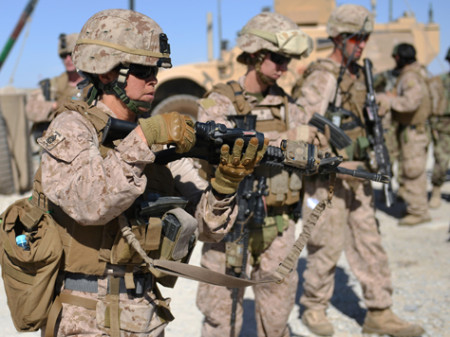
The Center for Military Readiness (CMR) has released a 64-page report analyzing ongoing research by the U.S. Marine Corps (USMC) about the effectiveness of integrating women into direct ground combat (DGC) units. The Interim CMR Special Report pokes a giant hole in the Obama administration’s assertions that standards of effectiveness can be maintained irrespective of the biological differences between men and women.

In January 2013, with all the attendant fanfare, Former Secretary of Defense Leon Panetta lifted a 1994 ban on women serving in smaller DGCs, insisting that “women are contributing in unprecedented ways to the military’s mission of defending the nation.” The move was recommended by the Joint Chiefs of Staff, and each branch of service has until January 2016 to seek special exemptions to the change. Panetta argued that women already make up 15 percent of the military and have already faced “the reality of combat.” He further insisted everyone is entitled to see if they can meet the qualifications for being in a DGC.

As it is with so many leftist agendas, the meaning of words can be manipulated to meet them. As the CMR explains, Joint Chiefs of Staff Chairman Gen. Martin Dempsey “has suggested that standards too high for women should be questioned” and has called for a “critical mass” of women in DGC units, a percentage that apparently ranges from 10-15 percent. To achieve this critical mass, the Obama administration has embraced “gender diversity metrics” that could lead to higher-preforming personnel being replaced by those meeting minimum standards characterized as “lower but equal.”

All of this is code-speak for quotas.

In 2012, Gen. James Amos initiated USMC research aimed at finding a way to integrate women into combat units. While physical strength was not the only issue of concern, it is the one where the disparities between men and women could not be obscured. Data collected in 2013 from 409 male and 379 female volunteers by the USMC Training and Education Command (TECOM) revealed several inconvenient truths during the five “proxy” tests designed to simulate ground combat element (GCE) tasks. In conjunction with data from Physical and Combat Fitness Tests (PFT and CFT), the greatest disparity between men and women was demonstrated in tests that measured upper body strength, which is considered essential for both survival and the success of missions involving direct ground combat.

The numbers are stark. In pull-up tests, men averaged 15.69 pull-ups, compared to a 3.59 pull-up average for women. Clean and press tests that involved lifting progressively heavier weights ranging from 70-115 pounds produced a passing rate of 80 percent among men at the 115 pound level, compared to only 8.7 percent of women. In a 120 mm Tank Loading Simulation drill, less than 1 percent of the men failed, compared to 18.68 percent of women. Less than 1 percent of men failed the 155 mm Artillery Lift and Carry, compared to 28.2 percent of women. And in the Obstacle Wall With Assist Box test that used a 20 inch box to simulate a “helping hand,” less than 1.2 percent of men could not get over the obstacle course, compared with 21.32 percent of women.

Enter “gender norming.” Gender norming is the idea that the military should have different (read: lower) standards for women than men. In practice, this has been going on for a long time. As a 1995 article written by Walter Williams reveals, “Army fitness standards call for 80 push-ups for men and 56 for women. Male soldiers ages 17 to 25 must run two miles in 17 minutes and 55 seconds. Females are given 22 minutes and 14 seconds. Male Marine trainees must climb 20 feet of rope in 30 seconds; women are given 50 seconds.” Nonetheless, proponents of gender norming say any concern that it will lead to lowered overall standards is unwarranted—because female soldiers will have to meet stringent guidelines before they are deployed in DGCs.

Not quite. “If we do decide that a particular standard is so high that a woman couldn’t make it, the burden is then on the service to come and explain to the secretary, ‘Why is it that high?  Does it really have to be that high?’” Gen. Dempsey contends.

The CMR further illuminates the machinations taking place, citing a June 2013 report to Congress by the Marines, noting that “gender-neutral” events in the PFT, CFT and obstacle courses “would be gender-normed for score…to account for physiological differences.” The CMR further reveals that researchers see the USMC project as a way to question whether tests such as the PFT and CFT serve as “valid predictors” of success in “combat-related tasks.” All of this is designed to downplay the conclusions reached by the CMR’s evaluation of the study: that “gender norming” is a contradiction of “gender neutral,” and despite the Pentagon’s insistence that those eligible for DGCs will have to meet gender-neutral standards, “data compiled so far indicates that this expectation cannot be met.”

How does the military plan to sidestep the issue? The CMR reveals the insidious concepts being employed in that regard. “Gender Diversity Dividends” could allow women to use “gender scoring tables” to accumulate points or dividends leading to 3rd, 2nd or 1st class status, that may even include extra points for women only. “Lower But Equal Standards” is the idea that the “worst performing decile” (one-tenth) of soldier performance should be used to calculate minimum passing test scores. “Training to Task” is the idea that women could improve their performance in pre-screening and other upper-body strength tests.

As the CMR notes, there is no specific study to support that assertion. A 1997 effort conducted by the Army revealed that specialized training could strengthen women on a temporary basis—but strengthen men even more, while retired expert in military medicine Rear Admiral Hugh Scott explained that androgenic hormones “that are not going to change” account for the differences in muscle mass and endurance training between men and women.

Military women have noticed. A recent survey conducted by the Army revealed that only 7.5 percent of the 30,000 who responded said they would want one of the combat jobs that would be made available. Even more telling, when the Army polled men and women about the physical standards, both groups said they should remain the same. “The men don’t want to lower the standards because they see that as a perceived risk to their team,” David Brinkley, deputy chief of staff for operations at the Army’s Training and Doctrine Command, told the AP. “The women don’t want to lower the standards because they want the men to know they’re just as able as they are to do the same task.” Regardless, the article further noted that “Brinkley’s office at Fort Eustis is filled with charts, graphs and data the Army is using to methodically bring women into jobs that have been previously open only to men.”

The CMR notes the effort is being aided by organizations such as the RAND Corporation, who have produced studies that are “not independent or objective, or likely to challenge the administration’s group-think on military-social issues.” It is group think that is seemingly determined to advance the agenda that methodology can eliminate biological differences between the overwhelming majority of men and women.

However, the military remains determined to try. The CMR notes the Marines will stand up “Ground Combat Element Integrated Task Forces” (GCEITF) that include a 25 percent rate of participation by women and will engage in simulated combat experiences. The CMR warns that the exercise might include “task-shifting” that could conceal deficiencies that would be unworkable in smaller DGC units.

They further warn that Congress needs to get heavily involved in reviewing the research, to consider the many “unresolved controversies that are barely mentioned in the current research.” They include disparities in injuries sustained by women, unit cohesion, the potential for sexual misconduct, readiness, recruiting, retention and reassignment costs, cultural ambivalence with regard to violence against women, and eligibility for Selective Service obligations tied to DGC units.

In conclusion, the CMR’s bottom line is clear: “None of the USMC research results produced so far support the activists’ theories that women can be physical equals and interchangeable with men in the combat arms.”

Unfortunately one suspects such reality is irrelevant. Speaking with Front Page, CMR President Elaine Donnelly noted that gender integration is driven by the idea of “how to make it happen, instead of whether to make it happen.” “The military should not be forced to achieve an agenda the president’s base demands,” she explained. “If you’re going to have a critical mass of women in direct ground combat units, standards have to be lowered. That’s the only was you can achieve that.” Donnelly also explained how such agendas are sustained. “Nobody holds the policy-makers accountable,” she said. For the sake of current and future soldiers who go into harm’s way to protect the nation, Americans must do exactly that — and demand an end to this dangerous, ideology-driven military policy.

The truth about diversity

October 8, 2014

The truth about diversity, Israel Hayom, Clifford D. May, October 8, 2014

(Please see also a satirical post by Mike at Make an Effort, in which he proposes a Middle East solution. Here’s an excerpt:

Here in the United States we have an abundance of Well Trained, Amazingly Equipped and Overly Funded Diversity Trainers.  (It’s worth noting that many of these same people are cross-trained in Sexual Harassment Education and Gender Sensitivity Issues.  All Added Value as far as my Proposal is concerned.)

I cannot believe it would take much to initiate a Mission composed of the Majority of these ‘Special Operators’ to head over to Syria and Iraq to impose Mandatory Diversity Training.  We can even make sure they wear comfortable shoes so they don’t challenge the President’s ‘No Boots on the Ground’ edict.

It may well be the best idea yet. It’s short; please read the entire thing.- DM)

Freedom may not be everyone’s cup of tea.

*****************

In theory, we Americans are great proponents of diversity. In practice, how many of us stop to seriously consider the meaning of the word? If peoples really are diverse — if we differ not just about clothes and cuisine but over ideas, values, interests, morality, and human rights — that implies there is no “international community,” certainly not one that embraces “international norms.” For years, we’ve told ourselves the world is a “global village.” Turns out it may be more like the “several remote nations” to which Gulliver traveled.

Multiculturalists of the Left are most likely to misconstrue diversity. But there also are those on the Right who believe all human hearts yearn for freedom. By now, I think, it’s become apparent: Freedom may not be everyone’s cup of tea.

The Iranians who took to the streets chanting “Death to the dictators” in 2009: I am convinced they did — and still do — want freedom, which, at a minimum, would mean liberation from theocracy, limiting the power of the billionaire mullahs, as well as the Islamic Revolutionary Guards and the Basij thugs who have oppressed ordinary Iranians since the Islamic Revolution of 1979.

Those protesting in Hong Kong now are risking life and limb to prevent Beijing Communist Party bosses from encroaching on their freedoms. Under the 1984 declaration that paved the way for the British colony to be turned over to China, Hong Kong was promised “a high degree of autonomy” for the half century following the transfer of sovereignty in 1997. The idea was not that when 2047 rolled around the people of Hong Kong would accept dictatorship with bovine passivity. Rather, it was assumed that by then dictators would have been relegated to the dustbin of history. At this point, that seems rather a long shot.

In a diverse world, there will be those who believe in peaceful coexistence and those who believe in what Franklin Roosevelt called “philosophies … based on conquest and the subjugation of other people”; those who believe that liberal democracy is the best form of governmental organization and those who prefer authoritarianism or totalitarianism; those who regard the intentional killing of other people’s children for political purposes as wrong, and those who kill other people’s children for political purposes, as well as moral relativists who say: “One man’s terrorist is another man’s freedom fighter.”

Addressing the U.N. General Assembly last month, President Barack Obama asserted that “the future belongs to those who build, not those who destroy.” First: That’s a hope, not a fact. Second: The hundreds of young Muslim men (and some women) flocking to the Islamic State group in Syria and Iraq see no contradiction between the two.

As they destroy ancient Christian, Yazidi, Kurdish and “apostate” Muslim communities, they also intend to build a caliphate for the 21st century, an empire in the image of what they imagine Muhammad founded in the seventh century, what my colleague Reuel Marc Gerecht calls “a new conquest society.” Obama may not think that’s a useful thing to construct but, in a diverse world, he can hardly expect everyone to concur.

Similarly, Hamas wants to build “an Islamic state in Palestine, all of Palestine” as Hamas Political Bureau member Mahmoud al-Zahar said last week. That would, obviously, require the destruction of Israel, a goal to which Hamas has always been openly and unequivocally committed.

Some of the Americans and Europeans who hold up signs reading “Free Palestine” ignore that. Others are just not troubled by it. Many turn a blind eye to this, too: Wherever Islamic militants rule, freedom is limited to a choice between submission and death. In Gaza, as in Islamic State, as in the Islamic Republic of Iran, no one gets up on a soap box in the public square, speaks his mind, criticizes those in power, and then goes home for a quiet dinner with the family. In a diverse world, some people are tolerant; others jail or slaughter those who displease them.

There is diversity among Islamists. For example, Hamas, al-Qaida and Iran don’t recognize the legitimacy of Islamic State. Over the weekend, however, the Pakistani Taliban declared its allegiance to Caliph Ibrahim, as the entity’s ruler, Abu Bakr al-Baghdadi, now calls himself. That must have come as a disappointment to al-Qaida leader Ayman al-Zawahri, who is al-Baghdadi’s rival (but not his enemy — there’s a difference).

There are Russians who value freedom. President Vladimir Putin is not among them. Then-president George W. Bush was mistaken when he looked into Putin’s eyes and thought he saw an aspiring democrat, just as Obama was wrong to think he could “reset” relations with Russia based on mutual respect and a shared commitment to peace and international law.

If the polls are to be believed, more than eight out of 10 Russians support Putin. An analysis by Radio Free Europe/Radio Liberty leads to the conclusion that most Russians value national pride and power over freedom and democracy. That’s diversity for you.

Within the U.S., diversity is most loudly trumpeted on our campuses — ironic because a scholar with unfashionable ideas has about as much chance of getting tenure as of winning the lottery. People forget that tenure was supposed to protect intellectual diversity, not abolish it.

And while many Americans continue to treasure freedom, others are more concerned with equality of outcome. There is a tension between the two because when individuals with dissimilar backgrounds, habits and talents compete in a free market they inevitably wind up in different places. But that’s not the kind of diversity most of those who claim to be championing diversity are willing to defend.

Turkey’s leaders see Kobani as opportunity, not threat

October 8, 2014

Turkey’s leaders see Kobani as opportunity, not threat, al Monitor, Amberin Zaman, October 7, 2014

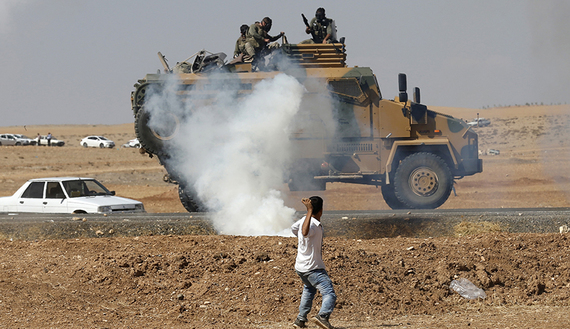
A protester throws stones at an armoured army vehicle during a pro-Kurdish demonstration, near the Mursitpinar border crossing on the Turkish-Syrian border, in SurucA protester throws stones at a Turkish armored vehicle during a pro-Kurdish demonstration in solidarity with the people of Kobani, near the Mursitpinar border crossing on the Turkish-Syrian border, Oct. 7, 2014. (photo by REUTERS/Umit Bektas)

The fall of Kobani would deal a severe blow to Kurdish independence hopes and bolster Turkey’s political goals.

The town has emerged as a symbol of Kurdish resistance.

***************

As Islamic State (IS) fighters keep up their battle to gain control over Kobani, a strategic Syrian Kurdish-controlled enclave on Turkey’s border, the effects of the conflict are being felt in Turkey itself. Thousands of Kurds took to the streets across the country on Oct. 7 to protest Turkey’s inaction against IS’ seemingly unstoppable advance. In the southeastern town of Varto, the government slapped curfews on six provinces in the mainly Kurdish southeast region after clashes between protestors and the security forces, and between rival Kurdish groups, left at least 14 people dead. Elsewhere across the country, police clashed with demonstrators, trying to push them back with pressurized water and pepper spray while the Kurds responded with Molotov cocktails in a foretaste of the violence that is likely to engulf the country should Kobani fall.

None of this comes as a surprise. Many Kurds continue to believe that Turkey is complicit in the jihadists’ onslaught against Kobani. Cemil Bayik, one of the top commanders of the Kurdistan Workers Party (PKK), repeated this claim in a Sept. 25 interview with Al-Monitor. Abdullah Ocalan, the imprisoned PKK leader, is threatening to call off peace talks with the Ankara government should there be a massacre in the enclave. Turkey denies it is siding with IS.

But it is doing little to aid the Kurds. This in turn invites the question of whether Turkey sees the Kurds as a greater threat than the jihadists, who stand to grab their third border crossing with Turkey. Turkish President Recep Tayyip Erdogan appeared to suggest that IS and the PKK were equally dangerous. “It is wrong to view them differently, we need to deal to them jointly,” he told reporters Oct. 3 in Istanbul. Erdogan’s comments hold the key to understanding Turkey’s policy on Kobani.

Turkey’s inaction over Kobani is undermining the peace process. Erdogan’s hopes of winning Kurdish support for constitutional amendments that would boost his presidential powers hang on friendship with the Kurds. A breakdown of the PKK’s 18-month-long cease-fire would likely jeopardize his ruling Justice and Development Party’s (AKP) chances in nationwide parliamentary elections scheduled for June. None of this appears to faze the Ankara government. This is because Erdogan and his AKP disciples view Kobani as an opportunity rather than a threat.

The opportunity ought to be to win the hearts and minds of Turkey’s Kurds by riding to the rescue of their brethren in Syria. Instead, Erdogan has chosen to exploit Kobani’s imminent fall to wrest maximum concessions from assorted Kurdish leaders. This was amply on display during last week’s secret meeting in Ankara between Salih Muslim, the co-chair of the Democratic Union Party (PYD), and senior Turkish officials from the Foreign Ministry and the national intelligence agency, MIT. Muslim reportedly beseeched the officials to allow the passage of arms and, most crucially, anti-tank weapons through the Mursitpinar border crossing with Kobani to enable Syrian Kurdish People’s Protection Units (YPG) fighters to fend off IS. Turkey said it would do so only if the PYD severed all its ties with the Syrian regime, joined the rebels, dissolved the PYD-dominated local governments running the enclaves, shared power with rival Syrian Kurdish parties and distanced itself from the PKK.

Muslim seems to have offered conflicting versions of what transpired, telling Al Jazeera that “agreement was reached in a number of areas” and the BBC that Turkey “did not keep its promises.” He has not responded to Al-Monitor’s repeated requests for comment. Either way, it’s hard to imagine that he yielded to Turkey’s demands or that he even has the authority to do so, because Ocalan and the PKK leadership in the Kandil Mountains call the final shots.

Turkey to its credit has offered sanctuary to more than 100,000 refugees from Kobani, and it is letting wounded YPG fighters in for treatment in hospitals. But Turkey would probably be happy to see Kobani fall. The town has emerged as a symbol of Kurdish resistance. It hosted Ocalan when he used to live in Syria under the patronage of the late Syrian President Hafez al-Assad. Kobani also has huge strategic significance. It lies between a swath of uninterrupted Kurdish-controlled towns and villages to the east collectively known as the canton of Jazeera and the Kurdish-administered town of Afrin to the southwest. The Kurds have long wanted to link the three by pushing out IS and other Syrian rebels from the areas separating them. The prospect of a Kurdish entity run by the PKK is more than Turkey, and especially its generals, can stomach.

Kobani’s fall would deal a humiliating blow to the PKK and weaken its support among Syria’s Kurds. It would also force Muslim and the PYD to patch up their differences with Massoud Barzani, the president of the Kurdistan Regional Government (KRG) in Iraq, who claims to be the “true leader” of all the Kurds. Although Barzani has spoken in defense of Kobani, he has yet to reproach Turkey over its stance.

Meanwhile, the PKK’s threats to resume its war sound like bluster to Turkish ears. Aaron Stein, a security analyst, told Al-Monitor, “The Turkish government is banking on the fact that the PKK can ill afford to open a second front against Turkey when it is battling IS in Iraq and in Syria.” Not only that, Ocalan would be loath to condemn himself to political irrelevance and spend the rest of his days rotting in prison. No matter how bitter, Kobani is a pill the Kurds will be forced to swallow. Ocalan will be forced to continue the peace talks, the pro-Kurdish People’s Democracy party (HDP) will play along and the PKK will hold its fire. This, anyway, seems to be Ankara’s thinking.

But it is fraught with risk.

The new generation of Kurds, as Bayik warned in his interview with Al-Monitor, is so radicalized that even the PKK finds it hard to keep them in line. Should Ocalan be perceived as capitulating to Turkey, he would lose his grip over them, too.

It was the fear of a PKK-dominated Kurdish statelet in Syria that propelled Turkey to resume peace talks with Ocalan in 2012 in the hope that he would keep the Syrian Kurds’ aspirations in check. The plan doesn’t seem to have worked. “The peace process began because of Syria’s Kurds,” recalls Arzu Yilmaz, a scholar of Kurdish affairs at Ankara University. “And it is because of them that it will unravel,” she concludes.

Editor’s Note: This piece has been updated since its initial publication.


Iran Tightens Grip on Yemen

October 8, 2014

Iran Tightens Grip on Yemen, National Review On LineAndrew C. McCarthy, October 8, 2014

(Obama continues to tell us that Islam helped to make America what she is today and is not his our enemy. Since we seem to have some, who might they be? Surely not the soon-to-be Islamic Nuclear Republic of Iran. — DM)

It is the height of folly to believe we can degrade and ultimately destroy anti-American jihadist organizations while continuing to turn a blind eye to Iran’s essential support for those organizations, while accommodating the mullahs on nuclear weapons, and while idling as Tehran’s agents seize control of key strategic territory (see Mr. Gerstman’s excerpt from Michael Segall’s analysis of Iran’s goals in Yemen and beyond). Again, we cannot defeat our enemies without recognizing who they are.

******************

Iran, the enemy of the United States that the Obama administration nonetheless regards as a potential ally and stabilizing influence in the Middle East, has seized substantial control of Yemen.

Under the apt headline, “While you were watching ISIS, Iran took Yemen,” Legal Insurrection’ David Gerstman sifts through reports from the Washington Post and Reuters, relating that the Houthi, Shiite jihadists backed by Tehran’s mullahs, have wrested “control of almost all state buildings, from the airport and the cental bank to the Defense Ministry.” They have likewise festooned Sanaa with signs proclaiming their mullah-echoing slogan, “Death to America, death to Israel, a curse on the Jews and victory to Islam.”

As Mr. Gertzman observes, the same chant is routinely heard from Iran’s forward jihadist militia, Hezbollah. Hezbollah means the “Party of Allah” and the Houthisimilarly call themselves “Ansal Allah,” the “Supporters of Allah.” And, taking another page out of the Hezbo playbook, the Houthi are blocking the appointment of a new prime minister – just as Hezbollah has done in Lebanon in the terror group’s role as, to quote the Post report, “top down brokers dominating the government and running a virtual state-within-a-state.

As in Syria, the Shiites are opposed by the combination of the “moderate” Muslim Brotherhood – i.e., the Islah party, whose power-sharing arrangement with the rump of the ousted Sunni government the Houthi reject – and the local al Qaeda franchise (al Qaeda in the Arabian Peninsula), which continues to attack Houthitargets.

Not to beat a dead horse, but we are in a global conflict in which the Islamic State is only one component of the enemy – and not the most significant one. I argued it this way a few weeks back:

The main challenge in the Middle East is not the Islamic State; it is the fact that the Islamic State and its al-Qaeda forebears have been fueled by Iran, which supports both Sunni and Shiite terrorism as long as it is directed at the United States. There cannot be a coherent strategy against Islamic supremacismunless the state sponsors of terrorism are accounted for, but Obama insists on seeing Iran as a potential ally rather than an incorrigible enemy.

It is the height of folly to believe we can degrade and ultimately destroy anti-American jihadist organizations while continuing to turn a blind eye to Iran’s essential support for those organizations, while accommodating the mullahs on nuclear weapons, and while idling as Tehran’s agents seize control of key strategic territory (see Mr. Gerstman’s excerpt from Michael Segall’s analysis of Iran’s goals in Yemen and beyond). Again, we cannot defeat our enemies without recognizing who they are.

U.S. officials: ISIS will capture Kobani, but it’s not a big concern to us

October 8, 2014

U.S. officials: ISIS will capture Kobani, but it’s not a big concern to us, CNN, Holly Yan and Elise Labott, October 8, 2014

(Please see video at the link. Turkey is not interested in helping the Kurds in Kobani, including the Kurdish fighters who are getting overwhelmed. Is keeping Turkey happy part of the Obama Administration war “strategy?”– DM)

As Time.com put it, “If the ISIS militants take control of Kobani, they will have a huge strategic corridor along the Turkish border, linking with the terrorist group’s positions in Aleppo to the west and Raqqa to the east.”

And Staffan de Mistura, U.N. special envoy for Syria, warned of the horrors ISIS could carry out against the people of Kobani — horrors it has carried out elsewhere. “The international community needs to defend them,” he said. “The international community cannot sustain another city falling under ISIS.”

********************

The key Syrian border city of Kobani will soon fall to the Islamist terror group ISIS, several senior U.S. administration officials said.

They downplayed the importance of it, saying Kobani is not a major U.S. concern.

But a look at the city shows why it would mark an important strategic victory for the Islamic mlitant group. ISIS would control a complete swath of land between its self-declared capital of Raqqa, Syria, and Turkey — a stretch of more than 100 kilometers (62 miles).

As Time.com put it, “If the ISIS militants take control of Kobani, they will have a huge strategic corridor along the Turkish border, linking with the terrorist group’s positions in Aleppo to the west and Raqqa to the east.”

And Staffan de Mistura, U.N. special envoy for Syria, warned of the horrors ISIS could carry out against the people of Kobani — horrors it has carried out elsewhere. “The international community needs to defend them,” he said. “The international community cannot sustain another city falling under ISIS.”

Coalition batters ISIS positions with airstrikes

A U.S.-led coalition has been pounding ISIS positions in the region with airstrikes for a few weeks.

The latest strikes, late Tuesday into Wednesday, included nine in Syria, the U.S. military said. Six were in the Kobani area, destroying an ISIS armored personnel carrier, four armed vehicles and two artillery pieces, U.S. Central Command said. U.S. and coalition forces also conducted five airstrikes against ISIS in Iraq, the military said.

The primary goal of the aerial campaign is not to save Syrian cities and towns, the U.S. officials said. Rather, the aim is to go after ISIS’ senior leadership, oil refineries and other infrastructure that would curb the terror group’s ability to operate — particularly in Iraq.

Saving Iraq is a more strategic goal for several reasons, the officials said. First, the United States has a relationship with the Iraqi government. By contrast, the Obama administration wants Syrian President Bashar al-Assad to step down.

Another reason: The United States has partners on the ground in Iraq, including Iraqi forces and Kurdish fighters known as Peshmerga.

Local fighters apparently made some headway Wednesday morning, when some ISIS militants in Kobani were pushed back to the city’s perimeter, Kurdish official Idriss Nassan said.

The battles have been bloody. More than 400 people have been killed in the fight for Kobani since mid-September, the Syrian Observatory for Human Rights said. The opposition group said it has documented the deaths of 219 ISIS jihadists, 163 members of the Kurdish militia and 20 civilians.

Kobani mapMap: Kobani (Ayn al-Arab)

U.S. plan against ISIS: Iraq first, then Syria

The United States’ goal is to first beat back ISIS in Iraq, then eliminate some of its leadership and resources in Syria, the U.S. administration officials said.

If all goes as planned, by the time officials turn their attention to Syria, some of the Syrian opposition will be trained well enough to tackle ISIS in earnest.

Washington has been making efforts to arm and train moderate Syrian opposition forces who are locked in a fight against both ISIS and the al-Assad regime.

Training Syrian rebels could take quite a long time.

“It could take years, actually,” retired Gen. John Allen said last week. “Expectations need to be managed.”

The United States also wants Turkey to do more, the officials said. The administration is urging Turkey to at least fire artillery at ISIS targets across the border.

But the Turkish reluctance, the officials say, is wrapped up in the complex relationship with their own Kurds and the idea that they don’t want to help any of the Kurds in any way.

Hundreds of strikes, millions of dollars

The United States and its allies have made at least 271 airstrikes in Iraq and 116 in Syria.

The cost? More than $62 million for just the munitions alone.

The effect? Negligible, some say, particularly in Iraq.

One by one, the cities have fallen to ISIS like dominoes: Hit, Albu Aytha, Kubaisya, Saqlawia and Sejal.

And standing on the western outskirts of Baghdad, ISIS is now within sight.

“That’s DAIISH right over there,” said Iraqi Brig. Gen. Ali Abdel Hussain Kazim, using the Arabic acronym for ISIS.

The militants’ proximity to the capital is cause for concern. If the terror group manages to infiltrate and launch attacks in Baghdad or its green zone, the results could be disastrous.

Kazim said ISIS has not been able to move from eastern Anbar province to Baghdad. But another brigadier general said that’s not even the biggest threat.

The real danger to the Iraqi capital, Brig. Gen. Mohamed al-Askari said, is from ISIS sympathizers in the city.

“They are a gang,” he said. “They deploy among civilians. They disappear into the civilian population and camouflage themselves.”

U.S. Denies Visa to Victim of Boko Haram, Muslim Persecution of Christians, May 2014

October 8, 2014

U.S. Denies Visa to Victim of Boko Haram, Muslim Persecution of Christians, May 2014, Gatestone InstituteRaymond Ibrahim, October 8, 2014

(Gee, couldn’t Obama at least have explained, gently, in a friendly way but persuasively to King Abdullah that Islam is the Religion of Peace and why torturing and executing people on account of their religious beliefs is not Islamic? Just think of the difference he might have made (none whatever).– DM)

U.S. President Barack Obama did not “publicly broach the subject of religious freedom” during talks with Saudi King Abdullah, despite a letter from 70 members of Congress urging him to “address specific human rights reforms” both in public and in direct meetings with King Abdullah. It was “remarkable that the resident could stay completely silent about religious freedom…. as well as other human rights concerns, with King Abdullah.” — International Christian Concern advocacy group.

Al-Shabaab Islamists publicly beheaded a mother of two girls and her cousin after discovering they were Christians. The two daughters of one of the women, ages 8 and 15, “were witnesses to the slaughter,” sources said, with the younger girl screaming for someone to save her mother.

“You will regret why you left the prophet’s religion.” — Threatening phone message, Kenya.

The deplorable state of religious freedom in the Islamic world really came to the fore in May with the arrest, imprisonment, and death sentencing of a pregnant Christian wife and mother on the accusation that she had left Islam for Christianity. On May 15, Meriam Ibrahim of Sudan, after repeatedly refusing to convert to Islam, was sentenced to being flogged with 100 lashes, followed by being hanged for apostasy.

During her 6-month imprisonment, with her one-year-old son by her side, she gave birth to another child. The girl was born with disabilities due to the harsh conditions of the prison cell in which she was delivered, and the chains with which her “apostate” mother was still shackled as she gave birth.

Because Meriam Ibrahim’s plight made it to the mainstream media, however, Sudan released Ibrahim and her children in June.

Before her release, Islamic clerics were often sent to her cell where they repeatedly pressured, and threatened her with death, to convert to Islam. In a recent interview with Megyn Kelly on Fox News, Ibrahim said: “My faith was the only weapon that I had in these confrontations with imams and Muslim scholars because that’s what I believe. Faith means life. If you don’t have faith, you’re not alive.”

When Kelly asked her why she didn’t simply do what the clerics wanted and convert to Islam in the interest of freedom, Ibrahim replied:

If I did, that would mean I gave up. It’s not possible because it’s not true. It’s my right to follow the religion of my choice. I’m not the only one suffering from this problem. There are many Meriams in Sudan and throughout the world. It’s not just me; I’m not the only one…. With regard to the situation of Christians, this is a well-known fact that they live under difficult circumstances and they are persecuted and treated harshly. They are afraid to say they are Christian out of fear of persecution. Sometimes imprisoned Christians with financial difficulties are told that the government will pay off their debts if they convert to Islam…. If you are a Christian and you convert to Islam it will become hard to leave Islam because if you do so you will be subjected to the death penalty.

As Ibrahim’s son, imprisoned with her, is an American citizen from his father’s side, many Americans wondered why the Obama administration was not saying or doing much. Speaking of Ibrahim’s ordeal, Sen. Ted Cruz said, “There is urgency, a dire need for U.S. leadership. President Obama should speak out publicly and call upon the government of Sudan to free Meriam Ibrahim. Secretary of State John Kerry should speak out loudly and forcibly and call up on.” [sic]

Members of Congress are increasingly urging Obama to speak up on behalf of persecuted minorities throughout the Islamic world.

A few weeks earlier, human rights activists criticized the U.S. president for not addressing the plight of Christians and other minorities during his talks with leaders in Saudi Arabia, where Christianity is banned.

Many Christians, far from being released, are killed for being Christian and refusing Islam.

Around the same time the world was hearing about Ibrahim’s plight, a prominent underground church Christian leader was killed by Muslims from the al-Shabaab group in Somalia. “Sadness and grief has befallen our community when our dear brother Abdishakur Yusuf was mercilessly murdered in Mogadishu by unknown gunmen,” said a local source: “He was found outside his house lying in a pool of blood… He was shot in the head multiple times, so that his face is barely recognizable.” Yusuf leaves a widow and three children, ages 11, 8 and 5. Weeks before this murder, al-Shabaab Islamists publicly beheaded a mother of two girls and her cousin after discovering they were Christians. According to local sources, the Islamists “called residents to the town center to witness the executions of the 41-year-old mother, Sadia Ali Omar, and her 35-year-old cousin, Osman Mohamoud Moge.” Before slaughtering the two women, an al-Shabaab member announced, “We know these two people are Christians who recently came back from Kenya—we want to wipe out any underground Christian living inside ofmujahidin [jihadi] area.” The two daughters of one of the women, ages 8 and 15, “were witness to the slaughter,” sources said, with the younger girl screaming for someone to save her mother.

According to the Washington-based International Christian Concern advocacy group, Obama did not “publicly broach the subject of religious freedom” during talks on March 28 with Saudi King Abdullah, despite a letter from 70 members of Congress urging him to “address specific human rights reforms” both in public and in direct meetings with Abdullah and other officials.

“This visit was an excellent opportunity for the president to speak up on an issue that affects millions of Saudi citizens and millions more foreign workers living in Saudi Arabia,” said Todd Daniels, ICC’s Middle East regional manager. He added that it was “remarkable that the president could stay completely silent about religious freedom” despite pressure from Congress “to publicly address the issue, as well as other human rights concerns, with King Abdullah…”

Another report appearing in May further highlighted the U.S. government’s indifference. Deborah Peters, a Christian teenage from Nigeria girl told of how Boko Haram came to her household and slaughtered her father and brother because they refused to convert to Islam. After abusing her, they tied her up and left her in a state of shock between the two corpses. Emmanuel Ogebe, the human rights attorney who helped Peters come to the United States after the murders, said that visa requests filed on Peters’ behalf were denied “multiple times” in 2011, with the State Department citing no family ties in the U.S. as the reason. The incident became public only this May.

Similarly, a month earlier, the United States Institute for Peace brought together the governors of Nigeria’s mostly Muslim northern states for a conference in the U.S., but the State Department blocked the visa of the region’s only Christian governor, an ordained minister, citing “administrative” problems.

The rest of May’s roundup of Muslim persecution of Christians around the world includes (but is not limited to) the following accounts, listed by theme and country alphabetical order, not necessarily according to severity.

Muslim Attacks on Christian Churches

Iran: Plainclothes security authorities raided an Easter service in a house-church in southern Tehran. They arrested and hauled off all those in attendance. Neighbors said that security authorities were “very disrespectful to those in the house-church as well as to the neighbors.”

Malaysia: Two Catholic nuns in the Muslim-majority nation “were viciously attacked on the grounds of the Church of Visitation in Seremban in what is believed to be a robbery attempt early this morning,” reported the Malaysian Insider. Sister Juliana Lim was hospitalized in critical condition and on a respirator, while Sister Mary-Rose received treatment for various injuries. “Both nuns from the Infant Jesus Convent, were left bruised, bleeding and in shock following the attack, said Fr Chan in his Facebook posting, adding: ‘As I anointed them [two nuns], tears streamed down my face. I couldn’t help it. How wicked it is to do this to our nuns, who have given their whole life to God.'” In response, the Council of Churches of Malaysia said: “The voices of antagonism and hatred have been on the increase in the country and it would be no surprise if the attack on the nuns were not conspired by those out to cause inter-religious conflict in the country.”

Nigeria: Seven churches were attacked and 29 Christians slaughtered. On Sunday, May 25, during a worship service, Islamic terrorists from Boko Haram killed 21 Christians of the Church of Christ in Nations congregation in town of Gwoza. The next day, Boko Haram Islamists burned down six churches and slaughtered eight more Christians in the area.

Palestinian Authority: St. George’s Orthodox Church in Bethlehem was attacked by Muslims during its annual St. George’s Day services on May 6, leaving one Christian stabbed, several injured, and the building damaged. According to Leila Gilbert, “Some local Muslims either tried to park a car too close [to] the church and/or tried to enter the church during a service honoring St. George—the initial instigation isn’t clear. But when the intruders were asked to leave, one of them stabbed a Christian man who was outside the church serving as a guard. He was hospitalized. Several then started throwing stones at the church. 7 or 8 Christians were injured and some physical damage was done—broken windows etc. The police didn’t show up for an hour.”

Tanzania: Two churches were attacked. As Christians were gathered for overnight prayers in the Assemblies of God church, around 80 Muslim men armed with arrows and knives attacked the church building while shouting “death to apostates.” They set fire to the church, leaving its interior in ruins, and then went looking for its pastor, a Muslim convert to Christianity, presumably to slaughter him. Separately, a homemade explosive device in a plastic bag left inside the Evangelical Lutheran Church of Tanzania exploded in the face of a female employee who found it, causing serious injuries to her face and legs and leaving her in critical condition.

Turkey: At least one Turkish church’s website was labeled “pornographic” and blocked from computers at the Grand National Assembly of Turkey, prompting one legislator to demand an investigation. When asked, the speaker for the ruling Islamist Justice and Development Party (AKP) said it was likely a technical glitch, but Aykan Erdemir, the legislator who discovered it, said “I wouldn’t be surprised if there was some malicious intent.” Umut Ṣahin, general secretary for Turkey’s Association of Protestant Churches, said the ban was “horrible… It’s a shame. It really pains us at having this kind of accusation when we have a high moral standard.”

Muslim Attacks on Christian Freedom: Apostasy, Blasphemy, Proselytization

Egypt: A Coptic Christian teacher, Bishoy Camille, was sentenced to four years in prison and fined 10,000 Egyptian pounds [$1,400 USD]. He was found guilty of sharing cartoons of the Islamic prophet Muhammad on Facebook, prompting Muslim riots against the Copts.

Iran: A May report by Morning Star News said that “Iran’s secret police and Revolutionary Guard are subjecting Christians to a continuing wave of arrests, and increased torture and brutal beatings, in an effort to crush the house-church movement, activists said. Human rights activists confirmed that there has been a noticeable increase this month in the number of reported assaults against Christians imprisoned in Iran. The assaults, which are taking place against converts who lead house churches, are meant to send a message to Christians in the country, said a Middle East Concern [MEC] researcher who focuses on Iran.” On May 5, for instance, internal security agents arrested Silas Rabbani, a leader with the Church of Iran in Karaj. Rabbani, a former Muslim, has been “informally charged” with apostasy and was accordingly beaten while in custody. “He was then transferred to Gohardasht Prison, also known as Rajai Shahr, where the torture has continued.”

Kenya: Three weeks after converting to Christianity, Hassan Hussein Mohammed, a 26-year-old former Muslim, was severely beaten in a mosque. Although he was training to become a Muslim leader, he met some Christians, discussed religion, and eventually converted. According to Morning Star News, “Mohammed later went to the mosque only to collect his identification papers, but leaders ordered him to stay and conduct evening prayers. After some hesitation, he agreed. A voice within, he later told church leaders, told him not to lead the prayers, and when he tried to say them his mind blanked. He then admitted that he had accepted ‘Isa,’ Jesus. Those in the mosque beat him with a blunt object, kicked him and struck him until he was unconscious, he told church leaders. When he regained consciousness a few minutes later, he said, ‘I am ready to die for Isa, and I forgive you for what you have done to me.'” He managed to escape, but after news of his conversion spread, Mohammed began receiving threatening phone messages and texts. One said: “You will regret why you left the prophet’s religion.”

Pakistan: When a Muslim religious leader discovered that four Christians, a married couple, and two women, were handing out Christian pamphlets, he immediately informed police who arrested the Christians, taking them away from a growing crowd of angry Muslims. According to Fr. Arshad John of the Archdiocese of Karachi, who is engaged in the protection of minority rights: “The claims that the religious minorities are free to practice and preach their religion, is clearly evident from this act. Although the act of distributing the religious material and preaching in such areas is not very wise, in the past such cases have produced unfortunate results. We pray for the group and hope they will be released soon.” Separately, the Pakistan Christian Post reported that Dr. Nazir S. Bhatti, President of Pakistan Christian Congress, was concerned about a recent example of double standards concerning the implementation of blasphemy laws. He said that when any Muslim commits blasphemy on electronic media watched by millions, he or she is pardoned after a simple apology note, but when a Christian or Ahmadiyyia community member is accused of blasphemy by one Muslim wittiness, then he faces death sentence even if he swears that he did not insult the name of prophet Muhammad: “All Christian victims of blasphemy laws after arrests have publically denied committing blasphemy but not any court or complainant have pardoned them but when a Muslim cleric or any Muslim very openly defiles name of Prophet Mohammad then uproar of Islamic decrees appear to Pardon these Muslims.”

Sudan: In the town of al-Gadarif on Sudan’s eastern border with Ethiopia, another Christian woman, like Meriam Ibrahim, was incarcerated on the accusation that she had apostatized from Islam. Immigration authorities arrested Faiza Abdalla, 37, when she responded to officers’ questions about her religion that she was Christian. They immediately arrested her based on her Muslim name. (Her family had converted to Christianity before she was born but kept their former name.) As with Meriam Ibrahim and others, a court went on to annul Faiza’s marriage to her husband, a lifelong Catholic from South Sudan, on grounds that she had committed “adultery” by allegedly having left Islam and married a Christian.

Dhimmitude: Generic Hostility, Abuse, and Discrimination

Egypt: Lawyers for a Muslim man who attacked Christian properties and persons—stabbing one Coptic woman to death—maintain that he is innocent by reason of insanity, even though psychiatric evaluations found him sane and fit to stand trial. Last February, Mahmoud Mohamed Ali went on a violent rampage, attacking three Christians with a knife. When his intended victim, a male Coptic pharmacy clerk, fought him off, Ali fled. Next, Ali stabbed Demian, a Coptic shopkeeper in another Christian-owned pharmacy; he severed an artery in her neck. She fell to the floor and bled to death. Soon after, Ali stabbed a female Coptic high school student, who barely managed to escape with her life. But according to Morning Star News: “Confirming fears of human rights activists who said attorneys for Mahmoud Mohamed Ali would use a tactic that has freed other Muslims from punishment for premeditated, religiously motivated murder, the lawyers are challenging results of the evaluation.”

Some Islamic teachings state that the life and worth of a Muslim is greater than that of an “infidel” and so they should not be punished, or should receive the minimum punishment when they kill non-Muslims. Egyptian human rights activist Osama Wagdy said the “insanity” plea is a tactic commonly used in Egypt by those who have violently targeted Christians: “They are pretending, because that is how they get out of cases… Nobody thinks he is mentally ill. He went from one place to another knowing what he was doing and told one of the victims, ‘You deserve it.'” Separately, five “unidentified persons” kidnapped a Coptic Christian pharmacy owner at gunpoint in Sohag, Upper Egypt. Shortly after Friday mosque prayers, a car pulled up in front of the pharmacy and opened fire on it before the assailants raided it and drove off with the kidnapped owner, Mr. Marcos, a 52-year-old Copt, at gunpoint.

Eritrea: Five Christians of the Evangelical Lutheran Church were arrested after their church announced that they were set to be ordained for pastoral ministry. “The arrests clearly show how even government recognized churches, namely the Catholic, [Eritrean] Orthodox [Church] and Evangelical Lutheran churches, are not free from government control,” said a source from the Open Doors organization on condition of anonymity. “The arrest of these pastoral candidates reminds us of one of the greatest challenges churches in Eritrea face…. Due to the constant turnover of pastors due to arrest or threats, continuous and biblically consistent pastoral care for Christians is hampered.” Further, “1,500 Christians are languishing in prison for their faith.” In 2010, an estimated 3,000 Christians were incarcerated for their faith; most were held in shipping containers in desert camps and others in underground cells; some were tortured to death while others perished in the desert trying to escape.

Germany: A Turkish man being treated in a hospital attacked his nurse because there were too many crosses on the wall. According to Mainpost, a German publication (as translated by Nicolai Sennels for Jihad Watch), “A 34-year-old went to St. Joseph Hospital early on Saturday morning due to a ‘gastro-intestinal flu.’ Suddenly he refused to be treated, because he thought there were too many Christian crosses on the wall. Because of the crosses, the man started insulting the nurse, calling her a bitch, fascist, and the like. Then the man, according to police report, also started becoming physically aggressive. The hospital called the police. The officers seized the man in front of the hospital and checked him.”

Pakistan: Five Christian families that, according to Agenzia Fides, were “kidnapped and enslaved by their Muslim employers” in the Punjab were released after nearly three decades of slavery. After their release, one of the families told of their suffering: they were victims of forced labor and were treated as slaves for over 25 years. One of the women, Safia Bibi, began working at the brick kiln along with her husband, Anwar Masih, right after her wedding. When their nine children were old enough, they also started to work in the same place. They lived in the factory complex with no toilets and often did not receive compensation. If they tried to leave their job, they were beaten and tortured, left days without food. In 2013, Safia’s husband died due to illness and weakness; no doctor was called. Her children could not attend his funeral—or go to prayer meetings or celebrate Christmas—because they were forced to work.

Nasir Saeed, a human rights activist, said: “It is sad to see that even in the 21st century slavery continues to exist in Pakistan. The owners of furnaces are often wealthy and influential and are rarely prosecuted. The workers, often Christian, work a life in slave-like conditions to pay their debts, that last generations. Sometimes they are sold from one furnace to another. The government is aware of the situation, but has never taken serious measures.”

Turkey: According to ANSamed, “Prime Minister Recep Tayyip Erdogan’s government plans to turn Istanbul’s Hagia Sofia Basilica into a mosque in the afternoon and evening and a museum in the morning. The historical monument, which draws millions of tourists every year, will have the Byzantine [Christian] frescoes covering its walls cast into shadow by ‘dark light’ so as to avoid offending Islam. The government would thus like to turn what is today seen as a symbol of Christianity back into a place of worship for Muslims, as it was after the Ottoman conquest of Constantinople in 1453.” A campaign to turn the Hagia Sofia back into a mosque has been brewing for quite some time now, raising alarm among Christian communities in the east. Patriarch of Constantinople, Bartholomew I, said that, “We and all other Christians will oppose it.” And Athens called it [sic] an “insult to the religious sensibilities of millions of Christians.” Even so, the Islamist party submitted a formal motion in parliament to transform Hagia Sofia into a mosque.
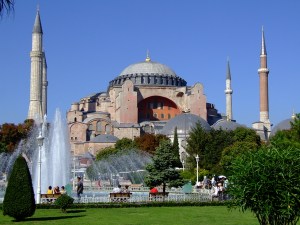
Hagia SophiaThe Turkish government plans to convert Istanbul’s Hagia Sofia Basilica, currently used as a museum, into a mosque. (Image source: Wikimedia Commons/Jerzy Kociatkiewicz )

While not all, or even most, Muslims are involved, persecution of Christians is expanding. “Muslim Persecution of Christians” was developed to collate some—by no means all—of the instances of persecution that surface each month.

It documents what the mainstream media often fails to report.

It posits that such persecution is not random but systematic, and takes place in all languages ethnicities and locations.
Hamas: Ruling West Bank could destroy Israel “with a speed that no one can imagine”

October 8, 2014

PMW BulletinsHamas: Ruling West Bank could destroy Israel “with a speed that no one can imagine”

by Itamar Marcus and Nan Jacques Zilberdik Oct. 5, 2014

via Hamas: Ruling West Bank could destroy Israel “with a speed that no one can imagine” – PMW Bulletins.


Hamas leader Al-Zahar:
If Hamas were to transfer “what it has [in Gaza]
or just a small part of it to the West Bank,”
it would destroy Israel
“with a speed that no one can imagine”
“We will build an Islamic state in Palestine,
all of Palestine”
New Poll: Hamas leader Haniyeh
would defeat Abbas in elections
in both the West Bank and the Gaza Strip
Haniyeh – 55%, Abbas – 38%
by Itamar Marcus and Nan Jacques Zilberdik

Last week, Hamas Political Bureau member Mahmoud Al-Zahar stated that Hamas wants to build an Islamic state in all of Palestine, meaning it would replace Israel:

“[Some] have said Hamas wants to create an Islamic emirate in Gaza. We won’t do that, but we will build an Islamic state in Palestine, all of Palestine.” [Al-Ayyam, Oct. 1, 2014]

Al-Zahar further said that if Hamas had a military foothold in the West Bank as it does in the Gaza Strip, it would be able to destroy Israel. He alluded to a possible future war of destruction against Israel by citing a Sura from the Quran about “the final promise,” which speaks of destroying “the enemies” and “what they had taken over with [total] destruction” [Sura 17:7]:

“Al-Zahar said that if his movement [Hamas] were to ‘transfer what it has or just a small part of it to the West Bank, we would be able to settle the battle of the final promise with a speed that no one can imagine.'”

His expression “the final promise” is taken from Sura 17:7 of the Quran: “Then when the final promise came, [We sent your enemies]… to enter the temple in Jerusalem, as they entered it the first time, and to destroy what they had taken over with [total] destruction.'” (trans. Sahih International) By alluding to this passage in the context of Israel, Hamas is promising a future war of destruction against Israel.

A recent Palestinian poll shows that Hamas indeed has a strong base of support in the West Bank. Last week, the Palestinian Center for Policy and Research found that were elections to be held now between Hamas leader Ismail Haniyeh and PA Chairman Mahmoud Abbas, Haniyeh would win with 55% support compared to 38% for Abbas. Interestingly, Haniyeh would win with only 50% – 47% in Gaza but on the West Bank Hamas’ Haniyeh is even stronger winning 57% to 33% over Abbas:

“If new presidential elections are held today and only two were nominated, Ismail Haniyeh [of Hamas] and Mahmoud Abbas, the former [Haniyeh] would win a majority of 55% (compared to 61% a month ago) and the latter 38% (compared to 32% a month ago). Votes for Abbas and Haniyeh are close in the Gaza Strip with the former receiving 47% and the latter 50%. In the West Bank, Abbas receives 33% and Haniyeh 57%.” [http://www.pcpsr.org/en/node/496, Sept. 29, 2014]

The following is a longer excerpt of the report on Al-Zahar’s statements about using the Wset Bank to destroy Israel and establishing an Islamic state in place of Israel:

Headline: “Al-Zahar: The Hamas movement will build an Islamic state in all of Palestine”
“Hamas Political Bureau member Mahmoud Al-Zahar emphasized that Hamas would ‘build an Islamic State in all of Palestine.’ During a ceremony for the relatives of policemen killed by the Israeli army in Gaza, Al-Zahar said: ‘[Some] have said Hamas wants to create an Islamic emirate in Gaza. We won’t do that, but we will build an Islamic state in Palestine, all of Palestine.’ Al-Zahar said that if his movement were to ‘transfer what it has or just a small part of it to the West Bank, we would be able to settle the battle of the final promise (an allusion to Sura 17:7 of the Quran) with a speed that no one can imagine.’
He continued by saying: ‘We know exactly how to liberate the land of Palestine, and we know how to hit every inch of Palestine with our hands, brains, and money.’ Al-Zahar promised ‘to protect the resistance project, including all its military, police, security and civilian wings.’
On the [issue of the] PA and the transfer of control of the Gaza Strip to the unity government, he said: ‘They relinquished these positions, but we look out for our citizens and our homeland. In no way whatsoever will we allow anyone to harm the resistance project or the dignity of any citizen.'”
[Al-Ayyam, Oct. 1, 2014]

Muslim States Enraged: EU Boycotts UN Israel Bash

October 8, 2014

Muslim States Outraged as EU Boycotts Anti-Israel UN Debate

EU and western countries begin sitting out UNHRC sessions singling out Israel for criticism.

By Hillel Fendel

First Publish: 10/8/2014, 11:36 AM

via Muslim States Enraged: EU Boycotts UN Israel Bash – Global Agenda – News – Arutz Sheva.


European Union (illustration)
Reuters


The European Union and several countries have decided to no longer participate in UN Human Rights Council (UNHRC) sessions that single out Israel as a violator of civil rights. The decision has many Islamic countries up in arms.

Agenda Item 7 of the UNHRC is entitled, “The Human rights situation in Palestine and other occupied Arab territories.”

Though this might imply that the many civil rights violations by the Palestinian Authority might be the topic of discussion, in fact it is Israel that is under the gun. Representative after representative typically takes the floor to condemn Israel’s activities, even though it is the only true democracy in the region, and despite its legal system and media that constantly ensure the preservation of civil rights for all.

Pakistan, speaking for the Islamic Group at the UNHRC, expressed “deep disappointment that certain member states of the Western European and Others Group had ceased their participation under agenda item 7, which [is] particularly disturbing in the light of the latest Israeli behavior.”

Other Arab countries reacted similarly. The United Arab Emirates, speaking for the Arab Group, expressed “extreme discontent about the European Union’s decision to boycott this agenda item.”

Iran, for the Non-Aligned Movement, was “deeply disappointed by the decision of certain states to cease their participation in this agenda item.”

Saudi Arabia said it saw that an increasing number of countries were insisting on boycotting agenda item 7, which was “proof of double standards concerning Israel.” It declared that “Item 7 [is] a fundamental agenda item of the Council which would stand until Israeli occupation and impunity ended.”

“Non-participation speaks loudest against bigotry”

Hillel Neuer, Executive Director of the UN Watch observer organization, took the floor at the most recent session and summed up as follows: “Today is an important day for justice at the United Nations… Today we meet under Agenda Item 7, which singles out one nation, Israel, for differential and discriminatory treatment.”

“Let us recall that in 1968, a similar form of discrimination took place in Tehran, at a UN conference celebrating the 20th anniversary of the Universal Declaration of Human Rights. René Cassin, author of that Declaration, was present at that event. When he saw that one nation was being singled out, he left early in protest,” said Neuer.

“Because sometimes,” Neuer continued, “non-participation speaks loudest. Sometimes, it is the only remedy that can deny the legitimacy of a bigotry which cannot otherwise be challenged or overcome.”

Neuer noted with satisfaction that the European Union, the United States, Canada, Australia, France, the United Kingdom, Germany, the Netherlands, and many other liberal democracies did not take the floor in the debate. “The free and democratic world, echoing the appeal of René Cassin, has spoken for justice.”

Is it a ‘war’? An ‘armed conflict’? Why words matter in the U.S. fight vs. the Islamic State.

October 8, 2014

Is it a ‘war’? An ‘armed conflict’? Why words matter in the U.S. fight vs. the Islamic State, Washington PostKaren DeYoung, October 7, 2014

(The teachings of “international law” are amorphous; meanings depend largely on who interprets it and why. See also  Humpty Dumpty: “”When I use a word,” Humpty Dumpty said, in rather a scornful tone, “it means just what I choose it to mean—neither more nor less.” “The question is,” said Alice, “whether you can make words mean so many different things.”  “The question is,” said Humpty Dumpty, “which is to be master—that’s all.” — DM)

When is a war not a war? Does it matter, when a bomb is dropped or a missile launched, whether it’s called “counterterrorism,” or “armed conflict,” or “hostilities”?

Actually, it does — especially to a president who has said he wants to keep American military action within the bounds of U.S. and international law, and to administration officials who have spent countless hours in recent weeks parsing the language used to describe operations in Syria.

It matters to the American people, who have said in surveys that they favor airstrikes against Islamic State militants in both Syria and Iraq but aren’t much interested in fighting another Middle East ground war. It also matters to Congress, which has not authorized a war since World War II but may decide to approve this specific “use of military force.”

For civilians on the ground, the likelihood of being hit by a U.S. airstrike may be different under President Obama’s narrow guidelines for non-war counterterrorism than under broader international rules governing “armed conflict.” And European allies, several of which have joined U.S. air operations in Iraq, remain uncertain of the international legal justification for military action in Syria.

The administration’s definition of what it is doing has continued to evolve in recent weeks. As government lawyers struggle to provide the president with maximum flexibility under both domestic and international law, the results at times have seemed both inconsistent and confusing.

When Obama announced on Sept. 10 that he had authorized offensive U.S. military action, he emphasized the potential threat the Islamic State posed to the U.S. homeland and said his objective was to “degrade and ultimately destroy” the group. Neither the president nor White House briefers who provided additional context for his remarks mentioned a request by the government of Iraq to conduct airstrikes in Syria.

Yet that request is now cited as a key international legal underpinning for the strikes that began on Sept. 22. It is not clear when it was initially made. On Sept. 23, U.S. Ambassador to the United Nations Samantha Power referred to an Iraqi letter sent to the U.N. secretary general three days earlier reporting an appeal to the United States to “lead international efforts to strike ISIL sites and military strongholds in Syria in order to end the continuing attacks on Iraq.”

Power cited the U.N. Charter’s recognition of the legitimacy of using force for both individual and collective self-defense. She did not mention the objective of destroying the Islamic State, also known as ISIL and ISIS.

The day after Obama’s nationwide address, CNN asked Secretary of State John F. Kerry whether the United States was at war with the Islamic State. That was the “wrong terminology,” Kerry said. “What we are doing is engaging in a very significant counterterrorism operation.”

Three days later, on CBS’s “Face the Nation,” Kerry called such semantic debates “a waste of time.” But, he said, “If people need a place to land . . . yes, we’re at war with ISIL.”

Obama, who has said in the past that the United States is “at war with al-Qaeda,” seemed to disagree when asked the war question about the Islamic State on CBS’s “60 Minutes” on Sept. 28.

“This is not America against ISIL,” he said. “This is America leading the international community to assist a country [Iraq] with whom we have a security partnership with, to make sure that they are able to take care of their business.”

When reporters asked the Pentagon press secretary, Rear Adm. John F. Kirby, on Tuesday whether the U.S. military was “at war with ISIL,” his response was succinct. “Yes, yes,” Kirby said.

Administration lawyers, seeking outside advice, have discussed the Iraq and Syria operations with a number of former officials. “We have encouraged them . . . to clarify publicly their legal theories under both domestic and international law,” said a participant in some of those closed-door discussions who would only discuss a private meeting on the condition of anonymity.

‘Armed conflict’ vs. ‘war’

International law, which uses the words “armed conflict” instead of “war,” applies whether states are fighting each other or against “non-state actors,” such as terrorist groups, although terrorists by definition do not follow the rules.

The law recognizes the possibility of civilian casualties. But governments cannot intentionally target civilians, and any action putting civilians at risk must be proportionate to the importance of the military objective.

In guidelines for lethal counterterrorism action he outlined last year, Obama imposed the narrower standard of “near certainty” that there would be no civilian casualties. But “that was then and this is now,” said John B. Bellinger III, State Department legal counsel in the George W. Bush administration. “I mean that seriously. When they were coming up with all those rules a year ago, they thought the terrorist threat was heading in one direction. Now it seems to be a completely different direction.”

Amid reports of civilian casualties from U.S. strikes in Syria — which the Pentagon said it had not confirmed — administration officials said the “near certainty” standard applied only “outside areas of active hostilities,” based on “among other things, the scope and intensity of the fighting,” said a senior administration official who spoke on the condition of anonymity about legal conclusions.

“We consider Iraq and Syria to be ‘areas of active hostilities,’ based on what we are seeing on the ground right now,” the official said. “This is not the same as a determination that an armed conflict is taking place in the country at issue.” Nevertheless, the official said, the administration has chosen to comply with laws applicable to armed conflict where possible civilian casualties are concerned.

But “in international law, there is only one concept — an armed conflict, or not,” said one former senior administration official who spoke on the condition of anonymity to candidly describe the administration’s quandary. The United States, the former official said, now recognizes something in between — a new category of “a hot battlefield, or an area of active hostilities.”

The administration has also said its actions are a legal response to the threat because Syria is “unwilling or unable” to fight the Islamic State itself. Naz Modirzadeh, founding director of the Harvard Law School Program on International Law and Armed Conflict, called that concept an example of “folk international law.”

Established law, she wrote Thursday on the Lawfare blog, includes no such distinction for violations of sovereignty.

The role of Congress

Under the Vietnam-era War Powers Resolution, the president must notify Congress whenever he sends U.S. forces into “hostilities” and must withdraw them after 60 days unless lawmakers agree.

Obama observed the requirement when launching U.S. military operations in Libya in the spring of 2011 but then adopted what critics called an elastic definition in deciding that the situation did not constitute “hostilities” that put U.S. military personnel at risk, and thus was not subject to the deadline.

In Iraq and Syria, Obama sent the notifications but has said he does not need congressional approval, because U.S. actions are separately justified by the president’s constitutional authority as commander in chief and the 2001 Authorization for Use of Military Force (AUMF) against al-Qaeda and its associates.

Last year, Obama proposed narrowing, and ultimately repealing, the al-Qaeda measure as outdated in an era in which that organization’s core leadership had been “decimated” and new, independent terrorist threats were emerging. Although he pledged to consult Congress on new authorizations for new threats, and some legislation was proposed, nothing had happened by the time the Islamic State took over vast territory in both Syria and Iraq.

The Islamic State and al-Qaeda have mutually and publicly rejected any association with each other. But the administration has said the once-rejected AUMF is valid, because the Islamic State is rooted in an al-Qaeda-linked group born in Iraq a decade ago.

‪Barbra Streisand sings Avinu Malkeinu & People for Shimon Peres 90 birthday‬‏

October 8, 2014

Beside the nitty gritty of the reality there is still beauty.

Forgive me.


