Archive for October 6, 2014

Changing only our rules of engagement won’t help much – Updated October 6th

October 6, 2014

Changing only our rules of engagement won’t help much – Updated October 6th, Dan Miller’s Blog, October 6, 2014

(The rather “defeatist” views expressed here are mine and do not necessarily reflect those of Warsclerotic. — DM)

I posted this article from Israel Hayom at Warsclerotic, of which I am an editor. The article argues that to fight the Islamic State we need to change our rules of engagement. The parenthetical comment at the top of the Warsclerotic post is mine and is reproduced below.

(Could the U.S. and her allies put effective boots on the ground, or have the boots and the nation become too multiculturally damaged to do what needs to be done? More than the rules of war needs to change.

When the U.S. responded to the Russian supplied, trained and initially led North Korean invasion on June 25, 1950, we had been at peace for only five years. We were tired and wanted peace to continue but war came to us unexpectedly; it should have been expected. Our peacetime boots were badly supplied, trained and, more often than not, led. Some but not enough officers and senior noncoms had experienced war and knew what to do. Very few in the lower enlisted ranks had or did and “bug out” became a much used phrase. The NK troops had been hardened in combat, were adequately supplied, well trained and well led. Those who did not fight were executed. They pushed us back nearly to Pusan. By mid-September, we had more better led and trained troops; they had also become very angry at the NK troops, and intense anger is a powerful force multiplier. The NK tide was reversed, for a couple of years.

Were we now to try to put green boots on the ground to do what is necessary against well trained, led and financed Islamic troops, a  majority  of the public would oppose it and it would be politically unpopular. Were we to put boots on the ground anyway, they would likely need to undergo lengthy and deadly immersion-style baptism by fire. There would be substantial casualties and the opposition would increase.

Should we do it anyway if only the rules of engagement change? Can we, or is that now a fantasy? — DM)

Can the Obama Nation field a well trained, led and supplied contingent, of adequate size, to defeat the “non-Islamic” Islamic State, its cohorts and friends? Or are we too multicultural and decadent? Is our multicultural focus more on such nonsense as, for only one example, “gender equality” in the military than on winning wars?

I have few if any concerns about real gender equality. Kurdish women fighting against the Islamic State have disabused me of most that I once had. Please watch the video embedded below. One of the commanders was asked why she joked and smiled when around her troops. She answered, “I have to in order to keep their morale high.” That is a statement one would expect from a seasoned and competent commander.

However, when politically correct gender “equality” means that military training and other standards are lowered so that young ladies can serve, it becomes gender inequality and diminishes the effectiveness of our military. It would be only slightly less absurd, and only slightly less dangerous — to them and to those around them — to send such green “boots” on the ground into combat wearing high heel shoes and carrying only their purses.

Compare the Kurdish women fighters to this specimen of our deranged, multicultural and politically correct society:

Back to the Korea “police action:” President Truman had served in World War I as an artillery battery commander and rose to colonel in the reserves. Although a far from perfect Commander in Chief, he knew more about war than Obama could ever learn. Obama has no desire to learn; the “smartest person” in any room, He commonly ignores advice from those who have learned. Truman knew about the need for good military discipline, Obama has very little discipline himself and does not.

We fared poorly during the June 25 through mid-September period in South Korea. Could we now expect green boots on the ground to do even as well if plucked from a peaceful, multicultural environment and sent to fight against the Islamic State, et al, no less brutal than were the North Korean and later Chinese forces? Is there sufficient reason to try, now, even though our “kinetic activity” can not be successful with air power alone?

Do we even know the enemy, when Obama and others continue to refer to Islam as the “Religion of Peace” and praise its contributions to American culture? From Obama’s 2014 Eid Greeting:

While Eid marks the completion of Ramadan, it also celebrates the common values that unite us in our humanity and reinforces the obligations that people of all faiths have to each other, especially those impacted by poverty, conflict, and disease.

In the United States, Eid also reminds us of the many achievements and contributions of Muslim Americans to building the very fabric of our nation and strengthening the core of our democracy. [Emphasis added.]

When the Islamic State is erroneously deemed non-Islamic? When we continue to label Islamic terrorism at home as “workplace violence?” When, shortly after the recent Oklahoma beheading by an Islamist, Obama sends a special messenger from the White House to deliver a belated note of thanks to the mosque he attended for “helping rebuild the Moore community after a destructive tornado tore through the city in 2013.” [Emphasis added.]

Your service is a powerful example of the powerful roots of the Abrahamic faiths and how our communities can come together with shared peace with dignity and a sense of justice,” President Barack Obama said.

The Imam, the leader of the prayer service, stated during his sermon that the Muslim faith has been called a “cancer that needs to be cut off from the American society.

It seems unlikely, at best, that we — or at least too many of us — know the enemy that cannot be named.

According to the linked Israel Hayom article,

Islamic State is not an organization that can be defeated with slow, uncertain, limited action. It cannot be defeated without “boots on the ground.” It is imperative to hit them with force; with waves of growing intensity. They must be attacked continuously, without breaks, without cease-fires and with the utmost determination. [Emphasis added.]

I agree, and wish that we could field a fighting force of that caliber to move quickly and effectively, before too many get clobbered and before we have to bring them all home, many in body bags. We seem less able to do that now than we were during the opening months of the “police action” in Korea. Since we can’t defeat the Islamic State, et al, with “slow, uncertain, limited action,” can we dispatch boots in the tens of thousands to do the job effectively? For the reasons suggested above, that seems even less likely.

Unfortunately, fantasy now trumps reality; until that changes, we should not send green boots into combat; we have few others to send. We. Are. Screwed.
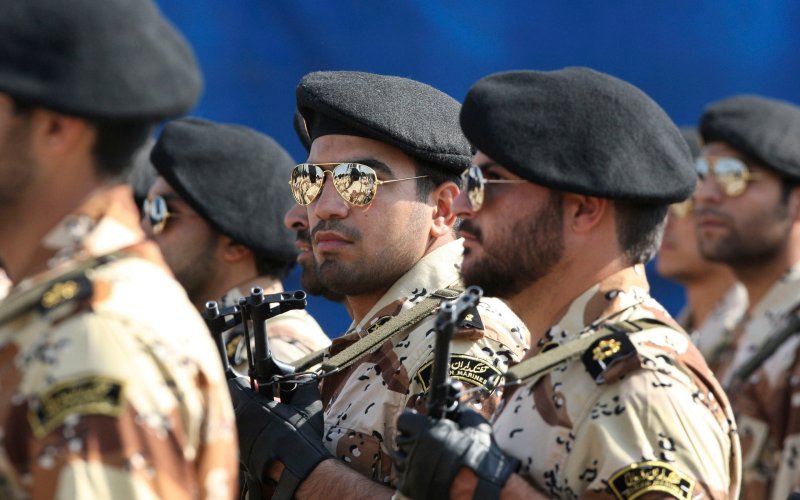
 

Iran Orders Elite Troops: Lay Off U.S. Forces in Iraq

October 6, 2014

Iran Orders Elite Troops: Lay Off U.S. Forces in Iraq, Daily BeastEli Lake, October 6, 2014

Quds forcesVahid Salemi/AP

U.S. intelligence officials tell The Daily Beast that the apparent Iranian decision not to target American troops inside Iraq reflects Iran’s desire to strike a nuclear bargain with the United States and the rest of the international community before the current negotiations expire at the end of November.

“They are not going after Americans,” one senior U.S. intelligence official told The Daily Beast familiar with the recent assessments. “They want the nuclear talks to succeed and an incident between our guys and their guys would not be good for those talks.”

******************

The last time Iranian and American forces were in Iraq, the two sides quietly fought each other. Now Iran’s Quds Force officers in Iraq are purposely leaving the Americans alone.

Pay no attention to the Shi’ite militias threatening to kill U.S. troops in Iraq. The elite Iranian forces backing those militias have been ordered not to attack the Americans.

That’s the conclusion of the latest U.S. intelligence assessment for Iraq. And it represents a stunning turnaround for Iran’s Quds Force, once considered America’s most dangerous foe in the region.

U.S. intelligence officials tell The Daily Beast that the apparent Iranian decision not to target American troops inside Iraq reflects Iran’s desire to strike a nuclear bargain with the United States and the rest of the international community before the current negotiations expire at the end of November.

“They are not going after Americans,” one senior U.S. intelligence official told The Daily Beast familiar with the recent assessments. “They want the nuclear talks to succeed and an incident between our guys and their guys would not be good for those talks.”

The Quds Force, named for the Arabic word for Jerusalem, are believed to have hundreds of troops in Iraq. As the primary arm of the Iranian state that supports allied terrorist organizations, their operatives worried Obama’s predecessor so much that the Treasury Department began sanctioning its members in 2007 for sabotaging the government of Iraq. The U.S. military accused the Quds Force of orchestrating cells of terrorists in Iraq. In 2012, Wired magazine dubbed Quds Force leader Qassem Suleimani the most dangerous person on the planet. In 2013, the New Yorker arrived at a similar conclusion, and claimed he has “directed Assad’s war in Syria.”

More recently, the Treasury Department has accused the Quds Force of international heroin trafficking and conducting terrorism and intelligence operations against the Afghanistan government. That’s why it’s so extraordinary that the Quds Force would be perceived to be laying off U.S. forces in Iraq.

But in some ways, the assessment is not surprising. Both Iran and the United States share a common enemy in the Islamic State of Iraq and al-Sham (ISIS). In late August, U.S. airpower and Iranian-backed militias broke the ISIS siege on the town of Amerli. Suleimani, the commander of the Quds Force, was photographed in Amerli, after the town was liberated from ISIS.

The latest assessments from the U.S. intelligence community also interpret Iran’s behavior in part as linked to the ongoing negotiations between Iran, the United States, the United Kingdom, France, Germany, Russia and China.

A U.S. intelligence official said the Quds Force behavior was the equivalent of a confidence building measure, a diplomatic term that refers to a concession offered to improve the atmosphere of negotiations. (Iran had already offered to play a more “active role” in the regional fight against ISIS, in exchange for nuclear concessions.)

The latest U.S. nuclear proposal to Iran would be favorable to the Islamic Republic and allow Iran to keep many of its declared centrifuges so long as they were disconnected from one another. Iran’s declared facilities in Qom and Natanz use a centrifuge process to enrich uranium into nuclear fuel.

The latest U.S. assessment also undercuts the public warnings from Iranian backed militias in Iraq that are doing much of the fighting now against ISIS.

Last month, the three largest Shiite militias told President Obama not to send ground troops into Iraq. But because the Quds Force is so instrumental in funding, training and in some cases providing strategic direction to these militias, it would suggest these public warnings were merely idle boasts.

To date, the Pentagon acknowledges that there are more than 1,600 U.S. forces inside Iraq, but these forces do not engage in combat missions, according to the Defense Department. Instead, the U.S. presence in Iraq is to advise Iraqi and Kurdish forces, assess the state of those forces and protect U.S. facilities inside Iraq.

Earlier this month in New York, Iran’s foreign minister Javad Zarif said the presence of foreign forces inside Iraq “creates domestic opposition and domestic resentment.” But in response to a question about the Shi’ite militias’ warnings against the United States, he also stressed that Iran did not support “anything that would complicate the situation” in Iraq..

The recent public warnings from groups like the Mahdi Army and the Asa’ib al-Haq were reminiscent of Iraq between 2006 and 2009. That’s when Shiite militias, working closely with Iran’s Quds Force, placed the sophisticated improvised bombs on routes traveled by U.S. forces. In the later years of the conflict, American forces captured what they said were dozens of Quds Force operatives working inside Iraq.

Exactly how long this informal Quds Force truce lasts is anyone’s guess. But Kimberly Kagan, the president of the Washington-based Institute for the Study of War and a one-time adviser to Gen. David Petraeus, cautioned that this alliance of convenience could break down quickly. “Without a doubt, Iranian backed elements have declared their intention many times in the past to attack the U.S. inside Iraq,” she said. “Whether or not those elements have immediate intentions to attack the United is irrelevant. They are declared enemies of the United States.”

That said, Kagan added that she believed “The Iranians do have a short term interest in being on their best behavior during these nuclear negotiations.” Those negotiations are set to expire at the end of November.

Report: Two dead after explosion in Iranian nuclear facility

October 6, 2014

Report: Two dead after explosion in Iranian nuclear facility.

The incident occurred at the Parchin military compound, not far from the Iranian capital, according to the Iranian Students News Agency.

Two people died in an explosion that ripped through an explosive material production unit at a nuclear facility near Tehran, according to Iranian press reports on Monday.

The incident occurred at the Parchin military compound, not far from the Iranian capital, according to the Iranian Students News Agency.

The BBC said on Monday that a pro-opposition website was also reporting an explosion at the site.

The BBC cited the pro-reform website Sahamnews as saying that the explosion on Sunday evening was “so intense that windows of buildings 15 km (nine miles) away were shattered.”

“The glare from the blast could also be seen from a great distance,” the report said.

ISNA quoted Iran’s defense industries organization as saying that “[u]nfortunately, due to the incident, two workers of this production unit lost their lives.”

Israel in the past has alleged that Iran has used its Parchin military base as the site for secret tests of technology that could be used only for detonating a nuclear weapon.

The Jewish state has been a severe critic of six big powers’ negotiations with Iran on restraining its nuclear program, suspecting Tehran is only trying to buy time to master sensitive nuclear know-how and would evade the terms of any final deal.

The Islamic Republic says allegations that it is seeking a nuclear weapons capability are false and baseless. Tehran says it is Israel’s assumed atomic arsenal that is a destabilizing threat to the Middle East.

A statement from Intelligence Minister Yuval Steinitz, issued a day before Iranian President Hassan Rouhani – the architect of Tehran’s diplomacy with the big powers – was to address the UN General Assembly, said internal neutron sources such as uranium were used in nuclear implosion tests at Parchin.

Israel, his statement said, based its information on “highly reliable information,” without elaborating.

Reuters contributed to this report.


