The Nuclear Giveaway, Center for Security Policy, Fred Fleitz, October 2, 2014
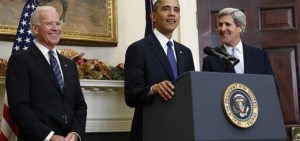 Source: National Review Online
With the Iran nuclear talks now in their endgame and the prospect of a very different political environment in Washington next year if Republicans capture the Senate, Obama officials are in overdrive to achieve their dream of a legacy agreement with Tehran so that President Obama can claim he halted the threat from the Iranian nuclear program. Their goal is to get a final agreement before the nuclear talks are scheduled to end November 24.
While the Obama administration has long been desperate to get such an agreement, two recent ill-advised American concessions and a string of misleading statements and proposals demonstrate how far the White House is willing to go and why it is vital that Congress denounce on a bipartisan basis the nuclear talks and a possible final agreement .
Two weeks ago, the United States floated a proposal to let Iran keep all of its 19,000 centrifuge machines, which Tehran is using to enrich uranium to reactor grade as long as all but 1,500 are “disconnected” and cease enriching uranium. This proposal alarmed many experts because Iran could quickly begin enriching uranium to weapons grade by reconnecting all of its centrifuges.
As generous as this offer was, it apparently did not go far enough for Tehran. The Associated Press reported on September 25 that U.S. diplomats have proposed letting Iran operate up to 4,500 centrifuges if its stockpile of enriched uranium gas is converted to uranium “powder.” This proposal rests on the assumption that such an arrangement would give the international community plenty of time to react to an Iranian “dash” toward constructing a nuclear weapon because it would take over a year for Iran to re-convert low-enriched powder into uranium gas for further enrichment to weapons-grade uranium.
The assumption behind this proposal is false. Both Amos Yadlin, former head of the Israeli Military Intelligence Directorate, and Mark Hibbs, a senior associate with the Carnegie Endowment and nuclear proliferation expert, agree that it would take Iran only about two weeks. [Emphasis added. — DM]
A final agreement also appears unlikely to do anything to reduce the nuclear-proliferation threat posed by Iran’s large stockpile of low-enriched uranium. I noted in NRO last November how a 2013 American Enterprise Institute study found that Iran has produced enough reactor-grade uranium since 2009 “to fuel a small arsenal of nuclear weapons after conversion to weapons grade.” The Langley Intelligence Group Network agreed with this assessment and estimated that, from its 20 percent-enriched-uranium stockpile, Iran could make enough nuclear fuel for one bomb and could make another seven from its reactor-grade uranium if further enriched to weapons grade.
Estimates by the American Enterprise Institute, the Institute for Science and International Security, and the Nuclear Proliferation Education Center on how fast Iran could make enough weapons-grade uranium for one nuclear bomb using reactor-grade uranium range from four to six weeks.
This latest proposed concession continues a pattern of misleading statements and proposals by Obama-administration officials on the Iran talks that began with last November’s interim agreement with Iran, which set up this year’s negotiations on a final agreement.
For example, last November, President Obama claimed the interim deal “halted the progress of the Iranian nuclear program.” At best, the agreement froze only part of this program.
Also last November, National Security Council aide Anthony Blinken said the interim deal halted progress on Iran’s Arak nuclear reactor — which will be a source of plutonium when completed — even though it allowed work on this reactor to continue. This marked a retreat from the West’s prior insistence that the dangerous Arak reactor be abandoned.
Negotiators are now discussing ways to allow the completion of the Arak reactor with design or operational alterations so it produces little plutonium. Iran has been resisting any limitations on this reactor and will likely agree only to one easily reversible change — fueling it with low-enriched uranium.
Although the interim agreement permitted Iran to continue uranium enrichment, Secretary of State John Kerry has insisted this did not mean the United States has conceded to Iran the “right” to enrich. Not true. The preamble of the interim agreement says “a final agreement will involve a mutually defined enrichment program.”
There also are issues concerning the interim deal and this year’s nuclear talks that Obama officials prefer not to discuss publicly. Talks on a final agreement were supposed to begin in late December 2013 but were delayed for several weeks because Iran cheated on the interim agreement shortly after it was signed by installing centrifuges with more advanced designs.
The Obama administration is playing down how the interim deal committed all parties to a “sunset” clause in a final agreement that will limit its duration and treat Iran as a “normal” state entitled to pursue whatever nuclear technologies it wishes under the Nuclear Nonproliferation Treaty after the agreement expires. This means after a final agreement, there will be no limits on how many uranium centrifuges and plutonium-producing reactors Iran can build as long as it informs the IAEA.
Iran wants a final agreement to last less than ten years. The Obama administration wants it to last “in double digits.”
Although there are three legs to a nuclear-weapons program — fuel production, designing and building a warhead, and delivery systems — the nuclear talks have ignored Tehran’s growing ballistic-missile arsenal, which experts believe is being developed to deliver nuclear warheads. Iran’s ballistic missiles have been excluded from the talks despite three Iranian satellite launches since 2009, which many experts believe were actually tests of long-range missiles capable of striking Europe and the United States.
Moreover, there is compelling evidence in a Iranian document obtained by the IAEA in 2005 of an effort by Iran to develop nuclear warheads for ballistic missiles. The IAEA believes this document is a layout for a Shahab-3 missile re-entry vehicle that appears “quite likely to accommodate a nuclear device.” Iran refuses to explain this document and has denounced it as a forgery.
Add to these concerns a recent IAEA report that says Iran is refusing to comply with an important element of the interim agreement: to fully cooperate with the IAEA, grant its inspectors full access to nuclear facilities, and answer all outstanding questions about past nuclear activities that appear to be related to weapons development.
Iran’s refusal to cooperate with the IAEA during the nuclear talks is certain to continue after the signing of a final nuclear agreement, which will make it difficult to verify its compliance with the agreement and the peaceful nature of any nuclear activities that Tehran launches after the pact expires.
And then there are recent reports that U.S. diplomats have discussed with Iranian officials during the nuclear talks how Iran might help defeat the Islamic State. Mixing the Iran nuclear talks with discussions of the situation in Iraq and Syria was a bad idea for two reasons.
First, Iran bears significant responsibility for the sectarian violence in Iraq because of its ties to the Maliki government and its training of Shiite militias that have killed Iraqi Sunnis. The U.S. should be trying to get Iran out of Iraq’s affairs, not draw it in further.
Second, Iran is using the U.S. request for help against the Islamic State to bargain for even better terms in a nuclear agreement. Senior Iranian officials told Reuters last week that Iran is ready to work with the United States and its allies to stop Islamic State militants but would like to see them show more flexibility on Iran’s uranium-enrichment program.
The Obama administration is telling the press that Western states and Iran are still far apart on key issues in the nuclear talks and that reported U.S concessions on enrichment have not been formally presented to Iranian diplomats. I doubt this is the case. I believe it is more likely that the Obama administration is staging an eleventh-hour show of toughness while simultaneously leaking controversial elements of the draft agreement before it announces a final nuclear deal that the White House knows will be very unpopular with Congress.
This all adds up to a dramatic and reckless shift in the U.S. approach to the Iranian nuclear program.
Before the spring of 2012, the Obama administration’s public approach to Iran’s nuclear program was the same as the Bush administration’s and can be summed up by the question “How do we stop Iran from getting a nuclear bomb?”
However, in their desperation to get a legacy nuclear agreement with Iran for President Obama, his diplomats have given away so much that the U.S. approach has essentially shifted to “How long can we delay an Iranian nuclear bomb?” and “How many nuclear bombs should Iran be allowed to make?”
This approach is unacceptable and poses grave risks to the Middle East and the world. We are headed for a weak, short-duration nuclear agreement with Iran that will do nothing to stop its pursuit of nuclear weapons and could spark a nuclear-arms race in the Middle East. The Iran talks have drifted so far from reality that they are unsalvageable. Congress therefore should reestablish a responsible U.S. policy on the Iranian nuclear program by renouncing these negotiations on a bipartisan basis and place new sanctions on Tehran if it does not halt its current nuclear activities, which violate six U.N. Security Council resolutions.
I believe a meaningful agreement with Tehran on its nuclear program involving significant compromises by both sides will someday be possible. Such an agreement must halt or significantly set back Iran’s pursuit of nuclear weapons and last 20 years or longer. Because of the one-sided concessions made by the United States in the current nuclear talks, it is clear this administration is incapable of negotiating a nuclear agreement with Iran that meets these standards.





 anneinpt
 artaxes
 danmillerinpanama
 davidking1530
 Peter Hofman
 Joseph Wouk
 Peter
Peter Louisiana Steve
 WarSclerotic
Recent Comments