Archive for September 2014

U.S. Ramping Up Major Renewal in Nuclear Arms

September 22, 2014

U.S. Ramping Up Major Renewal in Nuclear Arms
By WILLIAM J. BROAD and DAVID E. SANGERSEPT. 21, 2014 Via The New York Times


(While Obama doesn’t have much of a bark, the US military still has one helluva bite.-LS)

CITY, Mo. — A sprawling new plant here in a former soybean field makes the mechanical guts of America’s atomic warheads. Bigger than the Pentagon, full of futuristic gear and thousands of workers, the plant, dedicated last month, modernizes the aging weapons that the United States can fire from missiles, bombers and submarines.

It is part of a nationwide wave of atomic revitalization that includes plans for a new generation of weapon carriers. A recent federal study put the collective price tag, over the next three decades, at up to a trillion dollars.

This expansion comes under a president who campaigned for “a nuclear-free world” and made disarmament a main goal of American defense policy. The original idea was that modest rebuilding of the nation’s crumbling nuclear complex would speed arms refurbishment, raising confidence in the arsenal’s reliability and paving the way for new treaties that would significantly cut the number of warheads.

Modernizing a Nuclear Arsenal

The government is upgrading major nuclear weapon plants and laboratories, which employ more than 40,000 people.

Nevada National Security Site
EMPLOYEES: 2,500
UPGRADES:
1 proposed
The National Criticality Experiments Research Center was built for $150 million.
Los Alamos National Laboratory
EMPLOYEES: 7,430
UPGRADES:
7 approved, 6 proposed
A plutonium processing site was recently renovated.
Kansas City Plant
EMPLOYEES: 2,730
The National Security Campus, recently completed for $700 million.

Y-12 National Security Complex
EMPLOYEES: 4,720
UPGRADES:
5 approved, 4 proposed
The complex’s Highly Enriched Uranium Materials Facility was built for $550 million.
NEV.
CALIF.
MO.
TENN.
S.C.
N.M.
TEX.
Lawrence Livermore National Laboratory
EMPLOYEES: 5,250
UPGRADES:
2 approved, 6 more proposed

Sandia National Laboratories
EMPLOYEES: 9,880
UPGRADES:
3 approved,
9 proposed
A complex for testing weapons was recently rebuilt for $100 million.
Pantex Plant
EMPLOYEES: 3,180
UPGRADES:
3 approved, 10 proposed
The plant’s high-explosives pressing facility is being built for $145 million.
Savannah River Site
EMPLOYEES: 5,670
UPGRADES:
1 approved
The new Tritium Engineering Building was recently completed.

Sources: National Nuclear Security Administration, Government Accountability Office

Supporters of arms control, as well as some of President Obama’s closest advisers, say their hopes for the president’s vision have turned to baffled disappointment as the modernization of nuclear capabilities has become an end unto itself.

“A lot of it is hard to explain,” said Sam Nunn, the former senator whose writings on nuclear disarmament deeply influenced Mr. Obama. “The president’s vision was a significant change in direction. But the process has preserved the status quo.”

With Russia on the warpath, China pressing its own territorial claims and Pakistan expanding its arsenal, the overall chances for Mr. Obama’s legacy of disarmament look increasingly dim, analysts say. Congress has expressed less interest in atomic reductions than looking tough in Washington’s escalating confrontation with Moscow.

“The most fundamental game changer is Putin’s invasion of Ukraine,” said Gary Samore, Mr. Obama’s top nuclear adviser in his first term and now a scholar at Harvard. “That has made any measure to reduce the stockpile unilaterally politically impossible.”

That suits hawks just fine. They see the investments as putting the United States in a stronger position if a new arms race breaks out. In fact, the renovated plants that Mr. Obama has approved for a smaller force of more precise, reliable weapons could, under a different president, let the arsenal expand rapidly.

Arms controllers say the White House has made some progress toward Mr. Obama’s broader agenda. Mr. Nunn credits the president with improving nuclear security around the globe, persuading other leaders to sweep up loose nuclear materials that terrorists could seize.

In the end, however, budget realities may do more than nuclear philosophies to curb the atomic upgrades. “There isn’t enough money,” said Jeffrey Lewis, of the Monterey Institute of International Studies, an expert on the modernization effort. “You’re going to get a train wreck.”

While the Kansas City plant is considered a success — it opened ahead of schedule and under budget — other planned renovations are mired in delays and cost overruns. Even so, Congress can fight hard for projects that represent big-ticket items in important districts.

Skeptics say that the arsenal is already dependable and that the costly overhauls are aimed less at arms control than at seeking votes and attracting top talent, people who might otherwise gravitate to other fields.

But the Obama administration insists that the improvements to the nuclear arsenal are vital to making it smaller, more flexible and better able to fulfill Mr. Obama’s original vision.

Daniel B. Poneman, the departing deputy secretary of energy, whose department runs the complex, said, “The whole design of the modernization enables us to make reductions.”

A Farewell to Arms

In the fall of 2008, as Barack Obama campaigned for the presidency, a coalition of peace groups sued to halt work on a replacement bomb plant in Kansas City. They cited the prospect of a new administration that might, as one litigant put it, kill the project in “a few months.”

The Kansas City plant, an initiative of the Bush years, seemed like a good target, since Mr. Obama had declared his support for nuclear disarmament.

The $700 million weapons plant survived. But in April 2009, the new president and his Russian counterpart, Dmitri A. Medvedev, vowed to rapidly complete an arms treaty called New Start, and committed their nations “to achieving a nuclear-free world.”

Five days later, Mr. Obama spoke in Prague to a cheering throng, saying the United States had a moral responsibility to seek the “security of a world without nuclear weapons.”

“I’m not naïve,” he added. “This goal will not be reached quickly — perhaps not in my lifetime. It will take patience and persistence.”

That October, the Nobel committee, citing his disarmament efforts, announced it would award Mr. Obama the Peace Prize.

The accord with Moscow was hammered out quickly. The countries agreed to cut strategic arms by roughly 30 percent — from 2,200 to 1,550 deployed weapons apiece — over seven years. It was a modest step. The Russian arsenal was already declining, and today has dropped below the agreed number, military experts say.

Even so, to win Senate approval of the treaty, Mr. Obama struck a deal with Republicans in 2010 that would set the country’s nuclear agenda for decades to come.

Republicans objected to the treaty unless the president agreed to an aggressive rehabilitation of American nuclear forces and manufacturing sites. Senator Jon Kyl, Republican of Arizona, led the opposition. He likened the bomb complex to a rundown garage — a description some in the administration considered accurate.

Under fire, the administration promised to add $14 billion over a decade for atomic renovations. Then Senator Kyl refused to conclude a deal.

Facing the possible defeat of his first major treaty, Mr. Obama and the floor manager for the effort, Senator John Kerry, now the secretary of state, set up a war room and made deals to widen Republican support. In late December, the five-week campaign paid off, although the 71-to-26 vote represented the smallest margin ever for the ratification of a nuclear pact between Washington and Moscow.

The Democrats were unanimous in favor, their ranks including six senators with atomic plants in their states. Among the Republicans joining the Democrats were Bob Corker and Lamar Alexander, both of Tennessee and both strong backers of modernization. (“We’re glad to have the thousands of jobs,” Mr. Alexander said recently in announcing financing for a new plant.)

In open and classified reports to Congress, Mr. Obama laid out his atomic refurbishment plans, which the Congressional Budget Office now estimates will cost $355 billion dollars over the next decade. But that is just the start. The price tag will soar after 10 years as missiles, bombers and submarines made in the last century reach the end of their useful lives and replacements are built.

“That’s where all the big money is,” Ashton B. Carter, the former deputy secretary of defense, said last year. “By comparison, everything that we’re doing now is cheap.”

A Wave of Modernization

The money is flowing into a sprawling complex for making warheads that includes eight major plants and laboratories employing more than 40,000 people. Its oldest elements, some dating to 1943, have long struggled with fires, explosions and workplace injuries. This March, a concrete roof collapsed in Tennessee. More recently, chunks of ceiling clattered down a stairwell there, and employees were told to wear hard hats.

“It’s deplorable,” Representative Chuck Fleischmann, Republican of Tennessee, said at an April hearing. Equipment, he added, “breaks down on a daily basis.”

In some ways, the challenge is similar to what Detroit’s auto industry faces: Does it make sense to pour money into old structures or build new ones that are more secure, are fully computerized and adhere to modern environmental standards?

And if the government chooses the latter course, how does it justify that investment if the president’s avowed policy is to wean the world off nuclear arms?

The old bomb plant in Kansas City embodies the dilemma. It was built in World War II to produce aircraft engines and went nuclear in 1949, making the mechanical and electrical parts for warheads.

But a river flooded it repeatedly, and in the past year it was gradually shut down. Today, visitors see tacky furniture, old machinery and floors caked with mud.

Its replacement, eight miles south, sits on higher ground. Its five buildings hold 2,700 employees — just like the old plant — but officials say it uses half the energy, saving about $150 million annually. Everything is bright and modern, from the sleek lobby and cafeteria to the fitness center. Clean rooms for delicate manufacturing have tighter dust standards than hospital operating rooms.

It is called the National Security Campus, evoking a college rather than a factory for weapons that can pound cities into radioactive dust.

Rick L. Lavelock, a senior plant manager, said during a tour in July that employees had a “very great sense of mission” in keeping the arsenal safe and reliable.

Their main job now is extending the life of a nearly 40-year-old submarine warhead called the W-76. Drawing on thousands of parts, they seek to make it last 60 years — three times as long as originally planned.

The warhead’s new guts, a colorful assortment of electronic and mechanical parts, lay alongside a shiny nose cone on a metal table outside an assembly hall.

The last stop on the tour was a giant storage room. Mr. Lavelock said it covered 60,000 square feet — bigger than a football field. Laughing, he likened it to the “Raiders of the Lost Ark” scene showing a vast federal warehouse that seemed to go on forever.

If the Kansas City plant is the crown jewel of the modernization effort, other projects are reminders of how many billions have yet to be spent, and how even facilities completed successfully can go awry.

At Los Alamos National Laboratory in New Mexico, birthplace of the atomic bomb, plans for a new complex to shape plutonium fuel emerged a decade ago with a $660 million price tag. But antinuclear groups kept publicizing embarrassing details, like the discovery of a geologic fault under the site. The estimated cost soared to $5.8 billion, and in 2012, the Obama administration suspended the project.

A different problem hit the Y-12 National Security Complex in Oak Ridge, Tenn. A $550 million fortress was erected there to safeguard the nation’s main supplies of highly enriched uranium, a bomb fuel considered relatively easy for terrorists to make into deadly weapons.

In 2012, an 82-year-old Roman Catholic nun, Megan Rice, and two accomplices cut through fences, splashed blood on the stronghold and sprayed its walls with peace slogans. The security breach set off major investigations, and the nun was sentenced to almost three years in prison.

Now, the site’s woes have deepened. As Oak Ridge prepared for an even bigger upgrade — replacing buildings that process uranium — the price tag soared from $6.5 billion to $19 billion. This year, the Obama administration scuttled the current plan, and the lab is struggling to revise the blueprint.

Robert Alvarez, a policy adviser to the energy secretary during the Clinton administration, recently wrote in The Bulletin of the Atomic Scientists that Oak Ridge was the “poster child” of a dysfunctional nuclear complex.

Across the nation, 21 major upgrades have been approved and 36 more proposed, according to the Government Accountability Office. In nearly two dozen reports over five years, the congressional investigators have described the modernization push as poorly managed and financially unaccountable.

They recently warned — in typically understated language — that the managers of the atomic complex had repeatedly omitted and underestimated billions of dollars in costs, leaving the plan with “less funding than will be needed.”

The Military Deployments

The Obama administration says it sees no contradiction between rebuilding the nation’s atomic complex and the president’s vow to make the world less dependent on nuclear arms.

“While we still have weapons, the most important thing is to make sure they are safe, secure and reliable,” said Mr. Poneman, the deputy energy secretary. The improvements, he said, have reassured allies. “It’s important to our extended deterrent,” he said, referring to the American nuclear umbrella over nations in Asia and the Middle East, which has instilled a sense of military security and kept many from building their own arsenals.

The administration has told the Pentagon to plan for 12 new missile submarines, up to 100 new bombers and 400 land-based missiles, either new or refurbished. Manufacturing costs for these forces, if approved, will peak between 2024 and 2029, according to a recent study by Dr. Lewis and colleagues at the Monterey Institute.

It estimated the total cost of the nuclear enterprise over the next three decades at roughly $900 billion to $1.1 trillion. Policy makers, the report said, “are only now beginning to appreciate the full scope of these procurement costs.”

Nonetheless, lobbying for the new forces is heating up, with military officials often eager to show off dilapidated gear. In April, a “60 Minutes” segment featured a tour of aging missile silos. Officials pointed out antiquated phones, broken doors, a missile damaged from water leaks and an old computer that relied on enormous diskettes.

The looming crackup between trillion-dollar plans and tight budgets is starting to get Washington’s attention. Modernization delays are multiplying and cost estimates are rising. Panels of experts are bluntly describing the current path as unacceptable.

A new generation of missiles, bombers and submarines “is unaffordable,” a bipartisan, independent panel commissioned by Congress and the Defense Department declared in July. Its 10 experts, including former Secretary of Defense William J. Perry, echoed other estimates in putting the cost at up to $1 trillion.

The overall investment, the panel said, “would likely come at the expense of needed improvements in conventional forces.”

In August, the White House announced it was reviewing the atomic spending plans in preparation for next year’s budget request to Congress, which will set federal spending for 2016.

“This is Obama’s legacy budget,” said a senior administration official who spoke on the condition of anonymity because of the topic’s political delicacy. “It’s his last chance to make the hard choices and prioritize.”

Already, the administration has delayed plans for the Navy’s new submarines, the atomic certification of new bombers and a new generation of warheads meant to fit more than one delivery system. And debate is rising on whether to ax production of the air-launched cruise missile, a new nuclear weapon for bombers, its cost estimated at some $30 billion.

One of the most dramatic calls for reductions came from Chuck Hagel shortly before he became defense secretary last year. He signed a study, headed by retired Gen. James Cartwright, a former vice chairman of the Joint Chiefs of Staff, that proposed cutting the nuclear arsenal to 900 warheads and eliminating most of the 3,500 weapons in storage. The nation’s military plan, the study concluded, “artificially sustains nuclear stockpiles that are much larger than required for deterrence today.”

In a speech in Berlin last year, the president said he would cut the arsenal to roughly 1,000 weapons — but only as part of a broader deal requiring Russian reductions. So far, the Russian president, Vladimir V. Putin, has shown no interest, and Mr. Obama has made clear he will not cut weapons unilaterally. Unless either man changes his approach, the president’s legacy will be one of modest nuclear cuts and a significantly modernized atomic complex.

“I could imagine Putin might well decide it’s in his interest to seek more cuts,” said Rose Gottemoeller, the undersecretary of state for arms control and international security, and the country’s top arms negotiator. “I don’t discard the notion we could do it again.”

Few of her colleagues are so optimistic. They predict that if Mr. Obama is to achieve the kind of vision he entered office with, he will have to act alone.

Iranian talks with Saudi Arabia may signal thaw in relations

September 22, 2014

Iranian talks with Saudi Arabia may signal thaw in relations
Reuters in Dubai
The Guardian, Monday 22 September 2014 05.15 EDT


(In the House of Saud, they now say, “The enemy of my enemy was my friend until they became my enemy and made my other enemy a friend who is still an enemy of my other friend, the USA.”…got it? Good for you. You couldn’t make this crap up.-LS)

Iran and Saudi Arabia have held their first foreign minister-level meeting since the 2013 election of President Hassan Rouhani, official Iranian media have reported, signalling a possible thaw in relations between the rival Gulf powers.

Shia Muslim Iran and the conservative Sunni kingdom have been engaged in a bitter contest for influence in the region, evident in political and military struggles in Syria, Iraq, Lebanon, Bahrain and Yemen.

The Iranian foreign minister, Mohammad Javad Zarif, suggested after his meeting in New York with his Saudi counterpart, Prince Saud al-Faisal, that the talks could lead to an improvement in relations.

“Both my Saudi counterpart and I believe that this meeting will be the first page of a new chapter in our two countries’ relations,” Iran’s official IRNA news agency quoted Zarif as saying.

“We hope that this new chapter will be effective in establishing regional and global peace and security and will safeguard the interests of Muslim nations across the world.“

IRNA reported that Prince Saud, in a reference to the advance of Islamic State (Isis) militants in Iraq and Syria, said he was aware of the sensitivity of the situation.

“We are aware of the importance and sensitivity of this crisis and the opportunity we have ahead of us. We believe that by using this precious opportunity and avoid the mistakes of the past, we can deal with this crisis successfully,” he said.

“These two countries are influential in the region and cooperation between them will have clear effects on the establishment of regional and global security.“

US Reportedly Providing Indirect Military Aid to Hezbollah

September 22, 2014

US Reportedly Providing Indirect Military Aid to Hezbollah
By Ari Yashar date 9/22/2014 Via Israel National News


(Yet another reason for the US military to sit this one out.-LS)

Hezbollah PR chief gives rare interview about group’s quest for legitimacy, as Lebanese experts reveal US cooperating covertly against ISIS.

Mohammed Afif, the new head of public relations for the Lebanese-based Iranian-backed terror organization Hezbollah, gave a rare New York Times interview as Lebanese experts reveal his group is indirectly receiving American intelligence aid in its fight against Islamic State (ISIS).

Following ISIS’s temporary conquest of Arsal last month on the Lebanese side of the Syrian border, the US sent new weapons to the Lebanese army, which coordinates with Hezbollah. Likewise, US intelligence has found its way to Hezbollah according to Lebanese experts.

That leaked intelligence may explain some recent impressive achievements against ISIS, including the first known Hezbollah drone strike.

It is worth noting by contrast to the blasé indirect provision of intelligence and weapons to a terror group in Lebanon, during Operation Protective Edge US President Barack Obama blocked a routine Hellfire missile shipment to Israel and ordered strict supervision on future transfers.

Afif told the American newspaper “we need to open up a new page with the world media, with the Arabs and internationally,” hinting at the international legitimacy he hopes to achieve for the terror group under his role as media adviser to Hezbollah leader Hassan Nasrallah.

Nasrallah recently expressed his fears of the ISIS “monster,” calling the fight with the group “a battle of life and death no less important than fighting the Israeli enemy, as (ISIS) actions and objectives only serve Israel.” Indeed Hezbollah has called to wipe out Israel numerous times, and fought terror wars against the Jewish state.

Ali Rizk, a Lebanese analyst at the pro-Hezbollah Al-Mayadeen news channel, told the New York Times that while the US cannot publicly ally with the terrorist organization Hezbollah, “what happens underneath is something totally different.”

Justifying the aid, Rizk said “Hezbollah is not representing an imminent threat against the world. It represents a threat against Israel, as Israel represents a threat against Lebanon. But Hezbollah is not going to threaten the US and Europe. Nobody said Hezbollah is cutting off heads.”

While Hezbollah may be benefiting indirectly from the US, it remains antagonistic to America over Syria, where it has joined Iran in supporting Syrian President Bashar Assad against the very rebels the US is arming. However, the ISIS threat has indeed raised talk that the US may even join forces with Hezbollah’s sponsor Iran.

Afif blamed Americans for causing ISIS by supporting Syrian rebels, saying “this beast which you raised up, as in past cases, you find it’s dangerous for you.”

(As one commentor said, “I would think direct intelligence from the White House would be impossible.”-LS)

Netanyahu warns of easing sanctions on Iran

September 22, 2014

Netanyahu warns of easing sanctions on Iran – Israel News, Ynetnews.

Kerry, Zarif meet for talks on nuclear program, also possibly discuss Islamic State group, as Netanyahu warns not to appease Iran to fight Islamic threat.

Noam (Dabul) Dvir, AFP

Published: 09.21.14, 22:43 / Israel News

Prime Minister Benjamin Netanyahu on Sunday warned the West against easing sanctions on Iran to win its support in the fight against jihadists in Syria and Iraq.

He made the comments US Secretary of State John Kerry met with Iranian Foreign Minister Mohamad Javad Zarif for talks expected to focus on the prospects of reaching an agreement on reducing Tehran’s atomic activities in exchange for an end to nuclear-related sanctions on the Tehran.

Zarif with Kerry (Archive: Reuters)

Their meeting Sunday comes on the third day of the latest round of nuclear talks between Iran and six world powers – the United States, Russia, China, Britain, France and Germany.

As the Islamic republic and six world powers started a new round of talks in New York, Netanyahu said “respected commentators in the West” were counseling a softer approach on Iran to enlist Tehran in an alliance against Islamic State militants.

“I know what Begin would have said…They are fighting the IS out of their own interest,” he told an audience in Jerusalem’s Begin Center, which was marking ten years of activites.

“They are struggling over who will be leader of the Islamist world which they seek to impose on the whole world,” he said, referring to Iran.

Israel bitterly opposed an interim deal which world powers struck with Tehran last November, paving the way for talks on a comprehensive agreement on Iran’s future nuclear activities.

Iran and the six powers – Britain, China, France, Russia and the United States plus Germany – are meeting at United Nations headquarters on the sidelines of the General Assembly.

Israel has refused to rule out military action against Iranian nuclear facilities to prevent any possibility of it developing the technology for an atomic bomb.

Putin ‘privately threatened to invade Poland, Romania and the Baltic states’

September 22, 2014

Putin ‘privately threatened to invade Poland, Romania and the Baltic states’
By Justin Huggler 18 Sep 2014 Via The Telegraph


(Joe Biden to Putin: ‘Mr. Prime Minister, I’m looking into your eyes, and I don’t think you have a soul.’.-LS)

President Vladimir Putin privately threatened to invade Poland, Romania and the Baltic states, according to a record of a conversation with his Ukrainian counterpart.

“If I wanted, in two days I could have Russian troops not only in Kiev, but also in Riga, Vilnius, Tallinn, Warsaw and Bucharest,” Mr Putin allegedly told President Petro Poroshenko of Ukraine, reported Süddeustche Zeitung, a German newspaper.

If true, this would be the first time that Mr Putin has threatened to invade Nato or EU members. Any threat to send Russian troops into the capitals of Latvia, Lithuania, Estonia, Poland and Romania would cause grave alarm among Western leaders.

If Mr Putin were to act on this, Britain could find itself at war with Russia. All five countries mentioned in this alleged conversation are members of both the EU and Nato. They are covered by the security guarantee in Article V of Nato’s founding treaty, which states that “an attack on one is an attack on all”. In a speech in Tallinn earlier this month, President Barack Obama confirmed Nato’s commitment to this doctrine.

Mr Putin’s alleged threat bears similarities to remarks he made to Jose Manuel Barroso, the president of the European Commission, in which he warned: “If I want to, I can take Kiev in two weeks”.

Süddeustche Zeitung claims to have seen a European Union memorandum of a meeting between Mr Barroso and Mr Poroshenko in Kiev last week, during which the latter is said to have described Mr Putin’s threat.

The Russian president made these remarks in series of telephone conversations with Mr Poroshenko over the current ceasefire in eastern Ukraine.

Mr Putin also warned Mr Poroshenko not to put too much faith in the EU, saying that Russia could exert its influence and bring about a “blocking minority” among member states.

On Tuesday, Ukraine ratified a historic Association Agreement with the EU, placing the country on the path towards eventual EU membership. It was the refusal of the former president, Viktor Yanukovych, to sign this agreement last year that triggered the Ukraine crisis.

The EU recently announced further sanctions against Russia, focusing on the energy, financial and arms sectors. But there have been divisions among member states over sanctions, with many worried about the impact on their own economies.

The Baltic states are particularly nervous about Russian intentions, and Mr Obama sought to reassure them with his speech in Tallinn earlier this month.

“If you ever ask again ‘Who will come to help?’ you’ll know the answer: the Nato alliance, including the armed forces of the United States of America,” he said. “We’ll be here for Estonia. We will be here for Latvia. We will be here for Lithuania.”

Mr Poroshenko is the only alleged source for Mr Putin’s latest threat, and there will be concerns he might be motivated to exaggerate in order to strengthen EU and Nato support for Ukraine.

The European Commission refused to confirm or deny whether Mr Barroso had held such a conversation with Mr Poroshenko. “We will not conduct diplomacy in the press or discuss extracts of confidential conversations,” said Pia Ahrenkilde Hansen, the Commission spokesperson. “What matters to the EU and the Commission is to contribute to lasting peace, stability and prosperity in Ukraine.”

Britain’s Female Jihadists

September 22, 2014

Britain’s Female Jihadists, Gatestone InstituteSoeren Kern, September 21, 2014

(The gentler sex and the religion of peace submission and death. — DM)

“My son and I love life with the beheaders.” — British jihadist Sally Jones.

Mujahidah Bint Usama published pictures of herself on Twitter holding a severed head while wearing a white doctor’s jacket; alongside it, the message: “Dream job, a terrorist doc.”

British female jihadists are now in charge of guarding as many as 3,000 non-Muslim Iraqi women and girls held captive as sex slaves.

“The British women are some of the most zealous in imposing the IS laws in the region. I believe that’s why at least four of them have been chosen to join the women police force.” — British terrorism analyst Melanie Smith.

Mahmood also called on Muslims to conduct jihad operations on British streets. In a recent tweet, she counselled: “If you cannot make it to the battlefield, then bring the battlefield to yourself.” Great Britain is now the leading European source of female jihadists in Syria and Iraq.

********************

As many as 60 Muslim women between the ages of 18 and 24 are believed to have left Britain to join the jihadist group Islamic State [IS] during the past twelve months alone, according to British terrorism analysts.

Dozens more have inquired about joining IS since the beheading of American journalist James Foley in Syria in August 2014 set off a frenzy of enthusiasm within jihadist circles.

Many of the women seem to be motivated by the hope of finding a jihadist husband, analysts say, apparently because they covet the cultural and religious “prestige” conferred upon Muslim widows whose husbands have died as “martyrs” for Allah.

Until recently, most of the British women affiliated with IS have been restricted to performing domestic chores such as cleaning and cooking. Lately, however, some women have become restive and have demanded a greater role in the IS enterprise.

Several British women are now engaged in IS recruiting efforts, using social media platforms such as Facebook and Twitter to encourage a new wave of British jihadists to travel to Syria and Iraq.

A half-dozen other women have been incorporated into a female-only militia called the Al-Khansaa brigade, based in the Syrian city of Raqqa, where the IS has set up its headquarters.

Al-Khansaa—named after a seventh-century female Arab poet who was a contemporary of the Muslim Prophet Mohammed—was established in February 2014 with the purpose of exposing male enemy jihadists who try to disguise themselves by wearing women’s clothing in order to avoid detection and detention at IS checkpoints.

The brigade was also established to detain civilian women in Raqqa who do not follow the Islamic State’s strict interpretation of Islamic Sharia law, including the requirement that all women be fully covered in public and that they be accompanied by a male chaperone.

In an interview with the blog “Syria Deeply,” Abu Ahmad, an IS official in Raqqa, explained the rationale behind Al-Khansaa. He said:

“We have established the brigade to raise awareness of our religion among women, and to punish women who do not abide by the law. There are only women in this brigade, and we have given them their own facilities to prevent the mixture of men and women.”

British terrorism analyst Melanie Smith told the Daily Telegraph that Al-Khansaa is a Sharia law police brigade whose social media accounts are run by British women and written in English.

“The British women are some of the most zealous in imposing the IS laws in the region,” Smith said. “I believe that’s why at least four of them have been chosen to join the women police force.”

The Al-Khansaa brigade has now expanded its remit to operating brothels for the use of IS fighters. The result is that British female jihadists are now in charge of guarding as many as 3,000 non-Muslim Iraqi women and girls who are being held captive as sex slaves, according to British media.

“It is the British women who have risen to the top of the Islamic State’s Sharia police and now they are in charge of this operation,” another analyst told the Daily Mirror. “It is as bizarre as it is perverse.”

A key figure in the Al-Khansaa brigade is said to be Aqsa Mahmood, a 20-year-old woman from Glasgow, Scotland who left for Syria in November 2013. Mahmood attended private schools and had wanted to become a doctor, but she dropped out of university without warning and vanished overnight in order to become a jihadist and marry an IS fighter.

Using the jihadist name of Umm Layth (Arabic for “Mother of the Lion”) on Twitter (account now suspended), Mahmood has encouraged other British Muslim women to leave their families behind in order to join the jihad in Syria. She wrote:

“Biggest tip to sisters: don’t take detours, take the quickest route, don’t play around with your Hijrah [religious pilgrimage] by staying longer than 1 day for safety and get in touch with your contacts as soon as you reach your destination.”

Mahmood, who says she is dedicated to the “pursuit of Allah’s pleasure,” added: “Once you arrive in the land of jihad, [IS] is your family.”

In two tweets Mahmood described the kinship she felt with fellow Muslims in the Islamic State. Before referring to the place as “paradise,” she concluded:

“Wallahi [I swear] I will never be able to do justice with words as to how this place makes me feel or what Ansaar of Shaam [helpers of Syria] have done for me and Allah only knows how much I love and appreciate these people for His sake…”

In another post, Mahmood called on Muslims to imitate those who murdered British soldier Lee Rigby outside the Woolwich Barracks in London in May 2013. “Follow the examples of your brothers from Woolwich, Texas and Boston,” she wrote, referring also to the shooting in Fort Hood, Texas in November 2009 and the Boston Marathon bombings in April 2013.

Mahmood also called on Muslims to conduct jihad operations on British streets. In a recent tweet, she counselled: “If you cannot make it to the battlefield, then bring the battlefield to yourself.”

She also wrote about martyrdom: “Allahu Akbar, there’s no way to describe the feeling of sitting with the Akhawat [sisters] waiting on news of whose Husband has attained Shahadah [martyrdom].”

British media have published photographs of a burqa-clad Mahmood holding a shotgun, and of a child holding an AK-47 machine gun.

Mahmood’s parents have said they cannot understand why their daughter ran away from home to become a jihadist:

“Our daughter was brought up with love and affection in a happy home, attended Craigholme private school, went to university and was always taught to show respect for mankind and was well integrated into this society. She may believe that the jihadists of ISIS are her new family but they are not and are simply using her.

“If our daughter, who had all the chances and freedom in life, could become a bedroom radical, then it is possible for this to happen to any family.”

Another British jihadist linked to the Al-Khansaa brigade, a 21-year-old medical student who goes by the name Mujahidah Bint Usama, published pictures of herself on Twitter holding a severed head while wearing a white doctor’s jacket. The gruesome image appears alongside the message “Dream job, a terrorist doc,” followed by images of smiley faces and love hearts.

Usama’s Twitter account has now been suspended, but in her description of herself she wrote: “Running away from jihad will not save you from death. You can die as a coward or you can die as a martyr.”

Yet another British jihadist, a 22-year-old convert to Islam named Khadijah Dare, has vowed to become the first female jihadist to execute a British or American captive.

Writing under the Twitter name Muhajirah fi Sham (Arabic for “immigrant in Syria”), Dare asked for links to video footage of the beheading of James Foley. In a slang-filled tweet she wrote:

“Any links 4 da execution of da journalist plz. Allahu Akbar. UK must b shaking up ha ha. I wna b da 1st UK woman 2 kill a UK or US terorrist!(sic)”.

In another tweet, Dare wrote:

“All da people back in Dar ul kufr [land of disbelievers] what are you waiting for … hurry up and join da caravan to where the laws of Allah is implemented.

“No one from Lewisham [a borough in southeast London] has come here apart from an 18-year-old sister shame on all those people who afford fancy meals and clothes and do not make hijra [Mohamed’s flight from Mecca to Medina in 622]. Shame on you.”

Dare was born in London and converted to Islam at age 18, when she began worshipping at the Lewisham Islamic Center, a mosque linked to the radical cleric Abu Hamza and the two killers of Lee Rigby.

Dare moved to Syria in 2012 to marry a Swedish jihadist named Abu Bakr. The marriage was arranged through his mother on Facebook and she did not meet him until the day of their wedding. Dare recently published pictures of her son holding an AK-47 rifle.

In a Channel 4 documentary that aired in July 2013, Dare, who at that time went by the name Maryam, said:

“I couldn’t find anyone in the UK who was willing to sacrifice their life in this world for the life in the hereafter… I prayed, and Allah ruled that I came here to marry Abu Bakr.”

She also called on other British Muslims to join the jihad:

“You need to wake up and stop being scared of death…we know that there’s heaven and hell. At the end of the day, Allah’s going to question you. Instead of sitting down and focusing on your families or your study, you just need to wake up….”

702Khadijah “Maryam” Dare, a young London woman who converted to Islam and moved to Syria to marry a Swedish jihadist, is shown here in Aleppo setting off to go shopping with a friend and their small children. They bring along their AK-47 assault rifles “just in case”. (Image source: Channel 4 video screenshot)

On August 31, the Daily Mirror reported that Dare’s jihadist rants have turned her into a “celebrity jihadi” who has become an “immense threat” due to her popularity. The newspaper reported that British security services have now made finding her a “top priority” over fears that radical Muslims are answering her calls to leave the UK to join IS in the Middle East.

In a four-minute video entitled, “Answering the Call–Foreign Fighters (Mujahedeen) in Syria,” a burka-clad Dare appears firing an AK-47 rifle and pleading with fellow Brits to fight by her side in Syria. Speaking in a London accent, she said:

“These are your brothers and sisters as well and they need your help. So instead of sitting down and focusing on your families or focusing on your studies, you need to stop being selfish because time is ticking.”

Not all British female jihadists are in their teens and twenties. A 45-year-old British convert to Islam named Sally Jones recently issued threats via Twitter to behead Christians. Jones, who changed her name to Umm Hussain al-Britani, wrote: “You Christians all need beheading with a nice blunt knife and stuck on the railings at Raqqa. Come here I’ll do it for you!”

Police say Jones, who also goes by the name Sakinah Hussain, travelled to Syria in late 2013 after converting to Islam and developing an online romance with a 20-year-old British jihadist from Birmingham named Junaid Hussain.

Hussain, who uses the alias Abu Hussain al-Britani, was jailed in 2012 for running a computer hacking group known as Team Poison. He escaped to Syria in 2013 while on bail, and has been posting extremist messages on social media pledging to conquer the world and kill infidels.

Police fear Hussain is masterminding plan to teach jihadists how to empty the bank accounts of rich and famous Britons to fund terror attacks.

According to British media, Jones, originally from Kent in southeast England, was once an aspiring musician with an all-girl punk rock band but ended up spending a lifetime on social welfare benefits. She is now raising her 10-year-old son from a previous marriage as a Muslim under the Islamic State.

In an interview with The Sunday Times, Jones reflected on her new circumstances: “My son and I love life with the beheaders.”


Al Nusrah Front threatens to execute 2nd Lebanese hostage

September 21, 2014

Al Nusrah Front threatens to execute 2nd Lebanese hostage, Long War Journal, Thomas Joscelyn, September 21, 2014

Screen Shot 2014-09-21 at 2.16.39 PM-thumb-560x292-3761

The Al Nusrah Front, al Qaeda’s official branch in Syria, is threatening to kill a second Lebanese hostage held in its custody. The man has been identified as Ali al Bazzal.

The threat was posted in tweets on one of the group’s official Twitter feeds. A banner containing the threat can be seen above.

In addition, a video posted online appears to show the group executing another Lebanese hostage, Mohammad Hamiyeh. In a tweet on Sept. 19, Al Nusrah said that Hamiyeh “is the first casualty of the stubbornness of the Lebanese military that has become a puppet in the hands of the Iranian party.”

The “Iranian party” is Hezbollah, which is fighting alongside Bashar al Assad’s forces against Al Nusrah and other rebel forces.

Lebanese officials subsequently confirmed that Hamiyeh has been killed. The al Qaeda group had repeatedly promised to kill Hamiyeh if its demands were not met.

The video shows a man shooting Hamiyeh in the head, with Bazzal sitting to his right. Bazzal then pleads for his life, saying that Hezbollah, the “party of the devil,” must alter its operations.

“If you don’t stop attacking and inciting against our Sunni brethren then I will follow my fellow soldier who was killed right there,” Bazzal says, according to The Daily Star, a publication based in Lebanon.

The video does not appear to have been posted on Al Nusrah’s official Twitter feeds, but instead surfaced online separately. For instance, the banner shown above was posted on Al Nusrah’s Twitter feed for the Qalamoun region of Syria. The video was not posted on the same feed.

The version of the video viewed by The Long War Journal also does not contain Al Nusrah’s official media logo.

Still, the image of the man identified as Bazzal in the video matches the picture in banner republished above, which was released by Al Nusrah.

The banner contains the question, “Who will pay the price?” Al Nusrah used that same question in the first video it released showing its Lebanese hostages, who were captured in August, as well as in subsequent statements and online banners.

The al Qaeda group says that Hamiyeh was the first to pay the price, because the Lebanese army and Hezbollah have not met their demands. Al Nusrah has said previously that it wants Hezbollah to remove its fighters from Syria, and a number of other conditions met. As in Al Nusrah’s past hostage operations, the government of Qatar is attempting to broker the negotiations.

Al Nusrah has shied away from killing its captives in recent weeks, releasing hostages on several occasions. The organization has not produced graphic beheading videos like its counterparts in the Islamic State, a jihadist group that has captured large swaths of territory in Iraq and Syria since earlier this year. The Islamic State and Al Nusrah are fierce rivals.

While it has not produced gory execution videos like its rivals in the Islamic State, Al Nusrah has now executed a Lebanese soldier and threatened to kill another hostage.

Video games, Twitter tricks: How ISIS pulls in the kids

September 21, 2014

Video games, Twitter tricks: How ISIS pulls in the kids, Times of IsraelDavid Shamah, September 21, 2014

The Islamist extremists need young members to build Caliphate dream; social media is good for recruitment strategy.

jihad3-635x357Scene from the Jihad Simulator trailer (Youtube screenshot)

Get the kids on your side. That’s a strategy used by 20th century tyrants from Stalin to Hitler to Pol Pot for gaining and retaining power. The 21st century tyrants of ISIS, the Islamist group that seeks to set up a Muslim Caliphate in as much of the Middle East as possible, are using the latest tools in their quest for youth.

Over the past year, the group has made a splash on social media, producing slick recruitment videos, developing on-line games and activities, and utilizing Twitter to send out messages to users’ networks.

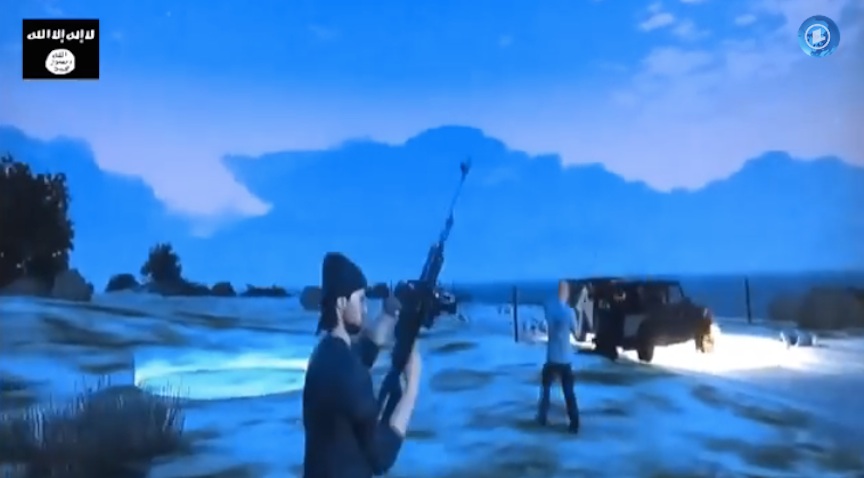
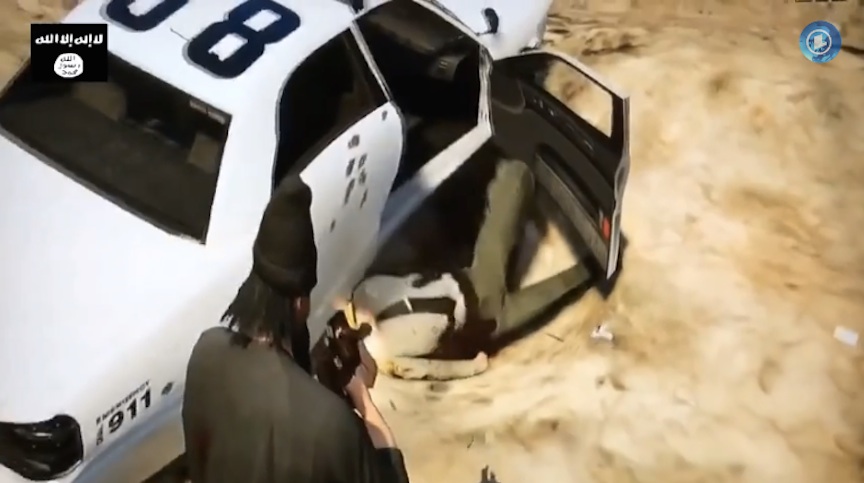
In its latest social media foray, ISIS released a trailer for a game called the “Jihad Simulator,” which looks suspiciously like the wildly popular Grand Theft Auto video game. In Jihad Simulator, players hijack military vehicles and blow them, carry out drive-by shootings of police cars with markings used by American police department), and shoot up what appears to be a school or office park. The video shows the perpetrators not as kaffiyeh-wearing terrorists, but as long-haired American kids wearing hoodies and knit wool hats. And, of course, players get points for every “kill” or explosion they successfully pull off.

It’s not clear who uploaded the video, and there was no website link for the actual game. As of Sunday afternoon, the video had not been taken down by YouTube administrators. Still floating around on the Internet are the videos showing the beheadings of James Foley and Steven Sotloff, journalists captured by ISIS and brutally murdered. Those videos were also posted on YouTube and quickly removed but can still be found — so it’s likely that the Jihad Simulator promo will have a long on-line life as well, regardless of what YouTube does.

ISIS is as concerned with Arabic-language video and news sites as it is with the Western-oriented YouTube, and according to Arabic news sites, there are dozens of Arabic language ISIS recruitment videos and even several Jihadist games floating around the Internet. In one game aimed squarely at kids, Egyptian media reports, players use animated characters to attack Iraqi and American forces, also represented by cartoon characters. There’s no blood, but there is a lot of killing, and the game drives home a message of just how much “fun” Jihad can be, what with all the cartoon killing, the Egyptian report said.

ISIS has plenty of other social media tricks, according to US cyber-security firm ZeroFox. In a special report, the group said that ISIS “has built a sophisticated and impactful online propaganda campaign using many social media networks, including but not limited to Facebook, Twitter, YouTube and WhatsApp. The group employs experts in the areas of marketing like experts from Las Vegas search engine optimization, PR and visual content production to ensure the legitimate appearance of its messages.”

jihad4Scene from the Jihad Simulator trailer (YouTube screenshot

One of the simple but effective methods spammers use to gear on-line conversation their way is by using hashtag hijacking, in which spammers use hashtags of trending Twitter topics in their own tweets to get the attention of people searching for a subject. With this tactic, ISIS could, ironically, soon be sending out Jihadist and anti-American tweets using #worldseries, when the championship games of the Great American Pastime take place in October. Twitter’s demographic skews young, and by choosing hashtags that highlight topics kids are talking about and searching for on Twitter, said ZeroFox, ISIS can make sure the people they’re most interested in have access to their message

ISIS also uses a version of a tweet forwarding app which allows them to use member accounts to send out tweets on its behalf. The Arabic-language “The Dawn of Glad Tidings” app, which was until recently available in several Google Play stores, promises to give users up to the minute news about what is happening on the ground in Iraq and Syria – but also has an option that allows users to automatically forward ISIS-oriented tweets. ZeroFox said the idea is that the tweets will reach “hundreds or thousands more accounts, giving the perception that their content is bigger and more popular than it might actually be.”

ISIS also utilizes bot networks to spread its message. An old hacker standby, bot networks are essentially large groups of hacked computers that are surreptitiously used to forward e-mail and social media messages employing the user accounts of the owners of the computers. They’re usually used to send out spam, but ISIS is using it to send out recruiting messages, mostly in Arabic, and with links to images and videos designed to appeal to the young recruits it covets.

jihad2Scene from the Jihad Simulator trailer (YouTube screenshot)

US and European-based services can try to shut out ISIS social media efforts by closing down accounts that post their content – but new accounts are being opened as quickly as Twitter, YouTube, and Facebook close ISIS-oriented content pages. But good luck shutting down ISIS on its home turf — the vast Arabic Internet – said ZeroFox.

“We have seen social media platforms act as channels for virtual grassroots campaigns, where the voices of millions coalesce into a single actionable goal,” said the cyber-security organization. “ISIS has taken this use of these platforms a step further by mastering the art of taking the voices of few and making them sound like the voices of millions. It is of utmost importance that the users of social media understand the real-world impacts it can have, because unfortunately, social media is not always used for good.”

 market

The muddled strategy of Jubilation T. Obama

September 21, 2014

The muddled strategy of Jubilation T. Obama, Dan Miller’s Blog, September 20, 2014
Obama continues to insist on leading from behind; that’s the most He can do. Who in his right mind would follow Him were He to try to lead from the front?

“Moderate” Islamists

Commander in Chief Juilation T. Cornpone Obama, Nobel Peace Prize recipient and Hero of the Obama Nation, has His own ideas about the “non-Islamic” Islamic State (IS) with which He is or isn’t at war (or going to war) with the help of “moderate” Islamists.

It is not out of ignorance that President Obama and Secretary Kerry are denying the Islamic roots of the Islamic State jihadists. As I argued in a column here last week, we should stop scoffing as if this were a blunder and understand the destructive strategy behind it. The Obama administration is quite intentionally promoting the progressive illusion that “moderate Islamists” are the solution to the woes of the Middle East, and thus that working cooperatively with “moderate Islamists” is the solution to America’s security challenges. [Emphasis added.]

. . . .

[T]he term “moderate Islamist” is an oxymoron. An Islamist is a Muslim who wants repressive sharia imposed. There is nothing moderate about sharia even if the Muslim in question does not advocate imposing it by violence.

Most people do not know what the term “Islamist” means, so the contradiction is not apparent to them. If they think about it at all, they figure “moderate Islamist” must be just another way of saying “moderate Muslim,” and since everyone acknowledges that there are millions of moderate Muslims, it seems logical enough. Yet, all Muslims are not Islamists. In particular, all Muslims who support the Western principles of liberty and reason are not Islamists.

If you want to say that some Islamists are not violent, that is certainly true. But that does not make them moderate. There is, moreover, less to their nonviolence than meets the eye. Many Islamists who do not personally participate in jihadist aggression support violent jihadists financially and morally – often while feigning objection to their methods or playing semantic games (e.g., “I oppose terrorism but I support resistance,” or “I oppose the killing of  innocent people . . . but don’t press me on who is an innocent). [Emphasis added.]

Perhaps Obama doesn’t know or doesn’t care what He wants to fight, beyond sagging poll numbers.

Coalition of the unwilling

His coalition of the unwilling is a diverse bunch, but how can He lead them, even from behind, when He can’t convince himself or them of much of anything?

Despite being the greatest orator of the last thousand years, he’s a complete bust at selling anything but himself, as comprehensively demonstrated in his first couple of years: see his rhetorical efforts on behalf of ObamaCare, or Massachusetts Senate candidate Martha Coakley, or Chicago’s Olympics bid. When it comes to war, he suffers from an additional burden: before he can persuade anybody else, he first has to persuade himself. And he can’t do it. So he gave the usual listless performance of a surly actor who resents the part he’s been given. It’s not just the accumulation of equivocations and qualifications – the “Islamic State” is not Islamic, our war with them is not a war, there’ll be no boots on the ground except the exotic footwear of a vast unspecified coalition – but something more basic: What he mainly communicates is that he doesn’t mean it. [Emphasis added.]

Coalition Islamists want to retain their own regional powers but have few quarrels with Islam (Egypt under President Sisi may be an exception as to Islam). Saudi Arabia?

Islamic State terrorists have infamously decapitated three of their prisoners in recent weeks. That is five fewer than the Saudi government decapitated in August alone. Indeed, it is three fewer beheadings than were carried out in September by the Free Syrian Army — the “moderate Islamists” that congressional Republicans have now joined Obama Democrats in supporting with arms and training underwritten by American taxpayer dollars.

The Obama administration regards the Saudi government as America’s key partner in the fight against Islamic State jihadists. The increasingly delusional Secretary of State John Kerry reasons that this is because the fight is more ideological than military. Get it? The world’s leading propagators of the ideology that breeds violent jihad are our best asset in an ideological struggle against violent jihadists. [Emphasis added.]

. . . .

Saudi Arabia is the cradle of Islam: the birthplace of Mohammed, the site of the Hijra by which Islam marks time — the migration from Mecca to Medina under siege by Mohammed and his followers. The Saudi king is formally known as the “Keeper of the Two Holy Mosques” (in Mecca and Medina); he is the guardian host of the Haj pilgrimage that Islam makes mandatory for able-bodied believers. The despotic Saudi kingdom is governed by Islamic law — sharia. No other law is deemed necessary and no contrary law is permissible.

Boots on the ground

The Obama Nation will have no “boots on the ground.” Obama, a specialist in all specialities and wiser in all matters than anyone else, apparently believes that He knows better about military matters than do His past and current military advisers.

Retired Marine Gen. James Mattis, who served under Obama until last year, became the latest high-profile skeptic on Thursday, telling the House Intelligence Committee that a blanket prohibition on ground combat was tying the military’s hands. “Half-hearted or tentative efforts, or airstrikes alone, can backfire on us and actually strengthen our foes’ credibility,” he said. “We may not wish to reassure our enemies in advance that they will not see American boots on the ground.”  [Emphasis added.]

Mattis’s comments came two days after Army Gen. Martin Dempsey, the chairman of the Joint Chiefs of Staff, took the rare step of publicly suggesting that a policy already set by the commander in chief could be reconsidered.

Despite Obama’s promise that he would not deploy ground combat forces, Dempsey made clear that he didn’t want to rule out the possibility, if only to deploy small teams in limited circumstances. He also acknowledged that Army Gen. Lloyd Austin, the commander for the Middle East, had already recommended doing so in the case of at least one battle in Iraq but was overruled. [Emphasis added.]

Perhaps a few of Obama’s Islamist allies will supply a few boots on the ground.

The “moderate” Islamists Obama wants to train and equip, now with Congressional approval, are little if any better.

Air strikes

Air power, provided by the Obama Nation and apparently now also by France, could be useful in degrading and destroying enemy leaders and their military equipment. However, Obama says that He will micromanage the process in Syria.

A man who’s a better speechwriter than his speechwriters, a better political director than his political directors, and who knows more about policy than his policy advisors must surely also be a better general than his generals, no?

The U.S. military campaign against Islamist militants in Syria is being designed to allow President Barack Obama to exert a high degree of personal control, going so far as to require that the military obtain presidential signoff for strikes in Syrian territory, officials said.

The requirements for strikes in Syria against the extremist group Islamic State will be far more stringent than those targeting it in Iraq, at least at first. U.S. officials say it is an attempt to limit the threat the U.S. could be dragged more deeply into the Syrian civil war… [Emphasis added.]

Throughout President Obama’s time in office, the White House has kept close control of counterterrorism targeting, reserving the right to sign off on strikes against al Qaeda and other militant targets in Yemen, Pakistan and elsewhere.

Defense officials said that the strikes in Syria are more likely to look like a targeted counterterrorism campaign than a classic military campaign, in which a combatant commander picks targets within the parameters set by the commander in chief.

President Johnson micromanaged airstrikes during the Vietnam war and joked (?) that no outhouse could be attacked without his approval. Obama, if He is awake and preoccupied with neither of the heavy burdens of office He bravely shoulders — golfing and fund raising — may perhaps manage it almost as well as did Johnson. Oh well. He may get a few IS leaders lurking in outhouses. Unfortunately, the IS is a many headed hydra: lop off one head and two replace it. Destroyed military equipment? Newly armed “moderate” Islamic jihad groups will provide more, willingly or otherwise.

The Commander in Chief, Jubilation T. Obama

The Confederacy had no General Cornpone. The Obama Nation now has its own, as the Commander in Chief. He is the leader who can best implement His “strategies,” if and when He decides what they are and how to do it. Please pay attention to the lyrics. How many analogies are there to our current Commander in Chief?

The country’s now in the very best of hands, at least since 2009.

But be of good cheer: help is on the way. Here are some better ideas than Obama has offered thus far:

Finally, the really good news

There is still one shimmering example of efficiency and wisdom in the Obama Administration, the Department of Homeland Security, which protects us from Tea Party and other far right terrorists, foreign and domestic. It’s right at home where it should be, in a (former) insane asylum. Here is a picture of DHS personnel hard at work doing their best for we the people:

Lunatic Asylum

Jubilation T. Obama is the demented gentleman to the far left rear of the photo, leading the DHS from His customary position.

UPDATE:

Rick Moran posted an article titled Defense Secretary Hagel to Review Pentagon-NFL Ties at PJ Tatler. His onerous new duties might keep the Secretary of Defense out of trouble by limiting any bothersome ruminations on insignificant military concerns such as those affecting the “non-Islamic” Islamic State, et al.

FURTHER UPDATE:


EXCLUSIVE: Q and A with former Islamic State member

September 21, 2014

EXCLUSIVE: Q&A with former Islamic State member, Your Middle East, Rozh Ahmad, September 19, 2014

IS pic

Islamic State (IS) member “Sherko Omer” would now be a dead jihadist hadn’t he surrendered to the pro-Kurdish People’s Protection Units (YPG) in northeast Syria earlier this year. Journalist Rozh Ahmad met him to learn more about the experience.

In this interview “Omer” explains how he left his hometown in Iraqi Kurdistan to join the Syrian opposition and eventually became an IS member, what he witnessed and the reasons for which he risked his life to exit the extremist Islamic organisation.

Why and how did you join the Islamic State (IS) in Syria?

Two friends and I decided to leave Iraqi Kurdistan to join the Syrian opposition and its fight against the regime. In October 2013 we got contacts from several people close to the Kurdistan Islamic Group (Komal) in my hometown, Halabja. We were told that the contacts were members of the Free Syria Army (FSA). We met the contacts in Turkey and they took us to a hotel for few days. Afterward, they took us to a training camp on the Turkey-Syria border and we found ourselves at an ISIS (or IS) camp instead of FSA.

But how is it possible that you weren’t aware your contacts were IS jihadists?

Well, we spoke with them in standard Arabic but they did not mention anything about IS until we were at the training camp. They talked against the regime as a machinery killing its own Muslim people and we had already heard that from FSA on TV. Moreover, they had no beards, dressed in modern clothes and even took us to a hotel in the Turkish city of Kilis. We therefore assumed that they were FSA not IS, as did many others who came to Turkey to join the Syrian opposition but joined us at the IS camp.

Is it true that IS trains new recruits for beheadings on dead bodies at the camps?

Not true for the camp I was at, where beheading training was practiced with chickens and other animals. I did not do it because when we arrived they asked for my skills and qualifications and because I am a technical professional and I had qualifications, I was assigned to technical works and trained with pistols and lightweight weapons. This is because my main duty was to learn the communication equipment, interception of enemy phone and radio lines as well as rescuing digital gadgets and archives during attacks. I never engaged in a firefight and this was the precise reason why Kurdish YPG fighters agreed to hand me back to my family after months of investigations.

How did IS members treat you as a new recruit?

IS commanders were very nice and respectful at the camp. You would think you knew them for many years. They gave us the best food; clothes, weapons and we enjoyed the friendship and brotherhood. In reality we knew deep inside there was a choice to leave, but (we started) to think of ourselves as fighters taking this brotherhood and luxury to Syria and we were told that we had secured a place in heaven too, that was very comforting. But beside these facts, to be honest staying also felt like a moral obligation since they spent money, gave us food, clothes, cars and respected us so much that leaving the camp felt like betraying the good deeds of those people.

What about the promise of virgin angles [sic] in heaven, is there any truths to this?

Yes, of course. We were told that as martyrs we would have 72 eternal virgins in heaven and we can save dozens of our close relatives from hell too.

So, IS promises its’ recruits 72 virgin angels and you are saying this is not “anti-Islamic propaganda” as some people may otherwise claim?

We were promised women in heaven and on earth too based on IS jihadist teaching of the verses of some Suras of the holy book of Quran and hadiths by prophet Muhammad, all of which were explained through the Tafsir (explanation) by Islamic scholars like Ibn Majah, Bukhari and Ibn Kathir. We were told all non-Muslim women prisoners will be our wives and God wills it.

In Islamic holy war you cannot kill enemy women and children under any circumstances, they can only be taken as prisoners. It is permissible to have sexual intercourse with the captive women even if jihadists are married. You can buy and sell these women but for the children you have to raise them as home workers or teach them to become jihadists. I did none of these things because I was a communication technician not in the battlefield. And, who would claim otherwise when IS openly and proudly say they are carrying out these acts as implementation of Islamic Sharia.

Nonetheless, there are Muslim women who willingly offer their bodies for IS jihadists and this is called “Sex for Jihad” and they too will be compensated in heaven according to IS. However, these women were mostly with the commanders, I did not see average jihadist fighters with these Muslim women.

And everyone believed in this at the camp?

The consequences of disbelieving were not clear in an environment where they practice beheading. Nonetheless, many IS jihadist fighters truly believed all this but foreign recruits had no clue as to what the verses of holy Quran actually meant. I saw many foreign recruits who were put in the suicide squads not because they were “great and God wanted it” as IS commanders praised them in front of us, but basically because they were useless for IS, they spoke no Arabic, they weren’t good fighters and had no professional skills.  They were brainwashed into the “women in heaven” and those they could rape on earth before they eventually killed themselves. I am alive partly thanks to my qualifications.

You have to remember that IS has been portrayed as an organisation of gangs only, although this is evident what they do, but the political leadership pay unbelievable attention to education and educated recruits. But at the end of the day good moral values are based on the way education and intelligence are being used.

So IS jihadists could just take women prisoners and sleep with them against their will, which the world considers rape?

Not only I say this but the IS emirs and commanders openly and proudly says it too. They believe it is permissible to sleep with women prisoners even against their will if they are infidels, non-Muslims and apostate women.  This happened to Christian women in Al-Raqqa after their husbands were publically beheaded and I witnessed it. Now it is happening to Kurdish Yezidi women of Sinjar in Iraqi Kurdistan.

What did you witness in Al-Raqqa?

After training, my two Kurdish friends left to A’zaz where they have been confirmed killed now, but I was assigned to work as a technician in Al-Raqqa in the communications department. I was once told to go to a house to test some equipment to see if they can be useful for the technical and communication bureau. Once inside I realised it was a Christian home.

I saw six jihadists demanding that a Christian women and her daughter become their wives. The daughter was about 12-13-years-old. I told the jihadists forcing women is forbidden in Islam and children can’t be touched under any circumstances. They loaded their guns in my face and told me to leave. I immediately left to the local court that was based in a small house, but the judge was worse, he said I was wrong because 13-year-old girl is not considered a child, essentially because prophet Muhammad married his wife, Aisha, when she was only 9 years old. He accused me of having poor faith in the practices of prophet Muhammad for which I could have been detained and possibly punished with tough sentences, but my field commander soon arrived and saved me.

This was the reason that made you leave IS?

I wanted to leave first week into my post in Al-Raqqa but I was a coward, scared of getting beheaded and did not know my way out. Unlike at the camp, IS jihadists acted as God in Al-Raqqa. They were rude, arrested and killed anybody for no real reason.

I decided to risk my life to escape after I witnessed a wounded captured Kurdish YPG fighter publically beheaded. He was about my age, but unlike me he was extremely brave. He spat on every jihadist around him. He shouted slogans about Kurdish freedom and Abdullah Ocalan. I had never seen anyone so brave in my life. His fingers were cut yet he shouted insults against the jihadists. He was finally beheaded from behind to suffer and salt was put on his half-cult neck to die in agony but he did not give up until he painfully died this way. Children too were present at the public execution. However, I felt very sick afterward and did not sleep for a week thinking I am either going to runaway or kill myself, but thank God the chance came soon afterward in the city of Serekaniye.

How and why did you end up in Serekaniye (Ras Al-Ain) because I am not sure if it is possible to travel from Al-Raqqa to the Kurdish region these days?  

My commander said Kurdish YPG was an infidel secularist army and impure, arguing that each jihadist has the duty to first purify his own people and if we were all pure then infidels would not exit. The commander and others too gave me examples of Palestine and Israel as well as Kosovo and Serbs.  They told me jihadists should first fight impure Muslims of Palestine and Kosovo to purify them and this way Israelis and Serbs would not exist. This was argued against my Kurdish people too.  I joined a new battalion; we went back to Turkey and crossed the Turkish border to enter Serekaniye.

And what about the Ceylanpinar Turkish border post that is heavily controlled by Turkish soldiers?

They just turned a blind eye.

How?

We were initially told by the IS field commander to fear nothing because there was cooperation with the Turks at the border. The watchtower light caught us and our commander said everybody should stop but do not look at the light. He talked on the radio, then the watchtower light began to move after 8-10 minutes and that was the signal saying we could safely cross the border.

When and how did you finally escape IS in Serekaniye?

I was sent to fix radios, communication equipment and help resolve technical issues of a small base north of Serekaniye end of February 2014. I joined a new battalion for this because IS planned to regroup northeast Syria to attack the YPG. I fixed all the faulty equipment after I arrived in Serekaniye, but then they asked me to intercept and interpret YPG radio communications. YPG members spoke Kurmanji Kurdish and I spoke Sorani Kurdish, but I could’ve tried harder to accurately intercept and interpret YPG radios and track their next moves, but when I heard female fighters speaking in Kurdish over the radio I just couldn’t do it.

Nearly a week passed at the base and it was the YPG that attacked our campsite. I was lucky because I was at the last outpost faraway when YPG first attacked and I immediately surrendered after YPG sniper killed the two jihadists beside me. I shouted in Kurdish, they told me to go closer and get naked and after it was clear that I had no suicide belt, they accepted my surrender.  It is true that I have physically escaped now thanks to God and thanks to the YPG, but Al-Raqqa is mentally haunting me now because what I have witnessed is just pure horror.

“Sherko Omer” is a pseudonym. His real identity has been kept secret for security reasons. The views expressed are his own.