Archive for September 2014

Israel: Iran tested nuclear tech at Parchin

September 25, 2014

Israel: Iran tested nuclear tech at Parchin – Israel News, Ynetnews.

Statement from Intelligence Minister Yuval Steinitz says Israel holds ‘highly reliable information’ that Iran tested technology that can only be used in WMDs.

Reuters

Published:

09.24.14, 21:39 / Israel News

Israel said on Wednesday that Iran has used its Parchin military base as the site for secret tests of technology that could be used only for detonating a nuclear weapon.

The Jewish state has been a severe critic of six big powers’ negotiations with Iran on restraining its nuclear program, suspecting Tehran is only trying to buy time to master sensitive nuclear know-how and would evade the terms of any final deal.

Iranian leader Rouhani to address the UN. (Photo: AP)

The Islamic Republic says allegations that it is seeking a nuclear weapons capability are false and baseless. Tehran says it is Israel’s assumed atomic arsenal that is a destabilizing threat to the Middle East.

A statement from Intelligence Minister Yuval Steinitz, issued a day before Iranian President Hassan Rouhani – the architect of Tehran’s diplomacy with the big powers – was to address the UN General Assembly, said internal neutron sources such as uranium were used in nuclear implosion tests at Parchin.

  • Israel, his statement said, based its information on “highly reliable information”, without elaborating.

    It gave no specific dates for such testing, saying only that it occurred during what it called the 2000-2001 construction of a nuclear weaponization test site in Parchin.

    An annex to an International Atomic Energy Agency (IAEA) report in 2011, which included information received from member states, indicated that Iran may have conducted such alleged experiments but did not specify where they had taken place.

    “It is important to emphasize that these kinds of tests can have no ‘dual use’ explanation, since the only possible purpose of such internal neutron sources is to ignite the nuclear chain reaction in nuclear weapons,” the Israeli statement said.

    MK Yuval Steinitz. (Photo: Gil Yochanon)
    MK Yuval Steinitz. (Photo: Gil Yochanon)

    “Dual use” technology, materials or know-how can be applied to producing either civilian nuclear energy or nuclear bombs.

    Iran has long denied UN nuclear inspectors access to the Parchin base outside Tehran where the IAEA has said it has observed, via satellite imagery, ongoing construction and revamping activity.

    Western officials believe Iran once conducted explosive tests at Parchin of relevance in developing a nuclear weapon and has sought to “cleanse” the compound of evidence since then.

    Iran says Parchin is a conventional military facility, and that the country’s nuclear program is for peaceful energy purposes only.

    The landslide election of the relatively moderate Rouhani last year raised hopes of a solution to Iran’s nuclear stand-off with the world powers after years of rising tension and fears of a new Middle East war.

    Israel critical of dialogue with Iran

    An interim accord was reached between Iran and the United States, Russia, China, Britain, France and Germany in Geneva last November. But the two sides did not meet a self-imposed July target date for a long-term agreement and now face a new deadline of Nov. 24.

    Steinitz’s intervention on the alleged Parchin tests issue came against a backdrop of sharp Israeli criticism of the powers’ strategy of seeking to remove the risks posed by Iran’s nuclear program through negotiations.

    An alleged Iranian nuclear facility. (Photo: AFP)
    An alleged Iranian nuclear facility. (Photo: AFP)

    In an interview published on Wednesday in the Israel Hayom newspaper, Prime Minister Benjamin Netanyahu said he was “worried … (by) signs that the powers will agree to accept Iran as a nuclear threshold state”.

    Israel has said it would better to tighten isolating international sanctions against Iran, rather than loosen some of them as has been done as part of the interim deal. The Jewish state has also threatened to bomb the nuclear installations of its arch-enemy if it deems the negotiations ultimately futile.

    The IAEA report in 2011 cited intelligence indicating Iran had a nuclear weapons research program that was halted in 2003 when it came under increased international pressure. The intelligence suggested some activities may have resumed later.

    The report identified about 12 specific areas that it said needed clarification, including alleged work on a neutron initiator that could be used to trigger an atomic explosion, and explosive tests at Parchin.

    The information was in part based on information received from IAEA member states. The Vienna-based UN agency did not name them but experts and diplomats say much of it is believed to come from Israel and Western powers.

    Iran has dismissed the allegations as fabricated.

    While the six powers seek to limit the size of Iran’s future nuclear program – and thereby extend the time it would need for any bid to amass fissile material for a weapon – the IAEA is investigating alleged research and experiments in the past that could have been applied to constructing the bomb itself.

    UN Security Council unifies behind anti-IS measures

    September 25, 2014

    UN Security Council unifies behind anti-IS measures

    Special UN Security Council meeting chaired by Obama sees international support rise for anti-Islamic State airstrikes in Syria;

    EU warns against possible attacks by al-Qaeda in bid to regain spotlight

    Yitzhak Benhorin

    Published: 09.25.14, 09:12 / Israel News

    via UN Security Council unifies behind anti-IS measures – Israel News, Ynetnews.


    The UN Security Council unified behind the international attempt to fight the Islamic State group and demanded on Wednesday that all states make it a serious criminal offense for their citizens to travel abroad to fight with militant groups, or to recruit and fund others to do so.

    UHHHHH, hamas , qatar and so on ??? who can believe this ? what about arming terrorist, sory freedom fighters, oposition forces so you want, by who ??


    At a meeting chaired by US President Barack Obama, the 15-member council unanimously adopted a US-drafted resolution that compels countries to “prevent and suppress” the recruitment and travel of militant fighters to foreign conflicts.

    The resolution will be penned by over 100 nations and de facto removed legal hurdles for US airstrikes in Syria, which unlike Iraq, did not invite the US’ intervention.

    Not for Isareli aistrikes on the hamas terorist ??

    “The United States of America will work with a broad coalition to dismantle this network of death,” Obama told the General Assembly of the United Nations. “Today I ask the world to join in this effort.”

    So now can Israel dismantle hams ?

    “We will use our military might in a campaign of airstrikes to roll back ISIL,” he declared, using an alternative acronym for the group.


    UN Security Council (Photo: AFP)

    After his address, Obama chaired a meeting of the UN Security Council which unanimously approved a binding resolution on stemming the flow of foreign jihadists to Iraq and Syria.

    The resolution requires all countries to adopt laws that would make it a serious crime for their nationals to join jihadist groups such as ISIS and the Nusra Front, Al-Qaeda’s branch in Syria.

    And what about hamas ?

    Obama described the resolution as “historic” at the special session of the Council, only the sixth time in UN history that the council was convening at the level of heads of state.


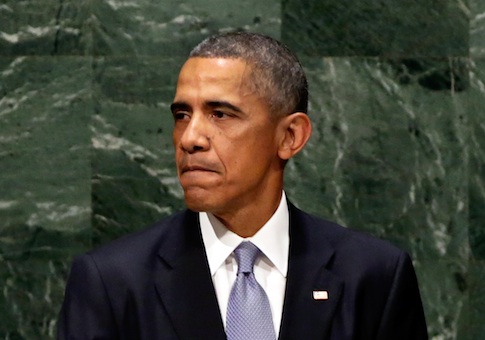
    US President Barack Obama (Photo: AFP)

    The UN action reflects mounting international concern over rising numbers of foreign fighters joining the Islamic State militant group and the threat they pose when returning home. Some 12,000 fighters from more than 70 nations have joined extremist groups in Syria and Iraq, experts say.

    British Prime Minister David Cameron told the Security Council that the beheadings of two American journalists and a British aid worker by a fighter with an apparent British accent “underlines the sinister, direct nature of this threat.”

    The council resolution is under Chapter 7 of the UN Charter, which makes it legally binding for the 193 UN member states and gives the Security Council authority to enforce decisions with economic sanctions or force.

    It targets fighters traveling to conflicts anywhere in the world, but does not mandate military force.

    Obama is building a global coalition against Islamic State, which has captured swaths of Syria and Iraq and urged its followers to attack citizens of various countries. The United States has led air strikes against the group in Iraq and Syria.

    “The words spoken here today must be matched and translated into action,” Obama told the Security Council after the adoption of the resolution. “For if there was ever a challenge in our interconnected world that cannot be met by one nation alone, it is this – terrorists crossing borders and threatening to unleash unspeakable violence.”

    Obama chaired the Security Council because the United States is president of the body for September.

    The UN resolution expresses concern that “foreign terrorist fighters increase the intensity, duration and intractability of conflicts, and also may pose a serious threat to their states of origin, the states they transit and the states to which they travel.”

    Australian Prime Minister Tony Abbott told the council that the passports of more than 60 Australians had been suspended to stop them from joining extremist groups in the Middle East. Both Abbott and Cameron outlined their efforts to strengthen laws.

    Terror target: Israel

    The European Union’s counterterrorism coordinator, Gilles de Kerchove said al-Qaeda may try to show its relevance by carrying out attacks in Europe, the United States or Israel, the European Union’s counterterrorism coordinator said on Wednesday.

    De Kerchove warned of the risk of competition between Islamic State and al-Qaeda, which has renounced its offshoot as too brutal.

    “It is possible that Al-Qaida may want to mount attacks to show that the organization is still relevant, they are still in the game,” De Kerchove told a European Parliament committee.

    He said some militants had moved from Afghanistan and Pakistan to Syria, where they formed part of the al-Qaeda-linked Khorasan Group.

    He added that it appeared they planned to recruit Europeans who had travelled to Syria to fight and persuade them to use their passports to return and mount attacks in Europe, Israel and the United States.

    While Islamic State was the main target of a US-led air assault in Syria this week, American officials said they also targeted the Khorasan Group, with the aim of disrupting a plot against US or European targets that the Pentagon said was “nearing the execution phase.”

    De Kerchove estimated that more than 3,000 Europeans were in Syria, had been there or planned to go there to fight, and that there was a real risk some of them could return and bring violence back to Europe.

    “We have seen that in Brussels with the killing of four persons at the Jewish Museum. It raises their level of tolerance of violence to such a level that there is a risk when they come back that killing is something normal,” he said.

    Arab states risk backlash by joining Syria strikes

    September 25, 2014

    Arab states risk backlash by joining Syria strikes

    As Gulf nations flex their military muscles, they are also treading dangerous, and complicated, political waters

    By Adam Schreck September 25, 2014, 9:07 am

    via Arab states risk backlash by joining Syria strikes | The Times of Israel.


    Hamas backed by Qatar and building rockets again  and the USA is in coalition with Qatar an use Qatar air bases .

    And obama blame Israel for the turmoil in the middle east  , and abu mazen smellls his change in the UN.

    The President called out to the Israeli leadership and public to not give up peace. “This conflict is the main source of problems in the region; for far too long, it has been used in part as a way to distract people from problems at home. And the violence engulfing the region today has made too many Israelis ready to abandon the hard work of peace”.


    Saudi Arabian air force pilots sit in the cockpit of a fighter jet at an undisclosed location on September 23, 2014, after taking part in a mission to strike Islamic State targets in Syria (Photo credit: AFP photo/Handout — Saudi Press Agency)


    DUBAI, United Arab Emirates (AP) — The Arab nations that joined the United States in striking the Islamic State group in Syria were unusually open about it, throwing aside their usual secrecy and wariness about appearing too close to Washington. Saudi Arabia even released heroic-looking photos of its pilots who flew the warplanes.

    Their boasting reflects the depth of Gulf nations’ concern over the threat of the extremist group sweeping over Iraq and Syria. It also shows their desire to flex some military muscle toward regional rival Iran, a key supporter of the Syrian and Iraqi governments.

    But the Sunni monarchies run the risk of a backlash by hard-line Islamists angered by the attacks against the Sunni fighters, whom many see as battling a Shiite-led government in Baghdad. Militant websites sympathetic to the Islamic State group lit up on Wednesday with the photos of the Saudi pilots, alongside calls for them to be killed.

    Even beyond the ranks of hard-liners, many around the region are suspicious of US motives in yet again launching military action in an Arab nation. Many among the Syrian rebels grumble that the United States and Arab nations ignored their pleas for action against Syrian President Bashar Assad for years and are intervening now against the radicals only because it is in their interest.

    Moreover, the US expanded the strikes beyond the Islamic State, hitting al-Qaeda’s branch in Syria, the al-Nusra Front, in a bid to take out a cell called the Khorasan Group that is believed to be plotting attacks against the United States. That has other Syrian rebel factions with Islamic ideologies — and there are many of them — worried they, too, could be hit by the Americans.

    “For four years, we called on the West to help us topple the regime, but it’s clear the target is the Islamic factions,” said a Damascus-based opposition activist, Abu Akram al-Shami, speaking via Skype.

    The countries whose air forces carried out strikes were all Sunni-led states run by hereditary monarchs with longstanding ties to the American military: Saudi Arabia, the United Arab Emirates, Jordan and Bahrain. Another Gulf monarchy, Qatar, played a supporting role, according to the Pentagon. US President Barack Obama — who had been eager for Arab backing in the campaign — praised them for their willingness to stand “shoulder to shoulder” with the US.

    Perhaps most vulnerable to a backlash is Jordan, which borders Syria and has a strong community of Islamists and ultraconservative Salafis who have sympathies with the Islamic State group. Jordan was the homeland of Abu Musab al-Zarqawi, the man who founded al-Qaeda’s branch in Iraq, which eventually evolved into the Islamic State group. He was killed eight years ago in a US airstrike in Iraq.

    Mohammed al-Shalabi, a prominent figure in the jihadi-Salafi movement in Jordan, told The Associated Press that while the Islamic State group has “made mistakes” — killing journalists, for example — it is still part of the Muslim nation and US strikes against it will only build support for it.

    “The US is hated in the region because of its support for Israel. People will now feel sympathy with (the Islamic State group) against the US,” he said.

    “This war is not in Jordan’s interests,” the deputy head of the Muslim Brotherhood in Jordan, Zaki Bani Rsheid, told the Al-Ghad newspaper. He warned that the war would only boost the power of Iran across the region and that Jordan’s participation could bring “responses targeting its internal security and stability.”

    In a move some saw as an attempt to soothe Salafi anger, a Jordanian court on Wednesday acquitted and freed a radical Muslim preacher known for his pro-al-Qaeda sermons, Abu Qatada. Analysts said the preacher could help give legitimacy to the campaign against the Islamic State group — or at least help keep Salafis quiet over it.

    The action in Syria makes for the largest grouping of Arab military forces against a common target since the broad-based coalition formed to evict Saddam Hussein’s Iraqi forces from Kuwait in 1991, according to analysts at the Austin, Texas-based geopolitical intelligence company Stratfor.

    Their participation reflects the growing concern among Gulf countries — particularly Saudi Arabia and the Emirates — about the rise of Islamist groups in the wake of the Arab Spring, such as the Muslim Brotherhood movement and various al-Qaeda affiliates.

    “The Islamic State represents a direct threat to the national security of these countries,” said Hossam Mohamed, a political analyst at the Regional Center for Strategic Studies in Cairo.

    Saudi Arabia and the Emirates, the two richest of the group, boast some of the region’s best-equipped militaries, including Western-made fighter jets and Apache attack helicopters.

    The Emirates in particular has been playing a more active military role. It has deployed troops as part of the NATO-led mission in Afghanistan and, along with Qatar, contributed warplanes to the alliance’s aerial campaign over Libya in 2011 that helped lead to the ouster of Moammar Gadhafi. American officials have also said the Emirates carried out airstrikes against Islamist rebels in Libya last month, but the country has not confirmed that.

    American and French sorties targeting the extremists have flown from air bases in Qatar and the Emirates, and from the aircraft carrier USS George H.W. Bush, which is assigned to the US Navy’s Fifth Fleet, based in Bahrain. Saudi Arabia has agreed to host training facilities for Syrian rebels on its territory.

    It remains unclear how much of a military role the countries will play from here on. Their participation may turn out to be token, the Stratfor analysts said — or “these airstrikes could develop into a small but growing assertiveness among the region’s Arab monarchies.”

    However, Saudi Arabia and its allies are looking beyond just striking the extremists. They want to pressure Iran and eventually turn the campaign against Assad, whose ouster they seek, said Mustafa Alani, an expert on security and terrorism at the Geneva-based Gulf Research Center.

    “They are not hoping to topple the regime by military strikes. Military strikes are only a means to generate pressure on the regime to accept a diplomatic political solution,” Alani said. “The idea is to weaken the regime to send a clear message.”

    Gazans Speak Out: Hamas War Crimes

    September 25, 2014

    Gazans Speak Out: Hamas War Crimes

    by Mudar Zahran

    September 19, 2014 at 5:00 am

    via Gazans Speak Out: Hamas War Crimes.

    If Hamas does not like you for any reason all they have to do now is say you are a Mossad agent and kill you.” — A., a Fatah member in Gaza.

    “Hamas wanted us butchered so it could win the media war against Israel showing our dead children on TV and then get money from Qatar.” — T., former Hamas Ministry officer.

    “They would fire rockets and then run away quickly, leaving us to face Israeli bombs for what they did.” — D., Gazan journalist.

    “Hamas imposed a curfew: anyone walking out in the street was shot. That way people had to stay in their homes, even if they were about to get bombed. Hamas held the whole Gazan population as a human shield.” — K., graduate student

    “The Israeli army allows supplies to come in and Hamas steals them. It seems even the Israelis care for us more than Hamas.” — E., first-aid volunteer.

    “We are under Hamas occupation, and if you ask most of us, we would rather be under Israeli occupation… We miss the days when we were able to work inside Israel and make good money. We miss the security and calm Israel provided when it was here.” — S., graduate of an American university, former Hamas sympathizer.

    While the world’s media has been blaming Israel for the death of Gazan civilians during Operation Protective Edge, this correspondent decided to speak with Gazans themselves to hear what they had to say.

    They spoke of Hamas atrocities and war crimes implicating Hamas in the civilian deaths of its own people.

    Although Gazans, fearful of Hamas’s revenge against them, were afraid to speak to the media, friends in the West Bank offered introductions to relatives in Gaza. One, a renowned Gazan academic, who spoke on condition of anonymity, said that as soon as someone talked to a Western journalist, he was immediately questioned by Hamas and accused of “communicating with the Mossad”. “Hamas makes sure that the average Gazan will not talk to Western journalists — or actually any journalists at all,” he said, continuing:

    “Hamas does not want the truth about Gaza to come out. Hamas terrorizes and kills us just like Daesh [ISIS] terrorizes kills Iraqis. Hamas is a dictatorship that kills us. The Gazans you see praising Hamas on TV are either Hamas members or too afraid to speak against Hamas. Few foreign [Western] journalists were probably able to report what Gazans think of Hamas.”

    When asked what Gazans did think of Hamas, he said:

    “The same as Iraqis thought of Saddam before he was toppled. He still won by 90-something percent in the presidential elections. If Hamas falls today in Gaza, people here will do what Iraqis did to Saddam’s statue after he fell. But even though Western journalists may not have been able to speak freely with Gazans, they still need a story to send to their editor by the end of the day. So it is just easier and safer for them to stick to the official line.”

    “What was that,” I asked: “‘Blame Israel’?”

    “I don’t know about that,” he said. “More like, ‘Never blame Hamas!’. Hamas was making a ‘statement’: Opposing Hamas Means Death. Hamas is a dictatorship that kills us.”

    M., a journalist, confirmed his view. “I do not believe any of the people Hamas killed in the last weeks were Israeli spies,” he said. “Hamas has killed many people for criticizing it, and claimed they were traitors working for Israel during the war.”

    That conversation took place four weeks before Hamas killed 21 alleged “Israeli Mossad agents.”

    D, a store owner, said:

    “There were two major protests against Hamas during the third week of the war. When Hamas fighters opened fire at the protesters in the Bait Hanoun area and the Shijaiya, five were killed instantly. I saw that with my own eyes. Many were injured. A doctor at Shifa hospital told me that 35 were killed at both protests. He went and saw their bodies at the morgue.”

    To verify those reports, I spoke to a second Gazan academic, who holds a PhD. from a Western university, who stated:

    “Hamas did kill protesters, no doubt about that. But we could not confirm how many were actually killed. If I have to guess, the number was more than reported. I am confident that not all of the 21 men Hamas killed on August 22 were collaborating with Israel. Hamas killed those men because it was weakened by Israel’s attacks and felt endangered. So it went on a ‘Salem Witch-Hunt.’ They arrested everyone who opposed them and had to make a few examples to scare people from standing against Hamas. Hamas’s tactic worked. Now Gazans are afraid to talk against Hamas even in front of their own family members. Gazans are probably afraid to criticize Hamas even in their sleep!”

    As already reported by the award-winning journalist, Khaled Abu Toameh, Hamas killed one of its leaders, Ayman Taha, and blamed Israel for it.

    Asked about Abu Toameh’s report, S., a Gazan political activist said:

    “Taha was already in Hamas’s jail before Israeli operations started. Hamas imprisoned him and tortured him because he was critical of its radical policies. He had warned Hamas not to cooperate with Qatar and Iran. Eye-witnesses said they saw Hamas militants bring him alive into the yard of Shifa hospital in Gaza and shoot him dead. They kept mutilating his body in front of viewers and little children and left it on the hospital’s yard for a few hours before allowing the staff to take it to the morgue.”

    A., a Fatah member in Gaza, spoke over Skype — fearful that Hamas was intercepting phone lines:

    “Even before the Israeli operation began, Hamas rounded up 400 of our members and other political-opposition figures. I would not be surprised if Hamas kills them all and then claims they were killed in an Israeli bombing. Hamas already beheaded a man known for opposing its views on the 22nd day of the war, then reported on its Facebook page that he was caught sending intelligence information to Israel. If Hamas does not like you for any reason, all they have to do now is claim you are a Mossad agent and kill you.”

    S. a medical worker, said:

    “The Israeli army sends warnings to people [Gazans] to evacuate buildings before an attack. The Israelis either call or send a text message. Sometimes they call several times to make sure everyone has been evacuated. Hamas’s strict policy, though, was not to allow us to evacuate. Many people got killed, locked inside their homes by Hamas militants. Hamas’s official Al-Quds TV regularly issued warnings to Gazans not to evacuate their homes. Hamas militants would block the exits to the places residents were asked to evacuate. In the Shijaiya area, people received warnings from the Israelis and tried to evacuate the area, but Hamas militants blocked the exits and ordered people to return to their homes. Some of the people had no choice but to run towards the Israelis and ask for protection for their families. Hamas shot some of those people as they were running; the rest were forced to return to their homes and get bombed. This is how the Shijaiya massacre happened. More than 100 people were killed.”

    Another Gazan journalist, D., said:

    “Hamas fired rockets from next to homes. Hamas was running from one home to another. Hamas lied when it claimed it was shooting from non-populated areas. To make things even worse for us, Hamas would fire from the balconies of homes and try to drag the Israelis into door-to-door battles and street-to-street fights — a death sentence for all the civilians here. They would fire rockets and then run away quickly, leaving us to face Israeli bombs for what they did. They are cowards. If Hamas militants are not afraid of dying, why do they run after they fire rockets from our homes? Why don’t they stay and die with us? Are they afraid to die and go to heaven? Isn’t that what they claim they wish?”


    Hamas boasted that Palestinian civilians were killed while Hamas’s terrorists remained alive, hiding in their underground bunkers and tunnels. (Image source: Hamas video screenshot)
     

    K, another graduate student at an Egyptian university who had gone to Gaza to see his family but was unable to leave after the war started, said on July 22:

    “When people stopped listening to Hamas orders not to evacuate and began leaving their homes anyway, Hamas imposed a curfew: anyone walking out in the street was shot without being asked any questions. That way Hamas made sure people had to stay in their homes even if they were about to get bombed. God will ask Hamas on judgment day for those killers’ blood.”

    I asked him if Hamas used people as “human shields.” He said: “Hamas held the entire Gazan population as a human shield. My answer to you is yes.”

    Palestinian Authority President Mahmoud Abbas told the press on September 6 that Hamas had killed 120 Fatah members who broke the curfew.

    T., a former Hamas Ministry officer, said: “Hamas fires from civilian areas for a good reason: The Israelis call the civilians and give them ten minutes to evacuate. This gives Hamas time to fire another rocket and run away.”

    Why, I asked, did Hamas not allow people to evacuate?

    “Some people say Hamas wants civilians killed in order to gain global sympathy, but I believe this is not the main reason. I think the reason is that if all the people were allowed to evacuate their homes, they all would have ended up in a certain area in Gaza. If that happened, it would have made the rest of Gaza empty of civilians, and the Israelis would have been able to hit Hamas without worrying about civilians in all those empty areas. Hamas wanted civilians all over the place to confuse the Israelis and make their operations more difficult.”

    S., a Gazan businessman, said:

    “The cease-fire Hamas agreed to carried the same conditions the Egyptians and the Israelis offered during the second week of the war — after only 160 Gazans had been killed. Why did Hamas have to wait until 2,200 were killed, and then accept the very same offer? Hamas has blackmailed the world with the killed Gazan civilians to make itself look like a freedom fighter against an evil Israel. Hamas showed Gazans that it could not care less for their blood and their children. And why should Hamas care? Its leaders are either in mansions in Qatar or villas in Jordan. Mashaal [Khaled Mashaal, the head of Hamas] is in Qatar, Mohammad Nazzal is in Jordan and Abu Marzouk is in Cairo: why should they want a ceasefire? Everyone here in Gaza is wondering why Hamas rejected so many ceasefires. Hamas knows it will not defeat Israel’s army, so why did it continue fighting? The answer is simple: Hamas wanted us butchered so it could win the media war against Israel by showing our dead children on TV and then get money from Qatar.”

    I asked S. if other Gazans shared his view. He said,

    “Gazans are not stupid. We are now telling Hamas: Either you bring victory and liberate Palestine as you claim, or simply leave Gaza and maybe give it back to the Palestinian Authority or even Israel — or even Egypt! We have had enough of Hamas’s hallucinations and promises that never come true.”

    O., a researcher who lives in Gaza Strip’s second largest city, Khan Younis, said:

    “Most of us see Hamas as too radical and too stubborn, especially the way it was refusing ceasefires offered from Israel. They even refused a 24-hour ceasefire during the third week of the war. They denied us even 24 hours of quiet to bury the dead. Even some Hamas loyalists here are asking why Hamas refused several ceasefires and made us suffer. Hamas did this on purpose because Hamas is a slave to Qatar. Qatar wants the war to go on because it is a terrorist Islamist country, and Hamas wants more of us dead to appease its masters in Qatar. Let’s be realistic, Hamas is in a bad shape now. Israel destroyed most tunnels; that is why Hamas had to join the ceasefire talks in Cairo. Were the Israelis’ hits to Hamas not so painful, Hamas would not be negotiating in the first place. At the same time, Hamas is asking Israel for the impossible, like an open seaport and an airport. Israel would never allow that, and Hamas knows this, but Hamas might just be buying time by throwing out these demands. You have to keep in mind that Hamas is not concerned with our conditions as Gazans. After all it is our children who are dying, not the children of Hamas’s leaders. Hamas is weak now, and I believe it lost most of its tunnels. Israel’s Iron Dome destroyed so many of their rockets before they landed in Israel; that is why Hamas is being ruthless with Gazans. When Hamas locks people inside homes about to be bombed, when it kills people protesting against it and when it executes alleged traitors without even a trail, these are war crimes.”

    A report by the Washington Institute, released in July, also reports that most Gazans are not happy with Hamas’s governance.

    “It is true,” said A., a teacher. “I do not know a single Gazan who is pro-Hamas at the moment, except for those on its payroll. Hamas maintains its control here through a military dictatorship, just like North Korea. People will be killed if they protest. Even Gazans living abroad fear to criticize Hamas because Hamas will take revenge on their relatives who are here.”

    M., a Gazan television producer, stated:

    “Of course I am against Israel and I want it out of Gaza and out of the West Bank, but I still believe Hamas is more of a threat to the Palestinian people. Hamas took over Gaza by killing us [Palestinians] and throwing our young men from high buildings. That is what Hamas is about: murder and power. Hamas is also delusional. Its leaders refused the Egyptian cease-fire proposal, they got hit hard by the Israelis, and then when the war stopped, they declared victory. Even the prophet Muhammad, peace be upon him, admitted it when he lost Ohoud war [A war in which pagan Arabs defeated Muhammad’s army and in which Muhammad was almost killed]. Hamas lives in its own fantasy world. Hamas wanted the dead bodies to make Israel look ugly. The media has exerted a huge pressure on Israel for every dead Gazan. In that sense, Hamas’s tactic has worked, and we have seen more Western tolerance of Hamas, especially in Europe. Of course Hamas doesn’t care if we all die so long as it achieves its goals. We are not going to accept living under Hamas any longer. Even if there is calm, and the firing stops, we are going to still be under Hamas’s mercy, where all basic living standards are considered luxuries. Hamas is just buying time by going to the ceasefire talks. Hamas does not want a ceasefire.”

    When asked why that was, he said, “Ask Qatar’s Sheikh, not me. He is Hamas’s god who gives them billions and tells them what to do. May God curse Qatar!”

    A first-aid volunteer, E., said that Hamas militants had confiscated 150 truckloads of humanitarian supplies the day before. He said the supplies were donated by charities in the West Bank and that their delivery was facilitated by the IDF. He commented: “This theft angers all of us [Gazans]. The Israeli army allows supplies to come in, and Hamas steals them. It seems even the Israelis care for us more than Hamas.”

    Another aid worker, A., confirmed that Hamas steals the humanitarian supplies given to Gaza. “They [Hamas] take most of it, sell it to us, and just give us the stuff they do not want.”

    A Gazan mosque’s imam said that the most precious aid item Hamas stole was water. “Gazans are thirsty and Hamas is stealing the water bottles provided to us for free and selling them at 20 Israeli shekels [approximately $5] for the big bottle and 10 Israeli shekels for the small one.”

    H., who did not want his profession to be mentioned, lost one of his legs in an Israeli raid. I asked him who he thought was responsible for his injury. He stated:

    “Hamas was. My father received a text-message from the Israeli army warning him that our area was going to be bombed, and Hamas prevented us from leaving. They said there was a curfew. A curfew, can you believe that? I swear to God, we will take revenge on Hamas. I swear to God I will stand on my other foot and fight against Hamas. Even if Israel leaves them alone, we will not. What had my two-year-old nephew done to be killed under the rubble of our home so Khaled Mashaal [Hamas leader based in Qatar] could be happy? We want change at any cost. I am not claiming the Israelis are innocent, but I know Hamas has fired rockets from every residential spot in Gaza. If that was not hiding behind civilians, then it was stupidity and recklessness. Nobody who is normal, in his right mind, in Gaza supports Hamas. People have lost parents, children and friends, and have nothing more to lose. I believe if given the chance and the weapons, they will stand against Hamas.”

    K., a Gazan school teacher agreed:

    “When Hamas starts caring for our children we will start caring for Hamas. Hamas has one policy, to attack Israel; so Israel attacks back, and gets us killed and Hamas then gets more money from Arabs and Erdogan [Turkey’s president]. My son has autism; he cannot handle the sounds of rockets and bombs landing. Why would I support Hamas, which causes this suffering to him? Gazans have had enough of Hamas, any claims that we love Hamas is just propaganda. A recent poll indicates that most of us support Hamas; this is not true, except maybe in the West Bank where they have not yet lived under Hamas rule. I cannot accuse the polling center of fabricating the poll, but my safest explanation for the result is that Gazans polled are too afraid to give their true opinions of Hamas. Hamas watches everything here. Most Gazans now have to deal with the aftermath of the war. Almost 300,000 Gazans are now homeless and Hamas is not providing them with anything. So why would they or their extended families have any love for Hamas? Would there be any common sense to that? Most Gazans are angry at Hamas, and most of us would love to see them replaced by any other force.”

    Despite all Hamas has done to Gazans, they do not seem to hold much love — or less hatred — for Israel.

    S., a graduate of an American university and a former Hamas sympathizer, warned:

    “Don’t get fooled. Gazans are not in love with Israel yet, but they do not want to fight Israel anymore. We do not want to embrace Israel; we just want to live normally without wars. We want to live and work in Israel like we used to. We are under Hamas occupation, and if you ask most of us, we would rather be under Israeli occupation, instead. I would welcome Netanyahu to rule Gaza so long as Hamas leaves, and I think most Gazans feel the same way. We miss the days when we were able to work inside Israel and make good money, we miss the security and calm Israel provided when it was here, but politically speaking, we just think of it as the better of two evils: Israel and Hamas.”

    M., who lost his 11 year old daughter in an Israeli bombing said: “I will not forgive either Hamas or Israel for losing my daughter. If you ask me if I hate Israelis, my answer would be no, but do I love them? Of course not. There is too much blood between us, but I can only hope someday we both will move on and heal our wounds.”

    When asked what he would do if he were in Israel’s place, being attacked non-stop by Hamas, he responded: “I do not care if both Israel and Gaza burn in hell.”

    F., a Gazan physician, said:

    “I wish Israel never existed, but as it does not seem to be going away, I would rather be working in Israel like I used to before the first Intifada, not fighting it. Hamas sympathizers, apologists and appeasers should be ashamed of themselves for supporting a terrorist organization that has butchered civilians, Israeli and Palestinian. Apparently a group of Israelis is working on bringing Hamas leader Khaled Mashaal to trial in the International Criminal Court. But perhaps the world should consider putting all the Hamas leaders on trial for crimes against the Gazan people.”

    Iranian leader: US should focus on terror, not nukes

    September 25, 2014

    Iranian leader: US should focus on terror, not nukesAhead of UN address, Rouhani says Tehran and Washington can work together to curb Islamic extremismBy George Jahn September 25, 2014, 12:23 pm

    via Iranian leader: US should focus on terror, not nukes | The Times of Israel.


    Iranian President Hassan Rouhani speaks during his keynote address at New America,
    a public policy institute and think tank,
    on Wednesday, Sept. 24, 2014 in New York (Photo credit: Bebeto Matthews/AP)


    NEW YORK (AP) — Iranian President Hasan Rouhani urged the United States on Wednesday to move beyond “insignificant” fears that his country seeks nuclear arms and challenged it to join his country in battling what he described as the global threat of Islamic extremism.

    During a speech and question-and-answer session hosted by the New America think tank, Rouhani urged the US government to “let go of pressure politics toward Iran” — a reference to Iranian complaints that Washington’s demands at the nuclear talks are unrealistic. Repeating that Iran is not interested in nuclear arms, he urged the US to “leave behind (this) insignificant issue.”

    Instead, he said, the two countries must focus on the fight against the Islamic State group and other extremist groups, the “real and serious common challenges which … threaten the entirety of the world.”

    At the same time, he was critical of the US bombing campaign of Islamic State strongholds in Iraq and Syria and the growing coalition of countries seeking to stop the terrorists by military means. “Bombing and airstrikes are not the appropriate way,” he said, warning that “extraterritorial interference…in fact only feeds and strengthens terrorism.”

    Blaming “the misunderstandings of the realities of the region by…outsiders,” Rouhani said wrong US policies, including the invasions of Afghanistan in 2001 and Iraq in 2003, likely led to the birth of the Islamic State group by creating power vacuums exploited by extremists.

    Rouhani also suggested it was in the West’s interest to reach a nuclear agreement with Iran, freeing Tehran to play a more active role in creating and maintaining stability in the Islamic world.

    The nuclear talks appear stuck two months before their extended November 24 deadline. While the US is formally joined by five other powers at the negotiating table with Iran, it is clear that the Americans are the lead negotiators, and Rouhani directed most of his comments at Washington.

    Even if a nuclear deal is sealed, it could face harsh opposition by Iranian hardliners and US congressional critics united in one fear — that their side has given away too much. But Rouhani shrugged off opposition from inside his country and said it was up to US President Barack Obama to deal with Congress.

    Iran-US tensions have eased since the election last year of the moderate Rouhani. A year ago, he and Obama spoke by telephone for 15 minutes, the first time the presidents of the United States and Iran had talked directly since the 1979 Iranian revolution and siege of the American embassy. The conversation was hailed as an historic breakthrough.

    Tensions have risen recently, with American officials furious over the arrest of Jason Rezarian, an American-Iranian journalist for the Washington Post detained on unspecified charges in Iran.

    But Rouhani made clear he was not prepared to interfere in the case of Rezarian, whose wife was also arrested.

    Iranian officials have not specifically said why the couple is being held, and Rouhani has dodged questions about their fate. Asked Wednesday about Rezarian, he said he would be freed if he is innocent of any crime.

    “We must not prematurely express opinions about a case that hasn’t reached the court yet,” he said.

    Fatah’s Gaza Branch Making Rockets to Use before Next Cease-Fire [video]

    September 25, 2014

    Hamas is making new rockets while Israel demands disarmament

    By: Palestinian Media Watch

    Published: September 24th, 2014

    via The Jewish Press » » Fatah’s Gaza Branch Making Rockets to Use before Next Cease-Fire .

    Fatah Al Aqsa terrorists shows off “cease-fire” rocket production.


    Gaza’s branch of Fatah, Hamas’ rival terrorist party headed by Palestinian Authority chairman Mahmoud Abbas, showed off its continuing rocket-manufacturing capabilities for visiting Russian journalists, Palestinian Media Watch (PMW) reported.

    Fatah invited Russian TV (RT) last week to a rocket production facility to witness and film the actual production of new rockets. Fatah’s military wing, the Al-Aqsa Martyrs’ Brigades, depleted its reserves while taking an active part in the Gaza war alongside Hamas, firing rockets at Israeli towns and cities:

    “The moment the war ended, the Palestinian military wings renewed military production in order to replenish the stock, which was emptied during the war,”  according to an Arab journalist for RT, quoted by Fatah on its Facebook page.

    A Fatah video, as seen below, shows Fatah members at work producing new rockets, and a masked Fatah terrorist explained, “We are preparing and developing rockets in the productions’ division of the Al-Aqsa Martyrs’ Brigades – Al-Asifa Army following the ceasefire agreement in preparation for the coming battles.”

    The Palestinian Authority does not want another cease-fire unless it has plenty of rockets on hand to make sure that the truce is temporary. Terrorists in Gaza, like those in the Judea and Samaria who received thousands of rifles from Israel in the 1990s to keep the peace as part of the Oslo Accords, never store their weapons for a long period of time. Their idea of “defense” is to use them to attack Israel, whose existence is considered an offensive act.

    The journalist added that Fatah is making rockets because the partial blockade imposed by Israel and Egypt interferes with efforts to smuggle weapons into Gaza.

    Of course, Israel could put an end to all smuggling simply by removing the maritime blockade. Then, Fatah, Islamic Jihad, Hamas and all of the other terrorist groups simply could bring in weapons at will in response to the “humanitarian gesture” by Israel.

    Fatah’s activity in the war, in which it lost 17 times more members than those identifying with Hamas, is a sign that Fatah and Hamas have achieved unity in the area of terror, if not on the diplomatic front.

    A Sept. 10 Fatah post, translated and published by PMW, quoted the RT reporter as stating. “We are visiting the Al-Aqsa Brigades – Al-Asifa Army (i.e., Fatah’s military wing)… where fuel for rockets and mortar shells is being produced.”

    An Al-Aqsa Martyrs’ Brigades fighter added, “We are preparing and developing rockets in the productions’ division of the Al-Aqsa Martyrs’ Brigades – Al-Asifa Army following the ceasefire agreement in preparation for the coming battles. During the last war, we fired rockets at the Zionist enemy. We have notified the enemy that we have many more [rockets]. We have also successfully developed the K-132 rocket, which is here beside me.”


    Egypt blasts Erdogan for questioning Sisi’s legitimacy

    September 25, 2014

    Egypt blasts Erdogan for questioning Sisi’s legitimacy – Israel News, Ynetnews.

    Egypt says Turkey’s leader supports terror after Erdogan said Egyptian leader Sisi ‘murdered democracy’ when he ousted Egypt’s first elected president Morsi.

    Reuters

    Published: 09.25.14, 12:10 / Israel News

    Egypt has accused Turkish leader Tayyip Erdogan of supporting terrorists and seeking to provoke mayhem in the Middle East after he questioned the legitimacy of Egyptian President Abdel Fattah al-Sisi in a speech at the UN General Assembly.

    Ties between Ankara and Cairo have been strained since then army chief Sisi toppled elected President Mohamed Mori of the Muslim Brotherhood last year after mass protests against his rule.

    Egyptian President Abdel Fattah al-Sisi  (Photo: AP)

    Egyptian President Abdel Fattah al-Sisi (Photo: AP)

    Egyptian security forces then mounted one of the fiercest crackdowns against the Islamist movement, killings hundreds of supporters at a Cairo protest camp, arresting thousands and putting Mori and other leaders on trial trial.

    After world leaders gathered at the United Nations, Erdogan delivered a speech which featured stinging criticism of Sisi’s rise and what he called inaction after Mori’s overthrow.

    Turkish leader Tayyip Erdogan (Photo: Reuters)
    Turkish leader Tayyip Erdogan (Photo: Reuters)

    “Again, those objecting (to) the murders in Iraq, Syria and the murder of democracy in Egypt are subjected to certain unfair and groundless accusations and almost immediately accused of supporting terrorism,” said Erdogan.

    “The United Nations as well as the democratic countries have done nothing but watch the events such as overthrowing the elected president in Egypt and the killings of thousands of innocent people who want to defend their choice. And the person who carried out this coup is being legitimized.”
    In a statement, Egypt’s foreign ministry dismissed Erdogan’s comments on Sisi.

    “There is no doubt that the fabrication of such lies and fabrications are not something strange that comes from the Turkish President, who is keen to provoke chaos to sow divisions in the Middle East region through its support for groups and terrorist organizations,” the foreign ministry said.

    “Whether political support or funding or accommodation in order to harm the interests of the peoples of the region to achieve personal ambitions for the Turkish president and revive illusions of the past.”

    Erdogan’s comments prompted Egyptian Foreign Minister Sameh Shukri to cancel a meeting on the sidelines of the General Assembly with his Turkish counterpart, according to the statement.

    Mori’s Muslim Brotherhood has close ties with Erdogan’s AK Party and Turkey has emerged as one of the fiercest international critics of Mori’s removal, calling it an “unacceptable coup” by the army.

    “If we defend democracy, then let’s respect the ballot box. If we will defend those who come to power not with democracy but with a coup then I wonder why this UN exists,” Erdogan said in his speech.

    Both the fall of the Muslim Brotherhood and the advance of Islamic State has drawn regional countries into sectarian and ideological conflicts destabilizing the Middle East.

    Erdogan and Turkish Prime Minister Ahmet Davutoglu, architects of a foreign policy which envisages Sunni Muslim Turkey as a regional power, have been reluctant to engage in action they fear could strengthen their enemy, Syrian President Bashar al-Assad, and exacerbate sectarian tensions inside Iraq.

    Ankara has backed Syrian rebel groups fighting Assad but strongly denies any suggestion that it has supported Islamic State or other radical Islamist militants, saying they pose a major security threat to Turkey.

    Egypt has been at odds with both Turkey and Qatar over the political transformation in the biggest Arab country since a popular uprising toppled autocrat Hosni Mubarak in 2011.

    Egypt says Sisi’s removal of the Brotherhood was not a coup, arguing that he was responding to the will of the Egyptian people after they rejected his troubled one-year rule.

    Saudi Arabia and the United Arab Emirates, Gulf Arab oil producers who feel threatened by the Brotherhood, have showered Egypt with billions of dollars since Mori’s exit.

    Sisi’s opponents accuse him of returning Egypt to an authoritarian past with widespread human rights abuses.

    Report: Syrian army retakes area northeast of Damascus

    September 25, 2014

    Report: Syrian army retakes area northeast of Damascus – Israel News, Ynetnews.

    Battles rage across Syria, with US air strikes hitting oil fields in north and east Syria, Kurdish forces beating Islamic State militants, as France and UK mull military intervention.

    Kurdish forces (Photo: Reuters)

    News Agencies

    The Syrian army has taken full control of a formerly insurgent-held area northeast of Damascus, Hezbollah’s al-Manar TV said on Thursday, as battles rage across war torn nation.

    Meanwhile, as France and the UK mull their roll in a US-led military campaign against the Islamic State group, scores of the group’s members were killed in clashes with Kurdish forces in northern Syria. The group also suffered addional losses in US airstrikes on oil fleids controled by the radical group.

    The area – Adra al-Omalia – is around 30 km (19 miles) from central Damascus but far from parts of Syria where the United States has launched air strikes against Islamic State militants.

    “The Syrian Army takes full control of the town of Adra al-Omalia in the eastern countryside of Damascus,” al-Manar said in a news flash.

    Assad’s forces, backed by the Lebanese Shi’ite terror movement Hezbollah, have been gradually extending control over a corridor of territory from Damascus to the Mediterranean coast this year, seizing towns and villages along the main north-south highway and in the mountainous Qalamoun along the Lebanese border.

    The Britain-based Syrian Observatory for Human Rights, which monitors the conflict, said at least 29 people – 18 of them rebel fighters – died during fighting on Wednesday between insurgents and government forces in the outskirts of Damascus.

    Kurdish front

    Officials said Islamic State had concentrated their fighters south of Kobani late on Wednesday and had pushed towards the town but Kurdish YPG forces repelled them.

    Islamic State launched a fresh offensive to try to capture Kobani more than a week ago after months of fighting. More than 100,000 Kurds have fled the town and surrounding villages, crossing over the nearby border into Turkey.

    Kurdish rebels
    Kurdish rebels

    “The YPG responded and pushed them back to about 10-15 km (6-9 miles) away,” Idris Nassan, deputy minister for foreign affairs in the Kobani canton, told Reuters by telephone.

    Ocalan Iso, a Kurdish defence official, confirmed that YPG forces had stemmed Islamic State’s advances south of Kobani, known as Ayn al-Arab in Arabic.

    “As our fighters secured the area, we found 12 Islamic State bodies,” he said by telephone. Islamic State fighters also remain to the east and west of the town and fighting continues in the south.

    US attacks as France, UK mull role

    Activists say that US-led airstrikes have targeted Syrian oil installations held by the militant Islamic State group, killing at least five people.

    Damage caused by US airstrike (Photo: Reuters)
    Damage caused by US airstrike (Photo: Reuters)

    The Britain-based Syrian Observatory for Human Rights and two local activist collectives say the airstrikes hit refineries and oil fields in the eastern provinces of Deir el-Zour and Hassakeh.

    In one incident, the activists said at least five people were killed, including women and children who were likely the wives and children of militants, living near a refinery building.

    The Observatory and activists said other airstrikes targeted the Nusra Front, a Syrian al-Qaida affiliate that has fought the Islamic State, and which is one of the most powerful groups fighting to overthrow Syrian President Bashar Assad.

    Other strikes targeted Islamic State compounds, checkpoints and military vehicles.

    France’s possible participation in air strikes on Islamic State targets in Syria is “on the table”, Defence Minister said on Thursday, hours after President Francois Hollande ruled out such strikes.

    France has joined the coalition bombing of Islamic State targets in Iraq on the basis it was asked for help by Baghdad, but has refrained from doing so in Syria, instead supporting the moderate opposition against Syrian President Bashar al-Assad.

    But Le Drian told RTL Radio when asked about the possibility France might join raids in Syria: “The opportunity is not there today. We already have an important task in Iraq and we will see in the coming days how the situation evolves.”

    Pressed further on whether it was a possibility in future, Le Drian – who is taking part in a war cabinet meeting with Hollande on Thursday – said: “The question is on the table”.

    The British prime minister said late Wednesday he will ask Parliament to approve joining international airstrikes against the Islamic State group in Iraq.

    David Cameron announced the move in his address to the UN General Assembly.

    Cameron did not mention the prospect of also joining the US-led international airstrikes against the Islamic State group in Syria that began this week.

    The threat of the terror group’s grip on large parts of both Iraq and Syria has dominated this week’s annual gathering of world leaders.

    Cameron also warned against believing that it’s necessary to “do a deal” with Syrian President Bashar Assad to defeat the Islamic State group, calling that thinking “dangerously misguided.” He said the brutality of Assad’s government has been a powerful recruiting tool for extremists during the conflict there, which is now in its fourth year.

    Assad’s government has not asked for international intervention in fighting the Islamic State group, but Iraq has.

    The prime minister defended his decision to pursue the UK’s involvement in airstrikes in Iraq, saying that the Islamic State group’s threat is global and that “when the safety and security of our people is at stake, we must be uncompromising in our response.”

    There are lessons to be learned from the past, including the invasion of Iraq a decade ago, he acknowledged, but “isolation and withdrawing from a problem like ISIL will only make things worse,” he said, using one of a number of acronyms for the Islamic State group.

    Cameron also said Iran could help in defeating the terror group’s threat. He met with Iran’s president Wednesday, the first such meeting since the Iranian revolution in 1979.

    “They could help secure a more stable, inclusive Iraq; and a more stable, inclusive Syria,” Cameron said of Iran, though he acknowledged that disagreements remain on other issues. “And if they are prepared to do this, then we should welcome their engagement.”


    Reuters and AP contributed to this report

    CURL: Obama’s breathtaking naivete at the United Nations

    September 25, 2014

    CURL: Obama’s breathtaking naivete at the United Nations, Washington TimesJoe Curl, September 24, 2014

    Obama's ToastPhoto by: Pablo Martinez Monsivais. President Barack Obama raises his glass to toast during a luncheon hosted by UN Secretary General Ban Ki-moon, Wednesday, Sept. 24, 2014, at the United Nations headquarters. (AP Photo/Pablo Martinez Monsivais)

    Simply believing something doesn’t make it so. The president’s desire for a world in which nations talk openly about their true feelings, perhaps share a good cry together, and sing kumbaya around the campfire, is the height of naivete.

    So is this passage of his speech: “… the United States is not and never will be at war with Islam. Islam teaches peace. Muslims the world over aspire to live with dignity and a sense of justice. And when it comes to America and Islam, there is no us and them, there is only us.”

    ******************

    ANALYSIS/OPINION:

    President Obama on Wednesday delivered a speech at the United Nations filled with his usual soaring rhetoric of global collectivism and the importance of “international norms.” But the president also displayed a shocking naivete about global affairs, religion, Islam — a Pollyannaish interpretation on the state of the world and America’s role in it.

    Although Mr. Obama won a Nobel Peace Prize just eight months into office, the president made his annual trip to the ineffectual world council to deliver a call to war. “Ladies and gentlemen, we come together at a crossroads between war and peace, between disorder and integration, between fear and hope.”

    Of course he waxed poetic about “climate change” and the promise of “the children,” but the president was forced to devote the bulk of his speech to what he called the “heart of darkness” and the “cancer of violent extremism.”

    He said upon opening his remarks that “the shadow of world war that existed at the founding of this institution has been lifted.” He couldn’t be more wrong. A true man of peace worthy of the Nobel Prize, Pope Francis, said just the opposite this month in remarkably astute comments to commemorate the anniversary of World War I.

    “Even today, after the second failure of another world war, perhaps one can speak of a third war, one fought piecemeal, with crimes, massacres, destruction,” the pope said, summing up the conflicts in Ukraine, Iraq, Syria, Israel, Gaza and much of northern Africa, including Libya and Tunisia, not to mention Somalia.

    To Mr. Obama, there’s no global conflict of ideology, just “pervasive unease in our world.” To him, the strife is merely the “failure of our international system to keep pace with an interconnected world.” And to him, “it is one of the tasks of all great religions to accommodate devout faith with a modern, multicultural world.”

    He asked delegates from nations across the world to mull this “central question of our global age: Whether we will solve our problems together, in a spirit of mutual interest and mutual respect, or whether we descend into the destructive rivalries of the past.”

    His answer? “It’s time for a broader negotiation in the region in which major powers address their differences directly, honestly, and peacefully across the table from one another, rather than through gun-wielding proxies.”

    Simply believing something doesn’t make it so. The president’s desire for a world in which nations talk openly about their true feelings, perhaps share a good cry together, and sing kumbaya around the campfire, is the height of naivete.

    So is this passage of his speech: ” … the United States is not and never will be at war with Islam. Islam teaches peace. Muslims the world over aspire to live with dignity and a sense of justice. And when it comes to America and Islam, there is no us and them, there is only us.”

    But Islam and the holy Koran on which Muslim militant groups like al Qaeda and the Islamic State base their actions do call for the extermination of all who do not follow Islam, do demand that followers kill anyone who leaves the religion, do subjugate women. For the record, the Koran contains more than 100 verses that call Muslims to war with nonbelievers.

    Mr. Obama said in his speech that “all people of faith have a responsibility to lift up the value at the heart of all great religions: Do unto thy neighbor as you would do — you would have done unto yourself.” But that is not a cornerstone of Islam. Militant Muslims have a very different belief: “Fight in the name of your religion with those who disagree with you.” And that edict comes straight from their holiest book.

    To the president, that ideology “will wilt and die if it is consistently exposed and confronted and refuted in the light of day.” Again, the callowness is astounding. While he urged the world, “especially Muslim communities,” to reject the ideology that underlies al Qaeda and the Islamic State, nothing will change the fact that cold-blooded killers are determined to destroy the West, wipe all infidels from the face of the earth and build a new caliphate based on strict adherence to Shariah law (which leans heavily toward beheadings, lashings, stonings).

    The president let loose some passing platitudes — “right makes might,” “the only language understood by killers like this is the language of force” — but in the end Mr. Obama still labors under the delusion that the Islamic State group and its ilk have “perverted one of the world’s great religions.” He still rejects “any suggestion of a clash of civilizations” — despite al Qaeda’s and Islamic State’s express declaration of war against western civilization (and anyone who is not Muslim).

    In the end, Mr. Obama said: “No external power can bring about a transformation of hearts and minds,” which means America is powerless. The only solution in this multicultural world is sharing our true feelings honestly with those who not only fundamentally disagree with us, but vow to do us harm.

    Exactly a year ago, Mr. Obama said this at the U.N.: “Together, we’ve also worked to end a decade of war.” But the worldwide war on terrorism does not end when the U.S. president decides it is so, it ends when the enemy is defeated.

    While he says “peace is not merely the absence of war, but the presence of a better life,” he really should say only this: “We didn’t start this war, but we will end it.”

    Obama Praises Muslim Cleric Who Backed Fatwa on Killing of U.S. Soldiers

    September 24, 2014

    Obama Praises Muslim Cleric Who Backed Fatwa on Killing of U.S. Soldiers, Washington Free Beacon, September 14, 2014

    Barack ObamaPresident Barack Obama addresses the United Nations General Assembly / AP

    Patrick Poole, a reporter and terrorism analyst who has long tracked Bin Bayyah, expressed shock that the Obama administration would endorse the cleric on the world stage.

    “It is simply amazing that just a few months ago the State Department had to publicly apologize for tweeting out it’s support for Bin Bayyah, only to have Barack Obama go before the leaders of the entire world and publicly endorse Bin Bayyah’s efforts,” Poole said.

    “It seems that nothing can stop this administration’s determination to rehabilitate Bin Bayyah’s image, transforming him from the Islamic cleric who issued the fatwa to kill Americans in Iraq and calling for the death of Jews to the de facto White House Islamic mufti,” he said.

    This type of mentality has contributed to the administration’s foreign policy failures in the region,” Poole said.

    ********************

    President Barack Obama favorably quoted and praised on Wednesday in his speech before the United Nations a controversial Muslim cleric whose organization has reportedly endorsed the terror group Hamas and supported a fatwa condoning the murder of U.S. soldiers in Iraq.

    Obama in his remarks offered praise to controversial cleric Sheikh Abdallah Bin Bayyah and referred to him as a moderate Muslim leader who can help combat the Islamic State of Iraq and the Levant’s (ISIL or ISIS) radical ideology.

    However, Bin Bayyah himself has long been engulfed in controversy for many of his views, including the reported backing of a 2004 fatwa that advocated violent resistance against Americans fighting in Iraq.

    This is not the first time that the Obama administration has extoled Bin Bayyah, who also has served as the vice president of a Muslim scholars group founded by a radical Muslim Brotherhood leader who has called “for the death of Jews and Americans,” according to Fox News and other reports.

    The State Department’s Counterterrorism Bureau (CT) was forced to issue multiple apologies earlier this year after the Washington Free Beacon reported on its promotion of Bin Bayyah on Twitter.

    “This should not have been tweeted and has since been deleted,” the CT Bureau tweeted at the time after many expressed anger over the original endorsement of Bin Bayyah.

    However, it appears that Obama and the White House are still supportive of Bin Bayyah, who, despite his past statements, is still hailed by some as a moderate alternative to ISIL and al Qaeda.

    “The ideology of ISIL or al Qaeda or Boko Haram will wilt and die if it is consistently exposed, confronted, and refuted in the light of day,” Obama said before the U.N., according to a White House transcript of his remarks.

    “Look at the new Forum for Promoting Peace in Muslim Societies—Sheikh bin Bayyah described its purpose: ‘We must declare war on war, so the outcome will be peace upon peace,’” Obama said, quoting the controversial cleric.

    Concern over the administration’s relationship with Bin Bayyah started as early as 2013, when outrage ensued after he was reported to have met with Obama’s National Security Council staff at the White House.

    While Bin Bayyah has condemned the actions of groups such as Boko Haram and ISIL, he also has taken controversial positions against Israel.

    He issued in 2009 a fatwa “barring ‘all forms of normalization’ with Israel,” according to a Fox report on the White House meeting.

    Additionally, the notorious 2004 fatwa permitting armed resistance against U.S. military personnel in Iraq reportedly stated that “resisting occupation troops” is a “duty” for all Muslims, according to reports about the edict.

    Patrick Poole, a reporter and terrorism analyst who has long tracked Bin Bayyah, expressed shock that the Obama administration would endorse the cleric on the world stage.

    “It is simply amazing that just a few months ago the State Department had to publicly apologize for tweeting out it’s support for Bin Bayyah, only to have Barack Obama go before the leaders of the entire world and publicly endorse Bin Bayyah’s efforts,” Poole said.

    “It seems that nothing can stop this administration’s determination to rehabilitate Bin Bayyah’s image, transforming him from the Islamic cleric who issued the fatwa to kill Americans in Iraq and calling for the death of Jews to the de facto White House Islamic mufti,” he said.

    This type of mentality has contributed to the administration’s foreign policy failures in the region,” Poole said.

    “This is a snapshot of why this administration’s foreign policy in the Middle East is a complete catastrophe,” he said. “The keystone of their policy has been that so-called ‘moderate Islamists’ were going to be the great counter to al Qaeda. But if you take less than 30 seconds to do a Google search on any of these ‘moderate Islamists,’ you immediately find they are just a degree or two from the most hardcore jihadis and have little to no difference when it comes to condoning violence.”

    A White House official said that the president’s remarks speak for themselves and declined to add anything further.