Archive for September 2014

Cameron: It is our duty to fight Islamic State

September 26, 2014

Cameron: It is our duty to fight Islamic State

UK lawmakers debate airstrikes on militants ahead of likely approval, as Denmark says it too will join the fight in the Middle East

By AP September 26, 2014, 2:14 pm

via Cameron: It is our duty to fight Islamic State | The Times of Israel.


British Prime Minister David Cameron delivers a speech on joining Iraq air strikes to The House of Commons in London, September 26, 2014 (Photo credit: AFP/Parliament TV)


British Prime Minister David Cameron made an impassioned plea Friday for Britain to join the United States and a coalition of Western and Arab nations in airstrikes meant to thwart Islamic State group militants in Iraq.

Cameron told a tense House of Commons that there was no more serious issue than asking the country to devote armed forces to conflict. He repeatedly stressed that no combat troops were planned, but he could barely get through his statement, as lawmakers peppered him with questions about the move.

“I believe it is our duty to take part,” he said. “This international operation is about protecting our people, too, and protecting the streets of Britain should not be a task that we are prepared to entirely subcontract to other air forces of other countries.”

Lawmakers are expected to approve the motion, which is supported by all three main parties and comes only days after Iraq’s prime minister requested help.

The motion does not address any action in Syria. Critics say that would be illegal because Syrian President Bashar Assad has not invited outsiders to help.

Foreign Secretary Philip Hammond refused to speculate Friday on how long the military campaign could last, but lawmakers envision a long-term action.

“We are going into this with our eyes open,” Hammond told Sky News, adding that the Islamic State group is a threat to national security.

The Danish government said Friday it was joining the coalition to hit IS, sending seven F-16 fighter jets to take part in airstrikes against the group in Iraq.

Prime Minister Helle Thorning-Schmidt said her left-leaning government had a parliamentary majority backing the deployment of four operational planes and three reserve jets along with 250 pilots and support staff. She said a vote in Parliament was planned and was considered a formality. However, no date was immediately set for the vote.

The Netherlands has already agreed to join the US-led coalition in Iraq. Neither country plans to strike in Syria.

Belgium was also considering on Friday whether to join the coalition.

KRAUTHAMMER: A real Syria strategy

September 26, 2014

KRAUTHAMMER: A real Syria strategy – Odessa American: Opinion Columnist.

Charles Krauthammer | Posted: Friday, September 26, 2014 5:00 am

WASHINGTON Late, hesitant and reluctant as he is, President Obama has begun effecting a workable strategy against the Islamic State. True, he’s been driven there by public opinion. Does anyone imagine that without the broadcast beheadings we’d be doing anything more than pinprick strikes within Iraq? If Obama can remain steady through future fluctuations in public opinion, his strategy might succeed.

But success will not be what he’s articulating publicly. The strategy will not destroy the Islamic State. It’s more containment-plus: Expel the Islamic State from Iraq, contain it in Syria. Because you can’t win from the air. In Iraq, we have potential ground allies. In Syria, we don’t.

 The order of battle in Iraq is straightforward. The Kurds will fight, but not far beyond their own territory.

 A vigorous air campaign could help them recover territory lost to the Islamic State and perhaps a bit beyond. But they won’t be anyone’s expeditionary force.

From the Shi’ites in Iraq we should expect little. U.S. advisers embedded with a few highly trained Iraqi special forces could make some progress. But we cannot count on the corrupt and demoralized regular Shi’ite-dominated military.

 Our key potential allies are the Sunni tribes. We will have to induce them to change allegiances a second time, joining us again, as they did during the 2007-2008 surge, against the jihadists.

Having abandoned them in 2011, this won’t be easy. But it is necessary. One good sign is the creation of a Sunni national guard, a descendant of the Sons of Iraq who, fighting with us, expelled al-Qaida in Iraq (AQI) during the Anbar Awakening. Only they could push the Islamic State out of Iraq. And surely only they could hold the territory regained.

Syria is another matter. Under the current strategy, the cancer will remain. The air power there is unsupported by ground troops. Nor is anyone in Obama’s “broad coalition” going to contribute any.

Perhaps Turkey will one day. But Islamist President Recep Tayyip Erdogan is not just refusing to join the air campaign. He has denied us use of his air bases.

As for what’s left of the Free Syrian Army, Obama has finally come around to training and arming it. But very late and very little. The administration admits it won’t be able to field any trained forces for a year. And even then only about 5,000. The Islamic State is already approximately 30,000 strong and growing.

Not that air power is useless. It can degrade and disrupt. If applied systematically enough it can damage the entrenched, expanding, secure and self-financing Islamic State, turning it back to more of a fugitive guerrilla force constantly on the run.

What kind of strategy is that? A compressed and more aggressive form of the George Kennan strategy of Soviet containment. Stop them, squeeze them and ultimately they will be defeated by their own contradictions.

As historian David Motadel points out, jihadist regimes stretching back two centuries have been undone by their own primitivism, barbarism, brutality — and the intense hostility thus engendered among those they rule.

That’s what just eight years ago created the Anbar Awakening that expelled AQI. Mahdi rule in Sudan in the 1880s and ’90s was no more successful. As Motadel notes, half the population died of disease, starvation or violence — and that was before the British annihilation of the Mahdi forces at Omdurman.

 Or to put it in a contemporary Middle East context, this kind of long-term combination of rollback and containment is what has carried the Israelis successfully through seven decades of terrorism arising at different times from different places proclaiming different ideologies. There is no one final stroke that ends it all. The Israelis engage, enjoy a respite, then re-engage.

With a bitter irony born of ceaseless attacks, the Israelis call it “mowing the lawn.”

They know a finality may come, but alas not in their time. They accept it, and go on living.

Obama was right and candid to say this war he’s renewed will take years.

This struggle is generational. This is not Sudan 1898. There is no Omdurman that defeats jihadism for much of a century.

Today jihadism is global, its religious and financial institutions ubiquitous and its roots deeply sunk in a world religion of more than a billion people. We are on a path — long, difficult, sober, undoubtedly painful — of long-term, low intensity rollback/containment.

Containment-plus. It’s the best of our available strategies. Obama must now demonstrate the steel to carry it through.

SHOCKING: Barack Obama’s Implied Pact With ISIS-Backed Terror Group

September 26, 2014

SHOCKING: Barack Obama’s Implied Pact With ISIS-Backed Terror Group

via SHOCKING: Barack Obama’s Implied Pact With ISIS-Backed Terror Group – UlstermanBooks.com.


Will this be given the attention it deserves? Many already know Barack Obama’s allegiance to the Muslim Brotherhood, but few likely are aware of a pact signed in 2013 that directly linked the Obama White House, the Muslim Brotherhood, and the ISIS-backed Egyptian terror organization known as Ansar all-Bayt.

Reader, please share this with others you know.

WARNING: GRAPHIC IMAGE

The above image is the recent work of  Ansar all-Bayt, an ISIS-backed Egyptian terror group who beheaded four men suspected of spying for Israel.

In December of 2013, the Muslim Brotherhood signed a pact with Ansar all-Bayt, a Sunni fundamentalist terror organization with direct links to al-Qaeda and is also suspected of receiving significant funding from Saudi Arabia.

The above photo was taken inside the White House in April of 2014. It shows Barack Obama meeting with Anas Altikriti, a top Washington D.C. lobbyist for the Muslim Brotherhood, whose father heads the Muslim Brotherhood in Iraq. It was shortly after this meeting that ISIS forces began pushing into Iraq.

Just prior to his now infamous 2009 speech in Cairo, whispers generated of senior adviser Valerie Jarrett’s insistence that no fewer than ten members of the Muslim Brotherhood be invited to attend the speech. This demand was largely ignored by most news agencies, but the Atlantic did provide this blurb:

Various Middle Eastern news sources report that the administration insisted that at least 10 members of the Muslim Brotherhood, the country’s chief opposition party, be allowed to attend his speech in Cairo on Thursday.

When then-head of the Muslim Brotherhood, Mohamed Morsi, was brought to power in Egypt shortly after Barack Obama came to power in the United States, the Obama government was quick to push for an expansive arms deal for the Muslim Brotherhood regime.

And then there are these more recent (and shocking) words in praise of the U.S. branch of the Muslim Brotherhood from Barack Obama himself, where the president states how Muslims have contributed to America’s “national fabric”:

As you listen to the words of praise for the Muslim Brotherhood by Barack Obama, look again at the photo of the decapitated bodies above. Those deaths were carried out by an extension of the Muslim Brotherhood.  ISIS itself is an extension of the Muslim Brotherhood.

Our own media refused to report the fact that in 2013, Egyptian lawyers  actually charged Barack Obama for crimes against humanity for his support of what they deem a brutal terrorist organization. Those lawyers are correct in their linking of the Obama administration with the current and horrific violence now spreading throughout the Middle East and if the terrorists succeed, to your own backyard as well.


RELATED STORY:

ISIS Crisis: “THE LIE IS BEFORE YOU, AND THE GRAVE IN FRONT OF YOU.”

US considers new, softened nuclear offer to Iran

September 26, 2014

US considers new, softened nuclear offer to Iran

Compromise being weighed would allow Tehran to keep half of its centrifuges in exchange for various checks and balances

By George Jahn September 26, 2014, 10:11 am

via US considers new, softened nuclear offer to Iran | The Times of Israel.

As expected but faster than I thought

Illustrative photo of centrifuges enriching uranium (photo credit:
US Department of Energy/Wikimedia Commons)
 

UNITED NATIONS (AP) — The US is considering softening present demands that Iran gut its uranium enrichment program in favor of a new proposal that would allow Tehran to keep nearly half of the project intact while placing other constraints on its possible use as a path to nuclear weapons, diplomats told The Associated Press.

The initiative, revealed late Thursday, comes after months of nuclear negotiations between Iran and six world powers that have failed to substantially narrow differences over the future size and capacity of Tehran’s uranium enrichment program. Iran insists it does not want atomic arms but the West is only willing to lift nuclear-related sanctions if Tehran agrees to substantially shrink enrichment and other activities that Iran could turn toward making such weapons.

The US, which fears Tehran may enrich to weapons-grade level used to arm nuclear warheads, ideally wants no more than 1,500 centrifuges left operating. Iran insists it wants to use the technology only to make reactor fuel and for other peaceful purposes and insists it be allowed to run at least the present 9,400 machines.

The tentative new US offer attempts to meet the Iranians close to half way on numbers, said two diplomats who demanded anonymity because their information is confidential. They said it envisages letting Iran keep up to 4,500 centrifuges but would reduce the stock of uranium gas fed into the machines to the point where it would take more than a year of enriching to create enough material for a nuclear warhead.

That, they said, would give the international community enough lead time to react to any such attempt.

The diplomats emphasized that the proposal is only one of several being discussed by the six powers — the US, Russia, China, Britain, France and Germany — and has not yet been formally submitted to the Iranians.

Other ideas also include letting Iran have more than 1,500 machines but removing or destroying much of the infrastructure needed to make them run — wiring, pipes used to feed uranium gas and other auxiliary equipment.


A meeting at the P5+1 talks with Iran at UN headquarters in Vienna, on July 3, 2014 (photo credit: AFP/Joe Klamar)

A meeting at the P5+1 talks with Iran at UN headquarters in Vienna,
on July 3, 2014 (photo credit: AFP/Joe Klamar)


Both ideas would allow the Iranians to claim that they did not compromise on vows that they would never emasculate their enrichment capabilities, while keeping intact American demands that the program be downgraded to a point where it could not be quickly turned to making bombs.

The new proposals reflect Washington’s desire to advance the talks ahead of a November 24 deadline that was extended from July. The current round began a week ago on the sidelines of the UN General Assembly, leading to speculation that foreign ministers of the negotiating nations would join in the talks. But the diplomats said that was no longer planned because of the lack of substantial progress.

The fates of a reactor under construction near the city of Arak and of an underground enrichment facility at Fordo are also contentious issues. The US and its Western allies want the reactor converted to reduce to a minimum its production of plutonium, an alternate pathway to nuclear arms. And they insist that the Fordo plant be shuttered or used for something else than enrichment because it is fortified and thought to be impervious to air attacks.

Unity Government Will Rule in Gaza

September 26, 2014

Unity Government Will Rule in Gaza

Both sides with intimate knowledge of recent Cairo talks have confirmed that progress has been made on previous points of contention.

According to a Hamas spokesperson, “an official statement will be released late today.” No details were revealed concerning the terms of the agreement

Sep 25, 2014, 08:02PM | Jacob Northbrook

via Israel News – Unity Government Will Rule in Gaza – JerusalemOnline.

Abu Mazen and Khaled Mashaal, archives Reuters
 

Is this the end of the fissure in Palestinian leadership? Arab news sources have reported that major ‘headway’ had been made in talks between Fatah and Hamas regarding a potential unity government. Among other things, it was agreed that the new government would rule in Gaza.

Egypt’s intelligence agency was heavily involved in the talks between the two parties, which began yesterday. Egyptian pressure was a catalyst for the recent breakthrough.

As part of the agreement, the Palestinian Authority will take responsibility in Gaza and will be responsible for rehabilitating the strip following Operation Protective Edge. What is more, Abu Mazen’s security forces will be those to patrol the entry and exit points of the Gaza Strip. According to sources, the agreement is meant to take effect immediately.


Will Rafah Crossing be controlled by Fatah? Archives Reuters

The talks were initiated in the midst of Israeli negotiations with Palestinian factions regarding a ceasefire following Operation Protective Edge. The unity government was first formed in July, however many crucial issues remained unresolved. Fatah claimed that Hamas continued to exercise unbridled authority in the Gaza Strip, while Hamas countered that Fatah had failed to pay Hamas’ civil servants their salaries.

“The salaries of civil servants will be paid by the unity government,” explained a senior Fatah source. “We are all Palestinian, and the unity government will represent all Palestinians,” he explained.

Rouhani ties Iran cooperation on Mideast violence to nuke deal

September 25, 2014

Rouhani ties Iran cooperation on Mideast violence to nuke deal, Fox News, September 25, 2014

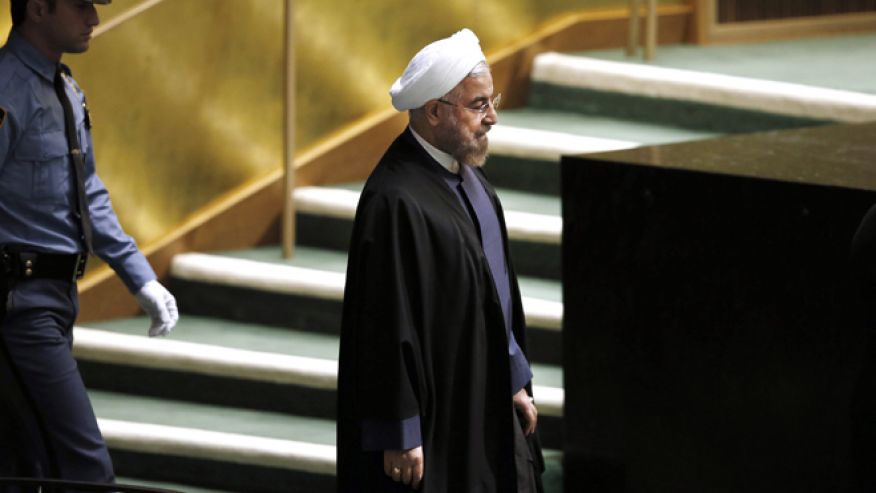
UN General Assembly_Rouhani_AP_660In this Thursday, Sept. 25, 2014 photo, President Hassan Rouhani of Iran walks in before addressing the 69th session of the United Nations General Assembly at U.N. headquarters. (AP)

Iranian President Hassan Rouhani on Thursday sought to leverage the crisis in the Middle East to ease sanctions on his country as part of nuclear talks, suggesting during a United Nations address that security cooperation between Iran and other nations could only occur if they struck a favorable nuclear deal.

The Iranian president, meanwhile, sought to lay the blame for raging violence in the Middle East at the feet of western nations. He strongly condemned terrorism and described it as a serious threat, but also said the West’s “blunders” in the region have created a “haven for terrorists and extremists.” He alleged that attempts to “export” democracy have created “weak and vulnerable governments.”

While focusing in large part on violent extremists in the region, Rouhani made clear Iran’s cooperation in addressing these threats hinges on the outcome of ongoing nuclear talks – as he once again urged other nations to drop what he described as “excessive demands.”

Rouhani said a deal could mark the “beginning of multilateral cooperation” and allow for “greater focus on some very important regional issues such as combating violence and extremism.”

But, he said: “The people of Iran who have been subjected to pressures … as a result of continued sanctions cannot place trust in any security cooperation between their governments with those who have imposed sanctions.”

Whether Iran’s cooperation in addressing Middle East unrest will serve as an effective bargaining chip remains to be seen.

The U.S. publicly has said it will not cooperate militarily or share intelligence with Iran to address the Islamic State threat.

Yet Secretary of State John Kerry said this week he was “open to have a conversation at some point in time if there’s a way to find something constructive.” And the U.S. reportedly notified Iran in advance of plans to strike inside Syria.

In his address to world leaders late Wednesday, British Prime Minister David Cameron also said Iran could help in defeating the terror group’s threat. Cameron spoke hours after meeting in person with Rouhani, the first meeting between the British and Iranian leaders since the Iranian revolution in 1979.

The world leaders spoke as the U.S., Iran and other nations resume nuclear talks after a two-month hiatus.

They are running up against a Nov. 24 deadline to reach a comprehensive agreement to curb Iran’s nuclear activities in exchange for easing sanctions.

Tehran, though, is resisting U.S. calls that it gut a nuclear program that enriches uranium, a process that can make both reactor fuel and the fissile core of a nuclear warhead. GOP lawmakers have also warned that the Obama administration may be willing to give too much ground to Iran in pursuit of an agreement.

Failure to seal a deal could see a return to confrontation, including U.S. and Israeli threats of military means as a last resort to slow Iran’s nuclear program.

“My message to Iran’s leaders and people is simple: Do not let this opportunity pass,” President Obama said Wednesday in his own address to world leaders.

The disagreement has complicated efforts to regarding the Islamic State menace.

In comments on the eve of his own General Assembly speech, Rouhani suggested his country was ready to join Washington and others in opposing the Islamic State. But he said the U.S. needed to move beyond “insignificant” fears that his country seeks nuclear arms.

At the same time, he was critical of the U.S. bombing campaign of Islamic State group strongholds and the growing coalition of countries seeking to stop the extremists by military means. “Bombing and airstrikes are not the appropriate way,” Rouhani said, warning that “extraterritorial interference … in fact only feeds and strengthens terrorism.”

There are other issues. American officials are furious with Iran for detaining Jason Rezarian, a Washington Post journalist who has both American and Iranian citizenship, as well as his wife.

Iranian officials have not specifically said why the couple is being held, and Rouhani has dodged questions about their fate. Asked again Wednesday about Rezarian, he said he would be freed if he is innocent of any crime.

Syrian Brotherhood Stands Nearer to ISIS Than to U.S. :: The Investigative Project on Terrorism

September 25, 2014

Syrian Brotherhood Stands Nearer to ISIS Than to U.S.

by Ravi Kumar

IPT News  September 16, 2014

via Syrian Brotherhood Stands Nearer to ISIS Than to U.S. :: The Investigative Project on Terrorism.

While the United States tries to build a coalition of Arab allies to join the fight against the terrorist group ISIS, now known as the Islamic State, one group which stands to benefit directly is coming out against Western intervention and expressing unity with other radical jihadists.

A Syrian Muslim Brotherhood spokesman says attacks on the Islamic State by the United States and its allies are not the answer.

“Our battle with ISIS is an intellectual battle,” Omar Mushaweh said in a statement published Sept. 9 on the Syrian Brotherhood’s official website, “and we wish that some of its members get back to their sanity, we really distinguish between those in ISIS who are lured and brainwashed and they might go back to the path of righteous, and between those who has foreign agendas and try to pervert the way of the [Syrian] revolution.”

Rather, the first target for any Western intervention should be dictator Bashar al-Assad’s regime, Mushaweh asserts, according to a translation of his comments by the Investigative Project on Terrorism.

Such comments should reinforce Western concerns about the Syrian Brotherhood, whose members are prominent among the Free Syrian Army (FSA), one of the supposedly moderate factions in the Syrian civil war which receive U.S. training and weapons. And it shows the challenge of finding truly moderate allies on the ground in Syria. Compared to ISIS, the FSA might be considered moderate. Then again, ISIS was so ruthlessly violent that al-Qaida disavowed the group in February.

In addition, the Syrian Brotherhood openly mourned the death last week of a commander in Ahrar Al Asham, a Syrian faction with ties to al-Qaida.

Mushaweh’s views about the U.S. intervention are shared by other Brotherhood members. Another Brotherhood leader, Zuher Salem, minimized the ISIS threat by comparing current American rhetoric to that which preceded the 2003 Iraq invasion.

“All of these tales that are being told by America about the primitive, terrorist and threatening nature of the Islamic State are similar to the tales that have been told in regard to the Weapons of Mass Destruction in Iraq, and about the crimes against humanity,” Salem wrote in an article published Sept. 13 by the Arab East Center, a think tank associated with the Muslim Brotherhood. “It is trifling to race with others to condemn terrorism and the killing of the American journalist, because we should be aware the aim of this anti ISIS coalition is to pave the way for an Iranian hegemony over the region.”

Yusuf Al Qaradawi, an influential Brotherhood cleric living in Qatar, joined in criticizing the American military campaign against ISIS. “I totally disagree with [ISIS] ideology and means,” he wrote on Twitter, “but I don’t at all accept that the one to fight it is America, which does not act in the name of Islam but rather in its own interests, even if blood is shed.”

While both are Sunni Muslim movements, each seeking to establish a global Islamic Caliphate, ISIS views the Brotherhood as too passive, while the Brotherhood sees ISIS as being unnecessarily violent in pursuing its aims.

The two have common enemies, however, including the ruling regimes of Saudi Arabia, Egypt, United Arab Emirates, and Jordan, which have worked to cripple the Brotherhood, and which ISIS considers infidel regimes which should be toppled in pursuit of a broader Islamic Caliphate.

In another indication the Syrian Brotherhood is no moderating force, it issued a statement on its website Sept. 10 mourning the killing of Ahrar Al Asham leader Hassan Aboud in a suicide bombing.

“Syria has given a  constellation of the best of its sons, and the bravest leaders of the Islamic front and Ahrar Al Sham,” the head of the Brotherhood’s political bureau, Hassan Al Hashimi, said in the statement translated by the IPT. “We consider them Martyrs.”

Ahrar Al Sham is a radical group co-founded by Abu Khaled al-Suri, who was al-Qaida chief Ayman al-Zawahiri’s designated representative in Syria. Al-Suri was killed in February in a suicide bombing believed to be carried out by ISIS.

Aboud made clear his ideological links to al-Qaida clear in a July 2013 Twitter post. “May God have mercy on the Mujahid Sheikh Abdullah Azzam. He was a scholar of Jihad and the morality.” Azzam was considered a mentor to Osama bin Laden, and pushed conspiracy theories involving Jewish and Christian plots against Islam.

The Brotherhood official mourning Aboud, Al Hashimi, has visited the United States a couple of times since the Syrian civil war started.


He spoke at the controversial Dar al-Hijrah mosque in northern Virginia on Nov. 17, 2013, as part of a program organized by the Syrian Emergency Task Force (SETF). The SETF has worked closely with Muslim Brotherhood members and some of its officials have expressed anti-Semitic statements and solidarity with Hamas.

Still, the SETF has partnered with the State Department to implement training projects in Syria. Last December, the SETF’s executive director endorsed working with a coalition of Syrian opposition groups called the Islamic Front, even though several entities involved, including Ahrar Al-Sham, had fought with ISIS and the radical Jabhat al-Nusra, or al-Nusra Front. Four Islamic Front affiliates also endorsed a declaration calling for “the rule of sharia and making it the sole source of legislation” in a post-Assad Syria.

The announcement of the event was distributed to the Dar Al Hijrah mailing list, but without mentioning that Al Hashimi is the head of the political bureau of the Muslim Brotherhood.

ISIS Fight: Mariam Al Mansouri Is First Woman Fighter Pilot for U.A.E.Pic of The Day

September 25, 2014

ISIS Fight: Mariam Al Mansouri Is First Woman Fighter Pilot for U.A.E.
BY ERIN MCCLAM September 25, 2014 Via NBC


(Silly me…and I thought women were not allowed to drive cars-LS)

The first female fighter pilot for the United Arab Emirates led the mission when that country joined the United States and other allies in airstrikes against ISIS over Syria earlier this week.

Maj. Mariam Al Mansouri graduated flight school in 2007 and was one of the first three to join the Emirati air force when it admitted women. She flew an F-16 Desert Falcon on Monday night.

“She is a fully qualified, highly trained, combat-ready pilot, and she led the mission,” Yousef Al Otaiba, the Emirati ambassador to the United States, said Thursday on MSNBC’s “Morning Joe.”

“Actually, funny story is, the U.S. tanker pilots called in for air refueling and asked for the UAE mission, and when they heard a female voice on the other side, they actually paused for about 20 seconds, radio silence,” he said.

Mansouri, 35, was born in Abu Dhabi and graduated college with a degree in English literature. She told the magazine Deraa Al Watan earlier this year that her love of country and a passion for challenge and competition drew her to aviation.

But she said that she never focused on competing with male pilots: “Competing with oneself,” she told the magazine, “is conducive to continued learning.”

Mansouri served in the Army before enrolling in flight training. She told The National, an English-language Emirati news outlet, in 2008: “A woman’s passion about something will lead her to achieving what she aspires, and that’s why she should pursue her interests.”

“Being in the air force is a responsibility,” she said. “I feel proud, especially that I am part of the first batch. And that encourages me to continue in this field.”

Earlier this year, the Emirati government presented Mansouri the Pride of the Emirates medal for excellence in her field.

The Emirates were among five Arab allies that joined the United States in the first round of airstrikes in Syria to beat back ISIS forces. They were the first to confirm their participation.

Otaiba, the ambassador, told MSNBC that it was imperative for moderate Arab and Muslim countries to step up and say: “This is a threat against us.”

He said the fight comes down to: “Do you want a model or a society that allows women to become ministers in government, female fighter pilots, business executives, artists — or do you want a society where, if a woman doesn’t cover up in public, she’s beaten or she’s lashed or she’s raped. I mean this is ultimately what this breaks down to.”

General Assembly 2014: Obama U.N. Speech

September 25, 2014

General Assembly 2014: Obama U.N. Speech [FULL] Today | The New York Times – YouTube.

I say we give his change of attitude, as evinced by his UN speech the benefit of the doubt.

We all know he allowed this situation to develop.

It would appear he now recognizes that himself.

As late and as hesitant as it is, his stand against Islamic extremism is the ONLY one in this cowardly and self -interested world “community.”

Three cheers for Obama !

Thank God for the United States of America !

– JW

Who Are Khorasan? The Al-Qaeda Leaders Who May Tie Iran To 9/11, that’s who!

September 25, 2014

WHO ARE KHORASAN? THE AL-QAEDA LEADERS WHO MAY TIE IRAN TO 9/11
by JORDAN SCHACHTEL 24 Sep 2014 Via Breitbart


(Iran…the snake in the woodpile.-LS)

Is Muhsin al-Fadhli, the Khorasan leader with a $7 million dollar price tag on his head, ultimately responsible for successfully soliciting Iran’s alleged cooperation in the al-Qaeda attacks against the United States on 9/11/01?

Prior to the United States’ Tuesday strike on al-Qaeda sub group Khorasan, American officials warned that the terror outfit, which has been given safe haven in Syria by the AQ-affiliated Nusra Front, has become as severe a threat to U.S. interests as the Islamic State.

Last week, U.S. Director of National Intelligence James Clapper said bluntly, “In terms of threat to the homeland, Khorasan may pose as much of a danger as the Islamic State.”

In 2012, the U.S. State Department announced a reward of $7 million dollars for information leading to the location of Muhsin al-Fadhli, who is recognized as the leader of the al-Qaeda sub group Khorasan. At the time, Fadhli was believed to be a chief operative of al-Qaeda in Iran, a terror entity largely given a free pass by Tehran to operate in their country.

Khorasan, however, is a relatively unconventional Sunni terror group because they have reportedly sought cooperation with the Iranian regime. The Islamic State, on the other hand, describes Shia Muslims as Rafida, or apostates, who reject true Islam.

In 2013, an intelligence assessment stated that Khorasan leader al-Fadhli “now plays a key role in advancing plans for attacks by al-Qaeda from Syria, in accordance with Iran’s interests.” Fadhli, who was once a trusted associate of deceased AQ leader Osama bin Laden, and is now reportedly a close confidant of AQ leader Ayman al-Zawahiri, was one of the few AQ members who was given advance notice of the 9/11 attacks, according to the State Department.

Many, including former U.S. President George W. Bush have noted the substantial ties between AQ and the Ayatollah’s regime in Tehran. Additionally, multiple members of President Bush’s 9/11 Commission filed affidavits determining that Iran’s direct cooperation with the AQ hijackers “constituted … direct support for al-Qaeda’s 9/11 attacks.”

Middle East expert Kenneth Timmerman documented the substantial connections between al-Qaeda’s 9/11 jihadis and the government of Iran. He wrote, “Secret intelligence reports detailed the travels of about 10 of the hijackers into Iran and back and forth into Afghanistan from October 2000 through February 2001, where they were whisked through border controls without ever getting their passports stamped.”

In May, The Long War Journal’s Thomas Joscelyn described al-Fadhli as a member of al-Qaeda’s “core,” the group directly responsible for the September 11 attacks. Additionally, in January, Joscelyn documented how Iran continues to let senior AQ operatives, including al-Fadhli, roam their country free of worry.

Will Khorasan and Muhsin al-Fadhli, as al-Qaeda’s premier bridge to Iran, end up refocusing the international spotlight on the atrocities committed by the Ayatollah’s regime in Tehran?