Archive for September 2014

The Big Picture: ISIS in Context

September 4, 2014

The Big Picture: ISIS in Context, Front Page Magazine, September 4, 2014

(Please see also Jihad Comes To Europe. — DM)
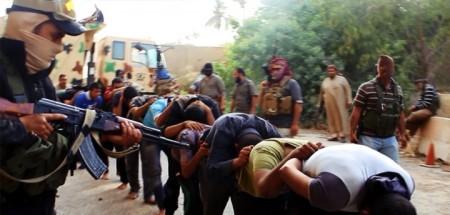
isis-iraq-450x215

Whether or not Obama is a secret Islamist (as claimed by another Egyptian newspaper) is almost beside the point. Judged by his policies, he might as well be. And long before its romance with the Egyptian Muslim Brotherhood, the current administration had shown a distinct favoritism toward Muslim Brotherhood offshoot organizations such as ISNA and CAIR. So also did the Bush administration. As I wrote two years ago:

In Europe, the rise of Islam has been a slow, incremental process—the result of decades of immigration combined with high birthrates for Muslims and low birthrates for indigenous Europeans. In America, Muslim strategists may have found a way to shortcut the long process.

Thus far, stealth jihad has met with relatively little resistance in America. That’s not to say that we should ignore armed jihad. Pakistan has nuclear weapons, Iran is acquiring them, and Turkey has the eighth largest army in the world. ISIS, Hezbollah, and Hamas have well-equipped fighting forces and all are capable of carrying out terrorist operations far from their home bases. And the United States? The U.S. plans to shrink its Army to pre-World War II levels. One other factor to be considered when assessing the big picture is that the U.S. is drastically reducing the size and strength of its military. Just at the point when the rest of the world is arming to the teeth, the American solons think it’s safe to bid a farewell to arms.

**********

It’s hard to keep up with the news about Islam. One week, the focus is on Boko Haram, then it shifts to Hamas, and then to ISIS.

Every once in a while, it helps to step back and take a look at the big picture—that is, the big picture in regard to the Islamic resurgence. Not that there aren’t other big threats on the horizon—such as Russia, China, and North Korea—but let’s confine ourselves here to the Islamic threat.

That threat comes in two forms: armed jihad and stealth jihad. Since armed jihad is more conspicuous, it gets most of our attention. It’s difficult not to notice the activities of Boko Haram in Nigeria or ISIS in Iraq, or the major terror attacks that occur once every year or so—the bombing of the World Trade Center and the Pentagon, the London bus and subway attack, the bombing of commuter trains in Madrid and Mumbai, and the mall massacre in Nairobi. In the back of our minds, we also know that Pakistan has nuclear weapons and that Iran will soon acquire them (although some American bishops assure us that Iran has no such intention).

The balance of military power still favors the West—although it’s no longer clear whether Turkey, which has the second largest military in NATO, will come down on the side of the West or on the side of the Islamists. But military power can be offset by asymmetrical warfare—in other words, the type of warfare that terrorists favor. A small team of terrorists can incinerate the World Trade Center or paralyze Madrid or Mumbai, and there’s not much that F-16s or nuclear submarines can do about it.

Which is where that other form of jihad comes in. Stealth jihad, which, as the name implies, is the less noticeable type, can create a base for armed jihadists to ply their trade. Stealth jihad, in essence, is an attempt to turn a culture in an Islamic direction by infiltrating and influencing key institutions such as schools, courts, churches, media, government, and the entertainment industry. The “Trojan Horse” plot for taking over 10 schools in Birmingham, England is one example of stealth jihad; the national security establishment’s purging of training materials that cast a critical eye on Islam is another.

But, in order to do the long march through the institutions, you have to have enough bodies to do the marching. Thus, many critics look upon Muslim immigration into non-Muslim societies as a form of stealth jihad. For example, in their book Modern-Day Trojan Horse: The Islamic Doctrine of Immigration, Sam Solomon and Elias Al-Maqdisi describe Muslim immigration as, well, a “modern-day Trojan Horse.” They’re not saying that every single Muslim immigrant wants to subvert your local school, but rather that mass migration and Islamic conquest have been linked ever since Muhammad and his followers migrated from Mecca to Medina and commenced the takeover of Arabia.

Many places in Europe have changed almost beyond recognition due to the combination of mass immigration and high Muslim birth rates. And the political makeup of Europe is also changing. Since Muslims in Europe and the UK tend to vote as a bloc, politicians have begun catering to them, thus magnifying their influence. It’s widely thought, for instance, that the victory margin for French President Francois Hollande—a strong proponent of Muslim immigration—was provided by Muslim voters.

It used to be that anyone who talked about the Islamization of Europe was dismissed as an “alarmist.” But plenty of Europeans are talking about it now– including European Muslims who proudly march with signs proclaiming their intention to dominate Europe. Social-network researchers at Rensselaer Polytechnic Institute have concluded that “when just 10 percent of the population holds an unshakeable belief, their belief will always be adopted by the majority of the society.” France is already over 10 percent Muslim, and the majority of Frenchmen, like most Europeans, don’t seem to have any strong convictions about anything outside of an unshakeable belief in long vacations and early retirement.

In significant ways, stealth jihad paves the way for armed jihad. In its early stages, it can create localized environments where homegrown jihadists can grow and flourish. In its later stages? The ultimate aim of stealth jihad is to put the reins of power in the hands of Muslims. What if, as seems increasingly likely, France and England concede more and more political power to Islamists? Both countries are nuclear powers with advanced delivery systems. Given the rapid rate at which the old order of things is being turned upside down, it is not inconceivable that these weapons could someday fall into the hands of Islamic radicals.

As for the Muslim nations—those with nukes and those without—they too are rapidly changing. The reason that the West was so unprepared for the reappearance of traditional Islam as a world force is that, up until relatively recent times, most of the major Muslim nations were under the control of secular-minded strongmen who made a point of suppressing the full expression of Islam. The 1979 Iranian Revolution changed all that, and most of the Westernized secular strongmen were replaced over time by leaders who felt they need answer only to Allah. For example, Turkey, which for years was touted by Westerners as a model moderate Muslim society, is now run by a rabidly anti-Semitic, Muslim Brotherhood true believer who seems intent on making Turkey the world’s foremost Islamic power—as it was as recently as one hundred short years ago.

Where does this leave the United States? Most Americans, I would venture to guess, are of the opinion that it can’t happen here. While many are now willing to admit that jihadists can once again damage America through terrorist attacks, few can imagine the possibility of an Islamicized America.

Yet Islamization is occurring in Europe, and many of the same conditions that make it possible there make it possible here, as well. Stealth jihad is already a fact in America. Its influence can be seen in textbooks and on college campuses, in the media, and even in the movies. Moreover, there are numerous American activist groups—offshoots of the Muslim Brotherhood—which are dedicated to stealth jihad. Although disguised as civil rights groups, these organizations would like nothing better than to see sharia become the law of the land. And their own litigators are as adept at lawfare as ISIS is at warfare.

Surprisingly, they meet with little resistance. That lack of pushback can be explained by considering one other factor in the overall mix—political correctness. Political correctness greases the skids for stealth jihad. It’s the “open sesame” password that allows the stealth jihadists in America to go just about anywhere they please. Right now, most Americans are more afraid of violating the rules of PC than they are of another 9/11 occurrence. They’re afraid, in other words, of being thought bigoted, racist, or—God forbid—Islamophobic. There’s little resistance to stealth jihad in America, because the few that do resist are reliably cast by the PC enforcers as anti-Muslim haters. Most people don’t want that to happen to them. So they don’t make a fuss when Muslims make demands. They go along to get along. As just one tiny example among hundreds of others, consider the recent story about a bistro in Winooski, Vermont, that removed a window sign advertising their delicious bacon because a Muslim woman claimed it was offensive.

That’s a fairly minor concession, but your nation’s really in trouble when Muslims complain about “insensitive” training materials used by the Department of Defense and the FBI, and the Department of Justice immediately complies by ordering a purge of all training manuals in all security agencies that contain even a hint of a link between terrorism and Islam. On the other hand, when five Congressmen complained that they had good evidence of Muslim Brotherhood penetration of the State Department and other government agencies, they were treated to a resounding rebuke by fellow legislators for having offended the Muslim community. Who needs ISIS when ISNA (the Islamic Society of North America) is allowed to vet military training manuals, or when Congress members who complain about such things risk being sent off to sensitivity training camp?

But wait a minute, you may be tempted to say, Europe’s slow-motion surrender can’t happen here because Europe’s birth rate imbalance and Muslim immigration problem don’t exist here. That’s true enough, but there is one other factor to consider—conversions. Right now, conversions to Islam by U.S. citizens remain on the low side. But remember that Muhammad also had a conversion problem. For the first twelve years of his ministry, he never had more than 100 followers. Then he moved to Medina, started raiding and looting, and the numbers kicked in. There seems to be a tipping point in the affairs of men which can result in a dramatic acceleration of conversions. Once a movement starts looking like the coming thing, more people will contemplate jumping on board.

We may be at one of those tipping points now. For the middle-aged and arthritic, it’s difficult to understand why thousands of recruits from all over the Western world are signing up with ISIS. But ISIS and similar groups do have a certain “cool” appeal to those of fighting age. Some Western analysts mistakenly believe that contact with Western pop culture will have a de-radicalizing effect on potential jihadists. But that’s not necessarily the case. Recall that Muhammad Atta and his crew partied it up at bars and strip clubs in the weeks before 9/11. Or consider that a British rapper is the main suspect in the Islamic State’s beheading of American journalist James Foley. It seems that the Islamic encounter with pop culture may turn out to be a case of “they came, they saw, they co-opted.” That’s because much of pop culture is already halfway there.

To youngsters brought up on gruesome video games and gangsta rap, YouTube videos of severed heads aren’t appalling, they’re “awesome.” Graduates of relativist pop culture don’t think in terms of right and wrong, they think in terms of cool and uncool. ISIS types are also very savvy exploiters of social media. “Like #ISIS in #Iraq” has become a popular hashtag. And the Daily Mail reports that “ISIS militants and their supporters are using social media to encourage protestors in Ferguson [Missouri] to embrace radical Islam and fight against the U.S. government.” Why should black Americans embrace Islam? Well, because “Racism and discrimination are rampant” in America and “In Islam there is no racism.” If the militants ever decide to hang up their bomb belts, they can always find work on Madison Avenue.

There is another disturbing possibility that needs to be taken into account when assessing the Islamic threat to America. In a recent column, former U.S. representative and retired lieutenant colonel Allen West stated that Barack Obama “is an Islamist in his foreign policy perspectives and supports their cause.” West isn’t saying that Obama was born in Mombasa or that he wears a secret Muslim decoder ring, but that his policies suggest a deep sympathy with Islamist causes. West provides a list of particulars, including this eye-catching item: “The Obama administration has lifted longtime restrictions on Libyans attending flight schools in the United States and training here in nuclear science.” To which the obvious reply is “What could possibly go wrong?”

Here are two other items on West’s list:

  • Returning sanction money, to the tune of billions of dollars, back to the theocratic regime led by Iran’s ayatollahs and allowing them to march on towards nuclear capability
  • Providing weapons of support to the Muslim Brotherhood-led Egyptian government—F-16s and M1A1 Abrams tanks—but not to the Egyptian government after the Islamist group has been removed.

The second item also troubled Michele Bachmann and four other House members when they asked for an investigation two years ago into possible Muslim Brotherhood infiltration of the government. They expressed concernthat the Department of State had “taken actions recently that have been enormously favorable to the Muslim Brotherhood and its interests.”

If not many Americans have taken notice of the administration’s Muslim Brotherhood bias, the Egyptians have. When then-Secretary of State Hillary Clinton visited Alexandria in July of 2012, her motorcade was pelted by tomato-throwing protestors who charged that Washington had helped the Muslim Brotherhood come to power. A year later, after the overthrow of the Brotherhood, demonstrators at a huge rally in Cairo roundly criticized Obama and U.S. Ambassador to Egypt Anne Patterson. A typical poster read: “Obama, stop supporting the Muslim Brotherhood fascist regime.” In December 2012, an Egyptian magazine, Rose El-Youssef, claimed that six American Islamic activists working within the Obama administration were Muslim Brotherhood operatives. And this past week, it was revealed that the Egyptians had teamed up with the United Arab Emirates to bomb Islamist forces in Libya, but purposely neglected to tell the Obama administration of their plans. It doesn’t take a mind-reader to guess why. They obviously feared that the Americans might leak the operation to the enemy. The point is that Obama’s consistent pro-Muslim Brotherhood policies reveals a lot more about his sympathies than his occasional don’t-slander-the-Prophet type remarks.

Whether or not Obama is a secret Islamist (as claimed by another Egyptian newspaper) is almost beside the point. Judged by his policies, he might as well be. And long before its romance with the Egyptian Muslim Brotherhood, the current administration had shown a distinct favoritism toward Muslim Brotherhood offshoot organizations such as ISNA and CAIR. So also did the Bush administration. As I wrote two years ago:

In Europe, the rise of Islam has been a slow, incremental process—the result of decades of immigration combined with high birthrates for Muslims and low birthrates for indigenous Europeans. In America, Muslim strategists may have found a way to shortcut the long process.

Thus far, stealth jihad has met with relatively little resistance in America. That’s not to say that we should ignore armed jihad. Pakistan has nuclear weapons, Iran is acquiring them, and Turkey has the eighth largest army in the world. ISIS, Hezbollah, and Hamas have well-equipped fighting forces and all are capable of carrying out terrorist operations far from their home bases. And the United States? The U.S. plans to shrink its Army to pre-World War II levels. One other factor to be considered when assessing the big picture is that the U.S. is drastically reducing the size and strength of its military. Just at the point when the rest of the world is arming to the teeth, the American solons think it’s safe to bid a farewell to arms.

When you put together all the pieces of the big picture puzzle, it begins to look like a decidedly grim picture.

Watchdog demands Schabas quit UN Gaza inquiry over anti-Israel bias

September 4, 2014

Watchdog demands Schabas quit UN Gaza inquiry over anti-Israel bias
By Raphael Ahren September 4, 2014, 6:40 pm Via Times of Israel


William Schabas (screen capture: YouTube)
‘Unfair and unbalanced.’


(I remember visiting the UN as a young man on a business trip. It was my first time in NYC. Nearby were the World Trade Center towers, one complete and the other still under construction. What a sight for a small town guy like myself. Walking around the UN was easy in those days. So much so, I wondered into a secure area and got run off by the guards. I guess I was ‘thrown out’ in a sense. This was my first and only experience with the UN. – LS)

A watchdog group on Thursday filed a legal request demanding William Schabas step down as the head of a United Nations-established fact-finding mission into Israel’s recent violent conflict with Gaza terrorists, citing statements he made in the past that were critical of Israeli leaders and policies and supportive of Hamas, which the legal scholar two years ago termed a “a political party” representing the Palestinian people’s aspiration for statehood.

Schabas in 2012, for instance, expressed the wish to see Prime Minister Benjamin Netanyahu tried at the International Criminal Court, which clearly indicates that he is biased and thus unqualified to lead the investigation, UN Watch’s executive director Hillel Neuer said. “That statement alone is sufficient to disqualify Prof. Schabas on the question of whether he can impartially sit on this panel.”

Schabas voiced his opinions about Israeli policies vis-à-vis Gaza as recently as this summer, Neuer said. In one interview Schabas gave during the early days of Operation Protective Edge, he suggested Israel’s military response to fire emanating from Gaza was disproportionate and therefore could not be considered legitimate self-defense.

“We are filing the first formal legal request to Professor Schabas at the Human Rights Council, calling on him to recuse himself,” Neuer told Israeli journalists during a press conference in Jerusalem. In any situation where a judge or the head of a fact-finding mission has been proven to be biased, or even if there is merely “the appearance of bias, the individual is obliged to step down,” he said.

Schabas remaining in place and leading the fact-finding mission “would have a potentially deleterious impact on the international rule of law,” Neuer writes in the request.

UN Watch’s legal request for Schabas to step down has been submitted as an official written statement to the upcoming session of the UN Human Rights Council and is set to be placed on its agenda for the September 22 debate on Israel. It will be distributed to the session’s delegates as an official document.

During the press conference, Neuer quoted several statements that Schabas, a Canadian international law professor, has made in the past that appear to portray him as a fierce critic of Israel sympathetic to Hamas.

Some of Schabas’s past quotes about Israel and Israeli leaders have been reported widely in the Israeli and Jewish media – such as the desire to see Netanyahu indicted, or calling him “the single individual most likely to threaten the survival of Israel.” UN Watch’s 20-page text documents many other instances in which he either criticized Israel or called for Israeli leaders to be investigated for war crimes. In October 2012, for instance, he accused Jerusalem of “crimes against humanity, war crimes and the crime of aggression.”

Neuer also discovered an interview Schabas gave to the BBC on July 17, about a week after Israel launched Operation Protective Edge in response to incessant rocket fire from Gaza terrorist groups. Asked by the interviewer whether Israel’s actions could be seen as self-defense, given that Hamas rockets were fired at residential areas, Schabas replied that self-defense can only be used as a justification if it is “proportionate to the threat that’s being posed.” Since there are “huge numbers” of Palestinian civilian casualties but virtually none on the Israeli side, “prima facie, there is evidence of disproportionality in the response that Israel is undertaking in order to protect itself.”

With this interview, UN Watch argues in the legal brief, “Schabas effectively pronounced Israel presumptively guilty on the very question his commission in now called to investigate.”

During a legal symposium in 2012, the UN Watch document states, Schabas said Israel’s actions during the 2008-09 Operation Cast Lead were to be seen as “punitive actions” aimed at Gaza’s civilian population rather than self-defense. “If we look at the poor people of Gaza… all they want is a state — and they get punished for insisting upon this, and for supporting a political party in their own determination and their own assessment that seems to be representing that aspiration.”

In August, Schabas refused to say during an interview with Channel 2 whether he considers Hamas a terrorist organization, arguing that such an evaluation would prejudge the work of his fact-finding commission. But Schabas is no agnostic or neutral on the nature of Hamas, Neuer said. “Hamas, in Prof. Schabas’s view, very clearly is a legitimate political party that represents the aspirations of the Palestinian people for statehood. He does not talk about the war crimes committed by Hamas or the daily genocidal anti-Semitism.”

EU:s new FM, Federica Mogherinis PhD thesis were on political Islam.

September 4, 2014

A portrait of Federica Mogherini, the EU’s next foreign policy chief

Critics claim she lacks high-level experience, but Italy’s foreign minister is not lacking in knowledge and self-assurance

Federica Mogherini

Federica Mogherini: ‘her strong points are not to be underestimated’. Photograph: Alain Jocard/AFP/Getty Images

In late November 2012, while Matteo Renzi was making an ill-fated bid for leadership of the Italian centre-left, a young MP from his Democratic Party (PD) piped up on Twitter to remark: “OK, Renzi has quite a lot to learn about foreign policy … He won’t make the pass mark, I fear #thirdgrade.” When he won the PD primaries the following winter, Renzi – canny as ever – hired his sharp-tongued critic as the party’s spokesperson on Europe and international affairs. Once prime minister, he ushered her into the top job at Italy‘s foreign office.

Now, the shoe is firmly on the other foot: it is Federica Mogherini – on her way to Brussels to become Cathy Ashton’s successor in the EU – who, according to her critics, has a lot to learn. And the jury is out on whether the 41-year-old Roman- who has six months’ experience in government as foreign minister, no more and no less – will make the grade. Le Monde, the French daily, last week said her appointment would be “a sad day for Europe”.

To Brussels box-tickers, Mogherini, as a woman and a social democrat, meets two of the chief criteria for the job. But her critics believe she lacks the proper credentials for a role that has always struggled to be as grand in practice as it is on paper. More than a decade younger than Ashton was when she started in 2009, the Italian had her first taste of executive power in late February, when she replaced the highly experienced Emma Bonino, a former European commissioner, in the Farnesina.

In Rome, she was viewed as the archetypal Renzi government minister: fresh-faced, vigorous and, it was hoped, effective. In Brussels, when her name started circulating as a potential new high representative several months later, it was inextricably linked with the suddenly risen star of Italy and the PD, boosted on the international stage by a landslide European election victory in which Renzi emerged as a powerful new force on the centre-left.

Despite her charismatic champion, Mogherini, to many, still lacked clout. But others say that, while her relative youth and lack of high-level experience are undeniable, she has other strengths that could yet see her thrive. “I believe her strong points are not to be underestimated,” said Ettore Greco, director of the Institute for International Affairs in Rome. “She knows how to work hard, how to work in a team; and she has always conducted herself with, I’d say, great composure … I can see her as a mediator. And then there’s her experience, her contacts built up gradually during years of work at relatively high levels … Ever since the start of her political career, she has worked on foreign policy. She is not a political neophyte.”

Born in the Italian capital in 1973, the daughter of a set designer who worked with some of the giants of Italian postwar cinema, Mogherini graduated with a degree in political science from La Sapienza university. Her thesis was on political Islam.

An active member of the Democrats of the Left (DS), a social democratic party containing many former Communists, she soon got noticed, and specialised in foreign affairs, working particularly on ties with the US Democrat party. In 2008, the year after the DS merged with others into the centre-left PD, she was elected as an MP for the first time. In February, aged 40, she became the youngest foreign minister in the history of the Italian republic.

Since her arrival on the national and international stage in February, Mogherini has quietly impressed many with her knowledge and self-assurance, demonstrating, too, that not all Italians’ English is as comic as the premier’s. (Hers is near perfect; she also has fluent French and, according to her online biography, a little Spanish.) She keeps an impressive pace of international visits, all of which she details on her website, BlogMog.it, in the manner, sniped the Berlusconi family newspaper, Il Giornale, of “a teenager confiding” in the pages of her journal.

But these haven’t all gone smoothly. She raised eyebrows in a July dominated by concerns over Russia’s stance on Ukraine, when she visited Kiev and Moscow and invited Vladimir Putin to an economics summit in Milan in October. Soon after, a group of eastern European countries united to try to block her candidacy for the high representative job, which they said was unacceptable due to Rome’s approach to Moscow.

“But I think when she was doing that, she was probably just following her brief from the [Italian] machine,” said a diplomatic source. “This is a question of differences over the tactical and possibly even strategic attitude towards Russia which is Italy’s rather than hers.” Greco said: “On the European stage, she will of course have to take into account a quite different mood and quite different climate where Moscow is concerned and she should not be – one would hope – conditioned by these Italian reflexes.”

On the BlogMog, Mogherini, a married mother of two, says that, as well as reading crime novels and spending time with her family, her big passion is travel: “Anywhere, anytime, and anyhow.” (The Farnesina said she flies economy class “whenever possible”.) Even if question marks remain over her experience and diplomatic clout, on the globe-trotting front, at least, she should be on safe ground.

Britain’s Lost Freedoms: “We’re Living in a Madhouse” — CBN News (US)

September 4, 2014

US to hold new nuclear talks with Iran in Geneva

September 4, 2014

US to hold new nuclear talks with Iran in Geneva – Israel News, Ynetnews.

Iranian FM Zarif meets with Italian counterpart, Federica Mogherini, soon to replace Catherine Ashton as EU foreign policy chief, saying Tehran looking forward to improving ties with Europe.

AFP

WASHINGTON – American and Iranian officials will resume negotiations in Geneva on Thursday and Friday as they seek to hammer out a full nuclear deal ahead of a November deadline, US officials said Wednesday.

“Deputy Secretary of State William J. Burns, Under Secretary for Political Affairs Wendy R. Sherman, and Senior Advisor Jacob J. Sullivan will meet with Iranian officials in Geneva on September 4-5,” the State Department said in a surprise late-night statement.

Global powers and Iran agreed in late July to extend a deadline to reach a comprehensive and complex deal on curbing Tehran’s nuclear ambitions until November 24.

Iranian Foreign Minister meets with Italian counterpart Federica Mogherini who will soon replace Catherine Ashton as EU foreign policy chief (Photo: EPA)


The negotiations being led by a group known as the P5+1 had been expected to resume on the sidelines of the UN General Assembly later this month in New York.

“These bilateral consultations will take place in the context of the P5+1 nuclear negotiations led by EU High Representative Catherine Ashton,” the State Department said in its announcement.

Earlier this week, Iranian Foreign Minister Mohammad Javad Zarif said he had “good discussions” with Ashton and Tehran was committed to an accord over its contested nuclear program.

Quoted by the Belga state news agency, Zarif said he was “fairly optimistic” after talks in Brussels on Monday with Ashton that Iran and the five permanent UN Security Council members – Britain, China, France, Russia and the United States – plus Germany could reach a deal by the November deadline.

The West suspects Iran wants to acquire nuclear weapons but Tehran insists the program is purely for peaceful purposes.

In exchange for accepting curbs on its nuclear activities, Iran wants a vast array of US, EU and UN sanctions to be lifted.

But any deal will have to be approved by the Islamic leadership in Tehran as well as by the US Congress, where many lawmakers are seeking to impose even greater sanctions on Iran.

Better prospects with Ashton’s successor

On Wednesday, Zarif said Iran was looking forward to improved relations with the European Union following the appointment of an Italian to be the bloc’s next foreign policy supremo.

Zarif’s comments came after talks with Federica Mogherini, the current Italian foreign minister who will shortly take over from Britain’s Catherine Ashton as the public face of EU relations with the rest of the world.

Zarif said the crisis in Iraq and Syria demonstrated that the EU and Iran need to work together to address common challenges.

Iranian Foreign Minister meets with Italian counterpart Federica Mogherini who will soon replace Catherine Ashton as EU foreign policy chief (Photo: EPA)

“The same challenges (Iran faces) are before the EU, both as international security and local and domestic security.

“The very sad fact a very large number of foreign fighters are now in Iraq and Syria brings this issue very close to home here in Europe.

“So I think we have common ground both in terms of opportunities for great cooperation, greater economic development, dialogue on human rights as well as cooperation to address these common challenges.

“This mixture… should provide us with a basis for better work together particularly with the role Italy has played as a bridge between Europe and the Islamic world. That role can be further enhanced by the role Mrs Mogherini will play as the High Representative of Europe.”

Mogherini’s first major goal in her new job will be to wrap up a deal with Iran on the Islamic state’s contested nuclear program. The Italian minister said her discussions with Zarif had left her hopeful that could be achieved.

“We have said that an agreement ought to be reached by November in order to guarantee greater stability in the region,” Mogherini said.

“It is my hope the negotiations will have a positive outcome and that this will be done by November 23, the agreed deadline.

“I was assured that there is a strong political will in Tehran for this to happen and we hope that there will also be the necessary technical steps taken.”

Mogherini said Italian officials had been in close discussions with their Iranian counterparts on how to bring stability to Iraq/Syria.

“We share a belief in the need to respond with a military presence in the emergency situation we are in but above all we believe in the need for an inclusive government in Baghdad,” Mogherini said.

Shurat HaDin to Bring Hamas to Hague for War Crimes Against its Own People

September 4, 2014

Shurat HaDin to Bring Hamas to Hague for War Crimes Against its Own People
By: Zeev Ben-Yechiel – Tazpit News Agency
Published: September 3rd, 2014


Israeli activist lawyer Nitzana Darshan-Leitner: The US should make Iran pay off its debts to American relatives of terror victims before easing sanctions.


(Just getting on the docket is half the battle.-LS)

An Israeli civil rights group, Shurat HaDin Israel Law Center, has filed a complaint in the International Criminal Court (ICC) in the Hague against Hamas leader Khaled Mashaal over the July-August murders of 38 Gazan civilians.

The motion by the Shurat Hadin Israel Law Center to bring Mashaal to the ICC was made possible by the fact that he is a citizen of Jordan, one of the ICC member states, and represents the first time that a Palestinian terrorist would be brought to the court on the basis of his Jordanian citizenship.

The complaint alleges that Hamas executed 20 Gazan civilians on July 28 for engaging in anti-Hamas protests, and publicly executed at least 18 civilians on August 22 for “collaboration” with Israel. The complaint further states that Mashaal “had knowledge of the executions, oversees Hamas’s governance of Gaza, and actively encourages and supports the executions.”

As a Jordanian citizen, the Hamas leader is subject to prosecution by the ICC because court is “empowered to exercise its jurisdiction over all acts committed by the citizen of a member, wherever those acts are committed,” explained attorney Nitsana Darshan-Leitner, the chairperson of Shurat Hadin.

In video footage broadcast around the world, Hamas spokesmen testified to the killings of at least 38 civilians in Gaza since the outbreak of this summer’s war with Israel. One of the videos shows Hamas executioners publicly announcing the verdict against some of the condemned civilians, who appear kneeling with cloth bags over their heads in a Gaza mosque. The executions brought widespread condemnation of Hamas from a number of human rights groups.

The Israeli legal group filed the complaint partly as a response to statements made last week by ICC Chief Prosecutor Fatou Bensouda, who said that the court has not “avoided opening an investigation into alleged war crimes in Gaza due to political pressure” and has only failed to do so due to a lack of jurisdiction. According to ICC protocols, either the claimant or defendant in a case must belong to an ICC member state, a status that neither Israel nor Gaza holds. By trying Mashaal as a Jordanian, the Israeli group hopes to force the court to convene on the case, as Bensouda indicated it would be willing to do.

Darshan-Leitner told Tazpit News Agency that if the case against Mashaal succeeds in going to court, the results would be significant for Israel. The Hamas leader would be arrested and put on trial, and as the attorney pointed out, “the punishment for war crimes is imprisonment for life. It’s a life sentence without parole.” She also noted that a successful trial would undermine the legitimacy of Hamas, who would be “recognized as committing war crimes against its own people.”

Asked about the prospects of the case going to trial, Darshan-Leitner said that she intends to “put public pressure on the court to deal with this issue.” She noted that the court has an incentive to take the case in order to avoid appearing hypocritical, since the chief ICC prosecutor herself wrote that the court is willing to deal with allegations against Hamas.

“Quite frankly,” she said, “I don’t see a way out for the court from dealing with this case. For the first time they have the jurisdiction to deal with Hamas war crimes in Gaza.”

More Mush from the wimp

September 4, 2014

More Mush from the wimp, Power LineSteven Hayward, September 3, 2014

Jimmy Carter was not available for comment.

**********

It sounded for a little while this morning as though Obama had woken up, maybe even had a bowl or two of Wheaties.  The headline comment from him was “The bottom line is this:  Our objective is clear and that is to degrade and destroy ISIL so it is no longer a threat.”

But ABC News noted that he’s spent the rest of the day backing away or qualifying this statement so as to make it virtually meaningless:

But when ABC News Radio White House correspondent Ann Compton today asked the president to clarify whether the United States now wants ISIS destroyed, the president seemed to significantly backtrack.

“Our objective is to make sure they aren’t an ongoing threat to the region,” he said.

Then, in response to another question, he seemed to backtrack even further:  “We know that if we are joined by the international community, we can continue to shrink ISIL’s sphere of influence, its effectiveness, its military capability to the point where it is a manageable problem.”

Making ISIS a “manageable problem” sounds like a far cry from destroying it.

Jimmy Carter was not available for comment.

Syria forces ranged for major counteroffensive to dislodge rebels from Quneitra. High tension on Golan

September 3, 2014

Syria forces ranged for major counteroffensive to dislodge rebels from Quneitra. High tension on Golan, DEBKAfile, September 3, 2014

Syrian_Tanks_Golan_3.9.14Syrian tanks roll into Golan

Israel’s Golan forces and population are in a state of preparedness. Tensions rose palpably Wednesday, when Syrian fighter-bombers flew over Quneitra and dropped Iranian-made barrel-bombs on rebel positions. They acted in defiance of Israel’s threat to send its air force against Syrian jets intruding in the Golan no-flight zone.

*************

The Syrian army was poised Wednesday, Sept. 3 for an all-out offensive in the coming hours to take out the rebels holding parts of the Golan town of Quneitra and the crossing into Israel, DEBKAfile’s military sources report. The concentration of Syrian troops at a staging point is clearly visible from Israeli military positions and villages on the Golan.

The assault force consists of a large number of troops from the Syrian army’s 7th Division with many tanks, which the Syrians have been wary hitherto of moving into the battle zone, after being cautioned by Israel via the UN that they would be infringing ceasefire agreements with Israel and risk incurring IDF counteraction.

However, high authority in Damascus appears to be counting on the revulsion and shock,  generated around the world by the beheading by ISIS of the American-Jewish journalist Steven Sotloff, deterring Israel from intervening against Syrian forces which are fighting another Al Qaeda offshoot, the Nusra Front.

All in all, say DEBKA’s sources, the decision to embark on a large-scale assault on rebel gains in the Golan means that military priorities have been reshuffled at the highest level of Syrian policy-making. After treating the Golan and Quneitra front as a strategic backwater hitherto, they suddenly occupy center stage in Damascus as a key arena for vanquishing rebel forces.

Israel’s Golan forces and population are in a state of preparedness. Tensions rose palpably Wednesday, when Syrian fighter-bombers flew over Quneitra and dropped Iranian-made barrel-bombs on rebel positions. They acted in defiance of Israel’s threat to send its air force against Syrian jets intruding in the Golan no-flight zone.

This threat followed the first Syria air strike over Quneitra on Aug. 28, against which Israel refrained from interfering. But Damascus was obviously not deterred from launching another air strike over the Golan to support its coming offensive.

Wednesday night, the Security Council called on all UN members who had any influence with Nusra al-Jabha to intercede for the release of the 44 UN Fijian observers the Islamist group is holding hostage since last week. The same resolution also ordered Nusra to immediately return the weapons and vehicles, some of them armored, they had seized from the UN Disengagement and Observer Force.

With the Syrian sword about to fall on their heads, it is doubtful that the Syrian Islamists will heed either of those calls.

What would Churchill say and do about World War Three?

September 3, 2014

What would Churchill say and do about World War Three? Dan Miller’s Blog, September 3, 2014

Winston Churchill was principally engaged in warning about, and later pursuing the defeat of, the Nazi threat to civilization. He also had much to say about the dangers of Islam. Today, the Islamic threat increases as multicultural voices assure us that Islam is not a threat and that Islamists merely seek peace and prosperity. The same was said many years ago of Nazi Germany.

Churchill

I closed a recent article with the rhetorical question, “What would Winston Churchill do?” and answered it as follows:

That’s an interesting question, helpful answers to which can be found in The Gathering Storm. Answers to the question are, unfortunately, not relevant because Churchill is dead and there is no one living who even approaches him in prescience, resolve and ability to do what needs to be done.

Churchill there spoke of Nazis. Would he now speak in similar ways about Islamists, as he did many years ago?

Might he be arrested for doing so?

Are we still the masters of our fate, as Churchill proclaimed us to be in 1942? Assuming that we are — a dubious assumption — how long will we remain so?

Churchill is dead. Does his spirit linger within us?

I very much hope, but doubt, that it does. Might it revive and persist?

The Gathering Storm offers some answers to my rhetorical question and they may be useful. Here are some from the early-mid 1930’s, after Hitler had gained control over the German Government. Page references are to a battered Bantam Books paperback edition I have long had and, fortuitously, to the Kindle version which has the same pagination but is easier to read.

Page 80, referring to 1933:

We must regard as deeply blameworthy before history the conduct not only of the British National and mainly Conservative Government, but of the Labour-Socialist and Liberal Parties, both in and out of office., during this fatal period. Delight in smooth-sounding platitudes, refusal to face unpleasant facts, desire for popularity and electoral success irrespective of the vital interests of the State, genuine love of peace and pathetic belief that love can be its sole foundation, obvious lack of intellectual vigour in both leaders of the British Coalition Government, marked ignorance of Europe and aversion from its problems in Mr. Baldwin, the strong and violent pacifism which at this time dominated the Labour-Socialist Party, the utter devotion of the Liberals to sentiment apart from reality, the failure and worse than failure of Mr. Lloyd George, the erstwhile great war-time leader, to address himself to the continuity of his work, the whole supported by overwhelming majorities in both Houses of Parliament: all of these constituted a picture of British fatuity and fecklessness which, though devoid of guile, was not devoid of guilt, and, though free from wickedness or evil design, played a definite part in the unleashing upon the world of horrors and miseries which, even so far as they have unfolded, are already beyond comparison in human experience. [Emphasis added.]

Soothing and pleasing (to some) platitudes abound today. According to a Washington Post opinion piece of September 2nd,

President Obama is not worried. And that is unnerving.

British Prime Minister David Cameron presented to Parliament on Monday the alarming conclusions of European leaders who had met in Brussels over the weekend: “The European Council believes the creation of an Islamic caliphate in Iraq and Syria and the Islamist extremism and export of terrorism on which it is based is a direct threat to every European country.”

Cameron added: “To confront the threat of Islamist extremism, we need a tough, intelligent, patient and comprehensive approach to defeat the terrorist threat at its source. We must use all the resources at our disposal, our aid, our diplomacy and our military.”

But three days earlier — the day Britain raised its terrorism threat level to “severe” — Obama delivered a very different message when he spoke to donors at a fundraiser in New York’s Westchester County. “Yes, the Middle East is challenging, but the truth is it’s been challenging for quite a while,” he said. “I promise you things are much less dangerous now than they were 20 years ago, 25 years ago or 30 years ago. This is not something that is comparable to the challenges we faced during the Cold War.” [Emphasis added.]

Speaking to another group of contributors that same day in Newport, R.I., the president said that the post-9/11 security apparatus “makes us in the here and now pretty safe” and that the threat from ISIS “doesn’t immediately threaten the homeland.”

I hope Obama’s chillax message turns out to be correct, but the happy talk is not reassuring. It’s probably true that the threat of domestic radicalization is greater in Europe than in the United States (hence the British plan to confiscate some passports) but Obama’s sanguinity is jarring compared with the mood of NATO allies Obama is meeting in Europe this week.

Obama has been giving Americans a pep talk, essentially counseling them not to let international turmoil get in the way of the domestic economic recovery. “The world has always been messy,” he said Friday. “In part, we’re just noticing now because of social media and our capacity to see in intimate detail the hardships that people are going through.” [Emphasis added.]

So we wouldn’t have fussed over Russia’s invasion of Ukraine if not for Facebook? Or worried about terrorists taking over much of Syria and Iraq if not for Twitter? This explanation, following Obama’s indiscreet admission Thursday that “we don’t have a strategy yet” for military action against the Islamic State, adds to the impression that Obama is disengaged.

In short, Americans would worry less if Obama worried more.

In his pep talk to the donors, Obama spoke optimistically about U.S. influence in the world. “The good news is that American leadership has never been more necessary,” he said, “and there’s really no competition out there for the ideas and the values that can create the sort of order that we need in this world.” [Emphasis added.]

Yes. And the necessity of American leadership — in Ukraine, Syria and elsewhere — is precisely why Obama needs to show more of it. [Emphasis added.]

Would Obama even know how to provide the necessary leadership? Would He lead competently and in the right directions?

Churchill had a dream. Does Obama” If so, what is it? Will His dream be a nightmare for western civilization?

It would be refreshing were a modern day Churchill to respond to Obama’s happy talk and question the nature of His dreams for Obama’s America.

Back to Churchill’s The Gathering Storm, at Page 91 referring to 1934:

In the course of June 1934 the Standing Committee of the Disarmament Conference at Geneva was adjourned indefinitely. On July 13 I said:

I am very glad that the Disarmament Conference is passing out of life into history. It is the greatest mistake to mix up disarmament with peace. When you have peace you will have disarmament. But there has been during these recent years a steady deterioration in the relations between different countries, a steady growth of ill-will, and a steady, indeed a rapid increase in armaments that has gone on through all these years in spite of the endless flow of oratory, of perorations, of well-meaning sentiments, of banquets, which have marked this  epoch. [Emphasis added.]

. . . .

This is not the only Germany which we shall live to see, but we have to consider that at present two or three men, in what may well be a desperate position, have the whole of that mighty country in their grip, have that wonderful, scientific, intelligent, docile, valiant people in their grip, a population of seventy millions; that there is no dynastic interest such as a monarchy brings as a restraint upon policy, because it looks long ahead and has much to lose; and that there is no public opinion except what is manufactured by those new and terrible engines–broadcasting and  a controlled Press. Politics in Germany are not as they are over here. There you do not leave office to join to Opposition. You do not leave the Front Bench to sit below the Gangway. You may well leave your high office at a quarter of an hour’s notice to drive to the police station, and you may be conducted thereafter very rapidly to an even graver ordeal.

It seems to me that men in that position might very easily be tempted to do what even a military dictatorship would not do, because a military dictatorship, with all its many faults, at any rate is one that is based on a very accurate study of the real facts; and there is more danger in this kind of dictatorship than there would be in a military dictatorship, because you have men who, to relieve themselves from the great peril which confronts them at home, might easily plunge into a foreign adventure of the most dangerous and catastrophic character to the whole world.

Again in 1934, at page 102, Churchill wrote:

Although Germany had not yet openly violated the clauses of the Treaty which forbade her a military air force, civil aviation and an immense development of gliding had now reached a point where they could very rapidly reinforce and extend the secret and illegal military air force already formed. The blunt denunciations of Communism and Bolshevism by Hitler had not prevented the clandestine sending by Germany of arms to Russia. On the other hand, from 1927 onwards a number of German pilots were trained by the Soviets for military purposes. There were fluctuations, but in 1932 the British Ambassador in Berlin reported that the Reichswehr had close technical liaison with the Red Army. Just as the Fascist Dictator of Italy had, almost from his accession to power, been the first to make a trade agreement with Soviet Russia, so now the relations between Nazi Germany and the vast Soviet State appeared to be unprejudiced by public ideological controversy.

Are a nuclear armed and Islamist Iran, along with its friends and allies, now less worrisome than Nazi Germany was during the 1930’s and 1940’s?

Obama’s happy talk is apparently intended to assure us that we face no problems which He will not face forcefully and effectively — but only if and when, if ever, He deems it necessary and convenient. He, and our acceptance of His happy talk, are symptoms of the disease that affects Obama’s America as well as Europe and even Britain.

Political theatrics

September 3, 2014

Political theatrics.

Ira Sharkansky

We’ve known for a long time that politics combines theater with serious business. How much of each can vary from place to place and within each place by circumstances?

Israeli pundits are having fun with recordings of Netanyahu’s hyperbolic promises and subsequent behavior. The prime minister has lost ground with the voters, but the same polls that show sharp decline in support for his conduct of the Gaza operation are showing that he is the only game in town. He has two or three times the percentage supporting him than other contenders for the big job.

Perhaps Israelis have learned to accept and discount Bibi’s bluster, to enjoy their decent level of existence, and to ignore the prime minister when he claims responsibility for all that is good.

Somewhat more frightening is the record of Bibi’s American equivalent. It’s hard to measure these things, but it appears from his public comments that the American leader is far removed from a realistic assessment of important things. What makes that more frightening than an Israeli’s bluster is the power of the United States to act or not, with results of great good or harm.

Obama’s record includes demanding, and perhaps expecting democracy and equality in the Muslim Middle East, discarding a moderate leader of Egypt while asserting that he was an extremist, seeing the mechanics of a third world election as more important than the essence of Islamic passions in the elevation of the Muslim Brotherhood to the control of an important Muslim country, and delivering three-quarters of an impassioned speech against Syria’s use of chemical weapons while the final quarter of the speech said that he would not do anything.

The most recent Obama wonderment is saying that the US does not have a strategy for dealing with Daish et al. He has sent his ponderous Secretary of State John Kerry on an international tour to gather support from a joint operation, largely among countries that have learned to distrust the Obama administration. Given the record, we can expect him to shuffle away from anything serious.

Historians and others will quarrel about the contribution of Obama’s Nobel-winning speech to Arab Spring, and its metamorphosis from hopes for democracy to the realities of barbarism.

Mainline Israeli commentators have been ridiculing the lack of judgment in the Obama administration, focusing on the obsessive concern for a formalized peace between Israelis and Palestinians when it should have been clear that neither were ready; seeing Qatar as an appropriate mediator between Israel and Hamas; and now dithering about what to do in response to the escalating ugliness of what is politely called Islamic extremism.

Competing with all of this in a continuing performance is the role of Palestinian Authority President Mahmoud Abbas. Staying in office five years after the end of his term exceeds the political comedies typical of the third world, where at least the semblance of election occurs as a device to claim legitimacy.

One wonders what is more worthy of cynicism: Abbas’s travels to meet the leaders of the world, kissing cheeks, reviewing honor guards, or proclaiming what it is doubtful he can deliver? His recent description of Khalid Marshal as a “peacock” after a meeting when each was claiming how much they could do for Gaza is worthy of some praise, but neither Abbas nor Mashal is likely to provide Palestinians more than individuals and families can acquire through their own hard work.

We should all learn something from the Palestinians. Politics is out there and cannot be avoided, but cynicism may be an essential component of mental health.

At the same time, we should not overlook the essential task of comparison. It’s a lot better on this side of the poorly defined borders with Palestine. When the Israeli government orders our children, grandchildren, or those of our friends into action, it is important to go along. We–and those younger folks risking a great deal more–will not get everything promised, but it would be a lot worse if we did not cooperate.

One must admit that judgement is difficult.

Iran is a case in point. Should we remain convinced that it is set to prepare nuclear weapons and the means to deliver them, see signs for hope in what some claim to be its compliance with international demands, take heart from the US reinstating certain sanctions, applaud Iran’s contribution to the military campaign against Daish in Iraq, or dismiss that as nothing more than Shi’ite mobilization against Sunni forces?

We should remember that politics is the most civilized way of settling disputes. Its essence is argument prior to voting, either by the masses in an election or by those who have acquired office and the responsibility to make policy.

Among the legitimate subjects of dispute are which candidate to select? what policy to support and has the incumbent screwed up enough to be thrown out of office?

Also to be remembered is that the cynic’s handbook for politics has no chapter on heroes. The authors may have searched for examples for such a chapter, but found none worthy.

It is not pleasant for Israelis to realize that we are on the borders of civilization, that many see us as part of the problem rather than part of the solution, and that the purported leader of the free world is wondering if a looming disaster is a problem worthy of action.