Archive for September 2014

Where Is Obama’s ‘Broad Coalition’?

September 21, 2014

Where Is Obama’s ‘Broad Coalition’? National Review Online, Victor Davis Hanson, September 18, 2014

The OnePresident Obama addresses servicemembers at MacDill Air Force Base. (Joe Raedle/Getty Images)

The so-called Islamic State has left destruction everywhere that it has gained ground. But as in the case of the tribal Scythians, Vandals, Huns, or Mongols of the past, sowing chaos in its wake does not mean that the Islamic State won’t continue to seek new targets for its devastation.

If unchecked, the Islamic State will turn what is left of the nations of the Middle East into a huge Mogadishu-like tribal wasteland, from the Syrian Mediterranean to the Persian Gulf. And they will happily call the resulting mess a caliphate.

It is critical for United States to put together some sort of alliance of friendly Middle East governments and European states to stop the Islamic State before it becomes a permanent base for terrorist operations against the U.S. and its allies. Unfortunately, it appears unlikely that the U.S. will line up a muscular alliance — at least until the Islamic State reaches the gates of Baghdad or plows on through to Saudi Arabia and forces millions of Arabs either to fight or submit.

Why the reluctance for allies to join the U.S.?

Most in the Middle East and Europe do not believe the Obama administration knows much about the Islamic State, much less what to do about it. The president has dismissed it in the past as a jayvee team that could be managed, contradicting the more dire assessments of his own secretary of defense and the Joint Chiefs of Staff.

When Obama finally promised to destroy the Islamic State, Secretary of State John Kerry almost immediately backtracked that idea of a full-blown war. Current CIA director John Brennan once dismissed as absurd any idea of Islamic terrorists seeking a modern caliphate. It may be absurd, but it is now also all too real.

Such confusion sadly is not new. The president hinges our hopes on the ground on the Free Syrian Army — which he chose not to help when it once may have been viable. And not long ago he dismissed it as an inexperienced group of doctors and farmers whose utility was mostly a “fantasy.”

No ally is quite sure of what Obama wants to do about Syrian President Bashar Assad, whom he once threatened to bomb for using chemical weapons before backing off.

Potential allies also feel that the Obama administration will get them involved in an operation only to either lose interest or leave them hanging. When Obama entered office in 2009, Iraq was mostly quiet. Both the president and Vice President Joe Biden soon announced it was secure and stable. Then they simply pulled out all U.S. troops, bragged during their re-election campaign that they had ended the war, and let our Iraqi and Kurdish allies fend for themselves against suddenly emboldened Islamic terrorists.

In Libya, the administration followed the British and French lead in bombing the Moammar Gadhafi regime out of power — but then failed to help dissidents fight opportunistic Islamists. The result was the Benghazi disaster, a caricature of a strategy dubbed “leading from behind,” and an Afghanistan-like failed state facing Europe across the Mediterranean.

Now, the president claims authorization to bomb the Islamic State based on a 13-year-old joint resolution — a Bush administration-sponsored effort that Obama himself had often criticized. If the president cannot make a new case to Congress and the American people for bombing the Islamic State, then allies will assume that he cannot build an effective coalition either.

Finally, potential allies doubt that the United States wants to be engaged abroad. They are watching China flex its muscles in the South China Sea. They have not yet seen a viable strategy to stop the serial aggression of Russian president Vladimir Putin. Iran seems to consider U.S. deadlines to stop nuclear enrichment in the same manner that Assad scoffed at administration red lines. With Egypt, the administration seemed confused about whether to support the tottering Hosni Mubarak government, the radical Muslim Brotherhood, or the junta of General Abdel Fattah el-Sisi — only at times to oppose all three.

Obama himself seems disengaged, if not bored, with foreign affairs. After publicly deploring the beheading of American journalist James Foley, Obama hit the golf course. When the media reported the disconnect, he scoffed that it was just bad “optics.”

There is a legitimate debate about the degree to which the United States should conduct a preemptive war to stop the Islamic State before it gobbles up any more nations. But so far the president has not entered that debate, much less won it.

No wonder, then, that potential allies do not quite know what the U.S. is doing, how long America will fight, and what will happen to U.S. allies when we likely get tired, quit, and leave.

For now, most allies are sitting tight and waiting for preemptive, unilateral U.S. action. If we begin defeating the Islamic State, they may eventually join in on the kill; if not, they won’t.

That is a terrible way to wage coalition warfare, but we are reaping what we have sown.

ISIS Releases ‘Flames of War’ Feature Film to Intimidate West

September 21, 2014

ISIS Releases ‘Flames of War’ Feature Film to Intimidate West, Clarion ProjectRyan Mauro, September 21, 2014

After releasing the trailer last week, the Islamic State released the full film — a gory, bravado flick showcasing their ruthless tactics in Syria.

Islamic-state-flames-of-war-full-film-IPA screen shot from ‘Flames of War.’ The American narrator of the film is on the far left.

This up-to-date, sophisticated cinematography combined with the bloodthirsty message the film makes Flames of War reminiscent of Hitler propagandist Leni Riefenstahl’s 1935 film, Triumph of the Will.

**********************

True to its promise, the Islamic State terrorist group released a 55-minute video (see below) narrated by an operative in Syria with an American accent.  At the same time, Al-Qaeda has released a new video (see below) featuring an American recruit named Adam Gadahn calling on Muslims to pursue regime change in Pakistan.

The Islamic State video is far above the Al-Qaeda video in terms of production. The 55-minute film, titled Flames of War, is professionally edited and highlights the Islamic State’s seizure of the Syrian Army’s 17th Division base near Raqqah.

Footage is shown from the attack and then the film shows an Islamic State fighter near the base speaking in fluent English with an American accent. Captured Syrian soldiers are shown digging their own graves. One claims that 800 of Assad’s troops were at the base and were defeated by only 20-30 Islamic State members. The captives are then shot point blank and shown gruesomely falling in the ditches.

Flames of War uses the narrator to explain the Islamic state’s version of the events, namely, that they are merely trying to establish god’s law on earth but are being attacked by Assad, the Americans, the West and various other foes.

The film utilizes romantic imagery carefully crafted to appeal to dissatisfied and alienated young men, replete with explosions, tanks and self-described mujahedeen winning battles. Anti-American rhetoric provides the voice-over to stop motion and slow motion action sequences. The use of special effects such as bullet-time is interspersed with newsreel footage.

This up-to-date, sophisticated cinematography combined with the bloodthirsty message the film makes Flames of War reminiscent of Hitler propagandist Leni Riefenstahl’s 1935 film, Triumph of the Will.

The film finishes with a written statement from Islamic State “Caliph” Abu Bakr al-Baghdadi referring to the U.S. as the “defender of the cross.” The message appears to indicate that the group believes U.S. combat forces will be sent to Iraq.

“As for the near future, you will be forced into a direct confrontation, with Allah’s permission, despite your reluctance. And the sons of Islam have prepared themselves for this day, so wait and see, for we too are also going to wait and see,” it says.

The new Al-Qaeda video with Adam Gadahn is simple and only features a lecture from him. The contrast between the two videos is a microcosm of how Al-Qaeda has faded into the background as the Islamic State has risen and is winning the next generation of jihadists.

Gadahn is from California and converted to Islam in 1995. He moved to Pakistan in 1998. He has been acting as an Al-Qaeda spokesman since 2004 and is often called “Azzam the American.”

The name of Gadahn’s newest video is, “The Pakistani Regime: The Agent of the Devil.” The Pakistani military began an offensive in North Waziristan, a terrorist stronghold, in June. A senior Pakistani Taliban commander was just killed in the fighting.

It is undated, but Gadahn mentions the Iraqi government led by Prime Minister Nouri al-Maliki, dating it to before August 15 when al-Maliki resigned. Gadahn last appeared in a video in March confirming the death of Abu Khalid al-Suri, the official liaison between Al-Qaeda chief Ayman al-Zawahiri and terrorists in Syria.

The focus of the new Al-Qaeda video is to urge Muslims to topple the Pakistani government and attack its military and intelligence services in order to replace it with a “just and prosperous Islamic state.” He preaches that Muslims are to follow Taliban leader Mullah Omar as their emir.

Gadahn tells the audience that only overthrowing the Pakistan government can prevent invasions by India and China, the dismantling of its nuclear weapons arsenal and the dividing of the country into several states. He states:

“The fastest way to achieve regime change in Pakistan is to target American and other Western and Zionist interests on our soil and theirs and besiege their diplomatic compounds and enclaves until the occupiers go back home where they belong.”

By “occupiers,” Gadahn is referring to any foreign presence that impedes the creation of an Islamic state with sharia governance. The native Muslim population that opposes such a goal would be branded as apostates, carrying the punishment of death.

Although Al-Qaeda is urging jihadists to focus on Pakistan, Gadahn singles out the government of Saudi Arabia as the “biggest Western tool of them all.”

Gadahn’s video comes at a time of increased concern about an Al-Qaeda attack on the West because of a special unit it has established in Syria named Khorasan.

It consists of top operatives from Pakistan that were trained by Ibrahim al-Asiri, an operative from Al-Qaeda’s branch in Yemen called Al-Qaeda in the Arabian Peninsula. He is known for inventing bombs that can penetrate airport security by hiding them in underwear and ink cartridges. It was previously reported that al-Asiri had switched allegiance to the Islamic State.

CBS News reports that intelligence sources described al-Asiri as “the most innovative bomb-builder in the jihadist world.”

The Khorasan operatives were sent to Syria with the specific objective of recruiting jihadists with Western passports so they can potentially get onto airliners and blow them up.

One commonality in the two videos is that both groups preach that battlefield success is proof of Allah’s approval. The Islamic State video, for example, says “Allah helps you and grants you victory” and repeats that point several times.

“Allah is with his believers and it is he who directs the RPG grenade, punishing the enemy with the hands of the Mujahadeen,” the film states.

If battlefield successes indicate Allah’s approval, then battlefield defeats must indicate Allah’s disapproval or even divine judgment. That is part of the reason for the Islamic State’s rise and Al-Qaeda’s decline.

Understanding this doctrine can help the West undermine the enemy’s support. Jihadists can spin their setbacks and tell supporters that Allah rewards patience, but it is hard to convince audiences that Allah is on your side if you repeatedly suffer defeat. If moderate Muslims reinforce that doubt, then the group’s troubles increase exponentially.

View Flames of War, Full film:

View Pakistani Regime: The Agent of the Devil:


Diplomats: Iran open to softened US nuke proposal

September 21, 2014

Diplomats: Iran open to softened US nuke proposal | The Times of Israel.

Initiative would forgo demand Tehran scale back its enrichment capacity, instead focus on cutting off the flow of uranium

September 21, 2014, 2:31 am An Iranian worker at the Uranium Conversion Facility at Isfahan, 410 kilometers, south of Tehran. (photo credit: AP Photo/Vahid Salemi)

An Iranian worker at the Uranium Conversion Facility at Isfahan, 410 kilometers, south of Tehran. (photo credit: AP Photo/Vahid Salemi)

UNITED NATIONS (AP) — With Iran refusing US demands that it gut its uranium enrichment program, the two sides are now discussing a new proposal that would leave much of Tehran’s enriching machines in place but disconnected from feeds of uranium, diplomats told The Associated Press Saturday.

The talks have been stalled for months over Iran’s opposition to sharply reducing the size and output of centrifuges that can enrich uranium to levels needed for reactor fuel or weapons-grade material used in the core of nuclear warheads. Iran says its enrichment program is only for peaceful purposes, but Washington fears it could be used to make a bomb.

Time is running out before a Nov. 24 deadline and both sides are eager to break the impasse.

Ahead of the resumption of talks Friday, The New York Times reported that Washington was considering putting a new plan on the table that would focus on removing piping connecting the centrifuges.

That would allow the US leeway on modifying demands that Iran cut the number of centrifuge machines from 19,000 to no more than 1,500.

Two diplomats told the AP that Tehran, which would gain an end to crippling nuclear-related sanctions as part of any deal, was initially non-committal at a bilateral meeting in August. But they say the proposal has now moved to being discussed at the talks Tehran is holding with the US and five other powers, and that the Islamic Republic was listening closely.

Both diplomats demanded anonymity because their information is confidential.

While only a proposal, the plan would allow the Iranians to claim that they did not compromise on vows that they would never emasculate their enrichment capabilities, while keeping intact American demands that the program be downgraded to a point where it could not be quickly turned to making bombs.

But any plan could founder due to opposition to major compromises at the negotiating table from Iranian hardliners as well as US congressional critics, and a group of 31 Republican senators quickly criticized the proposal.

US Secretary of State John Kerry chairs a meeting of the United Nations Security Council September 19, 2014 at the United Nations in New York. (Photo credit: AFP/Don Emmert)

Warning of “troubling nuclear concessions to Iran,” the Republican senators expressed grave concerns about the new initiative and the possible softening of Washington’s stance on other issues, in a letter dated Sept. 19 and sent to US Secretary of State John Kerry.

Among the signatories was Republican Sen. Mark Kirk of Illinois, who was behind many of the sanctions slapped on Iran over its nuclear defiance.

The talks bring Iran to the negotiating table with the United States, Russia, China, Britain, France and Germany on the sidelines of the UN General Assembly. That means US Secretary of State John Kerry and his counterparts will likely join in, adding their diplomatic muscle to the meeting.

.Ahead of the talks, chief US negotiator Wendy Sherman acknowledged that the sides “remain far apart” on the size and scope of Iran’s uranium enrichment capacity.

Iran’s demands that it be allowed to keep its program at its present size and output are not acceptable and will not give Iran what it wants — an end to the nuclear-related sanctions choking its economy, she told reporters.

“We must be confident that any effort by Tehran to break out of its obligations will be so visible and time-consuming that the attempt would have no chance of success,” she said of Washington’s push for deep, long-lasting cuts.

Other contentious issues are what to do with an underground enrichment plant near the village of Fordo and with a reactor under construction near the city of Arak.

The US wants the Fordo facility converted to non-enrichment use because it’s heavily fortified against underground attack. And it wants the reactor converted to reduce to a minimum its production of plutonium, an alternate pathway to nuclear arms.

The deadline was extended to Nov. 24 after the sides failed to reach agreement by the end of July.

Copyright 2014 The Associated Press.

Forget about Iran. In Washington, everyone’s speaking ISish

September 21, 2014

Forget about Iran. In Washington, everyone’s speaking ISish | The Times of Israel.

September 21, 2014, 5:49 am Fighters from the Islamic State seen marching in their stronghold of Raqqa, Syria, June 2014. (photo credit: AP/Militant Website, File)

Fighters from the Islamic State seen marching in their stronghold of Raqqa, Syria, June 2014. (photo credit: AP/Militant Website, File)
 

WASHINGTON, DC — For several days now, American news networks have been intensively, almost obsessively, covering the Islamic State and the war declared on the terror group by US President Barack Obama.Chilling clips produced by the jihadist group in order to deter the US are being aired over and over again. The terror group’s strategy appears to be paying off, at least in terms of the amount of media interest it has elicited in America.

If an alien were to land in Washington today and follow media reports on the Islamic State phenomenon — as well as witness the level of interest the group has created in the White House, Congress and the Senate — it might well conclude, mistakenly, that we are dealing with an evil empire the likes of which humanity has never seen, one which represents the only threat to the stability of the world in general, and to the Middle East in particular.

Some perspective may be in order.

The Islamic State does not present a significant, strategic threat to stable Mideast countries such as Jordan, Israel and Saudi Arabia. The group is successful in areas where there is a leadership vacuum. The Islamic State is not an army with significant power which can challenge an organized military force head on.

Its operatives, including subcontractors such as former Iraqi army soldiers who have joined the group out of economic interests, number some 30,000. That’s all. The most widespread weapon in its possession is an old Russian rifle. It has a few tanks and armored personnel carriers, but its chief vehicles in battle are old Toyota pick-up trucks – great cars, to be sure, but not machines that can go tire-to-tire with a well-ordered armored force, let alone not an air force. The Islamic State does pose a threat to Israel, Jordan and others (including the US), but mainly in the form of terror attacks — not in terms of conquests and takeovers.

US President Barack Obama delivers a statement from the White House in Washington, DC, September 18, 2014. (photo credit: Jim Watson/AFP)

So what is the secret of IS’s success? How did a relatively small organization become ostensibly the sole greatest threat to world peace in the eyes of the American government and media? How is it that even Obama has declared IS to be more dangerous to the region than Iran?

The number of people murdered by Tehran in recent years, including within Iran itself, far exceeds the number executed by IS. Iran’s potential threat to the Middle East, as noted two days ago by Israeli envoy to the US Ron Dermer, is a thousand-fold that of IS.

The answer to this conundrum is relatively straightforward: “good” PR. All you need are a few filmed executions, beheadings, some frightening people in masks — and presto, practically overnight all other terrorist organizations evaporate; all the other threats, like Iran, vanish.

And the big trap in which Western media and the US government now find themselves is that the more attention and interest IS receives, the more support it gains among its target audience: Islamists looking for an exceptionally radical doctrine to get behind. Suddenly al-Qaeda has lost it “sex appeal” for these jihadists; even IS’s competitor in Syria, the al-Nusra Front, is losing popularity.

As far as Israel is concerned, the exclusivity IS now enjoys on the American agenda is a substantial problem. In November, the deadline for Iran and the six world powers to reach an agreement on Iran’s nuclear program will expire, and so far lots of diplomacy has produced no definitive result. It’s doubtful that Obama will significantly change his diplomatic approach to Tehran; it’s doubtful that we’ll see new (or old) sanctions levied against Iran if no deal is concluded.

Military action against Iran is entirely out of the question at this point. The notion has vanished from Washington’s agenda (and to be fair, from Jerusalem’s as well) and the Iranian nuclear drive simply does not interest the US media. Ambassador Dermer attempted to breathe some life into the issue in a speech at the official Rosh Hashana reception at his home, but at this point everyone in Washington is speaking nothing but ‘ISish’.

The problem is compounded by profound strain in ties between the White House and Prime Minister Benjamin Netanyahu. The administration, and specifically its commander in chief, is exhibiting cold disinterest in anything Netanyahu, his envoy Dermer and other Jerusalem officials have to say. Even no-nonsense statements such as that made by the ambassador on the danger posed by Iran — accurate and true though they may be — are seen here as jabs at the White House and attempts to criticize or undermine Obama, who had made remarks to the opposite effect only two weeks ago.

Benjamin Netanyahu (right) hosts Mitt Romney in Jerusalem, July 29 (photo credit: Israel Sellem/GPO/Flash90)

Netanyahu and Dermer can quite definitely blame themselves for these tensions and misperceptions. Their not-so-discreet attempts to interfere in the last presidential election, via support for Republican candidate Mitt Romney, came at a heavy price for Israel, and it’s now being paid with interest.

But Dermer and Netanyahu are not exclusively responsible for the current crisis with Washington. The president is culpable too. Obama seems to be persisting with his uncertain, meandering policies on the Middle East. Worse, he is almost entirely unwilling to listen to opinions outside those of two or three of his close advisers. Like other leaders after lengthy terms in office, Obama is overly confident in his leadership and policies and shows little interest in, or ability to, learn from his mistakes. This, even though he quite plainly does not have all the answers to the difficult challenges at hand.

For instance, who are the groups or organizations that the administration now wishes to arm in Syria? The president on Thursday registered a significant achievement in the Senate when his offer to arm moderate rebels in Syria was adopted 78 to 22. But it is doubtful that the administration can guarantee that the weapons transferred to these groups will not eventually reach IS or the al-Qaeda-linked al-Nusra.

For now at least, the president appears more resolved than ever to take the fight against IS. According to one report, Obama is insisting that only the White House authorize any airstrikes in Syria, not the military.

Iranian TV airs a program in February 2014 showing computerized shots of Tel Aviv being bombed by Iran in retaliation for an American or Israeli strike on Iran. (screen capture: YouTube)

The problem is that, for reasons of his own, Obama has decided to ignore the larger beast to the east, Iran — which seems to be thoroughly enjoying its flirtations with Washington over dealing with IS.

Obama pledged many times that the US would use all means necessary and do whatever it takes to prevent Iran from attaining nuclear weapons. At this point, with IS blotting out all other dangers in Washington’s sights, that repeated promise seems unrealistic and empty.

Why Rouhani loves NY

September 21, 2014

Column One: Why Rouhani loves NY.

Ahead of US trip, media continues to present Iranian president as a moderate, and natural ally for the US.
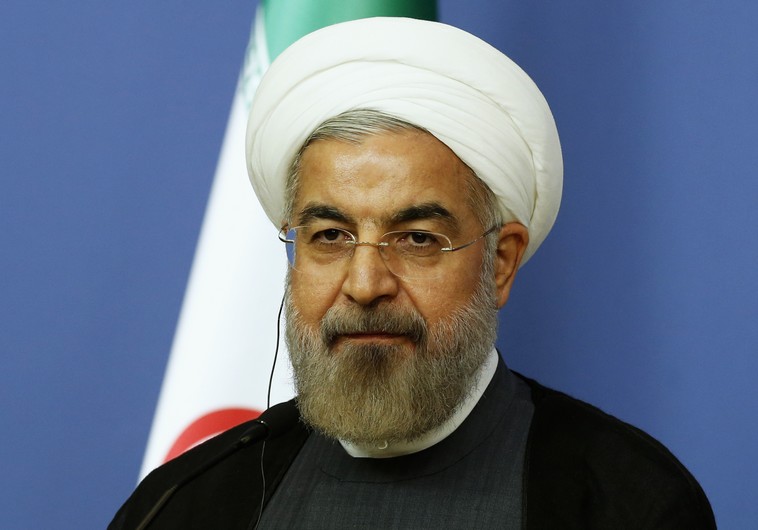
Iranian President Hassan Rouhani’s trip to New York next week will be a welcome relief for the Iranian leader. Finally, he’ll be somewhere where he’s appreciated, even loved.

Ahead of his trip to America, the US media continued its practice of presenting Rouhani as a moderate, and a natural ally for the US. NBC News’ Anne Curry interviewed Rouhani in Tehran, focusing her attention on his dim view of Islamic State.

Rouhani told Curry, “From the viewpoint of the Islamic tenets and culture, killing an innocent people equals the killing of the whole humanity. And therefore, the killing and beheading of innocent people in fact is a matter of shame for them and it’s the matter of concern and sorrow for all the human and all the mankind.”

The US media and political establishment’s willingness to take Rouhani at his word when he says that he’s a moderate is one of the reasons that Strategic Affairs Minister Yuval Steinitz was in such a desolate mood on Wednesday.

During a briefing with the foreign media, Steinitz described the state of negotiations between the US and its negotiating partners – Russia, China, Britain, France and Germany – and Iran regarding its illicit nuclear weapons program.

The briefing followed the latest round of the biennial Israeli-US strategic dialogue. Steinitz led the Israeli delegation to the talks, which focused on Iran, the week before nuclear talks were scheduled to be renewed.

One of Steinitz’s chief concerns was the US’s insistence that Rouhani is a moderate.

In his words, “The only thing that has changed [since Rouhani replaced president Mahmoud Ahmadinejad] is the tone. The only difference is that the world was unwilling to hear from Ahmadinejad and [his nuclear negotiator Saeed] Jalili, what it is willing to listen to from Rouhani and [Iranian Foreign Minister Javad] Zarif.”

Unlike the Americans, the Iranian people are through with the fiction that Rouhani is a moderate, which is why he no doubt will be happier in New York than in Tehran.

Rouhani’s trip to New York coincides with his one-year anniversary in office. Since he took power, a thousand Iranians have been executed by the regime. Forty-five people were executed in just the past two weeks.

According to Iranian scholar Majid Rafizadeh, the public’s tolerance for regime violence has reached a breaking point.

In an article in the Frontpage Magazine online journal, Rafizadeh described how 3,000 people descended on regime executioners as they were poised to kill a youth in Mahmoudabad in northern Iran. The protest forced them to call off the show.
They murdered the young man the next day, when no one was looking.

As Iran scholar Dr. Michael Ledeen has explained, the rise in regime brutality is directly proportional to the threat it perceives from the public.

And the regime has good reason to be worried.

Anti-regime protests and strikes occur countrywide, every day.

For instance, from September 9-14, MEK, an Iranian opposition group, documented public protests against security forces and attacks on regime agents in Tehran, Zanzan, Bane, Qom, Karaj and Bandar Abbas.

These actions ran the gamut from a strike by a thousand gas workers in the Aslaviyah gas fields who protested searches of their dormitory rooms by regime agents, to two separate assaults on military vehicles in Zanzan, to youth responding violently in cities throughout the country when regime agents tried to enforce Islamic dress codes on women and girls.

Under the same Rouhani who waxed so poetically against beheadings when speaking to an overeager NBC reporter, not only have state executions have massively intensified. Public floggings, public hand amputations and other public demonstrations of regime brutality have also expanded to levels unseen in recent years.

Rouhani promised to protect women’s rights. Yet since he took office, women’s rights have been severely curtailed.

Last month, the Revolutionary Guards barred women from working as waitresses. In July, Tehran’s mayor barred women from sharing workspace with men. These moves and others like them, aimed at enforcing gender apartheid in all public places in the country, force millions of women into poverty. The official unemployment level for women is already hovering around 20 percent.

Then there are Iran’s other social ills, for instance drug addiction.

Iran has the highest level of drug addiction in the world. According to Babak Dinparast, a senior Iranian drug enforcement official, some 3.5 million Iranians, or 4.4% of the population, are drug users.

In April, Dinparast made the stunning claim that 53% of drug users are government employees.

According to the Iranian parliament’s research institute, the average productive hours of Iranian workers is 22 minutes a day.

In Transparency International’s ranking of administrative and economic corruption, Iran ranks 144th out of 177 countries.

In other words, Iran is coming apart at the seams. The people cannot stand the regime. The regime, incompetent and unwilling to tackle any of Iran’s problems, responds to the public’s outrage with massive, brutal repression.

If left to its own devices, in all likelihood, the Iranian regime would have been toppled five years ago when it falsified the results of the 2009 presidential elections, and so fomented the Green Revolution But the people of Iran didn’t bet on the regime’s ace in the hole: the Obama administration.

The same Obama administration that supported the overthrow of US allies in the war on Islamic jihad – Egyptian president Hosni Mubarak and Libyan dictator Muammar Gaddafi – stood by the Iranian regime as it massacred its people in the streets of Iranian cities for daring to demand their freedom.

If the 2009 Green Revolution was the gravest threat the regime had faced since the 1979 revolution brought it to power, today the regime is also imperiled.

On Monday, Iran’s dictator Ayatollah Ali Khamenei was released from the hospital after undergoing prostate surgery. Several strategic analyses published since then claim that his days are numbered and that as a consequence, the regime faces a period of profound uncertainty and instability.

The Iranian people are watching all of this, and waiting.

As was the case in 2009, the disaffected Iranians, who hate their regime and want good relations with the US and the West, remain the greatest threat to the regime.

Beyond its borders, Iran is also under stress. With its Revolutionary Guard and Hezbollah forces committed to Syria in defense of Bashar Assad, Iran finds its position in Iraq threatened by the rising power of Islamic State.

Yet, as happened in 2009, in the midst of this gathering storm, the Obama administration is rushing to the mullahs’ rescue, begging Iran to support US efforts to fight Islamic State, indeed claiming that securing Iran’s support and cooperation is a necessary precondition for the mission’s success.

To say that this US policy is madness is an understatement.

As Michael Weiss documented in Foreign Policy in June, Iran and its puppet, the Syrian regime, played central roles in facilitating the development and empowerment of Islamic State both in Syria and Iraq. A defector from the Syrian Military Intelligence Directorate reported in January that the regime helped form Islamic State.

First, it sprang Sunni jihadist leaders from Sednaya prison in 2011. Then, it facilitated in the creation of the armed brigades that became Islamic State.

The idea was that through Islamic State, it could tarnish the reputation of all of its opponents by claiming they were all jihadists.

US military officers with deep knowledge of Iran’s role in Iraq told Weiss that Islamic State’s leadership entered Iraq from Iran.

A key al-Qaida financier, Olimzhon Adkhamovich Sadikov, was charged in February by the US Treasury Department with “provid[ing] logistical support and funding to al-Qaida’s Iran-based network.”

US Army Col. Rick Welch, who served as the military liaison to both the Sunni tribes and the Shi’ite militia in Iraq during the 2007-2008 US military surge, told Weiss that the assessment of Iraqi Sunnis and Shi’ites alike was that “Iran was funding any group that would keep Iraq in chaos.”

Iran sought chaos in order to prevent the establishment of a stable Iraqi government allied with the US while incrementally establishing Iranian control over the country.

Iran’s actions in Iraq and Syria, in other words, have for the past decade been focused on expanding Iranian power at the expense of the US and the Iraqi and Syrian people.

This behavior of course is in line with Iran’s global strategy. From its support for Hamas to its control over Hezbollah and Islamic Jihad, from developing a strategic alliance with Venezuela to expanding its presence throughout South and Central America, through its closely cultivated relationship with Russia, Iran’s every move involves expanding its power and influence at America’s expense.

And yet, despite this, the Obama administration has made strengthening the Iranian regime and appeasing it the centerpiece of its Middle East policy.

President Barack Obama told Jeffrey Goldberg in March that Iran is a rational actor that the US can do business with.

He said, “If you look at Iranian behavior, they are strategic, and they’re not impulsive. They have a worldview, and they see their interests, and they respond to costs and benefits.”

As Obama and Secretary of State John Kerry apparently now perceive things, Iran opposes Islamic State, and therefore it will play a supportive role in the US campaign against Islamic State. Moreover, by participating in the campaign, Iran will demonstrate its good faith and so make it possible for the US to cut a deal with the mullahs that will legitimize their illicit uranium enrichment – because really, how big a threat can a country that opposes Islamic State be?

As for Iran, it sees its interest as having the US destroy Islamic State, and if possible, having the US pay Iran for the privilege of fighting Iran’s war – against the foe Iran did so much to create.

And this brings us back to Steinitz’s gloomy assessment of the talks with Iran. Steinitz warned against the growing prospect of the US caving in to Iran’s nuclear demands as a payoff for Iranian support against Islamic State.

In his words, “Some people might think, ‘Let’s clean the table, let’s close the [nuclear] file,” in order to get Iran on board against Islamic State.

Unfortunately for Steinitz, and for the rest of the world, including the US, the Obama administration seems bent on proving him right.

Today the Iranian regime is weaker than it has been since it violently repressed the Green Revolution.

And that is why Rouhani is happy to be coming to New York.

He is certain that now, as then, the Obama administration will save the regime. This, even as the mullahs advance their goal of becoming the hegemons of the Middle East at the US’s expense, and completing their nuclear weapons program, which will secure the regime for decades to come, and threaten America directly.

Caroline B. Glick is the author of The Israeli Solution: A One-State Plan for Peace in the Middle East.

Iran: It Is All Good

September 20, 2014

Iran: It Is All Good.

September 20, 2014: The impact of the UN sanctions have been made worse by the falling price of oil. Iran and its ally Russia are two countries that are economically very dependent on oil revenue and the falling oil price is a major, and growing, problem.

This oil price decrease is caused largely by American innovations (fracking) that have unlocked huge quantities of oil and natural gas. For example, in 2010 foreign oil accounted for half the oil consumed in the United States. That is now 20 percent and falling rapidly.

The U.S. expects to be a major oil and natural gas exporter soon and that hurts the economies of Iran and Russia a great deal.  Meanwhile the fighting with ISIL is hurting Iran economically as a natural gas pipeline Iran is building to Iraq (to sell lots of unused natural gas) goes through territory currently controlled or threatened by ISIL. Some Iranian construction workers have been fired on by ISIL and most have been withdrawn from threatened areas until ISIL is destroyed or driven away.

The negotiations to end the sanctions against Iran are still stalled. Iran missed the agreed upon July deadline to come up with an agreeable compromise and now there are more sanctions imposed. Iran continues to refuse acceptable inspections and monitoring of its nuclear program to assure the rest of the world that there really is no nuclear program. But many foreign intelligence agencies (especially the U.S., Europe and Israel) have lots of evidence that the weapons program exists and Iran simply dismisses this evidence without offering credible proof that the charges are false.

Many Western politicians are uneasy with the fact that they are now de-facto allies with Iran and the Syrian Assad dictatorship as well as rebel groups that are openly Islamic terrorists and hostile to the West. Iran wants to destroy the West but at the moment it’s a case of “the enemy of my enemy is my ally whether I like it or not.” Despite official bans on cooperation there is some informal military coordination with Iran and the Assads. Meanwhile the Iranian government is encouraging the rumor that ISIL is part of an American plot to hurt Iran. This sort of thing is believed by most Iranians and many Arabs as well, who see the Western operations against ISIL as another form of the Western “war on Islam”. This conspiracy theory is so popular that many Arab states are reluctant to get too involved with the mainly Western coalition formed to stop ISIL. This is despite the fact that ISIL is a very immediate threat to Iran and all Arab states in the region. Iran backs the “ISIL is an American plot” in part to show their anger at the growing sanctions and Iranian efforts to formally coordinate anti-ISIL operations.

The Iranians appear to believe that the U.S. air strikes and all the military aid (from Iran, the U.S. and other NATO nations) going to the Iraqi Kurds, plus a new government in Iraq, will be able to deal with ISIL in Iraq.  Iran has been very active in supporting the Shia Arab government in Iraq against ISIL, but not very public about it. This is because many of the things that ISIL is hated for (restrictions on women and on what people drink and do for entertainment) are the same things that have long been enforced in Iran. It is possible for Iran to condemn the ISIL tendency to slaughter lots of people just for being different (not Islamic or not Islamic enough) but they are reluctant to go into much detail, as least in the media. Iran would like ISIL to just go away, permanently and with great violence if necessary.

All the Gulf states (Arabs and Iran) agree that extreme radical groups, especially one like ISIL that have declared themselves the leader of the Islamic world (by declaring a caliphate run by ISIL) are a threat to all Moslems. Actually, ISIL has a lot of supporters throughout the Islamic world, but these people are a minority (a few percent to maybe twenty or so in some countries) and most of these supporters would change their minds if they actually had to live under ISIL rule. That said, Saudi Arabia has long enforced strict Islamic lifestyle rules similar to those used by ISIL and beheads those who are major offenders of those rules. But the Saudis have courts and limits on the authority of those enforcing Islamic law. That makes a big difference, big enough to get a lot of Moslem countries that are at odds with each other over a wide variety of issues to finally have one thing they can unite against.

Al Qaeda also condemns ISIL, initially for ignoring al Qaeda orders to tone down the barbaric treatment (mass murder and torture) of the enemy because al Qaeda realized that this eventually extreme and triggers a backlash from other Moslems. Iran condemns ISIL because to them all Shia (meaning nearly all Iranians) are heretics and deserving of summary execution. Iran-backed Hezbollah is now using that ISIL threat against Lebanon to justify Hezbollah grabbing more power in Lebanon, where Shia are a third of the population but far more powerful politically because Iranian cash, weapons and training have made Hezbollah too strong for the elected Lebanese government to suppress or even oppose effectively. In Syria, the minority (Shia) Assad government, fighting a Sunni rebellion since 2011, now calls on their current Sunni enemies (Saudi Arabia and other Gulf Arabs, plus the Sunni majority in Syria) to join with them in destroying ISIL. There is not much public support for this, because the Assads are seen as vicious oppressors of Sunni Moslems (who own most of the oil in Arabia and comprise 80 percent of all Moslems). Nevertheless, the presence of a common threat (ISIL) has forced a temporary truce in the growing conflict between Shia (led by Iran) and Sunnis (led by Saudi Arabia).

So whatever else ISIL has done it has united many other Sunni factions and the Shia in the region into an uneasy anti-ISIL coalition. But even after ISIL is gone, Islamic radicalism will still be there. For most Moslems this radicalism is like the weather; every Moslem talks about but Moslems cannot seem to do anything to eliminate or even control it.

Iranian aid can make a big difference, even if the Iranians don’t send in troops to fight. For example, thanks to Iranian trainers and cash, the Syrian pro-government militias are better trained and more effective as are the Syrian soldiers. All of these men are paid regularly and most see a better future than do many of the rebel fighters. The Syrian Army is about half its pre-war strength of 300,000 but the remaining troops are loyal and most have combat experience. The army is expanding back to its pre-war strength. This is thanks to cash from Iran, because the Syrian economy is wrecked. In other instances, Iranian interference is not helpful. I n western Afghanistan local (Herat province) police blame Iran for an increase in violence and accuse Iran of funding the local Taliban and providing sanctuary for them in Iran. Performing similar magic in Iraq means shoving corrupt Iraqi officials and officers out of the way and taking care of Iraqi troops with Iranian cash and training these troops using experienced (in that sort of thing) Iranians. This is insulting to many Iraqis, especially senior politicians. But at the moment it is preferable to being murdered by ISIL gunmen.

Christianity in Iraq is finished – The Washington Post

September 20, 2014

Christianity in Iraq is finished – The Washington Post.


Displaced Iraq Christians who fled from Islamic State militants in Mosul, pray at a school acting as a refugee camp in Erbil September 6, 2014. (Ahmed Jadallah/Reuters)

September 19 at 6:50 PM

Daniel Williams is a former senior researcher at Human Rights Watch and Post correspondent.

In the part of his Sept. 10 speech on confronting the Islamic State that probably drew the least attention, President Obama mentioned the need to help Christians and other minorities, expelled from cities and villages in northern Iraq, return from where they came. “We cannot allow these communities to be driven from their ancient homeland,” he said.

Obama got that wrong. Christians, of whom around 120,000 have taken refuge in Iraqi Kurdistan, will not be going home even if their tormentors suddenly disappear.

I spent 10 days talking with Christian refugees in Irbil, the capital of the northern autonomous region of Kurdistan, this month, and they are adamant they will not be returning to Mosul and nearby towns on what is known as the Nineveh Plain.

It is not simply that these Christians have gone through tremendous trauma. It is not only because they lost everything, including their homes and businesses, and in some cases spent days and even weeks in detention while being badgered to convert to Islam, where they saw babies taken from mothers’ arms to be held for ransom and busloads of young people ferried off into the unknown.

Nor is it because their neighbors, in Mosul but especially in the countryside, welcomed and even joined fighters from the Islamic State, pointed out the homes of minorities and let them know which ones were wealthy.

No, it is because, for Christians in Iraq, the past three months have been the climax of 11 years of hell. We Americans have short memories (that goes for you, too, in the “Bush Was Right” crowd), but it’s worth noting that Christians began having serious problems within a year after the fall of Saddam Hussein in 2003. Sometimes it was the work of al-Qaeda, sometimes Sunni insurgents pining for the return of Sunni control of Iraq. Sometimes it was Shiite militias fighting the Sunnis but finding time to persecute Christians.

First came assaults on stores that sold alcohol. Then, in August 2004, bombs were placed outside five churches in Baghdad and Mosul. Eleven people died. Two more churches were bombed in November, and Christians began to flee to Kurdistan, Jordan and Syria. Since then, at least 60 churches in the country have been bombed. The latest was in Baghdad on Christmas Day last year.

Priests and bishops became particular targets, in order to deliver a message to their flock that no one is safe. In Mosul in June 2007, gunmen shot dead a Chaldean Catholic priest and three deacons because the priest refused to convert to Islam. The next year gunmen kidnapped Mosul’s Chaldean archbishop, Paul Rahho, and killed his driver and two bodyguards. The abductors stuffed Rahho into the trunk of a car, from where he was able to call a colleague by mobile phone and instruct the church not to pay ransom. He was found dead a few days later in a shallow grave.

Attacks on lay Christians were continuous. Women received threatening messages demanding that they stop working. Families received death threats attached to demands for money called “daftar,” slang for $10,000. Children were taken and held for ransom. Both Sunni and Shiites, though busy with what amounted to a civil war, found time to attack and expel Christians from the Baghdad suburb of Dora.

All this predated the Islamic State.

One priest, himself ransomed for $85,000 in Baghdad seven years ago, said a Muslim acquaintance once warned him, “Saturday’s gone. Why are you still here on Sunday?” His meaning was that Jews, who worship on Saturdays, had fled Iraq long ago, so why were the Christians still there?

Indeed, the exodus of Christians is ongoing. Has anyone noticed that the Christian population of Iraq has shrunk from more than 1 million in 2003 to maybe 300,000 today? Now, there are virtually no Christians left in either Mosul or on the plain.

So when I ask refugees their plans, it is unanimously to leave Iraq altogether. Enough is enough. This runs counter to the desire, expressed mostly outside Iraq, that a Christian presence be preserved in a land that has known Christianity for 2,000 years. It’s sad but true: Christianity in Iraq is finished. As one refugee told me, “We wanted Iraq. Iraq doesn’t want us.”

Humanitarian aid, mentioned by Obama, is fine and necessary. But the broader problem faced by refugees — the fact that Christians and other minorities will likely never return to Iraq — is left unaddressed.

The United States and Europe both have provisions for providing temporary protection to refugees who can’t go home; it falls short of asylum but nonetheless can provide people with economic help to get them on their feet while keeping open the possibility, unlikely as it seems, of returning to Iraq. France has already taken a couple of planeloads of Christians out of Kurdistan. Much more is needed. Western countries ought to come together and offer refuge to the tens of thousands who want to leave Iraq.

Yes, this would mean the end of Christianity in this part of the world, where its presence has often served as a bulwark against fanaticism. But it’s over anyway, whatever happens to the Islamic State. It’s time to face that fact and save the Christians themselves.

Iran remains America’s biggest challenge – The Washington Post

September 20, 2014

Iran remains America’s biggest challenge – The Washington Post.

September 18

Eric Edelman, a distinguished fellow at the Center for Strategic and Budgetary Assessments, served as undersecretary of defense for policy from 2005 to 2009. Dennis Ross, a fellow at the Washington Institute for Near East policy, was special assistant to the president for the Middle East and South Asia from 2009 to 2011. Ray Takeyh is a senior fellow at the Council on Foreign Relations.

As the United States begins its campaign to destroy the Islamic State, many voices can be counted on to call for cooperation with Iran. Among those has been none other than Secretary of State John Kerry, who insisted that Iran’s exclusion from the Paris Conference “doesn’t mean that we are opposed to the idea of communicating to find out if they will come on board, or under what circumstances, or whether there is the possibility of a change.” On the surface, this may seem sensible, as both Washington and Tehran have an interest in defanging a militant Sunni group. But we would be wise to bear in mind two points: first, Kerry’s proviso on the possibility of change, and second, that the essential axiom of Middle East politics is that the enemy of my enemy is sometimes still my enemy. The ebbs and flows of the war on terrorism should not be allowed to conceal the fact that the theocratic Iranian regime and its attempt to upend the regional order remains the United States’ most consequential long-term challenge in the Middle East.

The Islamic republic is not a normal nation-state seeking to realize its legitimate interests but an ideological entity mired in manufactured conspiracies. A persistent theme of Supreme Leader Ayatollah Ali Khamenei’s speeches is that the United States is a declining power whose domestic sources of strength are fast eroding. In today’s disorderly region, Iran sees a unique opportunity to project its influence and undermine the United States and its system of alliances.

In Afghanistan, in the aftermath of the 9/11 attacks, the misapprehension was born that the United States needed Iran’s assistance to rehabilitate its war-torn charge, and this misbegotten notion has since migrated from crisis to crisis. The tactical assistance that Iran offered in Afghanistan in 2001 was largely motivated by its fear of being the next target of U.S. retribution. Once it was disabused of that notion, Iran proceeded to lacerate U.S. forces in both Iraq and Afghanistan by providing munitions and sanctuary to various militias. In the meantime, Tehran sought steadily to subvert America’s allies in the Persian Gulf and to undermine the security of Israel.

Today, in the two central battlefronts of the Middle East — Syria and Iraq — Iran’s interests are inimical to those of the United States. Iran’s stake in Syria has been made clear by its provision of money, oil, arms, advisers and, most important, Hezbollah shock troops to prop up the regime of Bashar al-Assad. The United States’ interests, meanwhile, strongly argue against working with Iran against the Islamic State in Syria lest we lose the very Sunni support that will be necessary to eradicate the group. By taking a firm stand in Syria against both Assad and the Islamic State, we can send a strong signal to Iran’s leaders that the price for its troublemaking is going to rise.

Similarly in Iraq, any putative alliance with Iran would undo much of what the United States has attempted to accomplish there — the creation of a pluralistic, unitary state that does not represent a threat to itself or its neighbors and which is not a base for terrorism. The only way that President Obama’s objective of not only “degrading” but also “destroying” the Islamic State can be achieved is by taking back, over time, much of the territory seized by its fighters in Nineveh and Anbar provinces. This will require not only airstrikes in support of the Kurdish pesh merga troops and Iraqi security forces but also significant buy-in from the Sunni tribes who formed the backbone of the uprising against al-Qaeda during the surge. In addition, the sine qua non of the administration’s policy is an inclusive government in Iraq that can draw support from neighboring Sunni states such as Saudi Arabia and the United Arab Emirates. Both of these will be unattainable if there is a perception that the United States is seeking a de facto alliance with Iran.

During the past decade, and over two administrations, the United States has been effective in estranging Iran from its European and even Asian customers. But Washington has not affected Iran’s position in the Middle East to the same degree. Beyond arms sales to Arab states and attempts to assuage Israeli concerns, the United States has not undertaken a systematic effort to isolate Iran in its immediate neighborhood. Instead of pursuing the chimera of cooperation with the likes of Khamenei, Washington should contest all of Iran’s regional assets. From the Shiite slums of Baghdad to the battlefields of Syria, Iran should be confronted with a new, inhospitable reality as it searches for partners.

The United States and Iran stand at opposite ends of the spectrum of Middle East politics. The Islamic republic’s ideological compulsions and sheer opportunism make it an unlikely ally for the West. The coincidence of mutual opposition to a radical Sunni terrorist group should not blind us to the enduring threat that the mullahs represent.

China’s war on terror becomes all-out attack on Islam in Xinjiang – The Washington Post

September 20, 2014

China’s war on terror becomes all-out attack on Islam in Xinjiang – The Washington Post.

(This article continues the media’s practice of blaming non-Islamic victims for Islamic terrorism. Here, because it’s China, “Islamophobia”  is not blamed, rather it’s “all-out war on conservative Islam.”  Conservative? Is that more or less radical than” moderate?”  China’s actions are the reaction to terrorism, not the cause.  Just like everywhere else in the world where Islam exists. – JW )

– The month of Ramadan should have been a time of fasting, charity and prayer in China’s Muslim west. But here, in many of the towns and villages of southern Xinjiang, it was a time of fear, repression, and violence.  China’s campaign against separatism and terrorism in its mainly Muslim west has now become an all-out war on conservative Islam, residents here say.

Throughout Ramadan,police intensified a campaign of house-to-house searches, looking for books or clothing that betray “conservative” religious belief among the region’s ethnic Uighurs: women wearing veils were widely detained, and many young men arrested on the slightest pretext, residents say. Students and civil servants were forced to eat instead of fasting, and work or attend classes instead of attending Friday prayers.

The religious repression has bred resentment, and, at times, deadly protests. Reports have emerged of police firing on angry crowds in recent weeks in the towns of Elishku, and Alaqagha; since then, Chinese authorities have imposed a complete blackout on reporting from both locations, even more intense than that already in place across most of Xinjiang.

Chinese police have cracked down on the wearing of beards and veils, in observance of Ramadan, in Muslim-majority Xinjiang province.

A Washington Post team was turned away at the one of several checkpoints around Elishku, as army trucks rumbled past, and was subsequently detained for several hours by informers, police and Communist Party officials for reporting from villages in the surrounding district of Shache county; the following day, the team was again detained in Alaqagha in Kuqa county, and ultimately deported from the region from the nearest airport.

Across Shache county, the Internet has been cut, and text messaging services disabled, while foreigners have been barred. But in snatched conversations, in person and on the telephone, with the few people in the region brave enough to talk, a picture of constant harassment across Xinjiang emerges.

“The police are everywhere,” said one Uighur resident. Another said it was like “living in prison.” Another said his identity card had been checked so many times, “the magnetic strip is not working any more.”

On July 18, hundreds of people gathered outside a government building in the town of Alaqagha, angry about the arrest of two dozen girls and women who had refused to remove their headscarves, according to a report on Washington-based Radio Free Asia (RFA).

Protesters threw stones, bottles and bricks at the building; the police opened fire, killing at least two people, and wounding several more.

Then, on July 28, the last day of Ramadan, a protest in Elishku was met with an even more violent response, RFA reported. Hundreds of Uighurs attacked a police station with knives, axes and sticks; again, the police opened fire, mowing down scores of people.

China’s official Xinhua news agency said police killed 59 Uighur “terrorists” in the incident, although other reports suggest the death toll could have been significantly higher.

According to the Chinese government’s version, the angry crowd subsequently went on a rampage in nearby towns and villages, killing 37 civilians — mostly ethnic Han Chinese. The region has been in lockdown ever since, with police and SWAT teams arresting more than 200 people and drones scanning for suspects from the air.

Xinjiang is a land of deserts, oases and mountains, flanked by the Muslim lands of Central Asia. Its Uighur people are culturally more inclined towards Turkey than the rest of China.

China says foreign religious ideas — often propagated over the Internet— have corrupted the people of Xinjiang, promoting fundamentalist Saudi Arabian Wahhabi Islam and turning some of them towards terrorism in pursuit of separatist goals. It also blames a radical Islamist Uighur group — said to be based in Pakistan’s lawless tribal areas and to have links to al-Qaeda — for a recent upsurge in violence. In March, a gruesome knife attack at a train station in the city of Kunming left 33 people dead, while in May, a bomb attack on a street market in Urumqi killed 43 others.

In response, President Xi Jinping has vowed to catch the terrorists “with nets spreading from the earth to the sky,” and to chase them “like rats scurrying across the street, with everybody shouting, ‘Beat them.’ ”

But the nets appear to be also catching many innocent people, residents complain. “You should arrest the bad guys,” said one Uighur professional in Urumqi, “not just anyone who looks suspicious.”

Some 200,000 Communist Party cadres have been dispatched to the countryside, ostensibly to listen to people’s concerns. Yet those officials, who often shelter behind compound walls fortified with alarms and barbed wire, appear to be more interested in ever-more intrusive surveillance of Uighur life, locals say.

In Shache, known in Uighur as Yarkand, an official document boasts of spending more than $2 million to establish a network of informers and surveillance cameras. House-to-house inspections, it says, will identify separatists, terrorists and religious extremists – including women who cover their faces with veils or burqas, and young men with long beards.

In the city of Kashgar, checkpoints enforce what the authorities call “Project Beauty” — beauty, in this case, being an exposed face. A large billboard close to the main mosque carries pictures of women wearing headscarves that pass muster, and those — covering the face or even just the neck — which are banned.

Anyone caught breaking the rules faces the daunting prospect of “regular and irregular inspections,” “educational lectures” and having party cadres assigned as “buddies” to prevent backsliding, the billboard announced. In the city of Karamay, women wearing veils and men with long beards have been banned from public buses.

Terrorism — in the sense of attacks on civilians — is a new phenomenon in Xinjiang, but the unrest here has a much longer history, with many Uighurs chafing under Chinese repression since the Communist Party takeover of the country in 1949, and resentful of the subsequent flood of immigrants from China’s majority Han community into the region.

What has changed is the growth in conservative Islam, and the increasing desperation of Uighurs determined to resist Chinese rule.

Until a decade or two ago, Xinjiang’s Uighurs wore their religion lightly, known more for their singing, dancing and drinking than their observation of the pieties of their faith. But in the past two decades a stricter form of the religion has slowly gained a foothold, as China opened up to the outside world.

While worship was allowed at officially sanctioned — and closely supervised — mosques, a network of underground mosques sprang up. Village elders returning from the Hajj, the annual pilgrimage to Mecca, brought back more conservative ideas; high levels of unemployment among Uighur youth, and widespread discrimination against them, left many searching for new ideas and new directions in life. The rise of Islam was, in part, a reaction against social inequality and modernity.

But Joanne Smith Finley of Britain’s Newcastle University, an expert on Uighur identities and Islam, says religion has become a “symbolic form of resistance” to Chinese rule in a region where other resistance is impossible.

When hopes for independence were cruelly dashed by mass executions and arrests in the city of Ghulja — or Yining in Chinese — in 1997, Uighurs had nowhere else to turn, she said.

“People lost faith in the dream of independence,” she said, “and started looking to Islam instead.”

Not every Uighur in Xinjiang is happy with the rising tide of conservatism: one academic lamented the dramatic decline in Uighur establishments serving alcohol in the city of Hotan, while insisting that many young girls wear veils only out of compulsion.

But China’s clumsy attempts to “liberate” Uighurs from the oppression of conservative Islam are only driving more people into the hands of the fundamentalists, experts say.

“If the government continues to exaggerate extremism in this way, and take inappropriate measures to fix it, it will only force people towards extremism” a prominent Uighur scholar, Ilham Tohti, wrote, before being jailed in January on a charge of inciting separatism.

Xu Yangjingjing contributed to this report.

Simon Denyer is The Post’s bureau chief in China. He served previously as bureau chief in India and as a Reuters bureau chief in Washington, India and Pakistan.

Turkey frees 49 citizens held by Islamic State

September 20, 2014

Turkey frees 49 citizens held by Islamic State | The Times of Israel.

Prime Minister Davuoglu announces that all captives safe and sound after intelligence ‘methods’

Turkey's president-elect Recep Tayyip Erdogan, right, greets Foreign Minister Ahmet Davutoglu after he announced Davutoglu as his ruling Justice and Development Party's new leader, in Ankara, Turkey, on Thursday, August 21, 2014. (photo credit: AP Photo/Burhan Ozbilici)

Turkey’s president-elect Recep Tayyip Erdogan, right, greets Foreign Minister Ahmet Davutoglu after he announced Davutoglu as his ruling Justice and Development Party’s new leader, in Ankara, Turkey, on Thursday, August 21, 2014. (photo credit: AP Photo/Burhan Ozbilici)

ANKARA, Turkey — Turkish Prime Minister Ahmet Davutoglu saidhave Saturday that 49 Turkish hostages who were seized by Islamic militants in Iraq been freed and safely returned to Turkey, ending Turkey’s most serious hostage crisis.The Turks, including diplomatic staff, were seized from the consulate on June 11, when the Islamic State group overran Mosul, Iraq and stormed the Turkish Consulate there. The hostages included Consul General Ozturk Yilmaz, other diplomats, children and special forces police.

Davutoglu told Turkish reporters during a visit to Baku, Azerbaijan that the hostages were released early on Saturday and had arrived in Turkey. He was cutting his visit short to meet with the hostages in the province of Sanliurfa, near Turkey’s border with Syria.

He did not provide details on the circumstances of their release but said the hostages were freed through the intelligence agency’s “own methods” and that no operation was carried out. He thanked Turkey’s intelligence agency and the Foreign Ministry’s head official for their efforts toward their release.

Turkey had publicly resisted joining a coalition to defeat the Islamic State group, citing its 49 kidnapped citizens.

The United States had been careful not to push Turkey too hard as it tried to free the hostages.

The extremist group has beheaded two US journalists and a British aid worker who were working in Syria as payback for airstrikes that Washington has launched against them in Iraq.

“I am sharing a joyful news which as a nation we have been waiting for,” Davutoglu said. “After intense efforts that lasted days and weeks, in the early hours, our citizens were handed over to us and we brought them back to our country.”

“They have crossed into Turkey and I am on my way to see them,” Davutoglu said.

Thirty-two Turkish truck drivers who were also seized in Mosul in June 6 were released a month later. Turkey did not provide information surrounding their release.

Read more: Turkey frees 49 citizens held by Islamic State | The Times of Israel http://www.timesofisrael.com/turkey-49-islamic-state-hostages-freed/#ixzz3Dr5OOvNz
Follow us: @timesofisrael on Twitter | timesofisrael on Facebook


