Archive for September 24, 2014

Obama Praises Muslim Cleric Who Backed Fatwa on Killing of U.S. Soldiers

September 24, 2014

Obama Praises Muslim Cleric Who Backed Fatwa on Killing of U.S. Soldiers, Washington Free Beacon, September 14, 2014

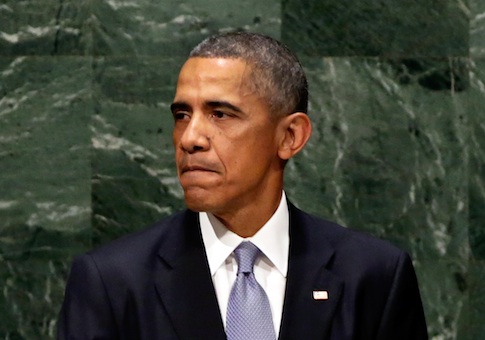
Barack ObamaPresident Barack Obama addresses the United Nations General Assembly / AP

Patrick Poole, a reporter and terrorism analyst who has long tracked Bin Bayyah, expressed shock that the Obama administration would endorse the cleric on the world stage.

“It is simply amazing that just a few months ago the State Department had to publicly apologize for tweeting out it’s support for Bin Bayyah, only to have Barack Obama go before the leaders of the entire world and publicly endorse Bin Bayyah’s efforts,” Poole said.

“It seems that nothing can stop this administration’s determination to rehabilitate Bin Bayyah’s image, transforming him from the Islamic cleric who issued the fatwa to kill Americans in Iraq and calling for the death of Jews to the de facto White House Islamic mufti,” he said.

This type of mentality has contributed to the administration’s foreign policy failures in the region,” Poole said.

********************

President Barack Obama favorably quoted and praised on Wednesday in his speech before the United Nations a controversial Muslim cleric whose organization has reportedly endorsed the terror group Hamas and supported a fatwa condoning the murder of U.S. soldiers in Iraq.

Obama in his remarks offered praise to controversial cleric Sheikh Abdallah Bin Bayyah and referred to him as a moderate Muslim leader who can help combat the Islamic State of Iraq and the Levant’s (ISIL or ISIS) radical ideology.

However, Bin Bayyah himself has long been engulfed in controversy for many of his views, including the reported backing of a 2004 fatwa that advocated violent resistance against Americans fighting in Iraq.

This is not the first time that the Obama administration has extoled Bin Bayyah, who also has served as the vice president of a Muslim scholars group founded by a radical Muslim Brotherhood leader who has called “for the death of Jews and Americans,” according to Fox News and other reports.

The State Department’s Counterterrorism Bureau (CT) was forced to issue multiple apologies earlier this year after the Washington Free Beacon reported on its promotion of Bin Bayyah on Twitter.

“This should not have been tweeted and has since been deleted,” the CT Bureau tweeted at the time after many expressed anger over the original endorsement of Bin Bayyah.

However, it appears that Obama and the White House are still supportive of Bin Bayyah, who, despite his past statements, is still hailed by some as a moderate alternative to ISIL and al Qaeda.

“The ideology of ISIL or al Qaeda or Boko Haram will wilt and die if it is consistently exposed, confronted, and refuted in the light of day,” Obama said before the U.N., according to a White House transcript of his remarks.

“Look at the new Forum for Promoting Peace in Muslim Societies—Sheikh bin Bayyah described its purpose: ‘We must declare war on war, so the outcome will be peace upon peace,’” Obama said, quoting the controversial cleric.

Concern over the administration’s relationship with Bin Bayyah started as early as 2013, when outrage ensued after he was reported to have met with Obama’s National Security Council staff at the White House.

While Bin Bayyah has condemned the actions of groups such as Boko Haram and ISIL, he also has taken controversial positions against Israel.

He issued in 2009 a fatwa “barring ‘all forms of normalization’ with Israel,” according to a Fox report on the White House meeting.

Additionally, the notorious 2004 fatwa permitting armed resistance against U.S. military personnel in Iraq reportedly stated that “resisting occupation troops” is a “duty” for all Muslims, according to reports about the edict.

Patrick Poole, a reporter and terrorism analyst who has long tracked Bin Bayyah, expressed shock that the Obama administration would endorse the cleric on the world stage.

“It is simply amazing that just a few months ago the State Department had to publicly apologize for tweeting out it’s support for Bin Bayyah, only to have Barack Obama go before the leaders of the entire world and publicly endorse Bin Bayyah’s efforts,” Poole said.

“It seems that nothing can stop this administration’s determination to rehabilitate Bin Bayyah’s image, transforming him from the Islamic cleric who issued the fatwa to kill Americans in Iraq and calling for the death of Jews to the de facto White House Islamic mufti,” he said.

This type of mentality has contributed to the administration’s foreign policy failures in the region,” Poole said.

“This is a snapshot of why this administration’s foreign policy in the Middle East is a complete catastrophe,” he said. “The keystone of their policy has been that so-called ‘moderate Islamists’ were going to be the great counter to al Qaeda. But if you take less than 30 seconds to do a Google search on any of these ‘moderate Islamists,’ you immediately find they are just a degree or two from the most hardcore jihadis and have little to no difference when it comes to condoning violence.”

A White House official said that the president’s remarks speak for themselves and declined to add anything further.

U.S.-Backed Syrian Group Harakat al-Hazm Condemns U.S. Strikes on ISIS as ‘Attack on the Revolution’

September 24, 2014

U.S.-Backed Syrian Group Harakat al-Hazm Condemns U.S. Strikes on ISIS as ‘Attack on the Revolution’

byPatrick Poole

via The PJ Tatler » U.S.-Backed Syrian Group Harakat al-Hazm Condemns U.S. Strikes on ISIS as ‘Attack on the Revolution’.


September 24, 2014 – 4:47 am

Just days after Congress approved $500 million in support for “vetted moderate” Syrian rebels, one of those same “vetted moderate” rebel groups currently receiving heavy weaponry from the U.S. has condemned the U.S. for airstrikes on ISIS in Syria earlier this week.

Harakat al-Hazm, which was one of the first Syrian rebel groups to receive heavy weapons from the U.S. this year, issued a statement Tuesday denouncing the U.S. for the anti-ISIS attacks. Harakat al-Hazm has been hailed by the Washington, D.C. foreign policy establishment as “rebels worth supporting” and “a model candidate for greater U.S. and allied support, including lethal military assistance.”

As reported by the L.A. Times:

One of the administration’s favored moderate rebel factions, Harakat Hazm, part of the Free Syrian Army alliance and a recipient of U.S. missiles and training, issued a statement Tuesday denouncing the “external intervention” — that is, the U.S.-led bombing campaign in Syria — as “an attack on the revolution.”

The group said its main goal was toppling Assad. It is demanding “unconditional arming” of the Free Syrian Army, yet its members also acknowledge fighting alongside Al Nusra Front, the official Al Qaeda force in Syria.

Still, the country’s motley bands of fighters labeled as moderates may well be the White House’s best hope for now. It has few other options.

Here is a copy of the statement by Harakat al-Hazm:

ByPCk0yCIAExhvhHarakat al-Hazm may sound familiar to PJ Media readers.

Earlier this month I reported that Hazm fighters admitted to an L.A. Times reporter that they were fighting alongside Jabhat al-Nusra, the official al-Qaeda affiliate in Syria. I also noted that despite media claims that Harakat al-Hazm had released a statement of “rejection of all forms of cooperation and coordination” with Nusra, it signed a statement of alliance with Nusra to prevent the Assad regime from advancing into Aleppo.

The Obama administration billed the $500 million approved last week by Congress as aid to the rebel groups to help roll back gains by hardcore jihadist groups, including ISIS.

And now that one of the primary groups to which the U.S. is supplying heavy weapons in order to supposedly “roll back” ISIS gains has not only denounced the U.S. for this week’s airstrikes on ISIS, declaring them an “attack on the revolution,” but is also partnering with a U.S.-designated terrorist group, Jabhat al-Nusra, what hope is there really that the “vetted moderate” Syrian rebel groups are going to accomplish that goal?

And one final question: in light of this catastrophe, who is vetting the vetters?


The “Khorasan Group”, New Name, Old Threat

September 24, 2014

The “Khorasan Group”, New Name, Old Threat, Center for Security PolicyKyle Shideler, September 24, 2014

There has been an attempt to try to separate out elements of Al Qaeda, into Core, and affiliates, and in the case of the Khorasan group, small units within affiliates. Or for that matter to disassociate ISIS from Al Qaeda, as ISIS being “too brutal”, when the reality is that ISIS hasn’t engaged in any tactic that Al Qaeda didn’t institute first.

This is a misguided attempt to convince people that what we face is a series of minor groups, and that the enemy who attacked us on 9/11 is broken, and/or on the run. The reality is we face an overarching enemy, a Global Islamic Movement – which is how they identify themselves – operating in accordance with a knowable strategic doctrine that we are not addressing.

That doctrine is Shariah law. It is the same law that ISIS is instituting in its territory, and the same one that Jabhat al Nusra and several of the other Syrian groups would institute in Syria if they prove successful in defeating Assad.

Until we are prepared to discuss the conflict in ideological terms, we will forever be playing “whack-a-mole” with a never ending series of “new” threats.

*****************

Recent media coverage has been bombarded by revelations of a “new terror threat“, “more dangerous than ISIS”, the Khorasan Group.

Khorasan refers to the historical area under the Islamic Caliphate that corresponds to Iran/Afghanistan/Pakistan and the subcontinent, and the Khorasan Group, according to intelligence officials speaking to the media, consists of a relatively small (between fifty and a hundred) group of veteran Al Qaeda fighters from the Afghanistan/Pakistan region. These fighters are said to include a number of highly skilled bomb makers and other operatives, led by Muhsin al-Fadhli, a native Kuwaiti, and long time Al Qaeda insider, who specializes in financing and facilitation. Jihadist social media is hinting that Al-Fadhli may have been killed in the first round of U.S. bombing.

Khorasan Group’s mission, supposedly, has been to find jihadists with western passports who have travelled to Syria, train them, and reinsert them into the West to conduct spectacular attacks of the kind that Al Qaeda is famous for.

Khorasan Group operates in and among Al Qaeda’s Syrian affiliate Jabhat al-Nusra, and there’s been lively debate in the counterterrorism community over whether its really worthwhile distinguishing between Jabhat al-Nusra and Khorasan group at all. This is significant because Jabhat al-Nusra, despite being Al Qaeda, is deeply intertwined with the Syrian rebels at-large, and they are widely supported by these rebels, including those that the Obama strategy calls for arming and training to fight ISIS. For their part, Jabhat al Nusra hasn’t made the distinction, claiming they were the recipient of U.S. bombings.

It’s entirely plausible that intelligence suggested that this Khorasan group was preparing an imminent attack, and even if they weren’t, they are definitely enemies of America and a legitimate target.

But the extra hype about this specific group, and separating them out as somehow different or more threatening than Jabhat al Nusra, and Al Qaeda proper, has more to do with attempting to limit the negative reaction from rebels within Syria, and to distract Americans from the reality that in Syria there really are few good guys, with a possible exception of the Kurdish forces, who aren’t really receiving support. That strategy has already failed, with multiple Syrian rebel groups complaining about the strikes against Jabhat al Nusra, includingone group expected to be the core of the force the U.S. intends to train to send against ISIS.

There has been an attempt to try to separate out elements of Al Qaeda, into Core, and affiliates, and in the case of the Khorasan group, small units within affiliates. Or for that matter to disassociate ISIS from Al Qaeda, as ISIS being “too brutal”, when the reality is that ISIS hasn’t engaged in any tactic that Al Qaeda didn’t institute first.

This is a misguided attempt to convince people that what we face is a series of minor groups, and that the enemy who attacked us on 9/11 is broken, and/or on the run. The reality is we face an overarching enemy, a Global Islamic Movement – which is how they identify themselves – operating in accordance with a knowable strategic doctrine that we are not addressing.

That doctrine is Shariah law. It is the same law that ISIS is instituting in its territory, and the same one that Jabhat al Nusra and several of the other Syrian groups would institute in Syria if they prove successful in defeating Assad.

Our enemy knows that you can not defeat an opponent you do not name. They do not say that their war is with the U.S. Army,  the 75th Ranger Regiment, or the 5th Special Forces Group. They say plainly and openly, that their war is with America, and the allies of America, and more importantly, that it is an ideological war, based on a conflict between belief systems which are irreconcilable.

Until we are prepared to discuss the conflict in ideological terms, we will forever be playing “whack-a-mole” with a never ending series of “new” threats.

Obama Defends Islam, Smacks Israel, American Racism at UN

September 24, 2014

Obama Defends Islam, Smacks Israel, American Racism at UN

via Obama Defends Islam, Smacks Israel, American Racism at UN.

24 Sep 2014, 8:26 AM PDT


On Wednesday, on the first anniversary of President Barack Obama’s speech to the United Nations in which he called for ouster of Syrian dictator Bashar Assad, Obama attempted to rally support for his airstrikes against Assad’s terrorist opposition. Taking on issues ranging from Iran to Russia, from Ukraine to Syria, from global warming to Ebola, Obama pledged to utilize American might in service to the United Nations, speaking grandly of the beauty and power of the world’s least effective and most morally bankrupt international institution.

Obama opened with a Dickensian world of Manichean opposites:

Mr. President, Mr. Secretary General, fellow delegates, ladies and gentlemen: we come together at a crossroads between war and peace; between disorder and integration; between fear and hope.

He then offered delegates a choice between paper and plastic.

Actually, he stated that the world has never been better off, praising the increase of member states at the UN and the decrease in poverty (neglecting, of course, that that decrease in poverty is a direct result of the rise of global capitalism), as well as the iPhone. “I often tell young people in the United States that this is the best time in human history to be born, for you are more likely than ever before to be literate, to be healthy, and to be free to pursue your dreams,” Obama said, apparently forgetting the last two decades of human history.

But, said Obama, there are a few problems with which we have to contend: Ebola, Russian aggression, “brutality of terrorists” in Syria and Iraq. And those problems, Obama continued, are “symptoms of a broader problem – the failure of our international system to keep pace with an interconnected world.” Incredibly enough, the rise of disease, Obama believes, is because we haven’t invested enough in the United Nations, not because incompetent regimes upheld by the UN have failed their people. In amazingly hypocritical fashion, Obama – a man elected on the basis of his undercutting of George W. Bush’s Iraq war, a war based almost entirely on enforcement of UN resolutions — said that terrorism has flourished because “we have failed to enforce international norms when it’s inconvenient to do so.”

Obama said America chooses “hope over fear.”

According to Obama, that choice entails standing up to Russia – presumably, by doing nothing. Obama stated that Russia’s worldview was that “might makes right,” that their vision was of a “world in which one nation’s borders can be redrawn by another, and civilized people are not allowed to recover the remains of their loved ones because of the truth that might be revealed.” Obama then contrasted that vision with America’s:

America stands for something different. We believe that right makes might – that bigger nations should not be able to bully smaller ones; that people should be able to choose their own future.

Right, of course, does not make might. To believe in that vision is idiotic. Right must build might in order to enforce right. But Obama’s unceasing belief in the power of his own verbiage means that he thinks he can simply talk Russia into backing off:

We call upon others to join us on the right side of history – for while small gains can be won at the barrel of a gun, they will ultimately be turned back if enough voices support the freedom of nations and peoples to make their own decisions.

Obama went on to suggest that Russia should use “the path of diplomacy and peace,” citing our signing of the Nuclear Non-Proliferation Treaty, which Russia has been routinely cheating. “That’s the kind of cooperation we are prepared to pursue again,” Obama said.

To which Vladimir Putin has formally responded: “ROFLMAO.”

Obama then turned to Ebola, stating that we’re sending troops to West Africa; he turned to Iran, where he said that “we can reach a solution that meets your energy needs while assuring the world that your program is peaceful.”

To which the mullahs have formally responded: “LOLWUT.”

Obama next addressed China’s aggression in the South China Sea, suggesting that America will insist “that all nations abide by the rules of the road, and resolve their territorial disputes peacefully, consistent with international law.”

To which China has formally responded: “SMDH.”

Then Obama went on his world-beating rant: he said that America would help “eradicate extreme poverty by 2030.” Not through capitalism, mind you: through foreign aid. He said that America would cut our own carbon emissions. He spouted trite slogans: “On issue after issue, we cannot rely on a rule-book written for a different century. If we lift our eyes beyond our borders – if we think globally and act cooperatively – we can shape the course of this century as our predecessors shaped the post-World War II age.”

Finally, he turned to the actual pressing issue of the day, Islamic terrorism. And he proceeded to explain that Islam is a religion of peace, no different from any other, and defend his reactive foreign policy as somehow proactive.

I have made it clear that America will not base our entire foreign policy on reacting to terrorism. Rather, we have waged a focused campaign against al Qaeda and its associated forces – taking out their leaders, and denying them the safe-havens they rely upon. At the same time, we have reaffirmed that the United States is not and never will be at war with Islam. Islam teaches peace. Muslims the world over aspire to live with dignity and a sense of justice. And when it comes to America and Islam, there is no us and them – there is only us, because millions of Muslim Americans are part of the fabric of our country.

He stated that America rejected “any suggestion of a clash of civilization.” Our opponents have not done the same, of course. But Obama stated that we could fight those “religiously motivated fanatics” – fanatics who have nothing to do with Islam, of course, even if they are universally Muslim – by providing food and water and jobs. Obama’s Marxist foreign policy has never wavered: he believes that inequality, not religious conflict, lies at the root of Islamist enmity for the West.

Obama laid out a four-pronged plan for fighting terrorism.

First, he said that ISIL had to be “degraded, and ultimately destroyed.” And once again, he emphasized that ISIL was not Islamic, and once again, he ruled out utilizing American troops.

Second, Obama said that Muslim communities had to “explicitly, forcefully, and consistently reject the ideology of al Qaeda and ISIL.” In the process, he praised Islam as part of a family of religions that “accommodate devout faith with a modern, multicultural world,” and added that “All religions have been attacked by extremists from within at some point, and all people of faith have a responsibility to lift up the value at the heart of all religion: do unto thy neighbor as you would have done unto you.”

His solution: talking about how ISIL and al Qaeda and Boko Haram are bad. Obama’s faith in words is absolutely unshakeable, as he made clear: “The ideology of ISIL or al Qaeda or Boko Haram will wilt and die if it is consistently exposed, confronted, and refuted in the light of day.” Hilariously, Obama explained that the UN Security Council would pass a resolution about combating “violent extremism,” but refused to explain what steps would actually be taken to do so, instead putting that discussion off for “next year.”

Third, Obama stated, sectarian conflict must end. How? Obama didn’t say. But he did pooh-pooh Muslim sectarian conflict as the religious norm:

There is nothing new about wars within religions. Christianity endured centuries of vicious sectarian conflict. Today, it is violence within Muslim communities that has become the source of so much human misery. It is time to acknowledge the destruction wrought by proxy wars and terror campaigns between Sunni and Shia across the Middle East. And it is time that political, civic and religious leaders reject sectarian strife. Let’s be clear: this is a fight that no one is winning.

Flipping through his trusty rhetorical playbook, Obama neglected any realistic solution to these sectarian conflicts, but did come up with this hackneyed chestnut:

Cynics may argue that such an outcome can never come to pass. But there is no other way for this madness to end – whether one year from now or ten. Indeed, it’s time for a broader negotiation in which major powers address their differences directly, honestly, and peacefully across the table from one another, rather than through gun-wielding proxies. I can promise you America will remain engaged in the region, and we are prepared to engage in that effort.

Fourth, Obama proposed, Arab and Muslim countries had to focus on “the extraordinary potential of their people – especially the youth.” He said that young Muslims “come from a great tradition that stands for education, not ignorance; innovation, not destruction; the dignity of life, not murder. Those who call you away from this path are betraying this tradition, not defending it.” That is the same message Obama and his minions have been braying for years at this point. No one, apparently, is listening.

And then Obama dropped the other shoe. After spending fifteen minutes blabbering about the glories and wonders of Islam, even as he decried extremism and sectarianism, Obama proceeded to blame Israel for conflict in the Middle East:

Leadership will also be necessary to address the conflict between Palestinians and Israelis. As bleak as the landscape appears, America will never give up the pursuit of peace. The situation in Iraq, Syria and Libya should cure anyone of the illusion that this conflict is the main source of problems in the region; for far too long, it has been used in part as a way to distract people from problems at home. And the violence engulfing the region today has made too many Israelis ready to abandon the hard work of peace. But let’s be clear: the status quo in the West Bank and Gaza is not sustainable. We cannot afford to turn away from this effort – not when rockets are fired at innocent Israelis, or the lives of so many Palestinian children are taken from us in Gaza. So long as I am President, we will stand up for the principle that Israelis, Palestinians, the region, and the world will be more just with two states living side by side, in peace and security.

The Israelis may not be the “main source of problems in the region,” but by pressuring Israel before the entire world just weeks after Hamas continuously fired rockets into Israel and shielded its own rockets with children, Obama demonstrates his distaste for the Jewish State, and his desire to cast them as a bleeding abscess leading to more violence. The moral equivalence here was stunning, unjustifiable, and purely disgusting.

As Obama moved toward his conclusion, he finally turned inward, apologizing for America yet again:

I realize that America’s critics will be quick to point out that at times we too have failed to live up to our ideals; that America has plenty of problems within our own borders. This is true. In a summer marked by instability in the Middle East and Eastern Europe, I know the world also took notice of the small American city of Ferguson, Missouri – where a young man was killed, and a community was divided. So yes, we have our own racial and ethnic tensions. And like every country, we continually wrestle with how to reconcile the vast changes wrought by globalization and greater diversity with the traditions that we hold dear.

Ferguson? Really? This is just the latest incident in which President Obama has condemned a private citizen before the world. In 2012, it was a filmmaker who guilty of provoking Islamic rage; today, it’s Officer Darren Wilson in Ferguson, Missouri, who has provoked America’s racial conflict. The United Nations has become a wonderful place for President Obama to convict American citizens.

Obama concluded with his campaign stump speech:

After nearly six years as President, I believe that this promise can help light the world. Because I’ve seen a longing for positive change – for peace and freedom and opportunity – in the eyes of young people I’ve met around the globe. They remind me that no matter who you are, or where you come from, or what you look like, or what God you pray to, or who you love, there is something fundamental that we all share.

America shares virtually nothing with the other member states at the UN. But President Obama shares a lot with them: a desire for America to take a secondary role in the world affairs, a desire for Israel to surrender in the face of its enemies, a desire for talk rather than action, a desire to demean the United States on the global stage.

Obama v. The Generals: Should Top Brass Contradict the Commander-in-chief in Public?

September 24, 2014

Obama v. The Generals: Should Top Brass Contradict the Commander-in-chief in Public? You Tube, September 23, 2014


Nobel Peace Prize-winning president urges U.N. to destroy Islamic State

September 24, 2014

Nobel Peace Prize-winning president urges U.N. to destroy Islamic State, Washington Times

The One at the UNU.S. President Barack Obama addresses the 69th session of the United Nations General Assembly at the U.N. headquarters, Wednesday, Sept. 24, 2014.

[W]e have reaffirmed that the United States is not and never will be at war with Islam. Islam teaches peace.” He added, “The only language understood by killers like this is the language of force.”

In advance of next week’s meeting at the White House with Israeli Prime Minister Benjamin Netanyahu, Mr. Obama said the situation in the Middle East looks “bleak” and laid down a marker for negotiations between Israel and the Palestinians.

“Let’s be clear: the status quo in the West Bank and Gaza is not sustainable,” Mr. Obama said. “We cannot afford to turn away from this effort — not when rockets are fired at innocent Israelis, or the lives of so many Palestinian children are taken from us in Gaza. So long as I am president, we will stand up for the principle that Israelis, Palestinians, the region, and the world will be more just with two states living side by side, in peace and security.”

**********************

Exactly one year after proclaiming that the world was “more stable,” President Obama urged the United Nations Wednesday to confront rising emergencies around the globe, from terrorists rampaging in Syria and Iraq to Russia’s invasion of Ukraine to the deadly Ebola epidemic in West Africa.

“We come together at a crossroads between war and peace, between disorder and integration, between fear and hope,” Mr. Obama told the United Nations general assembly. “Each of these problems demands urgent attention.”

Mr. Obama said pledged the U.S. will spend more on the emergencies, and blamed the international community for allowing the problems to fester.

“We collectively have not invested adequately in the public health system of developing countries,” he said. “We have not confronted forcefully enough the intolerance, sectarianism and hopelessness that feeds violent extremism in too many parts of the globe.”

He again criticized Russia’s “aggression” in Ukraine and said the world would lift sanctions against Moscow if Russia de-escalates the war.

Despite renewing America’s war against terrorists in the Middle East, Mr. Obama said his administration is not engaged in a “class of cultures.”

“I have made it clear that America will not base our entire foreign policy on reacting to terrorism,” he said. “Rather, we have waged a focused campaign against al Qaeda and its associated forces — taking out their leaders, and denying them the safe-havens they rely upon.

“At the same time, we have reaffirmed that the United States is not and never will be at war with Islam. Islam teaches peace.”He added, “The only language understood by killers like this is the language of force.”

Later Wednesday, Mr. Obama is expected to urge the U.N. Security Council to pass a broad new resolution that would impose global travel bans on fighters intent on enlisting in overseas wars, a measure aimed at the Islamic State. Administration officials have said they believe the resolution has enough support to be approved.

In his speech to the U.N. last year, Mr. Obama said “the world is more stable than it was five years ago.” He said “new circumstances” would allow the U.S. to shift away from a “perpetual war footing.”

Two days after expanding airstrikes into Syria against the militant group, Mr. Obama asked the world “to join in this effort.”

“Those who have joined [the Islamic State] should leave the battlefield while they can,” the president said. “Those who continue to fight for a hateful cause will find they are increasingly alone.”

He also urged nations and Muslim communities to reject sectarian strife, calling for “a new compact among the civilized peoples of this world to eradicate war at its most fundamental source: the corruption of young minds by violent ideology.”

“That means cutting off the funding that fuels this hate,” he said. “It’s time to end the hypocrisy of those who accumulate wealth through the global economy, and then siphon funds to those who teach children to tear it down.”

Mr. Obama said it’s “true” that the U.S. “has plenty of problems within our own borders,” and pointed as an example to the civil unrest spawned by a white police officer shooting black teenager Michael Brown in Ferguson, Mo., in August.

“In a summer marked by instability in the Middle East and Eastern Europe, I know the world also took notice of the small American city of Ferguson, Missouri — where a young man was killed, and a community was divided,” Mr. Obama said. “So yes, we have our own racial and ethnic tensions. And like every country, we continually wrestle with how to reconcile the vast changes wrought by globalization and greater diversity with the traditions that we hold dear.”

But Mr. Obama said Americans “welcome the scrutiny of the world, because what you see in America is a country that has steadily worked to address our problems and make our union more perfect.”

“America is not the same as it was 100 years ago, 50 years ago, or even a decade ago,” he said. “Because we fight for our ideals, and are willing to criticize ourselves when we fall short.”

In advance of next week’s meeting at the White House with Israeli Prime Minister Benjamin Netanyahu, Mr. Obama said the situation in the Middle East looks “bleak” and laid down a marker for negotiations between Israel and the Palestinians.

“Let’s be clear: the status quo in the West Bank and Gaza is not sustainable,” Mr. Obama said. “We cannot afford to turn away from this effort — not when rockets are fired at innocent Israelis, or the lives of so many Palestinian children are taken from us in Gaza. So long as I am president, we will stand up for the principle that Israelis, Palestinians, the region, and the world will be more just with two states living side by side, in peace and security.”

Manufacturing Excuses So Iran Can Get Nukes

September 24, 2014

Manufacturing Excuses So Iran Can Get Nukes, Gatestone InstitutePeter Huessy, September 24, 2014

(Islam is the religion of peace death and a nuclear armed Iran will act accordingly. — DM)

We assume Iran’s leaders will abide by the very international rules they are dedicated to destroying.

When we refer to Iranian missiles as a legitimate form of “deterrence,” we just fool ourselves into imagining that Iranian missiles, which support aggression, are no different from American and allied missiles, which prevent and deter aggression.

The U.S. has said it would not address Iran’s 30-plus years of sponsorship of terror nor is extensive ballistic missile program, even though the U.S. officially designates Iran as the leading state-sponsor of terror in the world.

While security threats have been increasingly serious, the United States and its allies have not been willing honestly to face the challenges of our time — especially from the coalition of oil-rich, rogue state sponsors of terror and their jihadist affiliates.

Instead they have been content to push for declining defense budgets and jettisoning their security obligations. This has — and is — making it increasingly difficult to find the leadership necessary to lead a coalition of nations to defeat the threats we face.

The United States is making three critical mistakes.

First, much of the deterrent effect of U.S. military power is being squandered. Not only have the U.S. and its NATO allies neglected their defense needs and cut defense budgets by a collective $2 trillion from the base budgets of 2009[1], but many leaders have adopted the view that military power is the problem, not part of the solution.

In the United States, critics of wars in both Afghanistan and Iraq have claimed that U.S. military power was the cause of much of the terrorism and aggression we see around the world. They see less military presence — even a complete withdrawal from parts of the world — as the key to a more peaceful world.[2]

This “blame America first” view was wrong in 1984 — as Ambassador Jeanne Kirkpatrick explained then — and it is wrong now. “They [San Francisco Democrats] said that saving Grenada from terror and totalitarianism was the wrong thing to do,” Kirkpatrick said then. “They didn’t blame Cuba or the communists for threatening American students and murdering Grenadians — they blamed the United States instead. But then, somehow, they always blame America first.”[3]

The second mistake the U.S. is making is not taking the threats we face seriously. Oddly, this seems true even when we admit that the threats are real and warrant action.

In June 2000, for instance, the top administration counter-terrorism expert, Richard Clarke, told a private Congressional briefing that, “we [the U.S.] could not prioritize the terrorist threats we faced because there were too many.” He concluded that therefore the administration could not “prioritize how to spend counter-terrorism funds.”[4]

The third mistake, also one of long standing, is that we have relied on false assumptions. One is that our adversaries adhere to international law, support “stability,” hold similar humanitarian concerns and are afraid of “being isolated.”

The other is we can persuade our adversaries to change by threatening them with paying an economic price for aggressive behavior. We hope that our adversaries will fear that “tough” economic sanctions levied on them will be painful enough to compel them to stop acting aggressively.

Then we hope that our adversaries will conclude that there is no long-term benefit even to starting aggression in the first place, and that therefore a series of peaceful deals are possible — theoretically as the only “reasonable alternative” our adversaries have.

From this rosy, wishful view we often see our adversaries’ intransigence only as a reaction to our “unfair” negotiating position, or to our supposedly threatening behavior — and not due to our determination to prevent them from carrying out their aggressive designs.

The late Senator Arlen Specter, for instance, traveled to Iraq in June 1990 and concluded that Saddam Hussein was “sincere” and had no territorial designs on his neighbors. On his return to Washington, he led a successful effort to block the imposition of sanctions against Iraq by the Bush Sr. administration, arguing Saddam Hussein had no territorial ambitions against Kuwait. Two months later Saddam invaded Kuwait.[5]

Taken together, dismantling a credible military capability, minimizing dangers to our security and failing to understand the intentions of our enemies markedly increases the danger to our Republic and our allies especially at a time when strong U.S. leadership is increasingly uncertain.

Probably the most serious of these mistakes is undermining the respect once given America’s combined military and diplomatic power. The United Arab Emirates and Egypt bombed Libya this past month without consulting the U.S. — this a time when Washington believes there is an effective central government in Tripoli, a conclusion clearly not shared by the UAE or Egypt.

Adam Garfinkle of the Foreign Policy Research Institute explains with understated disbelief: “According to [US] Administration fantasists, a competent and democratically elected Libyan central government exists and is in basic control of the country—excepting maybe a little militia kerfuffle, you know—so outsiders should not be dropping ordnance on warring groups so that the United Nations can work its diplomatic magic.”

In addition, Mahmoud Abbas of the Palestinian Authority is going to unveil a new initiative to resolve (he claims) the Palestinian-Israeli conflict but has announced the plan will not be shared beforehand with the United States.

When the red line on Syria’s use of chemical weapons disappeared during the first political sandstorm, it was clear the U.S. was contributing to this enfeebled state of affairs.

Meanwhile, even as U.S. intelligence sources for the past year have warned both Congress and administration officials of the expansion and growing danger to both Syria and Iraq from the armed Islamic State of Iraq and Syria ISIS], it was dismissed by the administration as a “JV” [junior varsity] affiliate of the more “serious” threat of Al Qaeda.

A Congressional Reference Service had reported to Congress in June 2014: “Senior U.S. officials have [over the past year] stated that ISIL poses a serious threat to the United States and maintains training camps in Iraq and Syria”.

After three videotaped beheadings of American journalists and British aid worker, even the American people, who have no stomach for more war, are said by at least one recent poll — by an overwhelming margin approaching 90% — to want a strong U.S. response to the threat from ISIS.[6]

Withdrawing precipitously from the international arena — avoiding “war” — does not buy peace. Avoiding war buys only more bad actors who march in wherever a vacuum has been created — creating, ironically, even greater threats.

American leaders have failed to lead the country toward what needs to be done simply because what needs to be done looked unpopular.

As former Secretary of State Henry Kissinger warned: “A free standing diplomacy is an ancient American illusion. History offers few examples of it. The attempt to separate diplomacy and power results in power lacking direction and diplomacy being deprived of incentives.”

When confronted with similar isolationist public perceptions, Prime Minister Margaret Thatcher and President Ronald Reagan, because of their extraordinary “complete cultural self-belief” succeeded. “[T]he world shifted toward them” as they led the U.S. and Great Britain with a policy of “peace through strength,” not “peace through retreat.”

The lawyer and constitutional scholar, John W. Howard, summed matters up:

“America has squandered 60 years of assiduous diplomacy and expanding American influence in the Middle East… Successive presidents, Republican and Democrat alike, carefully navigated the esoteric alleyways of shifting Middle Eastern politics to American advantage. American primacy was solidified by the decline and collapse of the Soviet Union, leaving a uni-polar sphere of influence. If there is one principle underlying Middle Eastern political culture, it is an acute sense of the importance and consequences of power and alliances.”

In confronting even those threats we admit must be faced, consider the deployment of missile defenses in Europe. They are a good thing, especially if you happen to be a state near Russia.

Many in the media, Hollywood, politics and academia, however, have charged that U.S. missile defense deployments in Europe “might upset the Russians” or “fuel an arms race.”

Their criticism started with the first proposed defense deployments early in the George W. Bush administration and continued long after the Polish and Czech governments had agreed to install the missiles and their associated radars.

The Bush-era pledge of a missile defense shield was scrapped, however, in 2009 by the current U.S. administration. Today, as Russia violates the Budapest memorandum of 1994 by invading Ukraine, we are still — again! — told that the new deployments of missile defense elements will “inflame tensions.”[7]

The missile defense components in Europe, specifically those now in Spain and England, but also those planned for Poland and Romania, were initiated primarily in response to missiles deployed by Iran, not the other way around.

Today, it is both Russian and Iranian missiles that are creating tensions. Both countries are carrying out terrorist acts or acts of aggression, safe in the belief that they are secure from being challenged because there is no threat from the West or its missiles.

This lack of seriousness extends to our allies as well. We are about to deploy a limited number of new THAAD [Terminal High Altitude Air Defenses] batteries in South Korea. These missile defenses are also a good thing, especially if you happen to be a state near North Korea, Russia or China.

But a spokesman for the South Korean government felt compelled to reassure Russia and China that the missile defenses are “only to protect American troops” and not part of any emerging South Korean “missile defense cooperative effort” with the United States.[8]

Conversely, Russia threatens to deploy Iskander nuclear-tipped missiles in the Crimea along with other nuclear-armed cruise missiles with the range to threaten all of Western Europe. Missiles of between 500-5500 kilometers are currently forbidden by the 1987 U.S.-Russia INF treaty — an agreement the US has formerly charged Russia with violating. If such missiles were deployed in the Crimea, their range could cover all of Europe.

Opponents of U.S. and NATO missile defense deployments admit Russia has already deployed such threatening missiles even absent any US missile defense. However, they are already charging that should the U.S. accelerate its plans for missile defenses in Europe to defend against these Russian missiles, “it would do nothing to reduce the Russian threat and would likely give Moscow reason to move Iskander short-range missiles closer to NATO.”[9]

In the face of recent Russian aggression against Ukraine, the U.S. initially put into place only relatively weak and limited sanctions against certain Moscow entities.

One part of those sanctions would prohibit prominent Russians from banking in New York City, but Russians have long since moved their money out of Russia, and would certainly not give up their pretensions to reconstituting their empire; they will continue to try to “shoot” Ukraine back into being the subsidiary of a new Russian state.

Since then, U.S. sanctions have been measurably strengthened, but the first action was what was noticed, and it was lacking in seriousness. Even today, as it is still not clear what further sanctions the U.S. is prepared to put into place, the sheer lack of resolve is associated with a lack of seriousness.

Another example of the U.S. lack of seriousness regarding national security threats is what former Army War College Russian expert Steve Blank calls the “cottage industry” of manufacturing excuses for Russian aggression.

One essay published by The Nation proclaimed that Putin’s invasion of Ukraine was really not an invasion because, after all, Ukraine was not a real country. The essay went on to excuse Russian aggression even further with the explanation that the “non-invasion” had simply taken place out of concern for “corruption” in the Kiev government — corruption being long known as a key concern of the Russian government![10]

Then, in addition to making excuses for our enemies, we go out of our way to announce to our adversaries that the U.S. military power will be used only in a very limited way. Airstrikes are to be only “pin pricks.” Military campaigns are advertised as “unbelievably small.” There will be “no boots on the ground,” or only “for limited objectives” or “only to protect American personnel.”

Years ago, President Eisenhower is reported to have warned his successor: “Never tell your enemies what you willnot do.”[11] Minimalist tactics, while perhaps popular, denote a lack of seriousness, which our adversaries see as incentives for continuing their aggression, while our friends further doubt our resolve and strength.

We appear to pick only those tools of war designed not to upset our political supporters rather than the tools needed to get the job done.

Then we assume that our enemies actually share some of our common objectives — such as “stability”, not being “isolated” and wanting “approval” from the “international community.”

The U.S. also deliberately handicaps itself by apparently believing that some kind of UN-sponsored “deal” — which no one will implement, that is if they even try — purporting to uphold international law, is the only workable solution to the threats we face.

After 9/11, Admiral James Loy, the Commander of the Coast Guard, explained to the author how helpful the United Nations International Maritime Organization [IMO] was in working to guard against attacks on our ports. The IMO effort was successful, he explained, because members of most host countries, and associated private commercial interests, all had an extremely strong economic interest in maintaining free trade and international commerce.[12]

Other U.N. institutions, however, are far less serious in the extreme. Not only has the UN’s Human Rights Council, for example, been chaired by Iran, but its current members include such “champions” of human rights such as Venezuela, Cuba, China, Pakistan, Russia, and Saudi Arabia. Further, over 70% of all the council’s past decade of inquiries have been about the supposed crimes or human rights violations of the only open, transparent, democratic human-rights adherent in the region: Israel.

The newest U.N.-approved inquiry about Gaza is being directed by London professor William Schabas, a Canadian citizen who reportedly refuses to describe Hamas as a terrorist outfit. That the U.S. continues to fund nearly a quarter of the budget of such a fraud once again shows the degree of contempt in which the U.S. holds its taxpayers.

Nowhere is this disingenuousness more evident than in the more than three decades of U.S. relations with the Islamic Republic of Iran. During this period, the U.S. has engaged in a variety of charades with Tehran, always with the Americans assuming that they would end with a deal in which the U.S. would no longer be the “Great Satan” and the mullahs would no longer seek nuclear weapons.[13]

In the current discussions with Iran over its nuclear program, however, the U.S. has said it would not address Iran’s 30-plus years of sponsorship of terror nor its major ballistic missile production programs — even though the U.S. officially designates Tehran as the leading state-sponsor of terror in the world and has repeatedly assessed its missile programs as dangerous.

The U.S. also seems not to understand that Iran calls America the “great arrogance” for a reason — because America was the major country putting together the “rules of the road” internationally after World War II.

Naturally, it is precisely these rules or “norms” — such as those governing international trade, the right to have nuclear weapons, which currencies are convertible, and, most critically, the rules against the use of force, assassinations and terrorism in conducting international relations — that Tehran seems to want to drop into the next ash-heap of what it considers historically bad ideas.

There is a message there, but we are not listening. We assume Iran’s leaders will abide by the very international rules they are dedicated to destroying.[14]

The U.S. administration also seems to be trying to downplay the extent to which Tehran’s extraordinarily robust missile production program, costing tens of billions of dollars, is now a threat now to the U.S., or will be into the future.

When asked whether a third East Coast missile-defense site would be beneficial to protect America from Iranian missiles, the administration reassures the American people that the mullah’s missiles cannot reach New York. (Yet.)

Spencer Ackerman of the Washington Post, in a February 24, 2012 essay, quotes intelligence officials: “Calm down, Iran’s missiles can’t (and won’t) hit the East Coast.” Former CIA Mideast analyst Paul Pillar assures us that, “the intelligence community does not believe the Iranians are anywhere close to having an ICBM”.

Even when the U.S. acknowledges that Iranian missiles can hit targets throughout the Middle East and much of Europe, especially U.S. allies and key security facilities, some intelligence analysts find a way to make such missiles seem less threatening.
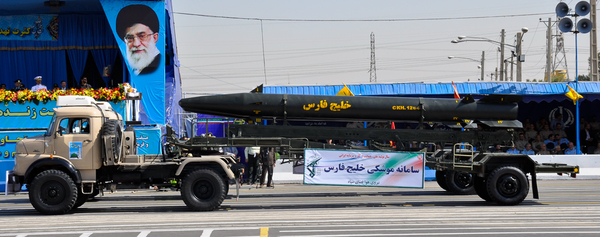
709An Iranian “Khalij Fars” mobile ballistic missile on parade in Iran. (Image source: Wikimedia Commons)

U.S. intelligence reports to Congress, for example, proclaim in all seriousness that Iran’s missiles, and even its nuclear programs, exist merely to ensure regime survival.

The Arms Control Association, for instance, approvingly quotes an administration report that, “Since the revolution, Iran’s first priority has consistently remained the survival of the regime” and that is why they are building and deploying ballistic missiles.

Iran’s missiles, we are told, are a “deterrent.” The deterrent, it is implied — is to protect Iran from the US and its allies.

Well, who can argue with that? Without their missiles and their nuclear weapons program (which, we are repeatedly assured they do not have — yet), they would be wide open to a U.S. invasion, don’t you see? And if the United States or Israel has nuclear weapons, why cannot Iran? So, the thinking seems to go, if we just leave Iran alone, then Iran’s missiles and bombs might very well go away.

This viewpoint is more widespread than many might believe. The former Director General of the United Nations International Atomic Energy Administration [IAEA], Mohamed Mustafa ElBaradei, admonished the United States and the Bush administration: “You can’t bomb your way through countries” to stop nuclear proliferation. He was implying that the U.S wanted to end nuclear proliferation in Iran, Iraq and Libya to give the U.S. a free hand to commit serial aggression against them.

During his entire time as head of the IAEA, ElBaradei also repeatedly downplayed or ignored the nuclear weapons threats from North Korea, Iran and Iraq. He said it was unfair for some countries such as the U.S. to have nuclear weapons while denying them to others, such as Iran.

He was also opposed to the liberation of Iraq, and claimed that the use of military force made terrorist problems worse. He ridiculed the U.S. and British elimination of the Libyan nuclear program largely because his agency, the IAEA, had “mysteriously” missed its very existence although it was their responsibility to monitor exactly such activities.[15]

One Times of India story put it this way: “Disarmament is for wimps. Go get your nukes if you can”.

The Washington Post ran an essay on December 2, 2013, in which nuclear-abolitionist Joe Cirincione of the Ploughshares Fund was quoted complaining, “Why is the U.S. okay with Israel having nuclear weapons but not Iran?” — again implying that U.S. concern over Iran’s potential nuclear proliferation was “unfair.”

A Christian Science Monitor essay concluded about the troubling lesson of Libya’s President Muammar Qaddafi giving up his nuclear weapons: that if he hadn’t, the U.S. and NATO would not have bombed him out of power.[16]

This sounds logical, but it is wrong. The U.S. government worked with the Libyan government to get rid of its nuclear program — which had not produced nuclear weapons fuel, let alone nuclear warheads. The two governments discussed normalizing relations after the elimination of Qaddafi’s nuclear program.

The bombing of Libya in 2011-12 took place in reaction to the terrorist threat emerging in Benghazi and the potential for mass killings in Libya. The bombing may have been misguided, but it was not triggered by Libya giving up its nuclear program in 2007.

Thus, by alleging that the US concern with Iranian or Libyan nuclear weapons programs is less than genuine, arms controllers and others in the U.S. then claim that Iran’s reluctance to abide by the rules of the Nuclear Non-Proliferation Treaty — which prohibits all but the permanent five members of the UN Security Council from having nuclear weapons — is understandable.

This view then leads to calls for even greater U.S. concessions to Iran — in order to “get a deal.” After all, it is claimed, Iran obviously has a legitimate reluctance to give ups its nuclear program with the knowledge that once Libya gave up its nuclear centrifuges in 2007, the U.S. then bombed Libya and helped overthrow the Qaddafi government four years later in 2011.

That supposed lesson is also being applied to Ukraine. In the 1994 Budapest Memorandum, Ukraine transferred its nuclear arsenal back to Russia with the assurance that Russia would guarantee Ukraine’s borders.

Today, some lawmakers in Kiev and critics of the 1994 deal have concluded that if Ukraine still possessed nuclear weapons, Russia would not have invaded either Crimea or Donetsk.

Yet at the time, Ukraine’s new leaders had no desire to become a new nuclear power and so they happily worked with the U.S. government to remove the Soviet-era nuclear weapons from their soil.

Glenn Greenwald, writing in the Guardian, echoes the idea that U.S. adversaries such as Iran have to keep whatever nuclear program they have because such weapons — once acquired — would allow Iran to “deter U.S. attacks.”[17]

The implication is that, as the U.S is such an out-of-control threat, Iran has every good reason to seek and build nuclear weapons.

The entire premise, however, that rogue states should resist having their nuclear programs dismantled because they are then more likely “to be invaded,” is wrong.

There are roughly 190 countries in the world with no nuclear weapons. Although they all lack nuclear weapons, the U.S., and its NATO and East Asian allies, have not invaded any of them and have no intention of invading them.

Afghanistan and the Taliban were removed from power because, with Osama bin Laden, they were partners in the 9-11 attacks.

Iraq was liberated from the murderous regime of Saddam Hussein because, since 1991, the Baghdad government had done everything not to comply with 17 UN resolutions; it had undermined and violated sanctions; it had armed and gave sanctuary to terrorists, and it remained committed to securing WMDs.[18]

When we refer to Iranian missiles as a legitimate form of “deterrence,” we just fool ourselves into imaging that Iranian missiles, which support aggression, are no different from American and allied missile defenses, whichprevent and deter aggression.

We have come to see Iran as a mirror image of ourselves. We assume Iran’s nuclear weapons and ballistic missiles are solely for deterrence and regime survival because, after all, that is why we in the US have both nuclear weapons and ballistic missiles — to protect our security.

But Iran’s ballistic missiles and potential nuclear weapons are to protect Tehran’s projection of power and terrorist activities, which are critical to its goals of dominating the Middle East, uniting all Muslims under its version of Islamic Shariah law, and gain the prize of having control over nearly 70% of the world’s conventional oil and gas resources — a hardly benign objective.

Judging from recent failures to counter Syria, Libya, Russia and ISIS, the U.S.’s squandering of its military might, taking a casual view of threats, and misunderstanding its enemies has led it to becoming an object of ridicule, instead of an object of fear, trust or respect.

Those can only be gained through the serious waging of war — economic, political, diplomatic and militarily — until our adversaries and enemies are defeated. Only then will they cease to fight.


[1] America in Retreat: The New Isolationism and the Coming Global Disorder by Bret Stephens (forthcoming Nov 18, 2014)

[2] See Sandy Davis, Progressive Democrats of America, “We Need To End the Disastrous Failure Of The War On Terror by Sandy Davis, February 4, 2014; or ABC News Blog: “Ron Paul Recruits Anonymous to Attack Rudy’s Foreign Policy,” May 22, 2007; and Jack A. Smith, “Terrorism–Cause and Effect”, May 29, 2010, anti-War.com; and Glen Greenwald on Salon: “A Rumsfeld-era reminder about what causes Terrorism”, October 20, 2009.

[3] Jeanne Kirkpatrick “They Always Blame America” from Jim Geraghty, The Campaign Spot, National Review, April 24th, 2013.

[4] This was explained in a detailed June 2000 letter from Congressman Chris Shays to Richard Clarke following the latter’s appearance before Shays Subcommittee on National Security, Emerging Threats and International Relations of the Committee on Government Reform.

[5] This is but one example of many cited by Michael Rubin of the American Enterprise Institute in his new book “Dancing with the Devil: The Perils of Engaging Rogue Regimes“, 2014, p. 209. Rubin notes that Senator Specter later acknowledged he had been “played by Saddam”.

[6] CNN poll as reported in FDD, 8 Sept 2014, “Majority of Americans Alarmed by ISIS”

[7] MDA Digest, September 4, 2014

[8] MDA Digest, September 4, 2014

[9] MDA Digest, August 29, 2014; and Tom Collina, “Nukes are Not the Answer to Containing Russia,” in Breaking Defense, April 11, 2014

[10] Stephen Cohen cited in the Daily Kos, February 20, 2014, “Stephen Cohen accuses Obama Administration of Coup Attempt in Ukraine” by Mark Lippman

[11] This quote was referenced by General Jack Keane, (US Army-Ret) on Fox News, Monday September 8, 2014.

[12] Admiral John Loy told me this about the IMU in a 2006 conversation we had at one of my NDUF Congressional breakfast seminars where he was the featured speaker. For an excellent review of the distortions of the UN see “UN Perversion of Human Rights“, J. Puder, Frontpage, September 8, 2014.

[13] Michael Ledeen in his “Accomplice to Evil: Iran and the War Against the West”, 2009; and Michael Ledeen, “How to Protect Against a Bad Deal With Iran“, The Hill, July 9, 2014.

[14] In a January 2014 Carnegie Europe report titled “Tehran Calling: Understanding a New Iranian Leadership”, Cornelius Adebahr says the norms Iran has had difficulty adhering to are “prohibitions against using assassinations and terrorism as legitimate tools of diplomacy” although he says the use of such tools by Iran is only “alleged” although he does admit “Iran does not accept all norms governing today’s international system”.

[15] Match Blog, October 26, 2004 and Ben Smith in Politico, January 31, 2011, quoting Malcolm Hoenlein, of the Conference of Presidents of Major American Jewish Organizations.

[16] See Reza Sanati, in the Christian Science Monitor, August 30, 2011, “A troubling lesson from Libya: Don’t give up nukes”. And NewsMax, “Ukraine Pays Price for US Advice to Give Up Nuclear Weapons” March 20, 2014; Ukrainian legislator Pavlo Rizanenko sums up the Crimea crisis: “If you have nuclear weapons, people don’t invade you.” See also “Ukraine’s Broken Nuclear Promises”, by Owen Matthews, March 19, 2014, Newsweek.

[17] Critics of US policy toward North Korea and Iran often assert both rogue states have or seek nuclear weapons to deter the United States from attacking — a variation on the “Always Blame America First Theme”. Here are two such essays: “DPRK Briefing Book: Confronting Ambiguity: How to Handle North Korea’s Nuclear Program”, by Phillip Saunders, Arms Control Association, March 3, 2003; and Glenn Greenwald, “The true reason US fears Iranian nukes: they can deter US attacks” in theguardian.com, Tuesday 2 October 2012. Greenwald also asserts “GOP Senator Lindsey Graham echoes a long line of US policymakers: Iran must not be allowed to deter US aggression”.

[18] On March 17, 2014, former Congressman Ron Paul wrote an essay in USA Today in which he said we have no interest in a fight “many thousands of miles from the US” about a country and people of “which we know almost nothing.” In the 2008 book “Munich: The 1938 Appeasement Crisis” by David Faber, British Prime Minister Neville Chamberlain is quoted saying this on September 27, 1938, just before traveling to Munich to sign a peace agreement with Chancellor Adolph Hitler:

“How horrible, fantastic, incredible it is that we should be digging trenches and trying on gas-masks here because of a quarrel in a far-away country between people of whom we know nothing. It seems still more impossible that a quarrel that has already been settled in principle should be the subject of war.

In light of the lack of seriousness with which we are treating the threats we face, it is instructive to refer to an exchange that reportedly took place between then Prime Minister Chamberlain and Winston Churchill. In this story Churchill told Prime Minister Chamberlain when the latter complained that preparing to defend England against Nazi aggression “might upset trade with Germany”: “Well, yes, Mr. Prime Minister”, said the representative from Epping/Woodford, “That would be the idea.”
Obama Calls on UN to Dismantle ISIS ‘Network of Death’

September 24, 2014

Obama Calls on UN to Dismantle ISIS ‘Network of Death

‘Wednesday, 24 Sep 2014 10:56 AM

via Obama Calls on UN to Dismantle ISIS ‘Network of Death’.


U.S. President Barack Obama addresses the 69th United Nations General Assembly
at U.N. headquarters in New York. (Kevin Lamarque/Reuters/Landov)
 

Declaring the world at a crossroads between war and peace, President Barack Obama vowed at the U.N. on Wednesday to lead a coalition to dismantle an Islamic State “network of death” that has wreaked havoc in the Middle East and drawn the U.S. back into military action in the region.

Speaking to the annual gathering of the United Nations General Assembly, Obama said the U.S. would be a “respectful and constructive partner” in confronting the Islamic State militants through force. But he also implored Middle Eastern nations to take the lead in addressing the conditions that have sparked the rise of extremists and to cut off funding to terror groups.

“Ultimately, the task of rejecting sectarianism and extremism is a generational task — a task for the people of the Middle East themselves,” Obama said. “No external power can bring about a transformation of hearts and minds.”

The president’s remarks came against the backdrop of an expanded U.S. military campaign against the Islamic State group, with airstrikes now hitting targets in both Iraq and Syria. A coalition of five Arab nations joined the U.S. this week in the strikes in Syria: Bahrain, Jordan, Saudi Arabia, United Arab Emirates and Qatar.

The U.S. also opened another military front with airstrikes this week against a new al-Qaida cell that the Pentagon said was “nearing the execution phase” of a direct attack on the U.S. or Europe.

The threats have drawn Obama back into conflicts in the Middle East that he has long sought to avoid, particularly in Syria, which is mired in a bloody three-year civil war. Just months ago, the president appeared to be on track to fulfill his pledge to end the U.S.-led wars he inherited in Iraq and Afghanistan.

Yet the militant threat in the Middle East is just one in a series of global crises that have tested Obama this year. Russia has repeatedly flouted warning from the U.S. and Europe to stop its threatening moves in Ukraine. And leaders in West Africa have criticized Obama for not doing more to help combat an Ebola outbreak that is believed to have infected more than 5,800 people in Liberia, Sierra Leone, Guinea, Nigeria and Senegal.

Obama took on Russia directly in his remarks, accusing Moscow of sending arms to pro-Kremlin separatists, refusing to allow access to the site of a downed civilian airliner and then moving its own troops across the border with Ukraine.

“This is a vision of the world in which might makes right, a world in which one nation’s borders can be redrawn by another, and civilized people are not allowed to recover the remains of their loved ones because of the truth that might be revealed,” Obama said. “America stands for something different.”

Still, Obama held open the prospect of a resolution to the monthslong conflict between Russia and Ukraine. While he has previously expressed skepticism about a fragile cease-fire signed earlier this month, he said Wednesday that the agreement “offers an opening” for peace.

If Russia follows through on the agreement, Obama said the U.S. will lift economic sanctions that have damaged Russia’s economy but so far done little to shift President Vladimir Putin’s approach.

As Obama spoke, Russian Foreign Minister Sergei Lavrov sat in the audience at the U.N., staring down at a stack of papers without glancing up at Obama.

Blog: David Rubin, The Israeli Response to Mahmoud Abbas’ Political ‘Bomb’

September 24, 2014

The Israeli Response to Mahmoud Abbas’ Political ‘Bomb’

By David Rubin9/24/2014, 7:09 AM

via Blog: David Rubin, The Israeli Response to Mahmoud Abbas’ Political ‘Bomb’ – Arutz Sheva.


t has now been confirmed that Palestinian Authority (PA) President Mahmoud Abbas is planning to ask the UN to set a timetable for the end of the Israeli “occupation” and the establishment of a Palestinian state along the pre-1967 borders, with its capital in eastern Jerusalem.

Interviewed in the Palestinian media, top PA official Jibril Rajoub has reported that Abbas will “drop a bomb” on Israel at the UN, presenting his aggressive proposal as part of a “day after” plan following the end of the current war in the Gaza Strip.

According to the Qatari News Agency, an agreement to that effect was reached in Abbas’ meeting with Qatari Emir Tamim bin Hamad al-Thani and Hamas’ political chief Khaled Meshal, in Doha last week.

Despite the fact that such a move by the Hamas-Fatah unity government at the UN is a clear violation of the Oslo Accords, which was the legal basis for the establishment of the Palestinian Authority, Israel’s political leadership is eerily silent. One might have thought that after past Israeli warnings to Abbas not to form a unity government with Hamas and not to ignore the Oslo Accords by taking hostile political steps at the UN, we would see Israeli firm action in response to this latest “timetable threat”.

The deafening silence from Israeli leaders, who still refer to Mahmoud Abbas affectionately as “Abu Mazen” (Mazen’s father), thereby putting a gentle, human face on a deceitful enemy who has continued the PA tradition of directly rewarding terrorists and their families after each terrorist attack, is very disturbing.  Despite the blatantly hostile moves taken by Abbas, there have been only weak, temporary responses, and so far, there has been no response to this latest threat, which this time he seems intent on carrying out in honor of Rosh Hashanah, the Jewish New Year. Somehow, the flaccid responses or non-responses from Jerusalem haven’t proven to be a convincing deterrent to Abbas’ political aggression.

The Israeli response doesn’t have to be complicated, but it should be very clearly stated as follows, as a direct response to hostile actions:

1. Once Abbas issues his “timetable” demand at the UN this week, make it clear to him and do so publically, that the Israeli time clock has started ticking, leading to the dissolution of his Palestinian Authority.

2. The PA was established as a result of an agreement with Israel. Once the PA unilaterally throws the responsibility for making peace over to the UN, that agreement is null and void.

3. The Levy Report, which in 2012 reaffirmed Israel’s national rights over Judea and Samaria (the so-called West Bank), should be immediately adopted, thereby replacing the Oslo Accords as the legal basis for government policy in these areas, in which the PA currently has seven autonomous cities and many defacto autonomous towns.

4. The PA should thus be declared “a hostile entity on Israeli soil”, with the ramifications of that statement for follow-up Israeli actions to be debated in the Cabinet.

While much was written during Operation Protective Edge about the need to restore Israel’s military deterrence, the real problem all along has been our lack of a political deterrence, which causes the world not to take seriously our occasional threats to respond to political aggression.

“You make of us an object of strife unto our neighbors, and our enemies laugh amongst themselves.” (Psalms 80:7)

Until we start responding with more than empty words to Abbas’ long list of hostile actions, Israel’s political deterrence will continue to be the laughing stock of the Middle East.

Special JPost interview with PM Netanyahu: ‘Who turned out to be right?’

September 24, 2014

Special JPost interview with PM Netanyahu: ‘Who turned out to be right?’.

Surprisingly buoyant, Prime Minister Binyamin Netanyahu sits down with ‘the Post’ and extols policy-making based on looking at the region as it truly is, without wishful thinking.

Power invigorates.

That must be the reason Prime Minister Binyamin Netanyahu appeared extremely chipper Sunday afternoon, during a 30-minute pre-Rosh Hashana interview with The Jerusalem Post.

Just a month after Operation Protective Edge, in the midst of a percolating political crisis both within his party and in his coalition, as Iran, Islamic State and Hezbollah are either near or at the gates, one would think there would be signs of strain and fatigue on the prime minister’s face, extreme agitation in his demeanor.

But when Netanyahu met with the Post in his Jerusalem office just an hour or so after a budgetary meeting with Finance Minister Yair Lapid that did not produce an agreement, he looked – counter-intuitively – as fresh and relaxed as if he had just left the gym and was ready to start a promising new day.

“How are you doing?” I asked innocuously on entering.

“Good,” he replied. “Really, very good.” His jaunty manner, surprisingly, did not belie his words, leaving this guest wondering how – with everything going on in the region and in his coalition, and with the fate of the Jewish people resting on his shoulders – he could claim to be doing “good.”

But then you hear him talk, and it starts to make sense.

Having now spent nearly nine years as prime minister, without a serious political challenger anywhere on the horizon, Netanyahu is a man who feels not only confident, but vindicated. He is looking out at the world with a barely suppressible I-told-you-so attitude.

Netanyahu is a leader who feels he has correctly predicted the future, often going very much against the grain to do so.

He accurately foresaw the disastrous consequences that would follow the 2005 withdrawal from the Gaza Strip; he predicted the Arab Spring would not – as the Thomas Friedmans of the world gushed – give birth to “Liberté, Égalité, Fraternité” in the Arab world; and he pushed hard, and successfully, for tough economic sanctions against Iran, saying this would have a significant impact on the country.

He also feels vindicated by the recent Gaza operation – that it proves to all the absolute necessity of the security requirements he has so long demanded from the Palestinian Authority, before signaling a willingness to withdraw from any additional territory .

“I call it like I see it,” he said, clearly relishing that role, even if it means needing to “punch through the rising tide of political correctness.”

Political correctness, and – he could have added – “conventional wisdom.”

Conventional wisdom holds that coming out of Operation Protective Edge, now is the time for Israel – with its image tarnished in much of the world – to put forward a daring new diplomatic initiative, if not necessarily to pave the path to an elusive peace agreement, then at least to “change the atmosphere.”

Netanyahu isn’t buying.

Those hoping to see a bold new Israeli diplomatic push will be disappointed.

What is needed now instead, he said, is to “create the equation between our battle against Hamas, and the West’s battle against ISIS [Islamic State].” And as the West continues to battle Islamic State, more and more people will come to understand the true nature of the Islamic threat on Israel’s porch, something that “will help alleviate some of the criticism that is leveled against Israel.”

Maybe yes, maybe no. But Netanyahu harbors no doubts. Ticking off some of his previous forecasts that turned out to be correct, Netanyahu asked, “Who turned out to be right?” Power invigorates. So too, it seems, does a sense of vindication.

In the Rosh Hashana message you taped, you spelled out five challenges facing Israel in this order: Islamic State, Hamas, al-Qaida, Hezbollah and Iran. Which of those, in your mind, is the biggest immediate danger to Israel?

The biggest threat without question is the marriage of militant Islam with nuclear weapons, which means Iran.

That is the biggest immediate threat?

It is the biggest immediate, medium and long-term threat to Israel, and to the world. Militant Islamists… have global ambitions. Not only ambitions to dominate the Middle East, but also warped ambitions to impose their horrible creed on the entire world.

There is no room for the infidels. No room for Jews, Christians, or secularists.

There is no liberty for women, who are treated as chattel, or for gays, or for minorities who are persecuted or annihilated altogether.

That is a terrible danger as it is, but it would become intolerable if these movements – or the regimes on which they are based, or the terrorists they field – have weapons of mass destruction.

Imagine ISIS [Islamic State] with chemical weapons, or with nuclear weapons. This is effectively what you would have with Iran, which is governed by an Islamic militancy that knows no bounds.

This is a great threat for the world, but first of all a great threat to us. Because we are the outpost of the civilization they abhor so much and wish to wipe off the face of the earth. They say as much. They mean it, and I take them at their word.

Iran said it is willing to join the fight against ISIS if the West shows more flexibility in the nuclear negotiations, specifically on the number of centrifuges they can retain.

How big of a concern is that for you?

That in itself is an absurd claim. Iran fights ISIS because of its own internal dispute over who will rule the Islamic world they want to impose.

For them, the battle against ISIS is derived from that.

It is the same thing with [Syrian President Bashar] Assad and Hezbollah. They fight ISIS for the same reason – because it is in their own interest. Suppose Assad would say, “I’ll fight ISIS if you give me chemical weapons back.” What would you say to that? It’s about as logical as the absurd claim that is now being made by Iran.

They fight ISIS anyway, and should not be rewarded with weapons of mass destruction.

To arm a militant regime like Iran with nuclear weapons is folly in itself, but to do so in order for them to fight what they are going to fight anyway is a double folly.

Does the West understand that?

I hope so. I do.

You’ve said over and over that ISIS is Hamas, and Hamas is ISIS, that they are both different branches of the same poisonous tree. This has not been accepted in the world. For instance, the US State Department spokeswoman said recently there is no comparison.

There are minor differences, to be sure. One wants to impose an Islamic caliphate, the other wants to impose the Mahdi [prophesied redeemer of Islam]’s return. One wants to return to the 11th century, the other to a 9th-century regime. There are other differences, but they are tactical.

The larger shared ambition is regional and ultimately global domination with no observance of human rights, pluralism or democracy, but rather the espousal of violence against their own people and everyone else.

As far as getting the message across about the similarity of the shared nature of the militant Islamists and what they represent, I think that message is getting through.

I have had long experience putting forward certain conceptions about fighting terrorism or airline hijackings, or putting sanctions on Iran or opening up our economy for competition, and many other causes and concepts that I’ve espoused that initially received the cold shoulder, but which over time more and more people accepted as self-evident truths.

They are not self-evident, but have to be punched through the rising tide of political correctness. That has never daunted me; I call it like I see it.

If you don’t identity a threat correctly, If you don’t diagnose the disease correctly, you are unlikely to treat it correctly.

And this is the first step in addressing this threat now endangering the entire world.

Is the world correctly diagnosing this threat?

It is beginning to. I’m not sure it is quite there yet, but it is moving in that direction – and that is something that we should help advance. The ones who see it best are actually many of our Arab neighbors.

They see it best; they see it clearly.

Indirect talks with Hamas are due to start tomorrow in Cairo. The presumption is that we are going to ask to keep Hamas from rearming, and prevent the demilitarization of Gaza. They are going to ask for things in return as well. What are you willing to give them?

If they don’t rearm and there is a mechanism for demilitarization, would you be willing to give them a seaport?

I’ve said more than once, that when Gaza is demilitarized and abandons the goal of destroying Israel, we are open to considering anything.

But that presumes the pacification of Gaza and the espousal of peace. That has always been our position. We don’t oppose a seaport in any Arab country.

I say that as an understatement; that is not an issue.

The real issue is whether we can ensure Israel’s vital security interests, and enable the reconstruction of Gaza and humanitarian assistance under our security requirements.

That, I think, will be the focus of what will be discussed, and certainly the focus of our current policies.

Why continue to do it indirectly? If everyone knows we are talking to Hamas, only doing it through the Egyptians, why not just cut out the middle man?

I think there is a big difference between these talks and political negotiations. That’s why I made sure the delegation is composed of security people.

It wasn’t happenstance, it was by deliberate design.

Often in situations of war, and even in the war against terrorism, you deal with sworn enemies through intermediates on certain matters of security, cease-fires or other matters.

Otherwise, there would never be a cease-fire. You always have to deal with someone, but you want to make sure that you don’t accord people who are committed to the war of terror against us any kind of political recognition.

This is the right policy.

What we want to make sure is that we go through the Egyptian channel, in order to secure Israel’s vital security interests. We are not going beyond that point into any kind of political negotiations with Hamas.

In your press conference on the day after the Gaza operation, you said there is presently a “reorganization” of forces in the Middle East creating a “possible diplomatic horizon for Israel that holds within it new possibilities for our state.” That’s a great statement, but amorphous.

Can you put any meat on that? What does that mean?

If you want to put any meat on that, don’t go beyond that publicly. If you want to do something that is not for the next headline, but to go somewhere, you want to explore whether the growing recognition of common challenges in the region can also translate itself into sharing the burden for peace among regional partners.

That is a delicate process.

Certainly a discrete process, and it remains to be seen whether we have such partners.

It is too early to say.

Would you be willing to accept the Saudi peace initiative now?

The question is not the Saudi peace initiative. If you read it carefully, you’ll see it was set up in another period: before the rise of Hamas; before Hamas took over Gaza; before ISIS took over chunks of Syria and Iraq, effectively dismantling those countries; before Iran’s accelerated nuclear program; before the takeover of Syria by al-Qaida on the Golan Heights.

Is it now irrelevant?

What is relevant, I think, is the fact that there is a new recognition among major countries in the Middle East that Israel is not their mortal enemy, to say the least, but a potential ally in addressing the common challenges. And whether we can translate that recognition of a political horizon into a peace proposal – a realistic peace proposal – is something worth exploring.

But I don’t think more can be said at this point.

But I will say that it has to be realistic. We pursue peace without ever disconnecting our wishes from our senses, from what we see around us.

You cannot pursue peace with a complete detachment to the reality around us. I never do.

I think the sober, responsible and careful approach has proven the correct one.

People say all the time, “Why don’t you take the plunge?” I think people are very lucky I didn’t take the plunge. The plunge we took in Gaza produced an Iranian proxy state in which thousands of rockets have been fired on Israeli cities, which has become a terrorist bastion that is poised like a dagger against the heart of Israel.

Some people celebrated.

I didn’t. I resigned from the government when that decision was finally made. And I warned about many of the things that came to pass.

At the time I was accused of being unimaginative, of being a doomsayer. I was completely realistic. In fact, the people who irresponsibly charged ahead proved to be wrong, we turned out to be right.

The same is true of the so-called Arab Spring. Everyone had the Pollyannaish view that the forces of liberal democracy would take over the entire Arab world. I cautioned them it was at least as equally possible – I said this as an understatement – that the forces that would come to the fore would be Islamists. Who turned out to be right? In this environment, you have to be sober and open to changes. The change that is evident is the realignment against the three sources of Islamic terrorism that threaten the Middle East: one led by the Muslim Brotherhood in Egypt; the second by the various branches of al-Qaida and its offshoots, including Jabhat al-Nusra and ISIS; and the third by the Shit’tes, the radical Shi’ites led by Iran with its Hezbollah proxies.

We can explore the possibilities for cooperation, not only to resist those forces but to establish a peace we can defend. But, as I say, we should do that carefully and responsibly.

Is that exploration happening now?

I think it is worth exploring, but I cannot tell you we have crossed the divide. Everything that I’ve been speaking about [in the past] in terms of Israel’s security needs in a potential peace agreement with the Palestinians has become sharply more evident after our experience in Gaza.

We walked out of Gaza and were promised this would open the way for a broader peace, and instead it was the very opposite: rockets, terror tunnels, unmanned aerial vehicles; ground, naval and air assaults on Israel. We don’t want that to happen again. Therefore, our security requirements, as well as the idea that on the opposite side of any potential border you have an entity that wants to live with you and not destroy you, these are basic needs that have been more than borne out by our experience in Gaza.

You mentioned not wanting to take the plunge. But Israel took a hit during the Gaza operation in public opinion in the West, and it seems that to restore Israel’s standing, there will be a need to initiate something diplomatic.

I think there is a need, on the contrary, to create the equation between our battle against Hamas, and the West’s battle against ISIS.

There is a situation now where the US and many other countries are – for good reason – going to take action against ISIS. Israel took such action against an organization – Hamas – that when we started the campaign was twice the size of ISIS.

This can give people an appreciation about how determined we were to strike at them, what force we used. But even then, we used force with judiciousness. It is tough to imagine what would have happened had the situation been reversed, if they had the power we had. What would they have done? Of course we don’t use – as democracies seldom, if ever, have done since 1945 – all the power we have, because we are constrained by considerations that guide democracies. We don’t target civilians. We don’t indiscriminately flatten cities.

We don’t do that, nor – as a rule – do democracies.

Yet I think Western democracies are going to find as they fight ISIS that it will challenge them more and more, because they [ISIS] use the same tactic.

They target civilians, they hide behind civilians, and they also kill their own civilians. This is exactly analogous to what Hamas is doing.

The reason Israel was criticized in the West, besides the influence of Islamic minorities in the West and the far Left, is that some people did not understand the common nature of the battle, of the danger, that threatens all of us.

I think that as time goes by more and more will understand, and it is our task to make that even more comprehensible.

That will help alleviate some of the criticism that is leveled against Israel.

In any case, we are open to a resumption of political negotiations, but to achieve a durable and responsible peace.

That is based on two principles: recognition and security.

Recognition because you make peace only with those who are willing to make peace with you, and security because that willingness may unravel over time.

So you need very strong security arrangements on the ground, as has been clearly demonstrated in Gaza, in order to avoid the repetition of Gaza – something that I am absolutely determined to achieve.

They are signaling me our time is up, so let me ask one political question.

How do you feel now [after Interior Minister Gideon Sa’ar’s surprise resignation last week] when you read critics saying that you are chasing away all the up-and-coming stars in the Likud Party, and you are not allowing anyone to grow in your shadow?

You know, I have had the opportunity to be in several places around the country. To go to the beach, a number of times, to meet citizens. And I actually see the exact opposite approach.

People come up to me, and I don’t mean only Likud members – that is obvious, there is enthusiastic support there – I mean people from many other parts of the Israeli political spectrum. And they come to me and say, ‘Prime minister, we want to tell you how much we appreciate the way you led the country during the [Gaza] operation.’ I have not seen any diminution in the support for me as compared to what it was before the operation, or during the years that I have led the country, and I have not seen diminution in support for the Likud.

But won’t it hurt the Likud when Gideon Sa’ar leaves?

Quite the contrary, I’ve seen a strong increase. That’s all I would say.