Archive for September 21, 2014

Al Nusrah Front threatens to execute 2nd Lebanese hostage

September 21, 2014

Al Nusrah Front threatens to execute 2nd Lebanese hostage, Long War Journal, Thomas Joscelyn, September 21, 2014

Screen Shot 2014-09-21 at 2.16.39 PM-thumb-560x292-3761

The Al Nusrah Front, al Qaeda’s official branch in Syria, is threatening to kill a second Lebanese hostage held in its custody. The man has been identified as Ali al Bazzal.

The threat was posted in tweets on one of the group’s official Twitter feeds. A banner containing the threat can be seen above.

In addition, a video posted online appears to show the group executing another Lebanese hostage, Mohammad Hamiyeh. In a tweet on Sept. 19, Al Nusrah said that Hamiyeh “is the first casualty of the stubbornness of the Lebanese military that has become a puppet in the hands of the Iranian party.”

The “Iranian party” is Hezbollah, which is fighting alongside Bashar al Assad’s forces against Al Nusrah and other rebel forces.

Lebanese officials subsequently confirmed that Hamiyeh has been killed. The al Qaeda group had repeatedly promised to kill Hamiyeh if its demands were not met.

The video shows a man shooting Hamiyeh in the head, with Bazzal sitting to his right. Bazzal then pleads for his life, saying that Hezbollah, the “party of the devil,” must alter its operations.

“If you don’t stop attacking and inciting against our Sunni brethren then I will follow my fellow soldier who was killed right there,” Bazzal says, according to The Daily Star, a publication based in Lebanon.

The video does not appear to have been posted on Al Nusrah’s official Twitter feeds, but instead surfaced online separately. For instance, the banner shown above was posted on Al Nusrah’s Twitter feed for the Qalamoun region of Syria. The video was not posted on the same feed.

The version of the video viewed by The Long War Journal also does not contain Al Nusrah’s official media logo.

Still, the image of the man identified as Bazzal in the video matches the picture in banner republished above, which was released by Al Nusrah.

The banner contains the question, “Who will pay the price?” Al Nusrah used that same question in the first video it released showing its Lebanese hostages, who were captured in August, as well as in subsequent statements and online banners.

The al Qaeda group says that Hamiyeh was the first to pay the price, because the Lebanese army and Hezbollah have not met their demands. Al Nusrah has said previously that it wants Hezbollah to remove its fighters from Syria, and a number of other conditions met. As in Al Nusrah’s past hostage operations, the government of Qatar is attempting to broker the negotiations.

Al Nusrah has shied away from killing its captives in recent weeks, releasing hostages on several occasions. The organization has not produced graphic beheading videos like its counterparts in the Islamic State, a jihadist group that has captured large swaths of territory in Iraq and Syria since earlier this year. The Islamic State and Al Nusrah are fierce rivals.

While it has not produced gory execution videos like its rivals in the Islamic State, Al Nusrah has now executed a Lebanese soldier and threatened to kill another hostage.

Video games, Twitter tricks: How ISIS pulls in the kids

September 21, 2014

Video games, Twitter tricks: How ISIS pulls in the kids, Times of IsraelDavid Shamah, September 21, 2014

The Islamist extremists need young members to build Caliphate dream; social media is good for recruitment strategy.

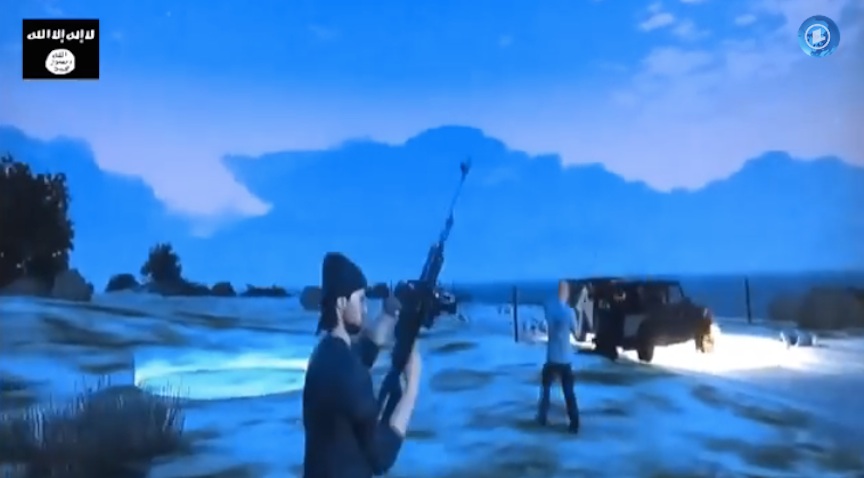
jihad3-635x357Scene from the Jihad Simulator trailer (Youtube screenshot)

Get the kids on your side. That’s a strategy used by 20th century tyrants from Stalin to Hitler to Pol Pot for gaining and retaining power. The 21st century tyrants of ISIS, the Islamist group that seeks to set up a Muslim Caliphate in as much of the Middle East as possible, are using the latest tools in their quest for youth.

Over the past year, the group has made a splash on social media, producing slick recruitment videos, developing on-line games and activities, and utilizing Twitter to send out messages to users’ networks.

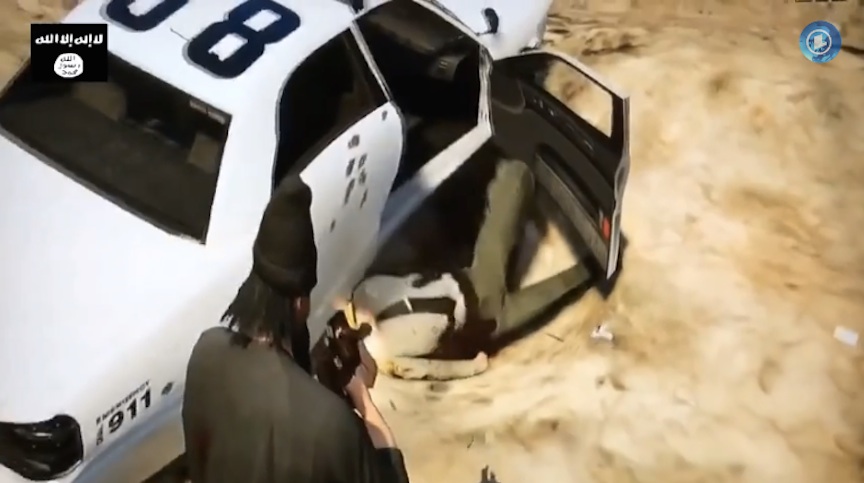
In its latest social media foray, ISIS released a trailer for a game called the “Jihad Simulator,” which looks suspiciously like the wildly popular Grand Theft Auto video game. In Jihad Simulator, players hijack military vehicles and blow them, carry out drive-by shootings of police cars with markings used by American police department), and shoot up what appears to be a school or office park. The video shows the perpetrators not as kaffiyeh-wearing terrorists, but as long-haired American kids wearing hoodies and knit wool hats. And, of course, players get points for every “kill” or explosion they successfully pull off.

It’s not clear who uploaded the video, and there was no website link for the actual game. As of Sunday afternoon, the video had not been taken down by YouTube administrators. Still floating around on the Internet are the videos showing the beheadings of James Foley and Steven Sotloff, journalists captured by ISIS and brutally murdered. Those videos were also posted on YouTube and quickly removed but can still be found — so it’s likely that the Jihad Simulator promo will have a long on-line life as well, regardless of what YouTube does.

ISIS is as concerned with Arabic-language video and news sites as it is with the Western-oriented YouTube, and according to Arabic news sites, there are dozens of Arabic language ISIS recruitment videos and even several Jihadist games floating around the Internet. In one game aimed squarely at kids, Egyptian media reports, players use animated characters to attack Iraqi and American forces, also represented by cartoon characters. There’s no blood, but there is a lot of killing, and the game drives home a message of just how much “fun” Jihad can be, what with all the cartoon killing, the Egyptian report said.

ISIS has plenty of other social media tricks, according to US cyber-security firm ZeroFox. In a special report, the group said that ISIS “has built a sophisticated and impactful online propaganda campaign using many social media networks, including but not limited to Facebook, Twitter, YouTube and WhatsApp. The group employs experts in the areas of marketing like experts from Las Vegas search engine optimization, PR and visual content production to ensure the legitimate appearance of its messages.”

jihad4Scene from the Jihad Simulator trailer (YouTube screenshot

One of the simple but effective methods spammers use to gear on-line conversation their way is by using hashtag hijacking, in which spammers use hashtags of trending Twitter topics in their own tweets to get the attention of people searching for a subject. With this tactic, ISIS could, ironically, soon be sending out Jihadist and anti-American tweets using #worldseries, when the championship games of the Great American Pastime take place in October. Twitter’s demographic skews young, and by choosing hashtags that highlight topics kids are talking about and searching for on Twitter, said ZeroFox, ISIS can make sure the people they’re most interested in have access to their message

ISIS also uses a version of a tweet forwarding app which allows them to use member accounts to send out tweets on its behalf. The Arabic-language “The Dawn of Glad Tidings” app, which was until recently available in several Google Play stores, promises to give users up to the minute news about what is happening on the ground in Iraq and Syria – but also has an option that allows users to automatically forward ISIS-oriented tweets. ZeroFox said the idea is that the tweets will reach “hundreds or thousands more accounts, giving the perception that their content is bigger and more popular than it might actually be.”

ISIS also utilizes bot networks to spread its message. An old hacker standby, bot networks are essentially large groups of hacked computers that are surreptitiously used to forward e-mail and social media messages employing the user accounts of the owners of the computers. They’re usually used to send out spam, but ISIS is using it to send out recruiting messages, mostly in Arabic, and with links to images and videos designed to appeal to the young recruits it covets.

jihad2Scene from the Jihad Simulator trailer (YouTube screenshot)

US and European-based services can try to shut out ISIS social media efforts by closing down accounts that post their content – but new accounts are being opened as quickly as Twitter, YouTube, and Facebook close ISIS-oriented content pages. But good luck shutting down ISIS on its home turf — the vast Arabic Internet – said ZeroFox.

“We have seen social media platforms act as channels for virtual grassroots campaigns, where the voices of millions coalesce into a single actionable goal,” said the cyber-security organization. “ISIS has taken this use of these platforms a step further by mastering the art of taking the voices of few and making them sound like the voices of millions. It is of utmost importance that the users of social media understand the real-world impacts it can have, because unfortunately, social media is not always used for good.”

 market

The muddled strategy of Jubilation T. Obama

September 21, 2014

The muddled strategy of Jubilation T. Obama, Dan Miller’s Blog, September 20, 2014
Obama continues to insist on leading from behind; that’s the most He can do. Who in his right mind would follow Him were He to try to lead from the front?

“Moderate” Islamists

Commander in Chief Juilation T. Cornpone Obama, Nobel Peace Prize recipient and Hero of the Obama Nation, has His own ideas about the “non-Islamic” Islamic State (IS) with which He is or isn’t at war (or going to war) with the help of “moderate” Islamists.

It is not out of ignorance that President Obama and Secretary Kerry are denying the Islamic roots of the Islamic State jihadists. As I argued in a column here last week, we should stop scoffing as if this were a blunder and understand the destructive strategy behind it. The Obama administration is quite intentionally promoting the progressive illusion that “moderate Islamists” are the solution to the woes of the Middle East, and thus that working cooperatively with “moderate Islamists” is the solution to America’s security challenges. [Emphasis added.]

. . . .

[T]he term “moderate Islamist” is an oxymoron. An Islamist is a Muslim who wants repressive sharia imposed. There is nothing moderate about sharia even if the Muslim in question does not advocate imposing it by violence.

Most people do not know what the term “Islamist” means, so the contradiction is not apparent to them. If they think about it at all, they figure “moderate Islamist” must be just another way of saying “moderate Muslim,” and since everyone acknowledges that there are millions of moderate Muslims, it seems logical enough. Yet, all Muslims are not Islamists. In particular, all Muslims who support the Western principles of liberty and reason are not Islamists.

If you want to say that some Islamists are not violent, that is certainly true. But that does not make them moderate. There is, moreover, less to their nonviolence than meets the eye. Many Islamists who do not personally participate in jihadist aggression support violent jihadists financially and morally – often while feigning objection to their methods or playing semantic games (e.g., “I oppose terrorism but I support resistance,” or “I oppose the killing of  innocent people . . . but don’t press me on who is an innocent). [Emphasis added.]

Perhaps Obama doesn’t know or doesn’t care what He wants to fight, beyond sagging poll numbers.

Coalition of the unwilling

His coalition of the unwilling is a diverse bunch, but how can He lead them, even from behind, when He can’t convince himself or them of much of anything?

Despite being the greatest orator of the last thousand years, he’s a complete bust at selling anything but himself, as comprehensively demonstrated in his first couple of years: see his rhetorical efforts on behalf of ObamaCare, or Massachusetts Senate candidate Martha Coakley, or Chicago’s Olympics bid. When it comes to war, he suffers from an additional burden: before he can persuade anybody else, he first has to persuade himself. And he can’t do it. So he gave the usual listless performance of a surly actor who resents the part he’s been given. It’s not just the accumulation of equivocations and qualifications – the “Islamic State” is not Islamic, our war with them is not a war, there’ll be no boots on the ground except the exotic footwear of a vast unspecified coalition – but something more basic: What he mainly communicates is that he doesn’t mean it. [Emphasis added.]

Coalition Islamists want to retain their own regional powers but have few quarrels with Islam (Egypt under President Sisi may be an exception as to Islam). Saudi Arabia?

Islamic State terrorists have infamously decapitated three of their prisoners in recent weeks. That is five fewer than the Saudi government decapitated in August alone. Indeed, it is three fewer beheadings than were carried out in September by the Free Syrian Army — the “moderate Islamists” that congressional Republicans have now joined Obama Democrats in supporting with arms and training underwritten by American taxpayer dollars.

The Obama administration regards the Saudi government as America’s key partner in the fight against Islamic State jihadists. The increasingly delusional Secretary of State John Kerry reasons that this is because the fight is more ideological than military. Get it? The world’s leading propagators of the ideology that breeds violent jihad are our best asset in an ideological struggle against violent jihadists. [Emphasis added.]

. . . .

Saudi Arabia is the cradle of Islam: the birthplace of Mohammed, the site of the Hijra by which Islam marks time — the migration from Mecca to Medina under siege by Mohammed and his followers. The Saudi king is formally known as the “Keeper of the Two Holy Mosques” (in Mecca and Medina); he is the guardian host of the Haj pilgrimage that Islam makes mandatory for able-bodied believers. The despotic Saudi kingdom is governed by Islamic law — sharia. No other law is deemed necessary and no contrary law is permissible.

Boots on the ground

The Obama Nation will have no “boots on the ground.” Obama, a specialist in all specialities and wiser in all matters than anyone else, apparently believes that He knows better about military matters than do His past and current military advisers.

Retired Marine Gen. James Mattis, who served under Obama until last year, became the latest high-profile skeptic on Thursday, telling the House Intelligence Committee that a blanket prohibition on ground combat was tying the military’s hands. “Half-hearted or tentative efforts, or airstrikes alone, can backfire on us and actually strengthen our foes’ credibility,” he said. “We may not wish to reassure our enemies in advance that they will not see American boots on the ground.”  [Emphasis added.]

Mattis’s comments came two days after Army Gen. Martin Dempsey, the chairman of the Joint Chiefs of Staff, took the rare step of publicly suggesting that a policy already set by the commander in chief could be reconsidered.

Despite Obama’s promise that he would not deploy ground combat forces, Dempsey made clear that he didn’t want to rule out the possibility, if only to deploy small teams in limited circumstances. He also acknowledged that Army Gen. Lloyd Austin, the commander for the Middle East, had already recommended doing so in the case of at least one battle in Iraq but was overruled. [Emphasis added.]

Perhaps a few of Obama’s Islamist allies will supply a few boots on the ground.

The “moderate” Islamists Obama wants to train and equip, now with Congressional approval, are little if any better.

Air strikes

Air power, provided by the Obama Nation and apparently now also by France, could be useful in degrading and destroying enemy leaders and their military equipment. However, Obama says that He will micromanage the process in Syria.

A man who’s a better speechwriter than his speechwriters, a better political director than his political directors, and who knows more about policy than his policy advisors must surely also be a better general than his generals, no?

The U.S. military campaign against Islamist militants in Syria is being designed to allow President Barack Obama to exert a high degree of personal control, going so far as to require that the military obtain presidential signoff for strikes in Syrian territory, officials said.

The requirements for strikes in Syria against the extremist group Islamic State will be far more stringent than those targeting it in Iraq, at least at first. U.S. officials say it is an attempt to limit the threat the U.S. could be dragged more deeply into the Syrian civil war… [Emphasis added.]

Throughout President Obama’s time in office, the White House has kept close control of counterterrorism targeting, reserving the right to sign off on strikes against al Qaeda and other militant targets in Yemen, Pakistan and elsewhere.

Defense officials said that the strikes in Syria are more likely to look like a targeted counterterrorism campaign than a classic military campaign, in which a combatant commander picks targets within the parameters set by the commander in chief.

President Johnson micromanaged airstrikes during the Vietnam war and joked (?) that no outhouse could be attacked without his approval. Obama, if He is awake and preoccupied with neither of the heavy burdens of office He bravely shoulders — golfing and fund raising — may perhaps manage it almost as well as did Johnson. Oh well. He may get a few IS leaders lurking in outhouses. Unfortunately, the IS is a many headed hydra: lop off one head and two replace it. Destroyed military equipment? Newly armed “moderate” Islamic jihad groups will provide more, willingly or otherwise.

The Commander in Chief, Jubilation T. Obama

The Confederacy had no General Cornpone. The Obama Nation now has its own, as the Commander in Chief. He is the leader who can best implement His “strategies,” if and when He decides what they are and how to do it. Please pay attention to the lyrics. How many analogies are there to our current Commander in Chief?

The country’s now in the very best of hands, at least since 2009.

But be of good cheer: help is on the way. Here are some better ideas than Obama has offered thus far:

Finally, the really good news

There is still one shimmering example of efficiency and wisdom in the Obama Administration, the Department of Homeland Security, which protects us from Tea Party and other far right terrorists, foreign and domestic. It’s right at home where it should be, in a (former) insane asylum. Here is a picture of DHS personnel hard at work doing their best for we the people:

Lunatic Asylum

Jubilation T. Obama is the demented gentleman to the far left rear of the photo, leading the DHS from His customary position.

UPDATE:

Rick Moran posted an article titled Defense Secretary Hagel to Review Pentagon-NFL Ties at PJ Tatler. His onerous new duties might keep the Secretary of Defense out of trouble by limiting any bothersome ruminations on insignificant military concerns such as those affecting the “non-Islamic” Islamic State, et al.

FURTHER UPDATE:


EXCLUSIVE: Q and A with former Islamic State member

September 21, 2014

EXCLUSIVE: Q&A with former Islamic State member, Your Middle East, Rozh Ahmad, September 19, 2014

IS pic

Islamic State (IS) member “Sherko Omer” would now be a dead jihadist hadn’t he surrendered to the pro-Kurdish People’s Protection Units (YPG) in northeast Syria earlier this year. Journalist Rozh Ahmad met him to learn more about the experience.

In this interview “Omer” explains how he left his hometown in Iraqi Kurdistan to join the Syrian opposition and eventually became an IS member, what he witnessed and the reasons for which he risked his life to exit the extremist Islamic organisation.

Why and how did you join the Islamic State (IS) in Syria?

Two friends and I decided to leave Iraqi Kurdistan to join the Syrian opposition and its fight against the regime. In October 2013 we got contacts from several people close to the Kurdistan Islamic Group (Komal) in my hometown, Halabja. We were told that the contacts were members of the Free Syria Army (FSA). We met the contacts in Turkey and they took us to a hotel for few days. Afterward, they took us to a training camp on the Turkey-Syria border and we found ourselves at an ISIS (or IS) camp instead of FSA.

But how is it possible that you weren’t aware your contacts were IS jihadists?

Well, we spoke with them in standard Arabic but they did not mention anything about IS until we were at the training camp. They talked against the regime as a machinery killing its own Muslim people and we had already heard that from FSA on TV. Moreover, they had no beards, dressed in modern clothes and even took us to a hotel in the Turkish city of Kilis. We therefore assumed that they were FSA not IS, as did many others who came to Turkey to join the Syrian opposition but joined us at the IS camp.

Is it true that IS trains new recruits for beheadings on dead bodies at the camps?

Not true for the camp I was at, where beheading training was practiced with chickens and other animals. I did not do it because when we arrived they asked for my skills and qualifications and because I am a technical professional and I had qualifications, I was assigned to technical works and trained with pistols and lightweight weapons. This is because my main duty was to learn the communication equipment, interception of enemy phone and radio lines as well as rescuing digital gadgets and archives during attacks. I never engaged in a firefight and this was the precise reason why Kurdish YPG fighters agreed to hand me back to my family after months of investigations.

How did IS members treat you as a new recruit?

IS commanders were very nice and respectful at the camp. You would think you knew them for many years. They gave us the best food; clothes, weapons and we enjoyed the friendship and brotherhood. In reality we knew deep inside there was a choice to leave, but (we started) to think of ourselves as fighters taking this brotherhood and luxury to Syria and we were told that we had secured a place in heaven too, that was very comforting. But beside these facts, to be honest staying also felt like a moral obligation since they spent money, gave us food, clothes, cars and respected us so much that leaving the camp felt like betraying the good deeds of those people.

What about the promise of virgin angles [sic] in heaven, is there any truths to this?

Yes, of course. We were told that as martyrs we would have 72 eternal virgins in heaven and we can save dozens of our close relatives from hell too.

So, IS promises its’ recruits 72 virgin angels and you are saying this is not “anti-Islamic propaganda” as some people may otherwise claim?

We were promised women in heaven and on earth too based on IS jihadist teaching of the verses of some Suras of the holy book of Quran and hadiths by prophet Muhammad, all of which were explained through the Tafsir (explanation) by Islamic scholars like Ibn Majah, Bukhari and Ibn Kathir. We were told all non-Muslim women prisoners will be our wives and God wills it.

In Islamic holy war you cannot kill enemy women and children under any circumstances, they can only be taken as prisoners. It is permissible to have sexual intercourse with the captive women even if jihadists are married. You can buy and sell these women but for the children you have to raise them as home workers or teach them to become jihadists. I did none of these things because I was a communication technician not in the battlefield. And, who would claim otherwise when IS openly and proudly say they are carrying out these acts as implementation of Islamic Sharia.

Nonetheless, there are Muslim women who willingly offer their bodies for IS jihadists and this is called “Sex for Jihad” and they too will be compensated in heaven according to IS. However, these women were mostly with the commanders, I did not see average jihadist fighters with these Muslim women.

And everyone believed in this at the camp?

The consequences of disbelieving were not clear in an environment where they practice beheading. Nonetheless, many IS jihadist fighters truly believed all this but foreign recruits had no clue as to what the verses of holy Quran actually meant. I saw many foreign recruits who were put in the suicide squads not because they were “great and God wanted it” as IS commanders praised them in front of us, but basically because they were useless for IS, they spoke no Arabic, they weren’t good fighters and had no professional skills.  They were brainwashed into the “women in heaven” and those they could rape on earth before they eventually killed themselves. I am alive partly thanks to my qualifications.

You have to remember that IS has been portrayed as an organisation of gangs only, although this is evident what they do, but the political leadership pay unbelievable attention to education and educated recruits. But at the end of the day good moral values are based on the way education and intelligence are being used.

So IS jihadists could just take women prisoners and sleep with them against their will, which the world considers rape?

Not only I say this but the IS emirs and commanders openly and proudly says it too. They believe it is permissible to sleep with women prisoners even against their will if they are infidels, non-Muslims and apostate women.  This happened to Christian women in Al-Raqqa after their husbands were publically beheaded and I witnessed it. Now it is happening to Kurdish Yezidi women of Sinjar in Iraqi Kurdistan.

What did you witness in Al-Raqqa?

After training, my two Kurdish friends left to A’zaz where they have been confirmed killed now, but I was assigned to work as a technician in Al-Raqqa in the communications department. I was once told to go to a house to test some equipment to see if they can be useful for the technical and communication bureau. Once inside I realised it was a Christian home.

I saw six jihadists demanding that a Christian women and her daughter become their wives. The daughter was about 12-13-years-old. I told the jihadists forcing women is forbidden in Islam and children can’t be touched under any circumstances. They loaded their guns in my face and told me to leave. I immediately left to the local court that was based in a small house, but the judge was worse, he said I was wrong because 13-year-old girl is not considered a child, essentially because prophet Muhammad married his wife, Aisha, when she was only 9 years old. He accused me of having poor faith in the practices of prophet Muhammad for which I could have been detained and possibly punished with tough sentences, but my field commander soon arrived and saved me.

This was the reason that made you leave IS?

I wanted to leave first week into my post in Al-Raqqa but I was a coward, scared of getting beheaded and did not know my way out. Unlike at the camp, IS jihadists acted as God in Al-Raqqa. They were rude, arrested and killed anybody for no real reason.

I decided to risk my life to escape after I witnessed a wounded captured Kurdish YPG fighter publically beheaded. He was about my age, but unlike me he was extremely brave. He spat on every jihadist around him. He shouted slogans about Kurdish freedom and Abdullah Ocalan. I had never seen anyone so brave in my life. His fingers were cut yet he shouted insults against the jihadists. He was finally beheaded from behind to suffer and salt was put on his half-cult neck to die in agony but he did not give up until he painfully died this way. Children too were present at the public execution. However, I felt very sick afterward and did not sleep for a week thinking I am either going to runaway or kill myself, but thank God the chance came soon afterward in the city of Serekaniye.

How and why did you end up in Serekaniye (Ras Al-Ain) because I am not sure if it is possible to travel from Al-Raqqa to the Kurdish region these days?  

My commander said Kurdish YPG was an infidel secularist army and impure, arguing that each jihadist has the duty to first purify his own people and if we were all pure then infidels would not exit. The commander and others too gave me examples of Palestine and Israel as well as Kosovo and Serbs.  They told me jihadists should first fight impure Muslims of Palestine and Kosovo to purify them and this way Israelis and Serbs would not exist. This was argued against my Kurdish people too.  I joined a new battalion; we went back to Turkey and crossed the Turkish border to enter Serekaniye.

And what about the Ceylanpinar Turkish border post that is heavily controlled by Turkish soldiers?

They just turned a blind eye.

How?

We were initially told by the IS field commander to fear nothing because there was cooperation with the Turks at the border. The watchtower light caught us and our commander said everybody should stop but do not look at the light. He talked on the radio, then the watchtower light began to move after 8-10 minutes and that was the signal saying we could safely cross the border.

When and how did you finally escape IS in Serekaniye?

I was sent to fix radios, communication equipment and help resolve technical issues of a small base north of Serekaniye end of February 2014. I joined a new battalion for this because IS planned to regroup northeast Syria to attack the YPG. I fixed all the faulty equipment after I arrived in Serekaniye, but then they asked me to intercept and interpret YPG radio communications. YPG members spoke Kurmanji Kurdish and I spoke Sorani Kurdish, but I could’ve tried harder to accurately intercept and interpret YPG radios and track their next moves, but when I heard female fighters speaking in Kurdish over the radio I just couldn’t do it.

Nearly a week passed at the base and it was the YPG that attacked our campsite. I was lucky because I was at the last outpost faraway when YPG first attacked and I immediately surrendered after YPG sniper killed the two jihadists beside me. I shouted in Kurdish, they told me to go closer and get naked and after it was clear that I had no suicide belt, they accepted my surrender.  It is true that I have physically escaped now thanks to God and thanks to the YPG, but Al-Raqqa is mentally haunting me now because what I have witnessed is just pure horror.

“Sherko Omer” is a pseudonym. His real identity has been kept secret for security reasons. The views expressed are his own.

Where Is Obama’s ‘Broad Coalition’?

September 21, 2014

Where Is Obama’s ‘Broad Coalition’? National Review Online, Victor Davis Hanson, September 18, 2014

The OnePresident Obama addresses servicemembers at MacDill Air Force Base. (Joe Raedle/Getty Images)

The so-called Islamic State has left destruction everywhere that it has gained ground. But as in the case of the tribal Scythians, Vandals, Huns, or Mongols of the past, sowing chaos in its wake does not mean that the Islamic State won’t continue to seek new targets for its devastation.

If unchecked, the Islamic State will turn what is left of the nations of the Middle East into a huge Mogadishu-like tribal wasteland, from the Syrian Mediterranean to the Persian Gulf. And they will happily call the resulting mess a caliphate.

It is critical for United States to put together some sort of alliance of friendly Middle East governments and European states to stop the Islamic State before it becomes a permanent base for terrorist operations against the U.S. and its allies. Unfortunately, it appears unlikely that the U.S. will line up a muscular alliance — at least until the Islamic State reaches the gates of Baghdad or plows on through to Saudi Arabia and forces millions of Arabs either to fight or submit.

Why the reluctance for allies to join the U.S.?

Most in the Middle East and Europe do not believe the Obama administration knows much about the Islamic State, much less what to do about it. The president has dismissed it in the past as a jayvee team that could be managed, contradicting the more dire assessments of his own secretary of defense and the Joint Chiefs of Staff.

When Obama finally promised to destroy the Islamic State, Secretary of State John Kerry almost immediately backtracked that idea of a full-blown war. Current CIA director John Brennan once dismissed as absurd any idea of Islamic terrorists seeking a modern caliphate. It may be absurd, but it is now also all too real.

Such confusion sadly is not new. The president hinges our hopes on the ground on the Free Syrian Army — which he chose not to help when it once may have been viable. And not long ago he dismissed it as an inexperienced group of doctors and farmers whose utility was mostly a “fantasy.”

No ally is quite sure of what Obama wants to do about Syrian President Bashar Assad, whom he once threatened to bomb for using chemical weapons before backing off.

Potential allies also feel that the Obama administration will get them involved in an operation only to either lose interest or leave them hanging. When Obama entered office in 2009, Iraq was mostly quiet. Both the president and Vice President Joe Biden soon announced it was secure and stable. Then they simply pulled out all U.S. troops, bragged during their re-election campaign that they had ended the war, and let our Iraqi and Kurdish allies fend for themselves against suddenly emboldened Islamic terrorists.

In Libya, the administration followed the British and French lead in bombing the Moammar Gadhafi regime out of power — but then failed to help dissidents fight opportunistic Islamists. The result was the Benghazi disaster, a caricature of a strategy dubbed “leading from behind,” and an Afghanistan-like failed state facing Europe across the Mediterranean.

Now, the president claims authorization to bomb the Islamic State based on a 13-year-old joint resolution — a Bush administration-sponsored effort that Obama himself had often criticized. If the president cannot make a new case to Congress and the American people for bombing the Islamic State, then allies will assume that he cannot build an effective coalition either.

Finally, potential allies doubt that the United States wants to be engaged abroad. They are watching China flex its muscles in the South China Sea. They have not yet seen a viable strategy to stop the serial aggression of Russian president Vladimir Putin. Iran seems to consider U.S. deadlines to stop nuclear enrichment in the same manner that Assad scoffed at administration red lines. With Egypt, the administration seemed confused about whether to support the tottering Hosni Mubarak government, the radical Muslim Brotherhood, or the junta of General Abdel Fattah el-Sisi — only at times to oppose all three.

Obama himself seems disengaged, if not bored, with foreign affairs. After publicly deploring the beheading of American journalist James Foley, Obama hit the golf course. When the media reported the disconnect, he scoffed that it was just bad “optics.”

There is a legitimate debate about the degree to which the United States should conduct a preemptive war to stop the Islamic State before it gobbles up any more nations. But so far the president has not entered that debate, much less won it.

No wonder, then, that potential allies do not quite know what the U.S. is doing, how long America will fight, and what will happen to U.S. allies when we likely get tired, quit, and leave.

For now, most allies are sitting tight and waiting for preemptive, unilateral U.S. action. If we begin defeating the Islamic State, they may eventually join in on the kill; if not, they won’t.

That is a terrible way to wage coalition warfare, but we are reaping what we have sown.

ISIS Releases ‘Flames of War’ Feature Film to Intimidate West

September 21, 2014

ISIS Releases ‘Flames of War’ Feature Film to Intimidate West, Clarion ProjectRyan Mauro, September 21, 2014

After releasing the trailer last week, the Islamic State released the full film — a gory, bravado flick showcasing their ruthless tactics in Syria.

Islamic-state-flames-of-war-full-film-IPA screen shot from ‘Flames of War.’ The American narrator of the film is on the far left.

This up-to-date, sophisticated cinematography combined with the bloodthirsty message the film makes Flames of War reminiscent of Hitler propagandist Leni Riefenstahl’s 1935 film, Triumph of the Will.

**********************

True to its promise, the Islamic State terrorist group released a 55-minute video (see below) narrated by an operative in Syria with an American accent.  At the same time, Al-Qaeda has released a new video (see below) featuring an American recruit named Adam Gadahn calling on Muslims to pursue regime change in Pakistan.

The Islamic State video is far above the Al-Qaeda video in terms of production. The 55-minute film, titled Flames of War, is professionally edited and highlights the Islamic State’s seizure of the Syrian Army’s 17th Division base near Raqqah.

Footage is shown from the attack and then the film shows an Islamic State fighter near the base speaking in fluent English with an American accent. Captured Syrian soldiers are shown digging their own graves. One claims that 800 of Assad’s troops were at the base and were defeated by only 20-30 Islamic State members. The captives are then shot point blank and shown gruesomely falling in the ditches.

Flames of War uses the narrator to explain the Islamic state’s version of the events, namely, that they are merely trying to establish god’s law on earth but are being attacked by Assad, the Americans, the West and various other foes.

The film utilizes romantic imagery carefully crafted to appeal to dissatisfied and alienated young men, replete with explosions, tanks and self-described mujahedeen winning battles. Anti-American rhetoric provides the voice-over to stop motion and slow motion action sequences. The use of special effects such as bullet-time is interspersed with newsreel footage.

This up-to-date, sophisticated cinematography combined with the bloodthirsty message the film makes Flames of War reminiscent of Hitler propagandist Leni Riefenstahl’s 1935 film, Triumph of the Will.

The film finishes with a written statement from Islamic State “Caliph” Abu Bakr al-Baghdadi referring to the U.S. as the “defender of the cross.” The message appears to indicate that the group believes U.S. combat forces will be sent to Iraq.

“As for the near future, you will be forced into a direct confrontation, with Allah’s permission, despite your reluctance. And the sons of Islam have prepared themselves for this day, so wait and see, for we too are also going to wait and see,” it says.

The new Al-Qaeda video with Adam Gadahn is simple and only features a lecture from him. The contrast between the two videos is a microcosm of how Al-Qaeda has faded into the background as the Islamic State has risen and is winning the next generation of jihadists.

Gadahn is from California and converted to Islam in 1995. He moved to Pakistan in 1998. He has been acting as an Al-Qaeda spokesman since 2004 and is often called “Azzam the American.”

The name of Gadahn’s newest video is, “The Pakistani Regime: The Agent of the Devil.” The Pakistani military began an offensive in North Waziristan, a terrorist stronghold, in June. A senior Pakistani Taliban commander was just killed in the fighting.

It is undated, but Gadahn mentions the Iraqi government led by Prime Minister Nouri al-Maliki, dating it to before August 15 when al-Maliki resigned. Gadahn last appeared in a video in March confirming the death of Abu Khalid al-Suri, the official liaison between Al-Qaeda chief Ayman al-Zawahiri and terrorists in Syria.

The focus of the new Al-Qaeda video is to urge Muslims to topple the Pakistani government and attack its military and intelligence services in order to replace it with a “just and prosperous Islamic state.” He preaches that Muslims are to follow Taliban leader Mullah Omar as their emir.

Gadahn tells the audience that only overthrowing the Pakistan government can prevent invasions by India and China, the dismantling of its nuclear weapons arsenal and the dividing of the country into several states. He states:

“The fastest way to achieve regime change in Pakistan is to target American and other Western and Zionist interests on our soil and theirs and besiege their diplomatic compounds and enclaves until the occupiers go back home where they belong.”

By “occupiers,” Gadahn is referring to any foreign presence that impedes the creation of an Islamic state with sharia governance. The native Muslim population that opposes such a goal would be branded as apostates, carrying the punishment of death.

Although Al-Qaeda is urging jihadists to focus on Pakistan, Gadahn singles out the government of Saudi Arabia as the “biggest Western tool of them all.”

Gadahn’s video comes at a time of increased concern about an Al-Qaeda attack on the West because of a special unit it has established in Syria named Khorasan.

It consists of top operatives from Pakistan that were trained by Ibrahim al-Asiri, an operative from Al-Qaeda’s branch in Yemen called Al-Qaeda in the Arabian Peninsula. He is known for inventing bombs that can penetrate airport security by hiding them in underwear and ink cartridges. It was previously reported that al-Asiri had switched allegiance to the Islamic State.

CBS News reports that intelligence sources described al-Asiri as “the most innovative bomb-builder in the jihadist world.”

The Khorasan operatives were sent to Syria with the specific objective of recruiting jihadists with Western passports so they can potentially get onto airliners and blow them up.

One commonality in the two videos is that both groups preach that battlefield success is proof of Allah’s approval. The Islamic State video, for example, says “Allah helps you and grants you victory” and repeats that point several times.

“Allah is with his believers and it is he who directs the RPG grenade, punishing the enemy with the hands of the Mujahadeen,” the film states.

If battlefield successes indicate Allah’s approval, then battlefield defeats must indicate Allah’s disapproval or even divine judgment. That is part of the reason for the Islamic State’s rise and Al-Qaeda’s decline.

Understanding this doctrine can help the West undermine the enemy’s support. Jihadists can spin their setbacks and tell supporters that Allah rewards patience, but it is hard to convince audiences that Allah is on your side if you repeatedly suffer defeat. If moderate Muslims reinforce that doubt, then the group’s troubles increase exponentially.

View Flames of War, Full film:

View Pakistani Regime: The Agent of the Devil:


Diplomats: Iran open to softened US nuke proposal

September 21, 2014

Diplomats: Iran open to softened US nuke proposal | The Times of Israel.

Initiative would forgo demand Tehran scale back its enrichment capacity, instead focus on cutting off the flow of uranium

September 21, 2014, 2:31 am An Iranian worker at the Uranium Conversion Facility at Isfahan, 410 kilometers, south of Tehran. (photo credit: AP Photo/Vahid Salemi)

An Iranian worker at the Uranium Conversion Facility at Isfahan, 410 kilometers, south of Tehran. (photo credit: AP Photo/Vahid Salemi)

UNITED NATIONS (AP) — With Iran refusing US demands that it gut its uranium enrichment program, the two sides are now discussing a new proposal that would leave much of Tehran’s enriching machines in place but disconnected from feeds of uranium, diplomats told The Associated Press Saturday.

The talks have been stalled for months over Iran’s opposition to sharply reducing the size and output of centrifuges that can enrich uranium to levels needed for reactor fuel or weapons-grade material used in the core of nuclear warheads. Iran says its enrichment program is only for peaceful purposes, but Washington fears it could be used to make a bomb.

Time is running out before a Nov. 24 deadline and both sides are eager to break the impasse.

Ahead of the resumption of talks Friday, The New York Times reported that Washington was considering putting a new plan on the table that would focus on removing piping connecting the centrifuges.

That would allow the US leeway on modifying demands that Iran cut the number of centrifuge machines from 19,000 to no more than 1,500.

Two diplomats told the AP that Tehran, which would gain an end to crippling nuclear-related sanctions as part of any deal, was initially non-committal at a bilateral meeting in August. But they say the proposal has now moved to being discussed at the talks Tehran is holding with the US and five other powers, and that the Islamic Republic was listening closely.

Both diplomats demanded anonymity because their information is confidential.

While only a proposal, the plan would allow the Iranians to claim that they did not compromise on vows that they would never emasculate their enrichment capabilities, while keeping intact American demands that the program be downgraded to a point where it could not be quickly turned to making bombs.

But any plan could founder due to opposition to major compromises at the negotiating table from Iranian hardliners as well as US congressional critics, and a group of 31 Republican senators quickly criticized the proposal.

US Secretary of State John Kerry chairs a meeting of the United Nations Security Council September 19, 2014 at the United Nations in New York. (Photo credit: AFP/Don Emmert)

Warning of “troubling nuclear concessions to Iran,” the Republican senators expressed grave concerns about the new initiative and the possible softening of Washington’s stance on other issues, in a letter dated Sept. 19 and sent to US Secretary of State John Kerry.

Among the signatories was Republican Sen. Mark Kirk of Illinois, who was behind many of the sanctions slapped on Iran over its nuclear defiance.

The talks bring Iran to the negotiating table with the United States, Russia, China, Britain, France and Germany on the sidelines of the UN General Assembly. That means US Secretary of State John Kerry and his counterparts will likely join in, adding their diplomatic muscle to the meeting.

.Ahead of the talks, chief US negotiator Wendy Sherman acknowledged that the sides “remain far apart” on the size and scope of Iran’s uranium enrichment capacity.

Iran’s demands that it be allowed to keep its program at its present size and output are not acceptable and will not give Iran what it wants — an end to the nuclear-related sanctions choking its economy, she told reporters.

“We must be confident that any effort by Tehran to break out of its obligations will be so visible and time-consuming that the attempt would have no chance of success,” she said of Washington’s push for deep, long-lasting cuts.

Other contentious issues are what to do with an underground enrichment plant near the village of Fordo and with a reactor under construction near the city of Arak.

The US wants the Fordo facility converted to non-enrichment use because it’s heavily fortified against underground attack. And it wants the reactor converted to reduce to a minimum its production of plutonium, an alternate pathway to nuclear arms.

The deadline was extended to Nov. 24 after the sides failed to reach agreement by the end of July.

Copyright 2014 The Associated Press.

Forget about Iran. In Washington, everyone’s speaking ISish

September 21, 2014

Forget about Iran. In Washington, everyone’s speaking ISish | The Times of Israel.

September 21, 2014, 5:49 am Fighters from the Islamic State seen marching in their stronghold of Raqqa, Syria, June 2014. (photo credit: AP/Militant Website, File)

Fighters from the Islamic State seen marching in their stronghold of Raqqa, Syria, June 2014. (photo credit: AP/Militant Website, File)
 

WASHINGTON, DC — For several days now, American news networks have been intensively, almost obsessively, covering the Islamic State and the war declared on the terror group by US President Barack Obama.Chilling clips produced by the jihadist group in order to deter the US are being aired over and over again. The terror group’s strategy appears to be paying off, at least in terms of the amount of media interest it has elicited in America.

If an alien were to land in Washington today and follow media reports on the Islamic State phenomenon — as well as witness the level of interest the group has created in the White House, Congress and the Senate — it might well conclude, mistakenly, that we are dealing with an evil empire the likes of which humanity has never seen, one which represents the only threat to the stability of the world in general, and to the Middle East in particular.

Some perspective may be in order.

The Islamic State does not present a significant, strategic threat to stable Mideast countries such as Jordan, Israel and Saudi Arabia. The group is successful in areas where there is a leadership vacuum. The Islamic State is not an army with significant power which can challenge an organized military force head on.

Its operatives, including subcontractors such as former Iraqi army soldiers who have joined the group out of economic interests, number some 30,000. That’s all. The most widespread weapon in its possession is an old Russian rifle. It has a few tanks and armored personnel carriers, but its chief vehicles in battle are old Toyota pick-up trucks – great cars, to be sure, but not machines that can go tire-to-tire with a well-ordered armored force, let alone not an air force. The Islamic State does pose a threat to Israel, Jordan and others (including the US), but mainly in the form of terror attacks — not in terms of conquests and takeovers.

US President Barack Obama delivers a statement from the White House in Washington, DC, September 18, 2014. (photo credit: Jim Watson/AFP)

So what is the secret of IS’s success? How did a relatively small organization become ostensibly the sole greatest threat to world peace in the eyes of the American government and media? How is it that even Obama has declared IS to be more dangerous to the region than Iran?

The number of people murdered by Tehran in recent years, including within Iran itself, far exceeds the number executed by IS. Iran’s potential threat to the Middle East, as noted two days ago by Israeli envoy to the US Ron Dermer, is a thousand-fold that of IS.

The answer to this conundrum is relatively straightforward: “good” PR. All you need are a few filmed executions, beheadings, some frightening people in masks — and presto, practically overnight all other terrorist organizations evaporate; all the other threats, like Iran, vanish.

And the big trap in which Western media and the US government now find themselves is that the more attention and interest IS receives, the more support it gains among its target audience: Islamists looking for an exceptionally radical doctrine to get behind. Suddenly al-Qaeda has lost it “sex appeal” for these jihadists; even IS’s competitor in Syria, the al-Nusra Front, is losing popularity.

As far as Israel is concerned, the exclusivity IS now enjoys on the American agenda is a substantial problem. In November, the deadline for Iran and the six world powers to reach an agreement on Iran’s nuclear program will expire, and so far lots of diplomacy has produced no definitive result. It’s doubtful that Obama will significantly change his diplomatic approach to Tehran; it’s doubtful that we’ll see new (or old) sanctions levied against Iran if no deal is concluded.

Military action against Iran is entirely out of the question at this point. The notion has vanished from Washington’s agenda (and to be fair, from Jerusalem’s as well) and the Iranian nuclear drive simply does not interest the US media. Ambassador Dermer attempted to breathe some life into the issue in a speech at the official Rosh Hashana reception at his home, but at this point everyone in Washington is speaking nothing but ‘ISish’.

The problem is compounded by profound strain in ties between the White House and Prime Minister Benjamin Netanyahu. The administration, and specifically its commander in chief, is exhibiting cold disinterest in anything Netanyahu, his envoy Dermer and other Jerusalem officials have to say. Even no-nonsense statements such as that made by the ambassador on the danger posed by Iran — accurate and true though they may be — are seen here as jabs at the White House and attempts to criticize or undermine Obama, who had made remarks to the opposite effect only two weeks ago.

Benjamin Netanyahu (right) hosts Mitt Romney in Jerusalem, July 29 (photo credit: Israel Sellem/GPO/Flash90)

Netanyahu and Dermer can quite definitely blame themselves for these tensions and misperceptions. Their not-so-discreet attempts to interfere in the last presidential election, via support for Republican candidate Mitt Romney, came at a heavy price for Israel, and it’s now being paid with interest.

But Dermer and Netanyahu are not exclusively responsible for the current crisis with Washington. The president is culpable too. Obama seems to be persisting with his uncertain, meandering policies on the Middle East. Worse, he is almost entirely unwilling to listen to opinions outside those of two or three of his close advisers. Like other leaders after lengthy terms in office, Obama is overly confident in his leadership and policies and shows little interest in, or ability to, learn from his mistakes. This, even though he quite plainly does not have all the answers to the difficult challenges at hand.

For instance, who are the groups or organizations that the administration now wishes to arm in Syria? The president on Thursday registered a significant achievement in the Senate when his offer to arm moderate rebels in Syria was adopted 78 to 22. But it is doubtful that the administration can guarantee that the weapons transferred to these groups will not eventually reach IS or the al-Qaeda-linked al-Nusra.

For now at least, the president appears more resolved than ever to take the fight against IS. According to one report, Obama is insisting that only the White House authorize any airstrikes in Syria, not the military.

Iranian TV airs a program in February 2014 showing computerized shots of Tel Aviv being bombed by Iran in retaliation for an American or Israeli strike on Iran. (screen capture: YouTube)

The problem is that, for reasons of his own, Obama has decided to ignore the larger beast to the east, Iran — which seems to be thoroughly enjoying its flirtations with Washington over dealing with IS.

Obama pledged many times that the US would use all means necessary and do whatever it takes to prevent Iran from attaining nuclear weapons. At this point, with IS blotting out all other dangers in Washington’s sights, that repeated promise seems unrealistic and empty.

Why Rouhani loves NY

September 21, 2014

Column One: Why Rouhani loves NY.

Ahead of US trip, media continues to present Iranian president as a moderate, and natural ally for the US.
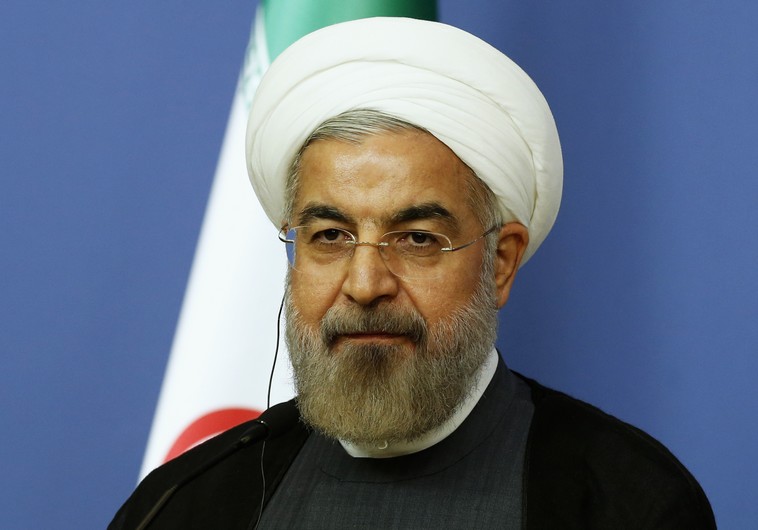
Iranian President Hassan Rouhani’s trip to New York next week will be a welcome relief for the Iranian leader. Finally, he’ll be somewhere where he’s appreciated, even loved.

Ahead of his trip to America, the US media continued its practice of presenting Rouhani as a moderate, and a natural ally for the US. NBC News’ Anne Curry interviewed Rouhani in Tehran, focusing her attention on his dim view of Islamic State.

Rouhani told Curry, “From the viewpoint of the Islamic tenets and culture, killing an innocent people equals the killing of the whole humanity. And therefore, the killing and beheading of innocent people in fact is a matter of shame for them and it’s the matter of concern and sorrow for all the human and all the mankind.”

The US media and political establishment’s willingness to take Rouhani at his word when he says that he’s a moderate is one of the reasons that Strategic Affairs Minister Yuval Steinitz was in such a desolate mood on Wednesday.

During a briefing with the foreign media, Steinitz described the state of negotiations between the US and its negotiating partners – Russia, China, Britain, France and Germany – and Iran regarding its illicit nuclear weapons program.

The briefing followed the latest round of the biennial Israeli-US strategic dialogue. Steinitz led the Israeli delegation to the talks, which focused on Iran, the week before nuclear talks were scheduled to be renewed.

One of Steinitz’s chief concerns was the US’s insistence that Rouhani is a moderate.

In his words, “The only thing that has changed [since Rouhani replaced president Mahmoud Ahmadinejad] is the tone. The only difference is that the world was unwilling to hear from Ahmadinejad and [his nuclear negotiator Saeed] Jalili, what it is willing to listen to from Rouhani and [Iranian Foreign Minister Javad] Zarif.”

Unlike the Americans, the Iranian people are through with the fiction that Rouhani is a moderate, which is why he no doubt will be happier in New York than in Tehran.

Rouhani’s trip to New York coincides with his one-year anniversary in office. Since he took power, a thousand Iranians have been executed by the regime. Forty-five people were executed in just the past two weeks.

According to Iranian scholar Majid Rafizadeh, the public’s tolerance for regime violence has reached a breaking point.

In an article in the Frontpage Magazine online journal, Rafizadeh described how 3,000 people descended on regime executioners as they were poised to kill a youth in Mahmoudabad in northern Iran. The protest forced them to call off the show.
They murdered the young man the next day, when no one was looking.

As Iran scholar Dr. Michael Ledeen has explained, the rise in regime brutality is directly proportional to the threat it perceives from the public.

And the regime has good reason to be worried.

Anti-regime protests and strikes occur countrywide, every day.

For instance, from September 9-14, MEK, an Iranian opposition group, documented public protests against security forces and attacks on regime agents in Tehran, Zanzan, Bane, Qom, Karaj and Bandar Abbas.

These actions ran the gamut from a strike by a thousand gas workers in the Aslaviyah gas fields who protested searches of their dormitory rooms by regime agents, to two separate assaults on military vehicles in Zanzan, to youth responding violently in cities throughout the country when regime agents tried to enforce Islamic dress codes on women and girls.

Under the same Rouhani who waxed so poetically against beheadings when speaking to an overeager NBC reporter, not only have state executions have massively intensified. Public floggings, public hand amputations and other public demonstrations of regime brutality have also expanded to levels unseen in recent years.

Rouhani promised to protect women’s rights. Yet since he took office, women’s rights have been severely curtailed.

Last month, the Revolutionary Guards barred women from working as waitresses. In July, Tehran’s mayor barred women from sharing workspace with men. These moves and others like them, aimed at enforcing gender apartheid in all public places in the country, force millions of women into poverty. The official unemployment level for women is already hovering around 20 percent.

Then there are Iran’s other social ills, for instance drug addiction.

Iran has the highest level of drug addiction in the world. According to Babak Dinparast, a senior Iranian drug enforcement official, some 3.5 million Iranians, or 4.4% of the population, are drug users.

In April, Dinparast made the stunning claim that 53% of drug users are government employees.

According to the Iranian parliament’s research institute, the average productive hours of Iranian workers is 22 minutes a day.

In Transparency International’s ranking of administrative and economic corruption, Iran ranks 144th out of 177 countries.

In other words, Iran is coming apart at the seams. The people cannot stand the regime. The regime, incompetent and unwilling to tackle any of Iran’s problems, responds to the public’s outrage with massive, brutal repression.

If left to its own devices, in all likelihood, the Iranian regime would have been toppled five years ago when it falsified the results of the 2009 presidential elections, and so fomented the Green Revolution But the people of Iran didn’t bet on the regime’s ace in the hole: the Obama administration.

The same Obama administration that supported the overthrow of US allies in the war on Islamic jihad – Egyptian president Hosni Mubarak and Libyan dictator Muammar Gaddafi – stood by the Iranian regime as it massacred its people in the streets of Iranian cities for daring to demand their freedom.

If the 2009 Green Revolution was the gravest threat the regime had faced since the 1979 revolution brought it to power, today the regime is also imperiled.

On Monday, Iran’s dictator Ayatollah Ali Khamenei was released from the hospital after undergoing prostate surgery. Several strategic analyses published since then claim that his days are numbered and that as a consequence, the regime faces a period of profound uncertainty and instability.

The Iranian people are watching all of this, and waiting.

As was the case in 2009, the disaffected Iranians, who hate their regime and want good relations with the US and the West, remain the greatest threat to the regime.

Beyond its borders, Iran is also under stress. With its Revolutionary Guard and Hezbollah forces committed to Syria in defense of Bashar Assad, Iran finds its position in Iraq threatened by the rising power of Islamic State.

Yet, as happened in 2009, in the midst of this gathering storm, the Obama administration is rushing to the mullahs’ rescue, begging Iran to support US efforts to fight Islamic State, indeed claiming that securing Iran’s support and cooperation is a necessary precondition for the mission’s success.

To say that this US policy is madness is an understatement.

As Michael Weiss documented in Foreign Policy in June, Iran and its puppet, the Syrian regime, played central roles in facilitating the development and empowerment of Islamic State both in Syria and Iraq. A defector from the Syrian Military Intelligence Directorate reported in January that the regime helped form Islamic State.

First, it sprang Sunni jihadist leaders from Sednaya prison in 2011. Then, it facilitated in the creation of the armed brigades that became Islamic State.

The idea was that through Islamic State, it could tarnish the reputation of all of its opponents by claiming they were all jihadists.

US military officers with deep knowledge of Iran’s role in Iraq told Weiss that Islamic State’s leadership entered Iraq from Iran.

A key al-Qaida financier, Olimzhon Adkhamovich Sadikov, was charged in February by the US Treasury Department with “provid[ing] logistical support and funding to al-Qaida’s Iran-based network.”

US Army Col. Rick Welch, who served as the military liaison to both the Sunni tribes and the Shi’ite militia in Iraq during the 2007-2008 US military surge, told Weiss that the assessment of Iraqi Sunnis and Shi’ites alike was that “Iran was funding any group that would keep Iraq in chaos.”

Iran sought chaos in order to prevent the establishment of a stable Iraqi government allied with the US while incrementally establishing Iranian control over the country.

Iran’s actions in Iraq and Syria, in other words, have for the past decade been focused on expanding Iranian power at the expense of the US and the Iraqi and Syrian people.

This behavior of course is in line with Iran’s global strategy. From its support for Hamas to its control over Hezbollah and Islamic Jihad, from developing a strategic alliance with Venezuela to expanding its presence throughout South and Central America, through its closely cultivated relationship with Russia, Iran’s every move involves expanding its power and influence at America’s expense.

And yet, despite this, the Obama administration has made strengthening the Iranian regime and appeasing it the centerpiece of its Middle East policy.

President Barack Obama told Jeffrey Goldberg in March that Iran is a rational actor that the US can do business with.

He said, “If you look at Iranian behavior, they are strategic, and they’re not impulsive. They have a worldview, and they see their interests, and they respond to costs and benefits.”

As Obama and Secretary of State John Kerry apparently now perceive things, Iran opposes Islamic State, and therefore it will play a supportive role in the US campaign against Islamic State. Moreover, by participating in the campaign, Iran will demonstrate its good faith and so make it possible for the US to cut a deal with the mullahs that will legitimize their illicit uranium enrichment – because really, how big a threat can a country that opposes Islamic State be?

As for Iran, it sees its interest as having the US destroy Islamic State, and if possible, having the US pay Iran for the privilege of fighting Iran’s war – against the foe Iran did so much to create.

And this brings us back to Steinitz’s gloomy assessment of the talks with Iran. Steinitz warned against the growing prospect of the US caving in to Iran’s nuclear demands as a payoff for Iranian support against Islamic State.

In his words, “Some people might think, ‘Let’s clean the table, let’s close the [nuclear] file,” in order to get Iran on board against Islamic State.

Unfortunately for Steinitz, and for the rest of the world, including the US, the Obama administration seems bent on proving him right.

Today the Iranian regime is weaker than it has been since it violently repressed the Green Revolution.

And that is why Rouhani is happy to be coming to New York.

He is certain that now, as then, the Obama administration will save the regime. This, even as the mullahs advance their goal of becoming the hegemons of the Middle East at the US’s expense, and completing their nuclear weapons program, which will secure the regime for decades to come, and threaten America directly.

Caroline B. Glick is the author of The Israeli Solution: A One-State Plan for Peace in the Middle East.