Archive for September 15, 2014

Why Many Arabs and Muslims Do Not Trust Obama

September 15, 2014

Why Many Arabs and Muslims Do Not Trust Obama, Gatestone InstituteKhaled Abu Toameh, September 15, 2014

Many Arabs and Muslims identify with the terrorists’ anti-Western objectives ideology; they are afraid of being dubbed traitors and U.S. agents for joining non-Muslims in a war that would result in the death of many Muslims, and they are afraid their people would rise up against them.

Many Arab and Muslim leaders view the Islamic State as a by-product of failed U.S. policies, especially the current U.S. Administration’s weak-kneed support for Iraq’s Nuri al-Maliki. Some of these leaders, such as Egypt’s Abdel Fattah al-Sisi, consider the U.S. to be a major ally of the Muslim Brotherhood. Sisi and his regime will never forgive Obama for his support for the Muslim Brotherhood.

Also, they do not seem to have much confidence in the Obama Administration, which is perceived as weak and incompetent when it comes to combating Islamists.

“Yes, this is not our war and we have nothing to do with it and we don’t need it. We don’t want to wage war on behalf of others in return for nothing and just to appease Obama. Not everything we hear and watch is correct. The best solution is for us to protect our borders and prevent Islamic State from infiltrating our country. If they come, then it will be our war.”

******************

“This is not our war and we should not be taking part in it.”

That is how many Arabs and Muslims reacted to US President Barack Obama’s plan to form an international coalition to fight the Islamic State [IS] terrorist organization, which is operating in Iraq and Syria and threatening to invade more Arab countries.

Islamic State terrorists have killed and wounded tens of thousands of Arabs and Muslims, mostly over the past few months. By contrast, Islamic State has targeted only a few Westerners, three of whom were beheaded in recent weeks.

Islamic State terrorists are also responsible for the displacement of millions of Iraqis and Syrians, and for the murder of many others.

Still, the atrocities committed by Islamic State against Arabs and Muslims, in addition to the immediate threat it poses to many of their countries, do not seem to be sufficient reason for them to declare war on the group.

While some Arabs and Muslims would prefer to see the U.S. and its Western allies fight Islamic State, others have voiced strong opposition to the new U.S.-led coalition against the group, mainly because they identify with the terrorists’ anti-Western objectives and ideology.

Arab leaders last week told U.S. Secretary of State John Kerry that they would contribute “in many aspects” to the anti-Islamic State coalition. But most are not prepared to commit ground troops to the battle against its estimated 30,000 jihadis.

The Arab leaders who want the U.S. to wage war on Islamic State are afraid of being dubbed traitors and U.S. agents for joining non-Muslims in a war on a group that seeks to establish an Islamic Caliphate. Their main fear is that their people would rise up against them once they were seen fighting alongside non-Muslims in a war that would result in the death of many Muslims.

The most these Arab leaders are prepared to do to help the emerging U.S.-led coalition is provide logistical and intelligence aid to the Americans and their Western allies in the war on Islamic State.

Jordan, for its part, has agreed to train members of Iraqi tribes to help them fight Islamic State terrorists in Iraq. Jordan and most of the Gulf countries are also reported to be opposed to serving as launching pads for airstrikes on the terrorist bases in Iraq and Syria.

Although they have formally agreed to join the U.S.-led coalition against Islamic State, it appears that Arab leaders do not trust the Obama Administration when it comes to combating Islamic fundamentalism in the Middle East.

Some of these leaders, such as Egypt’s Abdel Fattah al-Sisi, consider the U.S. Administration to be a major ally of the Muslim Brotherhood. Sisi and his regime will never forgive Obama for his support for the Muslim Brotherhood and deposed President Mohamed Morsi.

694Will Sisi ever forgive the Obama Administration for its support of the Muslim Brotherhood? Above, U.S. Secretary of State John Kerry chats with Egyptian President Abdel Fattah al-Sisi in Cairo on July 22, 2014. (Image source: U.S. State Department)

Moreover, many Arabs and Muslims view Islamic State as a by-product of failed U.S. policies in the Middle East in the aftermath of the “Arab Spring.” They say that the current U.S. Administration’s weak-kneed support for former Iraqi Prime Minister Nuri al-Maliki and his repressive measures against Sunnis paved the way for the emergence of Islamic State. They point out that Obama’s hesitance to support the moderate and secular opposition in Syria also facilitated Islamic State’s infiltration into that country.

Worse, there is no shortage of Arabs and Muslims who are convinced that Islamic State is actually an invention of Americans and “Zionists” to destroy the Arab world and tarnish the image of Islam.

The head of Egypt’s Al-Azhar University, Sunni Islam’s highest seat of learning, was recently quoted as saying that Islamic State terrorists were “colonial creations” serving a “Zionist” scheme to “destroy the Arab world.”

Many Arabs and Muslims probably do not like Islamic State and view it as a real threat. But at the same time, they also do not seem to have much confidence in the Obama Administration, which is perceived as weak and incompetent when it comes to combating Islamists. They simply do not trust the Obama Administration.

Sheikh Yusuf al Qaradawi, Chairman of the Qatari-based International Union of Muslim Scholars, who is no fan of Islamic State, has also come out against the emerging U.S.-led coalition.

“Our ideological differences with Islamic State do not mean that we agree to an American attack on the group,” al-Qaradawi explained. “America does not care about the values of Islam. It only cares about its own interests.”

If there is one Arab leader who is really concerned about the repercussions of a war on Islamic State, it is Jordan’s King Abdullah, who is facing growing domestic pressure to stay away from the U.S.-led coalition.

Ironically, this opposition comes despite Jordan clearly appearing to be the next target of the Islamic State jihadis. Some reports have even suggested that Islamic State terrorists have already succeeded in infiltrating the kingdom.

King Abdullah’s dilemma is that if he joins the U.S.-led coalition, his country would be plunged into turmoil and instability. Yet the monarch is well aware that failure to take part in the war would facilitate the jihadis’ mission of invading his kingdom.

Over the past week, many Jordanians have publicly come out against the idea of Jordan joining the new coalition. These voices are not coming only from Jordan’s Muslim Brotherhood, but also from secular individuals and groups.

Last week, 21 Jordanian parliament members wrote a letter to their government warning it against helping the Americans and their allies in the war on Islamic State.

Six Jordanian secular parties also joined the call in a statement addressed to the government: “We must resist imperialist schemes and continue to raise the motto of democracy, independence and freedom.”

Reflecting widespread skepticism over Obama’s intentions, Jordanian writer Maher Abu Tair, who is closely associated with King Abdullah, sounded an alarm: “Getting Jordan involved in the confrontation with Islamic State is a dangerous matter. If everyone is truly worried about Jordan, why not support it socially and economically instead of dragging it into a quagmire?”

Reflecting similar sentiments, another Jordanian writer, Abdel Hadi al Katamin, said: “Yes, this is not our war and we have nothing to do with it and we don’t need it. We don’t want to wage war on behalf of others in return for nothing and just to appease Obama. Not everything we hear and watch is correct. The best solution is for us to protect our borders and prevent Islamic State from infiltrating our country. If they come, then it will be our war.”
Three Choices and the Bitter Harvest of Denial: How Western denial about Islam has fueled Genocide in the Middle East

September 15, 2014

Three Choices and the Bitter Harvest of Denial: How Western denial about Islam has fueled Genocide in the Middle East, Dr. Mark Durie, September 2, 2014


Moderates


Who Are These ‘Moderate’ Syrians Obama Wants to Pit Against ISIS?

September 15, 2014

Who Are These ‘Moderate’ Syrians Obama Wants to Pit Against ISIS? Daily BeastJamie Dettmer, September 15, 2014

(Will Obama send a battalion of like minded savants, who claim that Islam is peaceful, to convince their “moderate” inferiors in Koranic wisdom that Islam really is peaceful and freedom loving? Perhaps he should accompany them.– DM)

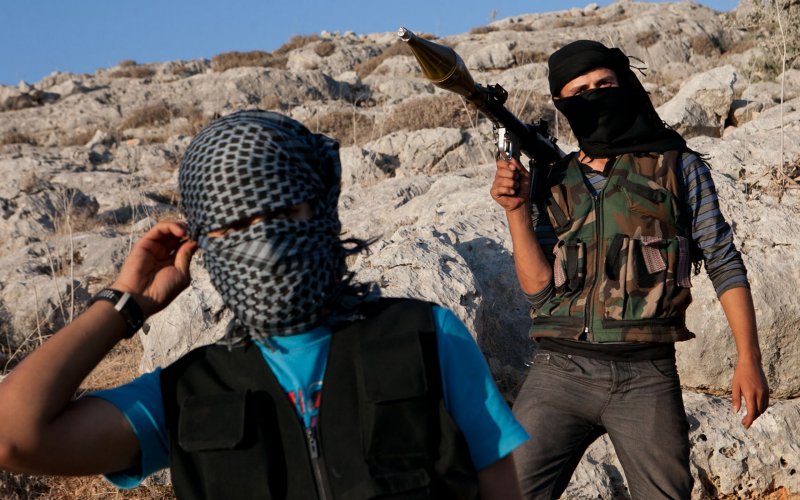
ModeratesDaniel Leal-Olivas/AFP/Getty

Like other countries convulsed by Arab Spring insurrections, there was a mismatch between Western expectations and perceptions and the thinking and religious views of the majority involved in the fighting, and that was a year before the emergence of ISIS. The war back then was clearly becoming more sectarian and Islamic—the trajectory was obvious.

*********************

There were few modern democrats among the armed opposition to Assad two years ago. There are far fewer now. So who can Obama trust not to turn Western-supplied weapons against us later?

The young rebels and opposition activists gathered in a school to discuss how the northern Syrian town of Al Bab should be governed after the departure of Bashar al Assad’s soldiers were taken aback by the question: “Why aren’t there any women here?” It was the summer of 2012, more than 12 months into the uprising against the Syrian president, and more than a year before Abu Bakr al Baghdadi announced the formation of his al Qaeda breakaway, the Islamic State of Syria and Sham, or ISIS.

Initial surprise at my question was followed by smirks. The young men who had talked about ushering in a new era of modern democracy and freedom in Syria pushed forward a nervous young imam to explain. “It is not in our tradition for men and women to mix,” he said. “They can have their own meeting, if they want. And if we need advice on some issues, we can ask them.” There were some chuckles at this. So much for democracy, at least in its Western guise.

Later that night I sat with two local sheikhs who explained how they were forming a court to adjudicate civil disputes and rule on criminal cases. “We will use Sharia law,” said Abdulbaset Kuredy. “What else is there? After Assad, the whole country will be governed by Sharia.” Then he launched into a condemnation of the corrupt West and its acceptance of homosexuality and same-sex marriage. The sheikhs were aligned with the Free Syrian Army, the rebel group now touted in Washington as the “moderates” to support in the fight against Assad on the one hand, ISIS on the other.

There was nothing I saw in Al Bab in August 2012—still early days in the insurrection that is now halfway through its fourth year—that led me to feel that if the Syrian uprising toppled Assad, it would lead to an inclusive, minority-respecting, and more or less democratic outcome. Like other countries convulsed by Arab Spring insurrections, there was a mismatch between Western expectations and perceptions and the thinking and religious views of the majority involved in the fighting, and that was a year before the emergence of ISIS. The war back then was clearly becoming more sectarian and Islamic—the trajectory was obvious.

After two years of brutal and barbaric sectarian warfare, the Syrian rebellion has seen an even greater hardening of sectarian attitudes among Syrian opponents of Assad and his regime, which is dominated by members of the minority Alawite sect. Many secular activists from the urban areas of Damascus or Aleppo withdrew long ago, sickened by what the uprising was becoming. They were appalled at the rise of the jihadists and their cruelty, worried by the strength of Islamist factions among the rural fighters who are the backbone of the militias. The center did not hold.

A key element in President Obama’s strategy to halt the jihadist campaign of terror across the Levant involves reversing his earlier decision to refrain from fully backing so-called moderate Syrian rebels with arms and training. Exasperated by infighting among the leaders of the Syrian National Council and the Free Syrian Army, and worried by the weakening of the more secular elements, the Obama administration basically left the uprising alone. Critics like Sen. John McCain say that helped the rise of extremists like ISIS.

Now the president is asking Congress for $500 million to bolster rebels he kept at arm’s length to give them weapons and pay for training these insurgents he once derided as ineffectual “former doctors, farmers, pharmacists and so forth.”

But we shouldn’t imagine this is a change of policy in line with President George W. Bush’s “freedom agenda” or the “New Beginning” philosophy of Obama’s 2009 address in Cairo that sought to mend relations between the U.S. and the Arab world.

In his 13-minute speech last week, Obama did not mention the word “democracy” once—nor, for that matter, did “freedom” make any appearance. The arming and training of Syrian rebels is about U.S. national security interests and the rolling back of the jihadists.

But the decision to do so prompts a key question once again: Who are the moderates? Who in rebel ranks can be trusted not to turn Western-supplied weapons against the West later, or switch sides as we’ve seen in Mali and other countries racked by Islamist rebellions? Who can receive arms that won’t be shared with ISIS or the official al Qaeda affiliate in Syria, Jabhat al-Nusra? Who won’t embarrass the West by engaging in some act of egregious cruelty, torturing prisoners or executing foes?

There were not many moderates around two years ago, as I found in Al Bab then, and there are far fewer now. A year ago the town was overrun by ISIS and many of the young rebels joined the group; others who remained loyal to brigades affiliated with the FSA pulled out. The bulk of those, according to locals, hooked up with the Islamic Front, a coalition of Islamist militias who are the second largest fighting insurgent formation after ISIS. The front has close ties with al-Nusra.

The Obama administration’s frustration with the rebellion and distrust of the insurgents were overlooked briefly a year ago, when Obama’s “red line” was crossed and Assad used chemical weapons against rebels and civilians. The administration considered taking action. Under skeptical questioning by some lawmakers, Secretary of State John Kerry insisted last summer: “The opposition has increasingly become more defined by its moderation, more defined by the breadth of its membership, and more defined by its adherence to some, you know, democratic process and to an all-inclusive, minority-protecting constitution, which will be broad-based and secular with respect to the future of Syria.”

That wasn’t the case then and it isn’t now. Shortly after Kerry’s comments, a respected British defense consultancy, IHS Jane’s, released a study claiming that more than half of the rebels battling to oust Assad were either jihadists or hardline Islamists.

“There are certainly moderates remaining,” says Jonathan Schanzer, a Mideast expert with the Washington-based think tank the Foundation for the Defense of Democracies. “The problem is that they are few in number and lacking in support. They have been marginalized by U.S., European, Turkish, and Arab policies that have only served to boost the presence and capabilities of the more radical factions. It’s unclear to me how Washington’s new approach can help reverse this trend in an urgent or expeditious manner—which is what is needed.”

Most of the militias that are effective fighting formations and have scored off-and-on successes on the battlefield against ISIS are not moderate by Western standards. Most are Islamist to varying degrees and some, like Ahrar al-Sham, which lost most of its top leaders this week in a bomb attack in Idlib, are dedicated to establishing a Sunni theocracy in Syria. They don’t subscribe to transnational jihadism, but they do have strong ties to al-Nusra, which is part of the al Qaeda international franchise.

The most effective anti-ISIS fighters are with the Kurdish self-defense forces of the YPG, but because of their links with the Turkish separatist PKK, which is designated as a terrorist organization by the United States and European countries, they can’t be included in groups that receive Western backing.

According to a report issued this week by the International Crisis Group, the “mainstream” rebel opposition is caught in a desperate plight, “locked in a two-front war against the regime and IS [Islamic State or ISIS], their position is more precarious than at any time since the fighting began.”

ISIS has pressed an offensive north of Aleppo and is threatening to deliver a severe blow to rebel opposition groups by cutting off their supply lines to Turkey. If this can’t be stopped, the Crisis Group warns, the loss “would reverberate throughout the country, pushing many to give up the fight or join a more powerful militant force: IS.”

So speed is also of the essence. But not only is the Obama administration going to find it hard to select rebel groups it can work with, it will also have the problem of persuading them to focus on ISIS at the expense of their struggle against Assad, and if the regime starts making up more ground, that in turn could ignite local Sunni anger to the benefit of the jihadists.

There are already signs emerging that key Islamist groups aren’t ready to fall into line with the Obama agenda. This week a deal was struck between IS and an important Islamist coalition, the Syrian Revolutionaries Front, which is made up of about 20,000 fighters.

According to the Syrian Observatory for Human Rights, a U.K.-based Syrian opposition monitoring group, the jihadists and the Front have agreed “not to attack each other” while fighting the principal enemy, Assad.

Paths to War, Then and Now, Haunt Obama – an excerpt

September 15, 2014

Paths to War, Then and Now, Haunt Obama
By PETER BAKERSEPT. 13, 2014 Via NYT


(Only one paragraph in this article was worth reading. I posted it below. You can follow the link if you wish to read the complete text. I call this excerpt…Yet Another Declaration of War.-LS)

He made clear the intricacy of the situation, though, as he contemplated the possibility that Mr. Assad might order his forces to fire at American planes entering Syrian airspace. If he dared to do that, Mr. Obama said he would order American forces to wipe out Syria’s air defense system, which he noted would be easier than striking ISIS because its locations are better known. He went on to say that such an action by Mr. Assad would lead to his overthrow, according to one account.


