Archive for September 8, 2014

Does Obama Remember He’s President?

September 8, 2014

Does Obama Remember He’s President? The Daily BeastStuart Stevens, September 8, 2014

(This is from a generally left-leaning publication. — DM)

Faces of ObamaThe Daily Beast

It is rarely a good thing when the country seems more worried than the president. Or when the country is worried about the president’s level of concern. But when confronted with vexing issues that defy easy solutions, more and more, the president seems to check out rather than dig in.

Our American tendency to see the world as populated by like-minded souls is never productive.

When the president says we don’t have a strategy to fight ISIS, it’s not theater but reality. When Russia invades another country and our response is predicated on denying it’s an invasion, that’s reality, not theater.

*************

More and more, Obama seems like a passive observer of events who dismisses criticism as superficial. Not a good combination.

“But part of this job is also the theater of it. A part of it is, you know, how are you, how, how are you, well, it’s not something that—that always comes naturally to me.” —President Barack Obama on Meet The Press, Sunday.

Some presidents might have garnered a bit of sympathy and understanding with claims that the “theater” of the office doesn’t come naturally to them. Gerald Ford, Jimmy Carter, Lyndon Johnson, maybe even Richard Nixon, who was so much the anti-natural he hired PR professionals to run his White House. But Barack Obama?

This is the Obama who as a candidate spoke before 200,000 at Berlin’s Brandenburg Gate? Der Spiegel headlined that speech with: “People of the World, Look at Me.” The same candidate who gave his acceptance speech outdoors in Denver surrounded by columns, mocked for their resemblance to ancient Greek temples, which is, ironically enough, where the Greeks performed the new art form of dramatic theater they were creating.

Why is this pretense necessary? Obama wrote two autobiographies by the age of 40 and is well aware of the role that his mastery of political theater has played in his rapid ascension to the White House. As Valerie Jarrett said of Senate candidate Obama’s speech at the 2004 Democratic Convention: “It changed his life.”

The “I’m not good at theater” is a calculated, if awkward, attempt to dismiss criticism as superficial and worthy of, well, theater critics, not serious thinkers. It’s fundamentally condescending, but like a lot of ill-considered defenses, it only reinforces the heart of the criticism. The charge is being disconnected and out of touch, and to dismiss it with a retort that even supporters will find inadequate seems….disconnected and out of touch.

Democratic supporters of the president are worried about both the perception and reality of the president’s leadership. “Too passive,” says Senator Diane Feinstein. In the Meet The Press interview he again disputed that he was talking specifically about ISIS when he now famously said in a January 2014 New Yorker interview,

I think the analogy we use around here sometimes, and I think is accurate, is if a JV team puts on Lakers uniforms, that doesn’t make them Kobe Bryant.”

As Washington Post fact-checker Glenn Kessler points out, that denial simply isn’t credible as “the context of Remnick’s question makes it clear that he was asking about ISIS.”

It is rarely a good thing when the country seems more worried than the president. Or when the country is worried about the president’s level of concern. But when confronted with vexing issues that defy easy solutions, more and more, the president seems to check out rather than dig in.

The “passive” comments of Senator Feinstein reflect not just a specific response to ISIS but a larger worldview. Increasingly the president seems to view the world as this dangerous place where things just keep happening but where the United States and our allies have little impact.

In one of the more revealing moments in the MTP interview, the president summed up the situation with ISIS and Syria: “You know, the reason we’re in this situation is because Assad brutalized his people and specifically brutalized the Sunni population that is the majority in Syria.”

Well, no. First there’s the fact that previously, the president had assured the world that Bashar al-Assad would soon no longer be in power. In his 2012 State of the Union address, he declared:

A year ago, Qaddafi was one of the world’s longest-serving dictators—a murderer with American blood on his hands. Today, he is gone. And in Syria, I have no doubt that the Assad regime will soon discover that the forces of change cannot be reversed, and that human dignity cannot be denied.

Qaddafi would likely not have fallen without external forces aided by the United States (the example cited as a success of “leading from behind”), and Assad’s ability to remain in power has largely been contingent on the United States and others not taking a more active role. If the president believes ISIS has been spawned by Assad brutalizing his people, that would surely be one more reason we should have intervened earlier. Maybe staying out of Syria was the right decision, maybe it was the wrong decision, but let’s don’t pretend that it wasn’t a decision—a decision made by our commander in chief.

But does ISIS exist as a consequence of Assad’s failures, or is it the latest continuation of a militant Islamic fundamentalism? As Shiraz Maher of the International Centre for the study of Radicalisation wrote in The New Statesman,

This is precisely what Bin Laden always envisioned. His main thesis on the failure of the Islamist project was that western interference in the Middle East prevented the rise of Islamic governments. Weaken the west’s sphere of influence, he argued, and a caliphate would emerge.

This is the antithesis of President Obama’s view. As outlined in his June 2009 Cairo speech, the president clearly believes that Western influence in the Muslim world is a contributing factor to radicalism, not a mitigating force.

Tension has been fed by colonialism that denied rights and opportunities to many Muslims,” the president declared in Cairo, “and a Cold War in which Muslim-majority countries were too often treated as proxies without regard to their own aspirations.

That’s certainly true in a historical sense, but the president seems unwilling to acknowledge other realities as well: that withdrawal of Western influence is rarely followed by the triumph of “the common principles—principles of justice and progress; tolerance and the dignity of all human beings”—that he described in Cairo. It’s as if he assumes that the life experience he describes —“I have known Islam on three continents”— will lead others to a like conclusion.

Our American tendency to see the world as populated by like-minded souls is never productive. It surely was a contributing factor in some of our greatest foreign policy miscalculations, from Vietnam to Iraq.

Americans are tired of war and would like much of the world to simply go away. But when we go away, the world has a way of demanding our attention. The task for a president—never easy—is to shape events to America’s advantage rather than allowing events to shape us. ISIS—like Vladimir Putin—seems to know what it wants and how to get it. The question is, do we?

When the president says we don’t have a strategy to fight ISIS, it’s not theater but reality. When Russia invades another country and our response is predicated on denying it’s an invasion, that’s reality, not theater.

President Obama has 864 days left in office, just a couple hundred less than JFK served. The president came to office with great energy and ambition. Chuck Todd asked him if he was “exhausted.” It’s time to prove he’s not.
Germany’s “Sharia Police”

September 8, 2014

Germany’s “Sharia Police,” Gatestone InstituteSoeren Kern, September 8, 2014

(Will similar Sharia police arrive in Gaza? How about the West Bank? Please see also A deadly battle for Gaza and Victor Davis Hanson’s article titled Are the Orcs winning? — DM)

According to Burkhard Freier, the director of domestic intelligence for North Rhine-Westphalia, German Salafists are increasingly inclined to use violence to achieve their aims, and many have travelled to Iraq or Syria to obtain combat training.

“The intention of these people is to provoke and intimidate and force their ideology upon others. We will not permit this.” — Wuppertal Mayor Peter Jung.

“In Germany, German law is determinative, not Sharia law.” — Christian Democratic Union (CDU) politician Volker Kauder.

Salafist ideology posits that Sharia law is superior to all secular laws because it emanates from Allah, the only legitimate lawgiver, and thus is legally binding for all of humanity. According to the Salafist worldview, democracy is an effort to elevate the will of human beings above the will of Allah.

Muslim radicals have begun enforcing Islamic Sharia law on the streets of Wuppertal, a city in North Rhine-Westphalia, the state with the largest Muslim population in Germany.

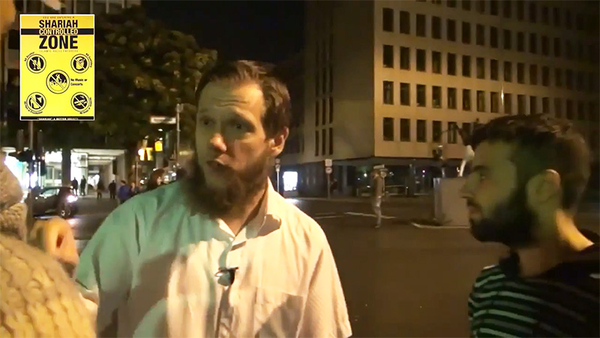
In what government officials say is a blatant challenge to the rule of law and the democratic order in Germany, groups of young bearded Islamists — some wearing orange traffic safety vests emblazoned with the words “Sharia Police” — have declared parts of downtown Wuppertal to be a “Sharia Controlled Zone.”

The self-appointed guardians of public morals have been distributing yellow leaflets that explain the Islamist code of conduct in the city’s Sharia zones. They have urged both Muslim and non-Muslim passersby to listen to Salafist sermons and to refrain from alcohol, cigarettes, drugs, gambling, listening to music, pornography or prostitution.

A seven-minute propaganda video in German, entitled “Sharia Police: Coming Soon to Your City,” shows a group of men led by a German convert to Islam, Sven Lau, roaming the streets of Wuppertal at night and pressing wayward youth to embrace radical Islam. In some instances, the men physically attempted to prevent young people from entering bars, casinos and discotheques; those who resisted were pursued and intimidated.

679Sven Lau chats on the street with locals in Wuppertal, in “Sharia Police: Coming Soon to Your City”.

After local residents alerted German authorities, police stepped up their presence in downtown Wuppertal and also established a telephone hotline to enable citizens to report any possible criminal activity.

Local authorities, however, appear uncertain about how to proceed.

Wuppertal Police Chief Birgitta Radermacher said the “pseudo police” represent a threat to the rule of law and that only police appointed and employed by the state have the legitimate right to act as police in Germany. She added:

“The monopoly of power lies exclusively with the State. Behavior that intimidates, threatens or provokes will not be tolerated. These ‘Sharia Police’ are not legitimate. Call 110 [police] when you meet these people.”

Wuppertal Mayor Peter Jung said he hoped the police would take a hard line against the Islamists. “The intention of these people is to provoke and intimidate and force their ideology upon others,” Jung said. “We will not permit this.”

More than a dozen Islamists between the ages of 19 and 30 are now being investigated on charges of illegal assembly. But the men have not been arrested and police say they have no legal authority to confiscate the orange vests, even though impersonating a police officer is a crime. Wuppertal’s Public Prosecutor, Wolf-Tilman Baumert, says it remains unclear whether the men have done anything illegal. “The mere explaining of religious rules is not a crime,” he said.

The vigilantes are followers of Salafism, a radically anti-Western ideology that openly seeks to replace democracy in Germany (and the rest of the world) with an Islamic government based on Sharia law.

Salafist ideology posits that Sharia law is superior to all secular laws because it emanates from Allah, the only legitimate lawgiver, and thus is legally binding for all of humanity. According to the Salafist worldview, democracy is an effort to elevate the will of human beings above the will of Allah. As such, participation in the democratic process is polytheism (shirk in Arabic) and must be rejected.

The number of Salafists in Germany has spiked in recent years, and German authorities have been issuing increasingly dire warnings about the threat posed by the relentless encroachment of Salafist ideology there and in the rest of Europe.

Many of those attracted to Salafi ideology are impressionable young Muslims who, authorities say, are especially susceptible to perpetrating terrorist acts in the name of Islam.

In an interview with the German public television broadcaster ZDF, the director of domestic intelligence for North Rhine-Westphalia, Burkhard Freier, said that German Salafists are increasingly inclined to use violence to achieve their aims, and that many have travelled to Iraq or Syria to obtain combat training.

In June 2014, approximately 400 Salafists met for a barbecue “grill fest” in the Tannenbusch district of Bonn to listen to sermons by some of the most radical Salafist preachers in Germany. Police say the purpose of the gathering was to raise funds and recruit volunteers for the jihad in Syria. But after the event, groups of young Salafists began enforcing Sharia law in Bonn by forcing women to wear veils. In one instance, they beat a teenager for drinking alcohol at a party.

The audacity of the Salafists’ actions in Wuppertal, however, has shocked the German public.

German politicians have responded by roundly denouncing the Sharia Police, although it remains unclear what they can and will do about the Salafist threat to Germany. “The Sharia will not be tolerated on German soil,” German Interior Minister Thomas de Maizière said. “No one shall presume to abuse the good name of the German police.”

According to German Justice Minister Heiko Maas, Germany is a constitutional state: “The state alone — and not the self-proclaimed Sharia police — is responsible for the enforcement of laws,” he said. “This much is sure: We will not tolerate an illegal parallel justice system.”

The center-right politician Wolfgang Bosbach said:

“The Sharia Police is a very deliberate provocation by the Salafists, who want to challenge the rule of law. The police must act forcefully against such actions. We cannot accept that the population is provoked, confused or intimidated in this way.”

A senior politician with the ruling Christian Democratic Union (CDU), Volker Kauder, said:

“We cannot tolerate under any circumstances that self-appointed Sharia police are patrolling our streets and want to dictate to people what they can and cannot do. In Germany, German law is determinative, not Sharia law.”

The general secretary of the CDU, Peter Tauber, said:

“We must confront such Salafist machinations with all severity. We need to enact a ban on their activities as quickly as possible. It was a big mistake of the Red-Green coalition [a coalition of left and center-left parties that governed Germany from 1998 to 2005] to change the law so that anti-democratic propaganda is no longer a criminal offense. We must quickly correct this. The state must show that there is zero tolerance for ideologies and organizations in Germany that are aimed at abolishing our Basic Law.”

Meanwhile, the trial of four Salafists — accused of planting a bomb at the main train station in Bonn in December 2012 and for plotting to murder an anti-Islam activist in Leverkusen in March 2013 — is set to begin in Düsseldorf, the capital of North Rhine-Westphalia.

Authorities are worried that the trial, which could take up to two years, will provoke violent confrontations between Salafists and the many members of the different neo-Nazi groups based in North Rhine-Westphalia.

One such group, Die Rechte (The Right), has just founded its own vigilante group called Stadtschutz Wuppertal(Wuppertal City Guard), aimed at fighting the Sharia Police. In a statement, the group explained:

“Wuppertal activists from Die Rechte immediately agreed: If in our city Salafists are allowed to patrol the city’s pedestrian zones as ‘Sharia Police’ and if police allow far left-wing criminal squatters to perpetrate their mischief in the Nordstadt district, then a counter pole must be created as soon as possible. Inspired by the successful model of the Stadtschutz in Dortmund, it was quickly agreed to take this form of action.

“After a very spontaneous legal training (thanks again to the party comrades from Dortmund!), theStadtschutz Wuppertal was brought to life in less than 48 hours! New radios and red T-Shirts were purchased at personal expense. Several thousand leaflets presenting the new Stadtschutz Wuppertalare being printed and will soon be distributed.

“Together for more security, law and order in our city—DIE RECHTE ‘Stadtschutz Wuppertal.'”

The implicit message to German authorities is that if they fail to stop the Salafist vigilantes, neo-Nazi vigilantes will do the job for them. No wonder many Germans have a strong sense of foreboding about what the future holds.

A deadly battle for Gaza

September 8, 2014

A deadly battle for Gaza, The Australian, September 9, 2014

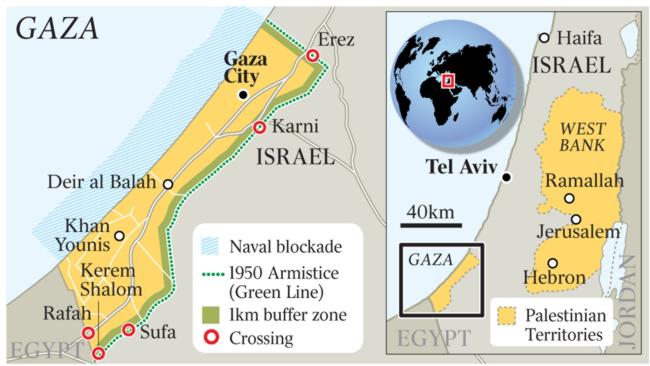
Israel Gaza map

Salafists are extremist Islamic groups that believe in caliphates rather than the “artificial boundaries” of countries.

The Islamic State is the highest profile example, but many of these groups in Gaza share that organisation’s views.

An investigation in Gaza by The Australian has found nine significant Salafist groups engaged in a secret war against Hamas.

They are: Jaish al Oumah (Army of the Nation); Jaljalat (Rolling Thunder); Jaish al-Islam (Army of Islam); Ansar al-Sunnah (Loyal Followers of Sunnah); Jund Ansar Allah (Soldiers of Followers of Allah); the Al Tawheed Brigades (The One God Brigades); the Al Haman Mohamed Bin Maslamah Brigades; the Mujahideen Shoura Council (the Defenders of God Council); and Ahrar al-Watan (the Free of the Homeland).

All are Sunni, all want sharia law immediately and some endorse kidnappings.

***********************

SITTING on a beach in Gaza as a deep rich sun sinks into the Mediterranean, one of Gaza’s jihadist leaders is explaining why sharia law would be good for Australia.

“Please tell people back home that under sharia there will be no more poor people, that everyone will be equal,” he says. “All the natural resources of Australia will be divided equally among all ­Australians.”

He must sense I’m not convinced. “I know that if you adopt sharia Australians will express sorrow and say to themselves, ‘Why didn’t we do this earlier?’ ”

Abu Hafs al-Maqdisi is leader of Jaish al-Oumah — the Army of the Nation — one of nine Salafist groups in Gaza that believe Hamas is not pushing sharia quickly enough.

Salafists are extremist Islamic groups that believe in caliphates rather than the “artificial boundaries” of countries.

The Islamic State is the highest profile example, but many of these groups in Gaza share that organisation’s views.

Hamas, which controls Gaza, does not like stories about these groups being written and sometimes even denies they exist — but the groups are armed and organised.

“Hamas tried but did not succeed to establish sharia in Gaza,” says Maqdisi. “We are working with all those who want sharia.”

I ask him what he thinks of the present wave of beheadings by the Islamic State.

“You must ask Islamic State,” he says. But then he adds: “You are a foreign journalist and have asked me that question, but I am not going to try to behead you.”

While Israel has just had a 50-day war with Hamas, these groups may pose a greater danger.

“For Jews, as humans, they have the right to live,” he says. “But Jews as a state, and an occupier, must not exist in Palestine and it must be destroyed from the universe. Israel must be destroyed.”

But before these groups can launch their own attack against ­Israel, they need to defeat Hamas.

An investigation in Gaza by The Australian has found nine significant Salafist groups engaged in a secret war against Hamas.

They are: Jaish al Oumah (Army of the Nation); Jaljalat (Rolling Thunder); Jaish al-Islam (Army of Islam); Ansar al-Sunnah (Loyal Followers of Sunnah); Jund Ansar Allah (Soldiers of Followers of Allah); the Al Tawheed Brigades (The One God Brigades); the Al Haman Mohamed Bin Maslamah Brigades; the Mujahideen Shoura Council (the Defenders of God Council); and Ahrar al-Watan (the Free of the Homeland).

All are Sunni, all want sharia law immediately and some endorse kidnappings.

The Army of Islam helped Hamas kidnap Israeli soldier Gilad Shalit in 2006 and kidnapped BBC journalist Alan Johnston in 2007.

It was the Al Haman Mohamed Bin Maslamah Brigades who kidnapped Italian pro-Palestinian ­activist Vittorio Arrigoni in 2011, then hanged him after saying he had come to Gaza “only to spread corruption”.

“Hamas are not happy to have such groups in Gaza,” says Palestinian journalist Hasan Jaber. “They (Hamas) don’t want anyone in competition, to gain the thoughts or support of people who believe in Islam.

“They were very worried when they discovered the majority in these groups had left Hamas.”

The rivalry has spilled into gunfights.

In 2009 Jund Ansar Allah declared the south of Gaza a caliphate. Hamas surrounded the group’s mosque and opened fire, with 28 members killed.

So deep is the hatred that Hamas then kidnapped the bodies of the dead to try to prevent ­funerals.

Hamas often raids the Salafists to seize weapons.

“At first when these groups began to emerge, Hamas began a campaign by their Islamic scholars to convince these groups to return to Hamas, but they failed,” says Jaber.

“So Hamas began to fight and arrest them.”

Nathan Thrall, of the International Crisis Group, says: “Salafi-­jihadis are regularly arrested and suppressed by Hamas.

“They have also made repeated allegations of having been tortured by (Hamas) Gaza security forces. Salafi-jihadis have attacked a number of sites within Gaza that they believe to have been places of immorality.”

Many in Israel say these groups pose a greater danger than Hamas: former Israeli ambassador to the US, Michael Oren, says Israel’s preferred outcome in Gaza was a “de-fanged Hamas”.

The ICG warned in 2011 that isolating Gaza benefited Salafists.

“The international community’s policy of snubbing Hamas and isolating Gaza has been misguided from the outset, for reasons Crisis Group long has enumerated,” it reported. “Besides condemning ­Gazans to a life of scarcity, it has not weakened the Islamist movement, loosened its grip over Gaza, bolstered Fatah or advanced the peace process.

“To that, one must add the assistance provided to Salafi-jihadis, who benefit from both Gaza’s lack of exposure to the outside world and the apparent futility of Hamas’s strategy of seeking greater engagement with the inter­national community, restraining, until recently, attacks against ­Israel and limiting Islamising policies advocated by more zealous leaders.”

Added to this lethal cocktail is Islamic Jihad, a formidable rival to Hamas.

While Hamas has aligned itself with Sunni powers — particularly Qatar — Islamic Jihad has aligned itself with Iran, leader of the Shia world.

One Western intelligence source who specialises in arms movements in the Middle East tells The Australian that in the recent war with Israel Islamic Jihad had more lethal weapons than Hamas, because theirs had been supplied by Iran, while many of Hamas’s were made in Gaza.

The Salafists are not just at war with Hamas but also with Islamic Jihad.

Three months ago masked men attacked a Salafist scholar with metal bars. Salafist groups accused Islamic Jihad of the bashing, citing their alliance with Iran.

The threat to Hamas is increasing as the Salafist groups consider becoming one entity.

“It could be bad for Hamas but it may also have benefits,” Palestinian journalist Jaber says. “Instead of talking to eight or nine groups, they will talk to one.”

As with the Islamic State, their Islam­ist soulmate cutting a swath of terror across Syria and Iraq, the Salafists in Gaza want a caliphate, or Islamic state and do not recognise borders.

Under pressure from these groups, Hamas has tried to push sharia law harder.

Last year Hamas banned girls from the annual Gaza marathon, despite a record 1500 schoolchildren registering.

The UN Relief and Works Agency, which organised the marathon, pulled out in protest.

Hamas and UNRWA organise separate summer camps for children each year. Hamas will not allow boys and girls to attend the same camps, while UNRWA does.

In 2010 a Salafist group called the Free of the Homeland said UNRWA was “teaching schoolgirls fitness, dancing and immorality”. Two days later the camp was attacked, prompting UNRWA chief John Ging to declare: “It is an attack on the happiness of children.”

The Salafist groups have two main differences with Hamas — they believe Hamas is not implementing sharia law quickly enough and that Gaza should be a caliphate.

“The chief rivals of Salafi-­jihadis are political Islamists, ­especially the Muslim Brotherhood, of which Hamas is the Palestinian branch,” says the ICG’s Thrall.

“Hamas is a Palestinian nationalist movement, it seeks to establish a Palestinian state with borders that are based on lines drawn by European officials less than 100 years ago.

“Salafi-jihadis, by contrast, do not have any interest in Palestinian nationalism or in the current borders of the Middle East.”

Back at the beach in Gaza, the leader of Army of the Nation is nervous about meeting, changing the venue several times.

He has reason to be anxious — both Israel and Hamas would be pleased to see the end of him. Hamas imprisoned him during a recent crackdown. He hobbles to our table because of injuries from battles with Israel.

He asks whether there is any chance sharia will be implemented in Australia.

I tell him I think it will be a challenge — for starters, 50 per cent of the electorate, women, may not like sharia status.

“Women are weak,” he ­responds. “Men can protect them. Men can work more than women.”

He clearly needs to do some focus group research before he tries selling sharia to Australia.

Islamic State fighters said to be using US arms

September 8, 2014

Islamic State fighters said to be using US armsInvestigation finds IS wielding American-made weapons originally supplied to Syrian rebels via Saudi Arabia

By AFP September 8, 2014, 12:50 pm

via Islamic State fighters said to be using US arms | The Times of Israel.

Illustrative photo of a bullet magazine. (photo credit: Flash90)


LONDON, United Kingdom — Islamic State fighters appear to be using captured US military issue arms and weapons supplied to moderate rebels in Syria by Saudi Arabia, according to a report published on Monday.

The study by the London-based small-arms research organisation Conflict Armament Research documented weapons seized by Kurdish forces from militants in Iraq and Syria over a 10-day period in July.

The report said the jihadists disposed of “significant quantities” of US-made small arms including M16 assault rifles and included photos showing the markings “Property of US Govt.”

It also found that anti-tank rockets used by IS in Syria were “identical to M79 rockets transferred by Saudi Arabia to forces operating under the Free Syrian Army umbrella in 2013.”

The rockets were made in the then Yugoslavia in the 1980s.

Islamic State is believed to have seized large quantities of weapons from Syrian military installations it has captured, as well as arms supplied by the United States to the Iraqi army after it swept through northern Iraq in recent weeks.

Ellison’s Must Read of the Day

September 8, 2014

Ellison’s Must Read of the DayBY: Ellison BarberSeptember 8, 2014 10:21 am

via Ellison’s Must Read of the Day | Washington Free Beacon.


My must read of the day is “President Barack Obama’s Full Interview with NBC’s Chuck Todd,” in NBC News:


CHUCK TODD:

You’ve ruled out boots on the ground. And I’m curious, have you only ruled them out simply for domestic political reasons? Or is there another reason you’ve ruled out American boots on the ground? Because your own—your own guys have said, “You can’t defeat ISIS with air strikes alone.”

PRESIDENT OBAMA:

Well, they’re absolutely right about that. But you also cannot, over the long term or even the medium term, deal with this problem by having the United States serially occupy various countries all around the Middle East. We don’t have the resources. It puts enormous strains on our military. And at some point, we leave. And then things blow up again. So we— […]

—so—so we’ve got to have a more sustainable strategy, which means the boots on the ground have to be Iraqi … and in Syria, the boots on the ground have to be Syrian. […]

And so the— the strategy both for Iraq and for Syria is that we will hunt down ISIL members and assets wherever they are. I will reserve the right to always protect the American people and go after folks who are trying to hurt us wherever they are.

But in terms of controlling territory, we’re going to have to develop a moderate Sunni opposition that can control territory and that we can work with. The notion that the United States should be putting boots on the ground, I think would be a profound mistake. And I want to be very clear and very explicit about that.

It is undoubtedly important to work with troops in both Iraq and Syria. The people who advocated going into Syria three years ago argued a similar thing: arm and work with the moderates so we have a proxy and don’t have to send all of our guys in down the road, if (and now clearly when) the problem metastasizes. But now we’re going to solve the ISIL problem and there will be no U.S. ground troops? There’s just no way.

That’s not to pass judgment on whether it’s a good idea to send them in, but it’s disingenuous to continuously peddle this notion that there will be no combat troops.

If the goal is to destroy ISIL and the task will, by the administration’s account, take years—it only takes a little common sense to realize something like that will require some forces on the ground.

When the president first started to step into Iraq he unequivocally promised there would be no boots on the ground. Then it switched to, “well, we meant no combat troops and these are humanitarian troops; they’re only carrying out the humanitarian mission.”

Currently there are at least 1,100 troops in Iraq, but the administration maintains that they’re not engaging in combat.

Obama is so determined to avoid being the fourth consecutive president in Iraq, and not revisit “Bush’s War” that he refuses to accept reality. We will not be “putting boots on the ground” is a political statement that may make the administration feel better about what they’re doing, but it is not rooted in reality.

In this same interview, Obama said when he addresses the nation on Wednesday it will be in an effort to level with the American people.

“More than anything,” he said, “I just want the American people to understand the nature of the threat and how we’re going to deal with it and to have confidence we’ll be able to deal with it.” 

That’s a noble aim, but it is immediately undermined by futile promises and absolutes like “no ground troops.” The American people deserve to hear a general plan, and they deserve to hear one that’s honest. There are boots on the ground, there will be boots on the ground, and it’s unlikely ISIL can be destroyed without them.

“Why has the U.N. waited so long?” 21-year-old Iraqi Christian woman asks UNHRC session

September 8, 2014


UN Watch testimony delivered by Maryam Wahida, a 21-year-old Iraqi Christian woman, to the UN Human Rights Council special session on ISIS, Sept. 1, 2014                       

Thank you, Mr. President.

My name is Maryam Wahida, and I am a Christian born and raised in Iraq, where most of my family remains. I am privileged to speak on behalf of UN Watch.

I have come here today, with my family, to bear witness before the world about the horrific crimes perpetrated by the Islamic State against my relatives, against the Christians, Yazidis and other minorities in Iraq.

For many weeks now, the terrorists have invaded our villages, destroyed ancient churches, and burned historical archives dating back many centuries.

Mr. President, I welcome today’s meeting. But given the extreme life-and-death urgency, we must ask: Why has the UN waited so long?

The victims of Iraq want to know: What could be more urgent than stopping the terrorists of the Islamic State from persecuting, attacking, enslaving, raping and beheading our men, women and children?

Mr. President,

Those who survived were forced to flee their homes. As displaced persons, they now live in horrible conditions, without basic hygiene and sanitation. They sleep in the streets, on the floor, inside and outside of churches. Children and the elderly suffer the most, and there are many illnesses that quickly spread among the victims.

I speak on the telephone to my relatives in Iraq. I learned about how my cousin Nawar, a 25-year-old pharmacist in Erbil, started collecting money to buy medical supplies for the sick. He managed to buy a wheelchair for one refugee, a 90-year-old woman, who was very happy to receive the help.

I wish to thank all of the governments that have helped so far. But the international community must do more—whatever it can—to help the victims, such as by creating a safe region for displaced persons within Iraq, and to facilitate asylum and migration.

Mr. President, I hope that I can call my relatives in Iraq tonight with news of strong and effective action from the UN, to save the victims who are in such desperate need of the world’s help.

Thank you, Mr. President.


Campaign to Destroy ISIS Could Take Years

September 8, 2014

Campaign to Destroy ISIS Could Take Years

via Campaign to Destroy ISIS Could Take Years.


Islamic State fighters in Syria’s northern Raqqa province. (Stringer/Reuters/Landov)

Monday, 08 Sep 2014 08:02 AM

By Melanie Batley

This can not be just plain stupidity

The Obama administration is gearing up for a campaign against the Islamic State (ISIS) that is expected to take up to three years to complete, The New York Times reported.

According to senior officials, the operation will be conducted in three phases, continuing past the end of President Barack Obama’s term in office, but as the president has previously stressed, there are no plans to use ground troops.

“What I want people to understand is that over the course of months, we are going to be able to not just blunt the momentum” of ISIS. “We are going to systematically degrade their capabilities; we’re going to shrink the territory that they control; and, ultimately, we’re going to defeat them,” Obama said in an interview aired Sunday on NBC’s “Meet the Press.”

The first phase of the mission, currently underway, has consisted of air strikes to halt the advance of the extremist group and protect religious minorities as well as American diplomatic, intelligence, and military personnel.

Phase two will be intended to train, advise, and equip the Iraqi military, Kurdish fighters, and possibly members of Sunni tribes, and is expected to begin after Iraq forms a more inclusive government which is scheduled for this week.

The last part of the offensive would destroy the group’s military capabilities inside Syria, with a campaign lasting at least 36 months. This part of the operation is expected to be the most politically controversial, according to the Times.

Meanwhile, the administration is working to solidify an international coalition to join the effort. Officials say that the countries committed to varying levels of help include Britain, Australia, Denmark, France, Germany, Jordan, Saudi Arabia, and United Arab Emirates.

Defense Secretary Chuck Hagel is also working to secure the support of Turkey, whose location is seen as strategically crucial to stopping foreign fighters from joining ISIS and allowing the American military to launch operations from bases in the country.

Differences, however, are expected to emerge on the issue of airstrikes in Syria.

“Everybody is on board Iraq,” one administration official told the Times. “But when it comes to Syria, there’s more concern” about where airstrikes could lead.

At the same time, the official said that the administration expects countries to ultimately agree to the plan because “there’s really no other alternative.”

Will the Gaza truce be shorter than the Gaza war? Hamas said rebuilding tunnels and restocking

September 8, 2014

Will the Gaza truce be shorter than the Gaza war? Hamas said rebuilding tunnels and restocking.

Debka

Day by day, the prospect recedes of the Israel-Hamas Cairo negotiations actually taking place on schedule, one month after Aug. 26, the date the last Gaza ceasefire went into force.  And even if they do, it will only be a pointless formality achieving nothing. The discussions, actions, disclosures and statements filling the air at present all point to the violence resuming on the Jewish New Year festival later this month.

Clearly aware of the dates, Hamas’ Gaza leader Ismail Haniyeh warned in a sermon Friday, Sept. 6, that rocket fire would start up against Israel on Sept. 25, the first day of the festival, unless the blockade of the Gaza Strip was lifted by then.

This eventuality would sorely embarrass Prime Minister Binyamin Netanyahu and Defense Minister Moshe Ya’alon, to say the least – after their extreme efforts to demonstrate to critics that Hamas would never dare shoot another rocket after the punishment it took in 50 days of relentless Israeli warfare and air strikes.
This was the rationale they used for halting hostilities, prematurely according to their critics, without delivering the final crushing blow against the Palestinian extremists.

It now seems that the truce may be shorter-lived than the conflict itself, because it rested on misconceptions. Egyptian President Abdel Fatteh El-Sisi and Prime Minister Netanyahu designated Palestinian Authority Chairman Mahmoud Abbas to oversee and take charge of the slow strangling of Hamas rule of the Gaza Strip. That was one misconception. For one thing, Abbas never dances to any tune but his own, and, for another, Hamas’s popularity has soared at his expense – especially in his own domain, the West Bank, where a recent Palestinian poll showed 80 percent support for Hamas’s rocket war on Israel.
Knowing which way the wind was blowing, Abbas made it clear in his remarks Saturday that he had no intention of disarming Hamas, but would take charge of the Gaza Strip only if he was assured by Egypt as well as Hamas that the Palestinians would have one ruling body and  “one gun.”
This was Abbas’s way of telling Israel to forget about its demand to demilitarize Gaza, because he had accepted the Hamas formula for a unity government: The Fatah-dominated Palestinian Authority would rule the territory and Hamas would continue to be the sole military force, enjoying a status akin to the autonomous Hizballah militia in Lebanon.

Israel knew about these understandings in the last week of August, when the Shin Bet Direct Yoram Cohen traveled to Jordan for a meeting with Abbas. That meeting was widely misrepresented as a rendezvous between Abbas and Netanyahu for launching the latter’s vision of a “new political horizon” arising from the successful Gaza campaign.

Cohen’s mission was quite different: He was to hand the Palestinian leader a clear warning about how Israel views the future of Hamas rule in the Gaza Strip and lay down red lines.
But for now, the second week of September, Hamas and Israel are back to the mid-war situation of impermanent truces, with Hamas still calling the shots and even setting the date for resuming its rocket war on Israel.

Hence the comments by Foreign Minister Avigdor Liberman Sunday, Sept. 7, that it was “unrealistic at this time” to demand Gaza’s demilitarization, although the issue “must stay on the table.”

Clearly Netanyahu has given up on his main condition for ceasing hostilities, which was the demilitarization of the terror-ridden strip of coastal land adjoining southwestern Israel. He and the defense minister seem to have resigned themselves to Hamas being left with the capacity to manufacture and shoot rockets at will.

This acceptance roused into action the critics, who were vocally opposed to the way the war was handled and pointed out, above all, how little was achieved before a truce was accepted. An unnamed “senior political figurel” caused a rumpus Sunday, when he reported in a leak to the media that, two weeks into the latest ceasefire, Hamas had begun rebuilding the attack tunnels, which IDF ground forces so painstakingly destroyed, and was again smuggling arms through Sinai tunnels, despite Egypt’s efforts to run interference.

Furthermore, the Gaza terrorists were again manufacturing M-75 rockets capable of reaching Tel Aviv. Even after Israel’s massive aerial strikes, they were left with one-third of their rocket arsenal.

Unnamed sources in the defense ministry questioned the official’s sources for this information, which landed with the same suddenness as the revelation that the government had begun discussing the choice of Lt. Gen. Benny Gantz’s successor as the next chief of staff.

This issue tends to be highly charged as different contenders vie to make the running. If Netanyahu and Ya’alon wanted to delay the decision, they could have extended Gen. Gantz term, which ends Feb. 15, 1915, or got it out of the way by promoting his deputy, Maj. Gen. Gadi Eisenkott.

But both are reported to prefer to draw a line on the Gaza conflict and the performance of the two generals and start afresh. They therefore find themselves caught uncomfortably in crossfire from two conflicts – the possible resumption of Palestinian attacks from Gaza, and the contest in the top ranks of the IDF for the top job as chief of staff.

President Coward

September 8, 2014

President Coward
9.5.2014 Videos Bill Whittle Via The Truth Revolt


(Henceforth, when referring to the President of the United States, it’s best to refer to him as President Coward.-LS)

He delayed the mission to rescue James Foley and other ISIS hostages because he didn’t want to be “Carterized.” He sent the men in the rescue helicopters back to their bunks as he watched our people die in real time at Benghazi. And he delayed the Osama bin Laden raid for MONTHS out of fear of what a failed attempt would do to his re-election chances. In his latest FIREWALL, Bill Whittle shows how President Coward always puts his personal image ahead of the lives of American citizens.


