Archive for September 3, 2014

Syria forces ranged for major counteroffensive to dislodge rebels from Quneitra. High tension on Golan

September 3, 2014

Syria forces ranged for major counteroffensive to dislodge rebels from Quneitra. High tension on Golan, DEBKAfile, September 3, 2014

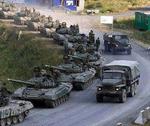
Syrian_Tanks_Golan_3.9.14Syrian tanks roll into Golan

Israel’s Golan forces and population are in a state of preparedness. Tensions rose palpably Wednesday, when Syrian fighter-bombers flew over Quneitra and dropped Iranian-made barrel-bombs on rebel positions. They acted in defiance of Israel’s threat to send its air force against Syrian jets intruding in the Golan no-flight zone.

*************

The Syrian army was poised Wednesday, Sept. 3 for an all-out offensive in the coming hours to take out the rebels holding parts of the Golan town of Quneitra and the crossing into Israel, DEBKAfile’s military sources report. The concentration of Syrian troops at a staging point is clearly visible from Israeli military positions and villages on the Golan.

The assault force consists of a large number of troops from the Syrian army’s 7th Division with many tanks, which the Syrians have been wary hitherto of moving into the battle zone, after being cautioned by Israel via the UN that they would be infringing ceasefire agreements with Israel and risk incurring IDF counteraction.

However, high authority in Damascus appears to be counting on the revulsion and shock,  generated around the world by the beheading by ISIS of the American-Jewish journalist Steven Sotloff, deterring Israel from intervening against Syrian forces which are fighting another Al Qaeda offshoot, the Nusra Front.

All in all, say DEBKA’s sources, the decision to embark on a large-scale assault on rebel gains in the Golan means that military priorities have been reshuffled at the highest level of Syrian policy-making. After treating the Golan and Quneitra front as a strategic backwater hitherto, they suddenly occupy center stage in Damascus as a key arena for vanquishing rebel forces.

Israel’s Golan forces and population are in a state of preparedness. Tensions rose palpably Wednesday, when Syrian fighter-bombers flew over Quneitra and dropped Iranian-made barrel-bombs on rebel positions. They acted in defiance of Israel’s threat to send its air force against Syrian jets intruding in the Golan no-flight zone.

This threat followed the first Syria air strike over Quneitra on Aug. 28, against which Israel refrained from interfering. But Damascus was obviously not deterred from launching another air strike over the Golan to support its coming offensive.

Wednesday night, the Security Council called on all UN members who had any influence with Nusra al-Jabha to intercede for the release of the 44 UN Fijian observers the Islamist group is holding hostage since last week. The same resolution also ordered Nusra to immediately return the weapons and vehicles, some of them armored, they had seized from the UN Disengagement and Observer Force.

With the Syrian sword about to fall on their heads, it is doubtful that the Syrian Islamists will heed either of those calls.

What would Churchill say and do about World War Three?

September 3, 2014

What would Churchill say and do about World War Three? Dan Miller’s Blog, September 3, 2014

Winston Churchill was principally engaged in warning about, and later pursuing the defeat of, the Nazi threat to civilization. He also had much to say about the dangers of Islam. Today, the Islamic threat increases as multicultural voices assure us that Islam is not a threat and that Islamists merely seek peace and prosperity. The same was said many years ago of Nazi Germany.

Churchill

I closed a recent article with the rhetorical question, “What would Winston Churchill do?” and answered it as follows:

That’s an interesting question, helpful answers to which can be found in The Gathering Storm. Answers to the question are, unfortunately, not relevant because Churchill is dead and there is no one living who even approaches him in prescience, resolve and ability to do what needs to be done.

Churchill there spoke of Nazis. Would he now speak in similar ways about Islamists, as he did many years ago?

Might he be arrested for doing so?

Are we still the masters of our fate, as Churchill proclaimed us to be in 1942? Assuming that we are — a dubious assumption — how long will we remain so?

Churchill is dead. Does his spirit linger within us?

I very much hope, but doubt, that it does. Might it revive and persist?

The Gathering Storm offers some answers to my rhetorical question and they may be useful. Here are some from the early-mid 1930’s, after Hitler had gained control over the German Government. Page references are to a battered Bantam Books paperback edition I have long had and, fortuitously, to the Kindle version which has the same pagination but is easier to read.

Page 80, referring to 1933:

We must regard as deeply blameworthy before history the conduct not only of the British National and mainly Conservative Government, but of the Labour-Socialist and Liberal Parties, both in and out of office., during this fatal period. Delight in smooth-sounding platitudes, refusal to face unpleasant facts, desire for popularity and electoral success irrespective of the vital interests of the State, genuine love of peace and pathetic belief that love can be its sole foundation, obvious lack of intellectual vigour in both leaders of the British Coalition Government, marked ignorance of Europe and aversion from its problems in Mr. Baldwin, the strong and violent pacifism which at this time dominated the Labour-Socialist Party, the utter devotion of the Liberals to sentiment apart from reality, the failure and worse than failure of Mr. Lloyd George, the erstwhile great war-time leader, to address himself to the continuity of his work, the whole supported by overwhelming majorities in both Houses of Parliament: all of these constituted a picture of British fatuity and fecklessness which, though devoid of guile, was not devoid of guilt, and, though free from wickedness or evil design, played a definite part in the unleashing upon the world of horrors and miseries which, even so far as they have unfolded, are already beyond comparison in human experience. [Emphasis added.]

Soothing and pleasing (to some) platitudes abound today. According to a Washington Post opinion piece of September 2nd,

President Obama is not worried. And that is unnerving.

British Prime Minister David Cameron presented to Parliament on Monday the alarming conclusions of European leaders who had met in Brussels over the weekend: “The European Council believes the creation of an Islamic caliphate in Iraq and Syria and the Islamist extremism and export of terrorism on which it is based is a direct threat to every European country.”

Cameron added: “To confront the threat of Islamist extremism, we need a tough, intelligent, patient and comprehensive approach to defeat the terrorist threat at its source. We must use all the resources at our disposal, our aid, our diplomacy and our military.”

But three days earlier — the day Britain raised its terrorism threat level to “severe” — Obama delivered a very different message when he spoke to donors at a fundraiser in New York’s Westchester County. “Yes, the Middle East is challenging, but the truth is it’s been challenging for quite a while,” he said. “I promise you things are much less dangerous now than they were 20 years ago, 25 years ago or 30 years ago. This is not something that is comparable to the challenges we faced during the Cold War.” [Emphasis added.]

Speaking to another group of contributors that same day in Newport, R.I., the president said that the post-9/11 security apparatus “makes us in the here and now pretty safe” and that the threat from ISIS “doesn’t immediately threaten the homeland.”

I hope Obama’s chillax message turns out to be correct, but the happy talk is not reassuring. It’s probably true that the threat of domestic radicalization is greater in Europe than in the United States (hence the British plan to confiscate some passports) but Obama’s sanguinity is jarring compared with the mood of NATO allies Obama is meeting in Europe this week.

Obama has been giving Americans a pep talk, essentially counseling them not to let international turmoil get in the way of the domestic economic recovery. “The world has always been messy,” he said Friday. “In part, we’re just noticing now because of social media and our capacity to see in intimate detail the hardships that people are going through.” [Emphasis added.]

So we wouldn’t have fussed over Russia’s invasion of Ukraine if not for Facebook? Or worried about terrorists taking over much of Syria and Iraq if not for Twitter? This explanation, following Obama’s indiscreet admission Thursday that “we don’t have a strategy yet” for military action against the Islamic State, adds to the impression that Obama is disengaged.

In short, Americans would worry less if Obama worried more.

In his pep talk to the donors, Obama spoke optimistically about U.S. influence in the world. “The good news is that American leadership has never been more necessary,” he said, “and there’s really no competition out there for the ideas and the values that can create the sort of order that we need in this world.” [Emphasis added.]

Yes. And the necessity of American leadership — in Ukraine, Syria and elsewhere — is precisely why Obama needs to show more of it. [Emphasis added.]

Would Obama even know how to provide the necessary leadership? Would He lead competently and in the right directions?

Churchill had a dream. Does Obama” If so, what is it? Will His dream be a nightmare for western civilization?

It would be refreshing were a modern day Churchill to respond to Obama’s happy talk and question the nature of His dreams for Obama’s America.

Back to Churchill’s The Gathering Storm, at Page 91 referring to 1934:

In the course of June 1934 the Standing Committee of the Disarmament Conference at Geneva was adjourned indefinitely. On July 13 I said:

I am very glad that the Disarmament Conference is passing out of life into history. It is the greatest mistake to mix up disarmament with peace. When you have peace you will have disarmament. But there has been during these recent years a steady deterioration in the relations between different countries, a steady growth of ill-will, and a steady, indeed a rapid increase in armaments that has gone on through all these years in spite of the endless flow of oratory, of perorations, of well-meaning sentiments, of banquets, which have marked this  epoch. [Emphasis added.]

. . . .

This is not the only Germany which we shall live to see, but we have to consider that at present two or three men, in what may well be a desperate position, have the whole of that mighty country in their grip, have that wonderful, scientific, intelligent, docile, valiant people in their grip, a population of seventy millions; that there is no dynastic interest such as a monarchy brings as a restraint upon policy, because it looks long ahead and has much to lose; and that there is no public opinion except what is manufactured by those new and terrible engines–broadcasting and  a controlled Press. Politics in Germany are not as they are over here. There you do not leave office to join to Opposition. You do not leave the Front Bench to sit below the Gangway. You may well leave your high office at a quarter of an hour’s notice to drive to the police station, and you may be conducted thereafter very rapidly to an even graver ordeal.

It seems to me that men in that position might very easily be tempted to do what even a military dictatorship would not do, because a military dictatorship, with all its many faults, at any rate is one that is based on a very accurate study of the real facts; and there is more danger in this kind of dictatorship than there would be in a military dictatorship, because you have men who, to relieve themselves from the great peril which confronts them at home, might easily plunge into a foreign adventure of the most dangerous and catastrophic character to the whole world.

Again in 1934, at page 102, Churchill wrote:

Although Germany had not yet openly violated the clauses of the Treaty which forbade her a military air force, civil aviation and an immense development of gliding had now reached a point where they could very rapidly reinforce and extend the secret and illegal military air force already formed. The blunt denunciations of Communism and Bolshevism by Hitler had not prevented the clandestine sending by Germany of arms to Russia. On the other hand, from 1927 onwards a number of German pilots were trained by the Soviets for military purposes. There were fluctuations, but in 1932 the British Ambassador in Berlin reported that the Reichswehr had close technical liaison with the Red Army. Just as the Fascist Dictator of Italy had, almost from his accession to power, been the first to make a trade agreement with Soviet Russia, so now the relations between Nazi Germany and the vast Soviet State appeared to be unprejudiced by public ideological controversy.

Are a nuclear armed and Islamist Iran, along with its friends and allies, now less worrisome than Nazi Germany was during the 1930’s and 1940’s?

Obama’s happy talk is apparently intended to assure us that we face no problems which He will not face forcefully and effectively — but only if and when, if ever, He deems it necessary and convenient. He, and our acceptance of His happy talk, are symptoms of the disease that affects Obama’s America as well as Europe and even Britain.

Political theatrics

September 3, 2014

Political theatrics.

Ira Sharkansky

We’ve known for a long time that politics combines theater with serious business. How much of each can vary from place to place and within each place by circumstances?

Israeli pundits are having fun with recordings of Netanyahu’s hyperbolic promises and subsequent behavior. The prime minister has lost ground with the voters, but the same polls that show sharp decline in support for his conduct of the Gaza operation are showing that he is the only game in town. He has two or three times the percentage supporting him than other contenders for the big job.

Perhaps Israelis have learned to accept and discount Bibi’s bluster, to enjoy their decent level of existence, and to ignore the prime minister when he claims responsibility for all that is good.

Somewhat more frightening is the record of Bibi’s American equivalent. It’s hard to measure these things, but it appears from his public comments that the American leader is far removed from a realistic assessment of important things. What makes that more frightening than an Israeli’s bluster is the power of the United States to act or not, with results of great good or harm.

Obama’s record includes demanding, and perhaps expecting democracy and equality in the Muslim Middle East, discarding a moderate leader of Egypt while asserting that he was an extremist, seeing the mechanics of a third world election as more important than the essence of Islamic passions in the elevation of the Muslim Brotherhood to the control of an important Muslim country, and delivering three-quarters of an impassioned speech against Syria’s use of chemical weapons while the final quarter of the speech said that he would not do anything.

The most recent Obama wonderment is saying that the US does not have a strategy for dealing with Daish et al. He has sent his ponderous Secretary of State John Kerry on an international tour to gather support from a joint operation, largely among countries that have learned to distrust the Obama administration. Given the record, we can expect him to shuffle away from anything serious.

Historians and others will quarrel about the contribution of Obama’s Nobel-winning speech to Arab Spring, and its metamorphosis from hopes for democracy to the realities of barbarism.

Mainline Israeli commentators have been ridiculing the lack of judgment in the Obama administration, focusing on the obsessive concern for a formalized peace between Israelis and Palestinians when it should have been clear that neither were ready; seeing Qatar as an appropriate mediator between Israel and Hamas; and now dithering about what to do in response to the escalating ugliness of what is politely called Islamic extremism.

Competing with all of this in a continuing performance is the role of Palestinian Authority President Mahmoud Abbas. Staying in office five years after the end of his term exceeds the political comedies typical of the third world, where at least the semblance of election occurs as a device to claim legitimacy.

One wonders what is more worthy of cynicism: Abbas’s travels to meet the leaders of the world, kissing cheeks, reviewing honor guards, or proclaiming what it is doubtful he can deliver? His recent description of Khalid Marshal as a “peacock” after a meeting when each was claiming how much they could do for Gaza is worthy of some praise, but neither Abbas nor Mashal is likely to provide Palestinians more than individuals and families can acquire through their own hard work.

We should all learn something from the Palestinians. Politics is out there and cannot be avoided, but cynicism may be an essential component of mental health.

At the same time, we should not overlook the essential task of comparison. It’s a lot better on this side of the poorly defined borders with Palestine. When the Israeli government orders our children, grandchildren, or those of our friends into action, it is important to go along. We–and those younger folks risking a great deal more–will not get everything promised, but it would be a lot worse if we did not cooperate.

One must admit that judgement is difficult.

Iran is a case in point. Should we remain convinced that it is set to prepare nuclear weapons and the means to deliver them, see signs for hope in what some claim to be its compliance with international demands, take heart from the US reinstating certain sanctions, applaud Iran’s contribution to the military campaign against Daish in Iraq, or dismiss that as nothing more than Shi’ite mobilization against Sunni forces?

We should remember that politics is the most civilized way of settling disputes. Its essence is argument prior to voting, either by the masses in an election or by those who have acquired office and the responsibility to make policy.

Among the legitimate subjects of dispute are which candidate to select? what policy to support and has the incumbent screwed up enough to be thrown out of office?

Also to be remembered is that the cynic’s handbook for politics has no chapter on heroes. The authors may have searched for examples for such a chapter, but found none worthy.

It is not pleasant for Israelis to realize that we are on the borders of civilization, that many see us as part of the problem rather than part of the solution, and that the purported leader of the free world is wondering if a looming disaster is a problem worthy of action.

Russia’s strategic nuclear forces to hold major exercise this month

September 3, 2014

Russia’s strategic nuclear forces to hold major exercise this month
MOSCOW Wed Sep 3, 2014 9:09am BST


(With the announcement of planned American military drills in the Ukraine, Mr. Putin announces planned Russian Armageddon drills.-LS)

(Reuters) – The forces responsible for Russia’s strategic nuclear arsenal will conduct major exercises this month involving more than 4,000 soldiers, the Defence Ministry said on Wednesday, in the latest sign of rising tension with NATO over the Ukraine crisis.

In an announcement a day before the start of a NATO summit in Wales, RIA news agency quoted the ministry as saying the exercises would take place in Altai in south-central Russia and would also include around 400 technical units and extensive use of air power.

The agency quoted Dmitry Andreyev, a major in the strategic rocket forces, as saying troops would practice countering irregular units and high-precision weapons, and “conducting combat missions in conditions of active radio-electronic jamming and intensive enemy actions in areas of troop deployment.”

He said enemy forces would be represented in the exercises by spetsnaz (special forces) units.

Supersonic MiG-31 fighter-interceptors and Su-24MR reconnaissance aircraft would take part, Andreyev said, saying the scale of air power involved was unprecedented for exercises of this kind.

Both Russia and NATO have stepped up military manoeuvres since the outbreak of conflict in Ukraine between government forces and pro-Russian separatists in the east of the former Soviet republic.

A Kremlin security adviser said on Tuesday that Russia would update its military doctrine this year in the light of the Ukraine crisis and the sharp deterioration in relations with NATO.

Gen. McInerney: “We Helped Build ISIS”

September 3, 2014

Gen. McInerney: ‘We Helped Build ISIS’
By Paul Joseph Watson September 3, 2014
Weapons from Benghazi ended up in the hands of Islamic State radicals


(“Igor…come quick. We’ve created a monster! It’s alive….alive…” All joking aside, I think it’s kind of arrogant to say ‘we’ created ISIS aka ISIL aka IS (whatever). Afterall, ‘we’ created democracy in Iraq and Afghanistan and look where that got us. Bottom line is…the Islamists created ISIS. It’s what they wanted all along and it’s what they got. Had they not been behind this movement, it would have never happened. So before you blame the US for every damned thing wrong with this planet, take a look at who’s doing the blaming and then take a look at who’s doing the beheading, killing of innocents and basically being a huge pain the ass. As most of you already know, the Mideast is a convoluted mess. Helping one hurts another who may or may not be an enemy one day. Like Israel, the US must step back and take a defensive posture while exerting whatever influence it can without getting drawn into the fight…until attacked of course.-LS)

During an appearance on Fox News, General Thomas McInerney acknowledged that the United States “helped build ISIS” as a result of the group obtaining weapons from the Benghazi consulate in Libya which was attacked by jihadists in September 2012.

Asked what he thought of the idea of arming so-called “moderate” Syrian rebels after FSA militants kidnapped UN peacekeepers in the Golan Heights, McInerney said the policy had been a failure.

“We backed I believe in some cases, some of the wrong people and not in the right part of the Free Syrian Army and that’s a little confusing to people, so I’ve always maintained….that we were backing the wrong types.”

He then made reference to a Bret Baier Fox News special set to air on Friday which will, “show some of those weapons from Benghazi ended up in the hands of ISIS – so we helped build ISIS,” said McInerney.

In May last year, Senator Rand Paul was one of the first to speculate that the truth behind Benghazi was linked to an illicit arms smuggling program that saw weapons being trafficked to terrorists in Syria as part of the United States’ proxy war against the Assad regime.

“I’ve actually always suspected that, although I have no evidence, that maybe we were facilitating arms leaving Libya going through Turkey into Syria,” Paul told CNN, adding that he “never….quite understood the cover-up — if it was intentional or incompetence”.

At the same time it emerged that the U.S. State Department had hired an Al-Qaeda offshoot organization, the February 17th Martyrs Brigade, to “defend” the Benghazi Mission months before the attack.

Senator Paul was vindicated less than three months later when it emerged that the CIA had been subjecting its operatives to monthly polygraph tests in an effort to keep a lid on details of the arms smuggling operation being leaked.

CNN subsequently reported that dozens of CIA agents were on the ground in Benghazi during the attack and that the polygraph tests were mandated in order to prevent operatives from talking to Congress or the media about a program that revolved around “secretly helping to move surface-to-air missiles out of Libya, through Turkey, and into the hands of Syrian rebels.” Key Syrian rebel leaders later defected to join ISIS.

In addition to ISIS obtaining weapons from Benghazi, many members of the group were also trained by the United States at a secret base in Jordan in 2012.

Aaron Klein was told by Jordanian officials that, “dozens of future ISIS members were trained at the time as part of covert aid to the insurgents targeting the regime of Syrian President Bashar al-Assad in Syria.”

As we have previously documented, many of the United States’ biggest allies in the region, including Saudi Arabia, Kuwait, Turkey and Qatar, have all bankrolled and armed ISIS militants.

UN probe into Iran nuclear activity stalls — again

September 3, 2014

UN probe into Iran nuclear activity stalls — again | The Times of Israel.

Chances of reaching a nuke deal depend on the investigation, which has not advanced in years, diplomats say

September 3, 2014, 2:40 pm

A nuclear research reactor at the headquarters of the Atomic Energy Organization of Iran, in Tehran, Iran, September 2014. (AP Photo/Vahid Salemi)

A nuclear research reactor at the headquarters of the Atomic Energy Organization of Iran, in Tehran, Iran, September 2014. (AP Photo/Vahid Salemi)

VIENNA (AP) — A new and seemingly promising UN probe of allegations that Iran worked on atomic arms has stalled, diplomats say, leaving investigators not much further than where they started a decade ago and dampening US hopes of reaching an overarching nuclear deal with Tehran by a November deadline.

Expectations were high just two weeks ago, when chief UN nuclear inspector Yukiya Amano emerged from talks in Tehran with Iranian President Hassan Rouhani saying Iran had given “a firm commitment” of cooperation.

“We have started and that is important,” Amano said, suggesting that the years of deadlock had been broken.

His high-profile trip was meant to kick-start the latest effort to investigate the allegations. The investigation was agreed to in February but had made little progress.

Two diplomats told The Associated Press that Amano’s International Atomic Energy Agency will report no substantial progress this week, when it issues its latest confidential report on the status of the investigations — a finding that could impact on the Iran-six power nuclear talks.

IAEA spokeswoman Gill Tudor said Wednesday the agency would have no comment. Iran’s mission to the IAEA said Reza Najafi, the chief delegate to the agency, was in Tehran and nobody else could talk to reporters.

The IAEA inquiry is formally separate from those U.S.-led talks. But Washington says that a final deal must include a conclusion by the IAEA that it has satisfactorily completed its investigation.

With the IAEA still making little headway in getting answers on a dossier of allegations that extends to more than 1,000 pages, it is unlikely to be able to make that ruling by the Nov. 24 deadline, even if the two sides agree by then on the rest of a deal meant to limit Iran’s nuclear capacities in exchange for sanctions relief.

The Iran-six power talks already have been extended from a July 31 deadline due to wide differences between the two sides.

Iran’s reported refusal to advance the probe is bound to embarrass Amano considering his optimistic comments after his August 17 talks with Rouhani. It also will strengthen those in US Congress and elsewhere skeptical of predictions that Rouhani’s assumption of the presidency last year marked a full turn away from confrontation on the nuclear issue.

Iran and the IAEA agreed in February to a new start to the probe after a decade of deadlock, marked by Tehran’s insistence that the allegations were based on falsified intelligence from the United States and arch-foe Israel.

Since then, the UN agency has sought information on three issues: alleged experiments with detonators that can be used to set off a nuclear explosion; separate work on high-explosive charges also used in nuclear blasts, and alleged studies on calculating nuclear explosive yields.

The allegations are part of 11 suspected weapons-related experiments first outlined by the IAEA in 2011.

But Iran denies wanting — or ever working on — nuclear arms, and the diplomats said that as of Tuesday evening it had only provided information on the detonators, insisting that they were used only for oil exploration.

While such applications are possible, the agency says that its body of interconnected information suggests that they were being tested for nuclear weapons use.

No information has been given on the other two issues, the diplomats said, although two senior IAEA experts pressed Iranian counterparts for seven hours on the weekend during a visit to Tehran.

The diplomats — who are familiar with the issue but demanded anonymity because they were not authorized to discuss the confidential talks — said Iranian officials repeated familiar arguments, saying the allegations were untrue. They also dismissed IAEA requests to interview those suspected of involvement in the alleged experiments, saying that could expose the scientists to assassination attempts by Israel.

They say the agency recently suggested expanding the probe by two to four new topics but has not yet received an answer.

Copyright 2014 The Associated Press.

Steinitz tells FADC: Unlikely that there will be a nuclear deal with Iran

September 3, 2014

Steinitz tells FADC: Unlikely that there will be a nuclear deal with Iran.

Earlier Wednesday, the minister said Israel was lobbying world powers anew against any Iranian nuclear deal that would let Tehran retain potential bomb-making technologies.

Strategic Affairs Minister Yuval Steinitz briefed the Knesset Foreign Affairs and Defense Committee Wednesday, ahead of the Iran nuclear talks.

Steinitz told the MKs that he is not “delusional” enough to think all of Israel’s demands will be attained.

The minister expressed skepticism that any agreement could be reached.

“It seems that the Iranians will not dramatically change their stance and will not compromise on the issue of centrifuges,” Steinitz explained. “Assuming that [US President Barack] Obama will continue to stand by his statement that no agreement is better than a bad agreement – there won’t be an agreement.”

Earlier Wednesday, Steinitz said Israel was lobbying world powers anew against any Iranian nuclear deal that would let Tehran retain potential bomb-making technologies.

Negotiators hope for a comprehensive agreement by Nov. 24 under which Iran, which denies seeking nuclear weaponry, would curb its disputed activities in exchange for an easing of economic sanctions crippling its economy.

The next round of talks between six world powers and Iran is expected to be held later this month in New York, possibly on the sidelines of the annual United Nations General Assembly.

Steinitz said in a radio interview he would head a government delegation to Washington next week to press the Jewish state’s demand that the Islamic republic be stripped of all nuclear capacity – something Tehran rules out and many Western diplomats deem unfeasible.

While not a party to the negotiations with Iran, Israel wields influence in foreign capitals given its veiled threats to launch preemptive war to prevent Iran getting the bomb.

“Next week I will be leading a very large delegation to two days of talks in the United States ahead of the main, the central and possibly the last round of talks between the world powers and Iran,” Steinitz told Israel Radio.

He saw no sign of Iran significantly scaling back uranium enrichment, a process that can make fuel for nuclear warheads, despite diplomatic outreach by its President Hassan Rouhani.

“What Rouhani has done is concede on all kinds of secondary issues, partial concessions, but protected the project’s core, which is what threatens us and the whole world,” Steinitz said.

“This means that in substance Iran’s positions have remained as tough as before, and if there is no dramatic development in the coming month then either there will be no deal – or there will be a bad deal leaving Iran a nuclear threshold state, and this is of course something we are not willing to accept.”

Fourth advanced German submarine en route to Israel

September 3, 2014

Fourth advanced German submarine en route to Israel | The Times of Israel.

Commander of Israel’s navy says Dolphin-Class INS Tanin ‘can operate at a level we have not seen until today’

September 3, 2014, 11:12 am

An Israeli navy Dolphin-class submarine (photo credit: Moshe Shai/FLASH90)

An Israeli navy Dolphin-class submarine (photo credit: Moshe Shai/FLASH90)

Israel will add a fourth advanced Dolphin-Class submarine to its naval fleet within the next few days, the commander of the Israel Navy said Tuesday.

“At this very moment, after leaving Germany, the INS Tanin, the Navy and the State of Israel’s fourth submarine, is making its way to Israel,” Vice Admiral Ram Rothberg said at a ceremony for graduates of a naval course. “It can dive deeper, go farther for a longer time and can operate at a level we have not seen until today.”

The impending arrival of the INS Tanin will bolster a submarine fleet has seen dramatic increases in the number and duration of its operational at-sea deployments over the past several years.

According to a senior Israel Navy officer, 58 percent of the submarine flotilla’s time at sea in 2013 was spent in operational deployments, the other 42% having been devoted to training. That marks a dramatic increase from the three previous years, when submarines spent just 36% of their time at sea in operational deployments.

The submarines also conducted 54 special operations in 2013, a similarly sharp increase from previous years. The operations included deployments to the Lebanese coast and unspecified deployments lasting several weeks that took the submarines thousands of kilometers from Israel.

Israel is also scheduled to receive a fifth Dolphin-Class submarine from Germany, the INS Rahav, later in 2014.

The new submarines have engines that don’t require surfacing to acquire new air supplies, effectively expanding Israel’s naval (and, reportedly, nuclear) reach and allowing for more distant and long-lasting operations.

In 2012, the German weekly Der Spiegel reported that Israel’s submarine fleet has nuclear capabilities and that Berlin is aware of this but has opted to publicly remain mum about it in order to avoid having to defend the deals.

The submarines, according to Der Spiegel, are equipped with Israeli-designed Popeye missiles, which can carry a warhead of up to 200 kilograms. The nuclear warheads are produced at Israel’s Dimona nuclear reactor, the report said.

Israel maintains a policy of nuclear ambiguity, neither confirming nor denying that it is in possession of nuclear weapons.

11 Aeroplanes Missing in Libya, Feared Could be Used to Stage Similar Terror 9/11 Attacks

September 3, 2014

11 Aeroplanes Missing in Libya, Feared Could be Used to Stage Similar Terror 9/11 Attacks – Intelligence – International Business Times.

By Esther Tanquintic-Misa

Intelligence authorities from the United States have warned the global community the aeroplanes now reported missing since August when Islamic militants overtook Libya’s international airport in Tripoli could be used to stage 9/11-style terrorist attacks in the region.

An unidentified official quoted by the Washington Free Beacon said they are especially concerned over the missing 11 aeroplanes because it occurred a mere three weeks before the 13th anniversary of 9/11 attacks.

At the same time, those days mark the second anniversary of the Libyan terrorist attack on the US diplomatic compound in Benghazi.

“There are a number of commercial airliners in Libya that are missing,” the official said. “We found out on September 11 what can happen with hijacked planes.”

Abderrahmane Mekkaoui, a Moroccan military expert, told Al Jazeera television it was the Islamic group Masked Men Brigade that took the planes, and that he strongly believes a number of them, if not all, would be used to stage attacks on the Maghreb state.

Sebastian Gorka, a counterterrorism expert, said the planes could be used to strike the oil fields of Saudi Arabia or North Africa.

A report by online news Web site Magharebia said joint military exercises, in co-ordination with US naval forces stationed in the Mediterranean and Italy, have begun which include simulations activities that teach how to intercept a passenger or military plane being piloted by terrorists.

It said the air forces of Algeria, Morocco, Tunisia, Mauritania, Spain, France, Portugal, Italy and Malta are expected to participate in the upcoming exercise.

To date, US intelligence agencies continue to locate all the missing aircraft which were owned by two Libyan state-owned airline companies.

Closed since mid-July, Tripoli airport and at least seven aircraft have been reported heavily damaged during the fighting that began in the same month.

The missing 11 aircraft were reportedly taken, following the takeover of Tripoli International Airport in late August by Libyan Dawn.

The Sept 11, 2001 attacks were a series of four coordinated terrorist attacks launched on the US by the Islamic terrorist group al-Qaeda. The attacks killed 3,000 people and left $10 billion damages in property and infrastructure.

Harvard National Security Journal – Staying Strong: Enhancing Israel’s Essential Strategic Options

September 3, 2014

Harvard National Security Journal – Staying Strong: Enhancing Israel’s Essential Strategic Options.

By Louis René Beres*

In early 2014, Washington and Moscow competed openly for influence in Egypt: Putin even promised expansive arms packages to now-President Sisi. With this in mind, Sisi is apt to play the U.S. and Russia off against each other, a cold war strategy that has implications for Israel’s security doctrine, including perhaps its nuclear doctrine.(1)

Israel operates within a global system(2) that appears to be falling back into some form of earlier bipolarity. This inchoate era may even devolve into a cold war between the US and Russia.(3) Jerusalem should consider this developing power shift in setting its nuclear policy.(4) Hardening bipolarity could lessen anarchy (good),(5) but also increase levels of adversity (bad). Jerusalem and Washington, inter alia, may need to recalculate certain nuclear posture policies with Moscow’s actions more in mind.

Since its inception, Israel’s central war-fighting tenet has been that any national war must be fought and won quickly. Today, avoiding protracted war is more urgent than ever as the correlation of forces(6) in the Middle East could become increasingly unfavorable to Israel – the result of a steady confluence of several intersecting factors, most notably enemy rocket proliferation, inconclusive regional fragmentations, and uninterrupted Iranian nuclearization. Israel’s nuclear forces and strategy must soon begin to assume expanded importance, not for actual combat,(7) but rather for stable and reliable deterrence.(8)

This shift raises two questions: Should Israeli nuclear weapons and strategy remain undeclared or ambiguous? Could some nuclear disclosure compensate for Israel’s lack of mass?

Israel’s Nuclear Deterrent: Historical Development

In the 1950s, Prime Minister David Ben-Gurion fixed certain ultimate hopes of national survival on developing Israeli nuclear weapons and doctrine. His rationale was simple: he reasoned that merely having nuclear weapons would likely deter at least those enemies who could employ weapons of mass destruction or large-scale conventional arms. Ben-Gurion’s successors have adhered, more-or-less openly, to this line of strategic reasoning.(9)

The “bomb in the basement” strategy made evident sense at the time: strategists believed Jerusalem did not need to be more explicit because everyone knew that Israel had nuclear weapons.

Enemy perceptions of Israel’s nuclear capacity that are too general do not necessarily create credible nuclear deterrence and may even undermine Israeli nuclear deterrence. For example, if Israel’s enemies believe it holds only very high-yield/strategic nuclear forces, they may reasonably doubt whether Israel would always be willing to activate such forces to retaliate against an enemy’s first-strike. Ironically, there could be an inverse relationship between Israel’s perceived nuclear capability and its deterrent credibility.

Nonetheless, deliberate ambiguity(10) has endured as the invariable core of Israel’s nuclear doctrine. Ignoring the potentially lethal deterrence shortcomings of any such opacity, Jerusalem seemingly remains convinced that removing the bomb from Israel’s basement – ending the deliberate ambiguity policy – could prompt widespread and corrosive global condemnation. These concerns are valid, but they pale in significance to the costs of any failure of Israel’s nuclear deterrent.

In the world of Israeli nuclear strategy, it is not sufficient for enemy states to acknowledge Israel’s nuclear status; they must also believe that Israel has usable nuclear weapons that it is willing to employ in specific threat situations.

Israel’s Non-Nuclear Defenses

Israel needs nuclear weapons.(11) It may not possess adequate landmass or conventional armed forces to prevail in a protracted conflict. As Carl von Clausewitz famously said in On War, there could come a military tipping point when mass counts. At such point, Israel would require adequate strategic substitutes for the strategic depth it lacks due to its small size and population (Israel is half the size of America’s Lake Michigan).

Israel faces specific, tangible risks from any proposed denuclearization. This is in part because the country’s regional adversaries may be joined by: A new enemy Arab state of Palestine(12) and/or a newly-nuclear enemy Iran.(13) Together, these three groups of risks could create conditions more harmful to Israel than the sum of the separate threats. Without its nuclear weapons, Israel could not credibly threaten to retaliate against such a hazard.(14)

However, even possessing nuclear weapons cannot necessarily ensure successful Israeli deterrence – its enemies must also believe that the Jewish state can and will employ them. Carefully ending deliberate ambiguity by providing limited information about its weapons and its strategic posture could therefore improve and sustain Israel’s nuclear deterrent. Skeptics argue that Israel’s nuclear ambiguity has thus far kept the country’s enemies from mounting authentically existential aggressions. Why rock the boat? Won’t Israel’s strategic future merely replicate the country’s strategic past?(15)

Even if Israel’s enemies remain non-nuclear, they could still carry out lethal assaults against the Jewish State, particularly if they work in concert with insurgent proxies. Speaking in late January, 2014, Major General Aviv Kochavi, head of the IDF Intelligence, indicated that 170,000 rockets are already pointed at Israel.

These are staggering, and sobering, numbers. In any joint military attack, Israel’s enemies would have superior mass.(16) To counter even certain non-nuclear threats, Israel could need to better exploit its nuclear deterrence.

Israel protects itself by implicit and explicit threats to retaliate, and by inter-penetrating elements of national defense. Specifically, its ballistic missile defense system (primarily the Arrow or “Hetz“) is designed to protect soft targets as well as the country’s indispensable nuclear retaliatory forces and infrastructure. No BMD system is perfectly leak proof, however, and even a single nuclear missile that penetrates Arrow defenses could potentially kill tens or even hundreds of thousands of Israelis. Israel could mitigate this threat by diminishing its traditional reliance on deliberate ambiguity.(17)

Deterring Iran

In order to deter a newly-nuclear Iran, Israel must show that its own nuclear weapons are sufficiently invulnerable and capable of penetrating Iranian defenses. Iran’s judgments about Israel’s capability and willingness to retaliate with nuclear weapons would depend largely on its own prior knowledge of Israel’s weapons, including how effective and well protected they are.

Oddly, if Israeli nuclear weapons appear too large and too powerful, this could actually weaken Israel’s nuclear posture. If Iran knows only of presumptively mega-destructive Israeli nuclear weapons – those that could reach thresholds of destructiveness beyond which no retaliatory threat appears credible – this misperception could effectively undermine the credibility of Israel’s core nuclear deterrent. In this scenario, Israel would benefit from certain limited and residual forms of expanded nuclear disclosure. This would mean slowly, purposefully, bringing Israel’s bomb out of the basement.(18)

A fully nuclear Iran now appears to be a fait accompli. The international community, Israel and the United States all have not displayed sufficient willingness to support preemption when such anticipatory self-defense(19) might still have been plausible.

At some point, a nuclear Iran might decide to share some of its nuclear components and materials with Hezbollah or another terrorist group. To prevent this, Israel would need to convince Iran that it possesses a range of viable nuclear options, as well as the will and capacity to retaliate against any Iranian-supported nuclear aggression. Accordingly, Israeli leadership must determine the exact extent to which it should reveal elements of its nuclear positions, intentions, and capabilities. To ensure that its nuclear forces appear sufficiently usable, invulnerable, and capable of penetrating the defenses of all prospective attackers, Israel should prepare to selectively release broad outlines of strategic information, including the hardening, dispersion, multiplication, basing, and yields of certain Israeli nuclear forces. Deploying these pieces of pertinent information at the proper moment could strengthen Israel’s nuclear deterrent.

Israel has probably adopted a counter-city or counter-value nuclear targeting policy. Under this policy, the nation targets an enemy’s population and certain noncombatant infrastructures. Although seemingly more aggressive than a counter-force or counter-military targeting posture, it is apt to reduce the probability of any nuclear engagement. Counter-city/counter-value policy should be communicated to Israel’s enemies in advance to put them on notice.

This strategy is unlikely to help Israel succeed against an irrational enemy,(20) however, that does not value its national survival more highly than any alternative preference or combination of preferences.(21)

As a last resort, Israel might also consider the Samson Option,(22) wherein it would signal that it is prepared to do whatever it takes to survive by threatening massive nuclear retaliation against certain enemy aggressions. Such a policy could be invoked credibly only when the aggression would plainly pose an existential threat to Israel’s physical existence and involve more destructive and high-yield nuclear weapons than might otherwise be thought usable for deterrence.

Israel could better exploit the benefits of a Samson Option by selectively ending its nuclear ambiguity. By emphasizing that it is committed to using its high-end weapons in some circumstances, for example, Israel could communicate to its enemies the viability of its full arsenal.

The time to begin such an end has not yet arrived. Israel’s overriding security objective is to seek stable nuclear deterrence at the lowest risk of military conflict. But, at the moment that Iran is verifiably presumed to cross the critical nuclear threshold, Israel should remove the bomb from the basement. Importantly, by the time this particularly urgent moment arrives, Israel should already have configured its planned reallocation of nuclear weapons assets and the measurable extent to which this up-to-date configuration should now be disclosed. This advance planning could enhance the credibility of Israel’s nuclear deterrence.(23)

U.S. President Barack Obama believes that nuclear weapons are inherently undesirable and destabilizing, and favors “a world free of nuclear weapons.”(24) Yet, there are obviously times when these most powerful weapons can suitably help preserve peace and prevent war. To understand this conceptually, we must first understand the differences between violence and power.

Machiavelli’s The Discourses advances the principle of an economy of violence, here, of course, on a more basic, interpersonal level: “For it is the man who uses violence to spoil things, not the man who uses it to mend them, that is blameworthy.”(25) Israel’s nuclear weapons can still be structured as a more effective deterrent for the prevention of large-scale war, including nuclear war. If shaped by a proper and comprehensive doctrine going forward,(26) including a properly calculated termination of deliberate ambiguity, these weapons could serve to mend the increasingly dangerous military cleavages between Israel and some of its enemies.

*Dr. Louis René Beres (PhD, Princeton) is a Professor of Political Science and International Law at Purdue.


—————

1. Both Russia and the United States are focused upon security threats from an effectively common enemy, that is, Islamic radicalism. Recognizing this, Egyptian President Sisi is apt to exploit this joint `superpower’ concern by playing off one side against the other, in his inevitable search for increased foreign aid and military assistance.

2. From an international law perspective, this fundamentally anarchic system has its origins in the Peace of Westphalia (1648), which concluded the Thirty Years War, and created the still-extant state system. See: Treaty of Peace of Munster, Oct. 1648, 1 Consol. T.S. 271; and Treaty of Peace of Osnabruck, Oct. 1648, 1, Consol. T.S. 119.

3. See: Louis René Beres, “Israeli Strategy in the Case of a New Cold War,” The Jerusalem Post, March 5, 2014.

4. In this connection, Israeli planners should once again consult Clausewitz, On War (1812), especially his call for “audacity” in conflict. Although obviously not susceptible to any forms of precise measurement, this quality could still make an important difference for Israeli strategy going forward.

5. See: Louis René Beres, “What Rough Beast? Israel, Anarchy, and the Shape of Chaos,” The Jerusalem Post, July 3, 2013.

6. See, on this issue: Louis René Beres, “Understanding the `Correlation of Forces’ in the Middle East: Israel’s Urgent Strategic Imperative,” Israel Journal of Foreign Affairs, Vol. IV, No. 1, 2010 (pp. 77-88).

7. The Israeli imperative to avoid nuclear war-fighting wherever possible was a major conclusion of the Final report of Project Daniel, Israel’s Strategic Future, ACPR Policy Paper No. 155, ACPR (Israel), May 2004, 64pp. See also: Louis René Beres, “Facing Iran’s Ongoing Nuclearization: A Retrospective on Project Daniel,” International Journal of Intelligence and Counterintelligence, Vol. 22, Issue 3, June 2009, pp. 491-514.

8. On this requirement, see: Louis René Beres and Isaac Ben-Israel (Major-General/Res./IDF), “The Limits of Deterrence,” The Washington Times, November 21, 2007; Louis René Beres and Isaac Ben-Israel, “Deterring Iran,” The Washington Times, June 10, 2007; and Louis René Beres and Isaac Ben-Israel, “Deterring an Iranian Nuclear Attack,” The Washington Times, January 27, 2009.

9. At the same time, all of Israel’s prime ministers have adhered to a posture of deliberate nuclear ambiguity with regard to any and all pertinent details. This posture is sometimes known as nuclear opacity, or, in Hebrew, amimut. See, on this point, Avner Cohen and Marvin Miller, “Bringing Israel’s Bomb out of the Basement,” Foreign Affairs, September/October 2010.

10. See Louis René Beres, “Looking Ahead: Revising Israel’s Nuclear Ambiguity in the Middle East,” Herzliya Conference Policy Paper, Herzliya Conference, March 11-14, 2013 (IDC Herzliya, Israel).

11. For a partially contra view, however, see Zeev Maoz, “The Mixed Blessing of Israel’s Nuclear Policy,” International Security (Harvard), Vol. 28, No.2., Fall 2003, pp. 44-77. For my response to Maoz in the same journal, see: Louis René Beres and Zeev Maoz, “Israel and the Bomb: A Dialogue,” International Security, Vol. 29, No. 1., Summer 2004, pp. 1-4.

12. There are vital legal as well as strategic aspects to the Oslo Agreements, which could still be the effective jurisprudential foundation of any new Palestinian state. For an early consideration of these legal aspects, see: Louis René Beres, “The Oslo Agreements in International Law, Natural Law, and World Politics,” Arizona Journal of International and Comparative Law, Vol. 14, No. 3., 1997, pp. 715-746, and Louis René Beres, “Why the Oslo Accords Should be Abrogated by Israel,” American University Journal of International Law and Policy, Vol. 12, No. 2,.1997, pp. 267-284. A particularly urgent legal problem with Palestinian statehood remains the naive expectation of Palestinian “demilitarization.” On this specific issue, see Louis René Beres and (Ambassador) Zalman Shoval, “Why a Demilitarized Palestinian State Would not Remain Demilitarized: A View Under International Law,” Temple International and Comparative Law Journal, Winter 1998, pp. 347-363; and Louis René Beres and (Ambassador) Zalman Shoval, “On Demilitarizing a Palestinian `Entity’ and the Golan Heights: An International Law Perspective,” Vanderbilt Journal of Transnational Law, Vol. 28, No.5., November 1995, pp. 959-972.

13. See Louis René Beres, “Like Two Scorpions in a Bottle: Could Israel and a Nuclear Iran Coexist in the Middle East?” The Israel Journal of Foreign Affairs, Vol. 8, No. 1., 2014, pp. 23-32.

14. In narrowly jurisprudential terms, Jerusalem would need to identify all such threats as an expression of self-defense (which could be lawful and law-enforcing), rather than as a reprisal (which in all cases, would not be legally permissible). For authoritative international law clarifications, see: Declaration on Principles of International Law Concerning Friendly Relations and Cooperation among States in Accordance with the Charter of the United Nations, G.A. Res. 2625 (XXV), U.N. GAOR, 25th Sess., Supp. No. 28, U.N. Doc. A/8028, at 121 (Oct. 24, 1970)(“States have a duty to refrain from acts of reprisal involving the use of force.”).

15. For a discussion of those who make this counter-argument, see Cohen and Miller, op. cit., “Bringing Israel’s Bomb Out of the Basement: Has Nuclear Ambiguity Outlived Its Shelf Life?” Cohen and Miller themselves make an argument for ending nuclear opacity, but their argument has nothing to do with enhancing Israel’s nuclear deterrent. On the contrary, its particular rationale is to encourage Jerusalem to join cooperatively in the global nonproliferation regime, and to keep the Government’s faith with Israeli democracy.

16. On the related issue of “strategic depth,” see, for example, Brig-GEN. Michael Herzog (IDF/ret.), “Minding the Gap: Territorial Issues in Israeli-Palestinian Peacemaking,” available at   http://www.washingtoninstitute.org/uploads/Documents/pubs/PolicyFocus116.pdf.

17. Inevitably, it would be better for Israel to successfully deter any nuclear attack on its territory and populations than to intercept incoming missiles once deterrence had already failed. With this in mind, and with the essential understanding that national deterrence and defense needs are mutually reinforcing – not mutually exclusive – Israel should continue with its documented progress on Arrow and related interception systems. For more on the usually-underreported function of ballistic missile defense in protecting Israel’s nuclear deterrent forces (that is, in hard target protection), see  Louis René Beres and Lt. General Thomas McInerney (USAF/ret.), “After Years of Delay, What Can Israel Do About Iran,” Israel National News, October 13, 2013.

18. For a very early treatment of this issue, by this author, see: Louis René Beres, Security or Armageddon: Israel’s Nuclear Strategy (Lexington, Mass: D.C. Heath/Lexington Books, 1986), 243 pp.

19. In law, the customary right of anticipatory self-defense has its modern origins in the Caroline incident, which concerned the unsuccessful rebellion of 1837 in Upper Canada against British rule – a rebellion that aroused sympathy and support in the American border states. Following this landmark case, the serious threat of armed attack has generally been taken as sufficient justification for an appropriate defensive action. In an exchange of notes between the governments of the United States and Great Britain, then U.S. Secretary of State, Daniel Webster, outlined a framework for self-defense that did not require a prior attack. Here, a military response to a military threat was judged permissible, so long as the danger posed was presumed “instant, overwhelming, leaving no choice of means, and no moment for deliberation.”

20. See: Louis René Beres, “Facing Myriad Enemies: Core Elements of Israeli Nuclear Deterrence,” The Brown Journal of World Affairs, Fall/Winter 2013, Vol. XX, Issue 1., pp. 17-30.

21. Under international law, a permissible preemption would be known as “anticipatory self-defense.” For more strategic (rather than jurisprudential) aspects of any such defensive first strike by Israel, see: Louis René Beres, and Major-General/Res./IDF Isaac Ben-Israel, “Think Anticipatory Self-Defense,” The Jerusalem Post, October 22, 2007.

22. See Louis René Beres, “Israel and Samson: Biblical Lessons for Israel’s Strategy in the Nuclear Age,” Israel Affairs, Vol. 1, No.3., July 2005, pp. 491-503.

23. See, also, Professor Beres and General Chain, “Living with Iran,” available at http://besacenter.org/wp-content/uploads/2014/05/Loius-Rene-Beres-and-General-John-T-Chain-Living-with-Iran-PP249-May-28.pdf.

24. See Louis René Beres and (Lt. Gen/Ret./USAF) Thomas G. McInerney, “Obama’s Inconceivable, Undesirable, Nuclear-Free Dream,” U.S. News & World Report, August 29, 2013.

25. Niccolo Machiavelli joined Aristotle’s plan for a more scientific study of politics with certain assumptions of power politics, or realpolitik. His most well-known conclusion underscores the dilemma of seeking to practice goodness in a generally evil world: “A man who wishes to make a profession of goodness in everything, must necessarily come to grief among so many who are not good.” (See: The Prince, Chapter XV). Machiavelli proceeds to construct his political theory on the assumption that “all men are potential criminals, and always ready to realize their evil intentions whenever they are free to do so.” This is a theory that Israel’s principal strategic decision-makers should now consider very closely.

26. In this connection, see: Louis René Beres, “Why Israel Must be Self-Reliant,” The Washington Times, March 28, 2014.