Archive for August 2014

Mohammed Deif, the shadowy figure who heads Hamas’s military wing

August 3, 2014

Mohammed Deif, the shadowy figure who heads Hamas’s military wing, The Washington PostSudarsan Raghavan, August 2, 2014

Deif, according to Israeli military and intelligence officials, is the mastermind of the Palestinian militant group’s current strategy of firing rockets at Israel and building tunnel networks through which highly trained fighters can infiltrate Israel. Those and other tactics have killed 63 Israeli soldiers and three civilians inside Israel since the war began July 8, making Deif the most wanted man in Gaza.


On a narrow, rubble-strewn Gaza street, where an Israeli airstrike recently obliterated the home of a top Hamas leader, a group of boys and men praised a shadowy, middle-age man most Palestinians have never seen — and whom Israel is eager to kill.

“He’s a role model for us,” declared Ahmed, 32, a Hamas security detail, clutching a walkie-talkie. “He’s a legend for the children, for everyone in Gaza.”

“He is defending our homeland,” agreed Yassin Abu Rialah, 14.

To Israelis, Mohammed Deif is enemy number one. As the top commander of the Izzedine al-Qassam Brigades, Hamas’s military wing, Deif has tormented the Jewish state for three decades, deploying suicide bombers and directing the kidnapping of Israeli soldiers. He has survived several attempts by Israel to assassinate him, earning him the nickname “the cat with nine lives.”

Deif, according to Israeli military and intelligence officials, is the mastermind of the Palestinian militant group’s current strategy of firing rockets at Israel and building tunnel networks through which highly trained fighters can infiltrate Israel. Those and other tactics have killed 63 Israeli soldiers and three civilians inside Israel since the war began July 8, making Deif the most wanted man in Gaza.

As Israel presses forward with its ground offensive, Deif is also viewed by some Israeli military analysts as a key obstacle to a negotiated end to the conflict. Al-Qassam Brigades fighters on Friday attacked Israeli soldiers and, according to Israel’s military, abducted an officer — shattering a 72-hour humanitarian truce brokered by the United States and the United Nations. That attack and other cease-fire violations by Hamas reflect divisions between the organization’s political and military wings, with the latter wielding greater influence, analysts said.

“The decision-maker in Hamas is Mohammed Deif, leader of the military wing, and he is against the cease-fire because he believes every day they continue to fight is another achievement for them,” said retired Gen. Giora Eiland, a former Israeli national security adviser.

To Palestinians, Deif is a heroic figure, one of the last remaining leaders from Hamas’s first and second generations, long admired for his defiance of Israel. A former stage actor, he is said to be a master of disguise, known for a chameleon-like ability to melt into the population.

He is thought to be about 50, but the last known photo of him dates back two decades. Little is known about his family life. No one even knows whether Deif is his real name. Some analysts say his name is actually Mohammed al-Masri and that he took his nom de guerre from a role he took in a play at university. Today, the soft-spoken Deif is rumored to be in a wheelchair, after an Israeli attack in 2006 that also cost him an eye and an arm.

“He’s very quiet. He keeps a low profile and lives hidden among the population. He moves with different passports and different identities,” said Imad Falouji, a former senior Hamas leader who helped found the al-Qassam Brigades and is one of the few people who has met Deif. “He’s successful until now because the circle around him is very small. That is why he is still alive.”

The fact that Deif’s life is shrouded in secrecy has only burnished his reputation. In a poll of Hamas leaders taken several months ago by a Palestinian news Web site, Deif was voted more popular than Khaled Meshal, the overall leader of Hamas, and Ismael Haniyeh, the group’s top political leader in Gaza — both highly visible personalities and known to every Palestinian.

Compared to Meshal, who reportedly lives in a five-star hotel in Qatar, Deif is perceived by Palestinians as down-to-earth, a man of the people, Falouji said. Deif’s hard-line attitude toward Israel is seen as an accurate representation of the interests and demands of Palestinians.

During this conflict, Deif’s profile has risen sharply. Palestinians were glued to their television sets last Tuesday when a fiery pre-recorded audio statement said to be from Deif was played on Hamas’s Al-Aqsa network. Shown as a shadowy image seated in a chair, Deif declared there would be no cease-fire in Gaza unless Israel lifts an economic blockade of the enclave and opens border crossings.

“What the air force and your artillery shelling has failed to accomplish will not be accomplished by ground forces,” the man purported to be Deif said. “You are sending your soldiers to a definite slaughterhouse, God willing.”

“The Zionist entity will not know security unless the Palestinian people live in peace,” he added.

One Israeli analyst, Avi Issacharoff, wrote in the Times of Israel newspaper that Deif’s statement, peppered with Koranic slogans, was meant “to create the sense that this was a sacred message, and his voice echoed as though he were a living saint.” It represented “a personal victory for Deif in his struggle for supremacy” within Hamas, Issacharoff wrote.

Born in southern Gaza’s Khan Younis enclave, Deif was introduced as a teenager to the Muslim Brotherhood, of which Hamas would later become an offshoot. In the 1980s, he studied science at the Islamic University of Gaza, where he deepened his involvement with the Islamist movement.

He set up a theater group called “The Returners,”a reference to the Palestinian refugees yearning to return to lands they owned before the creation of the state of Israel in 1948. Deif kept up his acting after he joined Hamas, sometimes playing small roles in propaganda videos, said Avi Melamed, a Middle East expert at the Eisenhower Institute in Washington.

In 1990, Israel arrested Deif for his involvement with Hamas but later released him. Soon after, he helped found the al-Qassam Brigades, along with Falouji and others. Deif quickly become known for his patience and his grasp of weaponry, and he played an instrumental role in developing Hamas’s capabilities, especially in the fields of rockets and bombs.

After Israeli agents killed his mentor, Yahya Ayash, in 1996 with a cellphone packed with explosives, Deif’s role in building up Hamas’s arsenal expanded. That was when he also began to lower his profile to avoid assassination, analysts said.

“He went off the radar around 20 years ago,” said Hamza Abu Shanab, a political analyst, whose father was a Hamas founder and senior leader in Gaza before Israeli forces assassinated him in 2003.

In 2002, at the height of the second Palestinian intifada, or uprising, Deif was appointed head of the al-Qassam Brigades after Israel killed his predecessor. Israel considers him the architect of a lethal campaign of suicide attacks on buses and public areas that lasted until the mid-2000s.

By then, Deif was already working on Hamas’s long-term strategy against Israel.

He oversaw committees that sought ways to increase financing and arms deliveries from Iran and other places and to develop and build sophisticated rockets in Gaza. He created a force of trained fighters who could go into combat and return without blowing themselves up. The building of tunnels was also his brainchild, analysts said.

“He has said for a while that Hamas’s war needs to be moved into Israeli territory, and he came up with the strategy of the tunnels,” said Melamed.

Despite his enhanced stature, Deif has no desire to replace Meshal as Hamas’s top leader, according to analysts. The elusive warrior, who rarely speaks in public, would need to run in elections inside the movement, increasing his visibility — and Israel’s ability to assassinate him.

“Political life does not serve his ambitions,” Abu Shanab said. “He only wants to overthrow the Israeli occupation through armed resistance.”


Cartoon of the day

August 3, 2014

Tip o’ the hat to Power line.

Kerry-Idiot-copy


Israeli troop exit from Gaza without achieving all goals bodes war of attrition

August 3, 2014

Israeli troop exit from Gaza without achieving all goals bodes war of attrition, DEBKAfile, August 2, 2014

goldin_family_2.8.14Missing officer Lt. Hadar Goldin’s family demands his recovery before IDF pullback

As the first Israel troops began pulling out of the Gaza Strip Saturday night, Aug. 2, Prime Minister Binyamin Netanyahu pledged that Operation Defense Edge would continue until security and calm are restored to all Israel’s citizens – however long it takes. But in his televised news conference, he also said: “The IDF will deploy according to the needs of Israel’s security – and only Israel’s security.”

After expressing deep gratitude to the American people and its leaders for their support, Netanyahuu underlined the importance of the links Israel had established with regional countries as a great asset for the future.

In the view of DEBKAfile’s military experts, Netanyahu and Defense Minister Moshe Ya’alon have been guided in their management of the Gaza operation by four major misapprehensions:

1. That Hamas wanted a ceasefire;

2. That the Hamas tunnel network has been largely discovered and disabled;

3. That Hamas will take years to recover from the thrashing the IDF administered in the 25 days of its counter-terror operation in the Gaza Strip. (Netanyahu: “We struck many thousands of terror targets and many hundreds of terrorists.”)

4.  That rocket fire will die down after Hamas fully appreciates the terrible devastation its war has inflicted on the Gaza Strip population.

The slogans of the last four weeks reflected these assumptions: “Quiet will be met with quiet” was one, or “We shall degrade Hamas’ military strength,” and “We’ll wipe out Hamas’ entire tunnel empire.”

But a change in tenor was apparent Saturday night: Variations on the theme of “No accommodation, only deterrence” were to be heard, as well as “No more ceasefires,” and “We’ll end the operation unilaterally as and when it suits our security needs.”

Those ideas reflected the rationale for Israel’s decision not to send envoys to the truce talks opening in Cairo Sunday.

Shortly before the Netanyahu-Ya’alon news conference, the parents and siblings of the captured Israeli officer, 2nd Lt, Hadar Goldin appeared before reporters for a moving appeal to the prime minister, defense minister and chief of staff not to evacuate Israeli troops from Gaza before ecovering the missing officer. His father and four siblings, all IDF officers on reserve or active service, maintained that it was unthinkable according to the most hallowed traditions of the Israeli army to abandon a serviceman in the field..

One of the prime minister’s answers to reporters’ questions can be traced to the deep impression the Goldin family made on the public. He said the IDF will act solely according to security and no other considerations.

The new set of war slogans are designed to soften the impact of a decision reached by the two war leaders last week, which was to pull the bulk of the troops out of the Gaza Strip and redeploy them behind the border fence in offensive formation. The Rafah sector in the south will remain beleaguered.

As for the claim that all the tunnels will be dealt with first, DEBKAfile reports that despite the weeks of fighting, the IDF has driven no deeper than 1-3 kilometers into the territory, leaving the western areas untouched. Therefore, the soldiers can only deal with the tunnels that come out in the eastern sector or cross under the border into Israel.

To truly finish off the warren of passageways, the IDF needs to burrow much farther west-  up to their starting points. But Hamas, with the help of Iranian and Hizballah engineers, constructed the labyrinthine system so that each tunnel forks off into another passage every few dozen or hundred meters. Some of these interconnected passageways lead under the border to places in Israel; others go further underground in Gaza.

The system is totally baffling. IDF spokesmen have said repeatedly that the troops have more or less dealt with the tunnels, while the politicians promise this will be done. They are anxious to allay people’s visceral dread of ferocious enemies jumping out of the bowels of the earth on kibbutz lawns, a terror that has driven more people north than even the rockets.

The truth is that only the tunnel sections reaching the Israeli border have been neutralized, whereas the honeycomb buried deep inside territory which the IDF has not reached has defied Israeli intelligence’s best efforts.And the surprises keep on coming. A capacious, cement-lined passageway leading into Israel was revealed Saturday night with two motorcycles parked inside, ready for terrorists to make a dash to their prey.

As for the rocket fire, Hamas still holds more than a third of the 9,000 rockets with which it launched its blitz – more than enough to keep Israeli civilians within a wide radius running for cover. The IDF has seriously trashed rocket production plants, but at least one-fifth of the facilities remain functional and can continue to replenish depleted stocks.

The assumption that Hamas will need years to recover may turn out to be a losing gamble if Iran and Hizballah decide to step in and rehabilitate their Palestinian ally from scratch.

At all events, if the IDF pulls back the bulk of its ground forces now, with its goals only partly attained, Israel and the communities and towns bordering Gaza will soon be caught up in a lengthy war of attrition and forced to repeat the ground operation.

Analysis: What the Gaza war means for Iran

August 2, 2014

Analysis: What the Gaza war means for Iran, Long War Journal, Behnam Ben Taleblu, August 1, 2014

“Peace [be] upon my dear brothers, the political leaders of Hamas and Islamic Jihad and all resistance groups,” said Brigadier General Qassem Suleimani, the Commander of Iran’s Islamic Revolutionary Guard Corps’ Qods Force (IRGC-QF,) in a recent letter about the Gaza conflict. As expected, the war between Hamas and Israel has provided great ideological fodder for Iran. And it is no surprise that Iran’s revolutionary leadership, best characterized by Ayatollah Khamenei, has been vocal on the issue.

When viewed from Tehran, the war has the added benefit of temporarily occupying the Israeli Defense Forces (IDF), while allowing the Islamic Republic’s strategists to watch, wait, and learn from the operations. Moreover, Iran’s political, religious, and military classes are afforded the opportunity to strut their stuff, tying in their respective areas of impact with the conflict.

In his July 31 letter, Suleimani proudly proclaimed: “We tell all that we love martyrdom. Martyrdom in the path of Palestine and martyrdom because of Jerusalem [Quds] is not only a wish that any noble Muslim wishes for ….” The IRGC-QF Commander additionally asked of God to “damn” numerous entities, “especially America, which is at the head of oppression and cruelty in the world.”

Suleimani’s letter has already elicited a positive response from Palestinian groups, specifically from Palestinian Islamic Jihad (PIJ). Ziad al-Nakhla, the Deputy Secretary of PIJ reportedly stated on July 31 that “[t]he message of Qassem Suleimani has much meaning for us,” and that “[i]f the resistance did not have help from Iran, it would not have been able to confront the Zionist enemy at this level.”

Only two weeks earlier, on July 15, another PIJ member, Khalid al Batash, was mentioned in the Persian media as discussing Iranian support for the PIJ. In his comments, al Batash made sure to single out Iran’s backing and contribution to the group, amid a host of other “brothers.”

Iran is also seeking to solidify its bonds with Hamas, which were severely strained during the Arab Spring due to differences over the future of Syria and the Assad regime. PIJ on the other hand has long been backed by Iran, and at one point in its history even “received training from the Iranian Revolutionary Guards.” It is thus conceivable that the seized shipment of arms from the Klos-C in March 2014 may have been destined for PIJ.

Political, strategic, and ideological perspectives

In a broader sense, Operation Protective Edge and the wider Hamas-Israel War can be viewed from several perspectives when defining its value to Iran — first, domestic Iranian politics and factional divides; second, strategic considerations that take into account Iran’s regional rivalries; and finally, the notion of ideological purity, which arguably has the greatest effect on Iranian behavior and motivations thus far.

With respect to Iranian internal politics, as was reported by Al Monitor in late June, several established reformist newspapers became the target of conservative news agencies over, as was described in the article title, “lackluster Gaza coverage.”

And in the aftermath of Suleimani’s dispatch, Mohsen Rezaie, the former Commander of the IRGC, penned a letter to President Rouhani, warning him of regional developments and blowback which could be linked to the outcomes of the Gaza conflict. He noted: “It appears that the Zionist regime committed and commits these crimes with two covers.” Rezaie explained that “[t]he first cover, is the political and economic support of European countries and America” and “[t]he second cover, is the presence of illegal and illegitimate nuclear and chemical weapons in the stocks of this occupying regime ….”

While there is no doubt regarding Rezaie’s convictions, his presenting them in this medium helps argue for an amplification of the Islamic Republic’s regional policies. It may be too soon to tell, but there could be a ripple effect by some in Iran (like Rezaie, who campaigned against Rouhani in 2013) who wish to use an intensification of Iran’s regional behavior as a way to limit nuclear concessions at the negotiating table. This would undercut the very-reversible concessions Rouhani has agreed to under the Joint-Plan of Action (JPOA). Hence, it is worth remembering that due to Rouhani’s focus on nuclear diplomacy, Iran’s regional policies have remained in the hands of the hardest of hardliners.Syria is the best example of this.

When considering the Islamic Republic’s regional competition, Iranian news outlets and political personalities have not shied away from poking at the traditional Sunni-Arab bloc’s response to the Gaza crisis. These states are best typified by Saudi Arabia, which has its own strategic, ideological, and economic grievances with Iran. For example, on Aug. 1, Hassan Rahimpour Azghadi of Iran’s Supreme Council of the Cultural Revolution advertised regarding the war, “The Zionists have easily confessed that this has been accompanied with the support of all Arab regimes except Syria and Iraq ….” He also proudly proclaimed : “Everyone knows that if it wasn’t for the help of the Islamic Republic and Hezbollah, Hamas and Islamic Jihad wouldn’t have been able to resist this much in previous wars and this war ….”

In an article from Aug. 1, Fars News Agency ran a headline reading, “The King of Saudi Criticized ‘Silence’ Towards Developments in Gaza!” The article served to highlight the irony of the Saudi leadership, who until recently, had been quiet on the matter. To that effect, The New York Times ran a piece a few days ago noting that “Egypt has led a new coalition of Arab states — including Jordan, Saudi Arabia and the United Arab Emirates — that has effectively lined up with Israel in its fight against Hamas, the Islamist movement that controls the Gaza Strip.”

At this juncture, Iran may not simply be imagining things. Indeed, Khamenei’s continued ecumenical appeals, such as the one on July 29, may be aimed at blunting the possibility of a tactical and/or covert Israeli-Saudi alliance if it does not exist already. He stated : “Our clear message to Islamic governments is this, come help the oppressed [and let’s] stand-up and show that the world of Islam will not sit calmly against oppression and cruelty.”

After all, despite Iran’s hostility toward its Sunni-Arab neighbors that are Western-aligned, Israel still reigns supreme in the mind of Iran’s Supreme Leader.

Lastly, on an ideological note, Iranian officials have managed to maintain the level of rhetoric bequeathed to them by Ayatollah Khomeini, the founding father of the Islamic Republic, when it comes to anti-Israeli sloganeering. At Friday prayers held in Tehran on Aug. 1, Ayatollah Movahedi-Kermani in referencing Israel proclaimed that “these criminals [should] await the day of revenge.” He also threatened that “Israel must know that the conscience of humanity is tolerant unto a limit, and if this tolerance spills over, [these] consciences will move against it, and [at] that time, this occupying regime must wish for death.”

Sentiments such as those unfortunately continue to guide Iran’s policies toward Israel. As the conflict between Hamas and Israel grinds on, it is worth keeping in mind that during the last Gaza War (Operation Pillar of Defense) in 2012, Iran’s Parliamentary Speaker, Ali Larijani, bragged that “[t]he Zionist regime needs to realize that Palestinian military power comes from Iranian military power.” Two years later, it can be seen that Iranian clout is magnified when prospects for peace between Israelis and Palestinians are at their bleakest.


Finnish TV Reporter at Gaza’s Al Shifa Hospital: ‘It’s True That Rockets Are Launched Here From the Gazan Side Into Israel’ (VIDEO in Finnish)

August 2, 2014

Finnish TV Reporter at Gaza’s Al Shifa Hospital: ‘It’s True That Rockets Are Launched Here From the Gazan Side Into Israel’ (VIDEO)

August 1, 2014 10:10 am

Author:

avatar Joshua Levitt

A report for Finland's Helsingin Sanomat says, "Right in the back parking lot of Al Shifa Hospital, a rocket was launched." Photo: Screenshot / YouTube.

A television reporter from Finland’s Helsingin Sanomat, the “Helsinki Dispatch,” spent the night reporting from Gaza’s Al Shifa Hospital, where she saw Hamas militants launching a rocket from the hospital’s parking lot, confirming a war crime that few journalists have dared report.

Using hospitals, schools and mosques to store weapons or as a military base is against international rules of war. The Al Shifa Hospital, in particular, has been an area of focus after journalists reported that Hamas was using the hospital as a headquarters, but many of their reports were withdrawn, deleted on social media or actually taken off their newspaper websites because of fears for their safety and retribution from Hamas for reporting the truth.

The Helsingin Sanomat report was titled, ‘HS spent the night at a hospital in Gaza.’

Their reporter, whose name is not shown in the segment uploaded to YouTube on Friday, is reporting from outside of the hospital, where she said, “Right in the back parking lot of Al Shifa Hospital, a rocket was launched, two o’clock in the morning.”

“Really, it happened right in the area, the sound of it was really loud,” she said. “It’s true that rockets are launched here from the Gazan side into Israel.”

Watch the Helsingin Sanomat report from the parking lot of Gaza’s Al Shifa Hospital.

Semi Satire: Since the two state solution for Israel is moribund, here are some other ideas

August 2, 2014

Since the two state solution for Israel is moribund, here are some other ideas, Dan Miller’s Blog, August 2, 2014

(Regular site visitors will have seen some of the videos presented below. I thought I should put them together. — DM)

It has been claimed, correctly for now, that the “two state” solution for Israel’s problems with Islamists is dead.

Hasan Rowhani

The general feeling seems to be that as long as Hamas remains in power in Gaza, the “two state” solution, much praised by the Obama Administration and many others, won’t work. It won’t, because Hamas (Nancy Pelosi and her friends in Qatar to the contrary notwithstanding) has long been and remains a terror organization devoted to the obliteration of Israel.

Iran, the Muslim Brotherhood, Turkey and Qatar favor Hamas’ objectives. Israel disagrees with them. Unlike Islamists, Israel prefers life to death.

Three years ago, Andrew Klavan suggested a one state solution. Here is his plan:

Unfortunately, Mr. Klavan’s plan won’t work either: the Islamist nations surrounding Israel wouldn’t allow it even to get a start, because they want to remain sovereign and generally independent. Leaving that obstacle aside however, Israel is the region’s only free and democratic nation. Since all would become citizens of Israel and have the right to vote, Israeli politics and Judaism would be overwhelmed by Islamists. They would easily override Jewish objections and impose Shari law along with all of its anti-freedom and misogynist religious doctrines on Israel. That would be fatal for Israel, but less bad for her Islamic neighbors.

Here’s a better idea, but it won’t work either:

Perhaps the Palestinians could simply be shipped to Honduras, given refugee status and flown to the United States. They wouldn’t even to leave their prayer rugs behind at the border.

Run-for-the-border-edition-copy

During the Obama family vacation this month, many of them could live in the White House and, when it returns to Washington, the Obama family could reside in the Blair House. Perhaps the rest of Hamas could be housed, fed and supported by former House Speaker Pelosi and her colleagues in appreciation of their humanitarian services. They would fit right into Obama’s America.


The Vanishing Two-State Solution

August 2, 2014

The Vanishing Two-State Solution, Algemeiner, Ben Cohen, August 1, 2014

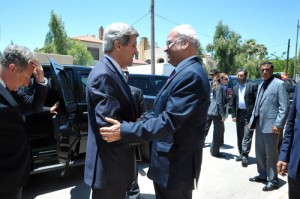
John-Kerry-Saed-Erekat-300x199U.S. Secretary of State John Kerry is greeted by Saeb Erekat, chief negotiator for the Palestinian Authority in the eventually collapsed American-brokered Israel-Palestinian peace talks, before a meeting in Amman, Jordan, on June 28, 2013. Photo: JNS.

JNS.orgSpeaking to a British television network this week, U.K. Prime Minister David Cameron bemoaned that “facts on the ground” were on the verge of wrecking the prospects for a two-state solution to the Israeli-Palestinian conflict.

Cameron, it should be said, has consistently supported Israel’s right to defend itself from the stream of rocket attacks launched from Hamas-ruled Gaza. At the same time, he believes that there is no substitute for a robust, lasting political solution.

That is why his anxiety about the two-state solution is likely shared by other world leaders. What’s so frustrating, the international community reasons, is that everyone knows what a final settlement will look like, yet no one is willing to take the steps necessary to get us there.

Insofar as a negotiated two-state solution is essentially a pipe dream at the present time, I think Cameron is correct to be worried. One of the reasons it’s a pipe dream is because, especially on the Palestinian side, the consensus behind it isn’t nearly as strong as Cameron and others would like us to think. Hamas rejects it outright, of course, as its goal—as CBS’s Charlie Rose confirmed when he recently interviewed Hamas leader Khaled Mashaal—is the elimination of the Jewish state.

The Fatah movement of Palestinian Authority (PA) President Mahmoud Abbas is formally committed to a two-state solution, but its continued backing of the “right of return” for the descendants of Palestinian refugees, as well as its pursuit of unilateral recognition in international bodies, has left Israelis skeptical.

As for the Israeli government, it’s no secret that any willingness there may have been to make territorial concessions to the PA has been badly eroded by both the kidnapping and murder of three Israeli teenagers in the West Bank and the renewed missile attacks from Gaza—after, remember, Fatah and Hamas formed a unity government of sorts.

In this grim context, appeals for an immediate, unconditional cease-fire in Gaza—a stance shared by the Obama administration, the U.N., and the Europeans—seem rather fanciful. Examined from the Israeli perspective, this demand is actually counter-productive. For if world leaders seriously think that the Israelis will return, when it comes to Gaza, to the status quo ante, then they either don’t understand or don’t care about Israel’s strategic calculus.

There are two big decisions facing Israel right now. The first one concerns the end goals of Operation Protective Edge in Gaza. The second one concerns its future relations with the U.S. Both are closely related, but all indications suggest that Jerusalem regards the first as more pressing than the second.

A growing chorus of influential voices in Israel, from right-wing Jewish Home party leader Minister Naftali Bennett to the respected historian Benny Morris, is arguing that Israel needs to finish the job in Gaza. What that means, ultimately, is the defeat of Hamas militarily and politically. The Israel Defense Forces is reported to have made good progress in destroying the network of attack tunnels constructed by Hamas beneath the ground in Gaza (at the same time, as much of the Hebrew press has recently noted, as the general realization dawned that successive Israeli governments had misread the strategic threat posed by these below-the-surface corridors).

Egypt, too, has joined the Israeli efforts to choke Hamas, destroying tunnels connecting the Sinai and Gaza. In these circumstances, it is hardly sensible to allow Hamas the breathing space that a cease-fire would afford. Instead of permitting Hamas to regroup and rebuild, the logic goes, strike the killer blow in the coming days.

This is not a conclusion that the Obama administration wants Israel to reach—and that, ironically, provides another reason for the Israelis to bring Hamas rule in Gaza to an end. Given that this administration has over two years left in office, Israel wants to avoid another Gazan firestorm, say six months from now, that would lead to yet more demands from Washington for an immediate cease-fire and more opprobrium against the IDF’s field operations.

With Hamas out of the picture, Israel is in a much better position to talk about peace and Palestinian statehood. Moreover, there will be an understandable desire among the battered Gazan population for a new authority to fill the vacuum left by Hamas, and that outcome can’t be secured without Israel’s consent.

I don’t believe that much diplomatic progress will be made while President Barack Obama remains in the White House. Trust between the Israeli and American governments has declined sharply, to the point where questions are being raised about Secretary of State John Kerry’s personal commitment to the alliance with Israel. All I’ll say for now is that there is reason to doubt Kerry’s commitment—he hasn’t taken Israeli concerns over Iran sanctions at all seriously, he has warned apocalyptically that Israel faces boycotts and isolation, and he was amiably cooking up a cease-fire proposal with the Turkish foreign minister just days after Turkish Prime Minister Recep Tayyip Erdogan declared that Israel was worse than Hitler.

Three to five years from now, the twin absences of the Hamas military threat and Obama’s bungling diplomacy may propel genuinely meaningful negotiations. In large part that will depend on who is in the White House. For now, though, Israel’s first priority is its national security. That is how it should be.

***********

(How about a one state solution? Nah, that won’t work either.– DM)

IDF to complete destruction of Hamas tunnels by Sunday; Troops begin withdrawal

August 2, 2014

IDF to complete destruction of Hamas tunnels by Sunday; Troops begin withdrawal, Jerusalem PostYaakov Lappin, August 2, 2014

ANALYSIS: In two weeks, IDF destroyed tunnel network which took Hamas five years to build; Army discovers motorcycles in some tunnels, earmarked by Hamas for rapid raids into Israel.

(It’s good that the IDF has found and destroyed most of the tunnels. Will sufficient forces remain to finish the job, and not only with any remaining tunnels? If not, why not?– DM)

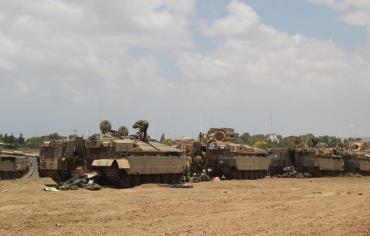
Gaza borderGaza border, July 18 Photo: BEN HARTMAN

The IDF is in the process of reorganizing its ground forces. It is preparing for further instructions from the security cabinet. Ground forces remain active in three areas across Gaza, as the last of the tunnels are destroyed. The remainder of the ground units have taken up positions in staging areas, and some will remain in Gaza, to protect Israeli villages from attempts by Hamas to exploit gaps in the border fence to stage further attacks.


The IDF has destroyed Hamas’s flagship terrorism project; its network of cross-border tunnels that snuck under the border into Israel. The military also began to pull its forces out of the Gaza Strip on Saturday evening.

Hamas has spent five years preparing this strategic threat; the IDF wrecked 31 tunnels in two weeks. By Sunday, all of the tunnels the IDF knew about, or discovered during the offensive, will be destroyed. A few tunnels that Israel doesn’t know about may remain intact.

Many of the underground passages were designed to send heavily armed murder squads into Israeli villages for killing sprees, and attack army positions from behind. They were filled with weapons, explosives, and equipment, enabling terrorists dressed in civilian clothing to disappear into a shaft in Gaza, and emerge in Israel, disguised as IDF soldiers and fully equipped to carry out a mass casualty attack. The IDF has discovered motorcycles in some of the tunnels, which were earmarked by Hamas for rapid raids into Israel and subsequent retreats back into Gaza.

Currently, inside the Strip, the army has gained good control of the areas it is maneuvering in. Despite very difficult fighting that has raged on the ground, which included heavy RPG, anti-tank, and automatic fire by Hamas cells, and despite the painful price Israel has paid thus far, the army is very close to achieving this key goal of its offensive.

In the big majority of cases where the IDF clashed with Hamas, the battle ended with the terrorists being killed, wounded, or with their surrender.

No one in the army expected the fighting to be easy, or one-way. And no one expected all of the battles to end without painful losses on the Israeli side, when tens of thousands of soldiers clashed with Hamas’s battalions of guerrillas.

Similarly, the intelligence available to the ground forces has been superb, but it is unrealistic to expect a 100% success rate. Planned ambushes, such as the one carried out by Hamas in Rafah on Friday, which led to the kidnapping of an officer, were part of the known threats facing the army in Gaza. Not all threats can be dealt with successfully on the battlefield. Such is the nature of war.

Only a ground offensive could provide the military with the needed tools to destroy the tunnels; air power alone could not achieve this goal.

The number of clashes between the IDF and Hamas cells has dropped dramatically in recent hours, an indication of the army’s firm control of the areas it holds. Exceptions to this include sporadic mortar and sniper fire.

Meanwhile, Hamas’s stockpile of medium-range rockets, of the kind it uses to target greater Tel Aviv, is becoming depleted. As a result, Hamas has lowered the number of of medium-range rockets it fires, to pace itself for a drawn-out conflict. On the weekend, Hamas has focused on firing on short-range rockets attacks on the south.

The IDF is in the process of reorganizing its ground forces. It is preparing for further instructions from the security cabinet. Ground forces remain active in three areas across Gaza, as the last of the tunnels are destroyed. The remainder of the ground units have taken up positions in staging areas, and some will remain in Gaza, to protect Israeli villages from attempts by Hamas to exploit gaps in the border fence to stage further attacks.

Some in the defense establishment believe that when Hamas’s leaders emerge from their bunkers, and see how years of tunnelling turned into wreckage, they may think again before investing so many resources into rebuilding a subterranean network. Nothing can stop Israel re-entering Gaza in the future to destroy newly built tunnels. this may lead Hamas to abandon the program.

Israel is continuing to search for a tunnel alert system, and has researched every known technology designed to deal with this threat.

According to the defense establishment, none have so far been found to be effective or operational. None would allow security chiefs to sleep soundly and expect to know, in real time, when Hamas’s diggers begin tunnelling towards Israel again.

A tale of two hospitals: One in Israel, one in Gaza

August 2, 2014

A tale of two hospitals: One in Israel, one in Gaza, The Washington Times, Sen. Ted Cruz, July 30, 2014

Israel saves its enemies; Hamas endangers its friends

The contrast in this tale of two hospitals could not be more clear: Hamas exploits their medical facilities as a human shield to launch terrorist operations against Israel, while Israel uses theirs to provide cutting-edge medical care to people whose government’s avowed goal is to destroy the Jewish state. Hamas’ actions are a war crime. Israel’s are one of the great, unsung humanitarian missions on the planet.


If you want to judge a nation, look at how it treats its most vulnerable civilians. Hospitals are a good place to start.

Al-Shifa, the largest hospital in Gaza, is housed in a converted British army barracks. Some 126 miles north is Israel’s Ziv Medical Center in Zefat.

Hamas, which controls Gaza, is using the civilian population as human shields. The terrorist group has placed its missiles in schools and mosques and, even more deplorably, burrowed its command center underneath the al-Shifa hospital.

Hamas‘ activities are taking place in plain sight. Just two weeks ago, The Washington Post described al-Shifa as “a de facto headquarters for Hamas leaders.” These terrorist facilities are of course well known not only to the foreign journalists who interview Hamas fighters there, but also to the Israelis, who would by necessity consider such a location a legitimate target for any action against Hamas. However, the terrorist group has tried to immunize their headquarters by digging it under a hospital, leaving Israel no option but to target al-Shifa if they want to get rid of the Hamas terrorist leadership.

Hamas sees no downside in this arrangement. Knowing that Israel prioritizes protecting civilians, the terrorists can be reasonably confident that al-Shifa will not be targeted, and they can continue their murderous activities undisturbed. If the Israelis finally decide that these activities are intolerable and that to destroy Hamas they must target their headquarters, Hamas will have pictures of the quintessentially innocent martyrs — hospital patients unable to flee — to plaster across international media in their ongoing propaganda war to demonize the Jewish state.

The medical care and even survival of the Gazan people are of no concern to these terrorists, for whom casualties are not an unintended consequence of war, but rather a deliberate objective. Like the rest of the population stationed around the many civilian institutions militarized by Hamas, they must either make do with a substandard medical facility being exploited by a terrorist organization, or die in the service of that organization’s savage campaign to destroy Israel.

Meanwhile in Israel, Ziv is a center for pediatric and orthopedic medicine. Given its proximity to Israel’s borders with Lebanon and Syria, Ziv has seen its share of violence, but despite taking direct rocket fire during the 2006 Lebanon war, it has remained in continuous operation.

During the past three years of the Syrian civil war, Ziv has treated more than 1,000 Syrians injured in that conflict — all free of charge.

In a visit to Ziv this spring, I met the social worker whose job it is to explain to the patients who wake up grievously injured and surrounded by Israelis that they are not in hell, but that the people who they have been told from birth are the devil are, in fact, working very hard to heal them.

I met a Syrian child who had lost three limbs but has been fitted with revolutionary prosthetics and will, God willing, walk again.

All of this means that many of Ziv’s hospital beds and a substantial portion of its funding are not available for Israelis, but the staff has concluded it is worth it if their work can start to reverse the intractable hate that has been relentlessly leveled at Israel by its neighbors.

The contrast in this tale of two hospitals could not be more clear: Hamas exploits their medical facilities as a human shield to launch terrorist operations against Israel, while Israel uses theirs to provide cutting-edge medical care to people whose government’s avowed goal is to destroy the Jewish state. Hamas‘ actions are a war crime. Israel’s are one of the great, unsung humanitarian missions on the planet.


Why is the West so afraid of Islam?

August 2, 2014

Why is the West so afraid of Islam? The Week

(President Obama, in The Audacity of Hope, wrote that he would stand with the Muslims “should the political winds shift in an ugly direction.” Has he ever said anything comparable about Judaism or Christianity? — DM)

dont-expect-much-support
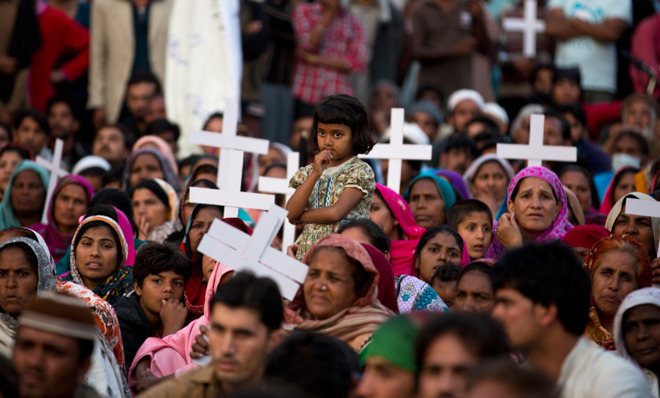
Don’t expect much support. (AP Photo/B.K. Bangash)

In perhaps the only sign of action from the West to the increased intensity of Christian persecution, France has opened itself up to refugees from Iraq, who are being driven out under pain of death by ISIS. This is a welcome reversion to form for France, which ever since the Middle Ages has periodically found ways to protect Christian minorities abroad. This is a great beginning — but it is such a small response to the magnitude of Christian persecution, happening not just in Iraq and Syria, but in Nigeria and Egypt as well.

Why hasn’t there been a greater response from the once-Christian West to the plight of Christians? It’s not for lack of outrageous events. The International Society for Human Rights estimates that 80 percent of acts of religious discrimination in the world have Christians as their victims. And these are starting to poke through the headlines. The purge in Mosul attracted some attention, the kidnapping and threatened murder of mostly Christian girls by Boko Haram even more. But much less is said about the fate of Syrian Christians or Copts. Still less is said about even more obscure religious minorities like Yazidi and Druze who face discrimination from ISIS.

One reason for our silence, suggested by John Allen Jr. in his book The Global War on Christians, is that the modern humanitarian West has difficulty seeing Christians as “native” to third-world nations. Their imagination of “global” Christianity is one of a religion implanted by Europeans and Americans through a violent, racist, and discredited colonialism. Of course this isn’t true in these cases, as there were Christians in Iraq, Syria, and Egypt long before there were any in Britannia or Biloxi. Allen also cited French philosopher Regis Debray’s view that in Christian persecution the victims are “‘too Christian’ to excite the Left, and ‘too foreign’ to excite the Right.”

But Ernesto Galli della Loggia, the lead editorial writer for Corriere Della Sera, offered one provocative suggestion for Europe’s unwillingness to get involved: fear of Islam. In an editorial titled “The Indifference That Kills,” he writes (translated here) that Europe fears what he calls “Arab Islam” and its ability to commit economic blackmail. He writes:

At the same time, and above all, it fears the ruthless terrorism, the many guerrillas that claim to be inspired by Islam, their cruel barbarity, as well as the movements of revolt that periodically deeply stir the masses of that world, always permeated by a sensibility that is extremely easy to light up and to break loose in violent xenophobia. [Corriere Della Sera]

There is something to this. Consider: When Pope Benedict XVI, in an academic setting, merely quoted a medieval critique of Islam, the result was riots across the Islamic world, including the murder of Christian nuns. There was similar rioting and threats over satirical cartoons in a Danish newspaper that if made about Christianity would elicit almost no reaction beyond a letter or a few digital comments.

Europe has seen debates about hate-speech laws passed under the banner of diversity that would function in ways barely distinguishable from anti-blasphemy laws in the Islamic world, singling out Islam and Muslims for special protections from critique and insult. America’s own State Department pleads with a yokel who plans on burning the Koran. Try pissing on some rosary beads and see if John Kerry denounces you in public for tearing at our fragile relations with Malta and the Vatican. (Though Rudy Giuliani might get involved.)

As comedian Penn Jillette elegantly pointed out, the way people avoid giving offense to Islam amounts to a damning condemnation in itself. It is perhaps the worst Western insult offered to Islamic people in the Middle East that we almost universally assume there’s not much point in asking them to recognize the human rights of Christians.

We don’t even expect polite reciprocity. Italy is expected to welcome one of the largest mosques in the world, funded by Saudi Arabia. But no one can build even a modest church in Saudi Arabia. In Egypt, Christians can’t even repair a wall in a church without explicit permission from the sovereign. Qatar has laws that punish people who convert from Islam to Christianity with death, but there’s no planned boycott of their upcoming World Cup because of it. We watch ISIS blow up what many consider the tomb of the prophet Jonah and just sigh, helplessly.

If silence permits Islamist persecution to grow and criticism only enflames its violent zeal, France’s gesture of solidarity with Iraq’s Christians has to be joined by many more countries in the West. It might as well start with the United States, which has played such a large role across this region over the last three decades while taking so little responsibility for the results.