The journalists covering the war on Israel from Gaza haven’t captured much of Hamas’s activities and Palestinians of all stripes have promoted the theme of Israeli perfidy promoted by Hamas. The theme has even become the native tongue of the Obama administration. This morning, in any event, the Foreign Minister of the Palestinian Authority filed formal charges in Geneva accusing Israel of war crimes for targeting civilian areas in Gaza.
The Simon Wiesenthal Center draws attention to the report filmed by India’s NDTV (video below), showing Hamas deliberately setting up a launch site and firing a rocket from Gaza in a densely populated area next to hotels and apartment buildings. According to NDTV, Hamas mounted the attack minutes before the ceasefire went into effect this morning. That’s just how they roll.
NDTV’s report is posted here. The video is definitely worth a look.
Hamas of course uses civilians in the vicinity as human shields who will act as deterrent to an Israeli response, or become casualties of it. Hamas’s modus operandi itself violates the laws of war, not that the Obama administration is willing to handle this elementary fact.
The video is well worth watching and the article, while long, is well worth reading. — DM)
Hamas’ PR strategy can only work if international news media follows the script, whether willingly or under coercion.
In this most recent exchange of hostilities between Hamas and Israel, a number of commentators have noted Hamas’ unusual war tactics. Jeffrey Goldberg asks, “Is Hamas Trying to Get Gazans Killed?” Even Mahmoud Abbas queried, “What are you trying to achieve by sending rockets?” As Bob Schieffer put it with a touch of euphemism:
In the Middle East, the Palestinian people find themselves in the grip of a terrorist group that has embarked on a strategy to get its own children killed in order to build sympathy for its cause—a strategy that might actually be working, at least in some quarters.
The dark strategy has even inspired Israeli Children for Peace to appeal to Palestinian children and a Francophone Israeli to reach outto a bereaved Palestinian mother.
It appears to some, like Michael Oren, that Hamas deliberately maximizes its own people’s suffering for PR. To others, such a strategy would be so base and unthinkable, that they consider the very suggestion of it “racist and reprehensible.” Hamas’ Khaled Mashaal officially denies that Hamas engages in such a heinous policy, even as other Palestinian Jihadis brag about media-assured benefits derived from their own civilians’ deaths. And now, the IDF has possession of a Hamas training manual that advises its combatants to use civilian shields.
Episodically attack Israel’s civilians in such as way as to provoke a counter-attack.
Hide behind Palestinian civilians (preferably in crowded neighborhoods, schools, and hospitals), while encouraging them, even forcing them, to stay, guaranteeing that the return fire wounds or kills civilians and damages civilian structures.
Encourage the Western news media to play up the civilian suffering, play down Hamas’ role in it, and accuse Israel.
Conjure a firestorm of outrage around the world that eventually pressures Israel into desisting from counteroffensive measures.
Survive to reap the propaganda victory and prepare the next round of hostilities.
Repeat, with each exchange hurting Israel more, and each round of international news coverage further savaging the Jewish State’s international reputation.
No matter what the Israeli response, the Hamas strategy is win-win. If the Israelis abort a strike to avoid civilian casualties (as they often do), then Hamas is spared the blow; if an Israeli strike causes civilian casualties, Hamas has dead babies to parade before the cameras. And eventually, the bloodletting will get so bad, the pictures so damning, that Israel will stop. Hamas’ endgame goals, at least at this stage of its asymmetrical war, are actually threefold: tie Israel down with constraints on its use of power, delegitimize and demonize it in the eyes of the world, and stir an aggressive “Muslim Street” in the West, where genocidal chants can lead to pogroms against the Jews worldwide.
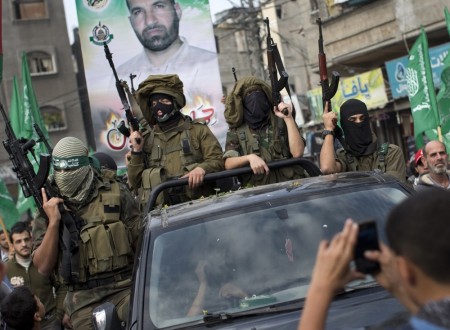
This time, however, this “dead baby” strategy, despite a pedigree of decades, has become increasingly apparent to the observant, perhaps because Hamas has resorted to ever-more obvious tactics to victimize their own people: storing its weapons and firing them from residential areas, hospitals, schools and mosques and even, hiding its leaders under Shiffa hospital. Asked about this, UN official John Ging readily admits: “Yes the armed groups are firing their armed rockets into Israel from the vicinity of UN facilities and residential areas, absolutely.” Indeed, in some cases, while journalists speak to the camera, often following Hamas’ script, Jihadis fire rockets right nearby—live, as it were.
The pattern consistently demonstrates what one Gazan from Tal Awad described to an Italian journalist in 2009 during Operation Cast Lead: “They wanted the [Israelis] to shoot at the [the civilians’] houses so they could accuse them of more war crimes.” The importance of these rockets is not where they’re aimed, but whence they’re fired. They’re a reverse target, designed to create the carnage that will rouse Western indignation.
Israel, operating in these terrible conditions expends considerable resources on an elaborate and multi-staged system of warnings encouraging civilians to leave, right down to calling the residents of houses on their cell phones. Hamas in response calls on people to make themselves human shields, and when they demur, Hamas orders and coerces them to stay. When refugees do flee to UN Schools and other shelters, Hamas follows them there, firing at Israel repeatedly from their midst, drawing Israeli fire toward the shelter. Almost every Israeli strike on or near a hospital or school was a direct result of fire emanating from the facility.
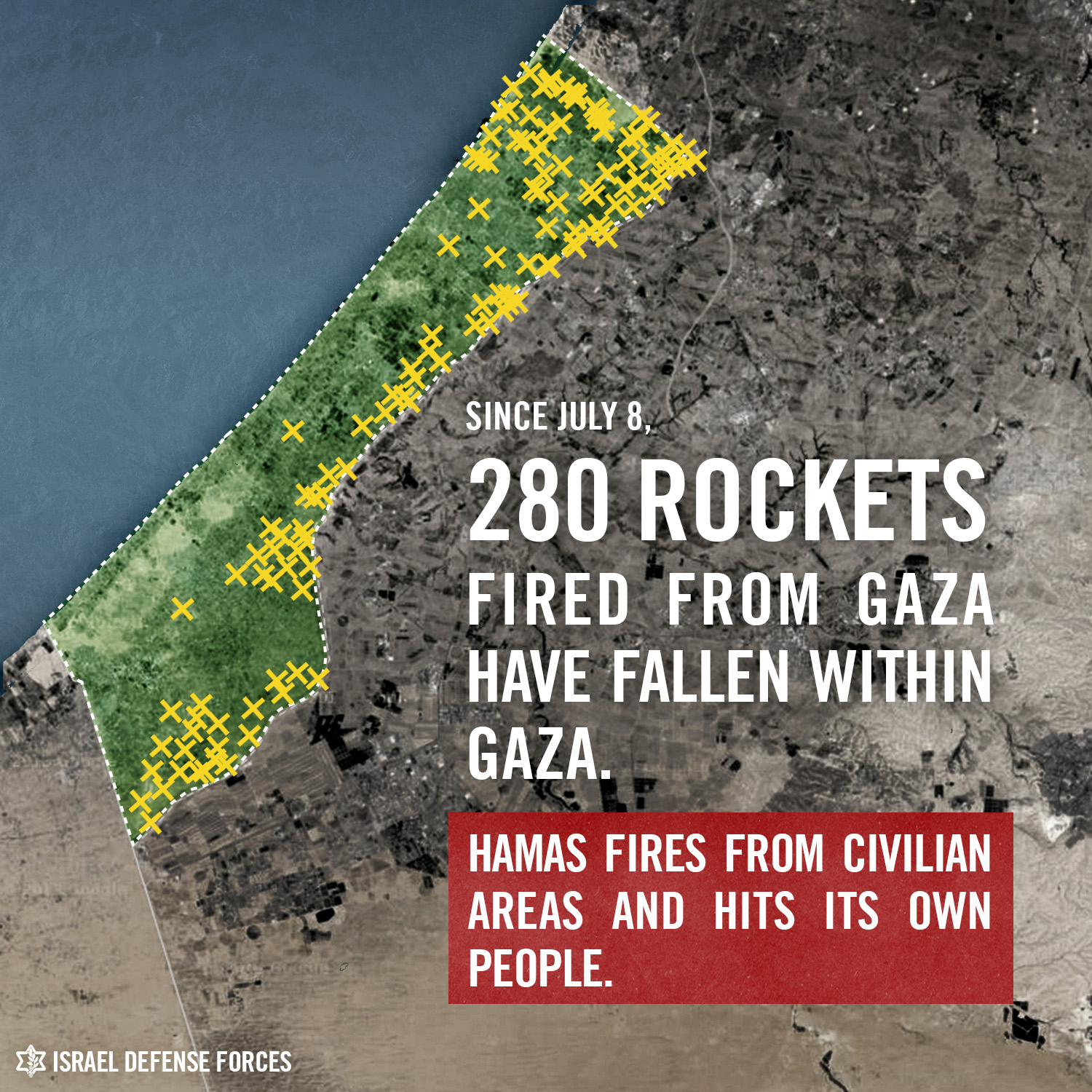
At the same time as Hamas draws Israeli return fire down on Palestinian civilians, Palestinian Jihadis fire their own rockets so wildly that 10-25 percent of their own rockets land in Gaza.
Jihadi Own-Goal Rocketing as of July 15, 2014. Source: IDF.
This happens so often that Hamas has cleaners who clear out their own munitions debris before the Western media are allowed on the scene. During Operation Pillar of Cloud (2012), a Hamas rocket misfired and exploded among civilians. AP reporter Karen Laub noted at the time: “Neighbors said local security officials quickly took what remained of the projectile, making it impossible to verify who fired it.” The same crews get a mention in a tweet by an Italian journalist, offered as “proof” of Hamas’ responsibility for the shelling: “militants rushed and cleared debris.” With all these own-goal rockets, casualties pile up: people not just trapped into getting killed by their purported enemy but getting killed by their supposed “defenders.”
In Beit Hanoun and Shati Refugee camps, own-goal strikes kill dozens of Palestinian men women and children. The news media run images of their suffering on the presumption of Israeli guilt. But when the dust settles and analysts do an honest reckoning of the casualty figures, sifting out the impact of propaganda on the statistics, even the most pro-Palestinian figures will show that Hamas killed many more Palestinian civilians with their rockets than they have killed Israelis. Where Palestinian casualties caused by Israelis will likely approximate a low urban warfare 1:1 civilian/combatant ratio, those caused by Hamas will have a much higher ratio.
THE WESTERN NEWS MEDIA’S SCRIPTED ROLE
Of course, Hamas’ strategy, what Elie Wiesel characterizes as child sacrifice, can only work if it has the sustained cooperation of the international news media, which must fulfill two key tasks in the strategy: 1) broadcast to the outside world the suffering the conflict causes; and 2) implicitly or explicitly blame Israel for that suffering. Without the first, there is no sense of outrage and urgency. Without the second, the world might not intervene on the Jihadi side.
Hamas shows full cognizance of the media’s importance. It has evenissued detailed directions to Gazan “social media activists.” And although Hamas addressed them to Palestinian social media activists, the guidelines clearly apply to their media “fixers,” who direct all the foreign journalists working in Gaza. One might call these directives the “Hamas media protocols.”
not to show Hamas fighters, certainly not firing from hospitals and schools;
to attribute all the casualties to Israeli attacks;
to call all dead “civilians”;
to give the statistics Hamas supplies as facts, emphasizing how the “vast majority” of casualties are civilian;
to show the face of Palestinian suffering 24-7;
to give voice—their own and those of invited guests—to indignation and outrage over the appalling carnage.
So consistently has the media played these scripted roles that it has become a mere pawn in a predictable game. Jeremy Bowen explains: every conflict plays out between the time the Israelis go in to stop the rocketing until the time that Western outrage at civilian casualties gets them to stop. The more victims, the greater the pressure. Anticipating the ground invasion, Christiane Amanpour asks Tony Blair during Operation Cast Lead: “The civilian casualties in Gaza are obviously going to put huge pressure on Israel. How long can Israel withstand this pressure?” It is a main goal of the activist media to emphasize Palestinian suffering to such a degree that Israel will stop.
And that emphasis indeed pervades the coverage: all the news Hamas sees fit to print. The overwhelming majority of the images on the television screens feature injured and dead Palestinians. As Michael Oren explained Hamas’ media strategy to CNN, for example, the viewer saw wall-to-wall Palestinian suffering, especially children. No one, apparently not even the State Department, can watch this coverage, no matter how inaccurate, without succumbing to its subliminal message.
Take, for example, the shelling of Shaati refugee camp in Gaza City and adjacent Shiffa Hospital on July 28. Newsrooms featured the ten innocent refugees, including eight children killed. The IDF deniedresponsibility for this carnage. But it didn’t matter what Israel said, nor did it matter that its evidence involved the tracking technology of Iron Dome. UN’s Ban Ki Moon called it “shameful, outrageous and unjustified,” while UNRWA’s General Commissioner lamented “the world stands disgraced” (presumably by Israel’s wanton slaughter of innocents). The belated tweet of an Italian reporter (to which we shall return below), confirming that Hamas rockets had hit the school, excited the Zionist blogosphere, but had no effect on the mainstream discussion.
One gets the distinct sense that these journalists don’t think they’re assisting Hamas in maximizing the human casualties. Some seem to think that their aggressive rush to judgment, invariably against Israel, is a form of “peace journalism,” designed to end the carnage as quickly as possible. They take for granted that their job is to nail the Israelis for their disproportionate brutality. Journalists publicly exult in theirvictory: “Gripping Gaza images upend balance of PR power in Middle East.” And in so doing—whatever their reasons—they not only thoroughly misinform their audiences, but do so precisely as Hamas would want.
INTIMIDATION AND ADVOCACY MOTIVATE MEDIA’S COOPERATION
The single most compelling reason for the near-unanimity of the media’s cooperation with Hamas is not advocacy, which alone could not create such a consensus, but rather intimidation. Like all systems of omertà this one covers its tracks. Some observers have pointedly asked, for example, why the mainstream news media has conveyed so few images of Hamas “militants.” The New York Times responded that out of the hundreds of photos from weeks of warfare, their award-winning photographer and his crew had provided only two blurry ones. Is this sheer incompetence? Or is it because, as one journalist, just out of Gaza told an Israeli off-the-record: “If we ever dared point our camera at them, they would shoot at us and kill us.” Asked to say that on camera, the journalist “refused and almost ran away.”
But in the Twitter age, evidence of cover-up abounds for those who care to look. Several journalists have reported receiving a wave of SMS threats when they even tweet about Hamas using human shields. Accused of being informants or fifth columnists who are lying and fabricating for Israel, these journalists rapidly learn how seriously Hamas considers their trade a weapon of war and their non-compliance a form of treason. The subsequent disappearance of many of those tweets indicates just how far Hamas’ threats reach.
Occasionally, a really telling piece of evidence appears. Two days after the shelling of Shaati and Shifa, that had “disgraced the world,” an Italian journalist tweeted:
Out of #Gaza far from #Hamas retaliation: misfired rocket killed children y[ester]day in Shati. Witness [proof]: militants rushed and cleared debris.
So, just as Israel had claimed, jihadis had killed their own women and children, cleaned the site, and then brought in journalists to blame Israel. It was indeed disgraceful on many counts, none of which concerned Israel. And yet we only know about this, if we do at all, because this one journalist felt himself beyond Hamas’ reach.
In a dramatic episode, Palestinian-born French journalist Radjaa Abou Dagga found himself summoned to Hamas offices (inside Shifa hospital), alternately accused of working for Abbas or the Israelis, and expelled from Gaza with instructions to work no more. Libérationpublished his account, which makes it clear that such intimidation is common. Indeed, a colleague refused him shelter for the night because he, too, had received these threats: “You don’t mess with these people during a war.” Three days later, Libé took downDagga’s article at his request. With family in Gaza, he clearly did not feel beyond Hamas’ reach.
If true, why does this terrible tale of civilian victimization and journalistic intimidation go untold? Some answer, because it’s not true: “Hamas does not use human shields,” BBC’s Jeremy Bowen assures us. Nor, insists CNN’s Karl Penhaul, do “any of the militant movements and factions here in Gaza,” give journalists “any form of instruction.” For one CNN analyst, it’s “complicated”, but, insists James Fallows, we owe our reporters respect. After all, would they all misinform us? Or is their intimidation and cowardice a public secret they won’t admit?
MISSING CORRECTIVE: MEDIA SELF-CRITICISM
Reporters thrown into the Gazan PR furnace must go through a great deal of mental anguish. On the one hand, as journalists who want to be taken seriously, they cannot avow the threat for violating Hamas Protocols (including forbidding the mention of these rules). Imagine Western audiences viewing a segment from Gaza while below a streamer informed: Report produced under severe conditions of Hamas censorship? On the other hand, they have to live with the knowledge that they daily violate their vocation’s fundamental principles, and that, in so doing, they turn a blind eye to terrible deeds, betraying both their audience at home and the Palestinian people (not to mention Israel).
It is should be one of the great agenda items of professional journalists to develop a special branch of research and ethical discussion on the problems of covering 21st-century asymmetrical wars in which the weak side systematically intimidates journalists and the strong side has democratic commitments to a free press. We can’t ask journalists to seek out martyrdom in the cause of Truth (even if their code does call for courage), but we ought to be able to hope that they would let us know, subtly if necessary, just how deep the intimidation goes.
Most of the time, it seems like the media reacts to criticism of its forced collaboration with Hamas’ war strategy with indignation and a rapid call to change the subject. Instead, they depict Israel as trying to censor, intimidate, and kill journalists, and themselves as bravely resisting this intimidation. CNN’s Karl Penhaul rejected as “obscene,” the mere suggestion that “we [journalists] would show dead, wounded, and dying to make headlines,” then denied any Hamas “instructions” on what to and not to report. On the contrary, tweeted one beleaguered journalist, Western journalists in Gaza feel bullied not by Hamas, but their Zionist critics in cyberspace who accuse them of doing Hamas’ bidding.
Just as Israel must relentlessly scrutinize its military actions in Gaza and their consequences, so, too, must journalists take a hard look at the way they cover this conflict. They must not allow themselves to act as accessories to Hamas’s murderous strategy that delegitimizes Israel and prolongs the Palestinians’ suffering.
When Bill Clinton told an Indian journalist that Hamas “knows it cannot lose politically with this strategy” of forcing Israel to kill its own people, he assumed (as does Hamas) that the media will always cooperate. Were our journalists to recover even a fraction of the courage and honesty that we assume they, as professionals, exercise on a daily basis, things would look very different on this troubled planet of ours. They might start the sobering task by answering the following questionnaire from Harry’s Place.
Spain has resolved to momentarily ban sales of military arms to Israel due to the conflict in Gaza, government sources stated last week, according to Spanish newspaper, El Pais.
On Thursday, Spanish Foreign Minister José Manuel García-Margallo stated in Congress that the amount of Gaza civilian deaths as a result of the bombings in the Strip were “heart-rending,” and while he recognized Israel’s right to defend its citizens, he also asserted that the IDF should take proportionate action “under respect for protection that civilians deserve, which is no less than a manifestation of international humanitarian rights,” reported El Pais.
Over the past year, Israel’s purchases of Spanish weaponry cost €4.9 million ($6.5 million), about one percent of the country’s total defense exports. Previously, the sales ban has also been put on Egypt, Ukraine and Venezuela, according to the report.
The Spanish government said it will review this suspension at their upcoming meeting in September.
The Independent reported that the UK was also evaluating their sale of £8 billion ($13.5 billion) in military equipment to Israel.
The death of innocents is always a tragedy. But the nation that kills is not necessarily the nation at fault. Deaths should not be tallied for balance, as if fairness necessitated a Jew die for every Palestinian killed, or as if the United States should have allowed 200,000 of its citizens to be bombed as an offset to Hiroshima and Nagasaki. The fault for death and destruction lies squarely with the aggressor. As Dennis Prager states concisely in the video on the next page, the aggressor in the Middle East is clearly Hamas.
Political bureau leader Ismail Haniyeh says military resistance, strength of Palestinians will lead to lifting of blockade during Cairo talks.
“We won,” said Hamas leader Ismail Haniyeh in his first statement since the ceasefire on Tuesday.
“The military victory by the resistance, and the legendary strength of our people will lead us to a lifting of the blockage on the Gaza Strip,” said the former prime minister of Hamas in the Strip in a formal statement released on the terror organization’s media outlets.
The Hamas chief said that Palestinian unity helped reach the agreement in Egypt. “A unified people stood behind our delegation in Cairo. We complied with all the diplomatic procedures and contacted our brothers in Qatar and Turkey and, now, in Egypt in order to end the aggression.”
Haniyeh stressed that “what the enemy could not achieve on the physical battlefield it will not achieve in the diplomatic battlefield.
The leader of Hamas’ political bureau said: “I am confident that our Egyptian and Arab brothers all want to help lift the blockage permanently. We support the unified Palestinian delegation in order to produce the most appropriate diplomatic solution and to bring about a resolution that would reflect both the immeasurable sacrifices of our people and the work of the resistance. The delegation stuck to our demands.”
He added that with the start of the ceasefire “the image of destruction seen by the world is the proof to the extent of the IDF’s defeat and its failure in fighting the brave resistance.”
The Hamas political leader said the organization “will be loyal to our people who were hurt by the brutal aggression. The blood spilled by the deceased and the injured is the leadership’s responsibility, we will not abandon them.”
Meanwhile, senior Hamas officials began leaving their underground bunkers. Khalil al-Haya, in his first TV appearance in Gaza, said: “We are leaving for the negotiations in Cairo to lift the blockage once and for all. Our finger remains on the trigger.”
Al-Haya and Imad al-Alami from Hamas and Khaled al-Batsh from Islamic Jihad all left Gaza for Cairo. They received guarantees they would not be hurt on the way to talks, similar to the guarantee received by Ahmed Jabari during the negotiations for the release of captured IDF soldier Gilad Shalit.
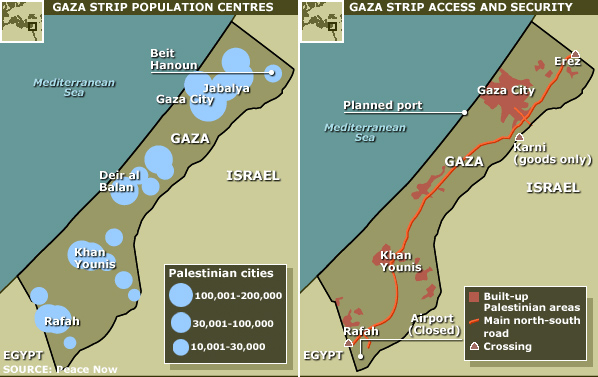
How many times have you heard on television or read in the media that the Gaza Strip is “the most densely populated area in the world”? Repeating this statement, however, does not make it true. There are dense parts of Gaza, especially Gaza City, Beit Hanoun and Khan Younis, but there are far less dense areas in Gaza between these cities. Just look at Google Earth, or this population density map.
(Image source: Peace Now)
The fact that these sparsely populated areas exist in the Gaza Strip raise several important moral questions: First, why don’t the media show the relatively open areas of the Gaza Strip? Why do they only show the densely populated cities? There are several possible reasons. There is no fighting going on in the sparsely populated areas, so showing them would be boring. But that’s precisely the point—to show areas from which Hamas could be firing rockets and building tunnels but has chosen not to. Or perhaps the reason the media doesn’t show these areas is that Hamas won’t let them. That too would be a story worth reporting.
Second, why doesn’t Hamas use sparsely populated areas from which to launch its rockets and build its tunnels? Were it to do so, Palestinian civilian casualties would decrease dramatically, but the casualty rate among Hamas terrorists would increase dramatically.
That is precisely why Hamas selects the most densely populated areas from which to fire and dig. The difference between Israel and Hamas is that Israel uses its soldiers to protect its civilians, whereas Hamas uses its civilians to protect its terrorists. That is why most of Israeli casualties have been soldiers and most of Hamas’ casualties have been civilians. The other reason is that Israel builds shelters for its civilians, whereas Hamas builds shelters only for its terrorists, intending that most of the casualties be among its civilian shields.
The law is clear: using civilians as human shields—which the Hamas battle manual mandates—is an absolutewar crime. There are no exceptions or matters of degree, especially when there are alternatives. On the other hand, shooting at legitimate military targets, such as rockets and terror tunnels is permitted, unless the number of anticipated civilian casualties is disproportionate to the military importance of the target. This is a matter of degree and judgment, often difficult to calculate in the fog of war. The law is also clear that when a criminal takes a hostage and uses that hostage as a shield from behind whom to fire at civilians or police, and if the police fire back and kill the hostage, it is the criminal and not the policeman who is guilty of murder. So too with Hamas: when it uses human shields and the Israeli military fires back and kills some of the shields, it is Hamaswho is responsible for their deaths.
The third moral question is why does the United Nations try to shelter Palestinian civilians right in the middle of the areas from which Hamas is firing? Hamas has decided not to use the less densely populated areas for rocket firing and tunnel digging. For that reason, the United Nations should use these sparsely populated areas as places of refuge. Since the Gaza Strip is relatively small, it would not be difficult to move civilians to these safer areas. They should declare these areas battle free and build temporary shelters—tents if necessary—as places of asylum for the residents of the crowded cities. It should prevent any Hamas fighters, any rockets and any tunnel builders from entering into these sanctuaries. In that way, Hamas would be denied the use of human shields and Israel would have no reason to fire its weapons anywhere near these United Nations sanctuaries. The net result would be a considerable saving of lives.
But instead the UN is playing right into the hands of Hamas, by sheltering civilians right next to Hamas fighters, Hamas weapons and Hamas tunnels. Then the United Nations and the international community accuses Israel of doing precisely what Hamas intended Israel to do: namely fire at its terrorists and kill United Nations protected civilians in the process. It’s a cynical game being played by Hamas, but it wouldn’t succeed without the complicity of UN agencies.
The only way to assure that Hamas’ strategy of using human shields to maximize civilian casualties is not repeated over and over again is for the international community, and especially the United Nations, not to encourage and facilitate it, as it currently does. International law must be enforced against Hamas for its double war crime: using civilian human shields to fire at civilian Israeli targets. If this tactic were to be brought to a halt, then Israel would have no need to respond in self-defense. Applying the laws of war to Israel alone will do no good, because any country faced with rockets and tunnels targeting its civilians will fight back. When the fighters and tunnel builders hide behind human shields, there will inevitably be civilian casualties—unintended by Israel, intended by Hamas—regardless of how careful the defenders are. Israel has tried its hardest to minimize civilian casualties. Hamas has tried its hardest to maximize civilian casualties. Now the United Nations and the international community must try their hardest to become part of the solution rather than part of the problem.
(According to the article, “Kawasme and Abu Aysha are still at large.” Presumably, the author intended to write that Quasma and Abu Aysha remain at large. — DM)
State prosecutors say Hussam Kawasme, a resident of Hebron, confessed not only to giving orders, but to collecting weapons, getting funding for attack from Hamas; two chief suspects behind attack still at large.
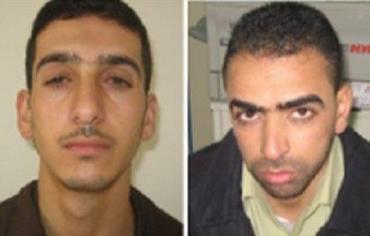
Wanted for kidnapping: (left to right) Marwan Quasma and Amar Abu Eisha Photo: Courtesy
Hussam Kawasme, the mastermind behind the kidnapping of three Israeli teens, was arrested on on July 11th, the state prosecution said on Tuesday.
Kawasma gave the mid-June order to Marwan Kawasme and Amir Abu Eisha to kidnap Eyal Yifrah, Naftali Fraenkel and Gil-Ad Shaer, according to the state.
The revelations arose in the state’s legal response to the High Court of Justice justifying its request to demolish the residences of the three suspected terrorists’ families.
Hussam confessed not only that he gave the orders, but also that he collected weapons and raised funding for the attack by the Hamas cell, the state said.
In addition, Hussam assisted Marwan in concealing the bodies by burying them on land he had bought in recent months.
Next, Hussam was attempting to flee the area and disappear across the Jordanian border with false documents subsequent to the bodies being found, when he was caught back in mid-July.
The state said that the evidence it had was at the level of near certainty, after interrogating Hussam.
That said, confessions to police can be withdrawn at trial, and to date, Hussam has not been indicted, and may not be for some time still.
Kawasme and Abu Aysha are still at large.
The High Court of Justice on Thursday had frozen three IDF demolition orders against those residences. The knocking down of the family homes were originally scheduled for late Thursday afternoon.
On July 1, the state dropped a self-imposed ban on house demolitions that had been in place since 2005.
Back in June, the Shin Bet revealed the identity of the two suspects involved in the kidnapping of the three youths, after a wide-scale search.
Marwan Kawasme and Amar Abu Aysha are from Hebron and longstanding Hamas members.
The Shin Bet added that both were wanted as soon as security forces learned of the kidnapping.
Eyal Yifrah, 19, and Naftali Fraenkel and Gil-Ad Shaer, both 16, went missing on the night of June 12 while hitchhiking outside a settlement in Gush Etzion, south of Jerusalem.
Group hasn’t abandoned its ideology but swapped armed resistance against retaining control over Gaza, senior Strategic Affairs Ministry official says.
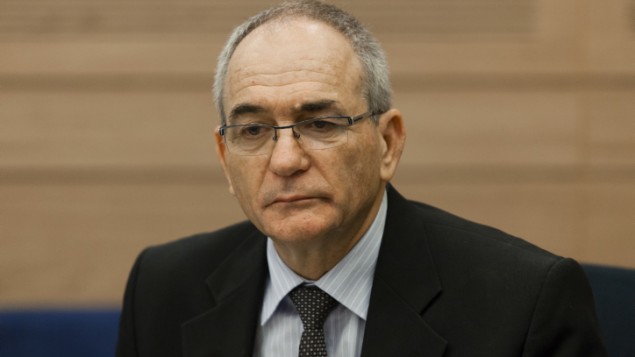
Yossi Kuperwasser at a recent Knesset hearing (Photo credit: Flash 90)
Clearly Egypt would have to play a major role regarding inspections at the Rafah crossing on its border with Gaza, he said. And the international community needs to ensure that cement and other materials entering the Strip designated for civilian projects are not used to construct terror tunnels, he said. “A totally different structure of supervision should be in place. We shall see how this can be done.”
By agreeing to the Egyptian ceasefire proposal, Hamas has temporarily renounced a part of its “terrorist identity” and relinquished its ability to carry out attacks against Israel, a senior Israeli official said Tuesday.
The group hasn’t abandoned its radical and violent anti-Israel ideology, but for practical reasons decided to swap armed resistance for retaining control over the Gaza Strip, said Brig.-Gen. (ret.) Yossi Kuperwasser, the director-general of the Strategic Affairs Ministry.
“By accepting the ceasefire, as proposed by Egypt, Hamas has actually made a strategic decision,” Kuperwasser said. “They realized that in order to keep Gaza under their control, they will have to give up — at least temporarily, but hopefully for a long time — their nature as a terrorist organization. They won’t carry out their attacks; they will continue to speak like a terrorist organization. But they will be forced to give up their ability to carry out their attacks.”
Israel and Hamas on Monday accepted a three-day truce, in which both sides commit to immediately halt any military actions and to meet in Cairo for talks intended to lead to a long-term ceasefire. Jerusalem is adamant that its key demand in these talks is the demilitarization of Gaza. “Israel will bring to these discussions our top priority, which is preventing Hamas from rearming,” a senior Israeli official told The Times of Israel on Monday morning, a few hours after the 8:00 a.m. ceasefire went into effect.
In return, Israel is ready to somewhat ease the blockade on Gaza. “These restrictions [on border crossings and imports of goods] are a function of the hostility and the violence. If the hostility and the violence were to cease it would give Israel room to move on the restrictions that are primarily there for security reasons,” the official said, speaking on the condition of anonymity.
The creation of a reliable international mechanism to monitor imports and exports and oversee the demilitarization of Gaza is “what we’re worried about most,” Kuperwasser said. If Israel is satisfied with security guarantees and an arrangement to disarm terror groups in the Strip, it would be willing to “enable the reconstruction and [allow for] better economic conditions in Gaza,” he said.
Security arrangements and the “control of what’s coming in and out of Gaza would be strictly supervised,” Kuperwasser added. Especially in the beginning, Israel would have to be very cautious, lest Hamas gets its hands on material that could use to attack Israelis, he said.
How exactly Israel’s demand to link the rehabilitation of Gaza to its demilitarization could play out has yet to be determined, said Kuperwasser, a former head of the military intelligence’s analysis and production division. “What we are looking for is creativity and maybe a little bit new ideas because the old ideas didn’t work,” he said.
Clearly Egypt would have to play a major role regarding inspections at the Rafah crossing on its border with Gaza, he said. And the international community needs to ensure that cement and other materials entering the Strip designated for civilian projects are not used to construct terror tunnels, he said. “A totally different structure of supervision should be in place. We shall see how this can be done.”
Palestinian Authority President Mahmoud Abbas can also play a limited role in the coastal enclave’s rehabilitation, Kuperwasser allowed. “But we can’t say that we can fully trust just [Abbas]. It has got to be something more robust than [Abbas’s security] forces.”
Israel is not in the position to determine who should rule Gaza, according to Kuperwasser. Many in the international community want the PA’s security forces to be stationed at the Rafah crossing, and this is indeed a possibility, he said. At the same time, it is unlikely that Abbas’s men will be deployed in Gaza itself, he surmised. “I don’t think this is in the cards right now. The strategic decision of Hamas was to give up some of its terrorist identity in return for keeping control of Gaza. That was the strategic decision Hamas has made, so I’d be quite surprised if in that context they will let [Abbas’s] forces to enter Gaza itself.”
Addressing reporters during a conference call organized by The Israel Project, Kuperwasser said he is confident that the current ceasefire will hold longer than previous such efforts. “Hamas has realized not only that they’re not gaining anything from the continuation of the fire, but that they’re losing a lot.”
Hamas started the current war because it hoped to force Egypt and Israel into easing the blockade on Gaza, he said. The group now understood that it cannot achieve this goal by firing at Israel but that it will have to also have to discuss Israel’s security concerns in the negotiation room.
After 28 days of fighting, Hamas assessing the situation and realized that it lost thousands of rockets, 32 tunnels and hundreds of fighters, Kuperwasser said. After 1,868 Palestinians were killed and 9,567 injured, after tens of thousands of buildings were destroyed, Hamas risked losing the ability to explain to Gazans why they should suffer so badly without getting anything out this war. “I guess that this lesson has been learned by Hamas,” he said, “and I hope that this will make the ceasefire last for a longer period than previous ones.”
When everything seems a mess and there are no clear answers, we must turn to faith. Some may find this article hard to believe, but I choose to believe. It’s the only way.-LS
Iron Dome operator: ‘I witnessed this miracle with my own eyes’
More claims of divine intervention are being reported in the ongoing conflict between Israel and Hamas, with an operator of Israel’s Iron Dome missile-defense system saying he personally witnessed “the hand of God” diverting an incoming rocket out of harm’s way.
Israel Today translated a report from a Hebrew-language news site, which noted the Iron Dome battery failed three times to intercept an incoming rocket headed toward Tel Aviv last week.
The commander recalled: “A missile was fired from Gaza. Iron Dome precisely calculated [its trajectory]. We know where these missiles are going to land down to a radius of 200 meters. This particular missile was going to hit either the Azrieli Towers, the Kirya (Israel’s equivalent of the Pentagon) or [a central Tel Aviv railway station]. Hundreds could have died.
“We fired the first [interceptor]. It missed. Second [interceptor]. It missed. This is very rare. I was in shock. At this point we had just four seconds until the missile lands. We had already notified emergency services to converge on the target location and had warned of a mass-casualty incident.
“Suddenly, Iron Dome (which calculates wind speeds, among other things) shows a major wind coming from the east, a strong wind that … sends the missile into the sea. We were all stunned. I stood up and shouted, ‘There is a God!’
“I witnessed this miracle with my own eyes. It was not told or reported to me. I saw the hand of God send that missile into the sea.”
The commander’s account is reminiscent of a recent newspaper headline which trumpeted the possibility of supernatural protection.
“Their God changes the path of our rockets in mid-air, said a terrorist,” was the headline in the July 18 edition of the Jewish Telegraph.
It was a partial quote from Barbara Ordman, who lives in Ma’ale Adumim on the West Bank.
Her exact quotation was: “As one of the terrorists from Gaza was reported to say when asked why they couldn’t aim their rockets more effectively: “We do aim them, but their God changes their path in mid-air.”
She opened her piece by noting: “In October 1956, [Israeli Prime Minister] David Ben Gurion was interviewed by CBS. He stated: ‘In Israel, in order to be a realist, you must believe in miracles.’”
Ordman also noted religious texts, specifically the Jerusalem Talmud, teaches Israelis not to depend on miracles for survival.
“It argues that we must not desist from our obligations and must not wait for miraculous intervention from the Supernatural,” she wrote.
Meanwhile, the Times of Israel reported a senior officer in Israel’s army said divine miracles protected his soldiers during fighting in the Gaza Strip.
Givati Brigade commander Col. Ofer Winter told the weekly publication Mishpacha that he “witnessed a miraculous occurrence, the likes of which he had never seen before during his military career.”
Winter indicated a predawn raid intended to use darkness as cover was delayed, forcing the soldiers to move toward their objective as sunrise was approaching.
With the troops in danger of being exposed at daybreak, Winter explained how heavy fog quickly descended to shroud their movements until their mission was accomplished.
“Suddenly a cloud protected us,” he said, referring to clouds the Bible says guided the ancient Israelites as they wandered in the desert. “Clouds of glory.”
Winter said only when the soldiers were in a secure position, the fog finally lifted.
“It really was a fulfillment of the verse ‘For the Lord your God is the one who goes with you to give you victory,’” he said, quoting Deuteronomy 20:4.
The Times of Israel notes Winter made headlines over an official letter he sent to battalion and company commanders July 9, telling his subordinates that “history has chosen us to spearhead the fighting (against) the terrorist ‘Gazan’ enemy which abuses, blasphemes and curses the God of Israel’s (defense) forces.”
The dispatch came under fire from some, since it portrayed the Operation Protective Edge as a religious war against non-Jews. The Israeli government’s stated aim is to stop rocket attacks at Israel and destroy a network of tunnels dug under the border from Gaza used to launch terror attacks inside Israeli territory.
In his interview with Mishpacha, Winter defended his message, saying everyone finds God when in combat.
“Anyone who attacked me for the letter apparently has only seen weapons in pictures, was never in combat, and doesn’t know what fighting spirit is,” he said, revealing that before going into action his custom was to recite the blessing with which the ancient Israelite priests would bless the army before it went to war.
“When a person is in a life-threatening situation he connects with his deepest internal truths, and when that happens, even the biggest atheist meets God,” he said, claiming soldiers see so many miracles, “it is hard not to believe [in God].”
Egyptian negotiators in Cairo working for a permanent ceasefire in the Gaza Strip told delegates from Hamas Tuesday that the issues of building an airport and sea port in Gaza, as well as opening the Rafah border crossing aren’t on the table for discussion.







 anneinpt
 artaxes
 danmillerinpanama
 davidking1530
 Peter Hofman
 Joseph Wouk
 Peter
Peter Louisiana Steve
 WarSclerotic

Recent Comments