.
Archive for August 2014
Palestinian Leader Mudar Zahran: Hamas is killing my people
August 8, 2014Take a look at yourself, world media
August 8, 2014Take a look at yourself, world media, Israel Hayom, Boaz Bismuth, August 8, 2014
It seems like the international media has thus far perceived members of the Islamic State as space aliens. Hamas, on the other hand, are seen as freedom fighters working to remove the blockade for the good of the people of Gaza. Unlike the Islamic State people, Hamas operatives are seen as righteous. Try and explain that they’re one and the same.
The cease-fire between Israel and Hamas has allowed the international media to go back to addressing, among other things, the fighting in Ukraine (remember that?) and the Ebola virus, which is much more worrying than the virus known as “Hamas.” The city of Donetsk in the eastern Ukraine has taken the place of Gaza in the headlines of European newspapers.
For some reason, the evacuation on Wednesday and Thursday of tens of thousands of Christians from their homes as the radical Sunni Islamic State takes over extensive areas in northern Iraq and Christian cities still hasn’t been properly covered by the European media (unlike the American media), which was very — I mean, very — worried about Gaza. Which by yesterday had nearly been forgotten.
Is it because there are no European journalists in northern Iraq? Or maybe because the U.N. Relief and Works Agency, which cares only for Palestinians, isn’t active there? Either way, the Islamic State, which is much more radical than al-Qaida (is that even possible?), continues about its business without too many headlines after taking over Kirkuk, Iraq’s most Christian city (it was home to 50,000 Iraqi Christians).
It seems like the international media has thus far perceived members of the Islamic State as space aliens. Hamas, on the other hand, are seen as freedom fighters working to remove the blockade for the good of the people of Gaza. Unlike the Islamic State people, Hamas operatives are seen as righteous. Try and explain that they’re one and the same.
U.S. President Barack Obama announced on Thursday that the U.S. was looking into the possibility of bombing Iraq. Nothing more was needed for the American media to devote its top headlines to what is happening in Iraq.
At any rate, the administration is sort of responsible for what is taking place in Iraq today: the invasion (Bush) and the withdrawal (Obama). We mentioned the American airstrikes? This is doubtless much less dangerous than a ground operation, and between us, will anyone demand investigative committees or a special session of the U.N. General Assembly if and when, heaven forbid, innocent Iraqi civilians are killed in those same airstrikes?
“Leave, convert, or die” was the top headline on the Fox News website. The readers, obviously, were shocked to discover just how hostile the radical Sunni Islamic State is to other religions. For some reason, no one this past month has thought to look into how Hamas sees non-Muslims. “Leave, convert, or die”… think for a moment how much Hamas would like to see a headline like that here. The world was busier removing the blockade than it was perusing the group’s charter. Might there be a connection?
Obviously, France also bears some responsibility for what’s happening in the Middle East. Do you remember the Sykes-Picot Agreement? Today it’s collapsing and France is seeing itself offering asylum to the Christians of the Orient. On Thursday, the government called a special session of the U.N. General Assembly to discuss the situation in Iraq. The Islamic state is “in” — Hamas is “out.”
How quickly the story dies
In general, it’s pretty amazing to see how quickly a story can die. You should see how far down on the CNN website Gaza has dropped. “Hamas: We are ready to renew the fighting,” one of the more modest headlines read. No one is moved by Hamas’ threats to resume shooting on Friday morning if the blockade is not removed from Gaza. The cease-fire talks in Cairo aren’t even mentioned, lest the readers/watchers/listeners doze off.
U.N. Secretary-General Ban Ki-moon managed on Wednesday to anger officials in Jerusalem when, even before the Human Rights Council investigative committee began its work looking into the Gaza war and civilian casualties, he laid the blame on Israel for attacks on U.N. facilities in Gaza and said they should stand trial. There is no question that the U.N. under Ban is having trouble handling the troubles of the world, and it’s good that there is Gaza — and Israel — for the U.N. to flex its muscles over in New York.
But recent weeks have merely shown how helpless the U.N. and the international community are in solving crises: Ukraine, Syria, Iraq, and Gaza have not helped the organization’s image. The various conflicts around the world just prove how weak it is.
The U.N. undoubtedly has a problem. The first clause of the U.N. Charter calls upon members to solve conflicts through peaceful means and refrain from threats and use of force to gain territory or power. Take note about just how relevant it is today.
And one favor from Israelis traveling abroad this weekend: If you happen to run into “international opinion,” ask it what exactly the “international community” is these days and where it’s headed. Because between us, it looks like the international community is in real trouble, and before it examines us, it should take a look at itself.
Why is the US on the sidelines as Cairo talks collapse?
August 8, 2014Why is the US on the sidelines as Cairo talks collapse? Times of Israel, Rebecca Shimoni Stoil, August 8,2014
As the ceasefire fails, Washington maintains an unusually low profile while Egypt reemerges as a regional powerhouse.
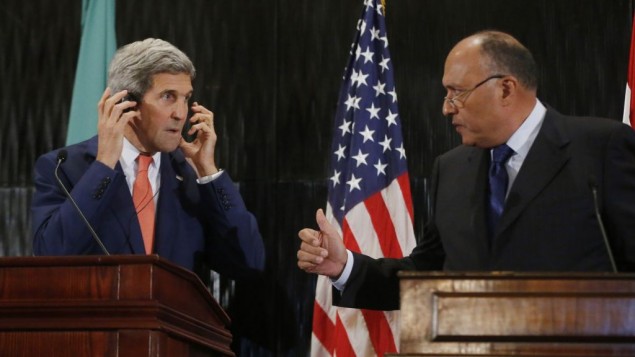 US Secretary of State John Kerry stands with Egypt’s Foreign Minister Sameh Shukri during a press conference in Cairo, Friday, July 25, 2014. (photo credit: AP/Pool)
WASHINGTON — As a 72-hour truce came to an explosive end with rockets fired into Israel Friday morning, it seemed as if the US had turned to other issues. In the days and hours leading up to the Gaza ceasefire’s demise, the US appeared largely absent at the crunch point in Cairo and, by Thursday night, it was the anxiously awaited humanitarian food drop to some 30,000 starving Yazidis on an Iraqi mountaintop that topped the administration’s foreign-policy talking points.
After weeks of blustering and blundering, with pronouncements from Washington podiums and Secretary of State John Kerry’s lengthy attempt at securing a negotiated ceasefire through shuttle diplomacy, Washington kept a low profile as delegations met in Egypt’s capital in the past few days.
The US was, in fact, represented in Cairo. Acting Special Envoy for Israeli-Palestinian Negotiations Frank Lowenstein — Martin Indyk’s successor — arrived in the Egyptian on Wednesday, August 6, after talks began. His role was treated ambivalently, with State Department Deputy Spokeswoman Marie Harf describing it as “to monitor progress and advise in areas where the US can be helpful and achieve — in achieving a lasting ceasefire and forging a sustainable long-term solution for Gaza,” but noting that “he will not be involved in direct mediation between the delegations.”
Harf suggested that the limited involvement stemmed from the fact that “obviously, Hamas is a designated foreign terrorist organization” and that Washington does not maintain “direct contact with Hamas officials.”
Kerry was nowhere to be seen — at least, not in the region. He was redirecting his focus on a seven-day whirlwind tour to Kabul, Afghanistan, Naypyitaw, Burma; Sydney, Australia; Honiara, Solomon Islands; and Honolulu, Hawaii.
The State Department emphasized that far from distant, “Secretary Kerry also continues to be engaged with — at the leader level — with the key stakeholders.”
“Obviously, what we need to see is a longer-term ceasefire put in place, and if Frank can help and our team there can help, if Secretary Kerry can help by making phone calls, we are absolutely there to do so,” Harf said Thursday, in a barrage of ‘if’s. The takeaway message between the lines was that Kerry was not currently engaged, but was willing to make phone calls if somebody thought it would help. Yet nobody — at least publicly — was clamoring for a Kerry call, nor were any such calls announced in the critical hours before Friday’s morning’s Hamas resumption of rocket fire and the subsequent Israeli response.
The ceasefire — for better or for worse — appeared to be a regional show, run by Egypt. While Egypt traditionally has served as a mediator in such conflicts, it did so in previous years with strong, top-level US backing and involvement in talks.
Part of the challenge to US engagement is Washington’s own ambivalent relationship with the Egyptian government.
Noting that there were aspects of Egyptian politics that the US found “objectionable,” the Washington Institute for Near East Policy Executive Director Robert Satloff said, during a Thursday panel on the Gaza ceasefire, that “if any strategic matter puts itself front and center and requires a rethink of the need for high-level sympathetic engagement between the US and Egypt, it is the events of the last few weeks.”
He said that senior members of the Obama administration are divided on their perspective on Egypt and its potential role in the Middle East. “There are some who believe that Egypt is part of the problem, and some who think it is part of the solution. And this difference of view stymies the potential for a serious, strategic rethink and a serious, strategic reset of our relationship with Cairo,” Satloff explained. “This is, to me, utterly regrettable, as underscored by the events of the last couple of weeks.”
In this round of conflict, the US has nominally supported Egypt’s endeavors for weeks, even writing off a United Nations attempt at brokering a deal with a statement that the US supports the “Egyptian plan.” But the US has seemed reluctant to throw its weight around after the fallout from Kerry’s Paris meetings with Qatari and Turkish representatives. Two weeks ago, Kerry submitted a proposal based on Qatari and Turkish input, taking Hamas demands into account, which Israel’s leaders flatly rejected and privately slammed. Kerry said later it was just a draft.
“The problem with the US proposal at the time, which raised a lot of consternation at the time not just in Israel but in the PA and Egypt, was not that they wanted Turkey and Qatar to play a role, but that they wanted to establish an alternative channel to the Egyptian role in this rather than direct everything in that role,” explained Mike Herzog, a former IDF general, member of Israel’s peace negotiations team and a fellow at the Washington Institute for Near East Policy during the Thursday discussion on the Gaza ceasefire.
Ultimately, Herzog said, “the United States was less relevant in bringing about the solution than Egypt and some regional actors, and that is very unfortunate.” As the US drew back from involvement, Egypt appeared to lead a coalition of concerned Arab states — Saudi Arabia, Jordan, and some Gulf states — who were invested in achieving a deescalation.
Egypt, with its control of the gate of the Rafah crossing, was the only state — other than Hamas’s financial supporters, Qatar and Turkey — that seemed to be capable of generating leverage over Hamas.
At the same time, Washington seemed to be losing some of its leverage. Aaron David Miller, a senior fellow at the Woodrow Wilson Institute, suggested that US-Israeli tensions, which came to a head following the Paris conference, had also served to limit Washington’s role in Cairo.
“The US at this point has little credibility with Israelis and no influence over Hamas,” Miller said, explaining the low US profile during the talks.
Miller continued that an additional factor in Washington’s relative quiet in Cairo was the fact that “there is a risk at this stage that a higher-profile role would complicate what it is that they’re trying to achieve.”
Low levels of US involvement in this round of talks also meant, he added, that the US could reassess its role should the ceasefire break down — as it did.
Speaking during the Washington Institute panel, Washington Institute Senior Fellow and former US special envoy to the Middle East Dennis Ross suggested that the US — and perhaps other western powers — could again take an active role toward a more lasting agreement after successful ceasefire talks.
“One of the things we can count on, and it’s understandable, is that there is going to be a push diplomatically to see what we can do with the Israeli-Palestinian conflict,” Ross suggested. President Barack Obama’s comments Wednesday, in which he looked beyond the ceasefire toward a more comprehensive resolution in Gaza, seemed to reinforce such a direction.
Ross went on to delineate possible steps that the US could take to create a more hospitable climate through conflict management, if not resolution, in an environment of intense mutual distrust between Israel and the Palestinian Authority, while still sidelining Hamas.
Ross’s colleague, Satloff, added that Washington’s relative sidelining in the ceasefire talks emphasized the fact that “it would be really important for the US to turn a page from recent events, to take on, to revisit the question of what are our priorities in this part of the world, what type of leadership are we going to be projecting.”
The tendency for US behavior in the region as a whole, he warned, “is very reactive.”
“The comments of my colleagues point not toward a reactive posture, but the need for a very active posture — one that is coordinated very well between the White House and the State Department,” Satloff commented.
With the ceasefire lying in shambles, it has yet to be seen whether Washington’s low-profile strategy will position the United States back in the center of any renewed attempts to deescalate, or whether it missed a critical opportunity to take advantage of a brief window of respite to achieve a lasting peace.
‘Top advisors predict a long, very long campaign’ in Iraq
August 8, 2014‘Top advisors predict a long, very long campaign’ in Iraq
POSTED AT 8:41 AM ON AUGUST 8, 2014 BY NOAH ROTHMAN via Hot Air
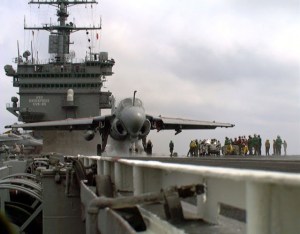
(Ironic. Let’s see who starts demanding a ceasefire now.-LS)
“We don’t understand real evil, organized evil very well,” said America’s former ambassador to Iraq and Afghanistan, Ryan Crocker, in an interview with The New York Times. “This is evil incarnate.”
“People like [Islamic State commander] Abu Bakar al-Baghdadi have been in a fight for a decade,” he added. “They are messianic in their vision, and they are not going to stop.”
President Barack Obama authorized military strikes on select targets in Iraq on Thursday aimed only to halt the Islamic State’s advance on the cities of Erbil, the Kurdish capital in the north, and Baghdad. At the same time, however, the president continues to assure the American public that this is not the start of a third Iraq War. For the time being, the introduction of American ground forces has been ruled out.
American military commanders seem to think that the president’s strategy of using airpower alone to reduce the threat posed by the Islamic State fighters is insufficient.
“We must neutralize this enemy,” Army Lt. Gen. Mick Bednarek, U.S. chief of the Office of Security and Cooperation-Iraq told a Military Times reporter. “This is not just an Iraqi issue. This is not just a regional issue.”
He added that, as even those only familiar with the threat posed by the Islamic State through media accounts know, this organization “is not just a violent extremist organization.”
“This is an army,” Bednarek added, “and it takes an army to defeat an army.”
Regardless of the assurances the president has made to a war-weary public, a report in CBS This Morning on Friday indicates that American military officials are aware of just how comprehensive a military campaign aimed at neutralizing this fundamentalist threat will have to be.
“Senior officials describe ISIL forces as swift, effective, and capable of carrying out military mission with quote ‘tremendous military proficiency,’” CBS news reporter Major Garrett reported. “The Iraqi army and Kurdish fighters have been no match for them. Now, from the air, the U.S. will join the fight. Top advisers predict a long, very long military campaign.”
CBS reporter David Martin noted that the humanitarian airlift operation “could foreshadow a much larger military campaign.” He noted that at least 150 American military advisors and an “unknown number of diplomats” remain in Erbil, a city under siege by Islamic State forces.
“Until this week, the Kurdish region had been considered so secure that the United States had chosen it as one of two Iraqi locations safe enough to transfer staffers from the U.S. Embassy in Iraq. But a sense of dread fell over the Kurdish capital on Thursday as the magnitude of the Islamic State threat became clear,” read a McClatchy news report revealing the fear that has overtaken that Iraqi city.
Military officials are already indicating that strikes in Iraq could be far broader than what the president described. “One senior administration official suggested that could include strikes on militants that have captured Iraq’s largest dam near Mosul,” a Wall Street Journal report read.
“We’re laying down a marker here,” an unnamed administration official said. “Just their presence…and the potential threat they pose could lead us to take action if targets present themselves.”
UPDATE: The first strikes on ISIS targets are already underway, according to the Pentagon.
BREAKING: U.S. Airstrikes Hit Islamic State Artillery Positions Near Erbil…
August 8, 2014BREAKING: U.S. Airstrikes Hit Islamic State Artillery Positions Near Erbil…
ZIP | August 8, 2014 8:57 am

(Game on. Finally. I prayed Obama would not let our fellow Christians die at the hands of these ISIS savages.-LS)
WH advisers are predicting a “long, very long campaign.”
Jake Tapper
@jaketapper
Pentagon says US military aircraft have hit ISIS artillery being used to attack Kurd forces defending Erbil, near Americans.
David Wood
@woodwriter
2 FA-18s put 500 pounder on ISIS artillery piece outside Irbil. It begins….
Hamas resumes rocket attacks on Israel, after ultimatum demanding open seaport for Gaza or war
August 8, 2014Hamas resumes rocket attacks on Israel, after ultimatum demanding open seaport for Gaza or war.
debka
Hours before the 72-hour ceasefire was due to expire Friday morning, Aug. 8, the Palestinian Hamas’ military wing slapped down an ultimatum before Israel: Either allow the Gaza Strip to have an open seaport – which would be tantamount to lifting the Gaza blockade – or prepare for a long and brutal war of attrition with thousands of fatalities.
Hamas’ decision about extending the ceasefire was tensely awaited Thursday night after Israel’s acceptance. Instead, the Palestinian Islamists declared that the war would go on unless Israel bowed to their dictates.
Israel’s envoys had previously rejected their demand for a deep sea Gaza port in the talks taking place in Cairo under Egyptian auspices.
Abu Obeida, spokesman of Hamas’ military wing, Ezz e-Din Al-Qassam, also announced that his movement had acquired new rockets with larger warheads than the more than 3,000 fired against the Israeli population in the month-long conflict, and they would be aimed at Israel’s Ben Gurion international airport. Israel would be severed from its air transport ties with the outside world, he said.
“We demand our fundamental rights,” said the Hamas spokesman, in a statement that was broadcast live Thursday night. “We call on our envoys to the Cairo talks not to continue negotiations until Israel surrenders to our demand for a seaport. The war is not over until the siege of Gaza ends.”
Obama authorizes airstrikes in Iraq to stop genocide
August 8, 2014Obama authorizes airstrikes in Iraq to stop genocide
David Jackson and Jim Michaels, USA TODAY 10:22 p.m. EDT August 7, 2014
(ISIS must not be ignored. These Islamo-Nazis are asking for a fight and it looks like they’re going to get one (or two), right Israel?-LS)
WASHINGTON — President Obama said Thursday he authorized “targeted airstrikes” if needed to protect U.S. personnel in Iraq, as well as airdrops of food and water to religious minorities in Iraq who are under siege from Islamic militants and trapped on a mountain top.
“Today, America is coming to help,” Obama said.
The president’s announcement Thursday amounts to a significant escalation of involvement in the growing Iraqi crisis, but Obama attempted to assure the American public that it would not lead to U.S. involvement in a ground war there.
The administration has been weighing options for weeks, but the issue has come to a head with a mounting humanitarian crisis and unrelenting progress by Islamic extremists.
The most immediate crisis involved the Yazidis, a small religious minority, who have fled their homes and are trapped on a mountain top surrounded by Islamic militants and are facing dehydration and starvation.
The U.S. military made an initial airdrop of meals and water to thousands of civilians threatened by militants on Thursday. The aircraft that made the drop safely exited the region after conducting a low level flight and staying over the area for 15 minutes.
Three U.S. cargo aircraft delivered 72 bundles of supplies, including food and water, the Pentagon said. The aircraft were escorted by two FA-18 fighter attack jets.
Innocent families face the prospect of “genocide,” Obama said, justifying U.S, military action that could eventually include airstrikes.
The United States “cannot turn a blind eye,” Obama said.
Obama said U.S. aid would turn to airstrikes, which would represent a much deeper involvement in the conflict, in order to prevent militants from reaching Irbil, the capital of the Kurdish region. Irbil is home to a U.S. Consulate and a joint U.S.-Iraqi security base.
On Thursday, The New York Times reported, citing Kurdish sources, that airstrikes had started. Rear Adm. John Kirby, the spokesman for Defense Secretary Chuck Hagel, quickly denied those reports.
“Press reports that US has conducted airstrikes in Iraq completely false. No such action taken,” Kirby said in a statement on Twitter.
The plight of the Yazidis in recent days attracted world attention. They were forced to flee their homes when militants attacked Sinjar in northern Iraq. The militants consider the Yazidis as apostates.
Tens of thousands of refugees fled into the mountains, perhaps hoping to reach the Kurdish region in the north, but were trapped because of militant activity between the mountain and the Kurdish area, and are running short on food and water.
The militants, who belong to a group called the Islamic State, have had a string of recent successes in the north.
On Thursday militants attacked a string of Christian villages, worsening an already desperate humanitarian crisis and dealing a blow to the Kurdish forces defending the region.
Christians flee Mosul amid threats to convert or die
Reports from the region also indicated that the militants may have seized Mosul Dam, a massive hydroelectric structure that would give the rebels control of resources and the ability to flood a wide swath of territory.
The Associated Press said the reports were based on residents who live near the dam who asked not to be named.
The militants were also fighting in an effort to seize the Haditha dam in the west. The two facilities would allow rebels to control water flowing south in the Tigris and Euphrates and much of the power supply for Baghdad.
The developments this week were particularly worrying because the militants dealt a blow to the Kurdish forces, called the peshmerga, which have a reputation of being disciplined and well trained forces. The peshmerga were defending Sanjir and the Christian villages that were overrun by militants.
The militants have been pressing the pershmerga all along the border of the Kurdish region, making it hard for the Kurdish forces to concentrate their forces in order to effectively defend towns or to counterattack, said Jessica Lewis, a military analyst with the Institute for the Study of War.
The strategy appears to have worked for the militants. “This tells us (Islamic State) … is a formidable force,” Lewis said.
Breaking News
August 8, 2014
(US military returning to Iraq. Just announced by White House. Humanitarian aid. Air strikes if necessary. Now I hear southern Israel was just hit with two rockets compliments of who else…Hamas – LS)
The Battle for Iraq
August 8, 2014The Battle for Iraq, Vice News, You Tube, June 17 – 27, 2014
Here is the five part series:
Part I
Part II
;
Part III
Part IV
Part V
Alleged mastermind behind kidnapping of three Israeli teens arrested
August 7, 2014Alleged mastermind behind kidnapping of three Israeli teens arrested
By YONAH JEREMY BOB 05/08/2014 Via The Jerusalem Post

(They caught a rat!-LS)
State prosecutors say Hussam Kawasme confessed to giving orders, collecting weapons, getting funds from Hamas; 2 chief suspects still at large.
Husam al-Qawasmi was the mastermind who gave the mid-June order to Marwan al-Qawasmi and Amir Abu Aisha to kidnap teenagers Gil-Ad Shaer, Eyal Yifrah and Naftali Fraenkel, the state prosecution revealed on Tuesday.
The kidnapping and murder, according to many, was the spark that ignited a rapid deterioration in the Israeli-Palestinian conflict culminating in the Gaza war that has rocked the region this past month.
The UN Security Council went out of its way to condemn the brutal murders.
According to the state, Husam confessed not only that he gave the orders, but also that he collected weapons and raised funding for the attack by the Hamas cell.
In addition, Husam assisted Marwan in concealing the bodies by burying them on land he had bought in recent months.
Husam was attempting to flee the area and disappear across the Jordanian border with false documents subsequent to the bodies being found when he was caught on July 11.
The state said the evidence it had was at the level of a near certainty, having interrogated Husam and collected other evidence.
That said, confessions to police can be withdrawn at trial, and to date, Husam has not been indicted, and may not be for some time.
Marwan and Amir are still at large.
The kidnapping took place when the three teens hitchhiked with their eventual assailants in the Gush Etzion settlement bloc.
The revelations arose in the state’s legal response to the High Court of Justice, justifying its request to demolish the residences of the families of the three suspected terrorists.
The High Court of Justice on Thursday had frozen three IDF demolition orders against those residences.
The knocking down of the family homes were originally scheduled for late Thursday afternoon.
On July 1, the state dropped a self-imposed ban on house demolitions that had been in place since 2005.




 anneinpt
 artaxes
 danmillerinpanama
 davidking1530
 Peter Hofman
 Joseph Wouk
 Peter
Peter Louisiana Steve
 WarSclerotic
Recent Comments