Archive for August 2014

Hamas wants civilian casualties and the media love them

August 8, 2014

Hamas wants civilian casualties and the media love them, Dan Miller’s Blog, August 8, 2014

Hamas, et al, have done a splendid job of helping Western media to blame Israel for noncombatant casualties in Gaza. There are none so blind as those who refuse to see.

Mr. Media

I see only what I want to see.

Although accused of intentionally causing “civilian” casualties in Gaza, Israel has done more than any other nation at war to prevent casualties among enemy noncombatants.

The first five videos provided immediately below show the efforts of Hamas, et al, to put Gazan noncombatants in harm’s way by using civilian facilities in Gaza as rocket launching points, Israel’s efforts to reduce noncombatant casualties to the extent possible and to provide medical treat for injured Gazans. The sixth video features a Gazan female who tried to “thank” Israeli medical personnel who had saved her life by murdering them and killing herself with a suicide bomb.


Here are two video from India’s NDTV showing Hamas missiles fired from a civilian hotel in Gaza.


Churches? Mosques? No problem.

Pat Condell got it right in this video:

“Reporters” for the “legitimate media” have news sources in Gaza who could provide pertinent information. Some “reporters” live in hotels from the grounds of which missiles are fired into Israel. For the most part, they chose to rely on propaganda provided by Hamas, et al, operatives rather than on their own eyes and ears

▶ Complete 1/2 hr FoxNews interview w Netanyahu – YouTube

August 8, 2014

▶ Complete 1/2 hr FoxNews interview w Netanyahu – YouTube.


Lebanon, Saudi Arabia, ISIS and Hezbollah

August 8, 2014

.

.


Lebanon, Saudi Arabia, ISIS and Hezbollah


The additional $1 billionwhich Saudi Arabia offered to the Lebanese army this week is not a gift but a political act that comes within the remit of curbing the current strife in Lebanon and its surroundings.

Saudi Arabia could have offered this financial aid to build up a Lebanese Sunni militia and would have had many reasons for doing so, from fighting the Sunni Islamic State of Iraq and Syria (ISIS) to deterring the Shiite Hezbollah and Bashar al-Assad’s intelligence forces.

Instead, Saudi Arabia chose to support the army in Lebanon – a country full of Christian, Druze and Shiite militias. So why does Saudi Arabia support the army and not Ahmad al-Assir, Khaled al-Daher or Adnan Imama and other Sunnis looking for a funder? It’s not in Saudi Arabia’s interest for Lebanon to turn into an arena for sectarian militias fighting each other on behalf of the region’s countries. It’s also not in the interest of Lebanon’s Sunnis and Shiites to support taking up arms and rebelling against the state. Despite assassinations and political mobilization, Lebanese public opinion remains mostly against resorting to arms, particularly following the destructive civil war that erupted in the 1970s. Therefore, the choice was made to support the Lebanese state and arm its military institution so the army can carry out its duties of protecting the Sunnis and the rest of the country’s factions. Let us recall that although Hezbollah has better arms and has had a fighting force for more than 30 years, it has failed to gain legitimacy despite its claim that it’s a resistance group and the guardian of Lebanon’s borders.

Strengthening the Lebanese army means weakening Hezbollah’s scheme to dominate Lebanon

Abdulrahman al-Rashed

It’s expected that supporting the army and strengthening it will anger groups such as Hezbollah. Hezbollah prefers the creation of Sunni militias so it can justify its existence as an armed Shiite militia. It prefers this scenario over strengthening the Lebanese army – something that can legitimately and militarily threaten it raison d’etre.

Standing against militias

Saudi Arabia has taken a decision against supporting the concept of militias, whether Sunni or Shiite, in Lebanon and other countries. It considers strengthening the state to be the correct option, not just for the Lebanese people, but for all the region’s countries which are concerned with establishing security. To respond to Saudi Arabia’s decision not to stand against legitimacy, Assad and the Iranian regime have since the 1980s invented religious Sunni leaders that compete with the civil Sunni leadership in order to hijack authority from leaders such as Karami, Solh and Hariri. Even Lebanon’s Sunni mufti, Mohammad Rashid Qabbani is rejected by Lebanon’s Sunnis because they consider him as an employee of the Assad regime! The Lebanese situation is similar to the Palestinian one as Fatah al-Islam, Hamas and the Islamic Jihad are linked to the Iranian and Syrian regimes.

Strengthening the Lebanese army means weakening Hezbollah’s scheme to dominate Lebanon and turn it into an Iranian emirate. It will enable the Lebanese to confront Sunni terrorist organizations which came running behind Hezbollah from Syria into Lebanon in this cat and mouse chase. The events in Arsal have proven the importance of having a strong army that stops the meddling of Hezbollah which sought to clash with Syrian groups under the Lebanese army’s flag. Military challenges at state level, from the events in Nahr al-Bared refugee camp to the recent events in Arsal, have proven that it’s not possible to trust Hezbollah and that the Lebanese people will not accept that any party besides the army defends their security.

However, strengthening the Lebanese army does not promise salvation from Hezbollah and other militias as this aim is impossible to achieve in the near future. The aim is to halt Hezbollah’s progress towards its goal of playing the role of the Syrian army, which was expelled from Lebanon after a UNSC decision following Syria’s involvement in the assassination of Hariri nine years ago. A strong Lebanese army will either weaken the militia’s justification that they should have a presence in the country or restrict their activity. In this case, Hezbollah will become a Shiite problem, and resolving it will be left to Lebanon’s Shiites.

This article was first published in Asharq al-Awsat on August 7, 2014.

____________________

Abdulrahman al-Rashed is the General Manager of Al Arabiya News Channel. A veteran and internationally acclaimed journalist, he is a former editor-in-chief of the London-based leading Arab daily Asharq al-Awsat, where he still regularly writes a political column. He has also served as the editor of Asharq al-Awsat’s sister publication, al-Majalla. Throughout his career, Rashed has interviewed several world leaders, with his articles garnering worldwide recognition, and he has successfully led Al Arabiya to the highly regarded, thriving and influential position it is in today.


Making David Into Goliath

August 8, 2014

Making David Into Goliath, Front Page Magazine, Daniel Greenfield, August 8, 2014

“The Arabs, notwithstanding their regressive social and political practices, nor their recent alignment with the fascist powers, now, in the guise of the Palestinians, assumed a place among the forces of virtue and progress while the Israelis were consigned to the ranks of the villains and reactionaries. . . .”


Empathizing with the underdog is a natural human instinct. When we see a little David facing off against a mighty Goliath, our hearts go out to the little guy. But what happens when Goliath pretends to be David and then accuses David of really being Goliath?

That is the situation that Israel finds itself in and it is also the topic of Joshua Muravchik’s new book, Making David Into Goliath: How the World Turned Against Israel.

Muravchik’s book looks at how the Arab Muslim countries swapped a hard military war for a soft political and cultural influence operation that combined murderous terrorism with economic boycotts and academic programming to convince the world that Israel was Goliath and they were little David.

It’s easy to spot the absurdity of the region’s intolerant and supremacist Sunni Muslim majority reinventing its identity as that of an oppressed people, but Muravchik also shows how this reinvention used the so-called “Palestinians” as a political vehicle for larger cultural goals. The current portrayal of Arab Muslims as an oppressed group stems in part from their association with the “Palestinian” cause.

“The Arabs, notwithstanding their regressive social and political practices, nor their recent alignment with the fascist powers, now, in the guise of the Palestinians, assumed a place among the forces of virtue and progress while the Israelis were consigned to the ranks of the villains and reactionaries,” Muravchik writes in Making David into Goliath.

Israel, as David, was able to leverage its limited manpower and resources in strategic military strikes against much bigger, but less centered opponents. Its opponents however learned to leverage the less demanding tools of soft power, such as the United Nations, to win soft power conflicts by demonizing Israel in as many international forums as possible.

War is a hard test of competence and courage. Influence operations in an international body are a matter of alliances. Academia, whose corruption Muravchik extensively chronicles in his chapter on Edward Said, specializes in the ability to infinitely invert ideas and distort their meanings.

David could beat Goliath with a slingshot, but he couldn’t yell louder or lie better than Goliath.

Against terrorism, the virtues of a free nation become its weakness. A free nation has dissenters who sympathize with terrorists. Terrorists however massacre dissenters. Israel’s Fifth Column generates much of the propaganda against it, but there is no corresponding movement on the other side because Hamas and the PLO are ruthlessly totalitarian in practice and purpose.

A nation can put aside its differences and unite in wartime. Netanyahu’s approval ratings show that Israelis are still capable of getting behind a clearly just and necessary war. But terrorism is permanent warfare and no free society can set aside all its differences and unite permanently. The United States could not do it for very long after September 11. Temporary crisis unity also comes apart in Israel.

In the West, where sympathy for Israel, especially among the political classes, was even weaker, the wave of Islamic terrorism took it apart that much more readily. Few Western governments wanted to be drawn into an international conflict by acts of terrorism on their own soil or to brave oil boycotts.

For Muravchik the turning point came when the Six Day War demonstrated the limits of Pan-Arabist efforts to smash Israel through pure force. Israel’s victory created a disproportionate sense of its power and the military defeats of clients of the USSR led to a strategic shift toward soft power and terrorism.

The world’s historical “Clock” for Israel has been set to right after 1967. The initial perceptions of its aftermath; Israel’s military superiority, the “oppressed” Palestinians who suddenly came into being after coming out of the rule of Egypt and Jordan, and the urgent need for a negotiated solution, have been frozen in time as the default worldview with little regard for what came before or after.

By recapturing Gaza and the West Bank, Israel had hoped to put an end to terrorism and violence by putting the territories under its control. But instead the sponsors of the PLO had the responsibility for the terrorism lifted off their shoulders and the conflict increasingly came to be seen in terms of those territories, even though the conflict had long predated the Six Day War.

Muravchik deftly handles these topics with extensive looks at everything from the Goldstone Report to the academic work of Edward Said for a better understanding of the larger shift that took place in a variety of forums and arenas. He discusses everything from the influence of the Non-Aligned Movement at the United Nations to the impact of radical theology on the World Council of Churches and the work of domestic anti-Israel groups such as B’Tselem.

At times he overstates how popular Israel was. The Jewish State was never more than a brief stopover on the way to winning over Arab Muslim support for everyone from the British Empire to the International Left. It wasn’t so much that they turned on Israel, as their preference was for a powerful Goliath over an isolated David, even if they then insisted on pretending that Goliath was really David.

American liberals hung on longer than many others, but as liberalism was cannibalized by the left, it adopted its ideological critiques of Israel as colonialist and terrorism as a means of liberation. Liberals did not so much abandon Israel as they abandoned liberalism and adopted the radical politics that they were being fed by formerly mainstream outlets of liberal thought such as NPR and the New York Times.

The concerns of Israeli and pro-Israel Jews over the world standing of the Jewish State are real, but they are also symptoms of insecurity. Zionism and Israel were never all that popular with elites, especially those of the left. Western Jews correctly view anti-Israel sentiment as a reflection of the antipathy toward them, but that is an ancient reality that short memories after the Holocaust made short work of.

This insecurity leads some Jews to loudly broadcast anti-Israel sentiments in the hope of escaping anti-Semitism, but that too is a futile and destructive ambition.

David, for all that he was the underdog, did not set out to be liked. He set out to win. He took an insanely dangerous risk with faith that a Higher Power would help him accomplish the impossible. Israel came closest to that in the Six Day War. It is not Goliath, but it has also forgotten how to be David.

People are more likely to rally behind those with conviction in their own righteousness. The Muslim Goliath has carried off his imitation of David through the degree of his conviction. Israel and its defenders have strived for reasonableness over conviction, trying to prove their humanitarian credentials through a willingness to see both sides.

But as the conflict has become a war of ideas, it has become clear that wars of ideas are no more won by those who see both sides than wars of force are won by those who fight on both sides.

Mirror Imaging: On the Fallacies of Western Peace-making in Gaza

August 8, 2014

Mirror Imaging: On the Fallacies of Western Peace-making in Gaza, Times of Israel Blogs, August 8, 2014

[W]hile the Europeans and Americans are pushing for an end to the blockade of Gaza, including the rebuilding of the shipping port, Israelis, who are largely aware of the mirror image fallacy, are firmly opposed. From experience, Israelis know that in Gaza, as long as the hate remains, any and all facilities and goods will continue to be used for war and terror.


So many negotiations, and so little success. Not only between Israelis and Palestinians, but also in most other violent political conflicts – in Sri Lanka, Africa, Ukraine, between India and Pakistan, and elsewhere. Surely, there must be something fundamentally wrong the ways that negotiators approach their tasks.

Indeed, an analysis of international negotiations over the past 50 years shows a common error in the behavior of would-be peace makers, particularly in the Middle East, based on the belief that individuals and nations have common values. Building on this faith-based foundation, politicians like John Kerry and UN Secretary Ban-ki Moon, as well as journalists, social psychologists and others stress the importance for each side to “recognize the other’s humanity” as the basis for peace.

This “one size fits all” approach erases the very different and unchanging collective identities, including religion, which fuels these conflicts, rendering the prescriptions not only useless but counterproductive. In his keynote speech in Jerusalem last March, President Obama noted that some Palestinians the same bright futures for their children as Israelis want for theirs. But many do not – the evidence clearly shows that a large number of Palestinians teach their children to hate and prepare them for “martyrdom” in the form of killing Israelis.

In academic theories, this basic error is known as the fallacy of mirror imaging – the assumption that “they” (meaning the terrorists and their supporters) are just like “us”. Obama, Kerry, most European diplomats and journalists, as well as the leaders of Israel’s peace industry, are guilty of mirror imaging —  of projecting their own experiences, cultural frameworks and perceptions onto different societies around the world.  Similarly, for the same reason the many well-funded and hope-filled academic peace dialogues, such as those run by Harvard social-psychologist Herbert Kelman and his followers, have produced little of significance, and caused damage.

In the Israeli-Palestinian case, for example, the mirror imaging fallacy assumes that if the people of Gaza were able to thrive economically, they would act to protect their investments and adopt middle class values, like Americans and European, for example.  As in the cases of other faith-based concepts, this belief is never examined in detail. If it were, the proponents would see that the massive economic aid to Gaza was funneled off into an industry of terror tunnels and rockets to attack Israel, and not to develop jobs and economic growth.  (The Hamas leadership in Gaza poured an estimated $1.25 billion into attack tunnels alone.)

As a result, while the Europeans and Americans are pushing for an end to the blockade of Gaza, including the rebuilding of the shipping port, Israelis, who are largely aware of the mirror image fallacy, are firmly opposed. From experience, Israelis know that in Gaza, as long as the hate remains, any and all facilities and goods will continue to be used for war and terror. The values, culture and collective goals of Hamas are very far removed from those of modern Western liberal societies.

In contrast, peace, or at least conflict management which is often the best that can be realistically achieved, as in Northern Ireland, is primarily based on core interests and deterrence – on the fear that the cost of continued violence is too great. Similarly, after the very costly 1973 war, Israeli and Egyptian leaders recognized that for both, further warfare would be disastrous and Kissinger emphasized negotiations based on deterrence and demilitarization of the Sinai. Going further, Begin and Sadat began direct talks that led to the 1979 peace treaty. In this very successful example, there was no mirror-imaging, and the social-psychological dimension that Jimmy Carter kept pushing, was irrelevant.

If the conflict in Gaza is to be managed, without the very high cost of destroying the Hamas leadership, it is necessary to establish long-term Israeli deterrence, requiring major military operations with the resulting casualties and damages. This approach, and not mirror imaging, proved largely successful in the West Bank after 2002, and any “two state” formula must first and foremost retain Israeli deterrence. Stability and economic development is taking place within the framework of unquestioned Israeli military dominance, and would end immediately if Israeli power was weakened.

Therefore, if they want to be successful, the eager mediators from the US and Europe must change their understanding of negotiations in such conflicts. Mirror imaging and projecting their own cultural values onto the leaders of jihadist terror groups (and the Islamic Republic of Iran) are dead ends.


Media Pretends to Wake Up on Gaza Coverage…Too Little, Too Late

August 8, 2014

Media Pretends to Wake Up on Gaza Coverage…Too Little, Too Late, Algemeiner, Elder of Ziyon, August 8, 2014

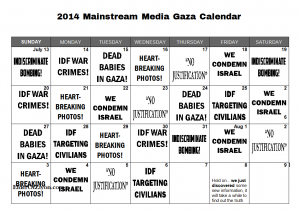
Media-Gaza-calendar-300x2122014 mainstrem media Gaza calendar. Photo: Elders of Ziyon.

After weeks of headlines blaring “indiscriminate bombings” and photos of dead babies, the world has been conditioned to believe Israel is evil and murders children wantonly. Even if there was a month of headlines showing that the original assumptions were wrong, it is too late – people internalize the first thing they read and it is very difficult to dislodge them of their initial beliefs.

The world has already been brainwashed by news media that made sweeping, false generalizations and tugged on heartstrings to take IDF actions way, way out of context. A few tiny articles several weeks later are more geared towards the news organizations pretending to assert their objectivity after the fact, knowing quite well that they have already poisoned the minds of millions with their irresponsible reporting.


The BBC just published a cautionary article about Gaza, pointing out what bloggers have been saying for weeks:

[I]f the Israeli attacks have been “indiscriminate,” as the UN Human Rights Council says, it is hard to work out why they have killed so many more civilian men than women.

Matthias Behnk, from OHCHR, told BBC News that the organization would not want to speculate about why there had been so many adult male casualties, adding that because they were having to deal with a lot of casualties in a short time, they had “focused primarily on recording the casualties.”

“As such, we have not at this stage conducted a detailed analysis of trends of civilian casualties, for example in relation to the reasons why different groups are affected and the types of incidents, but hope to carry this out at some point in the coming future,” he said.

“However, even in the compiling of these preliminary figures, we cross-verify between different sources, not only media and several different human rights organisations, but also use other sources, including, for example, names of alleged fighters released by the Israel Defense Forces (IDF) and notices by armed groups in Gaza claiming someone as a member.”

A number of other news organizations have been considering the civilian-to-fighter ratio.

An analysis by The New York Times looked at the names of 1,431 casualties and found that “the population most likely to be militants, men ages 20 to 29, is also the most over-represented in the death toll. They are 9 percent of Gaza’s 1.7 million residents, but 34 percent of those killed whose ages were provided.”

“At the same time, women and children under 15, the least likely to be legitimate targets, were the most underrepresented, making up 71 percent of the population and 33 percent of the known-age casualties.

Better late then never? Hardly.

After weeks of headlines blaring “indiscriminate bombings” and photos of dead babies, the world has been conditioned to believe Israel is evil and murders children wantonly. Even if there was a month of headlines showing that the original assumptions were wrong, it is too late – people internalize the first thing they read and it is very difficult to dislodge them of their initial beliefs.

The world has already been brainwashed by news media that made sweeping, false generalizations and tugged on heartstrings to take IDF actions way, way out of context. A few tiny articles several weeks later are more geared towards the news organizations pretending to assert their objectivity after the fact, knowing quite well that they have already poisoned the minds of millions with their irresponsible reporting.

The media should not be let off the hook this easily. Every single tactic that Hamas did to manipulate the media has been done before, in 2009 and 2012. There were the same threats against reporters, the same false statistics, the same manipulated photos, the same hiding among civilians, the same rockets from school and hospital and mosque grounds, the same lie about civilian casualties that were from terror rockets and explosives, the same collaborator murders being hidden as civilian casualties.There was nothing new here.

The media willingly ignored any lessons from history and happily took pages from a playbook written by terrorist organizations.

Now they are pretending to be daring and bold by questioning the lies that they have been in the forefront of pushing – lies that any news professional should have been quite aware of (if they weren’t, then they should not be in that business.)

The media is not engaging in a re-evaluation of their coverage. They are engaging in the deception that they are being objective after the fact.  Articles like this – while welcome – are more cynical than they are an admission of four weeks of unquestioning reporting of official lies. The skepticism should have occurred in real time, not weeks after when the world has moved on.

The damage has been done, and the news media is what caused the damage.

Report: Palestinians in Gaza to cease fire unilaterally at 8 p.m. on Friday

August 8, 2014

Report: Palestinians in Gaza to cease fire unilaterally at 8 p.m. on Friday, Jerusalem Post, August 8, 2014]

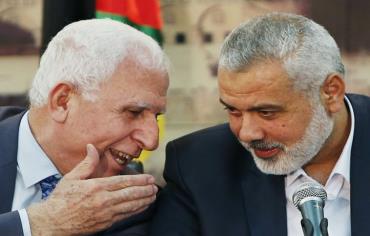
(Caption the photo. How about, “maybe we can fool the idiots again.” — DM)

According to the Ma’an news agency, the Palestinians in Gaza will observe a unilateral cease-fire, with Hamas even indicating a willingness to agree to another 72-hour truce.

Fatah and Hamas giggleFatah official Azzam al-Ahmad (L) and Hamas leader Ismail Haniyeh. Photo: REUTERS

It is believed that Hamas is demanding a lifting of the siege as well as the right to build a seaport in the Gaza Strip.


Israeli officials in Jerusalem are rejecting Palestinian media reports on Friday that Gaza factions will hold their fire beginning at 8:00 p.m. local time.

According to the Ma’an news agency, the Palestinians in Gaza will observe a unilateral cease-fire, with Hamas even indicating a willingness to agree to another 72-hour truce.

News reports indicate that Egyptian officials and international diplomats are exerting pressure on Hamas to agree to the extension of the cease-fire.

Earlier Friday, a Hamas spokesperson based in Qatar was quoted by Channel 2 as saying that “we are capable of continuing with a war of attrition, and Israel will not be able to deal with it.”

Hamas officials are in Cairo to continue cease-fire discussions with Egyptian mediators. It is believed that Hamas is demanding a lifting of the siege as well as the right to build a seaport in the Gaza Strip.

“Our demands are not negotiable,” the Hamas spokesperson, Hassam Badran, is quoted by Channel 2 as saying. “Israel tried and is trying to buy time and extend the cease-fire without giving us anything in return. We are ready to fight even during the discussions. We made it clear that we are opposed to an open, indefinite cease-fire and endless negotiations, which is what Israel wants.”

Despite the resumption of rocket fire by Palestinian terrorists in the Gaza Strip on Friday, officials in Jerusalem told Channel 10 that Israel still prefers to refrain from ordering a wide-scale operation that would deal Hamas a crippling military blow.

Palestinians in Gaza launched over 50 rockets and mortars at the western Negev beginning early Friday morning, as the 72-hour cease-fire that many thought put an end to Operation Protective Edge expired.

In response to the rockets, the Israel Air Force has made do with pinpoint strikes against Hamas targets in Gaza. Israel Radio reported that five Palestinians were killed, including a 10-year-old boy, and over two dozen were wounded.

Palestinian factions will remain in Cairo and press on with Egyptian-mediated talks despite the end of the ceasefire in Gaza, the head of the delegation, Fatah official Azzam Ahmed, told Reuters on Friday.

“We are not for escalation. We are ready to continue through our Egyptian brothers in negotiating to reach a final agreement that would return the rights to their owners,” Ahmed said. “I mean here lifting the blockade of Gaza.”

Ahmed said Palestinian negotiators were due to meet Egyptian intelligence officials, who have been mediating the talks, later in the day. He said Palestinian factions were united in their decision not to extend the 72-hour truce that ended at 0500 GMT and had been clear about their basic demands to end the conflict.

Egypt called on Friday for an immediate resumption of the ceasefire in Gaza and a return to the negotiating table, saying that only a few outstanding issues remained in negotiations it was mediating between Israel and the Palestinians.

“The foreign ministry calls on all sides to rise to their responsibilities … and to return immediately to the ceasefire commitment and exploit the opportunity available to resume negotiations on the very limited sticking points that remain in the fastest possible time,” the foreign ministry said in a statement.

Son Of Hamas / GOOD JOURNALISM

August 8, 2014

Christian Holocaust in Iraq

August 8, 2014

Demilitarize Gaza, by force

August 8, 2014

Demilitarize Gaza, by force, Israel Hayom, Avi Dichter, August 8, 2014

Israel has tried to reduce the size of this tumor with three radiation treatments (Operation Cast Lead, Operation Pillar of Defense and Operation Protective Edge). But the malignant tumor now must be removed — either by an Egyptian diplomatic surgeon or an Israeli military one.


This week, 69 years ago, U.S. leaders decided they had no other choice but to end the war against Japan in one fell swoop: the dropping of an atomic bomb on Hiroshima. Three days later, the U.S. confirmed the kill, destroying Nagasaki with another atomic bomb. No, the U.S. did not call the residents of these cities beforehand to warn them. There were no “knocks on the roof” to tell them to leave their cities, which were about to be wiped off the face of the earth. This is how a superpower acts when it has lost tens of thousands of its soldiers far from its shores.

Hamas is not the Imperial Japanese Army and Israel is not the U.S. Yet still, something can be learned from the processes the U.S. and Japan went through during World War II. Japan then, like Hamas now, knew its fate was sealed. Japan deployed a secret weapon — kamikaze pilots, who took thousands of American lives. But in the end, Japan paid a terrible price and was defeated.

Hamas has dragged Gazans into the same abyss that millions of Japanese were dragged into. Unlike the U.S., which fought far away from home, the Israel Defense Forces’ fight against Hamas and Islamic Jihad terrorists can be viewed from the windows of homes in Netiv Haasara, Nahal Oz and Nirim. Our soldiers are fighting for their homes as their families watch on. There is no war more just than the one we are currently fighting against Hamas in Gaza.

Thus, in addition to quiet, a cease-fire must lead to the demilitarization of Gaza, which was included in past agreements signed by the Palestinians in Washington and Cairo.

It would be delusional to think Hamas would voluntarily disarm itself. Hamas must be demilitarized by force!

Egypt, the country which currently has the most effective leverage on Hamas in Gaza, has a key to play in promoting Israel’s demand that the terrorist infrastructure in Gaza be dismantled. Israel must insist that future diplomatic negotiations be conducted with a single Palestinian authoritative body, which governs both in Judea and Samaria and in Gaza. No more peace talks with only with the Palestinians in Judea and Samaria.

Listening to the U.N. drumbeat, it appears Richard Goldstone will soon be summoned for reserve duty. If, God forbid, this does happen, we must avoid the mistakes we made during the investigation that followed Operation Cast Lead. This time, we must take an active and aggressive role in providing data and facts to the investigators. Let’s remove the masks from the faces of U.N. Relief and Works Agency employees, who today are mostly Hamas members. On top of every sack of flour in UNRWA warehouses in Gaza, there are now sacks of explosives and rockets.

Let’s show the mosques, hospitals and health clinics that have been turned into terrorist command centers and weapons storage sites. Let’s expose the chemistry labs at higher education institutions that have been used to produce propellant for rockets and mortar shells. Let’s reveal the cement that was supposed to be used to build homes for refugees, but was instead poured to reinforce the terror tunnels. Let’s help investigators see Gaza through a catheter and understand that Hamas has become a monstrous cancerous tumor. Israel has tried to reduce the size of this tumor with three radiation treatments (Operation Cast Lead, Operation Pillar of Defense and Operation Protective Edge). But the malignant tumor now must be removed — either by an Egyptian diplomatic surgeon or an Israeli military one.