Archive for August 2014

Analysis: Boko Haram focuses on seizing territory

August 28, 2014

Analysis: Boko Haram focuses on seizing territory, The Long War Journal, Laura Grosslam & Thomas Joscelyn, August 28, 2014

Shekau threatens to continue Boko Haram’s attacks because the rulers in Nigeria and neighboring countries refuse to forswear what he calls “democracy” and govern according to sharia.

***************

As Boko Haram has continued to unleash its violence across northern Nigeria, the group seems to be gaining ground. Under the leadership of Abubakar Shekau, Boko Haram has evolved from a terrorist group into an insurgency that seeks to establish an Islamic state. And Boko Haram’s tactics have changed accordingly, from smash and dash attacks, killing thousands, into attempts to grab and hold territory.

In a video obtained last weekend by Agence France Presse (AFP), Boko Haram leader Abubakar Shekau celebrated the group’s recent successes and gave a warning to those opposed to him and his ideology. Shekau is shown standing in front of three SUVs, wearing military fatigues with a Kalashnikov slung across his body, as he rants, in a mixture of Arabic and Hausa, to the camera. He holds a notebook in his left hand from which he reads.

After Shekau’s video was released, it was widely reported that he had declared the establishment of an Islamic caliphate covering significant parts of Nigeria. Shekau’s video came less than two months after Abu Bakr al Baghdadi, the head of the Islamic State, declared that he now rules as “Caliph Ibrahim” over large swaths of Iraq and Syria. With that in mind, Shekau’s appearance was widely interpreted as either an attempt to hitch his group to Baghdadi’s bandwagon, or to grab the spotlight for himself by capitalizing on caliphate fever.

But a careful analysis of Shekau’s recording shows that his words were likely misinterpreted. According to a translation obtained by The Long War Journal, Shekau highlights recent attacks perpetrated by his group throughout Nigeria. “Thanks be to God who gave victory to our brethren in Gwoza and made it a state among the Islamic states,” Shekau says. “Thanks be to God who brought grief to the unbelievers like Israel and Britain, or England, and their father America.”

While translations may vary, it does not appear that Shekau uses the specific word “caliphate,” as was reported. A “state among the Islamic states” in Gwoza, which is in northeastern Nigeria, is far short of being a caliphate. And later in the same video Shekau says that he and his followers belong to the “State of Islam” and do not recognize Nigeria as a nation-state. This again falls short of being a “caliphate,” as Shekau is simply repeating the jihadists’ argument that the Muslim community cannot be divided according to national boundaries because it is one “country” that “is governed by Allah’s Book and by the traditions of our Prophet.”

Perhaps Shekau intended to claim that Gwoza, which was seized by Boko Haram earlier this month, is now part of the jihadists’ imagined caliphate. But this interpretation falls short as well. Shekau does not use any of the terminology associated with the jihadists’ caliphate. He does not use the phrase “emir of the believers,” which is usually how the caliph is addressed. In fact, no other jihadist leader is named in the video. The only leader named is Shekau himself. But Shekau says he is the leader of Boko Haram, or the “People of the Sunna Group for Advocacy and Jihad in the country called Nigeria.” Shekau does not describe himself as a caliph, or even as the head of an Islamic state.

There is also no evidence in the video that Shekau intended to associate Boko Haram with Baghdadi and his Islamic State, as has been speculated. Baghdadi is not named, let alone addressed as the “emir of the believers.” He does not mention the Islamic State. And he mentions Iraq only in passing, noting that America is opposed to the jihadists’ imposition of sharia law in that country. Shekau has previously praised the jihadists’ advances in Iraq, but in this video he does not even do that.

Much of Shekau’s speech is a diatribe against democracy. Shekau draws a sharp distinction between his group and those who live under any form of democracy, which he defines very broadly. Shekau says the people of Nigeria cannot be Muslims unless they disassociate themselves “from democracy and other similar sacrileges.” He declares that democracy “is worse than sodomy … adultery … [and] paganism.” Shekau repeats the common jihadist argument that democracy is based on “man’s laws,” “made by man for fellow men.” Democracy is wrong, in Skekau’s view, because it is opposed to the sharia-based governance that Boko Haram seeks to impose based on supposedly divinely-ordained laws.

Shekau threatens to continue Boko Haram’s attacks because the rulers in Nigeria and neighboring countries refuse to forswear what he calls “democracy” and govern according to sharia.

Boko Haram’s territorial ambitions

Boko Haram’s offensive reveals that it is intent on holding territory and gaining new turf. The majority of the group’s attacks have taken place in Nigeria’s northeast, where the jihadists have repeatedly targeted security forces and anyone else opposed to its violent agenda. But Boko Haram’s violence is not without purpose and the group has an extensive reach beyond its strongholds in northern Nigeria. Shekau’s terrorists have, for instance, launched attacks in the capital of Abuja, including hitting a UN office in 2011 and a shopping center ahead of a World Cup match in June.

While Boko Haram has the capacity to strike throughout Nigeria, Shekau has placed greater emphasis in recent months on capturing territory. Boko Haram has attacked towns in northeastern Nigeria and sought to hold the land. The jihadists have hoisted their flags in Damboa, Gwoza, Buni Yadi, Gamboru, and Madagali, among other locations. The Nigerian armed forces have been struggling to regain control in the areas, reportedly recapturing Damboa and surrounding areas in early August. (In his recent video, Shekau claims that it is a “lie” to say that Boko Haram has been defeated in Damboa.)

The group is continuing its offensive in and around Nigeria’s northeastern Borno State. Yesterday the Biu local government council reported that insurgents targeted communication masts in the area, burning them down, and stole a vehicle. Cutting the area’s communications abilities may be a sign that the group intends to take control in Biu.

Additionally, state radio in Cameroon announced that the country’s army killed 27 Boko Haram fighters in continued clashes near Fotokol in Cameroon’s Extreme North region. Boko Haram attacked the neighboring Nigerian border town of Gamboru and an army barracks nearby on Aug. 25, sending over 400 Nigerian soldiers fleeing into Cameroon. The Nigerian press reported yesterday that fighting is ongoing between the Nigerian military and Boko Haram fighters around the strategically important border crossing area.
 

No Western European leader was there when Turkey got its new dictator: Erdogan

August 28, 2014


http://www.bbc.com/news/world-europe-28961495

“However, the US only sent a representative of its embassy and no Western European leader was there.

The BBC’s Mark Lowen in Ankara says it is perhaps a sign that Turkey’s relations with the West have deteriorated in the past few years of Mr Erdogan’s premiership.”


Senator McCain to Turkish Prime Minister Erdogan acts like dictator

Is UNRWA Aiding Terrorism?

August 28, 2014

Is UNRWA Aiding Terrorism? The Jewish Press, Zeev Ben-Yechiel / Tazpit News Agency, August 28, 2014

UNRWA-Rocket-Logo

The United Nations Relief Works Agency (UNRWA) has come under increasing fire in recent weeks for aiding Hamas in the terror group’s war against Israel, with one advocacy group lodging a formal complaint against the organization. As evidence seems to continue to emerge of the use of the agency’s schools and clinics as Hamas storehouses, rocket launching sites and tunnel entrances, protest has grown in Israel and abroad that the organization, established to aid the Palestinian Arab refugee population, has far exceeded its mandate by aiding and sustaining the psychological and physical assault on Israeli civilians and infrastructure.

At the same time that evidence was mounting that the UN agency was allowing Hamas to use its facilities to launch attacks on Israel, a number of statements were issued by UN Secretary-General Ban-Ki Moon criticizing Israel for use of disproportionate force. In response, the Legal Forum for Israel drafted a letter to Moon decrying his accusations and denouncing the lack of accountability by the international body for its role in the violence.

Several thousand attorneys from around the world signed the August 15 letter, which called Moon’s statements “shocking, deceitful and totally inaccurate” in light of the extraordinary efforts made by the IDF to minimize civilian casualties at the cost of its own soldiers’ lives, especially when compared to the continued appropriation of UN facilities by Hamas in its war on Israel.

“We are shocked at your utter disregard of the fact that the very UN premises of which you accuse Israel of attacking, have been cynically abused by Hamas and used as store-houses for ammunition, and launching pads for rockets,” read the statement.

“Rather than falsely accusing Israel,” the letter continued, “one might have expected that as the executive head of the UN, you would have admitted responsibility of the UN for such abuse of its facilities, and instituted a thorough inquiry as to how and why UNRWA facilities were placed at the disposal of the Hamas terror organization, how and why the UN officials responsible for such facilities permitted this situation to occur, and why those rockets and other weapons that were discovered in such facilities were transferred to Hamas, for their continued use against Israel’s citizens.

“In permitting the storage of weapons, and in transferring such weapons into the hands of Hamas,” the letter asserted, “the UN has in fact permitted itself to become accessory to the commission of war crimes.”

The statement concluded by calling on Moon to conduct a “high-level inquiry” of these infractions and to bring its perpetrators within the organization to justice, and charged that the Secretary-General’s “exaggerated, selective, biased and often false accusations against Israel and [his] total disregard of the truth have irreparably discredited [him] and the UN.”

Last Friday’s death of four-year-old Daniel Tragerman, killed in his home by mortar fire originating near a UNRWA school close to the Gaza-Israel border, capped a string of incidents involving UN facilities in Gaza. On July 30, IDF troops operating in Khan Yunis discovered a terror tunnel that had been dug inside a UNRWA medical clinic. Three soldiers were killed in the subsequent inspection when Hamas detonated 12 explosive devices they had embedded in the clinic’s walls as a booby trap.

The previous day, a stockpile of rockets was found in an UNRWA school in Gaza. The agency acknowledged the find but did not disclose the number of rockets found, the location of the school or which terror group the arms belonged to. Days earlier, an IDF investigation had found that Hamas terrorists fired anti-tank missiles at the army from within a different UNRWA school complex.

In addition, the IDF says at least 30 rockets have been fired at Israeli civilians from UNRWA compounds or places adjacent to them throughout the war.

On July 22, the UN agency found yet another cache of rockets stockpiled in one of its schools, which it said was “situated between two other UNRWA schools that currently each accommodate 1,500 internally displaced persons.”

This came just a week after some 20 Hamas rockets were discovered hidden in a different UNRWA school. Although the organization condemned the incident as a “flagrant violation” of international law, pledged an investigation, and later declared that the rockets had been removed, senior Israeli officials maintained that the rockets were simply returned to Hamas.

In another incident, while inspecting a terror tunnel in a private house in Gaza, IDF forces found UNRWA equipment that has been used to dig the tunnel, along with flour sacks bearing the UNRWA logo that were used for concealment purposes.

Admissions of malfeasance by at least one senior official of UNRWA bolstered the indictments leveled at the UN’s role in Gaza and its official conduct in the conflict. Speaking on condition of anonymity, the official told Times of Israel that his agency has been suffering from “battered-wife syndrome” for years and continues to “ingratiate itself with Hamas.”

Another UNRWA official said that the organization gave rockets that it found to “local authorities,” which answer to Hamas.

There is also evidence that the terror group has infiltrated the agency’s labor unions and school system.

According to David Bedein, head of the Center for Near East Policy Research, Hamas has been in control of UNRWA’s workers’ union for many years. In the last union elections on September 2012, the “Professional List,” led by Hamas operative Suhail al-Hindi, won all 11 of the seats that had been allocated to the teachers’ sector, six out of seven of the seats in the workers’ sector and eight of the nine seats in the service sector.

A report issued by the Center also named a number of terrorist operatives holding high-level teaching positions in UNRWA schools, resulting in Hamas having a “tremendous impact on the UNRWA education system and the contents taught in it.”

The radicalization of UNRWA school curricula by Hamas, and its use of the schools as a platform for inculcating children with hatred towards Jews and a desire for martyrdom, has long been documented. Phrases like “the road to Palestine passes through the blood of martyrs” and similar imagery are part of the regular syllabus, says the report. Posters in UNRWA classrooms glorify suicide bombers, and Gazan television stations regularly broadcast shows in which children are prompted to boast of their devotion to killing Jews.

The results, according to the report, speak for themselves. “An examination of the resumes of the Al-Qassam Brigades activists who were killed reveals a pattern,” notes the paper, coauthored by Lt. Col. (res.) Jonathan D. Halevi. “Dozens of activists in the Al-Qassam Brigades started out as activists in the Islamic Bloc in UNRWA schools in the Gaza Strip, joined Hamas and the Muslim Brotherhood and later the military wing of Hamas, the Izzedine al-Qassam Brigades. All of them were involved in terrorist activities against Israel or in fighting against the IDF,” Halevi added.

“By definition, UNRWA schools function as a supportive element of the Palestinian propaganda,” says Alan Baker, Director of the International Action Division of the Legal Forum for Israel and former Israeli Ambassador to Canada. Speaking about UNRWA workers, he noted that “it’s very clear what their orientation is—by day they may work in schools and clinics, by night go out and throw stones and commit other acts of terror.”

Baker went on to say that the situation vis-à-vis Hamas and UNRWA was “unbelievably inane” and perpetuated by deceit on all levels of the United Nations body. “Drastic change needs to take place in the way the international community funds UNRWA and the way it is run by its bosses and the United Nations,” he concluded.

British Islamic State Fighter In Syria Vows To Unleash Terrorist Bloodshed In The UK | VIDEO!!!

August 28, 2014

Publicerades den 27 aug 2014

British jihadist fighting in Syria last night vowed to unleash terrorist ­bloodshed in the UK unless the West stops its attacks on Islamic State targets. Amu Bakr’s chilling warning came as Met police chief Sir Bernard Hogan Howe revealed at least 250 Brits who went to fight in the region have already returned and could be plotting attacks on our streets.

The masked rebel appeared on a grainy video to declare his murderous intentions on our streets. He said: “If there’s no other chance than to come back then I’ll have to do that I’m ready to take that step to come back if your armies, if your countries don’t stop attacking us.” In the same footage another British jihadist calling himself Abu Anwar al-Britani boasted that he was prepared to take part in cowardly executions of innocent people like that of US journalist James Foley who was beheaded by IS last week or soldiers loyal to Syrian president Bashar al-Assad.

With his face also disguised, he said of the murder: “My initial reaction personally was that this was a direct justified response to the crimes of the US against the Islamic State. “I would be more than honoured to partake in an execution like this. “I hope God gives me the chance to do such a thing as the brother did with James Foley.

“Whether it be on someone like James Foley, a soldier of Bashar or a soldier of America, my hands are ready to do this blessed act.” Mr Hogan-Howe warned those Brits returning from war-torn Iraq and Syria pose a serious risk to home security. The Met commissioner insisted his force was “keeping an eye on them”. But he added: “The thing we’re worried about is so many people from Britain have gone to Syria and ­potentially Iraq to get involved in terrorism .

“We think at least 500 to 600 went. Some have come back. They risk being militarised and they are in a network of terrorists. It’s a worry because we think two thirds to three quarters of them come from the London area, so that’s quite a large number.” Mr Hogan Howe also called for the return of the abolished control orders for suspects who cannot be charged or deported.

They were replaced by less restrictive Terrorism Prevention and Investigation Measures by the Coalition Government. The officer said: “They were stopped because the threat was reduced and quite properly they were seen as too intrusive. “But I think these things have got to be considered when the drum beat changes, and it’s clear it has.” Mr Hogan-Howe backed growing calls to strip citizenship from Brits who go to war zones to fight alongside Islamic extremists. And he called on David Cameron to plough more cash into the battle to prevent terrorism on our streets.

The Dark State Rises: Can Barack & Bashar Tag-Team Caliphate? (Pt. 2)

August 28, 2014

ISIS draws U.S. into Iraq and Syria – ISIS executes 250 Syrian soldiers

August 28, 2014

.

43 U.N. Peacekeepers Detained In Golan Heights By Al Nusra

August 28, 2014

.

The Muslim Rape of Christian Nuns

August 28, 2014

The Muslim Rape of Christian Nuns, Front Page Magazine, August 28, 2014

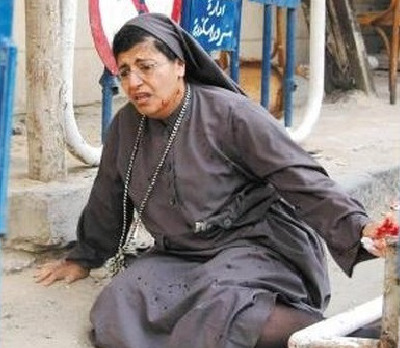
Raped nuns

[R]aped nuns is a phenomenon that goes back centuries.

**********

Despite how unsavory and barbaric Islamic groups and persons around the world have been acting—whether Nigeria’s Boko Haram, Mesopotamia’s Islamic State, Somalia’s Shabaab—perhaps few things are as disgusting and cowardly as the Muslim rape of nuns: defenseless Christian women who sacrifice much of their lives to help sick and needy Muslims.

The latest such attack comes from Bangladesh, which is over 90% Muslim in population.  In early July, dozens of men armed with machetes, knives and iron rods attacked the convent of PIME (Pontifical Institute of Foreign Missions nuns in Boldipuku), a village mission in north Bangladesh.

In the words of Bishop Sebastian Tudu “the nuns were beaten and molested, ending when police arrived.”

Catholic Online has the complete story:

[S]ome 60 men attempted to loot the building and rape the nuns… The attackers first tied the hands and legs of the mission’s two night watchmen and gagged them in the early morning hours. They then broke down the door of the room where the assistant pastor Father Anselmo Marandy was sleeping. They then raided the convent located in the mission campus…. Three PIME nuns suffered attempted rape and were sent to their provincial house in Dhaka, the national capital where they are trying to overcome the shock and mental suffering.  “It’s very sad that the sisters cannot continue to work for the people, but our sisters are no longer safe,” Rosaline Costa, a Catholic human rights activist lamented.  Local Christians are currently living in fear since the attack. Christians form only 0.8 percent of Dinajpur district’s three million people.

Although some of those quoted in the Catholic Online report say that this attack is “unprecedented,” the fact is, raped nuns is a phenomenon that goes back centuries.   According to Muslim historian Taqi al-Din al-Maqrizi (1364-1442), during his raids on then Christian-majority Egypt, Caliph Marwan II (r.744–50) “made captive a number of women from among the nuns of several convents. And he tried to seduce one of them.”

The account describes how the enslaved nun tricked him into killing her, by claiming she had a magic oil that make skin impenetrable: “She then took some oil and anointed herself with it; then stretched out her neck, which he smote with the sword, and made her head fly.  He then understood that she preferred death to defilement.”

Writing in the 10th century, the Coptic chronicler Severus ibn Muqaffa records that “the Arabs [i.e., Muslims] in the land of Egypt had ruined the country….  They burnt the fortresses and pillaged the provinces, and killed a multitude of the saintly monks who were in them [monasteries] and they violated a multitude of the virgin nuns and killed some of them with the sword.”

After the Islamic conquest of Constantinople in 1453, according to eyewitness accounts, “Monasteries and Convents were broken in. Their tenants were killed, nuns were raped, many, to avoid dishonor, killed themselves. Killing, raping, looting, burning, enslaving, went on and on according to tradition.”

Such is history—expunged as it is in the modern West—even as it repeats itself today. Thus, in August 2013, after torching a Franciscan school in Egypt, “Islamists,” in the words of the AP, “paraded three nuns on the streets like ‘prisoners of war’” and “Two other women working at the school were sexually harassed and abused as they fought their way through a mob.”

Indeed, the rise in attacks on Christian nuns throughout the Islamic world further demonstrates that they are no more inviolable than other “infidel” women:

•Somalia: In response to Pope Benedict’s historical quotes which, like so many other things so enraged the Islamic world, Muslims in Somalia shot Leonella Sgarbati—a 66-year-old nun who had devoted 30 years of her life working in Africa—in her back.  Her last words before dying in hospital were: “I forgive; I forgive.”

•Pakistan: In September 2012, gunmen on motorbikes dressed in green (Islam’s color) opened fire on the St. Francis Xavier Catholic Cathedral in Hyderabad, murdering at least 28 people.  Their immediate target was a nun, Mother Christina.

•Libya: In February 2013, after the fall of Col. Gaddafi, Islamic rebels threatened nuns into fleeing the nation. They had been there since 1921, focused primarily on helping the sick and needy.

•Palestinian Authority: Last year, nuns of the Greek-Orthodox monastery in Bethany sent a letter to Palestinian President Mahmoud Abbas urging him to respond to the escalation of attacks on the Christian house, including the throwing of stones, broken glass, theft and looting of the monastery property.

•Philippines: In an article discussing a Christmas Day church bombing in a Muslim-majority region, we learn that the jihadi group responsible “has been blamed for several bomb attacks on the Roman Catholic cathedral in Jolo since the early 2000s and for kidnapping priests and nuns.”

•Guinea: In June 2013, during a mob-led frenzy, Christians and their churches were savagely attacked in the Muslim-majority nation—with some 95 Christians slain and 130 wounded—including “the quarters of the nuns, [which] was looted before being torched.”

•Syria: Islamic rebels forcibly abducted 13 Christian nuns and three maids, holding them captive for three months.  They were finally released after the Bashar government agreed to release some 150 female criminals in exchange.

The above examples come from several countries that have little in common with one another—neither race, language, culture, nor economics—only Islam.

That alone should say something.

But no matter.  Far from discussing Islamic history and doctrine, and how they tie to current events—especially the subhuman treatment of non-Muslim “infidels”—the predominant Western mentality simply dismisses Muslim violence as the West’s fault, or, in the words of ex-nun Karen Armstrong and Islamic apologist extraordinaire, “We did this.” Armstrong—who quit the nunnery only to engage in pro-Islamic mummery—insists that what’s needed is for us to focus more on “Muslim pain, Muslim suffering.”

Such, according to the leftist mentality, are the “real” reasons why, wherever Muslim-majorities live near non-Muslim minorities, from the dawn of Islam till today, the latter are being attacked into extinction.

Analysis: A new wakeup call for Israel

August 28, 2014

Analysis: A new wakeup call for Israel

The rebel takeover of the Syrian Golan shows how changing events affect Israel’s security doctrine

Twelve hours after Israelis sighed in relief as the ceasefire in the Gaza war appeared to take hold, they awoke Wednesday morning to realize that a new source of concern had emerged on their northern border. Syrian opposition forces, after fierce battles with the Syrian army, had taken over Syria’s Quneitra border crossing with Israel on the Golan Heights.

The crossing is the only official gate between Syria and Israel, manned by the United Nations Disengagement Observation Force since the end of the 1973 Arab-Israeli war. Reports that the Nusra Front – Islamists identified with al-Qaida and supported by Saudi Arabia and Qatar – were the ones who had seized control of the area only increased Israeli concern. That concern was somewhat eased hours later, when new reports suggested that the secular unit of the Free Syrian Army was in control of the crossing, rather than the fundamentalist Muslim group.

Nevertheless, the incidents in Quneitra are a wake-up call for Israel, demonstrating how the changing events in the Middle East, from the advances of the Islamic State in Iraq and Syria, to turmoil in Libya and the Gaza war, are affecting old Israeli security doctrines and stability.

For three and a-half years, Israel tried to stay away from the Syrian civil war, having one ultimate interest in mind: maintaining security and stability on the border and preserving the daily routine of Israel’s rural communities in the Golan Heights, captured from Syria in the Six Day War of June 1967. On occasion, Israel interfered in the war when its intelligence uncovered attempts by President Bashar Assad’s regime to supply weapons – mainly long-range Iranian or Syrian-made missiles – to Hezbollah as payment for the Shiite Lebanese movement’s support in fighting the rebels.

The Israeli Air Force attacked such supply convoys and weapons depots six times, but never claimed responsibility for the actions. This provided a deniability that also enabled the Syrian government to turn a blind eye to the blatant Israeli violations of its sovereignty and thus to avoid any need to retaliate.

In other instances, Israel responded with mild artillery fire whenever errant fire or mortars landed on the Israeli side of the border as a result of the clashes between opposition forces and the Syrian army. Israel believed it was thus preserving its deterrence vis-à-vis the Syrian government, without humiliating the Assad regime. But in the last year, the opposition forces – the Nusra Front and the Free Syrian Army – have taken over most of the Syrian army positions on the Golan areas bordering Israel. As of Wednesday, they control virtually all of the 100-kilometer area along the border.

In light of these evolving events, Israel has been reaching out to opposition forces to prevent them from turning hostile. It opened a field hospital on the border and has in the last year treated more than 1,000 wounded Syrian combatants and civilians. On the face of it, this is a humanitarian gesture, but it also helps Israel maintain good neighborly relations with the opposition forces in Syria, hoping to ensure that the border stays relatively calm.

Nevertheless, other hostile elements such as the Islamic State are also gaining strength in the region. These forces are small and insignificant in the parts of Syria near Israel, but hold a potential threat to the stability of what has been Israel’s quietest border for decades.

At the same time, these and other regional events in Iraq and Kurdistan also provide an opportunity for new alliances. It was revealed this week that Iran is supplying Iraqi Kurdish authorities with ammunition and weapons to repel the IS. Israel, a traditional ally of the Kurds, is also still assisting them in the security and military field. For the first time since 1979, when Iran overthrew the Shah and became an Islamic republic which termed Israel the “small Satan,” the two countries find themselves supporting the same side on one of the Middle East’s major fronts.

Israel may now be having second thoughts, too, about events in Syria and might prefer – maybe even passively support – that the Assad regime remain in power despite the fact that its long-sworn enemies, Iran and Hezbollah, are allied with Damascus.

Yossi Melman is an Israeli security and intelligence commentator and co-author of “Spies Against Armageddon: Inside Israel’s Secret Wars”.

Golan Heights residents fear Syria conflict creeping closer

August 28, 2014

Golan Heights residents fear Syria conflict creeping closer, Israel Hayom, Danny Brenner, August 28, 2014

“Who will pay the price? All the residents of the Golan Heights. The militants of ISIS will not differentiate between us. They will kill everyone. We see videos on TV, Facebook. The danger is getting closer to us,” Golan resident Badi’a Ahmed says.

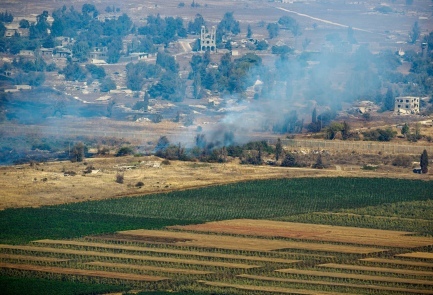
Smoke rises in Golan HeightsSmoke rises from explosions in the Golan Heights caused by nearby fighting in Syria | Photo credit: JINI

Residents of the Golan Heights say fighting across the border in conflict-torn Syria is creeping closer to them.

Syrian rebels, including fighters from an al-Qaida-linked group, seized control of a frontier crossing with Israel in the Golan Heights on Wednesday after heavy clashes with Syrian President Bashar Assad’s forces, activists and rebels said.

On Wednesday, stray fire from the fighting resulted in an Israeli officer and a civilian being wounded. The officer was moderately wounded by an errant mortar round and the civilian suffered light wounds from an errant Syrian tank shell which hit a kibbutz winery he was working at. The officer was airlifted to a local hospital.

Shortly after the incident, local media reported that Syrian rebels took hold of the Quneitra border crossing.

“Who will pay the price? All the residents of the Golan Heights. The militants of ISIS will not differentiate between us. They will kill everyone. We see videos on TV, Facebook. The danger is getting closer to us,” Golan Heights resident Badi’a Ahmed said.

Another resident of Golan Heights, Khaled Safadi also worried. “This is the reality that danger is getting close to us,” he said.

Shelling from the Syrian civil war has occasionally spilled over onto the Golan, including what Israel has said were deliberate attacks on its troops.

Shimon Ben Shushan, 25, from Katzrin, was standing mere feet from his father when a tank shell fired from Syria exploded in the kibbutz winery they were in and lightly wounded his father. According to Ben Shushan, a half hour before the tank shell exploded there had been another explosion in the western part of the Kibbutz and as a result the owner of the winery decided to evacuate his family members who were there at the time.

“A half hour later the shell hit the winery,” Ben Shushan said on Wednesday. “I was with my father in the production area of the factory. My father, who is in charge of assuring the winery’s kashrut, got out of the production area seconds before the shell exploded in the office. I ran to see what happened and was engulfed by a gray cloud of dust and there was a sharp smell of gunpowder in the area. My father was lucky to be standing between wine barrels,” he said.

Ben Shushan’s father was in the office only 15 seconds before the tank shell exploded in it. “It was a real miracle. The explosion caused ricochets to fly everywhere and one of them cut my dad on the back of his neck.” Ben Shushan says his father was saved by standing between the wine barrels.

While the Syrian army has a presence on the Golan, some areas are controlled by rebels fighting to topple Syrian President Bashar Assad, including al Qaida-inspired militants hostile to Israel.

Kenan Mohammed, a spokesman for the Western-backed Syrian opposition, said rebels aimed to push Assad’s troops from all of Quneitra. He also said opposition forces posed no threat to Israel.

“Our aim isn’t Israel right now, and we in the [Free Syrian Army] haven’t targeted Israeli lands,” he said, adding that the rebels’ focus is on Assad and the extremist Islamic State group. “The matter of Israel — it’s not for now, and it’s more political.”