Archive for August 2014

Ministers say Netanyahu concerned over cabinet dissent

August 13, 2014

Ministers say Netanyahu concerned over cabinet dissent

A day before the ceasefire ends, the Prime Minister is worried about the possibility that the cabinet will reject the developing agreement.

‘We didn’t get enough details, Netanyahu is trying to set a trap for us,” ministers say.

Attila Somfalvi Published: 08.13.14, 01:27 / Israel News

via Ministers say Netanyahu concerned over cabinet dissent – Israel News, Ynetnews.


The Israeli and Palestinian delegations will convene Wednesday for the third and final day of talks during the current 72-hour ceasefire, but Prime Minister Benjamin Netanyahu is concerned of the outcome of the cabinet vote on any agreement reached in Cairo.

Netanyahu summoned senior ministers late Tuesday night to discuss the developments in Cairo and to have a “preparation talk” as one minister called his conversation with the prime minister.

The impression gleaned by the ministers invited to the talks was that Netanyahu was troubled and worried from the possibility that the cabinet would reject the developing agreement.

“He is worried it will not pass,” said one of the ministers. “He is preparing for the day after, trying to soften the ministers. There are more than a few problems with this agreement, and Netanyahu is concerned about the possibility that we will say no, and then he will be mired in an international disaster.”

Though the cabinet agreed to send a delegation for the talks with Hamas in Cairo, there were more than a few clauses in the agreement that were deeply divisive. One of the issues revolves around the wages of Hamas officials in Gaza.

“How do we determine who gets paid and who doesn’t? Who supervises this money?” asked one of the cabinet ministers, who had a difficult conversation with Netanyahu.

If a nurse in a hospital receives her salary, maybe Mohammed Deif will also receive one. We need to supervise this cash.”

Netanyahu’s worries have opened the door for demands from his coalition partners. Cabinet ministers are formulating demands that Netanyahu will have to adhere to in order to win their vote in the upcoming vote on the agreement.

One minister stressed to the prime minister that he will lose his support if an international committee to draft a proposal to demilitarize and rehabilitate the Gaza Strip is not part of the agreement.

“Netanyahu is in crisis, that he decided to meet with us privately just reflects on the problems; it doesn’t solve them,” said another minister after his conversation with Netanyahu.

The ministers said that they were not fully involved in the details of the negotiations in Cairo. “We don’t really know. Netanyahu is trying to set a trap for us with this Egyptian agreement so we cannot reject him, but he has a problem.”

Among her other concerns, Justice Minister Tzipi Livni said she would not agree to the construction of a seaport.

Listening to the ministers present their assorted political plans and new demands, there is an understanding that beyond the diplomatic and defense issues, the agreement hinges on political issues – which will continue to rock the coalition after the calm returns to the south.

Elior Levy and Roi Kais contributed to this report.

Has ISIS reached the Gaza Strip?

August 13, 2014

By: Anav Silverman, Tazpit News Agency

Published: August 13th, 2014

via The Jewish Press » » Has ISIS reached the Gaza Strip?.


“I would rather die than accept Israeli blood.” A Gazan terrorist wrapped in an ISIS flag at his funeral.
 

According to a recent Gatestone Institute publication, the presence of the Islamic State of Iraq and Syria (ISIS) has begun to grow in the Gaza Strip, with both the PA and Israel convinced that followers of ISIS in Gaza have been responsible for some of the rocket attacks on Israel.

Last month, the Israel Intelligence and Terrorism Information Center reported that Salafist-jihadi operatives in the Gaza Strip uploaded a video clip to YouTube on July 8, documenting several instances of rockets being launched at Israel. The video clip, entitled “The Salafist-jihadi [movement[ in the Gaza Strip – lovers of the Islamic state [i.e. ISIS] launches rockets at the Jews.” The video showed at least 10 rockets being launched at Israel.

In addition, the Egyptian newspaper Al-Masry Al-Youm reported in late June that Egyptian security forces arrested 15 ISIS terrorists (known as ‘Daash’ in Arabic) who tried to infiltrate Sinai from the Gaza Strip. According to the report, the 15 who were arrested were instructed to begin the formation of an ISIS branch in Egypt among terrorist groups in the Sinai.

However, the Hamas Interior Ministry refuted the report, with Maan News Agency reporting that the ministry stated it was a lie and that “all tunnels between Gaza and Egypt have been closed completely after the Egyptian army destroyed them.” Iyad Al Bezem, a Hamas interior spokesman, stated that “there is no presence of the ISIS in the Gaza Strip.”

Hamas has dealt with expressions of ISIS support in the Strip strongly. Gatestone reports that ISIS followers organized a rally on June 12 to celebrate the military victories of the ISIS in Iraq, with Hamas policemen dispersing the Rafah rally in response. In addition, Hamas prevented local journalists from reporting the event “as part of its attempt to deny the existence of ISIS in the Gaza Strip.”

At the rally, dozens of Islamists were reported chanting, “Khaybar, Khaybar, Ya Yahud, Jaish Mohamed Saya’ud!” (O Jews, Mohamed’s army will return) in reference to the story of the 629 CE battle by the Prophet Mohamed against the Jews of Khaybar in northwestern Arabia, where many Jews were killed and Jewish women and children taken as slaves.

Additionally, at a funeral for two terrorists that Israel killed for firing rockets at Israeli communities, on Sunday, June 29, the black ISIS flags were seen flying, and the terrorists’ coffins were reportedly draped in ISIS flags according to a World Net Daily report.

The radical jihadi ISIS, which recently changed its name to The Islamic State, proclaimed itself an Islamic caliphate on June 29, claiming religious authority over all Muslims in the world, and having ushered in “a new era of international jihad.” The group has exterminated at least 500 people of Iraq’s Yazidi Kurdish ethnic minority, while burying some of its victims alive. Some 300 Yazidi women were kidnapped as slaves and around 150,000 Yazidi Kurds, who have been entrapped by ISIS on Iraq’s Sinjar mountains, are currently homeless and starving.

Vatican Advocates Military Action In Iraq

August 13, 2014

Vatican Advocates Military Action In Iraq
by JOHN ROSSOMANDO 12 Aug 2014, 12:56 PM PDT via Breibart dot Com


(This is a first for me. Never seen the Vatican take such a strong position. Looks like the Pope has a bigger pair than Obama. I pray his plea doesn’t fall on deaf ears. Are there any other countries listening or, as Christians, must we turn the other cheek? -LS)

Military intervention in Iraq may be the only way to stop the genocide against the country’s Christian minority by the Islamic State (formerly the Islamic State of Iraq and Syria, or ISIS), a senior Vatican diplomat says.

“At this moment, we hope the voice that is surging from different Christian and religious communities, from moderate Muslims, from people of good will around the world, may find the response of concrete humanitarian assistance that is provided for the Christians in northern Iraq as well as some political and even effective military protection,” Archbishop Silvano Tomasi, the Vatican’s permanent observer to the United Nations told Vatican Radio.

This marks the first time a Vatican official has supported military action of any kind in recent memory. Pope John Paul II condemned the 2003 invasion of Iraq and the 1991 Persian Gulf War.

At least 100,000 Christians have fled their villages in the Nineveh plains of northern Iraq, according to Iraq’s Chaldean Catholic Patriarch Louis Sako. Last month, the Islamic State ordered Christians living in Mosul to pay the jizyah tax mandated by the Quran, convert to Islam, or face death.

Sako called the Islamic State’s onslaught a “Way of the Cross” for Iraq’s Christians who have been in the region since the beginnings of Christianity. They have been forced to flee on foot amid Iraq’s summer heat.

“They are using the sword to cut off hand[s] and also beheading other[s] so I don’t think this is the behavior of human beings, but wild animals do that,” an Iraqi Christian refugee told CBN News.

Islamic State terrorists have looted the Christians’ possessions – everything from dentures to wedding rings – leaving them destitute. Churches have been burned or converted into mosques. Ancient Christian manuscripts also have been burned, and Christian symbols have been desecrated.

“They are killing our people in the name of Allah and telling people that anyone who kills a Christian will go straight to heaven,” Archbishop Toma Dawod of the Syrian Orthodox Church told U.K.’s The Guardian newspaper following the fall of Qaraqosh, which had been Iraq’s largest Christian city, to the Islamic State.

Archbishop Tomasi also complained that a “certain indifference” to Christian suffering in Iraq existed in the international community.

“It is difficult to convince—because of false modesty, I would say—the Western powers to take a strong stance in defense of the Christians,” Tomasi said.

This stance was echoed by Sako, who complained that President Obama’s decision to bomb Islamic State artillery positions near the Kurdish region was inadequate and that humanitarian aid alone was insufficient.

“The position of the American President Obama to only give military assistance to protect Erbil is disappointing,” Sako wrote. “The Americans are not up to a rapid solution to give hope specifically as they are not going to attack ISIS in Mosul and in the Nineveh plain.
“There is no strategy to dry up the sources of manpower and the resources of these Islamic terrorists.”

Senators want UNRWA investigated over ‘troubling’ Gaza role

August 13, 2014

Senators want UNRWA investigated over ‘troubling’ Gaza role

By MICHAEL WILNER08/13/2014 00:56

Lawmakers concerned by rockets “turned over to local authorities;” UN sending munitions experts in search of more weapons caches;

Situation “exceptionally difficult,” says State Department.

via Senators want UNRWA investigated over ‘troubling’ Gaza role | JPost | Israel News.


UNRWA school damaged by fighting in Gaza Photo: REUTERS
 

WASHINGTON — Members of the United States Senate are demanding an independent investigation into the role of the United Nations Relief and Works Agency during Israel’s most recent war in Gaza with Hamas.

Accusing UNRWA of maintaining active and extensive ties with Hamas— and of supporting its activities throughout the month-long war— Senate Foreign Relations Committee members Mark Kirk (R-Ill.), Ben Cardin (D-Md.) and Marco Rubio (R-Fla.) wrote a letter this week to US Secretary of State John Kerry accusing the UN agency of bias and its role in the conflict troubling. UNRWA, an ostensibly neutral agency tasked with administering aid to Palestinian refugees throughout the region, adopted a political role in the heat of the conflict, during which at least four of its facilities were badly damaged and many of their inhabitants killed.

During the deadliest days of the war, UNRWA officials went on record accusing the Israeli government of violating international humanitarian law. UNRWA also publicly declared the discovery of three caches of rockets stored in Gaza schools during the July battle. The organization did not identify a responsible party for the crime, however, noting that the schools used as weapons depots were “mothballed” for the summer months.

Media reports quickly surfaced suggesting UNRWA returned the recovered rockets to Hamas, but those claims were never independently unverified.

“UNRWA claimed to have turned over to the ‘local authorities’ or have gone missing,” the Senate letter reads. “We fear that this means these rockets may have found their way back into Hamas’ hands.” The senators note that the US government is the single largest donor to UNRWA, providing the agency with $294 million in 2013 and a total of $5 billion since 1950.

While the letter does not call on the State Department to cut aid, they say the American taxpayers “deserve to know if UNRWA is fulfilling its mission or taking sides in this tragic conflict.” The United States and European Union list Hamas as a terrorist organization, and the United Nations has called on the group to renounce violence, recognize Israel, and respect previous agreements between the Palestinian Authority and the Jewish state.

Responding to the letter, a State Department spokesman said that the UN is taking “proactive steps to address this problem,” including deploying munitions experts to the strip in search of more weapons caches.

“The international community cannot accept a situation where the United Nations– its facilities, staff and those it is protecting– are used as shields for militants and terrorist groups,” State Department spokesman Edgar Vasquez told The Jerusalem Post. “We remain in intensive consultations with UN leadership about the UN’s response.”

Hamas’ use of UN facilities as “shields” for its fighters and its weapons posed one of the most politically vexing challenges of the war. UN secretary-general Ban Ki-moon said that such crimes turned UN facilities into legitimate military targets, inviting Israeli strikes; but in a strongly-worded statement from the State Department, after an Israeli shelling killed UNRWA refugees in Gaza for a third time, the US said “the suspicion that militants are operating nearby does not justify strikes that put at risk the lives of so many innocent civilians.”

The Israeli army fiercely denies that it targets civilians, arguing that its use of leaflets, phone calls, text messages and “knocks on the roof” warning of impending strikes are indicative of its efforts to avoid civilian casualties.

“There are few good solutions given the exceptionally difficult situation in Gaza,” Vasquez continued, “but nonetheless we are in contact with the United Nations, other UNRWA donors and concerned parties— including Israel— on identifying better options for protecting the neutrality of UN facilities and ensuring that weapons discovered are handled appropriately and do not find their way back to Hamas or other terrorist groups.” Kirk, one of the signatories of the letter, said that UNRWA has had “ties to terrorism” in the past, and that, in September 2012, Hamas–affiliated candidates won 25 out of 27 seats on UNRWA’s workers union board.

“I am demanding a credible and independent assessment of UNRWA’s actions during this crisis,” Kirk said in a statement. “US taxpayers deserve immediate answers and full transparency regarding their intentions and actions.” Cardin was the sole Democrat among the three behind the letter.

“When leaders and organizations of the United Nations blur the clear distinction between a nation-state defending itself and a terrorist organization attempting to murder civilians, Americans take note,” Cardin said. “When an organization funded in part by the US suggests that the two are morally equivalent, US taxpayers take note.”

Fresh Gaza hostilities likely Wednesday. IDF to expand counteraction for Hamas rockets

August 12, 2014

Fresh Gaza hostilities likely Wednesday. IDF to expand counteraction for Hamas rockets, DEBKAfile, August 12, 2014

GOLANmobile_artillery_units_IDF mobile artillery ready for resumed Gaza warfare

The seventh truce in the ongoing Israel-Hamas passage of arms is generally expected to end Wednesday night Aug. 13, with a fresh outbreak of hostilities triggered by resumed Hamas rocket fire. The indirect Egyptian-brokered talks between the parties in Cairo have never got off the ground. From the start, all three realized that the gaps between Israel and the Palestinians were unbridgeable and, moreover, that Hamas and the Palestinian Authority were totally at odds on a common negotiating stance.

DEBKAfile’s intelligence sources report exclusively that Egyptian intelligence mediators presented separate papers to the Israelis and Palestinians, knowing – as they acknowledged informally – that the two papers were miles apart.

A source close to the talks told DEBKAfile Tuesday night that the Israeli envoys had nothing to do all day in Cairo except to drink hot cups of strong tea in the hotel room assigned them by their Egyptian hosts.

In any case, the Egyptian mediators were in no hurry to push for results and, in fact, appeared fairly unconcerned by the prospect of hostilities resuming in a day or two.

This indifference was also noticeable at the joint news conference addressed by Egyptian President Abdel-Fattah El-Sisi and President Vladimir Putin at the Russian resort of Sochi, Tuesday, when neither made any reference to the Gaza conflict.

The Palestinian team is in no shape to hold practical negotiations on any sort of resolution in Gaza, because it is deeply divided two ways.

For one, Hamas rejects the PA-PLO group as not fit to represent its interests because they say PA chairman Mahmoud Abbas is locked onto the Egyptian side.

The rancor between the two Palestinian factions came to the fore Tuesday night, our sources disclose, when PA security forces began detaining Hamas activists on the West Bank for the first time since the current conflict broke out in July. The arrests took place in the Qalqilya and Tulkarm refugee camps.

And for the second, the Hamas team itself was split between the envoys from Gaza and the delegates from Qatar. The Gaza group want the Cairo talks to lead off by setting conditions for a prolonged ceasefire, during which their political and military demands would be negotiated.

The Qatar envoys insist on reversing this order: first agreed solutions for the long term and only then a deal for extending the ceasefire.

Our Washington sources report that the US tried interceding with the Palestinian Authority in Ramallah, and also with Israel and Egypt, to persuade them to accept another extension of the three-day truce. This effort fell on deaf ears because the Obama administration has not carved out a role or gained levers of influence in the Gaza conflict.

The coming issue of DEBKA Weekly, out next Friday, Aug. 15 will examine the process leading up to the US administration’s loss of standing in the Gaza crisis. If you are not a subscriber, you may click here to sign on.

The one thing that can avert a fresh outbreak of violence Wednesday night is a declaration by Hamas’ military wing, Ezz e-Din al-Qassam, unconditionally halting further rocket fire and other aggressive activity.

Israel is not holding its breath for this to happen. Our military sources say that Israel’s government and military leaders are ready for the next stage of the confrontation with Hamas. This time, Prime Minister Binyamin Netanyahu and Defense Minister Moshe Ya’alon are preparing action a lot tougher than limited air strikes in response to Palestinian rocket fire of any intensity. They know that public patience has run out and will no longer tolerate a return to the situation that leaves Hamas holding the initiative to shoot rockets or not.

Not only the public, but the army too will no longer put off with half-measures and is ready to fight Hamas until it is no longer capable of harassing Israel with threats of violence.

UK says to suspend some Israel arms exports if Gaza truce fails

August 12, 2014

UK says to suspend some Israel arms exports if Gaza truce fails

After reviewing all licenses to Israel last week, Britain announces sale of 12 military items would be temporarily halted pending further investigation if fighting resumes.

ReutersPublished: 08.12.14, 21:51 / Israel Business

via UK says to suspend some Israel arms exports if Gaza truce fails – Israel Business, Ynetnews.

Britain said on Tuesday it would suspend 12 licenses to export military items to Israel, including tank, aircraft and radar parts, if hostilities with Hamas in Gaza resumed, citing concerns the exports may be used to breach international laws

Britain said last week it was reviewing all arms export licenses to Israel after fierce fighting which has resulted in heavy civilian casualties in the Palestinian enclave of Gaza.

That review concluded on Tuesday that 12 licenses would be temporarily suspended pending further investigation if the current truce breaks down and heavy fighting resumes.

“The UK government has not been able to clarify if the export license criteria are being met,” Business Secretary Vince Cable said in a statement.

“In light of that uncertainty, we have taken the decision to suspend these existing export licenses in the event of a resumption of significant hostilities.”

Israel says its operation in Gaza is self-defense, aimed at stopping rockets being fired from the enclave by Islamist militants.

According to a report by a British parliamentary committee last month, outstanding government-approved contracts for export of dual use or military goods to Israel are worth more than 7.8 billion pounds ($13 billion). These include contracts to supply body armor, drone components and missile parts.

Cable’s department said the vast majority of export licenses were not for items that could be used by Israeli forces in its operations in Gaza, but it was unable to immediately confirm the value of the licenses that could be suspended.

Britain said that the suspensions would not include components for Israel’s “Iron Dome” system which protects the country from rockets fired by Hamas.

Last week Sayeeda Warsi, a senior Foreign Office minister, resigned, accusing Prime Minister David Cameron’s government of taking a “morally indefensible” approach on Gaza.

IDF successfully tests system designed to detect terror tunnels

August 12, 2014

IDF successfully tests system designed to detect terror tunnels

By JPOST.COM STAFF
08/11/2014 18:13

Senior army officer says system passed lab tests, currently undergoing field testing; could be deployed around Gaza within 1 year; system will cost at least NIS 1.5 billion.


Tunnel uncovered by IDF in Gaza , July 23 Photo: IDF SPOKESMAN’S OFFICE

A system designed to detect infiltration tunnels proved successful in laboratory tests for the first time ever and is now being tested in the field, a senior IDF officer said Monday.

If the field test proves successful, the system can be deployed around the Gaza Strip within approximately one year, the officer added.

The system will cost from NIS 1.5 billlion to NIS 2.5 billion to deploy.

The officer said that the IDF is also working to improve the Iron Dome.  It is believed that, in the future, Israel’s enemies will try to overcome the rocket defense system by launching a number of missiles and rockets at the same time, including more advanced projectiles that can reach a greater height than those previously fired from Gaza. Among the improvements being worked on is giving the Iron Dome the ability to intercept rockets over enemy territory, before they enter Israel.

The officer also touted the Trophy tank defense system for its success in saving the lives of IDF soldiers during Operation Protective Edge.

He said the Trophy system had neutralized dozens of anti-tank missiles fired at tanks and armored personnel carriers during the operation.

The officer said the defense establishment was in need of an additional NIS 3 billion in order to bolster Israel’s ground forces.

Hamas says group preparing for ‘long battle,’ as three-day truce nears end

August 12, 2014

Hamas says group preparing for ‘long battle,’ as three-day truce nears end

By HERB KEINON, KHALED ABU TOAMEH 08/12/2014 22:30

As Netanyahu briefs coalition on cease-fire efforts, Palestinian sources say Israel has accepted few demands, and no progress has been made on key issues.

via Hamas says group preparing for ‘long battle,’ as three-day truce nears end | JPost | Israel News.


Palestinian chief negotiator Saeb Erekat (L) talks with Arab League Chief Nabil el-Araby during their meeting at the Arab League in Cairo August 11, 2014. Photo: REUTERS
 

The 72-hour cease-fire that went into effect in Gaza on Sunday is to expire at midnight Wednesday, with Israeli officials unable or unwilling to predict whether it will be extended or the fighting will start anew.

Finance Minister Yair Lapid, a member of the eight-person security cabinet, said the gaps between Israel and Hamas holding indirect talks in Cairo were “wide.”

“It is possible that the fighting will begin again at midnight,” he said in a Channel 2 interview. “But it will not be the same fighting, because we will hit them much harder.”

Lapid said that Israel was dealing “with a murderous terrorist organization that wants to kill Jews,” and it will be “impossible to move forward” unless the security of the communities in the south is secured.

Prime Minister Binyamin Netanyahu cancelled a security-cabinet that was scheduled for Tuesday after it became apparent that there had been no progress in the Cairo talks on Monday, and there was no need for any decisions to be taken. Rather than hold the security cabinet meeting, Netanyahu briefed the heads of his coalition partners in the afternoon.

One diplomatic official said that Israel hoped that the cease-fire would be extended, but that Hamas was the “wild card” and it was not clear how they would react.

Diplomatic officials said that all the options were on the table, and that three scenarios were being taken into consideration: that a longer-term cease fire is agreed upon by midnight; that another 72-hour cease-fire is declared during which negotiations continue on a longer deal; that the cease-fire ends and Hamas again begins rocketing Israeli towns.

The Palestinians, meanwhile, said that almost no progress has been achieved during the Egyptian-sponsored talks.

Unconfirmed reports suggested that Hamas and Islamic Jihad members of the Palestinian negotiating team were considering pulling out from the talks in protest against Israel’s refusal to accept their demands.

They accused Israel of “procrastination” and warned that Hamas and other Palestinian factions would not agree to an extension of the cease-fire.

“Israel is continuing with its policy of foot-dragging and is not taking our demands seriously,” a Palestinian official in Cairo told the Palestinian daily Al-Quds.

“Israel is trying to impose its conditions and this will never happen regardless of the cost. If Israel requests another extension of the cease-fire, our delegation won’t agree.”

The Cairo talks are being under the auspices of Egypt’s General Intelligence Service, with the Israeli team shuttling back and forth between Cairo and Jerusalem. .

Qais Abu Laila, member of the Palestinian team to the cease-fire talks, said that the gap between the two sides remained “very wide.”

Abu Laila said that he and his colleagues have informed the Egyptians that this would be the last cease-fire with Israel.

Yehya Musa, a senior Hamas official in the Gaza Strip, said that his movement was preparing for a “long battle” with Israel.

Musa, who was speaking during a pro-Hamas rally in Khan Yunis, said that the Palestinians “won’t accept humiliation.”

Addressing the Palestinian team in Cairo, Musa said: “We are all behind you until you achieve our just demands. We know that everyone is conspiring against you, but we are confident that you won’t make concessions. Be patient because we have nothing more to lose.”

Palestinian sources told the Palestinian Ma’an news agency that Israel was insisting on discussing the fate of two missing IDF soldiers who were killed during Operation protective Edge, while the Palestinians asked to delay this issue.

According to the sources, Israel has thus far accepted only a few of the Palestinian demands, including increasing the number of trucks loaded with food and goods that enter through Kerem Shalom and Nahal Oz and allowing 5000 Palestinians from the Gaza Strip to enter Israel every month.

Israel has also agreed to drop its opposition to the transfer of funds to pay salaries of Hamas civil servants in the Gaza Strip and expanding the fishing zone gradually, the sources said.

In addition, the sources added, the Israelis and Palestinians have agreed on the reopening of the Rafah border crossing and the deployment of 1000 Palestinian Authority police officers at the terminal, as well as the release of the fourth patch of Palestinian prisoners, who were supposed to be freed earlier this year in accordance with a US-sponsored agreement between the PA and Israel.

However, the two sides have still failed to make progress on several other issues, such the disarming of Palestinian groups in the Gaza Strip, the airport and seaport and a safe passage between the West Bank and Gaza Strip, the sources added.

Israeli officials refused to relate to these reports, with one official saying that Israel did not feel the need to respond to Palestinian “disinformation.”

In New York, meanwhile, US Secretary-General Ban Ki-moon said at a news conference that he hoped a “durable cease-fire “ would be reached soon.

Ban said that 2,000 Palestinians have been killed, including more children than were killed in the two previous Gaza crisis combined; 300,000 people were being sheltered in UNRWA facilities; and 100,000 people have had their homes destroyed or damaged.

“Israel’s duty to protect its citizens from rocket attacks by Hamas and other threats is beyond question,” Ban said. “At the same time, the fighting has raised serious questions about Israel’s respect for the principles of distinction and proportionality. Reports of militant activity does not justify jeopardizing the lives and safety of many thousands of innocent civilians.”

Ban did not mention that on at least three occasions Hamas rockets were stored in UNRWA schools, and that when when discovered they were turned over to Hamas, nor did he mention evidence showing that rockets were launched perilously close to UN facilities.

While directly condemning Israel, Ban only obliquely criticized Hamas, saying at one time during the press conference, though without mentioning the organization by name: “They simply have not listened to those voices of reason and they have not cared [for] their own people. In the name of protecting their own people, they have been letting their people be killed by others.”

Hamas: This will be last truce; Israel: No progress in talks

August 12, 2014

Hamas: This will be last truce; Israel: No progress in talks
Mati Tuchfeld, Yoav Limor, Israel Hayom Staff and Reuters August 12, 2014


(If this is the last, then what?-LS)

Israeli official says gaps between Israel’s and Hamas’ positions are big • Palestinian delegation consents to Palestinian unity government of technocrats overseeing reconstruction in Gaza, official says • Israeli cabinet meeting on truce talks canceled.

Talks to end a month-long war between Israel and Palestinian terrorist groups in the Gaza Strip have made no progress so far, an Israeli official said on Tuesday, as a 72-hour cease-fire in the Palestinian coastal enclave held for a second day.

Israeli and Palestinian negotiators were expected to reconvene later Tuesday in Cairo where Hamas and its allies are seeking an end to an Israeli and Egyptian blockade of Gaza.

“The gaps between the sides are big and there is no progress in the negotiations,” said an Israeli official who declined to be named.

Meanwhile, Hamas deputy political bureau chief Moussa Abu Marzouk told the Palestinian news agency Maan that “we are facing difficult negotiations, the first truce passed without any notable achievement, and this is the second and last truce. Its gravity now is clear. The delegation must achieve the people’s wishes.”

Hamas also seeks a seaport for Gaza, a project Israel says should be dealt with only under the framework of future talks on a permanent peace agreement with the Palestinians.

Israel has resisted lifting its blockade on Gaza out of fear that Hamas would restock with weapons from abroad if access to Gaza was eased. Neighboring Egypt also sees Hamas as a security threat.

Israel pulled ground forces out of Gaza last week after it said the IDF had completed its main mission of destroying more than 30 tunnels dug by terrorists for cross-border attacks. Israel now wants guarantees Hamas will not use any reconstruction supplies sent into Gaza to rebuild those tunnels.

A Palestinian official said Tuesday that the Palestinian delegation had consented that reconstruction in Gaza should be carried out by the unity government of technocrats set up in June by Hamas and the more secular Fatah party of Western-backed Palestinian Authority President Mahmoud Abbas, who is based in the West Bank.

Israeli representatives are not meeting face-to-face with the Palestinian delegation because it includes Hamas, which Israel regards as a terrorist organization. Hamas for its part is sworn to Israel’s destruction.

Israel’s cabinet was scheduled to convene on Tuesday to discuss the details of the potential cease-fire agreement, but the meeting was canceled in the morning.

Hamas and the Islamic State: Why the World’s Double Standard?

August 12, 2014

Hamas and the Islamic State: Why the World’s Double Standard? Clarion ProjectRyan Mauro, August 12, 2014

Islamic State’s intended genocide of Yazdis alarming, but Hamas’s desire of genocide against 6 million Jews in Israel given a pass.

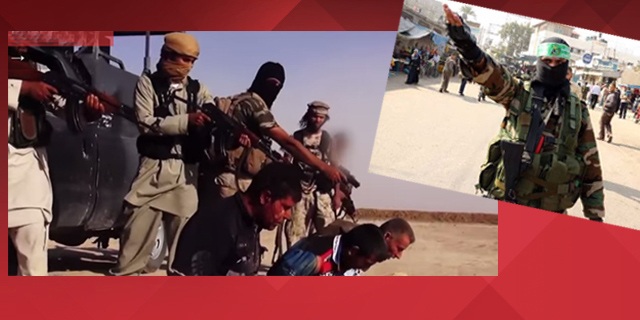
ISIS-Hamas-HPISIS fighters execute in cold blood(left); a Hamas fighter raises his hand in a Nazi salute (right)

The double standards in dealing with Hamas and IS are logically incoherent. Both implement sharia governance, deliberately target civilians, have genocidal beliefs and seek the establishment of a caliphate.

The calculated restraint of Hamas is mistaken for moderation. Hamas engages in negotiations and ceasefires only to strengthen its hand. It should not be interpreted as a reluctant acceptance of Israel’s existence.

**************

The world agrees that the Islamic State (IS) is morally repugnant and must be stopped from wiping out 40,000 mountain-bound Yazdis, but Hamas is able to escape the same condemnation. Why is IS’s sudden genocide of Yazdis alarming, but Hamas’s agenda of genocide against six million Jews in Israel given a pass?

The double standards in dealing with Hamas and IS are logically incoherent. Both implement sharia governance, deliberately target civilians, have genocidal beliefs and seek the establishment of a caliphate.

Hamas would love nothing more than to put Israelis in the position that the Yazidis are in today. Article 7 of its founding charter quotes from a commonly quoted hadith:

“The prophet, prayer and peace be upon him, said: The time will not come until Muslims will fight the Jews (and kill them); until the Jews hide behind rocks and trees, which will cry: O Muslim! there is a Jew hiding behind me, come on and kill him! This will not apply to the Gharqad, which is a Jewish tree (cited by Bukhari and Muslim).”

Hamas not only want to eliminate the state of Israel — a genocidal aspiration in its own right — but Hamas explicitly believes it is required by Allah to wage war against Jews until the end of time. Just as IS believes that the Yazdis are apostates deserving of death, Hamas sees Jews as the incarnation of evil.

The potential massacre of the 40,000 Yazdis is an imminent crisis warranting immediate action, but IS’s assault is not more egregious than Hamas’s desire to massacre millions of Israelis. To argue otherwise is to argue that a Yazdi life is worth more than that of an Israeli Jew.

Governance under IS and Hamas would be virtually indistinguishable because of their shared Islamist ideology. Their differences merely lie in tactics towards the same end.

Hamas’s parent organization, the Muslim Brotherhood, rejects IS’s declaration of a caliphate – but only on technical grounds. In November 2013, Hamas Interior Minister Fathi Hammad explained that his group’s aspirations to “uproot the Jews” are part of a larger project.

“We shall liberate our Al-Aqsa Mosque [in Jerusalem], and our cities and villages [in Israel], as a prelude to the establishment of the future Islamic caliphate,” he said.

The Muslim Brotherhood, of which Hamas is a subset, has always had the same agenda. However, the Brotherhood and its offspring follow a doctrine of gradualism towards establishing Sharia governance and the caliphate. IS terrorists use all means necessary to immediately implement sharia and have already declared a caliphate.

The Brotherhood and Hamas believe this should be done by an Islamist government that comes to power incrementally. IS rejects the democratic process entirely, viewing voting as an act of heresy, whereas Hamas believes voting is permissible within Islamist confines.

“Democracy itself also can make what it wants as lawful, or prohibit anything it does not like. In comparison, the sharia as a political system has limits. If we are to adopt democracy, we should adopt its best features,” preaches Sheikh Yousef Qaradawi, the spiritual leader of the Brotherhood.

The recent arrest of IS supporter Donald Ray Morgan on August 2 in New York shows the overlap between the two groups. He declared his loyalty to IS, but supported Hamas’s terrorism against Israel on Twitter. Under the name of “Abu Omar Al-Amreeki,” he tweeted, “I say Hamas is doing what they should, defending itself.”

Hamas and IS are cut from the same cloth. This raises the question of why many view IS as irreconcilable extremists but Hamas as a potential peace partner whose terrorism is an act of desperation against a superior adversary.

The calculated restraint of Hamas is mistaken for moderation. Hamas engages in negotiations and ceasefires only to strengthen its hand. It should not be interpreted as a reluctant acceptance of Israel’s existence.

Hamas’s victory in the 2006 Palestinian elections is often upheld as its certification of “legitimacy,” but democracy is much more than elections; it requires pluralism, human rights and freedoms that Hamas regularly stomps out.

Further, whatever “legitimacy” Hamas earned in 2006 has long since expired. That was eight years ago. There have been no elections since. The latest polls show the group’s support has collapsed among Gazans.

IS and Hamas violate every standard of morality. They stand together, shoulder-to-shoulder, waging the same overall jihad – only in different battlefields.