Occupation hypocrisy: Gaza vs. Cyprus
One provokes outrage; the other earns a yawn
Occupation hypocrisy: Gaza vs. Cyprus
One provokes outrage; the other earns a yawn
US scores military victory over Islamic State at Mosul Dam
By MICHAEL WILNER 08/17/2014 21:56 via Jerusalem Post

(OOORAH!!.-LS)
Key facility retaken by Kurdish forces after major campaign of American airstrikes.
WASHINGTON — The United States conducted a major air assault against the Islamic State at Mosul Dam over the weekend, striking two dozen targets over twenty-four hours with fighter jets, bombers, attack planes and drones.
The attack reportedly succeeded in forcing a retreat by the Islamist forces, which have swept throughout cities and key infrastructure sites in recent weeks.
The US strikes were coordinated with an advance by Kurdish peshmerga forces, which encircled Islamic State fighters at the strategically vital energy facility. The Islamic State retreated on Sunday morning from the dam and it is now under the control of the Kurds.
The fundamentalist Sunni army originally conquered the dam — which provides water and electricity to many cities in northern Iraq, including Mosul, the country’s second largest population center — on August 7. US military officials warned throughout the Iraq War that the dam’s infrastructure is in a troubling state of disrepair, and Washington feared this month that the Islamic State would not be able to operate the dam properly.
Failure to keep the dam operational risked a catastrophic water leak, risking the lives of hundreds of thousands of Iraqis down river.
The Islamic State retreat marks the second American success this week, after the US military successfully broke a siege the group was conducting against Yazidi religious minorities on Mount Sinjar.
The US conducted seven airstrikes against targets at the base of the mountain, creating corridors for escape, officials describe.
But in a demonstration of their persistence, the Islamist group killed at least 80 Yazidi men and enslaved “hundreds” of women in a small, nearby Yazidi town, according to local officials.
The Islamic State seeks to establish a fundamentalist Sunni “caliphate,” in observance with strict Sharia law, from Tel Aviv to Baghdad. The group has successfully taken control of territories throughout eastern Syria and northern Iraq, including Mosul, and Raqqa in Syria, the group’s self-described “capital” city.
The Kurds, who live in a semi-autonomous region in the north of Iraq and have proven loyal, moderate allies of Washington, have long dreamed of independence from central governments in Baghdad which oppressed the non-Arab ethnic group for decades under former dictator Saddam Hussein.
Tensions were also high under outgoing Prime Minister Nuri al-Maliki who clashed with them over budgets and oil.
The Kurds since June have capitalized on the chaos in northern Iraq, taking over oilfields in the disputed city of Kirkuk.
But a routing by the Islamic State, which seized heavy weapons from thousands of Iraqi soldiers who fled its onslaught, shattered the myth that the Kurds were highly effective and fearless fighters. Most of them fled.
Iraq’s new prime minister, Haider al-Abadi, faces the task of easing Sunni-Shi’ite tensions that have revived a sectarian civil war and Kurdish independence ambitions financed by oil exports.
Reuters contributed to this report.
Iran attempted large-scale cyber-attack on Israel, senior security source says
By YAAKOV LAPPIN
LAST UPDATED: 08/17/2014 21:12 via Jerusalem Post

(Meanwhile, back in Tehran…-LS)
“This is not something we have seen before, both in terms of scope and the type of targets,” source says; new, integrated military communications network was used in Gaza during the conflict.
Iran attempted to conduct a large-scale cyber-attack on Israeli civilian communications during the war with Hamas this summer, a senior security source revealed on Sunday.
“This is not something we have seen before, both in terms of scope and the type of targets. They targeted communications infrastructure that belong to the civilian sector in Israel,” the source said. Iranian elements were “definitely” behind the attack, he said, and their aim, which was not achieved, was to cause maximum disruption.
Cyber attackers also targeted IDF websites, but online defenses withstood the assault, the source said.
The source, who is highly familiar with the IDF’s telecommunications capabilities, said a new, integrated military communications network was used in Gaza during the conflict.
The network serves all branches of the armed forces, enabling them to share intelligence. This led to swift sensor-to-shooter cycles, in which targets that were detected in Gaza were rapidly destroyed. In addition to being linked to one another, the ground forces, air force, and navy were also directly linked in to Military Intelligence.
“Our aim is to enable a military force to be far more effective than it was a year ago. We succeeded in seeing that during this operation,” the source stated.
During the conflict, Military Intelligence loaded new targets onto encrypted servers, and relevant IDF units – particularly ground forces – were able to access the intelligence immediately on their command and control system.
Visual intelligence, a critical aspect of modern combat, was available on demand as well, meaning that all ground forces received access to aerial views of combat areas before entering them.
“Seventy five percent of the military’s visual intelligence is on the network,” the source said. “We can see, online, aerial visual intelligence, and what the aircraft is seeing,” he added. The network is highly encrypted, he stressed.
Additionally, the network allowed for “intelligence-based combat” in Gaza the source said, referring to the ability to direct ground forces to targets detected by Military Intelligence.
This included information that was obtained by the questioning of Hamas suspects who were taken into Israeli custody. The information was immediately transmitted to ground forces that operated in relevant areas.
“We reached a situation in which a navy vessel, armed with precision guided ammunition, received targets from the Southern Command’s target center, or from [ground forces] divisions,” the source said.
The Navy fired missiles with electro-optical sensors at targets eight to nine kilometers inside Gaza during the war, after communicating with armored brigades on the ground and receiving target locations from them.
Israel threatens Hamas with massive retaliation as cease-fire enters final day
By HERB KEINON, KHALED ABU TOAMEH via Jerusalem Post
LAST UPDATED: 08/18/2014 00:22

(Israel can never return to the status quo. In my opinion, this whole affair could end quickly with a complete blockade of everything going into and out of Gaza…and I mean everything. Of course, such a move is much too politically incorrect and will never happen.-LS)
Netanyahu told his cabinet ministers that Hamas was mistaken if it thought that it could cover its military defeat over the last month with a diplomatic achievement.
A day before the midnight expiration of a five-day ceasefire, Israel sent out clear messages on Sunday that it will respond massively to any type of fire from Gaza and not tolerate a long-term “war of attrition.”
“It is not clear whether there will be an agreement,” a senior diplomatic official said as the Israeli and Palestinian delegations held indirect talks in Cairo.
If no agreement is agreed upon, the official said, there are two possibilities. The first is that no cease-fire extension or agreement is reached by Monday at midnight, and Hamas renews its firing. “If that happens,” he said, “Israel’s response will be strong.”
He said an example of Israel’s likely reaction was last weekend’s breakdown of the cease-fire, when Hamas fired mortars at Israel and the IAF responded by hitting 170 terrorist targets inside Gaza.
The other possibility is that the cease-fire lapses, but the firing does not resume, in which case efforts would continue to find a longer-term arrangement, the official said.
But Prime Minister Binyamin Netanyahu told his cabinet ministers at the opening of the weekly Sunday cabinet meeting that Hamas is mistaken if it thinks it can cover its military defeat over the last month with a diplomatic achievement.
In an apparent response to Hamas’s threats to engage Israel in a long war of attrition if its demands were not met, Netanyahu said further that “if Hamas thinks that we cannot stand up to it over time, it is mistaken.”
“In the turbulent and unstable Middle East in which we live, it is not enough just to have more strength, you also need determination and patience,” he said. “Hamas knows that we are very strong, but perhaps it thinks we do not have enough determination and patience. And here it is making a big mistake as well.”
Netanyahu said that Israel is a “strong and determined” nation, whose citizens and soldiers showed “amazing resilience and fortitude” during the Gaza operation and which will stand “steadfast and united” until “quiet and security” are returned to the country’s citizens.
Netanyahu said that Hamas suffered a harsh military blow, which included the destruction of the attack-tunnel network it spent years building, the killing of “hundreds of terrorists,” the interception of thousands of rockets, and the prevention of terrorist attacks from the “land, sea, and air.”
“If Hamas thinks that by a continuation of a drizzle of rocket fire we will make concessions, it is mistaken,” Netanyahu said. “As long as quiet is not restored, Hamas will continue to take very hard blows.”
Netanyahu stressed that the Israeli delegation to the indirect talks in Cairo is working under “very clear directives” to insist on Israel’s security demands. “Only if there will be a clear answer to our security needs will we agree to any understandings,” he said.
Diplomatic sources said that one of the key messages Netanyahu conveyed during the cabinet meeting, and which he will repeat in the upcoming days, is the need for patience in the war of nerves Hamas is waging with the Israeli public.
A subtext of this message is that the Gaza operation is not yet completed, that more time is needed, and that the greater the patience and resolve of the country, the greater the chance that Israel will be able to achieve its goal of long-term security for the South.
Netanyahu briefed his ministers on the situation in Gaza, as did Defense Minister Moshe Ya’alon and National Security Adviser Yossi Cohen.
One of the problems in the negotiations, it has emerged, is that the Palestinian delegation to Cairo – made up of Fatah, Hamas, and Islamic Jihad representatives – is not a united group. For instance, while the Palestinian Authority under Fatah accepted the Egyptian proposals weeks ago, this was not binding on Hamas or Islamic Jihad.
And even among Hamas, there are differences of opinion between its leader Khaled Mashaal, who sits in Qatar, and the leadership in Gaza, which is more eager to come to an agreement. According to Israel, meanwhile, Qatar should be viewed as a state sponsor of terrorism, since it is Hamas’s main financial backer.
Before the cabinet meeting, disparities between some of the key ministers became apparent, with Finance Minister Yair Lapid promoting his idea for an international conference, and Economy Minister Naftali Bennett saying that Israel should halt the talks in Cairo.
Lapid, who is to travel to Germany for two days on Wednesday and promote the idea of an international conference as a vehicle for a long-term resolution to the Gaza crisis, said the outline of any agreement needed to be that there would not be a rehabilitation of the Gaza Strip without its disarmament, and there would not be a cease-fire agreement without quiet for the residents of the South.
Bennett called for an immediate end to the indirect negotiations with Hamas, saying that a situation where Israel is “biting its nails waiting for the answer of a murderous terrorist organizations must end.”
He said that Israel should immediately cease the talks, and adopt the following formula: “Yes to humanitarian aid to Gaza, no to terrorism.”
Under this formula, Israel would allow the passage of food and medicine to Gaza’s residents “without limit,” but would act “without limits” as well toward any weapons factory or terrorist tunnels found, or against any Hamas leaders.
Israel must extract a heavy price from Hamas for firing on its citizens, he said, adding that “any other arrangement that will tie our hands will bring the next war closer.”
Intelligence Minister Yuval Steinitz said that the most important element Israel must insist on is the demilitarization of Gaza. He said that Israel must not accede to Hamas’s demands for a seaport or airport, saying that this would be nothing more than “duty free for rockets and missiles. This would mean that if up until now we suffered from Grad and Fajr missiles from Gaza, in the future it would be Scuds.”
One official said that Hamas is pushing for a seaport because this would allow Iranian ships to dock and unload weaponry. Likewise, he said, Iran is very keen on securing access to a Mediterranean port.
In a related development, Israel agreed to lift the fishing ban it clamped on Gaza during the military operation, and will now allow fishing up to three miles from the coast.
Meanwhile, the head of the Palestinian delegation to the cease-fire talks in Cairo expressed hope that an agreement over a permanent truce with Israel would be reached in the coming hours.
Azzam al-Ahmed, a senior Fatah official and head of the delegation, was speaking shortly after holding talks in Cairo with Egyptian intelligence officials and other members of the Palestinian team from Hamas and Islamic Jihad.
“We won’t accept any weak agreement,” al-Ahmed said. “Any deal should meet the demands and goals of the Palestinian people, first and foremost halting the aggression, lifting the siege, and launching work to rebuild the Gaza Strip.”
He added that the Palestinian delegation would hold a meeting late Sunday with Egyptian intelligence officials to hear about the Israeli reply to the demands.
Meanwhile, Hamas and Islamic Jihad officials reiterated their refusal to make concessions on their demands.
Izzat al-Risheq, a Hamas member of the delegation, said the Palestinians would not give up the rights of their people “who made sacrifices for the resistance.”
He said that the Palestinian delegation’s goal is to “solidify the victory of the resistance with a political victory at the indirect talks in Cairo.”
How to Write About Israel, Sultan Knish Blog, Daniel Greenfield, August 17, 2014
Writing about Israel is a booming field. No news agency, be it ever so humble, can avoid embedding a few correspondents and a dog’s tail of stringers into Tel Aviv and Jerusalem, to sit in cafes clicking away on their laptops, meeting up with leftist NGO’s and the oppressed Muslim of the week.

At a time when international desks are being cut to the bone, this is the one bone that the newshounds won’t give up. Wars can be covered from thousands of miles away, genocide can go to the back page, but, when a rock flies in the West Bank, there had better be a correspondent with a fake continental accent and a khaki shirt to cover it.
Writing about Israel isn’t hard. Anyone who has consumed a steady diet of media over the years already knows all the bullet points. The trick is arranging them artistically, like so many wilted flowers, in the story of this week’s outrage.
Israel is hot, even in the winter, with the suggestion of violence brimming under the surface. It should be described as a “troubled land.” Throw in occasional ironic biblical references and end every article or broadcast by emphasizing that peace is still far away.
It has two types of people; the Israelis who live in posh houses stocked with all the latest appliances and the Arabs who live in crumbling shacks that are always in danger of being bulldozed. The Israelis are fanatical, the Arabs are passionate. The Israelis are hate-filled, while the Arabs are embittered. The Israelis have everything while the Arabs have nothing.
Avoid mentioning all the mansions that you pass on the way to interviewing some Palestinian Authority or Hamas bigwig. When visiting a terrorist prisoner in an Israeli jail, be sure to call him a militant, somewhere in the fifth paragraph, but do not mention the sheer amount of food in the prison, especially if he is on a hunger strike. If you happen to notice that the prisoners live better than most Israelis, that is something you will not refer to. Instead describe them as passionate and embittered. Never ask them how many children they killed or how much they make a month. Ask them what they think the prospects for peace are. Nod knowingly when they say that it’s up to Israel.
Weigh every story one way. Depersonalize Israelis, personalize Muslims. One is a statistic, the other a precious snowflake. A Muslim terrorist attack is always in retaliation for something, but an Israeli attack is rarely a retaliation for anything. When Israeli planes bomb a terrorist hideout, suggest that this latest action only feeds the “Cycle of Violence” and quote some official who urges Israel to return to peace negotiations– whether or not there actually are any negotiations to return to.
Center everything around peace negotiations. If Israel has any domestic politics that don’t involve checkpoints and air strikes, do your best to avoid learning about them. Frame all Israeli politics by asking whether a politician is finally willing to make the compromises that you think are necessary for peace. Always sigh regretfully and find them wanting. Assume that all Israelis think the same way. Every vote is a referendum on the peace process. A vote for a conservative party means that Israelis hate peace.
The Israelis can also be divided into two categories. There are the good Israelis, who wear glasses, own iPads and live in trendy neighborhoods. They are very concerned that the country is losing its soul by oppressing another people. They strum out-of-date American peace songs on guitars that they play badly, but which you will describe them as playing “soulfully”, and they show up at rallies demanding that the government make peace with the Palestinians.
Your good Israelis invariably volunteer or work for some NGO, a fact that you may or may not mention in your article, but you are not to discuss who funds their NGO, particularly if it’s a foreign government. Write about them as if they are the hope of an otherwise brutish and unreasonable Israel too obsessed with killing and destroying to listen to the hopeful voices of its children.
When writing about them, act as if they are representative of the country’s youth and its best and brightest, which for all you know they might be, because you rarely meet anyone who isn’t like them, because you rarely meet anyone who isn’t like you. When you do it’s either a taxi driver, repairman or some working-class fellow whom you have nothing in common with, and who turns out to be a raving militant when it comes to the terrorism question.
These are the other Israelis. The big swarthy men who have no interest in alternative art exhibits. If you have to deal with them at all, get a quote from them about their hopes for peace and how much they dislike the government. Pretend that the two things are connected, and that everything that your friends, who are aspiring artists and playwrights, as well as volunteer humanitarians, told you about the country being ready to rise up against right-wingers like Barak and Netanyahu, to demand peace, is absolutely true. Don’t ask yourself why the country keeps electing right-wingers; if you do, turn it into an essay that touches on Holocaust trauma and biblical hatred.
At some point, you will have to write about the thin bearded men in black hats rushing through the streets on their inscrutable errands. Describe them as “Ultra-Orthodox”, even if the word does not seem to mean anything, and pretend that they’re all the same. If anyone tries to explain the distinctions to you, ignore them. When writing about them, be sure to imply that they are ignorant and fanatical. Mention their growing numbers as a danger to the survival of the state, associate them wrongly with the right wing and throw in some of the complaints from your friends about the “Schorim”, the blacks, moving in and destroying secular neighborhoods.
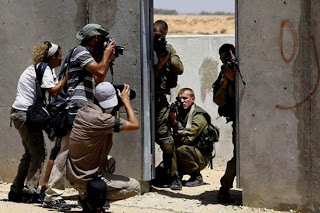
Israeli soldiers should be depicted looming menacingly over children. Your stringers are already experienced at urging a child into camera range, then getting down on one knee and tilting the camera up just as an Israeli soldier walks into the frame. If there isn’t time to set up the shot, get what you can. The photo can be cropped afterward to show just the Israeli soldier and the Palestinian child, even if the two are not actually interacting in any way.
In print, contrast the bored detachment of the soldiers with the prolonged miserable suffering of the Arab Muslims. Checkpoint lines should consist entirely of old and pregnant women waiting to visit their families. If you are Jewish then mention that the soldiers have given you special treatment on account of your race, even if the actual reason is because you are a journalist and your kind doesn’t set off bombs, your kind acts as the propaganda corps for those who set off bombs.
When visiting “settlers,” a term that currently covers a sizable portion of the country, describe them as “dogged” and “fanatical.” Dwell on their beards and on their assault rifles. Find some American ones and disarm them with hometown mentions of Brooklyn or Baltimore and then dig for a hateful comment. If you can’t get a properly damning quote from one of them, get it from one of their children. If you have no luck there, hit up one of your NGO friends, preferably with a degree, to give you a quote on the danger that they pose to peace.
Convey to the reader that there is something disturbing about the tenacity with which they cling to the land, while making it clear that they will have to be ethnically cleansed from the land for there to be peace. Do not use the word “ethnic cleansing,” use “evacuation,” it sounds cleaner. Be sure to mention that they believe G-d gave them the land. Mention something about the Caananites and the Amalekites. Talk to the girls and contrast their fresh youthful faces with their unwillingness to make peace with their neighbors.
Pay a visit to Jerusalem. Mention a place or two that you like to eat, make sure that it is owned by Arabs, accept their tale of being here for thousands of years with complete credulity. If they mention that they are worried about East Jerusalem being taken over by the Palestinian Authority, don’t report that. Do report any complaints that they have about the Judaization of Jerusalem. Draw a picture of the neighborhood as a wonderfully multicultural place dating back to when the Jordanians expelled all the Jews—that is now under assault by the returning Jews. Mourn all the tourists and the Jewish families who are getting in the way of your orientalism. Be sure to remind readers that the Muslim name of the city, or as you will write, the Arab name, is Al-Quds, and that it is holy to three great religions.
Visit with politicians. Israeli Prime Ministers will invariably be unpleasant obstructionist types, if they make jokes, describe it as a transparent effort to curry favor with you. Generals are even worse. Press them about the separation wall, checkpoints, misery and deprivation in the territories. Then get your NGO friends to introduce you to friendly left-wing pols who will commiserate with you about the state of the peace process and the leap of faith that needs to be taken to make peace. Get a quote from them about the next generation and describe them as saddened by their government’s unwilling to make peace.
Palestinian politicians are always willing to make peace, even when they aren’t. Work at it and you will get a hypothetical quote about their willingness to one day live in peace with the Jews. Turn that quote into the centerpiece of your article. Contrast it with Israeli leaders who still refuse to come to the table. Never ask them any tough questions about the budget, their support for terrorists or why they refuse to negotiate. Instead feed them softball questions, take their talking points and plug them into the template for the same article that your predecessors have been writing since the seventies. If an Israeli tells you that there is no such thing as Palestinians, that they’re gangs of Muslim militias who have no interest in running their own country, or that Jordan is the actual Palestinian State, ignore him. Details like that don’t matter and you’re not here to litigate history, you’re here to tell a story. The same story that has been told for generations about villainous Israelis and the heroic resistance fighters battling against them
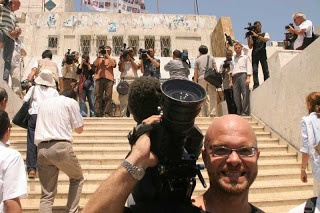
Don’t dig into the relationships between Arab clans, the depth of nepotism within the Palestinian Authority or the lack of elections. Don’t discuss Israeli poverty except when your NGO friends ask you to write about their work. Don’t mention the epidemic of car thefts or land seizures. Don’t try to understand what all the different religious subgroups are really all about. You were sent here to tell a simple story and your job is to tell that story.
Write about the hills and the blood-red sunsets, mention all the armies that probably passed over them in a history you never bothered to learn. Talk about your mixed feelings as a Jew or part-Jew or someone who has Jewish friends, at the sight of Jews oppressing another people. Describe the black soulful eyes of a Palestinian leader or terrorist or terrorist leader. Write up the settler children who are taught to hate. Write about how all the guns make you uncomfortable. Close with an old man who expresses hope that one day peace will come to this troubled land.
Then go home.
AQAP seeks to capitalize on anti-Israeli sentiment in new English-language magazine, Long War Journal, Thomas Joscelyn, August 17, 2014
AQAP provides a list of potential targets in the US and Britain where a car bomb could be deployed. The list includes specific locations such as Times Square, the Georgia Military College in Milledgeville, Georgia, the US Air Force Academy in Colorado Springs, Colorado, and the headquarters for General Atomics in San Diego, California. General Atomics is a defense contractor that develops unmanned aircraft systems and sensors, among other products.
****************
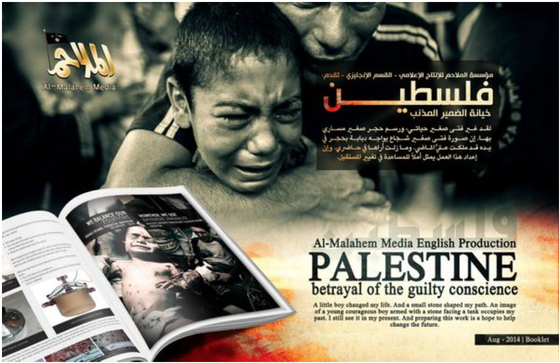
Al Malahem Media, the official propaganda arm of al Qaeda in the Arabian Peninsula (AQAP), has released a new English-language magazine titled, “Palestine, betrayal of the guilty conscience.” The slickly-produced publication was released online on Aug. 16 and, as a piece of propaganda, seeks to capitalize on anti-Israeli sentiment.
The magazine is similar to AQAP’s Inspire magazine, which has encouraged jihadist recruits to carry out individual acts of terrorism. The authors of the 24-page production portray their message as being part of the same “school” of thought that has led to a long line of terrorist attacks against American and Israeli interests, including those planned by al Qaeda’s senior leadership.
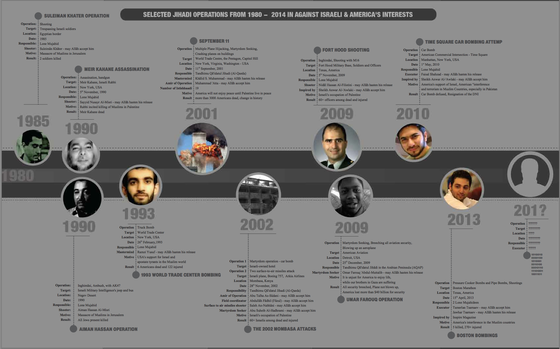 AQAP encourages jihadists to commit a new terrorist attack against American and Israeli interests, portraying the possible new attack as being consistent with a long line of other operations, including those planned by al Qaeda’s senior leadership.
“The statements, views and strategies expressed herein are those in line with September 11, [the] Muhammad Merah Operation, the Brussels Museum Shooting and [the] Boston Bombings,” the magazine reads. “This booklet is a collection of statements regarding this school plus a couple of ways to arm yourselves,” it continues. “This work is prepared to help the reader find a way to support his Muslim brothers in Palestine and Gaza.”
As in past AQAP publications, aspiring jihadists are given do-it-yourself instructions on how to build bombs. A section by the “AQ Chef” adapted from the first issue of Inspire shows how to build pressure cooker bombs like those used in the Apr. 15, 2013 Boston bombings. A photo glorifying the Tsarnaev brothers, the perpetrators of the attack, is included.
Another section, adapted from the 12th issue of Inspire, shows readers how to build a car bomb like the one used in the failed May 1, 2010 Times Square attack. That operation was carried out by Faisal Shahzad, who was trained by the Pakistani Taliban, and a photo of Shahzad accompanies the instructions.
AQAP provides a list of potential targets in the US and Britain where a car bomb could be deployed. The list includes specific locations such as Times Square, the Georgia Military College in Milledgeville, Georgia, the US Air Force Academy in Colorado Springs, Colorado, and the headquarters for General Atomics in San Diego, California. General Atomics is a defense contractor that develops unmanned aircraft systems and sensors, among other products.
Confronting the imagined Zionist-Crusader conspiracy
AQAP’s newest online magazine features the writings of prominent al Qaeda leaders and operatives, both deceased and alive, including Osama bin Laden and Abu Yahya al Libi. A piece by Samir Khan, an American who helped produce Inspire magazine before he was killed in a US drone strike, is also included.
One page includes quotes from Nasir al Wuhayshi, the head of AQAP and general manager of al Qaeda’s operations. Wuhayshi’s words are excerpted from the AQAP film, “Here We Start, And At Al-Aqsa We Will Meet.”
Wuhayshi says that demonstrations are not enough to counter the Zionist-Crusader alliance, a conspiratorial motif that is often included in al Qaeda’s propaganda. “No, demonstrations must be followed by explosions, and civil disobedience by military rage, and we must cut aid to the Zio-Crusader and kill those of the Crusaders whom we find on our land, and destroy Western interests until Europe and America stop their support of the Jews and stop the killing there and order their agents, the treasonous rulers, to open the border-crossings to Gaza and Palestine,” Wuhayshi says.
Another AQAP leader, Harith bin Ghazi al Nadhari, also stresses the importance of confronting the imagined Zionist-Crusader conspiracy. Nadhari’s statement first appeared in an audio message released earlier this year. The “cursed state of Jews is nothing without the American aid and support,” Nadhari says. “The Jews and the Americans are sharing the same trench in fighting the Muslim ummah [community]. So it is incumbent upon all Muslims to fight this Zio-Crusader enemy who has allied against the Muslim ummah.”
“The same way Muslims are obliged to fight and repel the Zionist Jews, they are obliged to fight America and their allies, the allies of the Jews in the killing of Muslims,” Nadhari argues.
Nadhari is a prominent AQAP ideologue whose writings have also been featured in al Qaeda publications focusing on the jihad in Afghanistan and Pakistan.
Netanyahu-Sisi-Abbas lineup tells Hamas: Accept an extra month’s truce – or Ramallah will, DEBKAfile, August 17, 2014
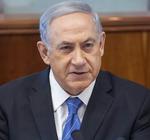 Binyamin Netanyahu talks tough at cabinet session
The Egyptian and Palestinian Authority delegations slapped down an ultimatum for Hamas when negotiations for a durable Gaza truce resumed in Cairo, Sunday, Aug. 17. DEBKAfile’s intelligence report that Hamas was given the option of declaring a one-month extension of the five-day ceasefire which runs out Monday midnight, or else the announcement would be made from Ramallah Monday in the name of the Palestinian national unity government. This was the first joint action taken by the triple bloc formed by Egyptian President Abdel Fatteh El-Sisi, Israeli Prime Minister Binyamin Netanyahu and Palestinian Authority Chairman Mahmoud Abbas for pushing the Islamist Hamas-Islamic Jihad duo up against a wall.
Their lineup, backed from the wings by Saudi King Abdullah and Russian President Vladimir Putin, set itself five objectives:
1. To confront Hamas with a solid political-security front which is beyond its power to break.
2. To corner Hamas into accepting the Egyptian ceasefire proposion unchanged and unconditionally.
3. To compel Hamas to disarm, i.e. dismantle its rockets and tunnels, so pulling the teeth of its military wing, Ezz e-Din al-Qassam.
4. To distance the Obama administration from the triple bloc’s dealings with the Palestinian Islamist factions.
5. To keep the Europeans from interfering in those dealings.
The foreign ministers of Britain, France, Germany and Italy meeting in Brussels offered Friday to take charge of Gaza’s border crossings and work to prevent illegal arms flows.
Saturday, Cairo, Jerusalem and Ramallah politely informed Brussels that they preferred to handle this situation on their own and no European diplomatic or security assistance was needed.
The quiet shaping of this three-way alliance for resolving the Gaza conflict, by means of a sustainable cessation of hostilities, kept most of Israel’s and world media guessing, says DEBKAfile. In the interests of tight secrecy, Netanyahu and Defense Minister Moshe Ya’alon chose to keep the rest of the cabinet in the dark as well, incurring loud complaints from ministers.
The proposition the three partners have formulated puts Hamas and Jihad on the spot. The Arab world has abandoned them and their only source of funding is Tehran. So their choices are grim: Face an escalated war that Israel will fight until the bitter end, or swallow hard and accept the only proposition on the table which is tantamount to disarmament and capitulation.
Their isolation is complete. The Egyptian, Israeli and Palestinian leaders have managed to cut Hamas away from any backing in Washington, Qatar and Turkey as well as blocking its path to Moscow.
To encourage Hamas to choose the right path, the Israel Air Force is cruising around-the-clock over Hamas bases and command centers in the Gaza Strip, ready at a signal to switch to the offensive if the Palestinian fundamentalists make the wrong choice in Cairo.
Mahmoud Abbas, who appeared to be sitting on the sidelines of the Gaza conflict during Israel’s month-long military operation, finally threw in his lot with Sisi and Netanyahu when it came to the crunch.
The tone of address adopted by Netanyahu at Sunday’s cabinet session was a pointer to the tough new mood prevailing in Jerusalem: “Hamas is mistaken if it thinks it can come out of a military defeat with a diplomatic victory… or that we lack the resolve and endurance for a drawn-out conflict,” he said..
Even in this troubled times we need a laugh !
Hundreds of Fatah members under Hamas house arrest in Gaza
Their leaders may be putting on a brave face in Cairo, but Fatah members in Gaza speak of Hamas intimidation
By Elhanan Miller August 17, 2014, 5:41 pm
via Hundreds of Fatah members under Hamas house arrest in Gaza | The Times of Israel.

Moments after the call for evening prayer on July 28, the first day of the Islamic festival of Eid al-Fitr, Fatah activist Sami Abu Lashin heard a knock on the door of his Gaza home.
Lashin, known as Abu Hassan, opened the door to discover some 20 masked men armed with rifles. When he asked the men what they wanted, one gunman stepped out of the group and promptly fired a shot at Lashin’s right thigh, and then two more at his left thigh, shattering the bone.
“It was a very powerful and painful scene for his little children who witnessed this heinous crime,” wrote Sami Fouda of Gaza, who reported the story on the Fatah-affiliated website Fateh Voice on Saturday. “They claimed he had broken the house arrest imposed on him.”
On Sunday, a photo of Lashin reading the Koran in his bed at Shifa hospital — under a Fatah flag, surrounded by large bouquets of flowers — was posted on Fatah’s official Facebook page. “A free voice in steadfast Gaza,” read the caption, which accused Hamas of the shooting. “Shame on the criminals who shed Palestinian blood.”

While Palestinian negotiators in Cairo strained to present a unified front in ceasefire talks with Egypt and Israel Sunday, Fatah continues to showcase stories of intimidation and physical assault against its members in Hamas-controlled Gaza.
One Fatah official, speaking on condition of anonymity for fear of reprisal against his party members in Gaza, told The Times of Israel on Sunday that as many as 250 Fatah members in the Strip have been told by Hamas to stay home throughout Operation Protective Edge, and as many as 125 were shot at by Hamas operatives when they refused to comply. Ten victims of gunshots to the legs have been transferred to hospitals in Ramallah and Nablus in the West Bank, he added.
“They [Hamas] don’t want Fatah’s voice to appear in Gaza,” the official said. “They may be afraid of a Fatah revolution.”
Having won the 2006 national elections by a large majority, Hamas violently took control of the Gaza Strip in the summer of 2007, banishing and killing Fatah members in the city. According to the International Red Cross, at least 118 Fatah members were killed and some 550 wounded during the second week of June 2007, some thrown off the rooftops of high-rise buildings. In January 2014, as part of his movement’s reconciliation efforts with Fatah, Hamas prime minister Ismail Haniyeh declared that Fatah members could return to Gaza.
On July 27, when the Israeli land operation in Gaza was already well underway, Fatah issued a statement condemning Hamas for placing “many Fatah members in various areas under house arrest.” Hamas had told Fatah that the order was carried out by individuals and would be reversed, but “as of now it is only increasing,” Fatah’s statement complained. On August 4, Fatah issued a second communique claiming the harassment was continuing unabated. It had even reached “the point of opening fire at Fatah members, causing serious injury and the tearing of bones and leg tissue.”
The Fatah official who spoke to the Times of Israel said that any Fatah member in Gaza wishing to change his address was required to notify Hamas authorities first.
“Any [Fatah member] leaving his home would have his legs shot at,” he said.
Meanwhile, a senior official in Hamas’s Internal Security Agency visited Abu Lashin at the hospital and condemned the attack, promising to bring the perpetrators to justice. But Fouda, who recounted Abu Lashin’s story, was not satisfied with Hamas’s explanations.
“I wonder who could be crazy enough to so blatantly defy the [Hamas] rulers of Gaza with such a high number of armed masked men; perpetrating such a heinous crime so calmly during the state of war and destruction experienced by the people of Gaza.”




 anneinpt
 artaxes
 danmillerinpanama
 davidking1530
 Peter Hofman
 Joseph Wouk
 Peter
Peter Louisiana Steve
 WarSclerotic
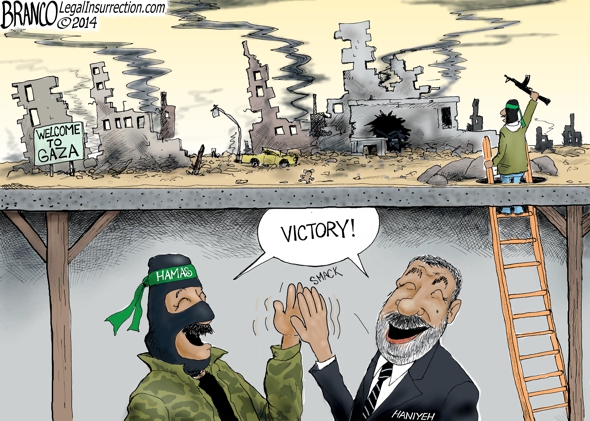
LIMASSOL, Cyprus | Cyprus is a beautiful island, but it has never recovered from the Turkish invasion of 1974. Turkish troops still control nearly 40 percent of the island — the most fertile and formerly the richest portion.
Some 200,000 Greek refugees never returned home after being expelled from their homes and farms in Northern Cyprus.
The capital of Nicosia remains divided. A 112-mile demilitarized “green line” runs right through the city across the entire island.
Thousands of settlers from Anatolia were shipped in by the Turkish government to occupy former Greek villages and to change Cypriot demography — in the same manner the occupying Ottoman Empire once did in the 16th century. Not a single nation recognizes the legitimacy of the Turkish Cypriot state. In contrast, Greek Cyprus is a member of the European Union.
Why, then, is the world not outraged at an occupied Cyprus the way it is at, say, Israel?
Nicosia is certainly more divided than is Jerusalem. Thousands of Greek refugees lost their homes more recently, in 1974, than did the Palestinians in 1947.
Turkey has far more troops in Northern Cyprus than Israel has in the West Bank. Greek Cypriots, unlike Palestinians, vastly outnumbered their adversaries. Indeed, a minority making up about a quarter of the island’s population controls close to 40 percent of the landmass. Whereas Israel is a member of the United Nations, Turkish Cyprus is an unrecognized outlaw nation.
Any Greek Cypriot attempt to reunify the island would be crushed by the formidable Turkish army, in the brutal manner of the brief war of 1974. Turkish generals would most likely not phone Greek homeowners warning them to evacuate their homes ahead of incoming Turkish artillery shells.
The island remains conquered not because the Greeks have given up, but because their resistance is futile against a NATO power of some 70 million people. Greeks know that Turkey worries little about what the world thinks of its occupation.
Greeks in Cyprus and mainland Greece together number less than 13 million people. That is far less than the roughly 300 million Arabic speakers, many from homelands that export oil, who support the Palestinians.
No European journalist fears that Greek terrorists will track him down should he write something critical of the Greek Cypriot cause. Greek Cypriots would not bully a journalist in their midst for broadcasting a critical report the way Hamas surely would to any candid reporter in Gaza.
In other words, there is not much practical advantage or interest in promoting the Greek Cypriot cause.
Unlike Israel, Turkey is in NATO — and is currently becoming more Islamic and anti-Western under Prime Minister Recep Tayyip Erdogan. If it is easy for the United States to jawbone tiny Israel, it is geostrategically unwise to do so to Turkey over the island of Cyprus.
Turkey is also less emblematic of the West than is Israel. In the racist habit of assuming low expectations for non-Westerners, European elites do not hold Turkey to the same standards that they do Israel.
We see such hypocrisy when the West stays silent while Muslims butcher each other by the thousands in Afghanistan, Iraq, Lebanon, Libya and Syria. Only when a Westernized country like Israel inflicts far less injury to Muslims does the West become irate. The same paradox seems to hold true for victims. Apparently, Western Christian Greeks are not the romantic victims that Palestinian Muslims are.
In the 40 years since they lost their land, Greek Cypriots have turned the once impoverished south into a far more prosperous land than the once-affluent but now stagnant Turkish-occupied north — unlike the Palestinians, who have not used their know-how to turn Gaza or Ramallah into a city like Limassol.
Resurgent anti-Semitism both in the Middle East and in Europe translates into inordinate criticism of Israel. Few connect Turkey’s occupation of Cyprus with some larger racist commentary about the supposed brutal past of the Turks.
The next time anti-Israeli demonstrators shout about divided cities, refugees, walls, settlers and occupied land, let us understand that those are not necessarily the issues in the Middle East. If they were, the Cyprus tragedy would also be center stage. Likewise, crowds would be condemning China for occupying Tibet, or still sympathizing with millions of Germans who fled a now-nonexistent Prussia, or deploring religious castes in India, or harboring anger over the tough Russian responses to Georgia, Crimea and Ukraine, or deploring beheadings in northern Iraq.
Instead, accept that the Middle East is not just about a dispute over land. Israel is inordinately condemned for what it supposedly does because its friends are few, its population is tiny, and its adversaries beyond Gaza numerous, dangerous and often powerful.
And, of course, because it is Jewish.
Victor Davis Hanson is a classicist and historian with the Hoover Institution at Stanford University.