Archive for August 2014

Hammering Hamas chiefs with pinpointed intelligence is Israel’s new war focus. Ministers in mutiny

August 21, 2014

Hammering Hamas chiefs with pinpointed intelligence is Israel’s new war focus. Ministers in mutiny.

The fact that, after six weeks of the Gaza war, Israel has no victory to show for it and Hamas can still fire 100-150 rockets a day, has sparked a ministerial mutiny against the way the war is managed by Prime Minister Binyamin Netanyahu and Defense Minister Moshe Ya’alon. The replies offered by the two war planners in a televised press conference Wednesday night, Aug. 20, failed to satisfy their critics. A radio interview with one of those critics, Interior Minister Gideon Sa’ar, the next morning, showed that the opposition to Netanyahu was snowballing beyond the vocal right-wing ministers Avigdor Liberman and Naftali Bennett. It had been joined by pro-diplomacy Justice Minister Tzipi Livni, head of Hatnua, as well as cabinet members from the prime minister’s own Likud.
The hard questions they are asking includes another: Why engage in diplomacy with the Hamas terrorist group in the first place, when it is obvious that Israel will have to make major concessions that would further strengthen Hamas’ grip on the Gaza Strip. The IDF should be allowed to finish Hamas off and rid Gaza of a terrorist regime which abuses its people and menaces Israel.
Netanyahu answered his opponents by giving he war a new direction, which he termed “hammering versus attrition” – his answer to the war of attrition launched by Hamas.

In other words, the prime minister has once again opted for dragging the Gaza war into a new phase rather than heading straight for a clear-cut victory.
The IDF embarked on this new phase Tuesday night, Aug. 19, shortly after Hamas resumed rocket attacks on Israel in violation of a 24-hour ceasefire, and Israeli negotiators quit Cairo for an indefinite absence.
Using pinpointed military intelligence, Israeli bombers struck a building in the Sheikh Radwan neighborhood, where Muhammed Deif, Hamas’ military chief, had hidden his family.

Netanyahu and Ya’alon counted on breaking the news of Deif’s death as a bombshell at their Wednesday press conference. But this was not to be. Deif’s wife and infant son died. Biut Hamas wrapped so many layers of secrecy and disinformation around the incident, that no one can tell whether its military chief came out of the massive bombardment alive or is dead.

Deprived of this trump card, the prime minister lost no time in striking again.

Thursday morning, the Israel air force, acting on precise intelligence, leveled a four-storey house in the Tel Sultan neighborhood of Rafah, killing three leading lights of Hamas’ southern command:
Ra’ad al-Atar (Abu Ayman), commander of the Rafah Brigade, Mohammed Abu Shamala (Abu Khalil), commander of the Southern Brigade; and Mohammed Barhoum. All three were deeply engaged in developing Hamas’ capabilities, including digging tunnels to Israel and smuggling weapons into Gaza.

Netanyahu’s “hammering” campaign had begun to unfold as the singling out of Hamas military leaders and commanders for assassination.

It is hard to say whether they would have been left alone if the Deif hit had succeeded.

It stands to reason that the IDF could have hit the three southern commanders back in the last week of July, during its punitive operation for the killing of Lt. Hadar Goldin by Hamas and its abduction of his remains.

But activating a hit list against Hamas chiefs in the third week of August takes the war in a direction which Netanyahu and Ya’alon refused to countenance until now – expansion.
It also closes off their preferred solution of the conflict – a diplomatic accord based on the Egyptian initiative which would inevitably lead to the new political horizon, which the prime minister promised Wednesday was awaiting Israel.

Netanyahu also denounced the ministers who inappropriately voice their objections to government policy in the middle of a war.

Gideon Sa’ar rejected this complaint. He also stressed that the Cairo negotiations must not be revived, because the only winner from the process would be Hamas, which would use its ill-gotten gains to beat the rival Fatah led by Mahmoud Abbas into submission.

“Hamas must be defeated for Israel to gain a new political horizon,” he said. “And the cabinet is against negotiating terms with a Palestinian terrorist organization.”

If the interior minister has got it right, Netanyahu and Ya’alon no longer have a majority for the way they are running the war in the security-political cabinet  – and  possibly even in the full cabinet too.

Bringing Abbas Back to Gaza Not a Good Idea

August 21, 2014

Bringing Abbas Back to Gaza Not a Good Idea, Gatestone InstituteKhaled Abu Toameh, August 21, 2014

A third reason Abbas still does not trust Hamas is the revelation this week that that the Islamist movement had planned to overthrow his regime in the West Bank. Even if the Palestinian Authority were to return to the Gaza Strip, Hamas, Islamic Jihad and other terrorist groups would not disappear.

This is precisely what Hamas wants, a weak Palestinian authority that would manage the day-to-day affairs of the Palestinians and pay salaries to tens of thousands of employees, while the Islamist movement and its allies continue to smuggle weapons and prepare for the next war with Israel.

Such a scenario would only strengthen Hamas: it would absolve it of it responsibilities toward the residents of Gaza Strip by laying the burden on the Palestinian Authority.

Abbas and the PA cannot return to the Gaza Strip unless Hamas and its allies are completely disarmed or severely undermined as result of Israeli military action or international agreements to demilitarize the entire Gaza Strip.

For now, it would be better to keep Abbas and his Palestinian Authority away from the Gaza Strip instead of turning them into puppets in the hands of Hamas and its sponsors in Qatar.

*************

Those who believe that the reinstatement of the Palestinian Authority [PA] in the Gaza Strip would destroy or undermine Hamas and end rocket attacks on Israel are living under an illusion.

The talk about restoring PA control over the Gaza Strip was first raised during the indirect cease-fire talks between Israel and Hamas in Cairo.

The Egyptians made clear during the talks that they would like to see PA President Mahmoud Abbas and his forces reassume control over the Gaza Strip. One proposal called for deploying security officers belonging to Abbas’s “Presidential Guard” along the border between the Gaza Strip and Egypt.

The Egyptian proposal has won the backing of the U.S. Administration, many European governments and some Arab countries, including Jordan, Saudi Arabia and the United Arab Emirates.

Abbas, who lost the Gaza Strip to Hamas in the summer of 2007, has thus far refrained from publicly commenting on these reports.

Abbas would probably love to retake control over the Gaza Strip, especially as such a move would solidify his status as president of all Palestinians, and not just the ruler of certain parts of the West Bank.

Abbas is well aware, however, that under the current circumstances, his return to the Gaza Strip would be seen by Hamas and other Palestinians as an act of treason. The last thing he needs is to be accused of returning to the Gaza Strip “aboard an Israeli tank.”

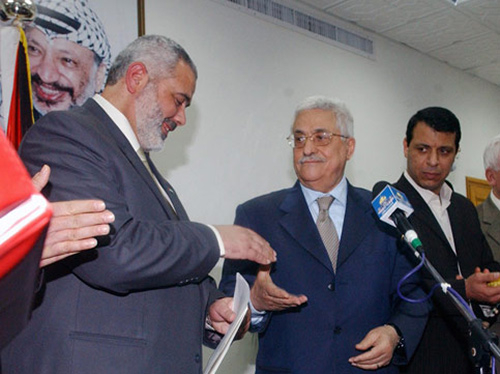
359Palestinian Authority President Mahmoud Abbas and Hamas leader Ismail Haniyeh in Gaza, in February 2007, before Hamas seized total control of Gaza. (Image source: MaanImages)

There are other reasons why Abbas is not eager, at least at this stage, to regain control over the Gaza Strip.

The main reason is that he still does not trust Hamas in spite of the unity agreement he signed with the Islamist movement last April.

When Hamas defeated his forces and toppled the Palestinian Authority in 2007, Abbas was lucky to leave the Gaza Strip alive.

After the Hamas coup, Abbas revealed that the Islamist movement had tried to kill him just before its militiamen seized control of the entire Gaza Strip.

In a televised speech in June 2007, Abbas accused Hamas of trying to assassinate him by using tunnels to target his motorcade.

Abbas said he had seen videotapes of Hamas terrorists digging a tunnel under a road where his car was supposed to pass in the Gaza Strip. The terrorists, he added, had planned to fill the tunnel with 250 kilograms of explosives.

Abbas said that the terrorists had boasted on the tape that the bomb was “for Abu Mazen” [Abbas’s nickname]. He said that he sent copies of the videotape to Arab heads of state to expose the Hamas plot.

Today, when Abbas sees the dozens of Hamas tunnels discovered by the Israel Defense Forces [IDF], he must be asking himself if these are the same tunnels that were supposed to be used in the assassination scheme against him.

And there is no doubt that Abbas must feel relieved to see the IDF destroy the terror tunnels.

Another reason Abbas is reluctant to return to the Gaza Strip is the ongoing tensions between his Fatah faction and Hamas. These tensions have persisted despite the unity agreement between the two parties and despite the formation of a Palestinian “national consensus” government.

According to sources in the Gaza Strip, since the beginning of the war Hamas has placed more than 250 Fatah members under house arrest. Some Fatah activists who violated the cease-fire were shot in the arms and legs. The lucky ones only had their arms and legs broken.

Gen. Adnan Damiri, spokesman for the PA security forces in the West Bank, confirmed this week that Hamas has been targeting Fatah activists in the Gaza Strip. He said that some of the wounded men had been transferred for medical treatment in West Bank and Jordanian hospitals.

A third reason why Abbas still does not trust Hamas is the revelation this week that the Islamist movement had planned to overthrow his regime in the West Bank.

Thanks to the efforts of the Israeli Shin Bet and IDF, the coup plot was foiled after the arrest of dozens of Hamas operatives in the West Bank.

Abbas himself seems to be aware that were it not for Israel, Hamas would have removed him from power a long time ago and extended its control to the West Bank.

Today, Abbas seems to feel safer sitting with Israel in the West Bank than he does being with Hamas in the Gaza Strip.

Abbas also knows that his return to the Gaza Strip would not stop Hamas and other terrorist groups from continuing their rocket attacks on Israel.

Many seem to have forgotten that even while he was in control of the Gaza Strip, Abbas could not stop the rocket attacks or disarm any of the terrorist groups. Even his predecessor, Yasser Arafat, was not able to stop the rocket attacks or rein in the terrorist groups.

Even if the Palestinian Authority were to return to the Gaza Strip, Hamas, Islamic Jihad and other terrorist groups would not disappear.

The PA in the Gaza Strip would end up like the Lebanese government, which has no control over the terrorist Hizbullah organization.

This is precisely what Hamas wants: a weak Palestinian Authority that would manage the day-to-day affairs of the Palestinians and pay salaries to tens of thousands of employees, while the Islamist movement and its allies continue to smuggle weapons and prepare for the next war with Israel.

Such a scenario would only strengthen Hamas: it would absolve it of its responsibilities toward the residents of the Gaza Strip by laying the burden on the Palestinian Authority.

Abbas and the PA cannot return to the Gaza Strip unless Hamas and its allies are completely disarmed or severely undermined as result of Israeli military action or international agreements to demilitarize the entire Gaza Strip.

For now, it would be better to keep Abbas and his Palestinian Authority away from the Gaza Strip instead of turning them into puppets in the hands of Hamas and its sponsors in Qatar.

U.S. Has Not Expressed Concerns Over Hamas Leader in Turkey

August 21, 2014

U.S. Has Not Expressed Concerns Over Hamas Leader in Turkey

Turkish official says no ‘concerns’ expressed to Turkey following Hamas coup plot

BY:

August 20, 2014 5:00 am

via U.S. Has Not Expressed Concerns Over Hamas Leader in Turkey | Washington Free Beacon.


AP
 

he Obama administration has not expressed to Turkey any concerns over recent reports indicating that a senior Hamas operative operating in Turkey had been implicated in a coup plot to overthrow the Palestinian government in the West Bank and wage war on Israel, according to a Turkish official.

The State Department on Monday defended new missile sales to Turkey just hours after news emerged that Ankara is hosting a senior Hamas operative who Israel accused of hatching a plan to violently overthrow the Palestinian Fatah government in the West Bank.

State Department spokeswoman Marie Harf did not respond yesterday to Free Beacon requests for comment on whether the Obama administration had related any concerns to Ankara over its reported sheltering of Hamas official Saleh Al-Arouri, who is said to have been responsible for planning the kidnapping of three Israeli teens who were killed by Hamas.

A Turkish official confirmed to the Free Beacon late Tuesday that the Obama administration has not reached out to express concerns over the reports about the alleged coup and rejected allegations that Turkey may be aiding Al-Arouri.

“Turkey strongly condemns and rejects such allegations. As a matter of fact Turkey’s strong support to the National Unity Government in Palestine and to the President [Mahmoud] Abbas himself is self-explanatory and refutes such accusations,” the official said.

The Turkish official further noted that “U.S. authorities are well aware” of Turkey’s support for Abbas and his government.

“Since U.S. authorities are well aware of Turkey’s aforementioned position, there has been no such concern [expressed by the Obama administration] as you mention in your email which has been conveyed to the Turkish side,” the official said.

Turkey’s Ministry of Foreign Affairs also addressed the controversy in a statement issued Tuesday in Turkish.

“Turkey is at the top of the list of countries that have supported the Palestinian reconciliation” between Hamas and Fatah, Turkey’s Foreign Ministry said in the statement, which was translated for the Free Beacon by Merve Tahiroglu, a research associate for the Foundation for Defense of Democracies (FDD). “In this regard, our country has welcomed and supported the Palestinian unity government that was formed on June 2.”

Turkey views this unity government as “an indispensible element” for peace in the region and “the welfare of the Palestinian people,” the statement adds.

Turkey maintains that is has not “overlooked any attempts to overthrow the Palestinian national unity government,” according to the statement. “We strongly reject and condemn such slander. Turkey’s close contact and strong cooperation with the Palestinian administration will, just as it has been in the past, continue with determination in the future.”

A heated back-and-forth between reporters and Harf broke out at the State Department’s daily briefing on Monday and Tuesday when questions emerged about why the administration is going through with the transfer of U.S. missiles to Turkey while simultaneously holding up similar weapons shipments to Israel.

Harf again on Tuesday ducked questions by reporters asking if the U.S. government had conveyed concerns to Turkey over the plot.

“Do you have any concerns at all about the apparent role of Turkey in this?” AP reporter Matt Lee asked Harf.

“I don’t have any more details on this, Matt. I’m happy to check with our team,” Harf responded.

“Okay. Because I did ask this yesterday. You weren’t aware of the incident, but … now, the Israelis say that this is all being planned and funded from Turkish territory,” Lee followd up.

“Well, as I said, I think it involves some Hamas militants and cash, but let me check on that piece of it. I certainly have nothing to confirm that,” Harf told Lee.

“I’m most curious to know if you guys are planning to raise any concerns with the—I don’t know, maybe you don’t have any concerns … if you’ll raise them with the Turks,” Lee responded.

Harf responded that she would “check on that.”

Harf maintained on Monday that the Turkish and Israeli arms shipments are completely separate matters.

“Turkey is also a NATO ally,” she told reporters. “So for all of us who are—talk a lot about the importance of the NATO alliance, particularly when it comes to Russia and Ukraine and what’s happening there, we think it’s important to provide our NATO allies with resources. We think that’s an important use of our resources. The two [cases] aren’t comparable, but those are the facts behind them, I would say.”

Additionally, Harf could not explain to reporters the exact process taking place behind the scenes regarding the hold up in Israeli arms shipments.

“I don’t know how the process specifically works in that granularity,” she said, when faced with questions about who in the government holds veto power over the arms shipments.

When asked later in the briefing to comment on reports about the Turkey-backed Hamas coup, Harf could not provide much information.

“I don’t have anything to confirm those [reports],” she said. “I hadn’t heard about that otherwise. I can check,” she told reporters.

Israel ‘Closer than Ever’ to Full Gaza Invasion

August 21, 2014

Minister: Israel ‘Closer than Ever’ to Full-Scale Gaza Invasion

Communications Minister and Security Cabinet member Gilad Erdan appeals to Israelis for patience, says Hamas will reach ‘breaking point.’

By Shlomo Piotrokovski

First Publish: 8/21/2014, 9:36 AM

via Israel ‘Closer than Ever’ to Full Gaza Invasion – Defense/Security – News – Arutz Sheva.


Minister Gilad Erdan Flash 90
 

Communications Minister and Security Cabinet Member Gilad Erdan (Likud) has appealed for Israelis to be patient and to allow the IDF time to complete Operation Protective Edge, adding that the army was closer than ever to launching a full ground invasion of Gaza.

Speaking in an interview with Army Radio on Thursday morning, Erdan revealed that Israel did not yield to Hamas’s demands during recent negotiations in Cairo.

“Hamas did not receive a single one of its demands and so it appears they have resumed firing,” he stated.

Echoing sentiments shared by Prime Minister Binyamin Netanyahu late last week, Erdan said that Israel was not prepared to concede its position of strength by suddenly capitulating to Hamas demands. He also noted that the negotiations were not expected to have achieved any major achievements for Israel apart from a period of calm, and added that

“Israel is the stronger party, it is the party in control here, and so there wasn’t much for Israel to receive apart from a long-term period of quiet. That is the achievement that we will receive, but in return we do not need to give anything more than humanitarian affairs.”

“When will Hamas reach breaking point? There’s no scientific formula,” he continued. “At first Hamas wanted to come (to the table) with preconditions and at the end it came without preconditions – in the end it will reach breaking point.

He added that Israel was closer than ever to launching a full-scale ground operation, but cautioned “Will this happen tomorrow? It’s not certain, since the price for this will be high, but we are closer today to a ground operation than we have been at any point since the start of the operation.”

Killing of Hamas chiefs will spark desperate terror attempts against Israel

August 21, 2014

Killing of Hamas chiefs will spark desperate terror attempts against Israel

Assassinations of Muhammad Deif’s founding colleagues in the Hamas military wing show Gaza’s terrorist regime penetrated by Israeli intelligence

By Avi Issacharoff August 21, 2014, 1:41 pm

via Killing of Hamas chiefs will spark desperate terror attempts against Israel | The Times of Israel.


A Palestinian gunman holds his weapon during a protest against Israeli operations in the Gaza Strip,
in the West Bank refugee camp of Jenin, August 20. (AP Photo/Mohammed Ballas)
 

amas has suffered a fair number of blows since the start of the conflict with Israel. Hundreds of gunmen from its military wing have been killed, many of its tunnels have been destroyed, and its rocket stores have been depleted. But the overnight strike on a home in the Tel al-Sultan district of Rafah was the harshest blow – militarily and in terms of morale – that it has sustained since the start of Operation Protective Edge.

Three of its most senior commanders in the southern area of the Strip were assassinated in the Israeli airstrike, in an operation that, for the first time, demonstrated that Hamas has been penetrated by Israeli intelligence, enabling the targeting of its most senior command echelons.

This was not just another strike, not just another assassination. The killing of the three constituted an indication that something in the intelligence discipline at the very top of the Izz ad-Din al-Qassam Brigades has cracked.

The Shin Bet, as the intelligence behind the strike, and the IDF, as the operational arm, targeted the trio in a building in a crowded Rafah neighborhood on one of the heaviest days of fighting thus far. Thus this was a very different strike from the one at the start of the Operation Pillar of Defense in November 2012 when the Hamas military commander, Ahmed Jabari, was assassinated in a surprise attack that marked the beginning of that operation. Given that the fighting had re-escalated since Tuesday, and that Israel was known to be trying to hit the Hamas military leadership, the three had taken every possible precaution to evade Israeli intelligence. Those precautions simply were not good enough.

It can be assumed that whether or not Muhammad Deif is still alive, those members of the Hamas military leadership who have survived are now desperately trying to figure out what went wrong. How could it be that after long weeks in which Israel was unable to get to any of the heads of the military wing, now, within 48 hours, the Shin Bet located one of Deif’s hideouts and killed three other members of the Hamas general staff?


Raed Al-Attar (courtesy: Shin Bet)


It should be stressed again: Two of the three were not mere senior commanders of the Izz ad-Din al-Qassam Brigades. Muhammad Abu Shamala, the “head of the southern command” and Raed al-Attar, the commander of the Rafah area, were part of the founding generation of the Hamas military wing — along with Deif and several others who are no longer with us, including Mahmoud Al-Mabhouh and Emad Akel. They were among Deif’s closest brothers-in-arms — long-term veterans with experience and knowledge that cannot be easily replaced.

Abu Shamala and al-Attar are tied to almost every major attack in and from the Rafah area since 2001. These include the kidnapping of Gilad Shalit on a tunnel raid into Israel in which two other soldiers were killed, and even the killing of 16 Egyptian soldiers on the Gaza-Sinai-Israel border two years ago. Thus the two had tangled not only with Israel, but also with Egypt, which knew of their ties to terrorist organizations in the Sinai.


Muhammad Deif


The elimination of the three leaves a big hole in the Hamas command structure in southern Gaza. They will be replaced, but not with people of similar stature.

Their colleagues in the military leadership — Marwan Issa, Muhammad Sinwar, and whatever may remain of Deif — will try to return to business as usual as soon as possible given the pressure under which Hamas now finds itself. That is to say Hamas will make every effort, every desperate effort, to carry out attacks — and that includes in the West Bank and in Israel.

In the next few days, Hamas will try to use every military means at its disposal: the rockets it has saved for a “moment of truth,” any of its cross-border attack tunnels that may remain, West Bank suicide bombers — anything to prove to Israel that Hamas has not been defeated and is still standing.

The indirect negotiations on a long-term ceasefire are thus unlikely to resume in the next few days, and an end to the conflict is nowhere on the horizon. Hamas will not want to come to talks in Cairo or anywhere else from a position of weakness, and will seek first of all to avenge the assassinations.

The elimination of the three and the attempt to kill Deif — whose fate is still unclear — paves the way for a return of the Hamas political leadership, in Gaza and overseas, to a more central role. People like Khaled Mashaal and Ismail Haniyeh, who needed authorization from Deif, al-Attar and Abu Shamala for every move, will now take a more central role in the leadership of the campaign against Israel, with fewer competitors. If Deif has been neutralized, there are no sufficiently senior figures in the military wing to contradict the orders of Haniyeh or Mashaal.

And ultimately the Hamas political leadership will have to decide how long to continue a conflict that is bringing destruction and devastation on Gaza and endangering Hamas’s survival. It will have to determine whether and when the time has come to end the fire, even at the cost of a blow to Hamas’s public standing.

A Light unto the Nations

August 21, 2014

A Light unto the NationsIsrael must preserve itself if it wishes its light to be seen.

August 19, 2014 – 12:01 am

via PJ Media » A Light unto the Nations.

I have often wondered why a people that professes itself, as the prophet Isaiah said (Isaiah 49:6), to be “a light unto the Nations” — something that it manifestly is, as any objective study of its world-benefitting discoveries and humane military practices would demonstrate –  is so often a darkness unto itself.

For example, a video clip has just surfaced of a Palestinian mother whose child was saved by Israeli doctors, gleefully proclaiming that she will raise that child to become a shahid, a suicide “martyr,” who will repay his gift of life by slaughtering Jews. The doctor and nurses are presented as smiling and full of fellow-feeling for someone who hopes her son will destroy them and their homeland. Why are Jews so eager to help those who seek to destroy their children? The moral calculus on the part of Israeli benefactors is self-destructively skewed.

On a similar note, I wonder why Israeli officialdom tarried so long before acknowledging Philippe Karsenty’s documentary evidence proving that the Palestinians staged the travesty at the infamous Netzarim Junction and the presumed death of Mohammed al Dura, for which Israel was duly blamed. Why was Israel so slow to proclaim its innocence and so prone to take seriously the scurrilous charges leveled against it?

More recently, a report reveals that the IDF is preparing to defend itself against potential charges of war crimes for its campaign in Gaza to defend Israel from thousands of rocket attacks launched by Hamas at Israeli civilian communities. Yet the fact remains that it is not the IDF that is guilty of war crimes, but Hamas itself, which deliberately targeted non-combatants and conscripted its own civilians as human shields, while Israel cripples its military effectiveness by warning Gazans of impending strikes.

Compounding the absurdity, for years after the Gaza withdrawal up to the present day, Israel has been furnishing an avowed and determined enemy with food, fuel, electricity, medical supplies, and building materials. Earlier embargos on certain dual-purpose items were eased in 2010 and 2012. According to IDF estimates, 181,000 tons of gravel, iron, cement and wood entered Gaza via Israeli crossings in the last half year alone.  I know of no other nation on earth that would stockpile and replenish a bellicose entity devoted to wiping every one of its supplier’s citizens off the face of the planet.

I freely admit that I am no military expert and certainly not a diplomat or policy wonk; nonetheless, it seemed undeniable to me that not only was Israel reinforcing a terrorist aggressor but that the so-called building materials would be used not only for civilian purposes but to construct military installations and structures, such as bunkers and tunnels. How could the Israeli political class and its high command not perceive what was so blatantly obvious that even a mere Canadian poet could see the writing on the underground walls?

Again, I freely admit that I cannot understand Israel’s official policies and even its humanitarian concerns, laudable as they may be. You do not win a war and save your own citizens in the process by alerting the enemy in advance of your intentions. You do not protect the lives of your people by healing future shahids. You do not earn brownie points by victualing those who wish only to exterminate you, as the Hamas charter and its asymmetrical guerrilla practices make abundantly clear. You do not allow shipments of cement and iron to the diggers of terror tunnels.

Nor do you immunize yourself against the allegation of war crimes by the consuming exertion of building a defense case; rather, you go on the attack, deploying the legal weapons at your disposal — journalist affidavits, the captured Hamas combat manual sanctioning the strategy of using human shields to sway the international press, the more than ten thousand rockets aimed at Israeli villages and towns since the disengagement — and prosecuting a case at the International Criminal Court accusing Hamas of war crimes. Israel does not and should not wait upon a judicial summons to The Hague by Hamas and its bigoted fellow travelers in the morally compromised West: it should immediately initiate a prosecutorial case against the real criminals, and force them to account for their actions before the world. It must take the bull by the horns, not wait to be gored.

Tikkun Olam, the mandate to repair a broken world, is a lovely theological notion, but it should not come at the expense of sacrificing one’s own civilians, soldiers and children to a bloodthirsty adversary, a decadent commentariat and a hopelessly corrupt United Nations. It is high time that Israel — its political and legal authorities, its commanders, the media, and the intellectual elites — adopt a new mode of thinking if the country has any hope of surviving into the indefinite future. If the prevailing mindset does not change, 1973, the year in which Israelis almost lost their country, may happen again, this time with a different result. A punching bag does not win a boxing match. I realize that the issue is insidiously complex. Soi-disant “allies” need to be partially mollified or taken into consideration, especially if they are surreptitiously hostile, but a country cannot be passive or half-hearted, always seeking to appease, always deferring victory, if it is to embrace a viable future. As Zionist leader Ze’ev Jabotinsky wrote in The Story of the Jewish Legion, “if you want to be ‘good,’ allow yourself to be killed and forego all that you made it your aim to defend: home, country, freedom, hope.”

A purely defensive posture, an extensive reliance on Iron Dome, limited military engagements that only prolong the agony, and legal extenuations are expressive of, as well as engender, a garrison mentality that is ultimately self-defeating.

Isaiah may have been right, but a light has at least two properties: it casts a glow, and it can be extinguished.


David Solway is a Canadian poet and essayist. He is the author of The Big Lie: On Terror, Antisemitism, and Identity, and is currently working on a sequel, Living in the Valley of Shmoon. His new book on Jewish and Israeli themes, Hear, O Israel!, was released by Mantua Books. His latest book is The Boxthorn Tree, published in December 2012. Visit his Website at www.davidsolway.com.

Israel’s nuclear strategy – a larger role for submarine-basing

August 21, 2014

Israel’s nuclear strategy – a larger role for submarine-basing | JPost | Israel News.

Looking ahead, it is plausible that it will be in Israel’s long-term survival interests to more fully commit to certain submarine-basing options.

https://i0.wp.com/rt.com/files/news/1e/e8/60/00/s-1.jpg

Although Israel’s current security emphases following Operation Protective Edge lie most plainly in counter-terrorism operations, this should not obscure the Jewish State’s overriding obligation to deter WMD attacks by enemy states, including, in the future, nuclear blows from Iran. In this connection, Jerusalem will need to fashion a fully comprehensive and calibrated strategic doctrine, one from which aptly specific security policies and operations could be suitably extrapolated. This focused framework could identify and correlate all available strategic options (deterrence, preemption, active defense, strategic targeting, nuclear war fighting) with assorted national survival goals.

Israel’s proposed strategic doctrine will have to take close account of possible interactions between different strategic options, and also of determinable synergies between possible enemy attacks. Significantly, calculating these particular interactions and synergies will represent a computational task on the highest order of intellectual difficulty. Indeed, going forward, the progressive refinement of Israel’s nuclear deterrent should always be seen as a primarily intellectual task, rather than as a merely political operation.

In the analysis that follows, we will identify the basic expectations of any Israeli nuclear deterrence posture, with particular reference to the twin criteria of perceived ability and perceived willingness. Before any rational adversary of Israel could be deterred by an Israeli nuclear deterrent, that enemy would first need to believe that Israel had both the capacity to launch appropriate nuclear reprisals for certain forms of aggression, and also the will to actually undertake such a launch. In matters involving a prospectively irrational strategic enemy of Israel, successful deterrence would need to be based upon threats to enemy values other than national survival, and/or would need to be supplanted altogether by strategies of preemption, or, as known in law, “anticipatory self-defense.”

As part of all considered strategies of Israeli nuclear deterrence, useful preparations will have to include the country’s complex and multi-layered systems of active defense, especially Arrow. Here, IDF planners will need to bear in mind that in intercepting Hamas rockets during the recent Gaza War (Operation Protective Edge), a less than 100% reliability of intercept was acceptable, but that nothing less than a 100% reliability of intercept could be tolerable when facing enemy nuclear missiles in the future.

Iron Dome has performed extremely well in intercepting Hamas rockets, but the prospective task for Arrow in any possible future encounters with long-range Iranian ballistic missiles would be far more demanding.

In meeting the perceived ability criterion of successful nuclear deterrence, Israel will need to demonstrate, inter alia, the substantial invulnerability of its nuclear retaliatory forces to enemy first strikes. Like the United States, Jerusalem is likely to depend upon some form or another of strategic triad deployments. Already, it is likely that Israel has begun to embark upon serious sea-basing of its still-undeclared nuclear forces.

Looking ahead, it is plausible that it will be in Israel’s long-term survival interests to more fully commit to certain submarine-basing options. Israel is a tiny country, and its land-based strategic forces could sometime present as too-vulnerable. In part, whether or not Israel actually proceeds to more explicit submarine-basing of nuclear retaliatory forces, it could still acquire certain meaningful deterrence benefits from an incremental end to its policy of “deliberate nuclear ambiguity.” Popularly, this policy is generally referred to as Israel’s “bomb in the basement.”

From the early days of the country’s first prime minister, David Ben-Gurion, Israel has understood the need to rely upon a “great equalizer,” that is, on nuclear weapons and (implicit) strategy. Of course, there are a great many circumstances in which a nuclear option would be unsuited – most obviously, in any forms of regional counter-terrorism – but, in the end, there can be no substitute for such a residual option. Doctrinally, Israel has already rejected any notions of theater nuclear deterrence, and/or nuclear war-fighting; nonetheless, there are still some identifiable circumstances wherein a nuclear exchange might not be prevented.

Nuclear war-fighting between Israel and particular enemies could break out, so long as: (a) enemy state first-strikes launched against Israel would not destroy Israel’s second-strike nuclear capability; (b) enemy state retaliations for an Israeli conventional preemption would not destroy Israel’s nuclear counter-retaliatory capability; (c) conventional Israeli preemptive strikes would not destroy enemy state second-strike nuclear capability; and (d) Israeli retaliations for enemy state conventional first strikes would not destroy enemy state nuclear counter-retaliatory capability.

What this means, for Israeli security, is that Jerusalem must take appropriate steps to ensure the plausibility of (a) and (b), above, and also the implausibility of (c) and (d).

Submarine deployments could be helpful or even indispensable to Israel’s nuclear deterrence posture. Submarines, after all, represent the ultimate stealth weapon, and an SLBM force could essentially guarantee the ability to unleash a catastrophic retaliatory strike. Naturally, these deployments would not replicate America’s nuclear response capability. Currently, 50-55% of this country’s nuclear response force is submarine-based in certain times of crisis.

Because of Israel’s irremediable lack of strategic depth, the small country’s submarine force represents an “ace in the hole” element of strategic deterrence. Now, Israel is upgrading its three Dolphin I submarines purchases from Germany with three additional Dolphin II submarines. These boats are diesel powered, and unlike the US nuclear submarine capability, are limited by the length of time they can remain submerged.

Israel’s submarines have been designed and built for specific Israeli requirements, and are larger than the German type 212 submarines. One must assume that the larger size is to accommodate nuclear tipped missiles. This capability is critical to maintain Israel’s deterrence from enemy attack. The country needs to continue with refinements of this sea-based retaliatory capability. Nuclear powered submarines would be preferable, in principle, but due to cost and construction requirements, they are not attainable, at least in the near term.

In the densely-arcane world of Israeli nuclear strategy, it can never be sufficient that Israel’s enemies acknowledge its nuclear status. It is also necessary that Israel’s enemies believe that Israel has distinctly secure nuclear weapons, and that Israel would be ready and willing to employ these usable weapons in certain very specific and readily identifiable threat situations.

To ensure that its nuclear forces appear usable, invulnerable, and also penetration-capable, Israel could benefit from a selective release of certain broad outlines of strategic information – that is, by a loosening of “deliberate nuclear ambiguity.” The disclosed information would concern, among other things, the hardening, dispersion, multiplication, basing and yields of selected Israeli nuclear forces. This suggestion, of course, is not meant to “give away” any military secrets, but rather, to use certain bits of pertinent information to substantially enhance Israel’s nuclear deterrent. No Israeli shift from nuclear ambiguity to disclosure would likely help in the case of an irrational nuclear enemy, an improbable but by no means inconceivable prospect.

By now, Israel has likely adopted a counter-city or “counter-value” nuclear targeting policy. This policy, replicating US targeting doctrine during the Cold War, should soon be made known to certain of Israel’s principal existential adversaries. Without such advance disclosures to these adversaries, and without any corollary development of a submarine-based nuclear deterrent, Israel’s credible nuclear deterrence posture could be put at risk.


—————–


LOUIS RENÉ BERES is Professor of Political Science and International Law at Purdue University. Educated at Princeton (Ph.D., 1971), he is the author of ten books and several hundred published articles dealing with Israeli security matters. In Israel, he was Chair of Project Daniel (PM Sharon, 2003).


LEON “BUD” EDNEY, Admiral (US Navy/ret). was Vice-Chief of Naval Operations; NATO Supreme Allied Commander, Atlantic; and Commander-in-Chief, US Atlantic Command. Admiral Edney, who served as a White House Fellow in 1970, holds an advanced degree in international affairs from Harvard. He was also Distinguished Professor of Leadership at the US Naval Academy.

 

‘It feels like we’re moving backward’

August 20, 2014

‘It feels like we’re moving backward’
Gadi Golan and Yehuda Shlezinger Wednesday August 20, 2014 Via Israel Hayom


A crater caused by a rocket that fell at Yad Mordechai junction, near Ashkelon | Photo credit: AFP


(Tuco: “When you have to shoot, shoot. Don’t talk.” from The Good, the Bad and the Ugly (1966).-LS)

Sderot Mayor Alon Davidi: “Any response other than cutting the head off the snake that controls Gaza should not be considered and would only make the current situation worse”

Mayors and community leaders in southern Israel are not prepared to take the renewed rocket fire from Gaza lightly, and are advocating an aggressive response to the cease-fire violation.

“We must respond strongly to the rocket fire, as if there were no negotiations in Cairo, and at the same time, we must continue trying to achieve a long-term deal in Cairo as if there was no rocket fire,” said Shaar Hanegev Regional Council head Alon Shuster.

Sderot Mayor Alon Davidi was similarly angered by the renewed Hamas aggression, saying, “We must deal Hamas a heavy blow that will decisively change the game. Any response other than cutting the head off the snake that controls Gaza should not be considered and would only make the current situation worse.”

These sentiments were also shared by Hof Ashkelon Regional Council head Yair Farjoun, who said, “We must act immediately and decisively to stop all rocket fire directed at us. We will not tolerate the threat of rocket fire, and we will allow the government to put forward a policy for continued calm.”

Eshkol Regional Council head Haim Yalin did not demand sweeping military action as did his colleagues, but rather expressed trust in the government’s ability to handle the situation. “We support and stand behind the cabinet as long as it continues to work toward long-term quiet along the Gaza border and in the south [of Israel],” he said.

“Now is the time to use military force wisely to win the diplomatic battle.”

Sedot Negev Regional Council head Tamir Idan said that he expects the government and the military “to respond forcefully to any escalation or fire on the communities of southern Israel.”

Meanwhile, Finance Minister Yair Lapid visited Sapir College near Sderot, where he outlined his solution to the ongoing conflict.

“Our commitment as a government is to provide quiet for residents of southern Israel, and we will continue to fight for that quiet,” he said. “We must wrap up this campaign with diplomatic success as well, and set up a regional committee that will allow for long-term quiet, and most importantly, we need you to know that we are with you, no matter what happens.”

Beersheba plans to go ahead with its White Night festival scheduled for Thursday, despite rocket fire directed at the city. The event will include performances by several leading Israeli singers and musicians.

On Tuesday evening, the Tel Aviv Municipality announced that it would reopen public bomb shelters in the city, due to the renewed rocket fire at central Israel.

“We don’t have to deal with [rocket] barrages the way they do in the south,” said Tel Aviv resident Yarin Galzar, “But, we still feel it very much, you notice it in the mood [around the city]. This past month, we went out much less — not because we were afraid, but because of the general mood — and this past week we had just started returning to our usual routine. People starting going out again to the bars, to the beach, people had parties.

“It feels like we are moving backward. On the other hand, maybe the time has come to teach them a lesson for once and for all, so that we don’t have to live week by week.”

Orit Shilon, a resident of southern Tel Aviv, was unconcerned by the renewed rocket fire. “We aren’t scared, it is something you can deal with. We already saw in the last round that it’s not so bad. The problem is constantly being vigilant, and that it just keeps repeating itself. I hope the army and the politicians will understand that we are not prepared to live like this, and that they will do what needs to be done.”

U.S. Has Not Expressed Concerns Over Hamas Leader in Turkey

August 20, 2014

U.S. Has Not Expressed Concerns Over Hamas Leader in Turkey
BY: Adam Kredo August 20, 2014 5:00 am Via: The Washington Free Beacon


(Turkey may find itself swimming in its own gravy one day.-LS)

Turkish official says no ‘concerns’ expressed to Turkey following Hamas coup plot

The Obama administration has not expressed to Turkey any concerns over recent reports indicating that a senior Hamas operative operating in Turkey had been implicated in a coup plot to overthrow the Palestinian government in the West Bank and wage war on Israel, according to a Turkish official.

The State Department on Monday defended new missile sales to Turkey just hours after news emerged that Ankara is hosting a senior Hamas operative who Israel accused of hatching a plan to violently overthrow the Palestinian Fatah government in the West Bank.

(That’s just their way of thanking Obama for all that support. Afterall, the Palestinian goverment refused to play ball with his stooge Kerry so now Obama’s out for revenge.-LS)

State Department spokeswoman Marie Harf did not respond yesterday to Free Beacon requests for comment on whether the Obama administration had related any concerns to Ankara over its reported sheltering of Hamas official Saleh Al-Arouri, who is said to have been responsible for planning the kidnapping of three Israeli teens who were killed by Hamas.

A Turkish official confirmed to the Free Beacon late Tuesday that the Obama administration has not reached out to express concerns over the reports about the alleged coup and rejected allegations that Turkey may be aiding Al-Arouri.

“Turkey strongly condemns and rejects such allegations. As a matter of fact Turkey’s strong support to the National Unity Government in Palestine and to the President [Mahmoud] Abbas himself is self-explanatory and refutes such accusations,” the official said.

The Turkish official further noted that “U.S. authorities are well aware” of Turkey’s support for Abbas and his government.

“Since U.S. authorities are well aware of Turkey’s aforementioned position, there has been no such concern [expressed by the Obama administration] as you mention in your email which has been conveyed to the Turkish side,” the official said.

Turkey’s Ministry of Foreign Affairs also addressed the controversy in a statement issued Tuesday in Turkish.

“Turkey is at the top of the list of countries that have supported the Palestinian reconciliation” between Hamas and Fatah, Turkey’s Foreign Ministry said in the statement, which was translated for the Free Beacon by Merve Tahiroglu, a research associate for the Foundation for Defense of Democracies (FDD). “In this regard, our country has welcomed and supported the Palestinian unity government that was formed on June 2.”

Turkey views this unity government as “an indispensible element” for peace in the region and “the welfare of the Palestinian people,” the statement adds.

Turkey maintains that is has not “overlooked any attempts to overthrow the Palestinian national unity government,” according to the statement. “We strongly reject and condemn such slander. Turkey’s close contact and strong cooperation with the Palestinian administration will, just as it has been in the past, continue with determination in the future.”

A heated back-and-forth between reporters and Harf broke out at the State Department’s daily briefing on Monday and Tuesday when questions emerged about why the administration is going through with the transfer of U.S. missiles to Turkey while simultaneously holding up similar weapons shipments to Israel.

Harf again on Tuesday ducked questions by reporters asking if the U.S. government had conveyed concerns to Turkey over the plot.

“Do you have any concerns at all about the apparent role of Turkey in this?” AP reporter Matt Lee asked Harf.

“I don’t have any more details on this, Matt. I’m happy to check with our team,” Harf responded.

(In other words, it’s none of your damned business, Matt….and no, I won’t get back with you.-LS)

“Okay. Because I did ask this yesterday. You weren’t aware of the incident, but … now, the Israelis say that this is all being planned and funded from Turkish territory,” Lee followd up.

“Well, as I said, I think it involves some Hamas militants and cash, but let me check on that piece of it. I certainly have nothing to confirm that,” Harf told Lee.

“I’m most curious to know if you guys are planning to raise any concerns with the—I don’t know, maybe you don’t have any concerns … if you’ll raise them with the Turks,” Lee responded.

Harf responded that she would “check on that.”

Harf maintained on Monday that the Turkish and Israeli arms shipments are completely separate matters.

“Turkey is also a NATO ally,” she told reporters. “So for all of us who are—talk a lot about the importance of the NATO alliance, particularly when it comes to Russia and Ukraine and what’s happening there, we think it’s important to provide our NATO allies with resources. We think that’s an important use of our resources. The two [cases] aren’t comparable, but those are the facts behind them, I would say.”

Additionally, Harf could not explain to reporters the exact process taking place behind the scenes regarding the hold up in Israeli arms shipments.

“I don’t know how the process specifically works in that granularity,” she said, when faced with questions about who in the government holds veto power over the arms shipments.

When asked later in the briefing to comment on reports about the Turkey-backed Hamas coup, Harf could not provide much information.

“I don’t have anything to confirm those [reports],” she said. “I hadn’t heard about that otherwise. I can check,” she told reporters.

Netanyahu: Hamas leaders are legitimate targets, no one is invincible

August 20, 2014

Netanyahu: Hamas leaders are legitimate targets, no one is invincible
By JPOST.COM STAFF, HERB KEINON 08/20/2014 20:51


(It’s not over until it’s over.-LS)

PM says that Operation Protective Edge is not over; does not confirm or deny reports that Israel attempted to kill Hamas military leader Muhammad Deif; says Hamas and ISIS are “branches of the same tree.”

Prime Minister Binyamin Netanyahu said on Wednesday night during a televised address that “Operation Protective Edge is not over.”

He said this his main priority at this time was to protect the citizens of Israel and keep them safe. He said the fight against terror, including international terror organizations, is Israel’s biggest challenge.

“This is the hardest that Hamas has ever been hit since it was founded. I promise that we will not stop until the goal of security for our citizens is achieved.”

Netanyahu warned Hamas that “If you shoot, you will be hit back seven-fold.”

When asked if Israel had attempted to assassinate Hamas military leader Muhammad Deif, Netanyahu said, “the leaders of Hamas are legitimate targets, no one is invincible.”

Netanyahu compared Hamas to the Islamic State, saying that the organizations were “branches of the same tree.”

The Prime Minister’s comments came following a long security cabinet meeting in Tel Aviv discussing the developments in Gaza, and how to go forward.

The meeting came amid an escalation of the fighting in Gaza, with Hamas firing dozens of rockets at Israel throughout the day.

The meeting also took place amid growing public criticism among some of the key ministers of the way Netanyahu is managing the Gaza crisis.

For instance, Foreign Minister Avigdor Liberman, in a posting on his Facebook page a few hours before the meetings, said “I hope that it is now clear to everyone that the policy of ‘quiet will be met with quiet’ means that Hamas is the one that takes the initiative and the one that decides when, where, and how many rockets it fires on Israeli civilians, while we make do with reacting. Even if our reaction is a strong it is still a reaction.”

“Hamas controls the intensity of the flames when it is convenient for it, it interrupts the daily routine of Israeli civilians, particularly those living in the South,” the foreign minister wrote. “It happened on [Tuesday], it’s happening today, and it is liable to happen on September 1st and also on the eve of Rosh Hashanah..”

“The proposals we have heard up until now, whereby there is no deal, no agreement, and no unequivocal commitment by the Palestinians to halt their fire forever means that we are in for a war of attrition, which is something that the State of Israel cannot be dragged into.” He slammed unilateral proposals suggested by “certain politicians suffering from memory lapse,” and said he wanted to “remind everyone about a unilateral measure known as ‘disengagement,’ that was already been carried out in Gaza, and which we are paying for until today..”

“Even if, Heaven forbid, [Meretz chief] Zehava Gal-On was prime minister and [Hadash MK] Dov Henin was defense minister, they, too, would ultimately order a wide-scale military operation to topple the Hamas regime,” Liberman wrote.

“So when people speak seriously about the security of the citizens of Israel, one needs to understand that there is no other viable alternative except for a determined Israeli campaign that leads to one thing – bringing Hamas to submission.”

Gal-On’s office issued a press release in response to Liberman’s post, calling the foreign minister’s claims “infantile.”

“Liberman is trying to sell us the delusion of liquidating Hamas for years now,” the Meretz chairperson said. “If the residents of the South are still vulnerable to rocket fire and shelling after a month of destruction and killing in the Gaza Strip, then apparently this operation didn’t change anything, and no military operation will change it.”

“Whoever calls for a more massive response and more assassinations in order to create deterrence and achieve a victory apparently has not learned the bloody lessons of the last month, during which 64 soldiers were killed on the Israeli side and 2,000 Palestinians were killed.”

Justice Minister Tzipi Livni also took public issue with Netanyahu’s policies, saying in a Ynet interview that the attempt to reach an arrangement with Hamas was “not right,” and that she was not willing to “pay Hamas,” or “establish Hamastan on our southern border that will send a message to Islamic State (IS), and Hezbollah, and all the other crazy groups in the region that we will be pay a price for quiet.”

Rather than come to an agreement with Hamas in Egypt, Livni is in favor of Israeli working with the US, EU, UN and Palestinian Authority to create different reality inside Gaza that would include demilitarization, massive humanitarian aid, and eventually transferring control of the Gaza Strip to the PA.

Meanwhile in Paris, French President Francois Hollande called on Israel and the Palestinians to resume truce talks, and said the demilitarization of the enclave and a lifting of a blockade should be part of a deal.

“We are at a critical point. France supports the Egyptian mediation,” Hollande told Le Monde in an interview. “Gaza can no longer remain like it is. The objective must be a demilitarization and a lifting of the blockade.”

“Demilitarization can only be done under the auspices of the Palestinian Authority. France with Europe can be useful in lifting the blockade at the Rafah crossing. Gaza must neither be an open prison or a military base,” Hollande said.

Hollande said if negotiations failed then the international community would have to take the lead to find a solution.

“We must do everything to ensure negotiations between Israel and the Palestinian Authority resume to find a solution to the conflict. We know the parameters, the only solution is a two states living side by side,” he said.

Reuters contributed to this report


