Archive for August 29, 2014

FBI National Domestic Threat Assessment Omits Islamist Terrorism

August 29, 2014

FBI National Domestic Threat Assessment Omits Islamist Terrorism

Internal report labels white supremacists, black separatists, militias, abortion extremists main domestic extremists

BY:
August 29, 2014 5:00 am

via FBI National Domestic Threat Assessment Omits Islamist Terrorism | Washington Free Beacon.


The FBI’s most recent national threat assessment for domestic terrorism makes no reference to Islamist terror threats, despite last year’s Boston Marathon bombing and the 2009 Fort Hood shooting—both carried out by radical Muslim Americans.

Instead, the internal FBI intelligence report concluded in its 2013 assessment published this month that the threat to U.S. internal security from extremists is limited to attacks and activities by eight types of domestic extremist movements—none motivated by radical Islam.

They include anti-government militia groups and white supremacy extremists, along with “sovereign citizen” nationalists, and anarchists. Other domestic threat groups outlined by the FBI assessment include violent animal rights and environmentalist extremists, black separatists, anti- and pro-abortion activists, and Puerto Rican nationalists.

“Domestic extremist violence continues to be unpredictable and, at times, severe,” the report states.

A copy of the unclassified, 60-page National Threat Assessment for Domestic Extremism, dated Aug. 14, was obtained by the Washington Free Beacon. It warns that the threat of domestic-origin extremism was moderate in 2013 and will remain so for this year.

“Domestic extremists collectively presented a medium-level threat to the United States in 2013; the FBI assesses the 2014 threat will remain close to this level,” the report said.

On black separatists, the report warned that a “high-profile racially charged crimes or events” could lead to an expansion of black separatist groups. The report identified three such groups as the New Black Panther Party, the Israelite Church of God in Jesus Christ, and the Black Hebrew Israelite group as extremists under FBI scrutiny.

An alternative assessment section in the report warned that radical black activists could “reinitiate violence at the historically high levels seen for the movement during the 1970s, when bombings, assassinations, hijackings, and hostage-takings occurred.”


“Such a scenario could occur as an extreme response to perceptions of devolving racial equality or perceptions of racially-motivated police brutality, or racially-biased injustice, oppression, or judicial rulings,” the report said. “Indicators include increased weapons procurement, reports of sophisticated plots, and development of an explosives capability.”

Black extremist groups may also seek “stronger ties to foreign governments in exchange for financial resources,” the report said.

The report was written before the racial unrest in Ferguson, Mo. However, it mentions that black separatist extremists stepped up threats against law enforcement officers, the U.S. government, and non-blacks following the Trayvon Martin shooting in 2012.

“FBI investigations reveal black separatist extremists engaged in financial crimes, and drug and weapons trafficking, possibly to finance activities and maintain access to weapons,” the report said.

FBI intelligence sources reported that domestic extremist groups “aspired” to carry out violent attacks. “Of a sample of 50 credible violent threat intelligence reports analyzed for this assessment, nearly 60 percent expressed lethal violence as an ultimate goal,” the report said, noting militias seeking the overthrow of the U.S. government, sovereign citizens, white supremacists and black separatists were among those seeking to conduct deadly attacks.

“Lone actors and small cells will continue to present the greatest threat in 2014,” the report says. “Some of these individuals will engage in lethal violence, although it is most likely the majority of violent criminal acts will continue to be characterized as serious crimes, such as arson and assault, but which are not, ultimately lethal.”

The Bureau anticipates an increase in activity by animal rights and environmental extremists, such as releasing animals and damaging property, as both movements began expanding in late 2013. Additionally, a similar level of activity is expected this year for anarchist, anti-government militias, white supremacy, and sovereign citizen extremists.

For abortion extremism, the report says violence prone groups fall into two categories, “anti-abortion” and “pro-choice,” but notes the primary threat of abortion extremism comes from lone individuals, not groups.

Puerto Rican nationalist extremists were described as “followers of Marxist-Leninist ideology,” have targeted the U.S. government for destabilization, and are seeking to create an independent island nation.

The FBI estimates domestic extremists caused more than $15 million in financial loses in 2012 and 2013, mainly through animal rights and environmental activities that targeted U.S. agriculture.

“It is highly likely extremists will continue to exact financial losses in 2014, with the agriculture, construction, and financial sectors serving as the most probable targets.”

FBI spokesman Paul Bresson had no immediate comment on the report.

One indirect explanation for the omission of Islamist extremism in the report is provided in a footnote to a graphic describing an “other” category of domestic extremism not included in the report. “The ‘Other’ category includes domestic extremist [sic] whose actions were motivated by beliefs which fall outside the eight designated [domestic terrorism] subprograms,” the footnote stated.

The footnote indicates the FBI has separated Islamist terrorism from other domestic extremism.

The Obama administration in 2009 adopted a new policy that substituted the vague term “violent extremism” as a replacement for terrorism.

The graphic showed that domestic extremists killed 43 people from 2003 to 2013 carried out by five categories of terrorists—abortion extremists, black separatists, sovereign citizens, white supremacists, and “others.”

The report left out all references to the April 2013 bombing of the Boston Marathon, which killed three people and injured some 264 others. Two brothers, Dzhokhar and Tamerlan Tsarnaev, who were motivated by Islamist extremist beliefs, carried out the bombing. They learned the techniques for the homemade pressure cooker bombers from an al Qaeda linked magazine.

The FBI had been warned in advance of the attack by Russian security services that the brothers may have links to Chechen terrorists but failed to act.

The FBI report also made no direct reference to the 2009 Fort Hood shooting, by radicalized Army Maj. Nidal Hasan. The mass shooting left 13 dead and more than 30 injured.

Former FBI Agent John Guandolo said he was not surprised the report did not include any reference to domestic-origin Islamic terror.

“It should not surprise anyone who follows the jihadi threats in the United States that the FBI would not even include ‘Islamic terrorism’ in its assessment of serious threats to the republic in an official report,” Guandolo said.

“Since 9/11, FBI leadership—as well as leaders from Department of Homeland Security, the State Department, CIA, Pentagon, and the National Security Council—relies on easily identifiable jihadis from the Muslim Brotherhood/Hamas, al Qaeda and elsewhere to advise it on how to deal with ‘domestic extremism.’”

Patrick Poole, a domestic terrorism expert, also was critical of the report’s omission of U.S. Islamist extremism, blaming “politically correct” policies at the FBI for the problem.

“At the same time we have senior members of the Obama administration openly saying that it’s not a question of if but when we have a terror attack targeting the United States by ISIL, we have the FBI putting on blinders to make sure they don’t see that threat,” Poole said.

“These politically correct policies have already allowed Americans to be killed at Fort Hood and in Boston,” he added

Guandolo said the failure to recognize the domestic Islamist threat had allowed domestic jihadist groups and their sympathizers to shape U.S. government create policies that do not acknowledge jihad as the root cause for the current global chaos.

An example, he said, is that the FBI has appointed a domestic Muslim Brotherhood and Hamas support organization leader to an FBI advisory council at the Washington headquarters.

Additionally, the FBI is failing to train agents and analysts on the Muslim Brotherhood network in the United States, Guandolo said.

“The FBI, no matter how diligent its agents are in their pursuit of ‘terrorists’, will never defeat this threat because its leaders refuse to address or even identify it,” he said. “This level of negligence on the part of the FBI leaders and their failure to understand the jihadi threat 13 years after 9/11 is appalling.”

Poole said the failure of the FBI to understand the domestic Islamist threat led to the U.S. government categorizing the 2009 Fort Hood shooting Army Maj. Nidal Hasan as “workplace violence.”

“In the case of Fort Hood, the FBI was monitoring Maj. Hasan’s email communication with al Qaeda cleric Anwar al-Awlaki but the FBI headquarters dismissed it because they were talking about ‘religious’ subjects,” Poole said.

“In the Boston bombing case the FBI cleared Tamerlan Tsarnayev with nothing more than a house visit after receiving a tip from Russian intelligence, and never making the connection that he was attending a mosque founded by an imprisoned al Qaeda financier and previously attended by two convicted terrorists,” Poole added.

As a result “we have more than a dozen dead Americans killed here at home because of these politically correct FBI policies, and with threats emerging from all corners this doubling-down on political correctness when it comes to Islam is undoubtedly going to get more Americans killed,” he added.

The domestic threat assessment is the latest example indicating the FBI has been forced by Obama administration policies from focusing on the domestic terror threat posed by radical Islamists.

Rep. Louie Gohmert (R., Texas) said in a 2012 House floor speech that the FBI was ordered to purge references to Islam, jihad, and Muslims in its counterterrorism “lexicon” guidelines for its reports.

As a result, the FBI is hamstrung from understanding the threat of terrorism from groups like al Qaeda that have declared jihad, or holy war, on the Untied States, Gomert said.

Guandolo, the former FBI agent, said the vast majority of U.S. Islamic organizations were identified in recent U.S. terrorism trials as part of the Muslim Brotherhood, the parent group for the Palestinian terror group Hamas. Thus, these groups are aligned with the same objectives as the Islamic State of Iraq and the Levant, al Qaeda, and others, he said.

“Our FBI is not teaching their agents and analysts this information; they are not sharing it with local and state law enforcement officials; and they are not investigating and pursuing the very individuals and organizations which are supporting and training jihadis in America,” Guandolo said.

Guandolo said former FBI director Robert Mueller testified to Congress that he was unaware that the Islamic Society of Boston was the organization behind the radicalization of the Tsarnaev brothers. “That tells you all we need to know about the FBI’s leadership about the threat here in America from the Islamic Movement—they are clueless,” he said.
Egypt: Hamas built underground rocket sites in Sinai, anticipating Israeli invasion – World Tribune

August 29, 2014

Egypt: Hamas built underground rocket sites in Sinai, anticipating Israeli invasion – World Tribune | World Tribune.

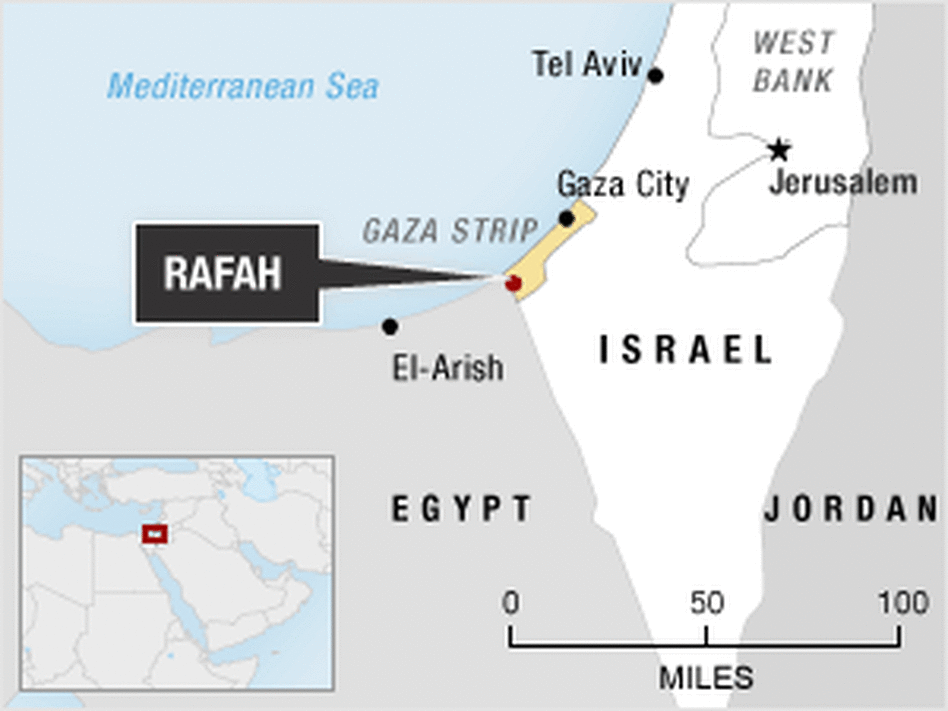
CAIRO — Egypt has determined that Hamas and its Palestinian allies established rocket launch sites in the northeastern section of the Sinai Peninsula.

Egyptian security sources said Hamas and Palestinian militias in the Gaza Strip have developed an underground infrastructure of rockets and tunnels in northeastern Sinai.

map-gaza-egypt-300-a392459d6c9d44f6cc63b39306fb3565db7883ceThe sources said the infrastructure was meant to sustain attacks on Israel amid a major ground invasion by Israel.

“There have been major changes to how Hamas and Islamic Jihad operate over the last year,” a source said.

The sources said Hamas and Jihad cooperated in establishing rocket workshops in Sinai. They said the Palestinians, with help from Bedouin smugglers and insurgents, transferred equipment from the Gaza Strip to Rafah and surrounding villages in the northeastern part of the peninsula.

On Aug. 21, Egypt’s official Middle East News Agency reported an army operation on Rafah and the nearby town of Sheik Zweid, both along the Sinai border with the Gaza Strip. MENA said four unidentified insurgents were killed and two others injured in a crackdown on suspected rocket sites.

“Thirty-one huts and houses used as launching pads for rockets were destroyed in the crackdown,” MENA quoted an Egyptian security source as saying.

The sources said Sheik Zweid has become a stronghold of Hamas and Jihad rocket operations. They said the two forces also transferred smuggling and operations tunnels from Rafah to Sheik Zweid, regarded as a base for Al Qaida-aligned militias in Sinai.

The Egyptian military has reported the destruction of 90 percent of the estimated 1,200 Palestinian tunnels that connected Sinai and the Gaza Strip, most of them along the divided town of Rafah. But the sources acknowledged that Hamas and Jihad built scores of tunnels that moved north to Sheik Zweid.

“The army has gained full control of Rafah, but faces much greater resistance in Sheik Zweid,” the source said.

Fighting in Syria spawns separate civil war in global jihadist movement

August 29, 2014

Fighting in Syria spawns separate civil war in global jihadist movement, Fox News, Jamie Dettmer, August 28, 2014

BaghdadizawahiriThe civil war in Syria has spawned another civil war in the global jihadist movement, with Islamic State, ruled by Abu Bakr al-Baghdadi (l.), and Al Qaeda, led by Ayman al-Zawahiri, (r.), emerging as sworn enemies.

All that comes even as Islamic State, estimated to include less than 20,000 fighters, continues to seize villages and kill enemies in Syria. If the well-funded upstart terror group hopes to stay on top of the global jihad movement, it will have to maintain its momentum.

*************

Syria’s bloody civil war has spawned a separate rift with ramifications well beyond the region known as the Levant — a battle for the very soul of the global jihad movement.

Islamic militants who poured into the embattled nation to help the Free Syrian Army in its bid to topple dictator Bashar Assad are now fighting Assad, the rebels and each other in a barbaric free-for-all. At the center is the split between Al Qaeda’s regional affiliate, Jabhat al-Nusra, and the newly emerged Islamic State, which are fighting each other on the battlefield and in the war for recruits to the cause of Islamic terrorism.

Last week, Al-Nusra, struggling to stay relevant and recruit fighters, released a video featuring three of their fighters as they head off in northern Syria near the city of Aleppo to battle the Islamic State, which was disowned by Al Qaeda. The message was that they, not Islamic State, have the purer motives.

“We in the Al Nusra Front only fight to raise the word of Allah, to make the oppressed triumphant,” one fighter says. “We only fight to get rid of the enemy Bashar and his soldiers. We have come to fight them so that we can impose Allah’s laws on the country. We have not come to oppress people, steal from people, or take their property.”

Another fighter urges Islamic State fighters to defect and “return to the truth” by joining Al Nusra, which is aligned with several Islamist rebel militias in Syria and has been fighting against the Islamic State since last winter, when Al Qaeda leader Ayman al-Zawahiri disavowed Abu Bakr al-Baghdadi, the boss of the upstart group then known as ISIS.

“Al Qaeda announces that it does not link itself with [ISIS] … It is not a branch of the Al Qaeda group, does not have an organizational relationship with it and [Al Qaeda] is not the group responsible for their actions,” the terror network’s General Command declared.

The pointed disavowal sparked mass defections from Al Baghdadi’s burgeoning operation. Jihadist and rebel groups eager to avenge ISIS assassinations of their comrades, took it as a sign it was open season on ISIS.

But Al Baghdadi, whose mentor was Abu Mousab al-Zarqawi, a Jordanian militant who himself was rebuked in 2005 by Al Zawahiri for excessive extremism in Iraq, clawed back. The success Islamic State, as it is now known, has enjoyed since is testament to his leadership skills and strategic savvy of the jihadist veterans from Iraq and Chechnya who are at the core of ISIS. By forming alliances with Sunni tribes along the border and deep into Iraq, Al Baghdadi managed to magnify his power.

Some terror experts believe Al Zawahiri, Usama bin Laden’s successor as Al Qaeda chief, was too slow in identifying Al Baghdadi as a serious rival for leadership of the global jihad movement. Tensions had existed within the jihadist movement in Syria since April 2013, the year before the disavowal, and “core Al Qaeda failed to take a genuinely commanding line,” said Charles Lister, a terrorism expert with the think tank Brookings Doha Center.

Some analysts view the split as having been prompted by Al Qaeda’s leadership fear that Al Baghdadi was too cruel with his beheadings, beatings and whippings and imposition of religious Shariah law on territory his men controlled.

But the dispute is, in some ways, more of a generational difference and a vying for the loyalty of jihadists affiliates and offshoots around the world – a jostling that is fracturing the jihadist movement and represents the biggest challenge Al Qaeda has faced since U.S. Navy SEALs took out bin Laden.

Many of the younger generation of jihadists support the Al Baghdadi idea of seizing territory and carving out a jihadist caliphate. They want their own state and have tired of Al Qaeda’s traditional approach of gradualism.

Caliphate refers to a system of government stretching across most of the Middle East and Turkey that ended nearly a century ago with the fall of the Ottomans.

And Al Baghdadi has been smart in his marketing – outshining Al Nusra in the use of social media to recruit and message.

“Taken globally, the younger generation of the jihadist community is becoming more and more supportive, largely out of fealty to its slick and proven capacity for attaining rapid results through brutality,” Lister said.

Al Baghdadi’s announcement of a caliphate in the summer straddling the border of Syria and Iraq – he has ambitions to spread it all the way west to Lebanon — has increased his standing among jihadi groups worldwide and more foreign fighters are choosing to join him than Al Nusra.

Several important affiliates have sworn allegiance to ISIS, while many others are avoiding declaring their choice between al Baghdadi or Al Qaeda, preferring to hedge their bets and wait to see who comes out on top.

On the ground in Syria and Iraq, the top dog at the moment is ISIS. With the advanced weaponry it has captured from fleeing Iraqi forces and the money it looted from Iraq’s regional banks, it has taken over the group and has much to offer recruits.

But Islamic State’s expansion has brought new battlefronts that could stretch the terror group to the breaking point. In Iraq, where it has carried out horrific executions of Christians and other religious minorities, it now faces hardened Kurdish fighters, the Iraqi Army, U.S. airstrikes and a budding international coalition and even Iran.

All that comes even as Islamic State, estimated to include less than 20,000 fighters, continues to seize villages and kill enemies in Syria. If the well-funded upstart terror group hopes to stay on top of the global jihad movement, it will have to maintain its momentum.

Talking Turkey with an Islamist academician

August 29, 2014

Talking Turkey with an Islamist academician, The Washington Times, Daniel Pipes, August 27, 2014

As Turkey’s 26th prime minister, Mr. Davutoglu faces a bubble economy perilously near collapse, a breakdown in the rule of law, a country inflamed by Mr. Erdogan’s divisive rule, a hostile Gulen movement, and a divided AKP, all converging within an increasingly Islamist (and therefore uncivil) country. Moreover, the foreign-policy problems that Mr. Davutoglu himself created still continue, especially the Islamic State hostage emergency in Mosul.

The unfortunate Mr. Davutoglu brings to mind a cleanup crew arriving at the party at 4 a.m., facing a mess created by now-departed revelers. Happily, the contentious and autocratic Mr. Erdogan no longer holds Turkey’s key governmental position, but his placing the country in the unsteady hands of a loyalist of proven incompetence brings many new concerns for the Turks, their neighbors and all who wish the country well.

**********

As Recep Tayyip Erdogan ascends Thursday to the presidency of Turkey, his hand-picked successor, Ahmet Davutoglu, simultaneously assumes Mr. Erdogan’s old job of prime minister. What do these changes portend for Turkey and its foreign policy? In two words: nothing good.

In June 2005, when Mr. Davutoglu served as chief foreign policy adviser to Mr. Erdogan, I spoke with him for an hour in Ankara. Two topics from that conversation remain vivid.

He asked me about the neoconservative movement in the United States, then at the height of its fame and supposed influence. I began by expressing doubts that I was a member of this elite group, as Mr. Davutoglu assumed, and went on to note that none of the key decision-makers in the George W. Bush administration (the president, vice president, secretaries of state and defense, or the national security adviser) was a neoconservative, a fact that made me skeptical of its vaunted power. Mr. Davutoglu responded with a subtle form of anti-Semitism, insisting that neoconservatives were far more powerful than I acknowledged because they worked together in a secret network based on religious ties. (He had the good grace not to mention which religion that might be.)

In turn, I asked him about the goals of Turkish foreign policy in the Middle East in the era of the Justice and Development Party (AKP) that had begun in 2002, noting Ankara’s new ambitions in a region it had long disdained. He conceded this change, then took me on a quick tour d’horizon from Afghanistan to Morocco, noting Turkey’s special ties with many countries. These included the presence of Turkic-speakers (e.g., in Iraq), the legacy of Ottoman rule (Lebanon), economic symbiosis (Syria), Islamic ties (Saudi Arabia), and diplomatic mediation (Iran).

What struck me most was the boastful optimism and complete self-assurance of Mr. Davutoglu, former professor of international relations and an Islamist ideologue. He not only implied that Turkey had waited breathlessly for him and his grand vision, but he also displayed an unconcealed delight at finding himself in a position to apply his academic theories to the great canvas of international politics. (This privilege occurs surprisingly rarely.) In sum, that conversation inspired neither my confidence nor my admiration.

While Mr. Davutoglu has done remarkably well for himself in the intervening years, he did so exclusively as consigliere to his sole patron, Mr. Erdogan. His record, by contrast, has been one of inconsistent policy and consistent failure, a failure so abject it borders on fiasco. Under Mr. Davutoglu’s stewardship, Ankara’s relations with Western countries have almost universally soured, while those with Iran, Iraq, Syria, Israel, Egypt and Libya, among other Middle Eastern states, have plummeted.

Symbolically, Turkey is slipping away from the NATO alliance of democracies and toward the shoddy Sino-Russian grouplet known as the Shanghai Cooperation Organization. As Kemal Kilicdaroglu, leader of the opposition, sadly notes, “Turkey has grown lonely in the world.”

Having failed as foreign minister, Mr. Davutoglu now — in an application of the Dilbert Principle — ascends to a heady but subservient leadership of both the AKP and the government. He faces two major challenges:

As AKP leader, he is tasked with producing a great victory in the June 2015 parliamentary elections to modify the constitution and turn the semi-ceremonial position of president into the elected sultanate Mr. Erdogan lusts for. Can Mr. Davutoglu deliver the votes? Color me skeptical. I expect that Mr. Erdogan will rue the day he relinquished his prime ministry to become president, as he finds himself ignored and bored living in the sprawling presidential “campus.”

As Turkey’s 26th prime minister, Mr. Davutoglu faces a bubble economy perilously near collapse, a breakdown in the rule of law, a country inflamed by Mr. Erdogan’s divisive rule, a hostile Gulen movement, and a divided AKP, all converging within an increasingly Islamist (and therefore uncivil) country. Moreover, the foreign-policy problems that Mr. Davutoglu himself created still continue, especially the Islamic State hostage emergency in Mosul.

The unfortunate Mr. Davutoglu brings to mind a cleanup crew arriving at the party at 4 a.m., facing a mess created by now-departed revelers. Happily, the contentious and autocratic Mr. Erdogan no longer holds Turkey’s key governmental position, but his placing the country in the unsteady hands of a loyalist of proven incompetence brings many new concerns for the Turks, their neighbors and all who wish the country well.

Mashaal Vows Cease-Fire a Step to New ‘Resistance’ War against Israel

August 29, 2014

By: Tzvi Ben-Gedalyahu

Published: August 28th, 2014

via The Jewish Press » » Mashaal Vows Cease-Fire a Step to New ‘Resistance’ War against Israel.


Hamas chief Khalid Mashaal rallies supporters in Gaza (archive).
Photo Credit: Screenshot

Hamas’ supreme leader Khaled Mashaal dashed any hopes of long-term peace with Israel in a speech in Qatar on Thursday in which he shot from the hip at Israel and also at his terrorist organization’s new partner, the rival Fatah movement headed by Palestinian Authority chairman Mahmoud Abbas.

His lengthy speech in Qatar, which has financed Hamas terror and which fought Egyptian cease-fire proposals, followed by one day a “victory” speech by Ismail Haniyeh, the senior Hamas political leader in Gaza. Mashaal’s silence while Haniyeh accepted the cease-fire is a clear sign of a fierce power struggle between Hamas in Gaza and between Mashaal and Qatar, which holds the purse strings.

Mashaal also claimed victory, with lies that Hamas missiles hit the Ben Gurion Airport, which is not true, and that more than 5 million Israelis hid in bomb shelters, a gross exaggeration. However, there is no doubt that Hamas succeeded in scaring the daylight out of millions of Israelis, interrupting a few flights and generally turning half of Israel into sitting ducks.

And this won’t be the last time, regardless of a cease-fire, he warned.

“Whatever happened [in Gaza] is not the end to this story, and this is not the last operation to free Palestine. It was an important stop on the way to victory,” Mashaal declared.

His speech threw every obstacle possible on the road to negotiations with Israel. The talks are supposed to begin in a month, leaving open the possibility, or probability, that Prime Minister Binyamin Netanyahu is carrying on secret negotiations that will be formalized in 30 days.

The Prime Minister suffered another blow to any trust that Israelis may have for him with a report on Thursday that he met secretly with Jordanian King Abdullah, and perhaps Abbas, prior to the cease-fire, circumstantial evidence that Israel negotiated under fire, contrary to Netanyahu’s promise.

If Mashaal gets his way, there won’t be any talks because one of the new powers in Gaza is slated to be Abbas, whose security forces would patrol Gaza borders, according to the Egyptian proposal. That would provide Cairo with another tactic to get rid of Hamas.

Mashaal nailed Abbas to the wall in his speech, accusing him of throwing cold water on the resumption of the intifada during the war by allowing his security forces to limit protests.

“The next operation needs to use all of the Palestinian capabilities, not just part of them,” Mashaal said. “The resistance is holy and weapons are holy. There is no such thing as a country without weapons.”

A country or not, Gaza still has at least 2,000 rockets as well as anti-tank rockets and presumably anti-aircraft missiles. It still has rocket factories, one of which was filmed in production by Hamas during one of the failed cease-fires during the war.

Netanyahu had demanded that any halt in violence would be accompanied by disarming Hamas, but this week’s cease-fire only left the issue to be put on the negotiating table, along with Hamas’s demands for a deep-sea port and an airport.

Mashaal’s speech was full of hate and crude accusations that Israel inflicted a “Holocaust” on Gaza by “destroying schools and hospitals,” which all but the most extreme anti-Israel media now know were used by Hamas as rocket launching and terrorist command centers.

“We are against what Hitler did to the Jews, and Israel committed a second Holocaust in Gaza. Israel is an embarrassment to Jews and to the entire world,” according to Mashaal.

His rhetoric was aimed at Abbas as well as Israel. If and when negotiations begin, Egypt and the United States will be on the side of Abbas, who despite his unity government with Hamas has proved politically smart by a patient and single-minded tactic of using international support to slowly but surely win concession after concession from Israel until there is nothing left to negotiate.

Including Gaza as part of the Palestinian Authority works to Abbas’ benefit because it will solidify position that a Palestinian Authority state needs to on contiguous territory, meaning that Sderot residents can start packing up and leaving their homes as well as their bomb shelters, which would save Hamas lots of time and money when digging terror tunnels from the Western Negev to Ashdod.

Mashaal’s aim is the same as Mashaal, but his strategy is different When Mashaal says that there will be another war to “free Palestine,” he is referring to all of Israel, from Kiryat Shmona in the north to Eilat in the south, and from the Dead Sea in the east to the Mediterranean Sea on the west.

Abbas talks about a “two-state solution,” the magic phrase that sends U.S. Secretary of State John Kerry into hallucinations and hypnotizes the foreign media into pretending that the Palestinian Authority’s maps of “Palestine” don’t include the existence of Israel.

But Mashaal reminded everyone in his speech that he has people on his side.

He thanked his sponsors for terror, namely Qatar, Turkey, Yemen and Algeria, and he thanked South Africa and Latin American countries for boycotting Israel.


