As time zones go, Israel is one hour ahead of Europe and seven hours ahead of the eastern U.S. But when it comes to understanding the magnitude of the threat posed by Hamas, Israel is years ahead of both. Israel does not have the luxury of waiting for the rest of the world to wake up. We have to act now and make sure the world acts as well — before hostilities resume.
***********
The next round of violence involving Israel and Hamas is just a matter of time, and Israel would be wise to take the initiative on the matter. The timing should by [sic] convenient for the political and military echelons, and it must be based on quality intelligence.
Israel should be the one to surprise Hamas, instead of waiting for rocket fire of any scale. Israel should not be the one left to mount a response. The days of Israel being dragged into a fight by Hamas are over.
In its seven years in power, Hamas has plunged Gaza into chaos, which should remain inside the Strip, instead of affecting the kibbutzim near the Israel-Gaza Strip border and cities nationwide.
Hamas’ brutality is growing. It is oppressing the people of Gaza and doing everything within its power to ensure Gaza does not become Westernized. Hamas favors maintaining a “Wild West” in the Gaza Strip, so that it can continue to dictate who can and cannot pull the trigger in Gaza, and how.
Several hours after arch-terrorist Mohammed Deif, commander of the Izzedine al-Qassam Brigades, and three other senior Hamas officials were killed by an Israeli Air Force strike in Khan Younis, thanks to accurate intelligence provided by the Shin Bet security agency (although officially, Deif’s fate remains unknown), Hamas proved that it could do what the Islamic State group (ISIS) does: Men and women suspected of collaborating with Israel were dragged out of their homes, and in some cases their jail cells, and marched to a public square, while a masked gunman used the Great Mosque of Gaza loudspeaker to urge the masses to attend their execution.
The masses obeyed, and eager to see the victims suffer, demanded they be hanged. But the masked terrorist told the crowd that if ISIS dispensed justice by sword, Hamas would dispense it via gunfire.
The bullet-riddled bodies of the 28 “traitors” were meant to send a message: The IAF may control the skies, but Hamas is well in control on the ground. Gaza’s rulers thus demonstrated that their brutality was not reserved solely for Jews or Christians — innocent Muslims were not safe from it either.
Thanks to Iran, Hamas has twice the power ISIS does. Tehran has made sure Hamas is well armed, well trained and has much better logistical, financial and command infrastructures. So why is it that the terror Hamas has subjected Israel to has failed to convince the world in general, and particularly the United States, of the need to destroy its infrastructures?
Why is it that the U.S.’s firepower is directed at the Islamic State group — which is no danger to its borders or citizens — and not at Hamas, which is a known Iranian proxy? And if the U.S. prefers to act indirectly, why has it failed to endorse the Israel Defense Forces’ operations?
Hamas is more calculating than ISIS. It prevents the true scope of its atrocities from being revealed, mainly because it is wary of the wrath of the families of murdered Gazans. It has no qualms about harming women and children if it suspects one of their relatives might be a collaborator, but takes great care to conceal it.
Had Hamas been able to realize its tunnels conspiracy, infiltrate one of the communities near the border and abduct Israeli men, women and children, then Israel, the U.S. and the EU would have understood the true nature of Hamas’ cruelty.
Luckily for us, while Hamas is stronger than ISIS, the IDF is significantly stronger than the Iraqi Army. The 2007 military coup Hamas staged in Gaza Strip included throwing Fatah officials from the rooftops. Hamas’ fantasy that they could do the same to Jews, will remain just that — a fantasy the IDF has ruined.
World must wake up
The notion of the Islamic caliphate is a principle shared by Hamas and ISIS. This future caliphate, regardless of whose product it is, would be free of any geographic border, and it would be subjected solely to Shariah and Islamic laws.
Hamas and ISIS seek to recapture the grand history and the legacy of the Islamic caliphate created by Saladin. Given the rise of Islam in Europe they have reason to believe the future is promising, and they believe that when the radical Muslims from East and West join forces, the time would come for the resurrection of Saladin’s caliphate.
Israel cannot afford to follow in the Western world’s footsteps when it comes to the way Hamas should be handled, and cannot afford to be complacent or indifferent. As the Jewish state we have a duty to wake the rest of the world up and ensure that the world’s nations see Hamas for what it really is.
As time zones go, Israel is one hour ahead of Europe and seven hours ahead of the eastern U.S. But when it comes to understanding the magnitude of the threat posed by Hamas, Israel is years ahead of both. Israel does not have the luxury of waiting for the rest of the world to wake up. We have to act now and make sure the world acts as well — before hostilities resume.
Israel is the tip of the spear pointed at those whose “holy” goal is the eradication not only of Israel but of freedom, “non-believers” and apostates everywhere.
Israel has been stalled in her quest to remain a free and democratic nation — she is the only one — in the otherwise Islamist Middle East. Hamas and associated Islamic jihadists in Gaza have hindered her only slightly. She could overcome them in relatively short order were it not for unwanted, hypocritical and harmful interference from fantasy-based ideologues such as President Obama and other members of “the international community.” The worst hindrances have been due to those in the West who claim to view Islam as the religion of peace, not death. They ignore reality while continuing to demand that Israel forfeit her legitimate right to defend herself against the existential dangers posed by Islamic jihad. They live in decreasingly free and democratic societies and reject for Israel the freedoms they themselves have forfeited.
The public beheading of James Foley, an American citizen, by a British citizen affiliated with the Islamic State (“IS”) brought much public attention to and produced outrage at the IS. It is good to be outraged at the IS. But it is only part of the problem because the religious ideology and actions of the IS are based on, consistent with and required by Islam.
The ideology
Islamic ideology that eliminates freedom and demands the slaughter of “unbelievers” and apostates is summarized in the video presented above. Here are two rather more serious efforts: Nothing to do with Islam, Part one and Part two. Part one states,
This fundamental error continues today, as Muslim violence and anti-Semitism are explained by every factor instead of the essential one––the theology, jurisprudence, and history of Islam.
[S]uch fantasies endanger our attempts to destroy a committed enemy who is motivated by a storied history of conquest and domination, and inspired and justified by the most cherished beliefs of millions of their co-religionists. [Emphasis added.]
Part one explains these statements at great length with multiple specific references to passages from the Koran.
Part two states,
We in the West correctly find such views “extreme,” or “savage” and “barbaric,” but they are not “fringe” anomalies conjured out of textual misreadings by an extremist cult. They derive from the history and sacred texts of Islam, the clear meaning of which is illustrated on page after page of Muslim history. And they are being acted upon today across the Muslim world, as evidenced by the nearly 24,000 violent attacks perpetrated by Muslim terrorists since 9/11. Contrary to Obama, ISIL does speak for a religion. It’s called Islam. [Emphasis added.]
Groups like ISIL or al Qaeda do not embrace “extreme religious views,” or “twist the overall message of religious texts,” as the New York Post has it. They act on a venerable tradition within Islam, one based on writings some Muslims have construed differently because of inconsistencies among various texts. But that doesn’t change the fact that the jihadists have within the faith long-established precedents for their actions, a tradition with millions of Muslim adherents worldwide, including the leaders of Turkey and Qatar who finance the vicious terrorist group Hamas, and the Mullahcracy in Iran, the world’s foremost supporter of Islamic terrorism. [Emphasis added.]
Part two explains these statements at great length, again with multiple and specific references to passages from the Koran.
Islamic jihad continues to Metastasize
Iraq — here’s a lengthy video from Vice News that provides useful summaries and insights.
By some estimates, the Islamic State group occupies up to 35 percent of Syria, or about a third of the country. It has consolidated its hold over an impressive stretch of territory from its westernmost end on the outskirts of the city of Aleppo, across northern Syria and most of the east. It spreads into most of the Sunni-dominated areas of northern and western Iraq, right up to the edges of Baghdad. That terrain includes the oil fields of Syria’s eastern Deir el-Zour province and parts of Hassakeh. It also includes parts of Aleppo province, including the major towns of Manbej and al-Bab, where the group’s black flags flutter over government buildings and main squares. Because it controls territory on both sides of the border, the group can move fighters, weapons and goods between Iraq and Syria with relative ease.
. . . .
The Islamic State’s declared capital is Raqqa, a city in northeastern Syria along the Euphrates River. With a population of 500,000, Raqqa is the group’s power base. Foreign fighters, some with their families, have flocked there from all over the world. Although it always has been a conservative city with strong tribal presence, Raqqa was once a diverse, thriving commercial center. Today, it is patrolled 24 hours a day by vice squads known as the Hisba — armed fighters in long robes who make sure their strict interpretation of Islam is observed. The militants have banned music and smoking, and have forced women to cover up. They have carried out beheadings in the main square for violators of Shariah, or Islamic law. People who were killed have had their bodies hung from crosses. The group recently imposed a curriculum in Raqqa schools, scrapping subjects such as philosophy and chemistry. [Emphasis added.]
As Boko Haram has continued to unleash its violence across northern Nigeria, the group seems to be gaining ground. Under the leadership of Abubakar Shekau, Boko Haram has evolved from a terrorist group into an insurgency that seeks to establish an Islamic state. And Boko Haram’s tactics have changed accordingly, from smash and dash attacks, killing thousands, into attempts to grab and hold territory. [Emphasis added.]
In a video obtained last weekend by Agence France Presse (AFP), Boko Haram leader Abubakar Shekau celebrated the group’s recent successes and gave a warning to those opposed to him and his ideology. Shekau is shown standing in front of three SUVs, wearing military fatigues with a Kalashnikov slung across his body, as he rants, in a mixture of Arabic and Hausa, to the camera. He holds a notebook in his left hand from which he reads.
After Shekau’s video was released, it was widely reported that he had declared the establishment of an Islamic caliphate covering significant parts of Nigeria. Shekau’s video came less than two months after Abu Bakr al Baghdadi, the head of the Islamic State, declared that he now rules as “Caliph Ibrahim” over large swaths of Iraq and Syria. With that in mind, Shekau’s appearance was widely interpreted as either an attempt to hitch his group to Baghdadi’s bandwagon, or to grab the spotlight for himself by capitalizing on caliphate fever.
But a careful analysis of Shekau’s recording shows that his words were likely misinterpreted. According to a translation obtained by The Long War Journal, Shekau highlights recent attacks perpetrated by his group throughout Nigeria. “Thanks be to God who gave victory to our brethren in Gwoza and made it a state among the Islamic states,” Shekau says. “Thanks be to God who brought grief to the unbelievers like Israel and Britain, or England, and their father America.” [Emphasis added.]
In February it was estimated that at least 50 U.S. citizens are fighting in Syria, and are liable to bring terrorism back to their home country once the war is over. [Emphasis added.]
The State Department estimates there are about 12,000 foreign fighters from at least 50 countries in Syria.
A “hundred or so” Americans are now thought to be fighting on behalf of the IS in Syria. Approximately three hundred are now thought to be fighting on behalf of the Islamic State there and elsewhere, presumably including Iraq.
There have been “significant increases” in “terror chatter” as September 11th approaches. Yet the FBI recently identified no Islamist terror threats to the United States.
The FBI’s most recent [August 14, 2014] national threat assessment for domestic terrorism makes no reference to Islamist terror threats, despite last year’s Boston Marathon bombing and the 2009 Fort Hood shooting—both carried out by radical Muslim Americans.[Emphasis added.]
. . . .
Instead, the internal FBI intelligence report concluded in its 2013 assessment published this month that the threat to U.S. internal security from extremists is limited to attacks and activities by eight types of domestic extremist movements—none motivated by radical Islam. [Emphasis added.]
They include anti-government militia groups and white supremacy extremists, along with “sovereign citizen” nationalists, and anarchists. Other domestic threat groups outlined by the FBI assessment include violent animal rights and environmentalist extremists, black separatists, anti- and pro-abortion activists, and Puerto Rican nationalists.
. . . .
Former FBI Agent John Guandolo said he was not surprised the report did not include any reference to domestic-origin Islamic terror.
“It should not surprise anyone who follows the jihadi threats in the United States that the FBI would not even include ‘Islamic terrorism’ in its assessment of serious threats to the republic in an official report,” Guandolo said.
“Since 9/11, FBI leadership—as well as leaders from Department of Homeland Security, the State Department, CIA, Pentagon, and the National Security Council—relies on easily identifiable jihadis from the Muslim Brotherhood/Hamas, al Qaeda and elsewhere to advise it on how to deal with ‘domestic extremism.’” [Emphasis added.]
. . . .
The domestic threat assessment is the latest example indicating the FBI has been forced by Obama administration policies from focusing on the domestic terror threat posed by radical Islamists. [Emphasis added.]
Rep. Louie Gohmert (R., Texas) said in a 2012 House floor speech that the FBI was ordered to purge references to Islam, jihad, and Muslims in its counterterrorism “lexicon” guidelines for its reports.
As a result, the FBI is hamstrung from understanding the threat of terrorism from groups like al Qaeda that have declared jihad, or holy war, on the Untied States, Gomert said.
Guandolo, the former FBI agent, said the vast majority of U.S. Islamic organizations were identified in recent U.S. terrorism trials as part of the Muslim Brotherhood, the parent group for the Palestinian terror group Hamas. Thus, these groups are aligned with the same objectives as the Islamic State of Iraq and the Levant, al Qaeda, and others, he said. [Emphasis added.]
“Our FBI is not teaching their agents and analysts this information; they are not sharing it with local and state law enforcement officials; and they are not investigating and pursuing the very individuals and organizations which are supporting and training jihadis in America,” Guandolo said.
Meanwhile Britain has raised the threat level to “severe,” the second highest level meaning that an attack is “highly likely.”
British Prime Minister David Cameron raised Friday the nation’s terrorism threat level to “severe,” saying bluntly that “poisonous” Islamic extremism is causing widespread problems that are spreading from the Middle East to other parts of the world.
. . . .
“I believe we will be fighting for years, and perhaps decades,” Mr. Cameron said, adding that the U.K. has already taken many actions, such as “legislating so that we can prosecute people on all aspects of terrorism.”
Mr. Cameron estimated about 500 people have traveled to the Middle East for terrorism training and to join the Islamic State.
He dismissed the theory that poverty fosters terrorism.
“The [current] terrorist threat was not created by the Iraq War … it existed even before the horrific attacks on 9/11,” he said. “It cannot be solved by addressing poverty, or dictatorships or instability in the region. The root cause is quite clear: a poisonous ideology of Islamic extremism that is condemned by all … [and that will] force people to live in a Medieval state” that includes beheadings, the enslavement of people, the rape of women.
. . . .
Mr. Cameron’s actions come as the U.S. response to the Islamic State remains in limbo. President Obama said Thursday the White House currently has no policy for dealing with the terrorist group.
to raise its terrorist threat level — at least in the short-term — after the U.K. did so Friday in response to a threat from the Islamic State of Iraq and Syria.
As noted in the video embedded below, illegal immigration by Islamists across our southern non-borders also presents substantial threats to our national security.
Islamic terrorist groups are operating in the Mexican border city of Ciudad Juarez and planning to attack the United States with car bombs or other vehicle born improvised explosive devices (VBIED). High-level federal law enforcement, intelligence and other sources have confirmed to Judicial Watch that a warning bulletin for an imminent terrorist attack on the border has been issued. Agents across a number of Homeland Security, Justice and Defense agencies have all been placed on alert and instructed to aggressively work all possible leads and sources concerning this imminent terrorist threat. [Emphasis added.]
Specifically, Judicial Watch sources reveal that the militant group Islamic State of Iraq and Greater Syria (ISIS) is confirmed to now be operating in Juarez, a famously crime-infested narcotics hotbed situated across from El Paso, Texas. Violent crimes are so rampant in Juarez that the U.S. State Department has issued a number of travel warnings for anyone planning to go there. The last one was issued just a few days ago. [Emphasis added.]
Intelligence officials have picked up radio talk and chatter indicating that the terrorist groups are going to “carry out an attack on the border,” according to one JW source. “It’s coming very soon,” according to this high-level source,who clearly identified the groups planning the plots as “ISIS and Al Qaeda.” An attack is so imminent that the commanding general at Ft. Bliss, the U.S. Army post in El Paso, is being briefed, another source confirms. The Department of Homeland Security (DHS) did not respond to multiple inquiries from Judicial Watch, both telephonic and in writing, about this information. [Emphasis added.]
The disturbing inside intelligence comes on the heels of news reports revealing that U.S. intelligence has picked up increased chatter among Islamist terror networks approaching the 13th anniversary of the 9/11 attacks. While these terrorists reportedly plan their attack just outside the U.S., President Obama admits that “we don’t have a strategy yet” to combat ISIS. “I don’t want to put the cart before the horse,” the commander-in-chief said this week during a White House press briefing. “I think what I’ve seen in some of the news reports suggest that folks are getting a little further ahead of what we’re at than what we currently are.”
The administration has also covered up, or at the very least downplayed, a serious epidemic of crime along the Mexican border even as heavily armed drug cartels have taken over portions of the region. Judicial Watch has reported that the U.S. Border Patrol actually ordered officers to avoid the most crime-infested stretches because they’re “too dangerous” and patrolling them could result in an “international incident” of cross border shooting. In the meantime, who could forget the famous words of Obama’s first Homeland Security Secretary, Janet Napolitano; the southern border is “as secure as it has ever been.” [Emphasis added.]
Americans who have traveled to foreign countries to train and fight with terror groups such as the Islamic State of Iraq and the Levant (ISIS or ISIL) are not being barred from freely returning to America, where they post a substantial terror threat, according to a leading member of Congress. [Emphasis added.]
U.S. intelligence agencies have been tracking Americans who travel abroad to join jihadist groups, but there is no law on the books restricting travel to countries posing a substantial terror threat, according to Rep. Frank Wolf (R., Va.). He is proposing a new law that would significantly restrict travel to Syria and other “nations of concern.”
Wolf, who originally introduced the bill earlier this year, is leading a new push to pass legislation that would imprison for up to 20 years Americans who travel to these countries following the reported deaths of at least two Americans who had travelled to Syria to fight alongside ISIL.
At least 300 Americans are believed to be fighting alongside ISIL, according to U.S. intelligence sources, who have reportedly expressed concern about these fighters returning to carry out terror attacks in America.
. . . .
“Limited U.S. intelligence about their activities in the region effectively means our law enforcement can do nothing when they return home, despite concerns about their activities, contacts and training while in Syria,” Wolf writes. “I think most would agree we need to do more to prevent these terrorists from returning freely to the U.S.” [Emphasis added.]
. . . .
“The U.S. is not taking any substantial steps to discourage Americans from going over to fight—and these would-be fighters can see there is little price to pay for doing so,” the letter states. “This is an untenable situation that puts our country at greater risk of attack from a radicalized American who trains and fights with these groups and later returns home.”
The actions of Ohama’s America in response to the Islamist threat have been consistent with President Obama’s views and defenses of Islam
President Obama announced on August 28th that He does not yet have a strategy, telling the IS something it could easily have concluded from the actions and inactions of the Obama Nation. His strategy, such as it is, is concisely stated in His (claimed) autobiography, The Audacity of Hope.
It was thrown away. First, President Obama cut defense massively, constraining the Pentagon and hollowing out the force. He was helped not only by Democrats in Congress but also by Republicans, who agreed to the budget sequester in 2011. Democrats want more money for social programs; Republicans want to cut the deficit. They are both guilty of short-term thinking.
The effects of defense cuts are felt not only in one budget. They are felt over time—in weapons not developed or devised, forces not raised, troops not adequately trained and equipped. The government cashes out a peace dividend just once. Later, we all pay. [Emphasis added.]
But don’t fret! President Obama’s charming ways, superior intellect and multicultural understanding of the beauties of Islam will force the bad guys to reform and become good little Obamabots.
President Obama, along with Secretary Kerry, really should go to Iraq, Syria and other IS strongholds and discuss things with them while enjoying rounds of golf and listening to Secretary Kerry’s sailing fantasies.
What would Winston Churchill do?
That’s an interesting question, helpful answers to which can be found in The Gathering Storm. Answers to the question are, unfortunately, not relevant because Churchill is dead and there is no one living who even approaches him in prescience, resolve and ability to do what needs to be done.
(Finally some of my fellow Christians are running out of cheeks.-LS)
Dohuk, Iraq — Of all the many ancient peoples who once lived in the land between the Tigris and the Euphrates, Iraq’s Assyrian Christians pride themselves on having persisted in their traditional homeland for millennia, even as other civilizations thrived then disappeared, as languages and cultures died out, as ethnic groups melted into the ways and genetic pools of their conquerors.
But today Iraq’s Assyrians, and its Christians in general, fear that their place in this multiethnic, multisectarian mosaic society is shrinking, under severe threat from the ultraconservative Islamist group the Islamic State (IS).
It isn’t the first time that Iraq’s Christians have faced such a foe. The IS’s earlier incarnation, al Qaeda in Iraq–a group that formed after the U.S.-led invasion in 2003–also menaced Christians, and others, prompting tens of thousands to flee into exile.
Now, the particularly harsh nature of the IS’s assault on Christians, Yazidis, Shiite Muslims, and others who do not share allegiance to the IS’s brand of ultraconservative Sunni Islam has led some of Iraq’s Christians to take the unusual step of shedding their historical passivity and consider taking up arms to defend and eventually govern themselves.
The Assyrian Patriotic Party, one of several Assyrian political organizations, has armed and dispatched a symbolic, rather than an active, force of some 40 members to join the Kurdish Peshmerga fighting the IS in the northwest of Iraq, according to party official Henry Sarkis.
The Peshmerga are the official forces of the Kurdistan Regional Government. It is the first such action by Iraqi Christians since some Christians fought briefly alongside the Kurds against Saddam Hussein.
Sarkis, 44, is the newly appointed branch chief of the party’s office in Dohuk, a northern governorate in the semiautonomous Kurdish region that borders Syria and Turkey.
The 40 men constitute what Sarkis calls the “first wave,” and the unit has adopted the name Dukha, an Assyrian word that means “sacrifice.”
Carved into a mountainside, the seventh-century Rabban Hormizd monastery overlooks the Nineveh Plains. Christians have lived in the area continuously since the first century, but in the past decade more than two-thirds of Iraq’s estimated 1.5 million have fled (photo: J.B. Russell, Panos).
“We keep talking about Jesus and peace, and now we’ve reached the point where it’s not enough,” he said in an interview at his party’s headquarters in Dohuk. “The age of waiting for the Peshmerga to take back territory while we sit is over. We took the decision that, with our limited abilities, we will try to participate.”
The party bought weapons with money donated by members in the diaspora, Sarkis said, and is looking to raise more funds through donations to increase its stockpile.
Sarkis’s men are mainly behind the front line, around the town of Sharfiyah, not so much fighting alongside the Peshmerga as holding territory the Kurdish forces have gained or are pushing forward from.
A Perilous Shift
Still, it marks a significant shift in the attitude of Iraq’s Christians, a shift that’s fraught with peril.
Since 2003, Iraq’s Christian community has been viewed by other Iraqis as a passive victim of the country’s many conflicts, not an active aggressor.
Taking up arms will make the Christians direct participants, armed targets who pose military rather than just ideological opposition to ultraconservative Islamist groups.
Sarkis acknowledges this but said his party is prepared to accept the consequences. “We’re being killed in our homes, so why not defend ourselves? Then even if we die, we die with dignity,” he said. “We didn’t want to reach this point–we just want to live in our areas.”
Before 2003, Iraq held about 1.5 million Christians. The number today is fewer than 500,000, say community leaders, the majority having been driven out by war and all the trouble it inflicts and breeds, including corruption and insecurity.
Juan Jose Valdws, Daniela Santamarina, Ng Staff. Source: Institute For The Study Of Wars; Atlas Of Global Christianity 1910-2010, Center For The Study Of Christianity, 2009.
According to the CIA’s World Factbook, Shiites now make up 60 to 65 percent of Iraq’s population, Sunnis 32 to 37 percent, and Christians just 0.8 percent. Most remaining Christians live on the Nineveh Plains, an area that is also home to other ethnic and religious minorities in Iraq, including the Yazidis and the Turkomans.
Fall of Mosul
On June 10, Mosul, the capital of the Nineveh governorate, in northern Iraq, fell to IS-led militants in a blitzkrieg advance. The IS was ruthless with its enemies, uploading videos of mass executions of soldiers and security forces they’d captured. The Iraqi Army melted away, rather than try to repel the incursion.
Weeks later, the Kurdish Peshmerga also retreated from some areas in the face of an IS-led onslaught. Kurdish troops are now fighting, with the aid of limited U.S. air strikes, to regain territory.
The IS gave Mosul’s estimated 8,000 to 10,000 Christians three options: convert to Islam, pay a tax, or die. Instead they fled en masse to villages on the Nineveh Plains, as well as farther north into the Kurdish heartland.
As few as 40 Christians remain in Mosul, according to Duraid Tobiya, 53, an Assyrian from the city and an adviser on minority affairs to the governor of Nineveh.
He said that the few who stayed were too sick, too old, or too poor to leave–so much so that the IS exempted them from paying the jizya, a tax on non-Muslims.
“I’m from Mosul–this is the first time I’ve been displaced,” Tobiya said. “I lived through everything else that happened in Mosul, but it’s all very different from what’s happening now.”
This time, he said, he had no faith in either the Iraqi Army or the Kurdish Peshmerga to protect Christians and other minorities, such as the Yazidis and Turkomans, against a much more dangerous foe, because both forces initially abrogated their duties.
Iraq’s Christians, like all of the country’s sectarian communities, do not speak with one voice. There are numerous political parties with varying platforms.
The solution as Tobiya saw it, was one of two options: “either mass emigration or an internationally protected safe zone. We have no other options. We are against emigration, because we are not only the sons of this country but its original inhabitants.”
All dozen or so Christians interviewed by National Geographic adamantly shared the demand for a safe zone, akin to the two no-fly zones the West established in 1992 to protect Kurds in the north and Shiite Muslims in the south from the forces of former leader Saddam Hussein.
But 1992 was a long time ago in terms of Western resources and commitment to the region–especially at a time when President Barack Obama’s administration is trying to pivot away from the troubles of the Middle East. Still, Tobiya and others insisted it’s a viable option.
“We must protect ourselves–and also have international protection,” he said.
Refused entry to the humanitarian aid center in Al Hamdaniyah (Qaraqosh), a Christian refugee expresses his frustration to a Peshmerga soldier. (photo: Vianney Le Caer, Pacific Press/Lightrocket Via Getty).
Long-term Plans
In another part of Dohuk, behind the high concrete walls of the Assyrian Democratic Movement’s headquarters, the local branch leader, Farid Yacoub, 42, says his party too is moving to arm its men.
It is registering volunteers, having gathered more than 2,000 names from the Dohuk governorate alone. But unlike Assyrian Patriotic Party leaders, Yacoub is recruiting men to protect Christian areas after they’ve been won back from the IS and its allies.
The intention is not to participate in the battle to reclaim those areas. “We have lots who are volunteering, who want to fight, but we don’t have the means to arm them,” he said.
The party doesn’t want Christian villages such as Al Hamdaniyah (Qaraqosh) to be controlled or protected by the Peshmerga after they’ve been reclaimed. “Our people don’t trust them any more,” Yacoub said.
There’s a bigger issue here. Nineveh has long been caught in a conflict between the central government in Baghdad and the semiautonomous Kurdish region in the north.
Some Christians on the Nineveh Plains have pushed to govern themselves, but Kurdistan also has claims on their territory and wants to absorb it into its zone.
Earlier this year, long before the country descended into the current level of mayhem and fragmentation, Baghdad “agreed in principle” to turn the Nineveh Plains, as well as two other areas, Fallujah and Tuzkhurmatu, into provinces. This would enable the Christians to manage their own affairs and secure an independent share of the national budget.
The Assyrian Democratic Movement doesn’t want the Nineveh Plains to be part of Kurdistan, but Sarkis said his Assyrian Patriotic Party does.
Sarkis’s men are working with the Peshmerga, independent of the national government’s recent call for volunteers to fight the IS.
“Let’s be honest,” he said. “When the [Shiite-led] government asked for volunteers, it’s because the war is sectarian, between Shiites and Sunnis. They didn’t volunteer to protect Christians. They did so to fight Sunnis.”
Yacoub, on the other hand, is not working with the Peshmerga and said his men are waiting for the central government to train and arm them, though with the proviso that they return to their areas.
“Our men said they were worried because they didn’t want to defend areas other than theirs. We want to defend areas where our people are, specifically the Nineveh Plains,” Yacoub said. “We’re nationalists, but the circumstances that Iraq is living through now necessitate that we have a safe place, a place for us.”
Turning to Lebanon’s Christians
Of all the dwindling Christian communities in the Middle East in recent times, only the Lebanese have picked up arms during civil turmoil. Lebanese Christians battled not only Muslims but also each other during their country’s brutal 15-year civil war, which ended in 1990.
Duraid Tobiya, the adviser to the Nineveh governor, is also a member of Yacoub’s Assyrian Democratic Movement. He said that since the fall of Mosul, his party had received a delegation from the Lebanese Forces, a militia turned political party, and had also sent representatives to Lebanon twice to meet with the party.
He didn’t elaborate about the nature of the meetings, saying only that “we want to benefit from their experience. We explained our situation, and they explained their experience in Lebanon.” He added, “We might proceed with some things, apply them on the ground.”
Antoinette Geagea, a spokesperson for the Lebanese Forces in Beirut, confirmed the meetings. She said they were part of a series her party had undertaken with Christian spiritual and political leaders from Nineveh and Kurdistan, as well as Kurdish parties, in the wake of the fall of Mosul.
“There are many different views among Iraq’s Christians,” she said. “The Lebanese Forces told them that they must unite. We told them that if you all agree on a position, we will stand with you and help you.”
That help could be political, in the form of lobbying international and regional players, or humanitarian. Or “if they want to protect themselves, we will put our experience at their disposal,” Geagea said. “We told them they must decide on the best solution to help Christians stay in their country.”
“We’re Still Here”
Yaqoob Yaqo, one of the Assyrian Democratic Movement’s members of parliament in Kurdistan, said that more than a hundred thousand Christians fled in the wake of the IS advances into their areas. “The problem is that even if [the IS] withdraws, a hundred thousand won’t return.”
He rattled off a long list of massacres and episodes of persecution directed against his people, but despite that litany, he wasn’t downbeat.
“We’re still here,” he said, adding that his community has lived in these lands for 6,700 years, persisting after the fall of the Assyrian empire in 612 B.C. and practicing as Christians for the past 2,000 years.
“I feel strong when I think about our history, that all of these great powers couldn’t uproot us from here,” he said. “We’re still here, but we want our own security.”
LONDON, ENGLAND (BNO NEWS) — The United Kingdom on Friday raised its international terrorism threat level from substantial to severe due to the crisis in Iraq and Syria, saying a terrorist attack is “highly likely” though there is no intelligence to suggest an attack is imminent.
“The increase in the threat level is related to developments in Syria and Iraq where terrorist groups are planning attacks against the West,” said British Home Secretary Theresa May. “Some of these plots are likely to involve foreign fighters who have travelled there from the UK and Europe to take part in those conflicts.”
Severe is the second highest level on the five-step scale of threat levels.
(Copyright 2014 by BNO News B.V. All rights reserved. Info: sales@bnone
JTAC raised the terror alert, that is the UK Joint Terror group and is not political. That is the security services and military advising the Prime Minister through their group, so this is not politically done. It is MI5/MI6/Military/Police committee who feed in to government.
They are CONVINCED there is a real and concrete terror threat based on intel coming out of ISIS. There is worry of a simultaneous serious of attacks affecting both the UK and USA. perhaps aviation again.
They know something is coming. The what, when and where they are not getting right now. This is not a general ISIS warning type thing, but REAL intel of a real risk. JTAC are normally very wary of raising our level here. Again, this is not a political thing. JTAC made the request to government.
It IS linked to ISIS out of Syria/Iraq, likely affects both the UK and USA and that is all they know. They also believe the beheading of Foley was a calling card, signalling their intent to strike.
They will only raise the alert status to imminent when an attack is actually under way. This is the most serious alert the UK has, short of the attack actually being in progress. (I know that is weird, but they only go to imminent when it is actually happening in terms of the bad guys heading to the target)
I am told it is the most dangerous threat since 9/11.
COBRA is set to meet shortly. I am told the US national security meeting was primarily focused around the threat last night.
it seems to be both sides of the pond are on alert, but the US has yet to go public. I am told that might happen soon. The whole national security meeting with Obama yesterday was focused around the threat.- Janey
Nidal Hasan, pictured above, proudly wearing his new Soldier of Allah uniform. General Hasan for the Midwest division is best known for his bravery while shooting unarmed soldiers on an enemy military base near his battlefield.
(Here’s a man (questionable) who was willing to die, we were told, in the name of ‘workplace violence’.-LS)
The convicted shooter in the Fort Hood massacre has written a letter to the leader of the Islamic State saying he wants to become a “citizen” of the caliphate, in the latest example of the terror group’s reach inside the U.S.
The letter from Nidal Hasan, obtained by Fox News, comes after two Americans reportedly died fighting for ISIS in Syria. Sources late Wednesday identified the second as Abdirahmaan Muhumed, of Minneapolis. Fox affiliate KMSP-TV in Minneapolis reported that Muhumed was killed in the same battle as Douglas McArthur McCain, who grew up outside Minneapolis in the town of New Hope and most recently lived in San Diego.
The State Department said Thursday it could not confirm Muhumed’s death and efforts to reach his family were unsuccessful.
In the undated letter, Hasan — who fatally shot 13 people and injured more than 30 at Fort Hood in 2009 in what the Defense Department called “workplace violence”– tells ISIS leader Abu Bakr al-Baghdadi that he wants to join the caliphate.
“I formally and humbly request to be made a citizen of the Islamic State,”Hasan says in the handwritten document addressed to “Ameer, Mujahid Dr. Abu Bakr al-Baghdadi.”
“It would be an honor for any believer to be an obedient citizen soldier to a people and its leader who don’t compromise the religion of All-Mighty Allah to get along with the disbelievers.”
The two-page letter includes Hasan’s signature and the abbreviation SoA for Soldier of Allah.
Hasan’s attorney, John Galligan, said the letter “underscores how much of his life, actions and mental thought process are driven by religious zeal. And it also reinforces my belief that the military judge committed reversible error by prohibiting Major Hasan from both testifying and arguing…how his religious beliefs” motivated his actions during the shooting.
In the last year, the Department of Justice has brought at least five prosecutions against Americans — in Florida, California, Virginia and North Carolina – for trying to help terrorists in Iraq and Syria.
Omar Jamal, who is well known in Minneapolis’ Somali community, said at least 10 young men from there have been recruited to travel to Syria for ISIS.
“Douglas McCain wasn’t the first one and unfortunately he won’t be the last,”Jamal told KMSP-TV.
The former chairman of the House Homeland Security Committee that investigated radicalization in a series of congressional hearings said there is a pattern.
“It was clear and convincing evidence then, that there was a pipeline from Minneapolis to Islamic jihad overseas,” said Peter King, R-N.Y. “And that people in the community knew about it and that people in the community were covering it up.”
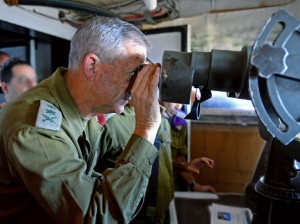
IDF Chief of Staff, Lt.-Gen. Benny Gantz viewing Syrian fighting on the Golan. Photo: IDF
Senior Israeli military officials are apprehensively watching their Golan Heights border with Syria, and estimate that Assad forces may seek to regain control of the Quneitra Crossing as soon as tonight from rebel fighters in the area, Israel’s Walla News reported Thursday.
Calling the fast-deteriorating situation “worrying,” a senior military official said, “it’s clear to us that the Syrian Army doesn’t want to deteriorate the situation and will be very careful about avoiding ‘spillover’ of the fighting to the Israeli side.”
The IDF, “is watching what’s happening on the Syrian side and is prepared for any eventuality,” the source stressed.
IDF Chief of Staff, Lt.-Gen. Benny Gantz and senior officers toured locations along the tense border Thursday, and met with civilians on Kibbutz Ein Zivan, where a man was lightly wounded from a Syrian tank shell fired across the border on Wednesday. Earlier in the day, an IDF medical officer was hit by gunfire from battles on the other side.
The IDF responded with artillery fire to the first attack, hitting two Syrian army positions, according to a spokesman.
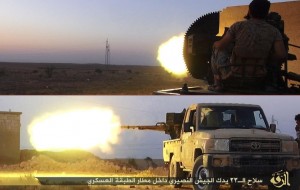
ISIS fighting in Syria Photo: screenshot
Fierce battles between pro-and anti-Syrian government forces close to the border with Israel on Wednesday prompted the army to evacuate residents, tourists and farmers from certain areas close to the northern and southern ends of the frontier, Israel’s Channel 2 reported on Wednesday.
According to reports several hundred fighters of the al-Qaeda-linked al Nusra Front overtook the southern Quneitra Crossing from Syrian government forces, and posted black flags dozens of meters from Israeli forces on the other side of the fence.
On Thursday, the United Nations said 43 peacekeepers were “detained” by rebels at the Israel-Syria border in the Golan Heights amid fighting in the area.
“During a period of increased fighting beginning yesterday between armed elements and Syrian Arab Armed Forces within the area of separation in the Golan Heights, 43 peacekeepers from the United Nations Disengagement Observer Force (UNDOF) were detained early this morning by an armed group in the vicinity of Quneitra,” the U.N. press office said in a statement.
“From what we know, opposition forces overran the Syrian regime forces on the Syrian side of the Quneitra crossing, some of those including the Al-Nusra Front, which ultimately leave the crossing in the opposition forces’ hands,” IDF Spokesman Lieutenant Colonel Peter Lerner told AFP Wednesday.
He said there had been “extensive fighting” on the Syrian side of the ceasefire line since early Wednesday which had resulted in several instances of “errant fire.”
A visitor to Ein Zivan told The Algemeiner on Wednesday that, “since we arrived [0n Monday], we’ve heard booms, the war going on in Syria.
“[Wednesday] morning, it was just one after another after another, I mean, boom, boom, boom,” Josh Hasten, a radio talk show host, said.
An employee at a B&B where they were staying on the kibbutz, told him that outdoor activities for guests were curtailed, apparently, due to “a [mortar] shell that fell in the orchard there.”
“As we were leaving, it was crazy; [security authorities] closed route 98 – they wouldn’t let anyone go north … there were ambulances and firetrucks, and a whole lot of army,” he said.
Terrorist cells affiliated with Palestinian Authority (PA) President Mahmoud Abbas’s Fatah movement are braggingtheyfiredsome 2,000 rockets and mortar shells at Israel during the 50-day Operation Protective Edge, according to several Arab-language sources on Wednesday, flagged by blogger Elder of Ziyon.
“The Al Aqsa Martyrs Brigades ‘Army of the storm,’ claimed responsibility for launching 620 rockets at Israeli towns during the days of the Israeli aggression,” according to the PA-affiliated Palestinian Ma’an News Agency.
“The battalions fired 620 rockets over the days of the war,” the report said, as well as “launching several Grad rockets. The munitions were “launch[ed] at a large number of settlements around the Gaza Strip.”
The Abu Nidal Brigades claim to have shot 532 rockets and mortars at “the Zionist enemy,” Elder of Ziyon reported.
The Abdul Kader Husseini Brigades, yet another Fatah group, claims to have shot 864 rockets and mortars at Israel.
“Fatah has several hundred militiamen in the Gaza Strip, some of whom are members of the Palestinian Authority security forces, who continue to receive their salaries from Western governments,” according to reporter Khaled Abu Toameh on July 9th.
“At least two Fatah armed groups announced that they had started firing rockets at the ‘settlements’ of Ashkelon and Sderot, cities inside the pre-1967 borders of Israel, with another Fatah group claiming responsibility for firing 35 rockets into Israel since Sunday,” Toameh wrote at the time.
“So [as] far as Abbas is concerned, ‘it all started when Israel fired back’ in response to hundred of rockets fired at Israel from the Gaza Strip during the last few days. He seems concerned that if the world hears about the role of Fatah in the rocket attacks, the news will affect Western financial aid to the Palestinian Authority, which is dominated by Fatah,” according to Toameh.
RAFAH, Egypt — Concern has spread among residents of the border areas in the northern Sinai Peninsula following the Egyptian army’s planned establishment of a buffer zone on the Egyptian side of Rafah along the border with the Gaza Strip.
The undeclared move prompted local concern that a new reality is being secretly shaped, and that the government has adopted a policy of strategic patience to draw the map of the Israeli-Palestinian conflict at the expense of the people in Sinai.
The Egyptian army has stated its military operations in Sinai are part of the war on terrorism, yet residents believe the operations are designed to forcibly displace them.
Informed authority sources told Al-Monitor that the army’s plan to establish a buffer zone will take two years to implement and will necessitate the razing of homes located about a kilometer (0.6 miles) inside the Rafah border. The plan also necessitates building a large barrier equipped with surveillance cameras and lights, and deploying ground sensors to abort any Palestinian attempts to dig tunnels or smuggle arms.
An official source explained that several countries seek to achieve stability in the area and will help the Egyptian authorities fund the project. The source refused to name these countries.
On the reasons behind the establishment of the buffer zone, the source said, “Every country has the right to preserve its borders as it deems fit. No country in the world accepts that its rights be violated the way they are violated on the border with the Gaza Strip.”
The source said that homes will be razed to empty the area in preparation for the so-called protection of the national security project. He said the government, not the army, is the authority designated to compensate residents and talk about whether their rights are legitimate.
The source added, “The establishment of a buffer zone on the border is of absolute necessity to preserve Egyptian national security, particularly with the growing plans to export the Palestinian cause to Egyptian territory, away from its natural context. Thus, we cannot be emotional while thinking of the [population] displacement issue.”
A source who is a member of the Sawarka tribe and close to Sinai authorities told Al-Monitor that the border operations — namely, the demolition of houses — are designed to control the area where Hamas is promoting its influence through the tunnels.
Rafah resident Um Ibrahim told Al-Monitor how her family’s house on the Gaza border was blown up. “The army blew up our house, claiming there were tunnels. This is totally untrue. We told them, ‘If there are indeed tunnels, blow us up with the house.’ The officer replied, ‘Relax, all of the houses in [the Egyptian side of] Rafah will be destroyed and razed. Forget about this area and find yourself another place to live in. This is about Egypt’s national security,’” she said.
Um Ibrahim added, “If the area will be used to preserve the security of Egypt, we demand the government provide us a place to live.”
According to residents of the border area, the attempts to displace them began when Hamas came to power in the Gaza Strip. In 2009, ousted Egyptian President Hosni Mubarak attempted to build a separation barrier made of steel in the highly populated border area. Other attempts were made to dig a 10-kilometer (6-mile) stream of water along the Gaza border.
At the time, Egyptian authorities said the steel barrier was designed to preserve national security and halt smuggling operations through the tunnels. Mubarak’s buffer zone was never completed following local objections broadcast in the Egyptian media, the escalation in the Gaza Strip and Palestinian portrayal of the issue as an Egyptian attempt to tighten the siege on Gaza.
Residents of the Egyptian side of Rafah said that drilling equipment shakes the ground and further cracks the foundations of their houses. Beneath the houses are tunnels, which further weaken the ground, according to Mohammed al-Barahimeh, who lives just a few meters from the border.
He told Al-Monitor, “Since 2009, the successive Egyptian authorities have tried to create a buffer zone between Egypt and Gaza at our expense and without compensation and without even providing us another place to live.”
Barahimeh said, “Mubarak failed to displace us, as we managed to express our real suffering to the public. But today, harsh plans are being implemented to displace us, while the Egyptian public opinion is being deluded with the pretext of the war on terrorism. The Egyptian people believe that the army’s actions are part of the war on terrorism.”
Authorities under Mubarak were not the only ones working to displace border residents. The Sinai residents were shocked when the Ministry of Defense under the rule of ousted President Mohammed Morsi passed a December 2012 decision, Decree No. 203, prohibiting the right to own, rent or build property located within 5 kilometers (3 miles) of the border. Sinai residents largely rejected the decision, viewing it as an attempt to halt life in the area, according to local resident Mohammed al-Manei.
Manei told Al-Monitor that it has become more difficult to stand against the army’s decisions. The army has chosen the right time to build the buffer zone. Public opinion has been mobilized against Rafah, the tunnels and Gaza, with the army linking them to the war on terrorism.
Sinai novelist Massaad Abu-Fajr told Al-Monitor, “The Egyptian government is fighting to preserve its violated border in a different way. Yet, we need to exert pressure on it to develop its means. As for the reason why the people of Sinai are paying the price, some of them did not declare their clear rejection of Hamas.”
He added, “Everything that is taking place in Sinai is the consequence of Hamas keeping its grip over the Gaza Strip, turning Sinai into a corridor for smuggling and a reservoir to store missiles and weapons. The movement is working to expel the state from Sinai by turning our children into smugglers and terrorists, and using Sinai as a place to keep criminal groups out of Gaza.”
If Hamas is ousted, said Abu-Fajr, half of Sinai’s problems will be solved.
With the aggravation of the political situation between the Egyptian and Palestinian sides, the people of Sinai remain victims until further notice.
Illustrative photo of Hellfire missiles (photo credit: CC BY-Wikipedia)
WASHINGTON — Exactly how bad are Israel-US relations today? Who the Hellfire knows.
What is clear is that two weeks after the revelation that the US had added an additional level of scrutiny to resupplying the IDF with weapons, business was anything but usual regarding the military-to-military relationship upon which Israel relies.
The administration in Washington is hunkered down tight on the transfer of Hellfire missiles to the IDF — a transfer that would most likely have been routine until the additional level of scrutiny was applied. And, despite optimism that the transfer would soon go ahead as planned, no such action has been confirmed by Washington.
Details on the timeline for the release of the Hellfires have proven elusive. Even on Capitol Hill, the sense is that the missiles will be released “soon” — a word repeated in numerous off-the-record conversations on the subject — but neither the timeline, nor the mechanism for their release, is clear.
Washington has, in fact, been extremely closed-lipped about the Hellfires.
It has been two weeks since The Wall Street Journal first reported that the White House had been caught off-guard by transfers of military equipment from the Pentagon to the IDF in the course of Operation Protective Edge.
According to that report, the administration responded to the surprise by tying up further arms transfers in an additional multi-agency review process. Some transfers requested by the IDF have since been released, but a request for additional Hellfire missiles remains unfulfilled.
Asked about the Hellfires almost two weeks ago, State Department Deputy Spokesperson Marie Harf said that “we generally don’t talk about specific deliveries after they’re requested and before they’re delivered, but I will say that things are being — things that have been requested from Israel are — we’re taking a little bit of additional care now given the situation, and if there were requests for such missiles, that would fall under that.”
Harf downplayed the significance of the “additional care”, arguing that “when there’s an ongoing crisis that senior people are involved with, whether it’s Secretary Kerry trying to get a ceasefire, whether it’s other folks on the ground, obviously we believe there’s an inter-agency process that needs to be at play here, and there always is for these.”
But, along with the State Department, neither the Pentagon nor the National Security Council would clarify any details about the process itself, including the timeline, the considerations involved, or the mechanism for the missiles’ release.
The report of the “additional care” emerged after a much-reported dust-up between Washington and Jerusalem over Secretary of State John Kerry’s attempts to broker an Israel-Hamas ceasefire, in consultation with Qatar and Turkey. The timing reinforced perceptions that political — and even personal — considerations may be involved in the decision to freeze the transfer.
Harf responded to that charge too, saying that she “strongly disagreed with the notion” that “the additional care is being taken because of some sort of diplomatic or political wrangling.”
Instead, in repeated statements, the State Department emphasized that the additional scrutiny was tied to the ongoing military in Gaza.
With a ceasefire in its third day on Friday, however, there was still no word from the administration regarding a timeline for the missiles’ delivery.
In fact, on Wednesday, State Department spokeswoman Jen Psaki said that the ceasefire had not impacted the additional level of scrutiny that the transfer of weapons to Israel has faced in recent weeks.
The relative quiet on the issue in Washington has been compounded by a number of factors.
It is late August, a period in which Washington goes on vacation. Issues get put on hold, unless they are really pressing, e.g., a Russian invasion of Ukraine, or a terror group decapitating American journalists.
Congress, which has traditionally taken a very vocal front seat on issues related to Israel’s defense, is on its summer recess and will only return for a whirlwind two-week session before departing Washington for another week.
In addition, mid-term elections are around the corner, a fact that generally redirects the focus to domestic topics.
Although there was some anticipation that Congress might address the missile transfer, should the munitions remain undelivered when Congress returns to work next week, the silence thus far has been dominant — if not entirely deafening.
Last week, Sen. Ted Cruz (R-TX) offered a solitary tweet on the topic, asking why arms sales to Turkey were underway while the transfer to Israel had been stalled. But many Congressional Republicans and Democrats alike have indicated that they were told that the Hellfires would be released “soon” — and that there was no reason to worry or to act to speed them up at this juncture.
On Tuesday, Israeli media also reported that the delay was ending and the weapons would be transferred “soon” — but once again, no specific timeline was given by an unnamed military official quoted in a Haaretz article.
Such delays are not unprecedented. Previous administrations — and this administration — have put a temporary kibosh on weapons transfers to Israel in the past when relationships between Washington and Jerusalem have soured.
In late 2006, following the Second Lebanon War, the Bush administration delayed transferring weapons requested by Israel to replenish stockpiles, including the Joint Direct Attack Munition. In that period as well, State Department officials emphasized that Israeli requests for munitions were not rejected, just merely under examination.
There are different claims as to why that defense slowdown occurred, but it likely reached an even broader scale than the current “additional scrutiny.” The US went so far as to block military contractor Northrop Grummond from revealing details on US-made missile defense technology that Israel hoped to purchase, effectively suspending the deal altogether. An Israeli military delegation to the US was canceled as the media reported that relations had hit an all-time low for the Bush administration.
Even before that, in the early days of the Second Intifada, the US also threatened to stop the supply of spare parts for the Apache helicopters in protest at Israel’s use of targeted assassination — a threat that receded in the months following the September 11 terror attacks. At that time, Hellfires were also at the center of the controversy — the Apaches were the launching platform for Hellfire missiles used in the strikes, such as the November 2000 killing of Tanzim official Hussein Mohammed Abayat.
In the case of the Apaches, however, there was a clear ultimatum delivered: Stop targeted killings, or else. In this case — at least publicly — there has been little explanation as to why the precision missiles have been singled out for extra, protracted scrutiny.
It is, ultimately, a scrutiny that, according to all sources, will be over “soon.” But how long “soon” means, and what steps Israel is meant to take in the meantime, are anything but clear.
Iranian military leaders say that they have begun weapons deliveries to Palestinian terrorists in the West Bank and elsewhere in the region after months of promising increased military support for Israel’s enemies, according to regional reports.
A top Iranian military commander confirmed that weapon shipments to the West Bank have already begun and that more will be sent to other “Palestinian resistance groups.”
“Arming the West Bank has started and weapons will be supplied to the people of this region,” Brigadier General Mohammad Reza Naqdi, the commander of Iran’s volunteer Basij force told the state-run Fars News Agency on Wednesday.
The announcement was made after weeks of inflammatory statements from Iranian leaders threatening war on Israel and promising to rearm Palestinian militants such as Hamas so that they can continue their war on the Jewish state.
The military leader also confirmed what has long been suspected by Israeli intelligence agencies: That Iran is responsible for training and arming Hamas with highly advanced rockets that were used to penetrate deep into Israeli territory during the most recent conflict.
Much of the arms Hamas deployed “were the products of the Islamic Republic of Iran,” Fars reported Naqdi as saying.
Iran is arming terrorists in the more moderate West Bank of Israel—as opposed to the Hamas-run Gaza Strip—because attacks on Israel from this area will ensure “the annihilation of the Zionist regime.”
“The Zionists should know that the next war won’t be confined to the present borders and the Mujahedeen will push them back,” Naqdi said.
An Iranian General this week vowed to launch a surprise attack on Israel in retaliation for an Israeli drone that was reportedly shot down near an Iranian nuclear site.
Anger at the incident has also prompted Tehran to step up its military support for Palestinian terrorists.
“We will accelerate arming the West Bank and we think that we are entitled to give any response (to the recent aggression) which we deem appropriate,” Brigadier General Amir Ali Hajizadeh, commander of Iran’s Revolutionary Guards Corps’ (IRGC) Aerospace Force, was quoted as saying on Monday.
Iran also is considering military force, according to Hajizadeh.
The IRGC claims to have shot down the Israeli drone with a surface to air missile. It lashed out at Israel in vitriolic terms in a statement issued earlier in the week.
“This mischievous attempt once again made the adventurous nature of the Zionist regime more evident and added another black page to the dark record of this fake and warmongering regime, which is full of crimes and wickedness,” the IRGC said in its statement.
Iran has been promising to arm Palestinian terrorist for weeks as the most recent conflict between Israel and Hamas escalated.
“The West Bank must be armed like Gaza,” Iranian Supreme Leader Ayatollah Ali Khamenei said in late July. He echoed these comments on Twitter.
Iran also has boasted of its past arming of Hamas terrorists.
“Today, the fighters in Gaza have good capabilities and can meet their own needs for weapons,” an Iranian lawmaker reportedly stated on television in July. “But once upon a time, they needed the arms manufacture know-how and we gave it to them.”







 anneinpt
 artaxes
 danmillerinpanama
 davidking1530
 Peter Hofman
 Joseph Wouk
 Peter
Peter Louisiana Steve
 WarSclerotic
Recent Comments