Archive for August 26, 2014

Austria: Springboard for Global Jihad

August 26, 2014

Austria: Springboard for Global Jihad, Gatestone InstituteSoeren Kern, August 26, 2014

Austria figures prominently in a map produced by the IS that outlines the group’s five-year plan for expanding its caliphate into Europe, and has emerged as a central hub for jihadists seeking to fight in Syria.

“The spectrum of recruits for the conflict in Syria is ethnically diverse. The motivation, however, appears to be uniformly jihadist.” — Austrian intelligence agency BVT.

“Allah also gives you the opportunity to wage jihad in Austria.” — Austrian jihadist Firas Houidi.

“We are proud that Allah has chosen us. We feel like lions.” — Austrian jihadist Abu Hamza al-Austria.

Salafism is on track to becoming a permanent fixture of Austrian society, if demographics are any indication. The Muslim population in Austria now exceeds 500,000 (or roughly 6% of the total population), up from an estimated 150,000 (or 2%) in 1990. The Muslim population is expected to reach 800,000 (or 9.5%) by 2030, according to recent estimates.

Muslim students already outnumber Roman Catholic students at middle and secondary schools in Vienna, the capital and largest city of Austria, according to statistics compiled by the Vienna Board of Education (Stadtschulrat für Wien) and published by Radio Vatican website in March 2014.

The data—which show that Muslim students are also on the verge of overtaking Catholics in Viennese elementary schools—reflect an established trend and provide empirical evidence of a massive demographic and religious shift underway in Austria, traditionally a Roman Catholic country.

***********

The Austrian government has announced plans to improve its intelligence gathering and analysis capabilities in an urgent effort to crack down on would-be jihadists in the country.

The decision by Austrian Interior Minister Johanna Mikl-Leitner to recruit 20 new intelligence officers to focus exclusively on the threat posed by radical Islam comes after police in Austria arrested nine Chechen immigrants who were on their way to wage jihad in Syria.

The move also comes amid growing concerns that Austria’s shiftless Muslim youth are becoming increasingly radicalized and vocal in their support of the jihadist group Islamic State.

The Chechens—eight men and one woman, ranging in age from 17 to 32—were purportedly planning to travel to Syria over a land route that would take them from Austria through the neighboring Balkans and on into Turkey. Four of the individuals were arrested in the southeastern Austrian province of Styria, and five others were detained in the province of Carinthia. Both provinces border Slovenia.

According to an analysis published by the newspaper Der Standard, Austria has emerged as a central hub for jihadists seeking to fight in Syria because Austria’s geographic location provides easy access to land routes through the Balkans.

Austrian intelligence officials say that most of the 130 Austrians who are thought to have travelled to Syria are Chechens. The rest are immigrants from Bosnia, Kosovo and Turkey. Approximately 60 Austrian jihadists are currently on the front lines, 50 have already returned to Austria and 20 have been killed in action.

The returning jihadists are “ticking time bombs,” according to Mikl-Leitner. Her concerns are echoed in a June 2014 report by the Austrian intelligence agency BVT, which is emphatic about the threat posed by returning jihadists. The document states:

“When fighters return from the warzone, their newly acquired combat skills, traumatic experiences and changes in behavior, plus the possibility that they have become highly radicalized, represent a considerable security risk for Austria. Those who return could become involved in proselytizing activities as well as in establishing new radical centers in which they could serve as instructors. Potential terrorist attacks could be perpetrated by so-called lone wolves but also by organized terrorist groups.”

The report also warns of the “exploding radicalization of the Salafist scene in Austria.” Salafism is an anti-Western ideology that seeks to impose Islamic sharia law in Austria and other parts of Europe. The document states:

“The number of young radicalized followers of violent Salafism in Austria continues to rise. In this context, the conflict in Syria is of urgent relevance for Austria, because systematic efforts are being made within Austria to radicalize and recruit people for the war in Syria.

“The conflict in Syria has become very popular among violent extremist Salafists in Austria. The spectrum of recruits for the conflict in Syria is ethnically diverse. The motivation, however, appears to be uniformly jihadist.

“So-called hate preachers can have a decisive influence on the radicalization and recruiting processes by means of ideological and personal indoctrination. Jihad is offered as the only adequate means to solving disputes between Muslims and non-Muslims. In Austria, this targeted manipulation is achieved through conspiratorial performances by charismatic leaders. Young Muslims, who are seeking alternative perspectives due to life crises, are often submissive victims to these ‘radicalizers’ and ‘recruiters’ and are often fascinated by the prospect of armed jihad.”

In any event, Salafism is on track to becoming a permanent fixture of Austrian society, if demographics are any indication. The Muslim population in Austria now exceeds 500,000 (or roughly 6% of the total population), up from an estimated 150,000 (or 2%) in 1990. The Muslim population is expected to reach 800,000 (or 9.5%) by 2030, according to recent estimates.

Muslim students already outnumber Roman Catholic students at middle and secondary schools in Vienna, the capital and largest city of Austria, according to statistics compiled by the Vienna Board of Education (Stadtschulrat für Wien) and published by Radio Vatican website in March 2014.

The data—which show that Muslim students are also on the verge of overtaking Catholics in Viennese elementary schools—reflect an established trend and provide empirical evidence of a massive demographic and religious shift underway in Austria, traditionally a Roman Catholic country.

In the current school year, 10,734 Muslim students are enrolled in Viennese middle and secondary schools, compared to 8,632 Roman Catholic students, 4,259 Serbian Orthodox students and 3,219 students with “no religious persuasion,” the data shows.

As far as elementary schools are concerned, there are 23,807 Roman Catholic students, followed by 17,913 Muslim students, 11,119 “non-religious” students, 6,083 Serbian Orthodox students and 2,322 Protestants.

The statistics show that the only Viennese schools where Muslims remain a distinct minority are in the gymnasium, advanced secondary schools that place a strong emphasis on academic learning rather than on vocational skills. Students graduating from a gymnasium are more likely than others to be admitted to attend university in Austria.

Official statistics also show that nearly 60% of the inhabitants of Vienna are immigrants or foreigners.

Meanwhile, Austrian jihadists are busy using social media to promote their cause, and to taunt counter-terrorism authorities. Before leaving for Syria in early 2014, a 19-year-old jihadist from Vienna named Firas Houidi wrote the following message on his Facebook page: “To the intelligence agent who may be reading this: Either you kill us or we continue, until the heads fly.” In mid-August, Houidi, who goes by the nom de guerre Firas Abdullah II, sent a follow-up “greeting” from Syria that included a photograph of an artillery shell in a box ready to be shipped to Austrian authorities.

In another message, Houidi, who has a Tunisian immigrant background, wrote that it is not necessary for Austrian Muslims to travel all the way to Syria to wage jihad against infidels. “Even if you do not emigrate and fight, then do it in Austria,” he wrote. “Allah also gives you the opportunity to wage jihad in Austria.” After his Facebook page was suspended, he reportedly opened another one under the name “Firas Abdullah III.”

Europol, the international police organization, has now issued an international arrest warrant for Houidi for belonging to a terrorist organization and for inciting to commit serious crimes.

Another so-called Austro-Islamist named “Abu Hamza al-Austria” produced an eight-minute recruitment video calling on Muslims to wage jihad. He can be heard saying: “My name is Abu Hamza. I lived in Vienna until Allah called me and I obeyed his call.” He continues:

“My brothers and sisters. When I lived in Austria, I thought it would be difficult to leave because I was used to a life of luxury. I imagined that in Syria there would be no water, very little food and drink. This is not the case. We live in houses that exceed western expectations. We live in villas with fireplaces and swimming pools. We have everything here. We have no fear of death. We are proud that Allah has chosen us. We feel like lions.”
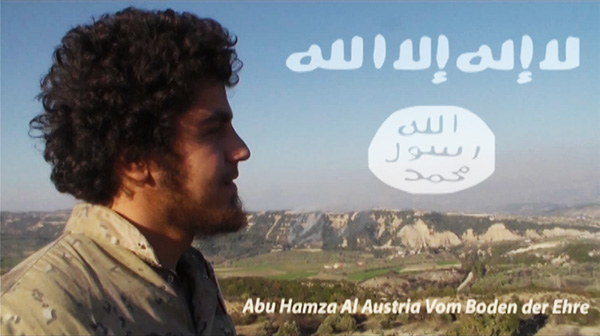
657The Islamist known as “Abu Hamza al-Austria,” fighting in Syria, pictured from his jihadist recruitment video.

Austrian jihadists have also used social media to call on fellow Muslims to murder Yazidis, ethnic Kurdish non-Muslims, living in Austria. One image shows an Austro-Islamist brandishing a knife accompanied by a quote from the Prophet Mohammed: “We have come to you for no other purpose than to slaughter you.” Another jihadist writes: “All Yazidis living in Vienna, report to me. My knife is extra sharp.” Yet another writes: “Every dirty devil worshiper [the Muslim term for Yazidis], report to me, you will bleed for what you did to my brothers in Herford, in the name of Allah, you will bleed and be killed by my very own hands.” Evidently, he was referring to jihadistclashes with Yazidis in neighboring Germany in early August.

In Vienna, supporters of the jihadist group Islamic State [IS] have set up a “fan club” to promote holy war. They sell camouflage baseball caps emblazoned with the IS logo and T-shirts with terrorist messages in Arabic. Austrian newspapers have published photographs (here and here) of IS sympathizers posing in different locations throughout Vienna with messages of support. One reads: “One billion Muslims support the Islamic State.” Austrian jihadists have been seen wearing IS attire on Vienna subway trains. Others have postedcomments and photos on Facebook that glorify jihad and show weapons displays.

The propaganda has added significance because of Vienna’s historic role in preventing Islam from overrunning Christian Europe during the Siege of Vienna in 1529 and the Battle of Vienna in 1683. Like Spain, Austria figures prominently in a map produced by the IS that outlines the group’s five-year plan for expanding its caliphate into Europe. Today’s jihadists are simply fighting a new phase of a very old conflict.
Obama’s Iraq-Syria Dilemma: No Force Now on the Ground Can Beat ISIS

August 26, 2014

Obama’s Iraq-Syria Dilemma: No Force Now on the Ground Can Beat ISIS, Daily Beast, Jamie Dettmer, August 26, 2014

A1409053767636.cachedYoussef Boudlal/Reuters

If Washington is counting on the Kurds to defeat the terrorist caliphate with a little support from American drones and warplanes, it had better think again.

Back when the Obama administration was contemplating retaliation against the Syrian government for using chemical weapons, Secretary of State John Kerry sought to assuage worries that America would become ensnared in Syria’s civil war by promising that any reprisals would be “unbelievably small”—a matter of pinprick airstrikes. In the event Russian diplomatic maneuvering let the administration off the hook.

In Iraq today the administration has committed to doing something against the forces of the so-called Islamic State, but the limited military intervention we’ve seen to date lags far behind the bellicose rhetoric of Obama officials since the murder of American journalist James Foley. Once again, we see the same reluctance that was on display about retaliation against Syrian President Bashar al Assad for spreading toxins. Fear of mission creep, fear of putting American boots on the ground, and excessive faith in the wonders of American military technology contribute to a fatal and contradictory combination of excessive caution and excessive confidence.

The gap between rhetoric and action was on vivid display this weekend with pinprick U.S. strikes in northern Iraq. “Bombing raids could significantly weaken IS but they are insufficient currently,” says Jonathan Schanzer, a Mideast analyst with the Washington, D.C.-based Foundation for the Defense of Democracies. He says a “surge in sorties” is needed to meet even the limited administration goal of reining in the jihadists.

(Video at link — DM)

Consider this bottom line: Weekend strikes from U.S. warplanes defending the Kurdish capital, Erbil, and the recently retaken Mosul Dam managed to destroy a jihadist Humvee and an armed vehicle, according to U.S. Central Command. Meanwhile jihadists from the Islamic State scored a major advance in neighboring Syria by finally capturing the air base at Tabqa, the last military stronghold of the Syrian government in Raqqa province, and pressing assaults against more moderate rebels in northern Aleppo province, threatening to cut all-important supply lines to Turkey.

In Iraq, the loss of the key Mosul Dam doesn’t appear to have rocked the jihadists and their Sunni allies on their heels either. They are continuing to press their siege on Amirli, a Shia Turkmen town in northern Iraq, prompting fears that residents there may endure the same fate as the Yazidis of Sinjar, who fled to a mountaintop in the face of the Islamic State advance, a humanitarian crisis that partly prompted U.S. intervention in Iraq this month in the first place.

All efforts to get to Amirli have failed and the United Nations has warned of a “possible massacre,” with the U.N.’s special envoy to Iraq, Nickolay Mladenov, declaring that without immediate action the town’s 17,000 people, already suffering “desperate conditions” after months of siege, face a very grim future.

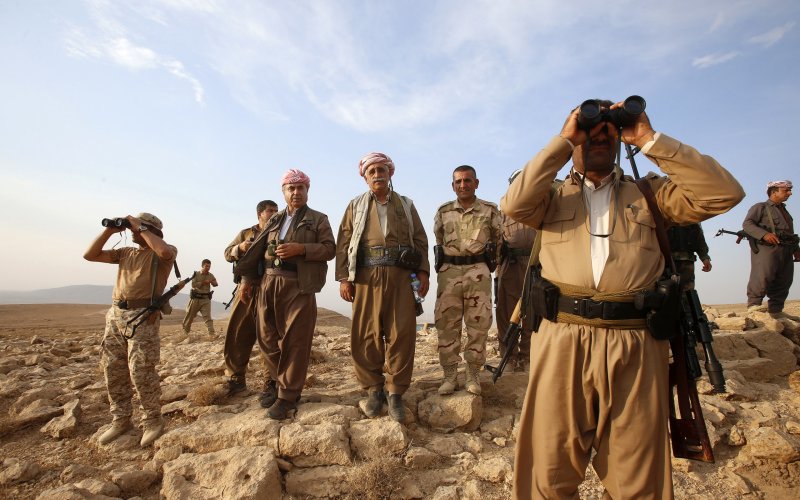
Islamic State fighters are also holding off Kurdish efforts to retake a series of key towns bordering Iraq’s semi-autonomous Kurdish region, including the flashpoint town of Jalawla. European military observers tell The Daily Beast they fear that the Peshmerga, the Kurdish military, don’t have the strength to push the jihadists and their Sunni allies back without much greater Western support, rearming and training.

“The Peshmerga are doing their best but they are not the fighting force they were,” says a senior British military observer. “There is an element of Dad’s Army to them with the bulk veterans from guerrilla warfare from 20 to 30 years ago.” Analysts say the Kurds’ elite counter-terrorist group is doing well and has notched successes, taking some vantage points from jihadist fighters, but they are anxious for promised help from abroad.

“The help has not been up to the standard we need,” says Polad Talabani, the deputy commander of the Peshmerga’s counter-terrorism group. “The jihadists seized weaponry from the Iraqi army and they have much more advanced tanks than us, more arms, and they have a lot of ammunition. We are forced to scrape together what we can.” The tanks the jihadists seized from retreating Iraqi forces this summer were, of course, made in the U.S.A.

President Barack Obama explained last week that the challenge posed by the Islamic State would  “take time” to combat: “There are going to be many challenges ahead. But meanwhile, there should be no doubt that the United States military will continue to carry out the limited missions that I’ve authorized: protecting our personnel and facilities in Iraq in both Erbil and Baghdad; and providing humanitarian support as we did on Mount Sinjar.”

General Martin E. Dempsey, chairman of the U.S. Joint Chiefs of Staff, also stressed last week that IS can’t be defeated without taking the jihadists on in both Syria and Iraq.

But some analysts say the administration doesn’t have a plan for this—or the will—and the weekend airstrikes just underline the reluctance.

Counterterrorism expert Brian Fishman says the Islamic State has become a terror army that can only be defeated through a full-scale war with serious fighting in both Iraq and Syria. He argues it “will actually require years, direct military action on both sides of the Iraq/Syria border, tens (if not hundreds) of billions of dollars, and many more than 15,000 troops.”

“No one has offered a plausible strategy to defeat IS that does not include a major U.S. commitment on the ground and the renewal of functional governance on both sides of the Iraqi-Syrian border,” says Fishman.

Mideast expert Schanzer also sees the fight required as a huge undertaking. Even airstrikes extended across Iraq and deep into Syria will not be sufficient without a more comprehensive approach that includes sanctioning jihadist financiers in the Gulf and targeting the Islamic State’s financial and logistical networks in Turkey.

“However, it is still unclear to me if the U.S. and its allies are prepared to undertake such a comprehensive approach,” he says. “It would create diplomatic tensions with our allies, like Qatar, Turkey and Kuwait. It would also mean entering into the Syrian theater. These are two things the Obama administration has sought to avoid at all costs.”

Even that may not be enough. Syria expert Joshua Landis maintains that military action will fail if the “deep grievances of the Sunni communities in Syria and Iraq, where they are shut out from real power, representation, and basic justice by the sectarian governments of both countries,” aren’t addressed. He maintains the time has come for the countries to be allowed to split formally along sectarian lines.

It’s 2003 Again

August 26, 2014

It’s 2003 Again
Aug 25 2014 @ 1:39pm by Jonah Shepp


Image by TexasEagle


(More boots on the ground in Iraq will only result in more bodies in the ground in America. Once again, we’re being sold on the dire need to go to war.-LS)

What else can one possibly take away from this Noah Rothman exegesis of Peggy Noonan’s and Charles Krauthammer’s cases for expanding the new Iraq war to Syria? Here’s the crux of the argument:

The mission Krauthammer describes does not appear to require a significant American ground force, though it would be one which would only be effective in Iraq. The Islamic State’s stronghold in Syria will require an entirely different strategy, one far more robust and which may require putting American service personnel in harm’s way. But rolling back the Islamic State in Iraq is an acceptable short-term goal, and the American people should be informed that this is the mission in which their military is presently engaged. Those opposed to going to war to rid the world of ISIS worry that achieving that objective will require more commitment than most are willing to admit. And it is possible that the American national interests at stake in this region, while appreciable, are not threatened to the degree that would merit a return of tens of thousands of American troops to Iraq. At least, not yet.

These are worthwhile debates to have, and Americans need to have an honest discussion about this threat. It is a discussion that must be led by their president. It seems, however, that some conservatives are beginning to observe that those who object to a military solution to the Islamic State threat rest their argument on the claim that it heralds a new occupation of Iraq. This is a straw man argument. The vast majority of Americans of every political stripe do not want to reoccupy that country, and this is not on the table. Destroying ISIS, however, is.

Right, because we all remember what happened the last time right-wing hawks sold the American public on a war that they alleged would have no long-term consequences. After the past decade, I suppose I shouldn’t be all that surprised that the cheerleaders for this new war are demanding that their opponents make a probative case against intervention, while the neo-neocons’ contention that a light-touch war with no “significant” ground force is presented as obviously true. (By the by, how many soldiers constitute “significant”? 1,000? 10,000? 100,000? No one wants to say…) For more of the same, see Elliott Abrams here. Brian Fishman wishes advocates of an all-out, two-front war on ISIS would stop bullshitting the public already about what that would entail:

No one has offered a plausible strategy to defeat ISIL that does not include a major U.S. commitment on the ground and the renewal of functional governance on both sides of the Iraqi-Syrian border. And no one will, because none exists.

But that has not prevented a slew of hacks and wonks from suggesting grandiose policy goals without paying serious attention to the costs of implementation and the fragility of the U.S. political consensus for achieving those goals. Although ISIL has some characteristics of a state now, it still has the resilience of an ideologically motivated terrorist organization that will survive and perhaps even thrive in the face of setbacks. We must never again make the mistake that we made in 2008, which was to assume that we have destroyed a jihadist organization because we have pushed it out of former safe-havens and inhibited its ability to hold territory. Bombing ISIL will not destroy it. Giving the Kurds sniper rifles or artillery will not destroy it. A new prime minister in Iraq will not destroy it.Please do not step in here with the fly-paper argument: that the conflict will attract the world’s would-be jihadis to one geographic area where we can target them all and thereby solve the problem. Notice that no authorities on jihadism ever make this argument. That is because they understand that war makes the jihadist movement stronger, even in the face of major tactical and operational defeats.

There is a case to be made for this war. It is not the case that its backers are making. They still seem to inhabit the same alternate universe as Donald Rumsfeld, in which the only limit to what American power can accomplish is the imagination of the Commander-in-Chief. I may not support all of Obama’s foreign policy choices, but I find it reassuring that he is nowhere near as prone as his predecessor was to flights of imperial fancy. As Fishman rightly points out, one cannot make the argument that the withdrawal of US forces from Iraq precipitated the current crisis without also acknowledging that the 2003 invasion set the ball rolling. The honest case for more intervention now, it seems to me, is that Bush’s Iraq adventure obligated the US to accept responsibility for maintaining the new Iraqi order we created and protecting the people of the Middle East from the jihadist menace our war unleashed.

But the usual suspects can’t make that argument, because to do so, they’d have to admit that they were wrong in the first place.

Retired general’s dire warning: ‘We should go to DEFCON 1 …. We may even see a 9/11/14′

August 26, 2014

Retired general’s dire warning: ‘We should go to DEFCON 1 …. We may even see a 9/11/14′ Bizpac Review, August 24, 2014

Retired Lt. Gen. Thomas McInerney thinks the United States should “go to DEFCON 1, our highest state of readiness and be prepared as we lead up to 9/11.

McInerney made the comment Saturday in an appearance with Uma Pemmaraju  on Fox News Channel’s “America’s News HQ.”

“We may even see a 9/11/14,” he added.

“There’s a narrative gap,” McInerney said in response to Pemmaraju’s questions about border security and domestic threats from Islamic State. “The president thinks everything’s OK. Al-Qaida’s dead. He killed Osama bin Laden, but he’s three years behind in the narrative.”

01Photo Credit: article.wn.com

The Air Force veteran called an “unchecked” Islamic State “an existential threat to the United States.”

“I’m not talking about two or three years from now,” he said. “I’m talking very, very soon.”

Check out the interview here:


Saudi and UAE leaders in particular have expressed concern that Washington can no longer be counted on, citing US diplomatic overtures to Iran and a cautious approach to the Syrian conflict.

August 26, 2014

US, EU condemn ‘outside interference’ in Libya

US says UAE aircraft bombed Islamists in Libya over the past week using bases in Egypt

Des nuages de fumée s'élèvent au-dessus de la ville côtière de Benghazi, dans l'est de la Libye, où s'affrontent les forces de sécurité libyennes et les milices islamistes, le 23 août 2014 ( Abdullah Doma (AFP) )

The United Arab Emirates has secretly sent warplanes on bombing raids against Islamist militias in Libya over the past week, using bases in Egypt, US officials said Monday.

The two attacks carried out over seven days mark a dramatic expansion of the conflict as the United States and its European allies denounced “outside interference” in Libya.

“Those responsible for violence, which undermines Libya’s democratic transition and national security, must be held accountable,” officials from France, Germany, Italy, the UK and the US said in a joint statement.

“We welcome discussions on the political and security situation in Libya to be held by the United Nations Security Council in the coming days, including consequences for those who undermine Libya’s peace and stability,” the statement read.

The strikes signaled a step toward direct action by regional Arab states that previously have fought proxy wars in Libya, Syria and Iraq in a struggle for power and influence.

The bombing raids were first reported by The New York Times and Islamist forces in Libya also had alleged strikes had taken place.

“The UAE carried out those strikes,” one of the officials told AFP on condition of anonymity.

Asked about the account, the senior US official said “the report is accurate.”

The United States did not take part or provide any assistance in the bombing raids, the two officials said.

The first airstrikes took place a week ago, focusing on targets in Tripoli held by the militias, including a small weapons depot, according to the Times. Six people were killed in the bombing.

Libyan foreign minister Muhammad Abdelaziz attends a meeting with his counterparts from neighbouring states in the Egyptial capital Cairo, August 25, 2014  ( Khaled Desouki (AFP) )

A second round was conducted south of the city early Saturday targeting rocket launchers, military vehicles and a warehouse, according to the newspaper.

Those strikes may have represented a bid to prevent the capture of the Tripoli airport, but the militia forces eventually prevailed and seized control of it despite the air attacks.

The UAE — which has spent billions on US-manufactured warplanes and other advanced weaponry — provided the military aircraft, aerial refueling planes and aviation crews to bomb Libya, while Cairo offered access to its air bases, the paper said.

But it remained unclear whether and to what degree Egypt and the UAE had informed the Americans in advance of the airstrikes.

When pressed on the issue, US officials could not confirm that Egypt and the Emirates had left Washington totally in the dark about the air attacks.

Neither the UAE nor Egypt publicly acknowledged any role in the air strikes.

Common danger

Egypt, Saudi Arabia and the Emirates view Islamist militants in the region as a serious threat and have forged cooperation against what they see as a common danger.

The Islamist groups that emerged after the Arab Spring uprisings in turn have enjoyed support from Qatar and Turkey.

The bombing raids came amid a Western diplomatic push for a negotiated settlement to quell the violence in Libya, where the government’s authority has unraveled in the face of the Islamist-linked militias.

Britain, France, Germany, Italy and the United States issued a joint statement condemning an “escalation of fighting and violence” in Libya and urged a democratic, peaceful transition.

The Western powers expressed particular concern over violence “against residential areas, public facilities, and critical infrastructure, by both land attacks and air strikes.”

Without mentioning any air strikes by the UAE and Egypt, the statement said “outside interference in Libya exacerbates current divisions and undermines Libya’s democratic transition.”

The governments welcomed upcoming discussions at the UN Security Council on Libya and said “we encourage the international community to support Libya’s elected institutions.”

The air strikes also underscored how Washington’s old allies are more willing to act on their own, without backing from the Americans.

Saudi Arabia's King Abdullah bin Abdulaziz Al-Saud (R) and US Secretary of State John Kerry meet at the King's private residence in Jeddah, June 27, 2014 ( Brendan Smialowski (AFP/File) )

Saudi and UAE leaders in particular have expressed concern that Washington can no longer be counted on, citing US diplomatic overtures to Iran and a cautious approach to the Syrian conflict.

The strikes in and around Tripoli demonstrated the UAE’s readiness to employ its air power, as the Emirates have built up one of the region’s most proficient air forces with American gear and training. UAE pilots flew combat missions in the NATO-led air war in Libya in 2011.

Over the past decade, the Emirates have purchased dozens of US F-16 fighter jets, as well as transport aircraft, precision-guided bombs and advanced missiles for their warplanes.

About 5,000 American troops are based in the Emirates, most of them airmen stationed at Al-Dhafra Air Base.

(with AFP)

Khaled Meshaal rock firm against truce. Hamas-Gaza fires upgraded rocket to maximize casualties

August 26, 2014

via Khaled Meshaal rock firm against truce. Hamas-Gaza fires upgraded rocket to maximize casualties.

Debka

Battered by Hamas’ escalating rocket and mortar assaults, Israelis are again tossed on the uncertain waters of an imminent ceasefire which never materializes. This illusion is propagated again by Prime Minister Binyamin Netanyahu and Egyptian President Abdel-Fatteh El-Sisi. Washington has also been enlisted to the effort by drafting a resolution for the UN Security Council. It was tabled at the request of the White House with quiet backing from Netanyahu for the purpose of blocking the European measure, which is backed by Qatar, one of the Hamas’ few supporters and host to its political leader Khaled Meshaal.
Why is President Barack Obama standing behind Egypt and Israel this time?
His reasoning is complicated. Netanyahu and El-Sisi, who speak regularly and discreetly by phone, have been persuaded by their intelligence services that Meshaal is an impediment – not just to a temporary ceasefire, but to any sort of accommodation for ending the Gaza conflict. They are convinced that all the Palestinian factions, including Hamas-Gaza, would go for an end to the war, in the hope of a Gaza deal leading to a settlement between Israel and Palestinian Authority Chairman Mahmoud Abbas.
Those intelligence analysts cling to the hypothesis that Hamas-Gaza really wants to end the war, and this assumption dominates top-level thinking in Jerusalem and Cairo, in the face of all Hamas’ actions to the contrary in 50 days of escalating Hamas warfare up until Tuesday, Aug. 26.

This dichotomy leaves Israelis increasingly confused and uncertain about how to conduct their lives, especially in the areas closest to the Gaza Strip, which have been largely depopulated by non-stop Hamas short-range rocket and mortar fire.
The theory found a champion this week in an unexpected quarter: Khaled al-Batsh, one of the top men of Islamic Jihad, the pro-Iranian Palestinian terrorist movement which is Hamas’ most active partner in the offensive against Israel.

He suddenly announced he was in favor of a truce.

Lest he be suspected of overnight conversion to peace-lover, DEBKAfile’s intelligence services turns to another hidden aspect of the Gaza conflict for an explanation: The Palestinian group’s patrons, Iran and Hizballah, are working hard to paint their ally Syrian President Bashar Assad as the only force in the Middle East capable of fighting the Islamic State of Iraq and Syria – IS. If their proposition is accepted, they will reciprocate by bringing about a halt in the Gaza hostilities. They would also be able to show themselves in the light of the real forces of peace and moderation in the region.
The US-Egyptian-Israeli line therefore hinged on the presumption that a deal introducing Tehran to the Gaza equation would be beneficial, because Meshaal, who relies heavily on Iranian support, would not be able to spurn an Iranian demand to stop the fighting in Gaza.

But this math has not panned out.  Meshaal showed his nerves were strong enough to withstand the potion mixed for him in Washington, Jerusalem, Cairo, Ramallah. He not only stuck to his guns against ending the Gaza conflict, he outmaneuvered them all by enlisting Hamas’ secretive military chief Muhammed Deif to this end. The object of an Israeli targeted assassination on Aug. 19, Meshaal said that Deif had survived the attack and they were in close contact.

Whether he spoke the truth or not cannot be determined at this point. But by bandying Deif’s name and claiming he too was flat against a ceasefire, Meshaal set a clear course for the war to continue, irrespective of efforts to bring about a truce in the fighting. Deif’s word in the movement is law, which no Hamas member would dare defy.

So, at this point, all the schemes and machinations for ending the Gaza crisis by diplomacy are in deadlock, DEBKAfile’s intelligence and military sources report.

The two options remaining to the leaders of Egypt and Israel are: 1) Unable to break Khaled Meshaal’s will, they must find a way to persuade Hamas-Gaza that it is in their best interests to defy, or even sack, him. 2)  To apply military pressure that is beyond Hamas’ capacity to resist – i.e., effective IDF ground action – to stop the fighting by sheer force.

Of course, if the Hamas political chief were to surprise everyone by caving in and accepting a truce, that would be a third option. But there are no signs of this happening. His movement continued meanwhile to signal its true intentions in no uncertain terms Tuesday, Aug. 26, Day 50 of the Gaza conflict, by unveiling a new 340mm rocket with an extra large warhead which crashed down on a private home in Ashkelon, injuring 59 people – the largest number of casualties by any single rocket so far. Two houses were leveled and dozens more damaged.
And so Hamas Gaza graphically belied the hypothesis of its intentions which guide – or misguide – Washington, Jerusalem and Cairo.