Archive for August 16, 2014
Us, the US, and the “I” word
August 16, 2014Us, the US, and the “I” word | Jerusalem Post – Blogs.
Ira Sharkansky
Two recent articles emerge from IDF’s operating in Gaza, and concern the tensions between Israel and other western democracies, most notably the United States.
An item in the Wall Street Journal comes with the provocative headline, “Gaza Crisis: Israel Outflanks the White House on Strategy.”
Could it possibly mean that the editors were expressing admiration for Israeli maneuverability?
Perhaps. However, the essence of the text describes high tension between the Israeli government and the Obama White House.
- Personal friction between Benyamin Netanyahu and Barack Obama. This has a history, including several meetings and telephone conversations over the years described as frosty, frank, difficult, and even insulting, with each national leader said to depart from conventional norms of courtesy in order to lecture the other.
- An escalation of the personal tensions in recent months, reflecting public criticism of leading Americans (i.e., John Kerry and Barack Obama) by Israeli government ministers who have used the terms obsessive, messianic, Nobel Prize aspiring, and naive.
- Israeli actions said to side step (not exactly violate) the appropriate procedures, whereby Israel sought and obtained the delivery of weapons directly from the Defense Department without first seeking approval from the White House and/or State Department.
- Israel’s working with Egypt in order to arrange cease fire and perhaps an end to the conflict with Hamas, relegating John Kerry and the State Department to subordinate and–in American eyes–insulting positions as observers rather than key mediators.
- All the above brought to a head due to fundamental differences in appropriate ways of self defense, with the American President expressing time and again criticism against the Israeli Prime Minister and the IDF for excessive force, and a lack of concern for civilian casualties. (It is these expressions that in recent days have produced comments from ranking Israelis that the US President is out of touch and naive about the realities of Hamas and the Middle East.)
“Liberals can no longer ignore the awful plague of Middle Eastern brutality and the fact that millions of Arabs live with no rights and no future.The new Middle East is a brutal one. Many Sunnis hate Shi’ites and many Shi’ites hate Sunnis. Many Sunnis and Shi’ites hate Christians, Jews, women and homosexuals. In numerous countries in the region, a considerable part of the majority hates the minorities – Kurds, Druze, Copts, Turkmen, Yazidis. Monarchs and secular people hate members of the Muslim Brotherhood and members of the Muslim Brotherhood hate secular people and monarchs.
These hatreds turn into violence. The violence becomes ferocious. Too many demons awaken and begin devouring people. Heretics are murdered, sinners are stoned, women are sold to slavery. A new Middle East is exposing its face these days, and it’s a face of horror.”
Day 40: Egypt warns there will be no more truce proposals
August 16, 2014Day 40: Egypt warns there will be no more truce proposalsHamas threatens Israel with war of attrition if demands not met, says many more issues to be resolved in Cairo negotiations; Palestinian delegation says progress made but chances for ceasefire deal no higher than 50%By Yifa Yaakov and Ricky Ben-David August 16, 2014, 12:13 am Updated: August 16, 2014, 3:03 pm
via Day 40: Egypt warns there will be no more truce proposals | The Times of Israel.

$1,000 of Qatari money to be paid to Gazans who lost homes
The Hamas social affairs ministry tells Palestinians in Gaza that in two day’s time, it will pay — using donations from Qatar — $1,000 to each person whose home was destroyed during Operation Protective Edge, Ynet reports.
‘Hamas has not agreed to the Egyptian proposal’
A senior Hamas official says the terror group has not agreed and will not agree to what the Palestinian delegation has been offered before leaving Cairo, Ynet reports
“The stance of the [Palestinian] delegation is clear. We will not accept what has been offered to us before we leave. We object to any formula [of a proposal] that does not go hand in hand with the demands of the Palestinian people. There are several issues [in the 11-point Egyptian proposal] that are unacceptable to the delegation,’ says Issat a-Rishq, a close associate of Hamas political chief Khaled Mashaal.
No more ceasefire proposals, says Egypt
Egypt says it will not submit any more ceasefire proposals to either side, after Cairo offered an 11-point proposal yesterday, Israel Radio reports.
Hamas has said the bid did not meet the needs of the Palestinian people.
Head of Palestinian delegation has ‘high hopes’ for truce deal
Azzam al-Ahmad, who heads the Palestinian delegation at the Cairo talks, tells AFP he is quietly optimistic that an agreement for a longer-term truce could be reached.
“We have high hopes of reaching an agreement very soon, before the end of the truce, and perhaps even, very quickly, for a permanent ceasefire,” he says.
But Hamas spokesman Sami Abu Zuhri struck a hardline, insisting that there can be no return to peace without a lifting of Israel’s blockade, which it imposed together with Egypt in large part to prevent Hamas from importng weapons, after it violently seized control in 2007.
“We can reach an agreement if the Israeli side accepts all the demands of the unified Palestinian delegation, in particular the end of any aggression against our people, the war on Gaza and the complete lifting of the siege,” Abu Zuhri said.
Israel has spoken little in public about the negotiations.
The five-day truce is set to end Monday night.
They are coming – Judge Jeanine Pirro Opening Statement
August 16, 2014
Published on Aug 9, 2014
Judge Jeanine Pirro Opening Statement – United States Back In Iraq To Attack ISIS
Krauthammer: You Either Do Air Strikes Seriously Or Don’t Do Them At All
Judge Jeanine Pirro Opening Statement – Striking ISIS – The Fight For Iraq – 8-10-2014 Bellow
‘Moderate’ Palestinian Authority Claims U.S. Created ISIS To Divide Muslims
August 16, 2014Moderate’ Palestinian Authority Claims U.S. Created ISIS To Divide Muslims
The US, whose most advanced pawns include Israel and its new creation, ISIS, whose goal is to destroy the Arab world and eliminate the Palestinian cause.”
8.15.2014Israel RevoltJeff Dunetz
via ‘Moderate’ Palestinian Authority Claims U.S. Created ISIS To Divide Muslims | Truth Revolt.

he supposedly “moderate” Palestinian Authority led by President Abbas is rewarding the billions of dollars provided by this country by inciting its citizens to hate the United States, claiming America has established the radical Islamic movement Islamic State (ISIS or IS) with the long-term goal of controlling the Arab-Muslim states by dividing them through conflict and wars.
On August 7th, the official Palestinian Authority TV Station, the “Palestine News Network,” reported Fatah Central Committee Member Abbas Zaki made the claim:
Fatah Central Committee Member and Commissioner of Arab Relations and Relations with China Abbas Zaki said the Palestinian language and terminology [employed] with the Zionist enemy must be changed, as whoever has seen the extent of the destruction, the ruins and the limbs torn from the pure bodies of our people in Gaza understands the goals of the Zionist attack (i.e., Operation Protective Edge) – [namely,] to exploit the terrible situation in the Arab world that has resulted from the lack of bravery, enthusiasm and willpower among those [countries] who have made subjugation to the US their way [of life]… [The US,] whose most advanced pawns include Israel and its new creation, ISIS, whose goal is to destroy the Arab world and eliminate the Palestinian cause.
Additionally five times in the past six week the official Palestinian Authority Newspaper “Al-Hayat Al-Jadida” published an op-ed slandering America with the same claim. Below are three examples:
A July 10th Op-ed by Adli Sadeq, PLO Ambassador to India and regular columnist for Al-Hayat Al-Jadida, said, in part:
It is Israel that, whenever it gets bored, returns to Gaza with military aircraft to destroy homes and facilities and kill children. Where is the help, you [Hezbollah] sectarian liars who collaborate with the Persian Ayatollahs… hostile [ones], and your ilk – the CIA’s collaborators from the ISIS -who destroy revolutions and give nations a bad name?
Palestinian Youth Union General Director Muharram Barghouti wrote on July 16th:
The ISIS (Islamic State of Iraq), Islamic Front, and Al-Nusra Front (i.e., all radical Islamists) are Muslims from various countries the US is using to fight in Iraq and Syria, in order to fragment the unity of these two Arab countries…
We are now more aware that the Americans – who want to fight for their own interests using Islamic, Jewish and Christian believers – are truly the head of the snake… ISIS’s declaration that it will fight Israel only after it has finished with the infidels merely proves that ISIS in Syria and Iraq will not fight the Jewish ISIS, because the plot is the same plot, the boss is the same boss, and the goal is the same goal: to tear [apart] the Arab homeland and gain control of its resources – through the blood of others.”
Palestinian Author Ibrahim Abd Al-Majid’s op-ed on August 3rd:
This [ignorance] has peaked in [recent] years, with the radical terrorists of ISIS and those like them, who were created by Israel and the US, and are paving the way for Israel to act like them.”
These as well as the remaining examples were originally posted at Palwatch
Hamas to Israel: Accept our terms or brace for war of attrition
August 16, 2014Hamas to Israel: Accept our terms or brace for war of attrition
While Cairo ceasefire talks expected to resume tomorrow, Hamas official says that if demands of Palestinian delegation are not met, Israel should prepare itself for a prolonged war.
YnetnewsPublished: 08.16.14, 10:34 / Israel News
via Hamas to Israel: Accept our terms or brace for war of attrition – Israel News, Ynetnews.
Senior Hamas and Islamic Jihad members say that the proposals that Palestinians received during the negotiations in Cairo, including those detailed in the latest Egyptian draft, do not meet their demands, Israel Radio reported. Hamas’ foreign affairs spokesman Osama Hamdan said during a visit to Sudan that Israel has a choice: accept the terms of the Palestinian people or prepare for a prolonged war of attrition.
According to the report, a senior Islamic Jihad operative in Gaza said that the Palestinian delegation will not sign a degrading agreement and would prefer to return to the Strip without any agreement. However, he added that his organization would give Egypt enough time to conduct successful negotiations on a permanent ceasefire.

Speaking ahead of the renewal of the talks in Cairo on Sunday, Khaled al-Batesh, member of the Palestinian envoy in Cairo and leader of the Islamic Jihad Movement stressed that “the Palestinian factions have put forward reasonable and limited aims for the current campaign, and didn’t ask for the release of the city of Ramla.” Al-Batesh also criticized the Egyptian efforts, saying the country “could have done more for the Palestinians.”
Meanwhile, Bassam Salhi, a Palestinian delegation member, said that progress is being made in the talks but that the chances of reaching an agreement in the upcoming round of talks are no greater than 50% due to differences of opinion on several issues, the report added. According to Salhi, the Palestinians are prepared to postpone the discussion of operating a seaport and airport in Gaza, but only by several weeks.
Two-pronged formula
On Friday, a report from an Egyptian news source published additional details of the current ceasefire draft from talks in Cairo, saying that the document stipulates that organizations in Gaza will concede to cease the construction of new smuggling tunnels in and out of the Strip.
Palestinian officials expressed optimism regarding the proposal currently on the table, meant to reach a long-term ceasefire in Gaza, as Israel’s Cabinet convened, presumably to discuss the looming deal.
Palestinian source close to the talks spoke with Ynet and said the current ceasefire deal was based on two simple formulas which together formed the agreement: (1) A ceasefire deal in return for Gaza’s rehabilitation, and (2) redevelopment of Gaza in return for demilitarization of the Strip.
The two pronged deal will be gradually implemented, the sources said.
Economy Minister Naftali Bennett seemed to hint a deal existed, but said that Israel should make unilateral concessions to Palestinians in Gaza without actually reaching an agreement with Hamas, which he claimed would empower the terror group.
Speaking at the end of Cabinet meeting Friday morning, Bennett said Israel should open Gaza’s border crossings and expand the Strip’s fishing zone unilaterally, without reaching a deal with Hamas, which he said “harms our right to target (terror) tunnels.”
Will ISIS be Defeated in Iraq and will it attack the U.S.?
August 16, 2014Will ISIS be Defeated in Iraq and will it attack the U.S.? Power Line,
Reportedly, there are at least 100 ISIS fighter with U.S. passports and probably more than 1,000 with European ones. Thus, there is a very real threat that ISIS fighters will carry out acts of terrorism in the Europe and/or the U.S.
*************
Yesterday, I attended a conference at the Heritage Foundation. The topic was Iraq and Obama’s approach to dealing with the current crisis. The panel consisted of Steven Hadley (formerly, President Bush’s National Security Adviser), Mary Habeck (of the Johns Hopkins School of Advanced International Studies), and Steven Bucci (of Heritage and a retired Special Forces Colonel).
The panel quickly agreed on two things. First, President Obama will not commit a large number of American ground troops to fight ISIS. Second, his current military approach, consisting mostly of air strikes, will not defeat ISIS.
The question thus became whether there is an intermediate approach, one that goes further than Obama’s current one but stops short of a substantial U.S. ground commitment, through which ISIS can be defeated. The answer? It’s not clear.
Bucci argued in favor of mobilizing allies — the Kurds, some Sunnis, the Jordanians, the Saudis — to create a fighting force. We would embed some of our people with that force, and provide equipment, intelligence, and air power. This, he said, would be similar to our approach during the early days of the war in Afghanistan (but note that ISIS is much more battle-hardened than the Taliban was in 2001).
In this scenario, there would be boots on the ground but not, by and large, U.S. boots.
The question, though, is whether the U.S. can expect others to fight ISIS on the ground when we are unwilling to do so. After all, the risk of taking on these barbarians is enormous.
It’s one thing to defend against their advance, as the Kurds have tried to do but the Sunnis and the Iraqi army didn’t. It’s another to engage them in an area they already control. It seems to me particularly far-fetched to think that outsiders like Jordan will help fill the breach in Iraq if the U.S. isn’t willing to fight in numbers alongside them.
Habeck acknowledged this problem. However, she says that certain Sunni tribes that helped us during the successful 2007 surge are willing to take on ISIS if the U.S. provides strong backing.
That backing wouldn’t necessarily have to rise to the level of the surge. But it would have to involve considerably more than just air support.
Hadley believes that if a unity government is formed, and he thinks it will be, Obama will probably be willing to increase significantly the amount of equipment and other assistance to be provided to that government. But again, it is unclear whether our commitment will rise to the level necessary to spur a successful counter-attack against ISIS.
The panel also considered the direct threat to the U.S. homeland posed by ISIS. They found it substantial.
Bucci noted that ISIS has stated publicly it is coming after the U.S. We should believe it.
Hadley said that ISIS’s focus now is on consolidating what it has already won and expanding territorially in the Middle East. But this will change.
He also noted that some of the most militant members of al Qaeda in places like the Maghreb are switching their allegiance to ISIS. As they are absorbed, al Qaeda’s global vision may become more pronounced within ISIS.
However, Habeck believes that ISIS’s ideology already entails a global vision. It sees the Islamic state as a caliphate and, in their theology, there can be only one caliphate. This entails worldwide reach as prelude to worldwide expansion.
Reportedly, there are at least 100 ISIS fighter with U.S. passports and probably more than 1,000 with European ones. Thus, there is a very real threat that ISIS fighters will carry out acts of terrorism in the Europe and/or the U.S.
According to Habeck, ISIS isn’t playing “the long game,” as al Qaeda did. It has less patience.
Thus, we shouldn’t assume that ISIS will wait to hatch a grandiose scheme like 9/11 — one that requires lots of planning and has lots of moving parts, and thus one we have a decent chance of detecting in advance. ISIS is more likely than al Qaeda to produce an attack on our homeland just for the sake of producing an attack, and it is more likely to act spontaneously.
Perhaps the most telling and most frightening line of the day came in response to the question of whether ISIS has terrorist training camps like those operated by al Qaeda in the pre-9/11 days. Hadley responded that Syria and Iraq are ISIS’s terrorist training camp.
Indeed.
Do Islam and the Islamic State present threats to Obama’s America?
August 16, 2014Do Islam and the Islamic State present threats to Obama’s America? Dan Miller’s Blog, August 15, 2014
Be of good cheer! President Obama has everything under control, as He wants it to be.
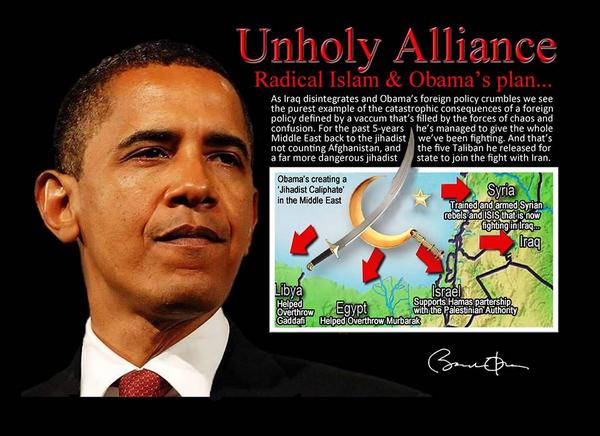
The following video is a compilation of earlier Vice News videos about Iraq, Syria and the Islamic State.
Intensely religious folk who love their families to death, jihadists for the Islamic State are devotees of the religion of peace and a stabilizing influence wherever they go. Through their efforts, commerce becomes fair and just. Even trains, buses and airplanes can be made to run on time, all according to Shari law.
More transparent even than the Obama Administration — claimed to be the most transparent in history — they candidly acknowledge and brag about their methods and goals.
The Islamic State is accepted or at least unopposed by “moderate” Muslims.
The complete lack of Muslims voicing strong opposition both vocally and militarily tells us that even though they are butchering fellow Shiite Muslims (besides Kurds & Christians) it’s not really something they want to speak out against. We have seen no marches against ISIS but on the contrary an influx of ISIS flags at the anti-Israel marches. In Paris, one was draped on a statute, another hanging by a government building at The Hague. While silence is complicit, this seems far from silent. In fact the rise of ISIS seems to have emboldened Muslim communities in Europe in its quest for Sharia Law and independence of local government law. Along with more reports of demonic sermons, rabid Jew hate, preaching the need for Sharia and fights with outsiders in heavily Muslim populated areas. In places like Tower Hamlet London black ISIS flags flew guarded by Muslim youth. In Norway Muslims have recently demanded Sharia Law, if not threatening Jihad and suicide bombs. The most bold was recently in Paris, Muslims marched in a blatant disregard of the law by the President which ended in pitched street battles with police reminiscent of former Intifadas. [Emphasis added.]
. . . .
[W]hat ISIS is preaching and doing is written clear as day in the Koran and to the layman Muslim man it’s no more fundamental then praying 5 times a day. In comparison it’s like asking a Christian to denounce Christ, a Jew to denounce Hashem. Off course you will have some push back from those who have lived in Western democracies, but the overwhelming majority not only don’t denounce ISIS openly (or internally) but seem rather excited to see where this movement can go. The entire concept of the moderate when it comes to Sharia law is a complete falsify and the quicker we learn this the better. Recently in a packed mosque the Mullah asked the question to a packed audience “do you think Sharia Law is extreme”, every single young Muslims answered “no”. [Emphasis added.]
When Shari law replaces the tired old U.S. Constitution, is implemented fully and all submit as required, there will be no more anti-government violence. Until then, there will continue to be big problems according to the Department of Homeland Security. The religion of peace is not the problem, since only a few deviates from it engage in workplace violence and the like.
A leaked document from the Department of Homeland Security’s Office of Intelligence and Analysis predicts increased “anti-government violence over the next year.”
. . . .
After years of only sporadic violence from violent domestic extremists motivated by anti-government ideologies, I&A has seen a spike within the past year in violence committed by militia extremists and lone offenders who hold violent anti-government beliefs. These groups and individuals recognize government authority but facilitate or engage in acts of violence due to their perception that the United States Government is tyrannical and oppressive, coupled to their belief that the government needs to be violently resisted or overthrown. [Emphasis added.]

Unlike domestic “terrorists” who are apparently a focus of the Department of Homeland Security’s concerns, Islam and the IS present no threat to the United States Obama’s America and indeed are badly needed. Only they can and will bring us the peace and stability that passeth all understanding.
While awaiting their coming, we must keep calm and move forward® more vigorously to confiscate dangerous firearms from all foolish U.S. citizens who still have them, to redistribute wealth from the rich to the poor (and political favorites) and to eliminate not only our national borders but also false religions, Allah willing.

Like Islam, President Obama desires only peace, understanding and submission. Let us all bow toward Mecca and praise Him, the anointed One. Failure to do so would be racist.

Does President Obama not care what’s happening on His watch, or is He pleased with it?
Diplomacy: An operation full of surprises
August 16, 2014Diplomacy: An operation full of surprises, Jerusalem Post, Herb Keinon, August 16, 2014
(Are the officials who should know what’s happening confused and bewildered, or do they just want to operate in secrecy because they need to? If they were more forthcoming, might the Obama Administration further insert itself into the mess?– DM)
Certain elements of Operation Protective Edge did not go according to script: Hamas could not be read; European governments lent support, even as their publics protested viciously.
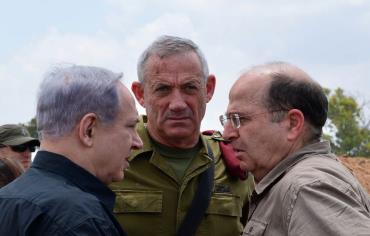 PM Netanyahu, Ya’alon and Gantz in the South Photo: KOBI GIDEON/GPO
The most surprising aspect about the rockets fired into Israel just before and after the expiration of a 72-hour cease-fire Wednesday at midnight is that nobody was really surprised.
If the more than month-long Operation Protective Edge has taught us anything, it is the degree to which the logic we are used to does not apply in this particular fight.
According to our rationale, Hamas – having been pounded by the IDF, brought death and destruction onto Gaza, and been isolated from most of the world (even the Arab world, save for Iran, Qatar and Recep Tayyip Erdogan’s Turkey) – should have wanted a cease-fire back on July 15. If not on that date, then at least on July 20; if not then, surely on August 1; and if not on August 1, at least on August 4… and on and on and on.
And each time those who thought Hamas would buckle – like IDF Chief of Staff Lt.-Gen. Benny Gantz, who delivered a positively poetic speech while calling residents of the South to return home after one cease-fire – we’re surprised.
“We have a hot summer. Fall will soon come. The rain will wash away the dust left by the tanks,” Gantz said, sounding like a modern-day Song of Songs. “The fields will turn green, and the South will be awash in red – in the positive sense of the word – in anemones, flowers and stability, which will be here for many years to come.”
Gantz made those comments on August 6, one day after a three-day cease-fire was declared, and two days before Hamas broke it and then refused to extend another truce. Such beautiful lines built – as it turned out – on foundations of sand.
Until, at a certain point, no one seemed to have any more expectations.
At 2:30 p.m. Wednesday, some nine-and-a-half hours before the expiration of the latest cease-fire, Intelligence Minister Yuval Steinitz held a press briefing and said, “We don’t yet know what is going to happen.”
Kudos to Steinitz for being so honest. What was troubling, however, is that he is not just some random fellow off the street asked for his opinion. He is the intelligence minister, a man who sits in on the deliberations of the security cabinet (albeit without voting rights), and a person considered close to Prime Minister Binyamin Netanyahu.
That Steinitz could not gauge how Hamas would react once the clock struck midnight and the 72-hour cease-fire ended illustrates the degree to which the government seems to be groping in the dark concerning the terrorist organization’s plans and tactics. Hamas’s logic is not our logic, and the terrorist organization uses a vastly different ruler to measure success.
All of that has made the current war so difficult to read, even for those at the top.
THE FAILURE to predict Hamas’s decision vis-a-vis the cease-fires is not the only element of this particular conflagration that went against the grain, against conventional wisdom. Other aspects of this war also defied prewar expectations.
For instance, the reaction in Europe. No, not the anti-Israel and anti-Semitic protests on the streets of European cities – those reactions were, at least to some degree, expected – but rather, the reactions of key governments like those in Germany, France and Britain. Germany’s Angela Merkel, Britain’s David Cameron and France’s Francois Hollande provided Israel with a degree of diplomatic space to pursue Hamas that was not a given.
And they did it despite ugly, angry and even at times violent anti-Israel demonstrations in their cities.
Aviv Shir-On, the recently appointed deputy director-general for Western Europe in the Foreign Ministry, told The Jerusalem Post this week that the criticism on a governmental level in Europe was “for the most part much less than it was on the street,” where the demonstrations often took on an anti-Semitic tone.
“The governments were restrained, showing understanding for Operation Protective Edge,” he said.
With all the understanding that European governments displayed, Shir-On added, once this conflict ends Europe is going to have to deal with two phenomena that the anti-Israel protests have revealed.
First of all, the governments, various justice systems and media will have to grapple with the realization that there is an anti-Semitic streak in Europe which is wider, deeper and more troubling than most people thought.
“The anti-Semitism evident in the demonstrations has to worry Israel, but also the Europeans themselves,” said Shir-On, a veteran diplomat who served as Israel’s envoy to Switzerland and later to Austria, and is definitely not one to readily conflate legitimate criticism of Israeli policy with anti-Semitism.
But what was seen on the streets of Europe in the last month often blurred the lines from legitimate to illegitimate criticism, he said.
He also said the size of the demonstrations was different this time than in the past – measured now in the thousands, not in the hundreds – a testament to the growth of Europe’s Muslim population, which formed the basis of the protests. Once the protests reach a certain size, they are amplified by media coverage and their composition becomes less important, creating a certain atmosphere very problematic for Israel.
Shir-On said there were large numbers of Turks at many of these European protests, and they were prodded on to no small extent by Erdogan’s anti-Israel and anti-Semitic comments.
The second phenomenon that Europe will have to deal with now is the degree to which the Mideast conflict – despite the best wishes of Europe’s leaders – has indeed been imported to their cities and towns, though not in the classic sense of Arab-Jewish clashes, like the ones seen in Paris at the beginning of the conflict Rather, the Mideast conflict is being imported to Europe in that political, cultural, sociological and economic elements of the global Islamic radicals are gaining a voice there.
“The challenge of IS [terrorist group Islamic State] is for everyone,” Shir-On said.
“I think that the anti-Israel demonstrations are a show of strength for the extremists, and that needs to set off red lights.”
Another rather unexpected byproduct of Operation Protective Edge was the degree to which it compelled various Israeli political leaders to put forward a “day after” plan.
Justice Minister Tzipi Livni, Finance Minister Yair Lapid and Foreign Minister Avigdor Liberman all presented skeletal plans this week for what should come after the fighting stops.
Livni’s plan included the following elements: Returning the “effective and legitimate control” of the Palestinian Authority to the Gaza Strip in the long term, and beginning this by reintroducing PA officials at the border crossings; disarming Gaza of all illicit arms; and restarting peace negotiations between Israel and the PA, during which “we will discuss with them all the things connected to Gaza, like a seaport, airport and all the stuff that is part of the list of things needed to negotiate as part of a final-status agreement.”
Lapid unveiled a plan he is promoting that includes an international conference involving the US, EU, Russia, Egypt, Saudi Arabia and Jordan, toward the goal of demilitarizing Gaza and eventually transferring it to PA control.
Points include returning the PA to the border crossings; making the PA responsible for the rehabilitation of Gaza, and the sole body responsible for the rehabilitation funds; and ensuring the demilitarization of Gaza.
While both Lapid and Livni’s plans lean heavily on PA President Mahmoud Abbas, Liberman discounts Abbas and says PA elections are needed, to elect a voice with true legitimacy and authority to negotiate.
Liberman’s plan is to topple Hamas, hold PA elections and then work on a “regional comprehensive solution,” not Oslo-style Israeli-Palestinian negotiations.
Israel’s conflict is not with the Palestinians, but rather with the Arab world, he told the Post this week. And that conflict has three dimensions: the Arab countries, the Palestinians and the “split identity” of the Israeli Arabs.
In his view, what is needed is one package to solve – or as he said, “arrange” – Israel’s “relations with all three dimensions at one time.”
What was surprising about these plans was not that they were presented, or even that they illustrated deep differences inside the ruling coalition.
What was unexpected was that all the big guns weighed in… except for Netanyahu.
And, as one senior diplomatic source said, what many key decision-makers in the international community are eager to hear is Netanyahu’s plan.
The source said that one way Israel will be able to recover some of the goodwill it lost over the last few weeks – as a result of the pictures of the carnage beamed nightly into living rooms around the world – is to initiate a program and present a vision for Gaza and the West Bank.
Liberman has a plan, as does Liberman, Lapid and even Economy Minister Naftali Bennett, though he didn’t unveil it this week.
Only Netanyahu’s plan tarries – which is a shame, for his is the one that matters most.




 anneinpt
 artaxes
 danmillerinpanama
 davidking1530
 Peter Hofman
 Joseph Wouk
 Peter
Peter Louisiana Steve
 WarSclerotic
Recent Comments